

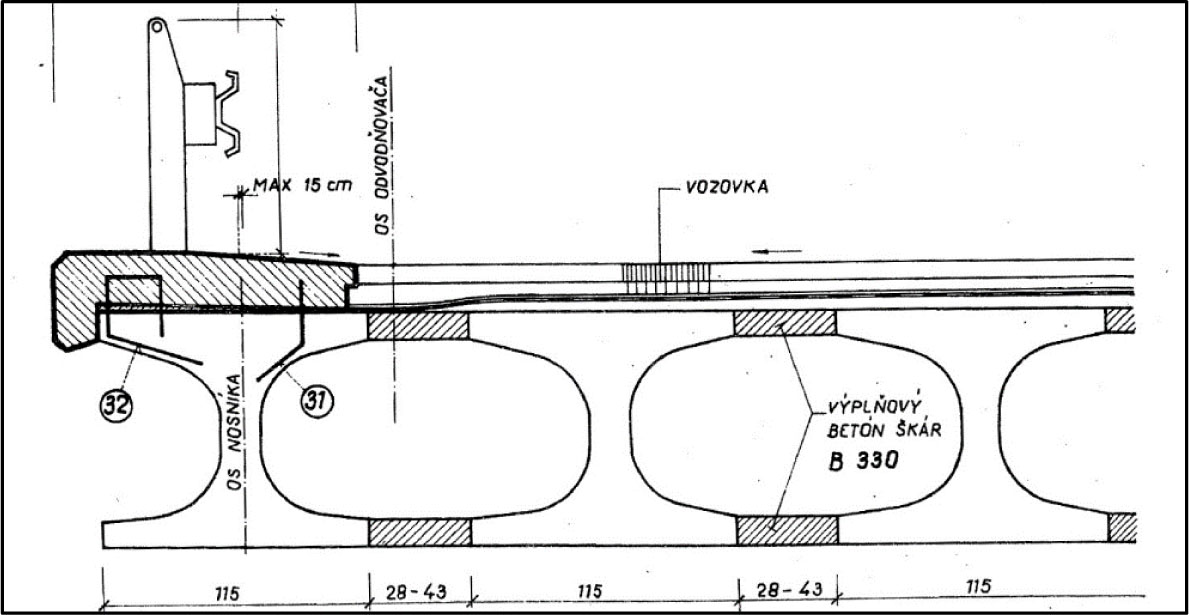
Figure 1:
Cross-section of a bridge, where the superstructures consist of I-73 girders (Dopravoprojekt, 1973)

Figure 2:
Reinforcement of the 21-meter-long I-73 girder with prestressing tendons (Dopravoprojekt, 1973)
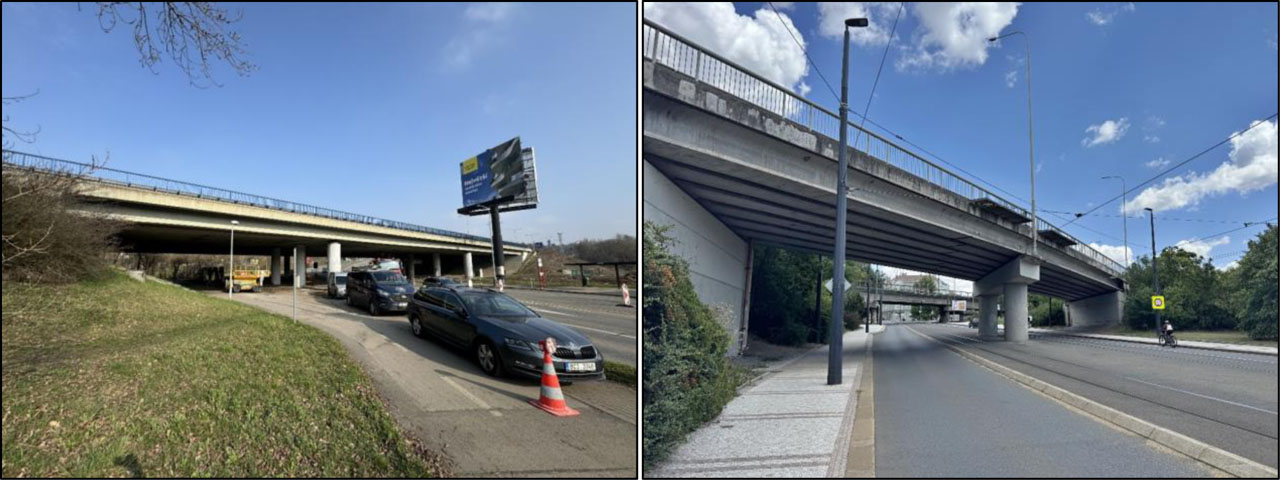
Figure 3:
Three-span bridge (left) and two-span bridges (right), both located in Prague
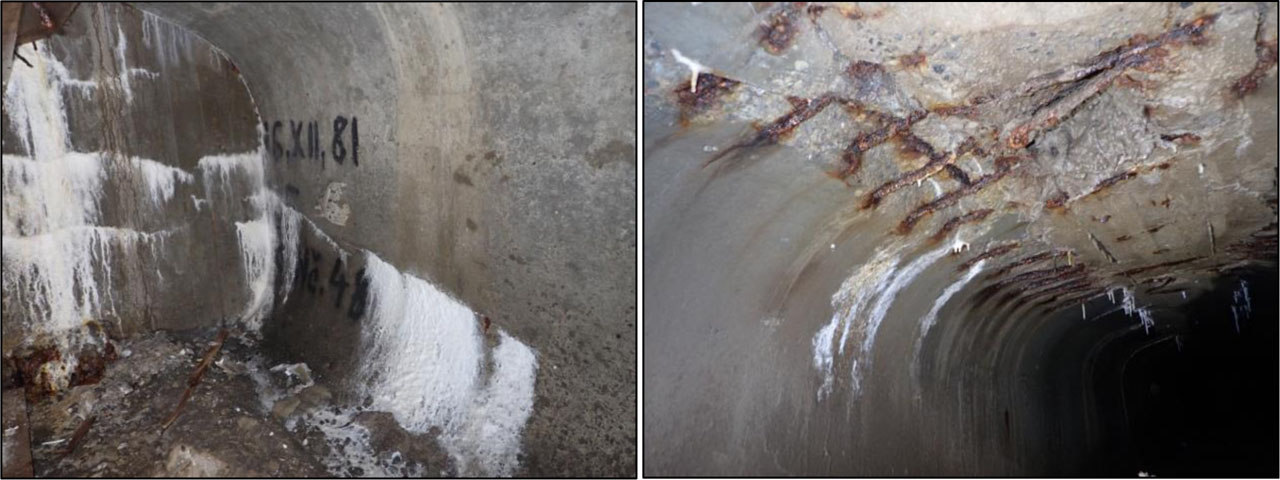
Figure 4:
Significant active water leakage into the cells between the I-73 girders. Visible surface degradation of the concrete and exposed reinforcement. Observable paths of prestressing reinforcement (cracks and leachates)

Figure 5:
Presence of non-grouted tendon ducts and corrosion of prestressing strands and wires
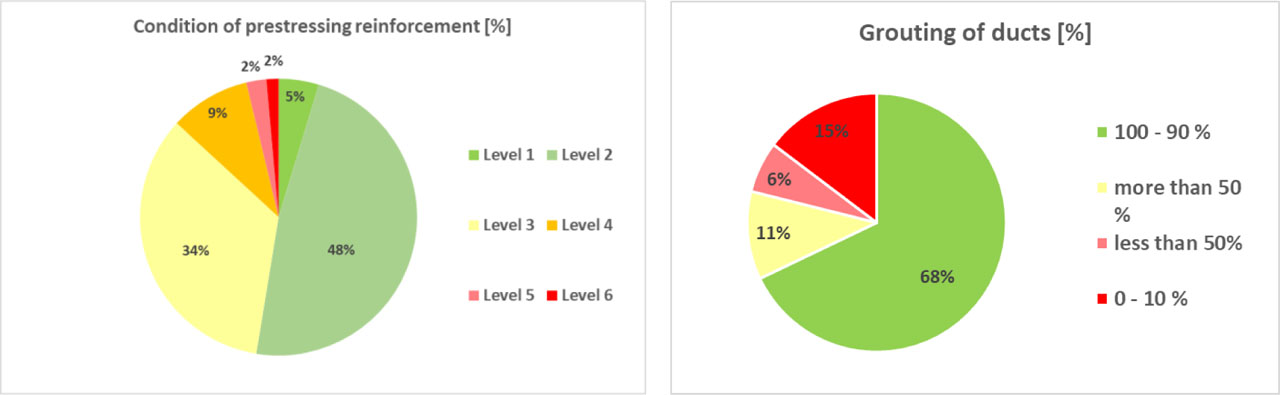
Figure 6:
Presence of ungrouted tendon ducts and corrosion affecting the prestressing strands
Table 1:
Summary of Concrete Test Results
| Bridge no. | Structural condition of superstructure (Scale I–VII) | Strength class of concrete | Conversion of Cl- to cement quantity of approximately 420 kg in 1 m3 of concrete [%] | Concrete carbonation depth [mm] | ||
|---|---|---|---|---|---|---|
| ČSN 736221 | ČSN EN 206+A2 | Depth 0 – 15 [mm] | Depth 15 – 30 [mm] | Depth 30 – 45 [mm] | ||
| 1 | VI | C 45/55 | 0.45 | 0.32 | 0.16 | 1 – 7 |
| 2 | V | C 45/55 | 0.71 | 0.58 | 0.37 | 3 – 6 |
| 3 | VI | C 50/60 | 1,17 | 0.70 | 0.35 | 3 – 12 |
| 4 | V | C 40/50 | 0,89 | 0.70 | 0.44 | 4 – 13 |
| 5 | V | C 45/55 | 0.15 | 0.11 | 0.07 | 2 – 8 |
| 6 | IV | C 40/50 | 0.25 | 0.12 | 0.05 | 1 – 7 |
| 7 | VI | C 45/55 | 0.78 | 0.59 | 0.44 | 1 – 9 |
| 8 | V | C 35/45 | 0.38 | 0.30 | 0.15 | 2 – 10 |
Table 2:
Condition Assessment of Prestressing Reinforcement
| Condition of reinforcement | Corrosion damage | Damage description |
|---|---|---|
 | Level 1 | Reinforcement showing no signs of corrosion. |
 | Level 2 | The reinforcement exhibits only localized surface corrosion, with no impact on cross-sectional area. |
 | Level 3 | Surface corrosion is present without accumulation of corrosion products, and its impact on cross-section reduction and mechanical properties is negligible. |
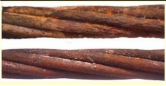 | Level 4 | Surface corrosion is fully distributed, with corrosion products peeling off. Cross-sectional area reduction has already reached approximately 2 – 4%; this type of corrosion represents a borderline case in terms of its negative effect on mechanical properties. |
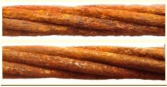 | Level 5 | The strand exhibits fully spread surface corrosion, with extensive peeling of corrosion products. Noticeable deformation and cross-sectional area loss are significant, reaching several tens of percent. |
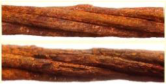 | Level 6 | Noticeable deformation of the strand is observed, with some wires broken or fully corroded. Cross-sectional area is significantly reduced, by 50 % or more. |
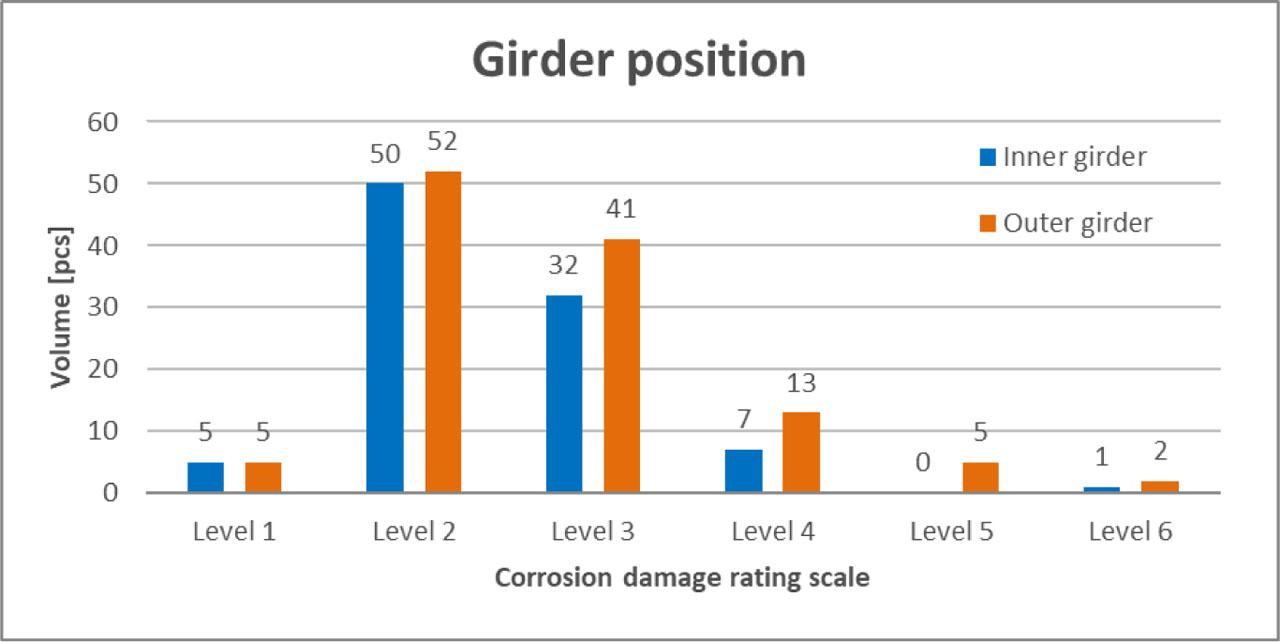
Figure 7:
Prestressing Reinforcement Condition Evaluated by Girder Location