

Table 1:
Lab Evaluation of Asphalt Binder
| Property | Unit | Results | SCRB Standard Range | ASTM Standard |
|---|---|---|---|---|
| Penetration (25 [°C], 100 [g], 5 [sec]) | 0.1 mm | 43 | 40–50 | D5 |
| Ductility (25 [°C], 5 [cm/min]) | cm | 159 | 100 Min. | D113 |
| Softening Point (Ring& Ball) | °C | 53 | - | D36 |
| Flash point (Cleveland open Cup) | °C | 265 | 232 Min. | D92 |
| Specific Gravity @25 [°C] | --- | 1.044 | - | D70 |
| After conducting the Thin-Film Oven Test (ASTM D 1754) | ||||
| Retained Penetration [% of original] | % | 65 | 55 Min. | D5 |
| Ductility (25 [°C], 5 [cm/min]) | cm | 78 | >25 | D113 |
Table 2:
Fine and Coarse Aggregate Properties
| Property Evaluated | ASTM Standard | Results | SCRB Standard Range |
|---|---|---|---|
| Coarse Aggregate | |||
| Bulk Specific Gravity | (ASTM C128) | 2.62 | --- |
| Water Absorption [%] | (ASTM C127) | 0.55 | --- |
| Los Angeles Abrasion [%] | (ASTM C131) | 17.8 | 30 Max |
| Fine Aggregate | |||
| Bulk Specific Gravity | (ASTM C128) | 2.632 | --- |
| Water Absorption [%] | (ASTM C127) | 0.79 | --- |
Table 3:
Characteristics of the limestone dust
| Property Evaluated | Result Obtained | SCRB Standard Range |
|---|---|---|
| Specific Gravity | 2.711 | --- |
| Passing 0.075 [mm], % | 99 | 70–100 |
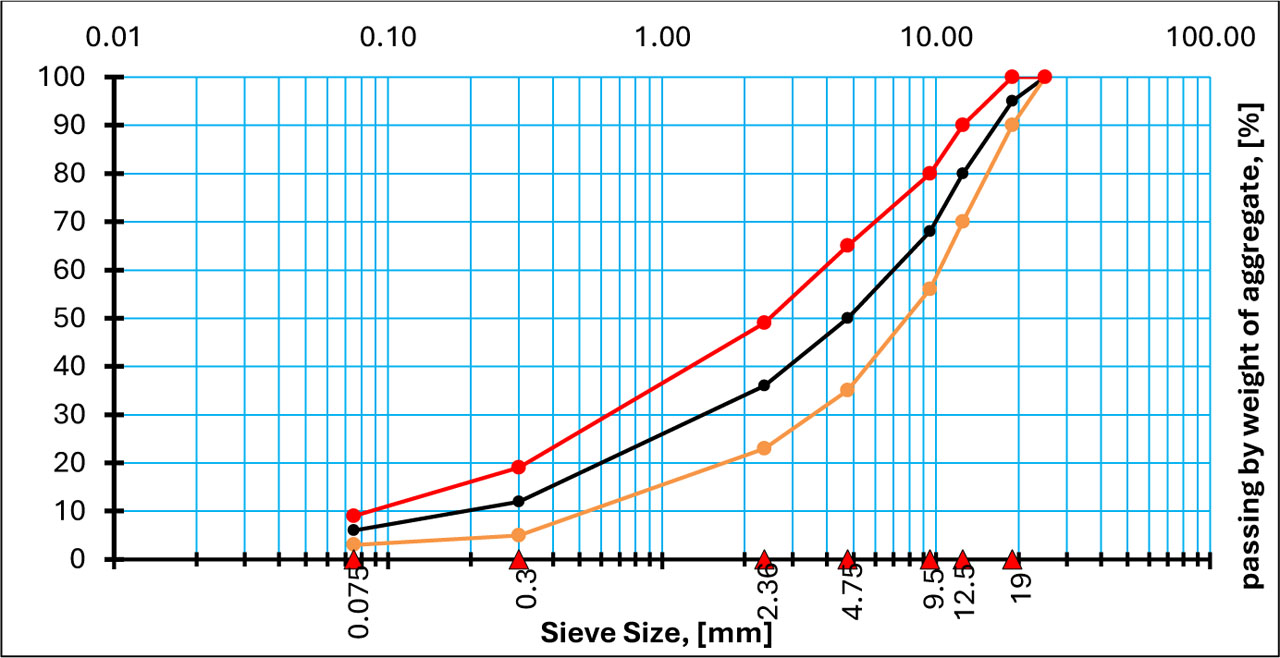
Figure 1:
The gradation of Binder Course
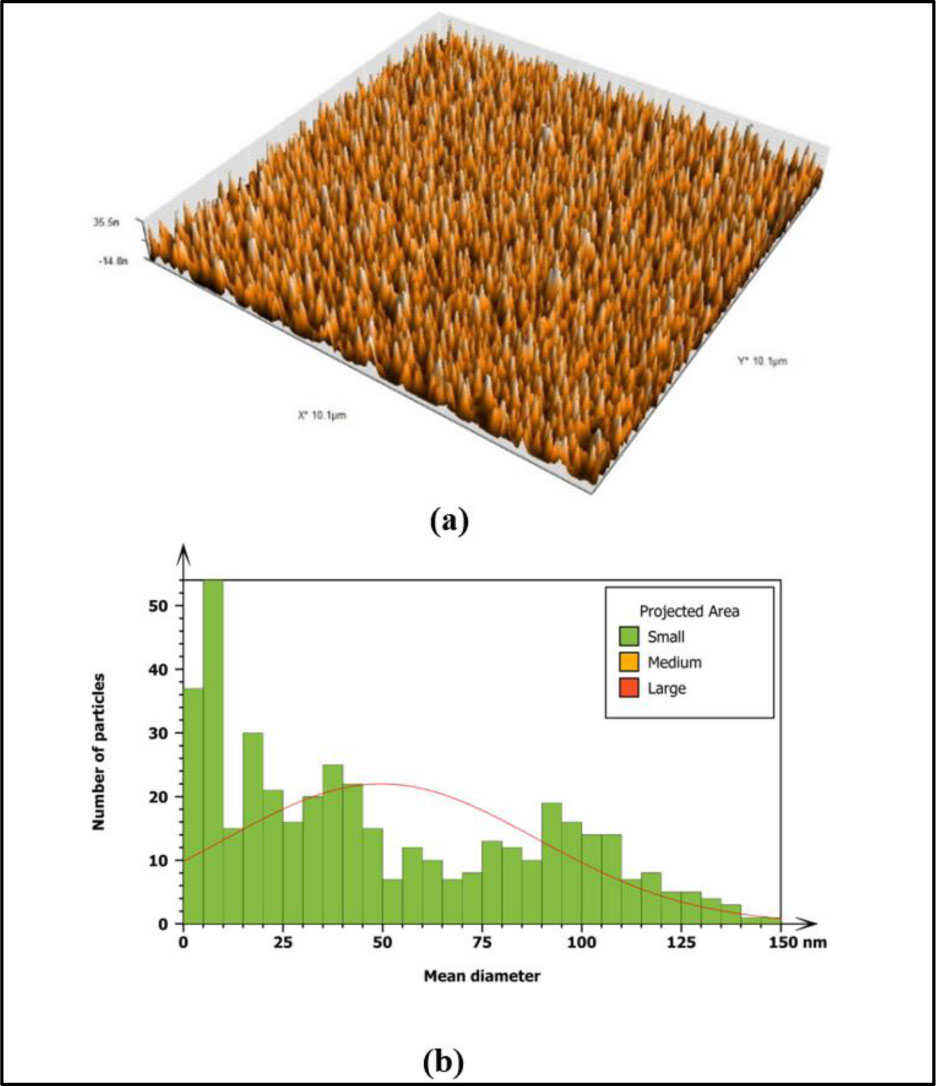
Figure 2:
(a) AFM image of nanoclay platelets; (b) particle size distribution of the nanoclay
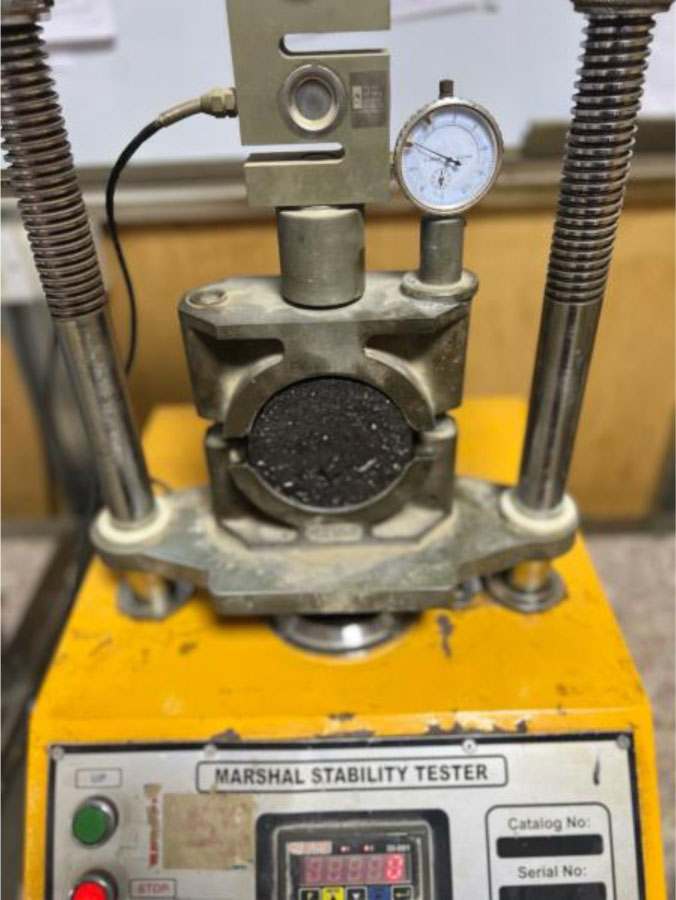
Figure 3:
Marshall test setup
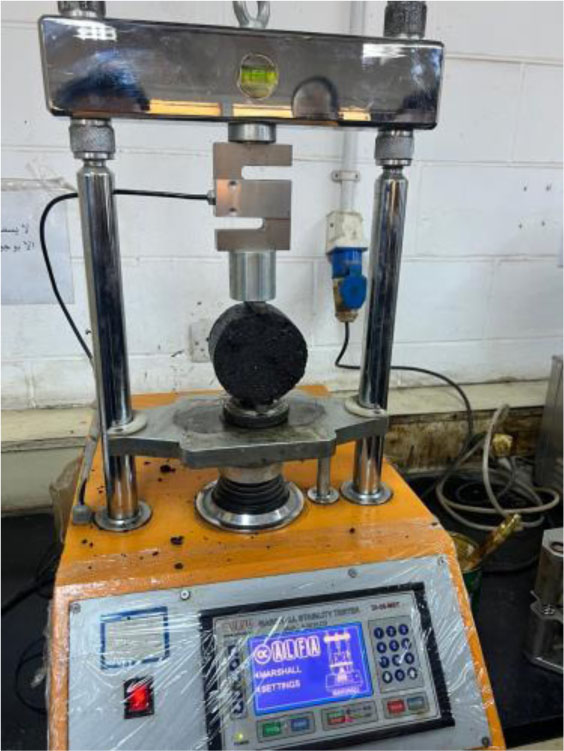
Figure 4:
Indirect tensile strength (ITS) test setup
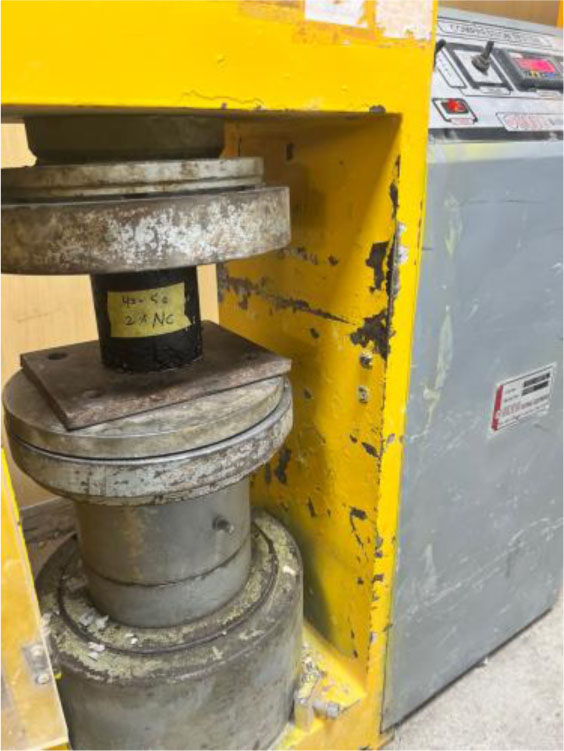
Figure 5:
Compressive strength test setup
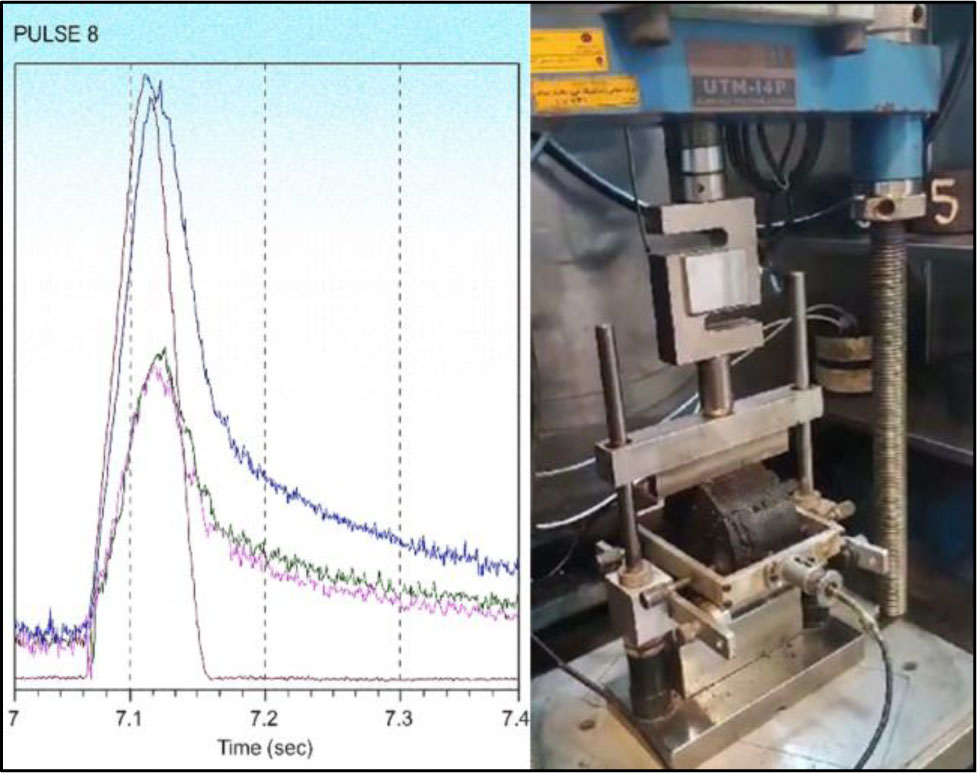
Figure 6:
Resilient modulus (MR) test setup
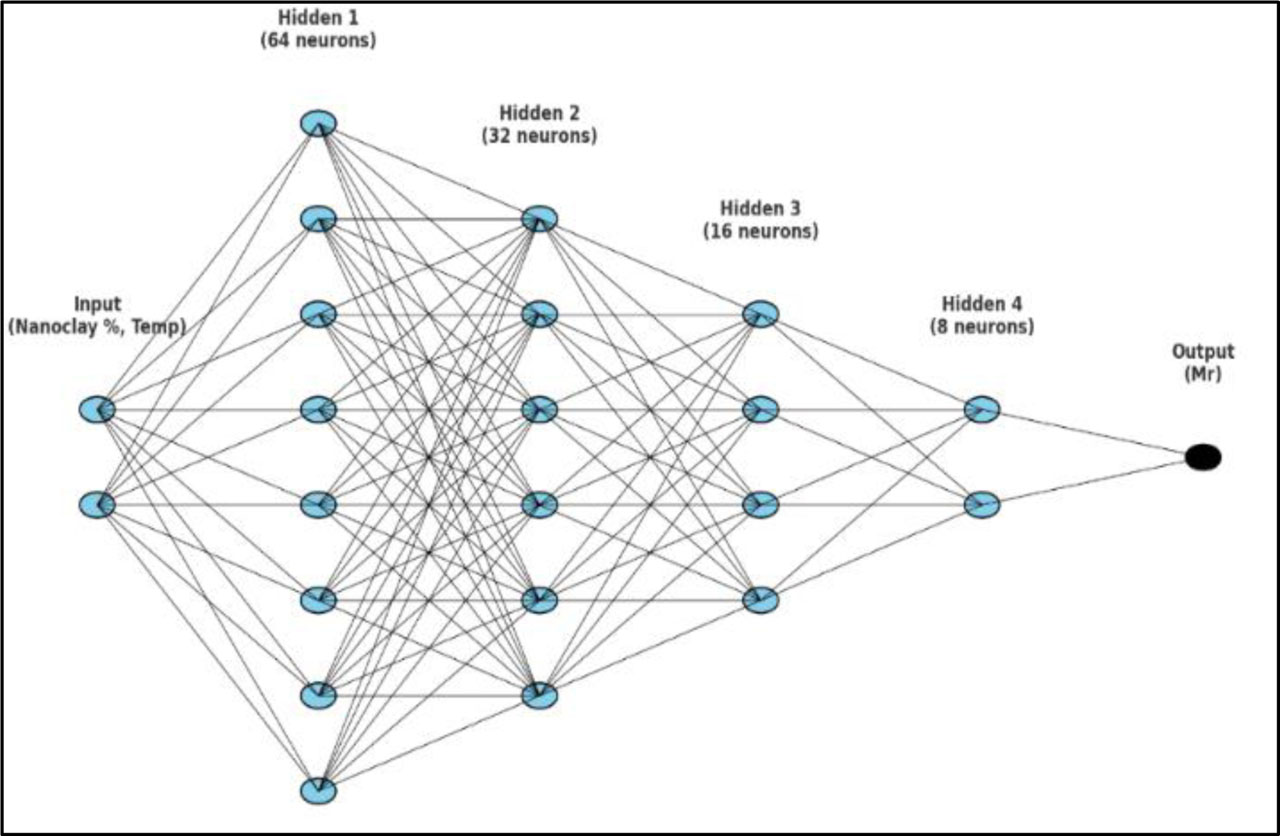
Figure 7:
ANN Model Architecture for MR Prediction
Table 4:
Marshall Properties at Different Nanoclay Levels
| Mixture | Optimum Asphalt Content [%] | Marshall Stability [kN] | Flow [mm] | Bulk density [g/cm3] | Air Voids [%] | Voids in Mineral Aggregate [%] | Voids Filled with Asphalt [%] | Marshall Stiffness [kN/mm] |
|---|---|---|---|---|---|---|---|---|
| No.1 (0 % NC) | 4.72 | 11.51 | 3.78 | 2.371 | 4 | 13.80 | 71.11 | 3.05 |
| No.2 (2% NC) | 4.94 | 12.61 | 3.39 | 2.360 | 4 | 14.37 | 72.13 | 3.72 |
| No.3 (4% NC) | 5.02 | 13.45 | 3.26 | 2.358 | 4 | 14.54 | 72.35 | 4.13 |
| No.4 (6% NC) | 5.11 | 14.63 | 3.60 | 2.356 | 4 | 14.72 | 72.62 | 3.98 |
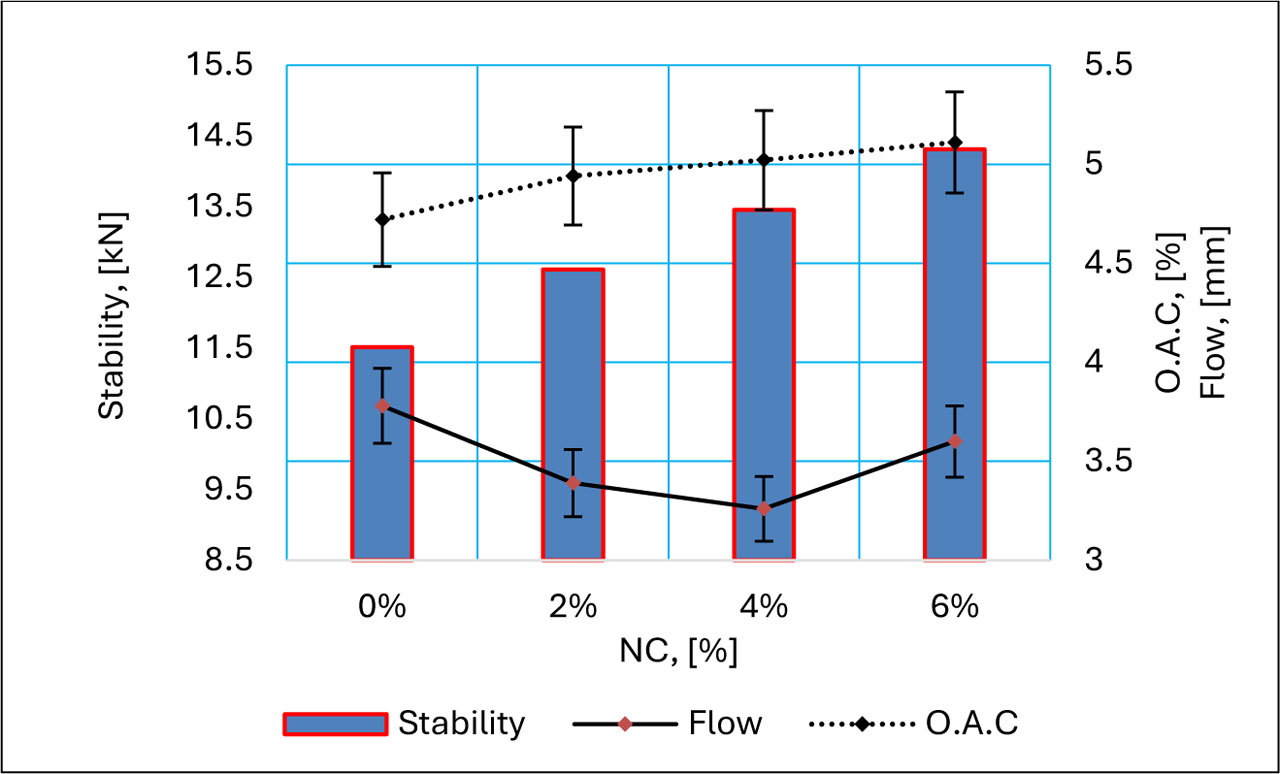
Figure 8:
Influence of varying nanoclay dosages on Marshall stability, flow characteristics, and (O.A.C)
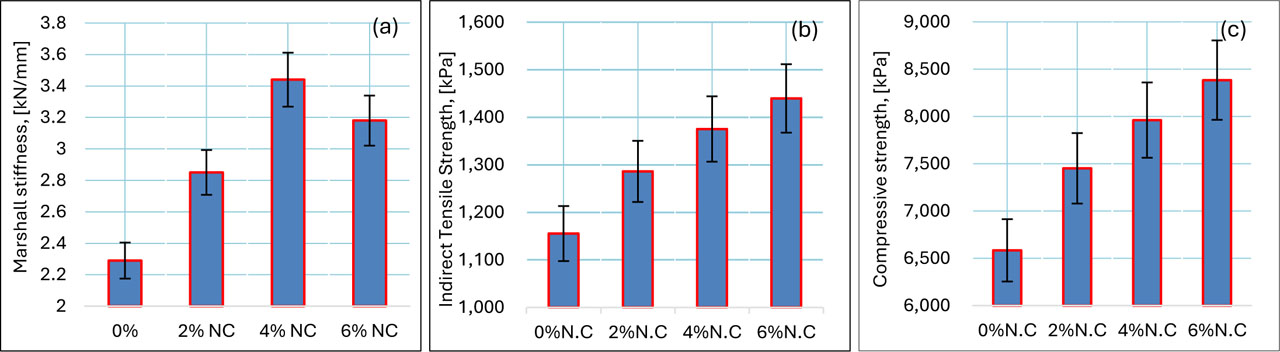
Figure 9:
Effect of Nanoclay Content on (a) Marshall Stiffness; (b) Indirect Tensile Strength; and (c) Compressive Strength
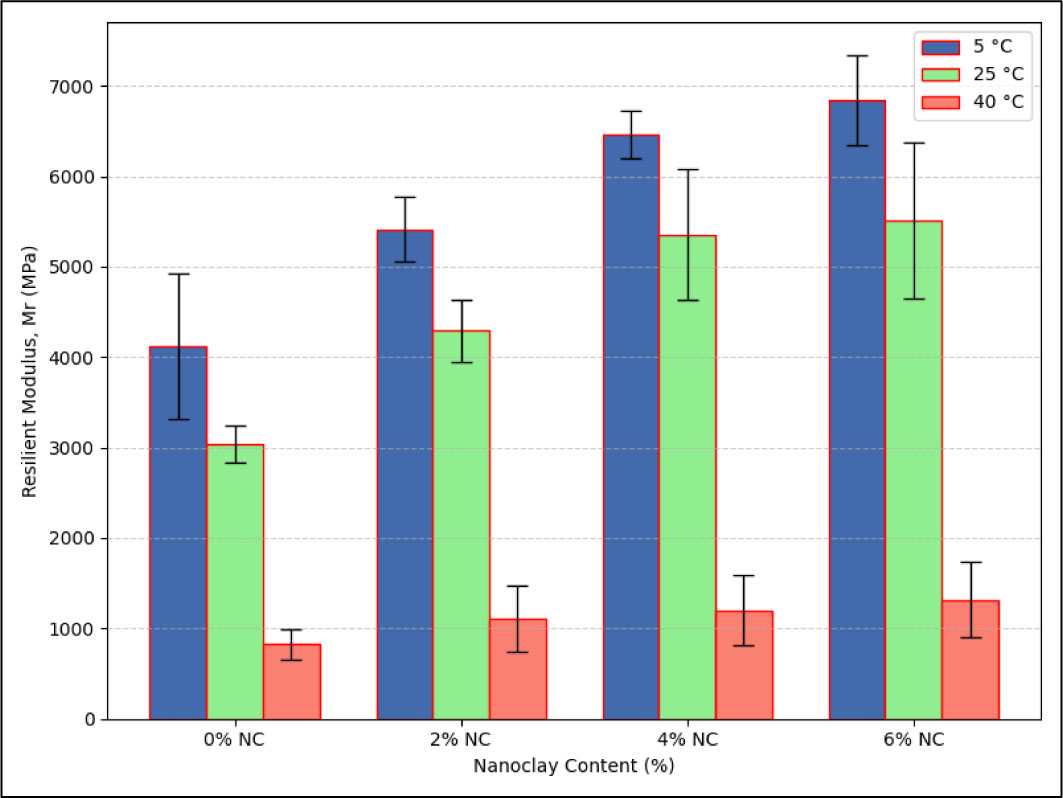
Figure 10:
Effect of nanoclay content and temperature on resilient modulus (Mr) of asphalt mixtures
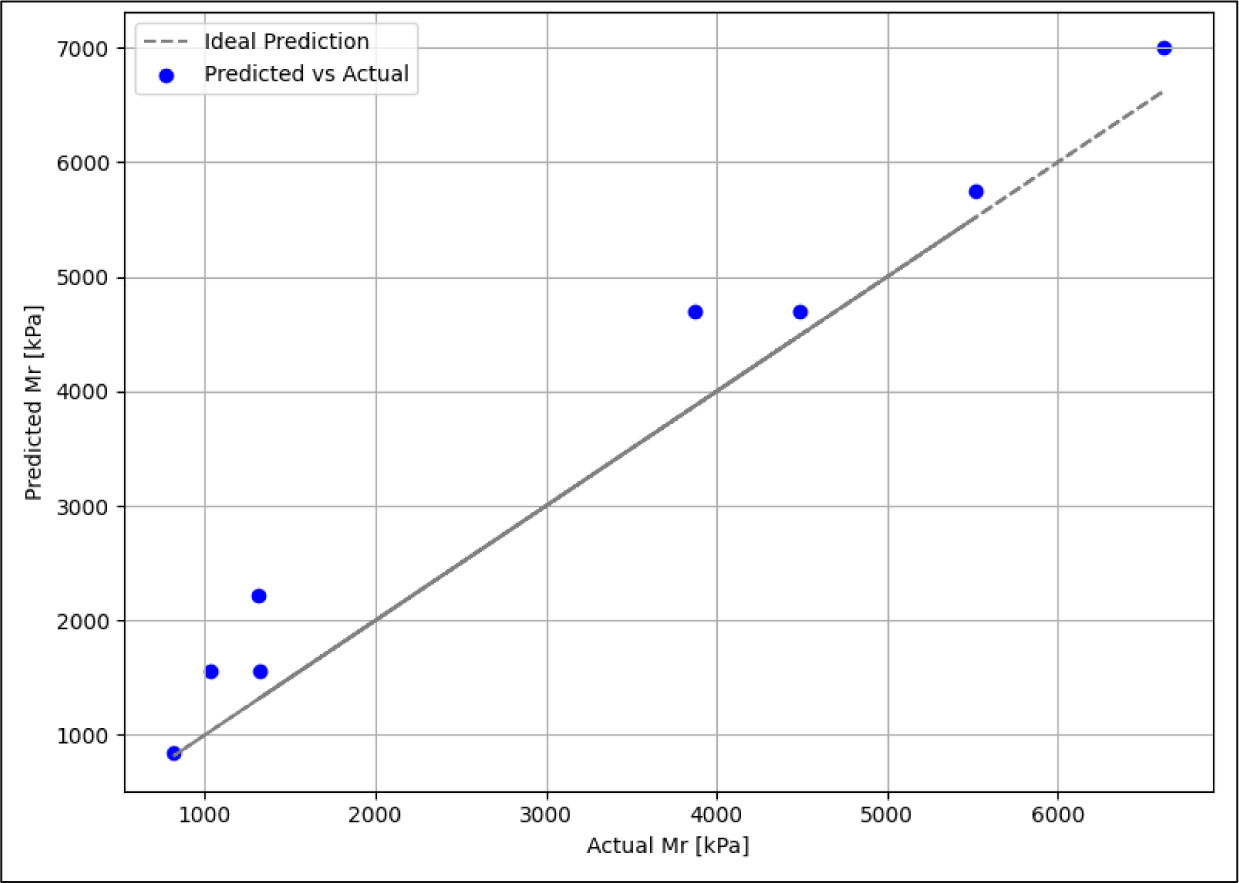
Figure 11:
Comparison between actual and predicted MR values using the trained ANN model