

1. Introduction
The world’s biggest producer of Hot Mix Asphalt (HMA) is the asphalt paving industry, producing more than 1.5 billion tons annually. Even though it is essential to infrastructure, it faces serious problems in becoming sustainable. The contribution of asphalt to road construction is nonrenewable, as it is made from petroleum that produces considerable and irreversible environmental damage (Santos et al., 2022). At the same time, plastic waste is piling up at emergency levels, with over 350 million tons being made each year, less than 10% of which is recycled, resulting in overflowing landfills and polluted oceans (OCED, 2022). The environmental issues caused by waste plastics, especially polyvinyl chloride (PVC), are among the most difficult to recycle due to the chlorine content. PVC is a versatile thermoplastic that makes up approximately 12% of global plastic production. PVC may also exhibit unique binding and reinforcing qualities when reused in construction materials. The use of waste plastics such as PVC, Polyethylene (PE), and Polyethylene Terephthalate (PET) in bituminous mixtures is a great way to minimize environmental impacts while maximizing the disposal space of non-biodegradable materials (Rahman et al., 2013; Movilla-Quesada et al., 2021; Zhou et al., 2021). Further, it improves the performance of pavements while helping in the disposal of waste plastic (Jiang et al., 2022; Manjunatha et al., 2022; Dalhat & Al-Abdul Wahhab, 2015). The rutting resistance, fatigue life, and stiffness of pavements can be improved by waste plastics, leading to reduced maintenance costs and increasing the service life of pavement (Manjunatha et al., 2022).
Waste plastics in asphalt mixtures are increasingly recognized for their contribution to sustainability. Previous studies have shown that waste PVC enhances Marshall stability and rutting resistance (Leng et al., 2021). Incorporating 5–7% PVC waste into bituminous binders improves the complex modulus and deformation resistance, although some challenges remain regarding low-temperature performance (Manjunatha et al., 2022). PVC waste has also been reported to enhance the compressive strength of concrete (Jiang et al., 2022).
Dynamic Mechanical Analysis (DMA) has been widely used to study viscoelastic properties, showing improved stiffness when recycled fillers are incorporated (Michel et al., 2023; Aldagari et al., 2022). However, compatibility issues in plastic-modified asphalt still require advanced processing to ensure stable performance (Aldagari et al., 2022). More recent studies highlight the broader benefits of using waste plastics in road construction, including reduced landfill waste and enhanced pavement durability (Dalhat & Al-Abdul Wahhab, 2015). These findings collectively indicate the potential of PVC waste as a viable modifier but also underline the lack of comprehensive DMA-based evaluations of its viscoelastic behavior.
Recent bibliometric analyses have documented extensive research on using LDPE, HDPE, and PET via the dry mixing method, highlighting procedural variations and performance outcomes (Bueno & Taixeira, 2024). Moreover, experimental investigations have demonstrated remarkable improvements: LDPE-modified mixtures showed a stiffness increase of up to 171% at 25°C and 125% at 35°C, alongside enhanced rutting and fatigue resistance, while also offering economic and environmental benefits (Singh & Gupta, 2024; Ibrahim et al., 2024). However, most existing research focuses on PE and PET, with limited attention to PVC as a modifier, particularly evaluated using dynamic mechanical analysis (DMA).
Plastic has become an environmental issue because it persists for a long time and is difficult to manage. The high chlorine content of PVC and its potentially hazardous and harmful effects during its lifecycle, as well as its inability to fully degrade, make PVC a highly polluting material. Nevertheless, PVC has the potential to improve the viscoelastic characteristics of bitumen by forming a three-dimensional polymer network within the asphalt binder.
Dynamic Mechanical Analysis is a process that enables the characterization of the viscoelastic properties of bituminous mixture. It is measured by parameters such as complex modulus (E*), storage modulus (E′), loss modulus (E″), and phase angle (δ) (Michel et al., 2023). Usually, high values of E*, E′, and E″ indicate that the asphalt is stiffer, more elastic, and more energy dissipative. Also, the phase angle (δ) indicates the degree of elastic or viscous behavior. The resistant qualities needed for rutting or cracking depend on the desired performance of the asphalt. While several investigations into plastic-modified asphalt were conducted using DMA, the available data on PVC is still scarce, particularly regarding its mechanical behavior at various temperatures and loading frequencies (Dalhat & Al-Abdul Wahhab, 2015; Aldagari et al., 2022). Although extensive research has been devoted to plastic-modified asphalt, limited studies have investigated the incorporation of PVC waste, and even fewer have employed DMA to evaluate its viscoelastic properties. This study addresses this gap by systematically assessing the mechanical performance of PVC-modified asphalt mixtures using DMA. This study aims to evaluate the effect of incorporating PVC waste into asphalt mixtures on their viscoelastic behavior using DMA. The specific objectives are to:
Assess the complex modulus (E*) of PVC-modified mixtures under different temperatures and loading frequencies.
Compare the mechanical performance of PVC-modified mixtures with conventional mixtures.
Highlight the environmental benefits of recycling PVC in road construction as a sustainable pavement solution.
2. Methodology
2.1. Materials and Procedures
2.1.1. Asphalt and Aggregate
Asphalt was chosen as the reference material, with its technical specifications presented in Table 1.
Table 1:
Physical properties of 40/50 bitumen
| Items | Results |
|---|---|
| Penetrability at 25°C (1/10) | 44 |
| Softening temperature [°C] | 47 |
In asphalt mixtures, coarse aggregates act as the main load-bearing component. High-quality asphalt mixtures require aggregates with excellent mechanical properties, as determined by the Micro-Deval and Los Angeles tests. The gravel was chosen as aggregate for this study, with its physical properties outlined in Table 2. Their granulometric analysis in Table 3 presents the characteristics of the filler used.
Table 2:
Characteristics of the aggregates used
| Micro-Deval [%] | Los Angeles [%] | Sand Friability [%] | Real Density [g/cm3] | Clean Aggregates [%] | Sand equivalent [%] | Flattening coefficient [%] | |
|---|---|---|---|---|---|---|---|
| Norm | NF P 18-572 | NF P 18-573 | NF P 18-576 | NF EN 1097-6 | NF P 18-591 | NF P 18-598 | NF P 18-561 |
| Specification | < 20% | < 25% | ≤ 35% | / | <2 % | ≥45 % | <20 % |
| 0/3 | / | / | 33 | 2.62 | / | 77 | / |
| 3/8 | / | / | / | 2.67 | 0.83 | / | 9.86 |
| 8/15 | 18 | 20 | / | 2.74 | 0.81 | / | 4.96 |
Table 3:
Granulometric analysis of the aggregates used
| sand | gravel 3/8 | gravel 8/15 | ||||
|---|---|---|---|---|---|---|
| sieve aperture in [mm] | M = 1000 g | M = 1600 g | M = 3000 g | |||
| Weight retained [g] | Retained [%] | Weight retained [g] | Retained [%] | Weight retained [g] | Retained [%] | |
| 25 | 0 | 100 | 0 | 100 | 0 | 100 |
| 20 | 0 | 100 | 0 | 100 | 0 | 100 |
| 16 | 0 | 100 | 0 | 100 | 23 | 99 |
| 14 | 0 | 100 | 0 | 100 | 407 | 86 |
| 12,5 | 0 | 100 | 0 | 100 | 1102 | 63 |
| 10 | 0 | 100 | 0 | 100 | 2297 | 23 |
| 8 | 0 | 100 | 0 | 100,00 | 2973 | 1 |
| 6,3 | 0 | 100 | 496 | 69 | 3000 | 0 |
| 5 | 0 | 100 | 1135 | 29 | 3000 | 0 |
| 4 | 0 | 100 | 1485 | 7 | 3000 | 0 |
| 3,15 | 105 | 90 | 1590 | 1 | 3000 | 0 |
| 2,5 | 111 | 89 | 1600 | 0 | 3000 | 0 |
| 2 | 206 | 79 | 1600 | 0 | 3000 | 0 |
| 1,25 | 367 | 63 | 1600 | 0 | 3000 | 0 |
| 0,63 | 509 | 49 | 1600 | 0 | 3000 | 0 |
| 0,315 | 615 | 39 | 1600 | 0 | 3000 | 0 |
| 0,16 | 772 | 23 | 1600 | 0 | 3000 | 0 |
| 0,08 | 879 | 12 | 1600 | 0 | 3000 | 0 |
Table 4:
Characteristics of the Filler Used
| CaCO3 | Cl | SO4 | Insoluble | VBS | ||
|---|---|---|---|---|---|---|
| [ml] | [%] | [ml] | [%] | [%] | ||
| 45 | 42.1 | 0.30 | 0.11 | - | 57.79 | 0.17 |
The main chemical properties of the mineral filler used in the present study were shown in Table 4. The filler has an average of 42.1% of calcium carbonate (CaCO3) (the measure is equal to 45 ml). This shows that the filler is calcareous in nature. The calcareous nature of a filler is preferable to improve stiffness and stability in asphalt mixtures. The value of chloride (Cl) content was 0.11% (0.30 ml). So, this amount is low, which has little effect on the corrosion of pavement. Further, the chemical properties are not much affected. The sulfate (SO4) content was 57.79%. The sulfate content is high. The insoluble residue was measured at 0.17%, indicating a high purity with low inert matter content. Finally, the testing of the Volume of Bitumen Soluble (VBS) gave a reading of 6%. This indicates that the compatibility of the filler with the bitumen is moderate.
According to the previous results, Figure 1 shows the grading curve of the asphalt mixture, which describes the distribution of aggregate particle sizes within the mix. The Figure also illustrates the proportion of coarse and fine aggregates relative to the specification limits, confirming that the designed mixture meets the required gradation envelope.
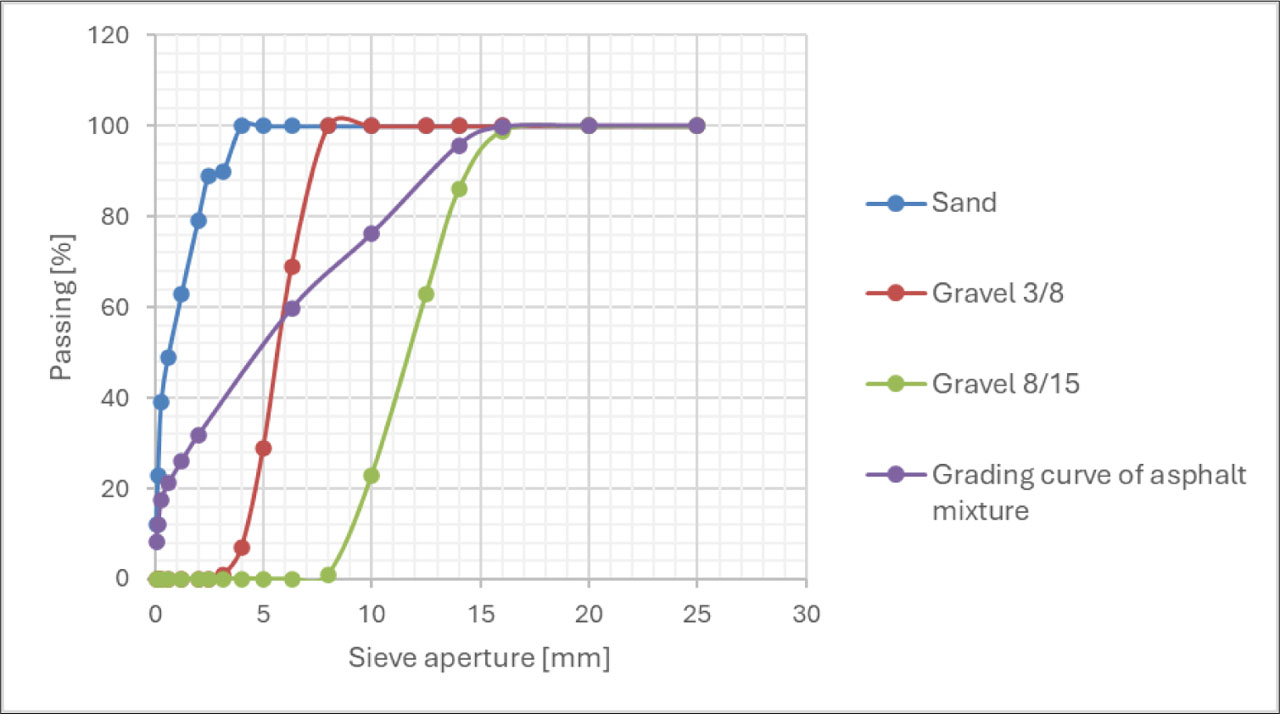
Figure 1:
Grading curve of asphalt mixture
2.1.2. PVC waste plastic
The polyvinyl chloride (PVC) plastic waste used in this study (Figure 2) was obtained from a local panel and ceiling manufacturing plant. This modifier was ground into a fine powder suitable for incorporation into bituminous mixtures. Table 5 summarizes the main physical characteristics of the PVC.
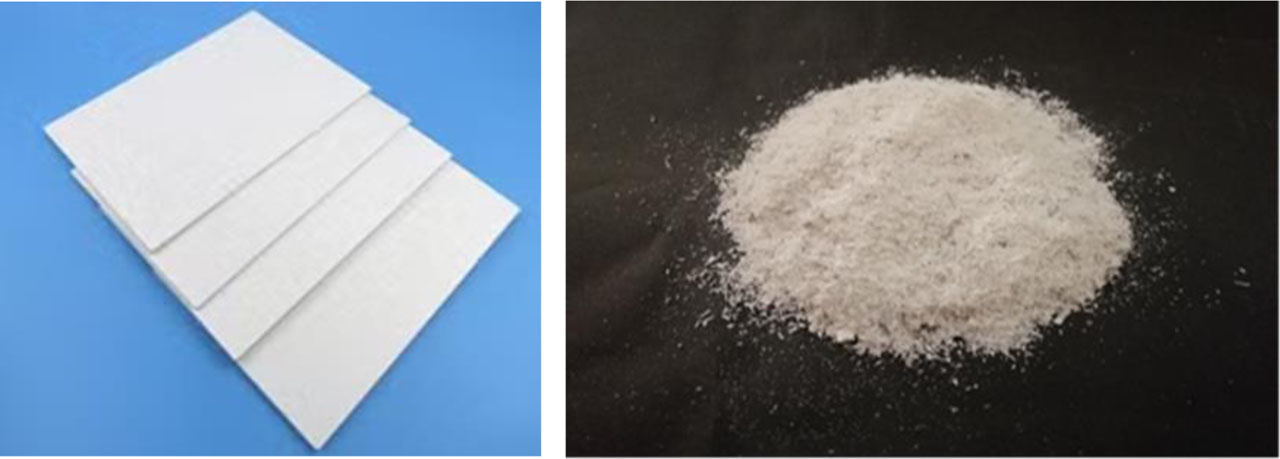
Figure 2:
Polyvinyl Chloride: Source and Post-Use Waste from Ceiling Manufacturing
Table 5:
Characteristics of the PVC used
| Density [g/cm3] | Melting point [°C] | Type of PVC | Molecular formula | color |
|---|---|---|---|---|
| 1.38 | 160 | rigid | C2H3Cl | white |
Table 5:
Granulometric analysis of the PVC used
| Tamis [mm] | Cumulative refusals [g] | Sieving [% Passing] |
|---|---|---|
| 2 | 0,73 | 1,46 |
| 1 | 4,85 | 9,7 |
| 0,5 | 17,73 | 35,46 |
| 0,25 | 36,66 | 73,32 |
| 0,2 | 41,79 | 83,58 |
| 0,125 | 45,92 | 91,84 |
| 0,08 | 47,91 | 95,82 |
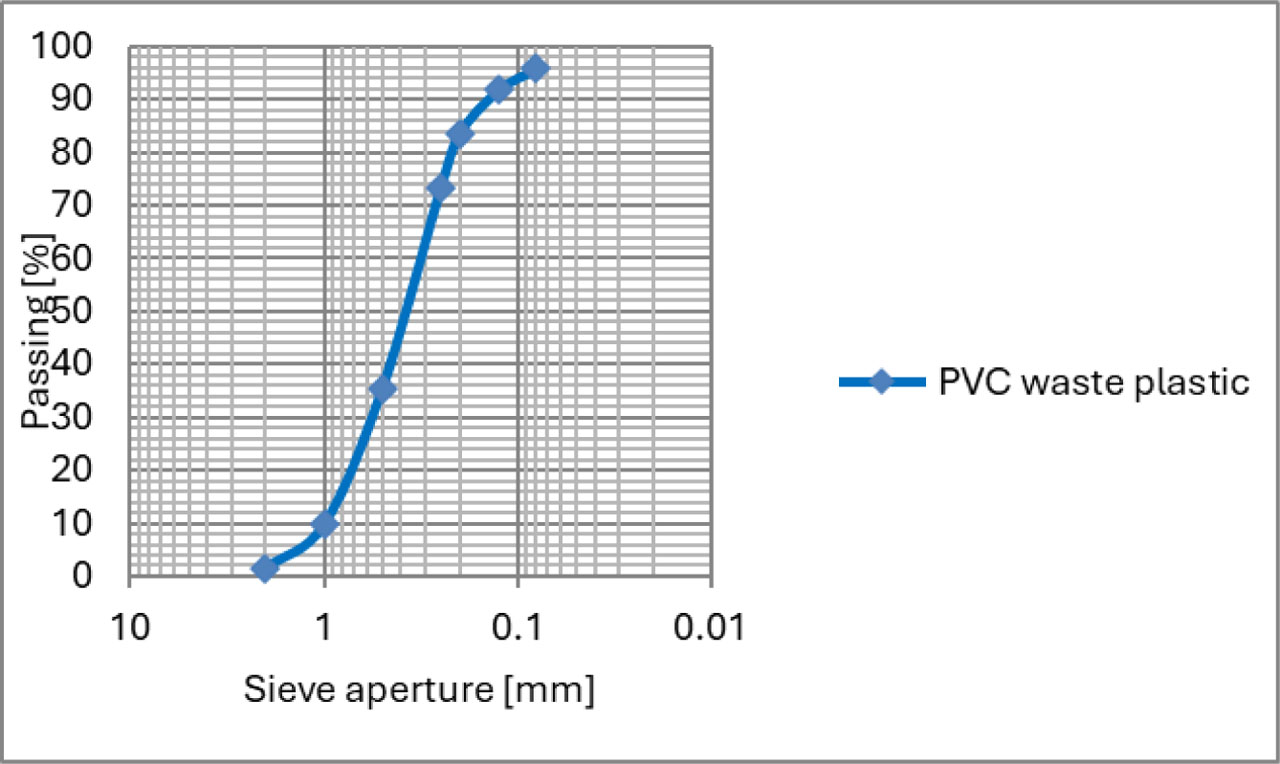
Figure 3:
Granulometric of the PVC used
2.2. Methods
2.2.1. Mixture Design
Mixtures were designed using a continuously graded aggregate blend (nominal maximum size: 15 mm) following NF P 98-250-1 (AFNOR, n.d.). The optimum binder content was 5.5% bitumen by weight, determined using the Marshall mix design method. The modification of the asphalt hot mixture is in the dry process (Radeef et al., 2021; Arbani et al., 2018). When PVC is directly mixed with the hot aggregates and the binder. Mixing was conducted for approximately 3–4 min (± 1 min) at 160°C to ensure uniform dispersion of PVC within the mixture. After modifying the reference formulation (0% PVC) by introducing PVC waste, the results shown in Table 6 are obtained.
2.2.2. Dynamic Mechanical Analysis (DMA)
As a viscoelastic material, asphalt mixtures demonstrate characteristic stress-strain behavior under combined thermal and mechanical loading. The total deformation comprises two fundamental components: instantaneous elastic recovery and time-dependent viscous flow. The dynamic modulus (comprising storage and loss moduli) quantifies the material's response to cyclic loading. To characterize the stiffness of bituminous mixes, in particular via the two-point bending test on trapezoidal specimens (2PB-TR) (Figure 5) described in Annex A (normative) of standard NF EN 12697-26 (European Committee for Standardization, 2018), a sinusoidal or controlled two-point bending load. The aim is to measure the material's response (deformation under stress) to determine its mechanical properties, notably stiffness, as a function of temperature and loading frequency. Before testing, the specimen is compacted in the laboratory to 500 × 180 × 100 mm3. Compaction is carried out using a roller compactor (Figure 4) under EN 12697-22:2020 (European Committee for Standardization, 2020). The test was conducted at the Southern Public Works Laboratory (LTPS) in Ghardaïa (Algeria).
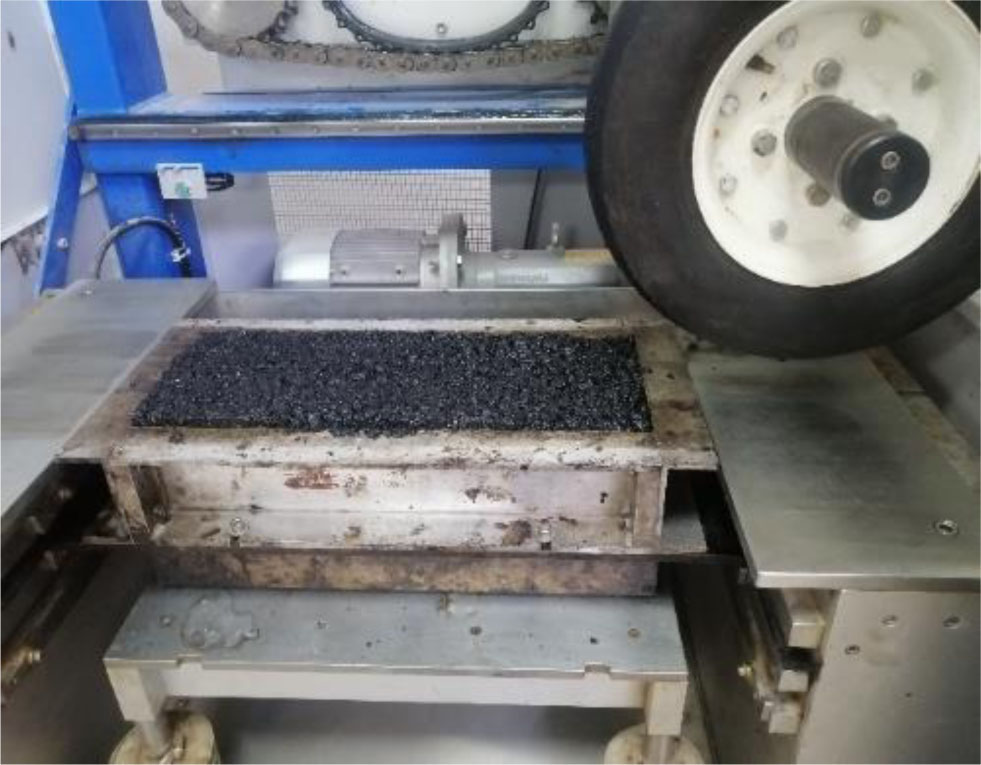
Figure 4:
Roller compactor with compacted plate
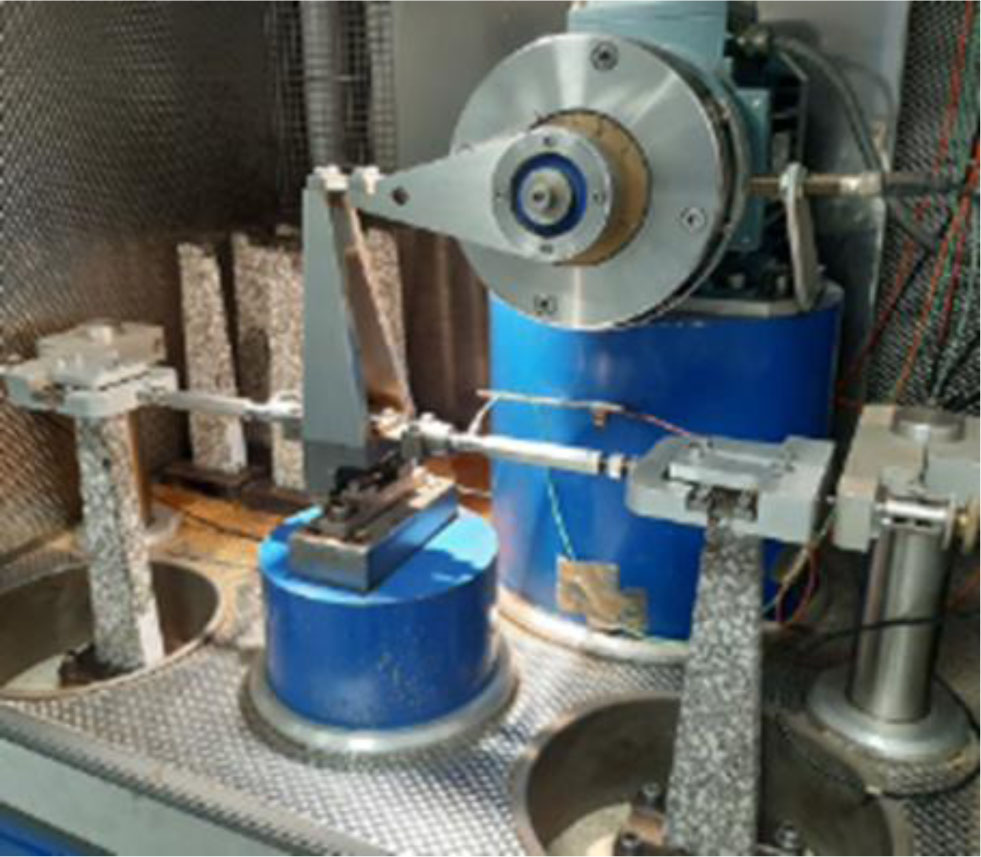
Figure 5:
Test equipment complex Modulus
Afterward, the specimen is conditioned to a specified ambient temperature to ensure consistent test conditions. After 48 hours, it is cut by sawing into a compact trapezoidal specimen, with a wider section at the base and a narrower one at the top. The trapezoidal specimens had the following dimensions: upper base (B) = 56,860 mm, lower (b) = 24,920 mm, height (H) = 25,910 mm, and thickness (e) = 250,880 mm, with an average weight of 0.640 kg, allowing for specific stress distribution (Figure 4). Additionally, parameters include E* (complex modulus, representing the overall stiffness of a material under oscillatory loading, combining both elastic and viscous responses), E′ (storage modulus, measuring the elastic energy-storing component, indicating how much energy is stored and recovered per cycle), E″ (loss modulus, quantifying the viscous energy-dissipating component, showing how much energy is lost as heat per cycle), phase angle (δ), deformation (mm), stress (MPa), and microstrain. Dynamic modulus |E*| and phase angle (δ) represent the lag between the applied stress and the resulting strain, indicating the balance between elastic and viscous behavior. A higher δ means a more viscous response; a lower δ means a more elastic response, and loss modulus E″ was calculated using Equations (1), (2), (3), and (4):
3. Results and Discussion
3.1. Effect of Temperature
Isothermal (Figure 5) and isochrone (Figure 6) curves are essential for understanding the viscoelastic and temperature-dependent behavior of asphalt mixes. They enable the assessment of pavement performance under various climatic (temperature) and traffic (frequency) conditions, facilitating the optimization of mix design for enhanced durability.
The curves in Figure 6 illustrate the relationship between stiffness and frequency for a fixed loading temperature (10.5, 15.5, 20.5, and 25.5°C) for modified asphalt with PVC and unmodified asphalt.
The results show that stiffness increases with loading frequency, reaching its maximum at high frequency (20 Hz) and low temperature (10.5°C). In comparison, the lowest stiffness is observed at low frequency (0.5 Hz) and high temperature (25.5°C). At low temperatures, the mixtures exhibit a more rigid, elastic behavior, whereas at higher temperatures, they become softer and more viscous. As shown in Table 7, PVC modification consistently enhances stiffness values across all temperatures and frequencies.
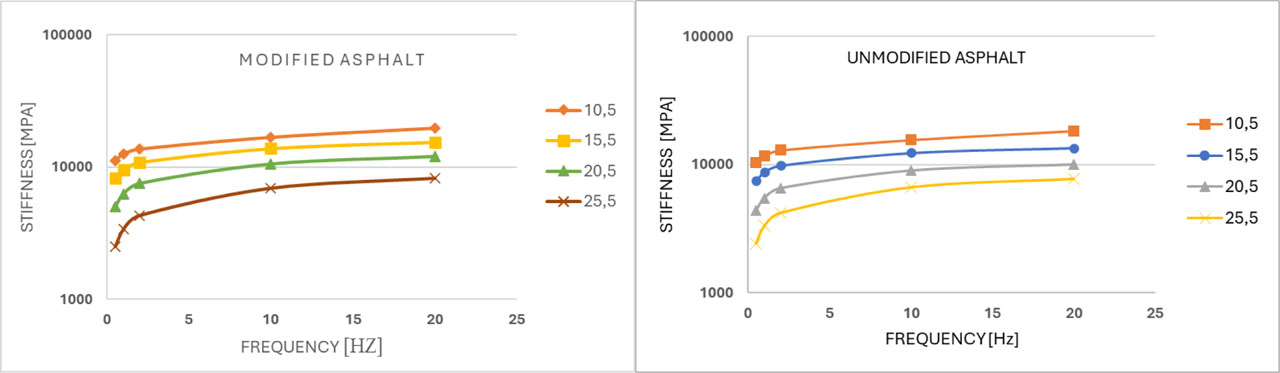
Figure 6:
Isothermal curve of modified asphalt and unmodified asphalt
3.2. Effect of Frequency
The curves in Figure 7 show the relationship between stiffness and temperature for fixed loading frequencies (0.5 Hz, 1 Hz, 2 Hz, 10 Hz, and 20 Hz) for modified asphalt with PVC and unmodified asphalt.
The Figures demonstrate that the material stiffness varies with temperature and frequency, as shown in table 7. The stiffness attains its maximum value at low temperature and high frequency (20 Hz) and its minimum value at ambient temperature (25°C) and low frequency (0.5 Hz), indicating the material’s viscoelastic behavior. At higher frequencies, the material behaves rigidly (elastically), and at low frequencies, it behaves more softly (viscously).
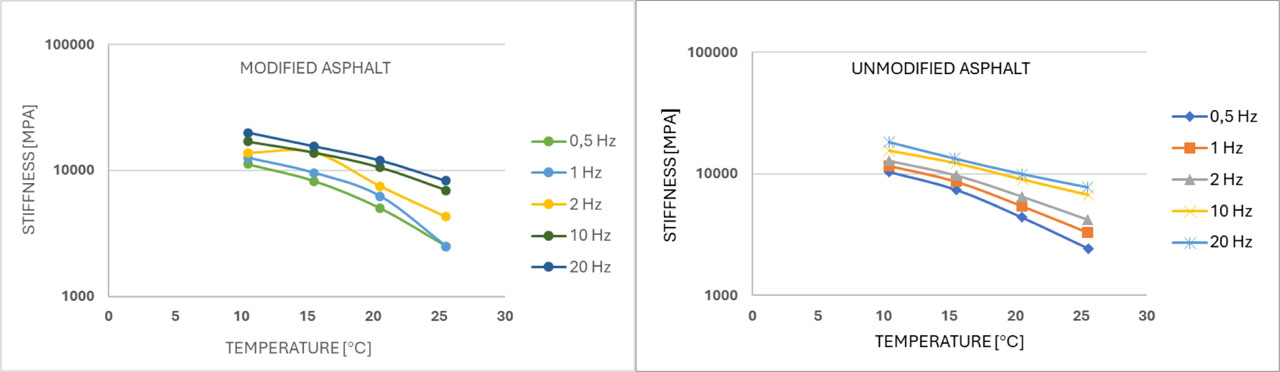
Figure 7:
Isochronous curve of modified asphalt and unmodified asphalt
The initial stiffness of the bituminous material reaches its maximum due to increased molecular interactions or structural resonance of the viscoelastic material, which adopts a stiffer behavior when rapid oscillations limit deformation, and the storage modulus of the bituminous material increases as frequency increases, as evidenced in Table 7.
This behavior reflects a dynamic response in which the system becomes more resistant to deformation as oscillations accelerate. Over time, however, stiffness gradually decreases, meaning that the materials become viscoelastic. This temporal behavior indicates that the material becomes less deformable under stress.
3.3. Phase Angle and Loss Modulus Analysis
Table 7 summarizes DMA results showing a decrease in thermal softening. E′ followed a similar trend, and phase angles increased from 13° to 41°, indicating a shift toward viscous behavior (Manjunatha et al., 2022). Deformation increased from 0.0146 mm at 10.5°C to 0.1221 mm at 25.5°C, consistent with a reduction in stiffness.
Table 7:
DMA Test Results for Unmodified and PVC-Modified Bituminous Mixtures (0.5 Hz)
| Temperature [°C] | E′ [MPa] | E″ [MPa] | E* [MPa] | Phase Angle [°] | Deformation [mm] | Stress [MPa] | ||||||
|---|---|---|---|---|---|---|---|---|---|---|---|---|
| MODIF | ORD | MODIF | ORD | MODIF | ORD | MODIF | ORD | MODIF | ORD | MODIF | ORD | |
| 10.5 | 10892 | 10020 | 2495 | 2703 | 11174,10 | 10380,11 | 13 | 15 | 0.0146 | 0,0151 | 127 | 120 |
| 15.5 | 7850 | 6877 | 2457 | 2762 | 8225,53 | 7410,92 | 17 | 22 | 0.0308 | 0,0323 | 197 | 184 |
| 20.5 | 4338 | 3735 | 2480 | 2325 | 4996,86 | 4399,52 | 30 | 32 | 0.0820 | 0,0874 | 319 | 296 |
| 25.5 | 1870 | 1774 | 1643 | 1663 | 2489,24 | 2431,59 | 41 | 43 | 0.1221 | 0,1222 | 237 | 229 |
Modified asphalt has a consistently higher E′ modulus, meaning it retains more elastic stiffness, particularly noticeable at 15.5°C and 20.5°C. The decrease in E′ with temperature is normal (viscoelastic behavior), but slower for modified bitumen. Modified bitumen retains its shape better when heated. It is less sensitive to thermal softening. This means it performs better in hot climates or under slow traffic (creep).
The loss modulus E measures energy loss in a viscoelastic material, and the more energy the material dissipates as heat, the more viscous (less elastic) it is. At 10.5°C, E″ord=2703 MPa and E″modif=2495 MPa. This indicates that ordinary bitumen is more viscous than modified bitumen at low temperatures, which is not ideal, as it should be rigid and elastic to resist thermal cracking.
Modified asphalt always has a lower phase angle, which means less energy dissipation (less viscous) and a better ability to return to its original shape after loading.
3.4. An Analysis of Rheological Behavior with the WLF Model & Master Curve Construction
To analyze the rheological behavior of bitumen modified with polymers, the Williams-Landel-Ferry (WLF) model was used to determine the time-temperature shift factors aT (using a reference temperature Tref=40°C). This model can change the original frequency data into reduced frequencies. The test results associated with different temperatures can therefore be assembled into a single master curve based on the time–temperature superposition principle (Williams, Landel, & Ferry, 1955).
The WLF model is expressed as follows:
Where:
C1 and C2 - material-specific constants.
For several bituminous and polymeric materials, it is common to use C1 = 17.44 and C2 = 51.6 (Williams, Landel, & Ferry, 1955).
After applying this model, the rheological behavior of the samples became clearer, as shown in the curves in Figure 8. The master curves of the complex modulus illustrate that PVC-modified asphalt exhibits higher stiffness across a wide range of reduced frequencies compared to the unmodified asphalt, confirming the beneficial effect of PVC incorporation.
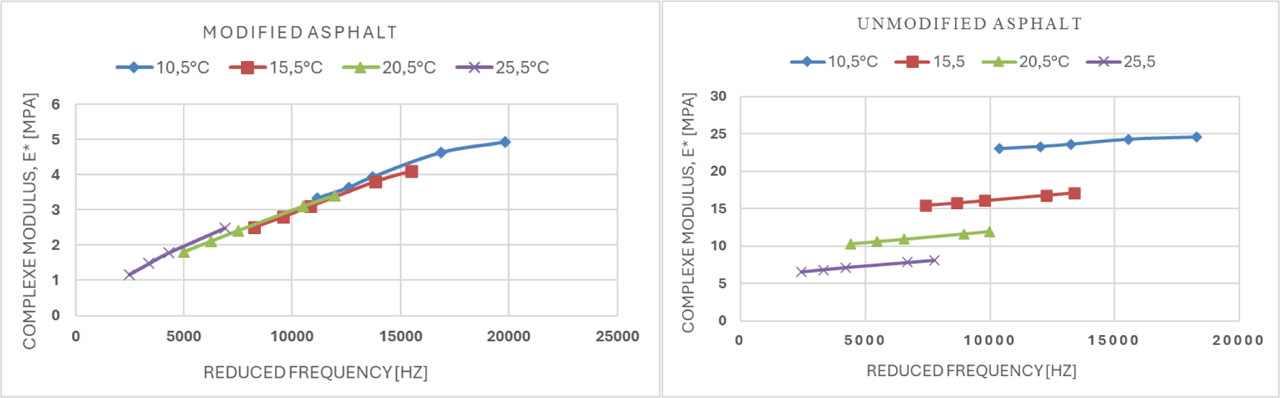
Figure 8:
Master curve representation
For the unmodified asphalt, the master curves did not overlap consistently, indicating that the material is highly thermosensitive and exhibits a complex viscoelastic behavior. This variability makes it difficult to model and accurately predict performance at different temperatures (Bahia et al., 2015).
In contrast, the PVC-modified bitumen displayed matching and converging master curves, suggesting a more uniform structure and a stable viscoelastic behavior across the frequency-temperature resistance and enhancing the structural performance of asphalt mixtures under vehicular loading (Lu & Isacsson, 1997).
The application of this method is particularly significant for evaluating the durability and long-term performance of asphalt mixtures, among which are severe climates and heavy traffic conditions (Read & Whiteoak, 2003).
4. Conclusions
The use of PVC waste as a modifier in asphalt pavements enhances road performance while contributing to plastic waste reduction. Incorporating 7% waste PVC into 40/50 bitumen mixtures significantly improves mechanical performance compared to unmodified mixtures. Dynamic Mechanical Analysis (DMA) results show that complex modulus (E*) increased by up to +13.6%. In comparison, the storage modulus (E′) rose by as much as 16.1%, indicating higher stiffness and resistance to permanent deformation. Stress capacity also improved by +7–8% across all tested temperatures. Furthermore, the phase angle (δ) and deformation decreased consistently (up to 22.7%), reflecting enhanced elasticity and rutting resistance. These findings confirm that PVC-modified asphalt mixtures are particularly suitable for resisting high-temperature rutting. However, the slight reductions in loss modulus (E″) at low temperatures highlight the need for further research to optimize PVC content and improve flexibility under cold climate conditions. Overall, PVC waste incorporation not only provides a sustainable solution for plastic disposal but also leads to more durable and resilient asphalt pavements.
Acknowledgements
This research was carried out at the Laboratory for Materials Reliability in Saharan Regions (FIMAS), University of Tahri Mohammed (Bechar), with the assistance of the LECTO laboratory and the laboratory of the Southern Public Works Laboratory (LTPS) in Ghardaïa (Algeria). The authors would like to thank all those who contributed effectively to the realization of this laboratory survey.