
INTRODUCTION
Nitrogen is a component of DNA, RNA, proteins, and thus chlorophyll, ATP, enzymes, auxins and cytokinins by which it plays an important role in the entire life process of plants (Hussain et al., 2020; Wen et al., 2020). Plants can take up and utilize inorganic and organic forms of N from the soil, primarily in the form of nitrate (NO3−) and ammonium (NH4+) ions (Andrews et al., 2013). However, low N availability in the soil is a common problem that contributes to worsening crop yields (Anas et al., 2020). Population growth and increasing demand for food, have led to intensification of agricultural practices. Increased fertilization has become an important and cost-effective strategy used to increase yields in intensive farming systems around the world, but which has led to, among other things, loss of biodiversity and the “chemicalization” of food (Ahmed et al., 2020). Today, modern agriculture is based on environmentally friendly practices and the search for solutions to produce healthy and safe agricultural products (Ahirwar et al., 2020; Muhie, 2022). Various farming systems are used in modern agriculture. In potato cultivation, the most common systems are integrated, conventional and organic. The integrated method makes it possible to obtain high yields of first-class quality with the use of lower doses of mineral fertilizers, organic fertilizers and chemical plant protection products (Nowacki, 2020). The use of lower fertilizer doses can reduce the accumulation of harmful compounds found in potato tubers, which include nitrates (Abdo et al., 2020). Nitrate accumulation in the plant also depends on the genotype, harvest date and post-harvest factors (Voronov et al., 2019; Ahmed et al., 2020; Pobereżny et al., 2023). Many scientific reports speak of the positive effects of nitrates on the human body (Ma et al., 2018). This is due to the fact that they are exogenous carriers used to create NO, which plays a beneficial role in the physiology of the human body (Karwowska, Kononiuk, 2020; Olas, 2024). Studies show that dietary nitrates and nitrites lower blood pressure through their antioxidant properties (Siervo et al., 2013). They also reduce triglycerides (TGs), improve endothelial dysfunction and vascular stiffness in elderly people with moderately increased risk of cardiovascular disease, and prevent stroke and atherosclerosis by reducing platelet aggregation (Zand et al., 2011; Rammos et al., 2014). On the other hand, there are reports of harmful effects of nitrates on human health. Many authors (DellaValle et al., 2014; Karwowska, Kononiuk, 2020; Shrock, Krasowski, 2020; Abasse et al., 2022; Seyyedsalehi et al., 2023) point to a link between nitrate and nitrite consumption and a higher risk of breast, stomach, colon, esophageal and thyroid cancer. Moreover, the elevated nitrate content of potato tubers poses a threat to the general health of the population. With the involvement of commensal bacteria, nitrates can be converted into dangerous nitrites and these into carcinogenic nitrosamines (Karwowska, Kononiuk, 2020). Accordingly, the FAO/WHO Expert Committee on Food Additives (JECFA, 2002) set the safe daily intake of nitrates for an adult at 0.0–3.7 mg, and nitrites at 0.0–0.7 mg kg−1. Due to the ever-increasing consumption of vegetables among the public, it is important to seek solutions in their cultivation technology, including that of the edible potato, leading to a reduction in NO3 accumulation. Taking into account the above factors, the aim of this study was to evaluate the content of nitrates and nitrites in tubers of 18 edible potato varieties belonging to different earliness groups grown in an integrated system of plant production, immediately after harvest and after 6-month storage.
MATERIALS AND METHODS
A field experiment was carried out in 2020–2022 at Agricultural Experimental Station belonging to Bydgoszcz University of Science and Technology in Minikowo (53°10′02″N, 17°44′22″E, Kuyavian-Pomeranian voivodeship). The material for the study consisted of 18 edible potato varieties classified in different earliness groups – very early varieties: Impresja, Surmia, Tacja, early varieties: Baltic fire, Bohun, Gardena, Golden Marie, Ignacy, Ismena, Magnolia, Mia, Stokrotka, Wega, medium-early varieties: American Rose, Baltic Rose, Jurek, Mazur, Tajfun. The potatoes came from three producers: Zamarte Potato Breeding Ltd., Pomeranian Masurian Potato Breeding Ltd and Norika Polska Ltd. All varieties were grown each year of the tests conducted. The experiment was established in a randomized block design in 3 repetitions on lessive soil, classified as lessive podzolic soil (very good rye complex, soil quality class III a). The field experiment was carried out on a light soil with a slightly acidic pH. The soil was characterized by a medium content of available phosphorus and potassium, and low magnesium content (Table 1). These soil conditions are considered suitable for potato cultivation, as the crop prefers light, well-drained soils with a slightly acidic pH (optimal pH 5.0–6.5). The basic nutrient levels were supplemented through fertilisation, as described later in this article.
Table 1.
Soil parameters before the field experiment in 2020–2022.
| Parameter | Value |
|---|---|
| pH KCl | 6.0 |
| Available P2O5 [mg kg−1] | 243.4 |
| Available K2O [mg kg−1] | 222.2 |
| Available MgO [mg kg−1] | 70.0 |
In the years 2020–2022, the potato growing season (May–September) was characterized by variable weather conditions. In 2020, exceptionally high precipitation was recorded in June (165.5 mm) as well as in August (104.7 mm). Temperatures during this period were favorable, ranging on average from 10.8°C in May to 19.7°C in August. In 2021, the total precipitation was lower, particularly in June (40.9 mm) and August (34.1 mm), while temperatures, especially in July (22.5 °C), were high. In 2022, precipitation was moderate (e.g., 39.5 mm in June and 63.7 mm in August), and temperatures were stable and closely aligned with the mean values observed during the 2020–2021 potato growing seasons (Table 2).
Table 2.
Meteorological conditions in 2020–2022.
| Month | 2020 | 2021 | 2022 | |||
|---|---|---|---|---|---|---|
| Precipitation [mm] | Air temperature [°C] | Precipitation [mm] | Air temperature [°C] | Precipitation [mm] | Air temperature [°C] | |
| January | 32.0 | 2.6 | 49.2 | −1.4 | 64.0 | 0.7 |
| February | 42.1 | 3.7 | 29.4 | −2.7 | 49.0 | 3.0 |
| March | 28.1 | 4.0 | 21.4 | 3.3 | 0.5 | 2.9 |
| April | 4.2 | 8.0 | 33.2 | 5.8 | 24.5 | 6.8 |
| Mai | 44.8 | 10.8 | 68.0 | 11.6 | 24.8 | 12.9 |
| June | 165.5 | 17.7 | 40.9 | 19.1 | 39.5 | 18.3 |
| July | 57.4 | 18.2 | 45.7 | 22.5 | 42.9 | 18.8 |
| August | 104.7 | 19.7 | 34.1 | 17.1 | 63.7 | 21.2 |
| September | 55.1 | 14.5 | 25.0 | 14.0 | 54.1 | 12.1 |
| October | 70.0 | 10.1 | 24.6 | 8.8 | 28.3 | 10.3 |
| November | 12.3 | 5.7 | 33.8 | 4.9 | 19.8 | 3.6 |
| December | 35.9 | 1.6 | 25.1 | −1.4 | 31.1 | 0.7 |
| Averages | 557.9 | 9.7 | 430.4 | 8.5 | 442.2 | 9.3 |
The potatoes were planted on the 30th of April. The forecrop for the tubers was cereals. The experiment was set up in plots of 30 m2 with a row spacing of 0.30 m × 0.75 m.
Treatments were carried out in accordance with the requirements of optimal agrotechnology for potato and using BASF SE preparations. Before planting, soil fertilization was applied with nitrogen (YaraMila Viking) – 100 kg N ha−1, phosphorus – 70 kg P ha−1 and potassium – 70 kg K ha−1. At the stage of 3–4 leaves, foliar micronutrient fertilization was applied in the form of boron – 1 l ha−1 YaraVita Bortrac, and at the stage of inter-row compactness, micronutrient fertilizer YaraVita Kombiphos – 5 l ha−1 was applied. The fertilisers used were from Anwil Group Orlen. Plant protection included treatments in accordance with the principles of optimal potato cultivation. Three fungicide treatments were carried out during the growing season. The first treatment, two weeks before bud setting, was carried out with Enervin (1.2 l ha−1) and Polyram 70WG (1.8 kg ha−1). The second treatment was carried out at the bud setting stage with Cabrio Duo 112EC (2.5 l ha−1). The third treatment, on the other hand, was carried out immediately after flowering with Acrobat (2 kg ha−1). The potato protection programme also included the use of herbicides. Stomp 400 SC+ Aklonifen 600 SC (3 l ha−1 + 2 l ha−1 before emergence) and Focus Ultra 100 EC + Dash HC (1 l ha−1) were used. Treatments were carried out during the germination period and at the beginning of flowering. For insecticides, Mospilan 20 SP – 0.08 kg ha−1 – was applied.
Tubers were harvested depending on the earliness group when they reached full maturity (September/October). During harvest, tubers were sampled for direct post-harvest evaluation (10 kg) and for storage experiment (10 kg).
Immediately after harvesting, potato tubers were put in storage chambers (Thermolux Refrigeration Air Conditioning, Raszyn, Poland) at 10 °C and 80% relative humidity. After three days, some of the tubers were sampled and then washed. These tubers were cut into 1 × 1 × 1 cm cubes and frozen in liquid nitrogen. The potato samples were kept frozen at −18 °C. The samples were then lyophilized (CHRIST ALPHA 1-4 LSC, Osterode am Harz, Germany) and ground (particle size 0.3–0.5 mm) with Ultra-Centrifuge Retsch ZM 100 laboratory grinder (Retsch, Haan, Germany). The ground samples were kept in sealed bags in a desiccator, stored in the dark, until laboratory analysis. Nitrate and nitrite contents were determined in the material thus prepared. Analyses were performed in triplicate under laboratory conditions.
A CX-721 multifunctional computerized instrument (Elmetron, Zabrze, Poland) was used to measure the nitrate and nitrite content by the ion-selective potentiometric method (Wszelaczyńska et al., 2022). The measurement principle is based on the linear dependence of the electrode potential on the logarithm of ion activity in solution. This is given by the Nernst equation (Wszelaczyńska et al., 2022).
where:E – SEM measuring cell composed of ionoselective electrodes and references in the test solution (V)
Eo – normal potential of the ion-selective electrode depends mainly on the activity of the internal electrode solution and the type of reference electrode (V)
aj – activity of the determined ion
n – value of the measured ion
R – is the universal gas constant: R = 8.314 J K−1mol−1
T – is the temperature in Kelvins
F – is the Faraday constant, the number of coulombs per mole of electrons: F = 96,485 C mol−1
Two grams of lyophilized potatoes were combined with 50 ml of 1 % KAl(SO4)2 solution (Merck, Darmstadt, Germany) and extracted thoroughly. The extraction was conducted for 1 hour using a shaker (IKA KS, Model 130 Basic-Staufen, Germany). The samples were filtered over Whatman filter paper No. 4. Then 10 milliliters of 60% Al2(SO4)3 solution (Acros Organics, Carlsbad, CA, USA) was mixed into the filtrate and stirred immediately before the test. Nitrate content was determined using KNO3 standard curves (Merck, Darmstadt, Germany) and expressed as NO3−. Nitrite content was quantified after oxidation to nitrate using 30% H2O2 and measured in the same way (expressed as NO2−). Deionized water was utilized at all stages of the analytical testing process.
For the purpose of the storage experiment, 10 kg sample from each plot – were placed in controlled atmosphere chambers (Thermolux Refrigeration Air Conditioning, Raszyn, Poland) for a period of 6 months (October–March), depending on the earliness group, belonging to the Institute of Agri-Foodstuff Commodity of Bydgoszcz University of Science and Technology. A constant temperature of 4 °C and relative humidity of 95% were maintained throughout the storage period. To simulate the ambient temperature and minimize heat loss, the experimental chamber is insulated with 20 mm thick foam. Additionally, the chamber is fitted with an automatic system to maintain humidity levels. After 6 months, the nitrate and nitrite contents were again determined using the method described above.
Statistics
The obtained results were analysed using Statistica 13.1 software (StatSoft, Tulsa, OK, USA). The data were verified for normality of distribution the Shapiro–Wilk test (were transformed when required by either sqrt(x + 1) or ln(x + 1)) and homogeneity of variance, and the average values obtained in individual groups were subjected to ANOVA (analysis of variance) at a significance level of 0.05 using Tukey’s method. The values were presented as averages with standard deviations (SD). To identify the relationship between the distinguishing qualitative features under study, Spearman’s rank correlation coefficients were determined at p = 0.05.
RESULTS AND DISCUSSION
The results indicate that the tested varieties of edible potato are characterized by low nitrate content, as the content does not exceed the specified standard. According to the guidelines of the FAO/WHO Expert Committee on Food Additives (JECFA, 2002) and Commission Regulation (EC) No. 1822/2005 of November 8, 2005, the nitrate content in potato tubers should not exceed 200 mg kg−1 f.m. Regardless of the experimental factors, the average nitrate content of the tubers tested, determined immediately after harvest, ranged from 28.4 to 95.6 mg kg−1 f.m. and nitrite from 0.18 to 0.98 mg kg−1 f.m. (Fig. 1, 2). The literature shows that the potato is a plant that has a medium tendency to accumulate nitrates (Bienia et al., 2021; Djaman et al., 2021; Wszelaczyńska et al., 2022). The content of nitrate and nitrite in potato tubers varies within wide limits, as reported in the literature from 35.6 to 203.0 mg kg−1 f.m. for nitrate (Ebrahimi et al., 2020; Wszelaczyńska et al., 2022) and from 0.03 to 4.3 mg kg−1 f.m. for nitrite (Mozolewski, Smoczyński, 2004; Kmecl et al., 2017; Mahmoudzadeh, Atefi, 2022). Nitrate accumulation in plants is a complex process. Nitrate uptake, translocation and assimilation in plants are tightly regulated by the interaction of internal signals (expression of related genes and enzyme activities) with external environmental factors (Iqbal et al., 2020; Liu et al., 2020). In addition to developing appropriate fertilizer management strategies, nitrate concentrations in vegetables can be reduced by selecting appropriate varieties. Analysis of variance showed that the varieties studied differed significantly in nitrate and nitrite content. The highest content of nitrates and nitrites was characterized by Tacja variety (95.6 and 0.98 mg kg−1 f.m. respectively) and the lowest by Wega variety (28.4 and 0.18 mg kg−1 f.m., respectively) (Fig. 1, 2). Nitrate content is genetically determined and can be a characteristic of the species or even the variety (Trawczyński, 2016).
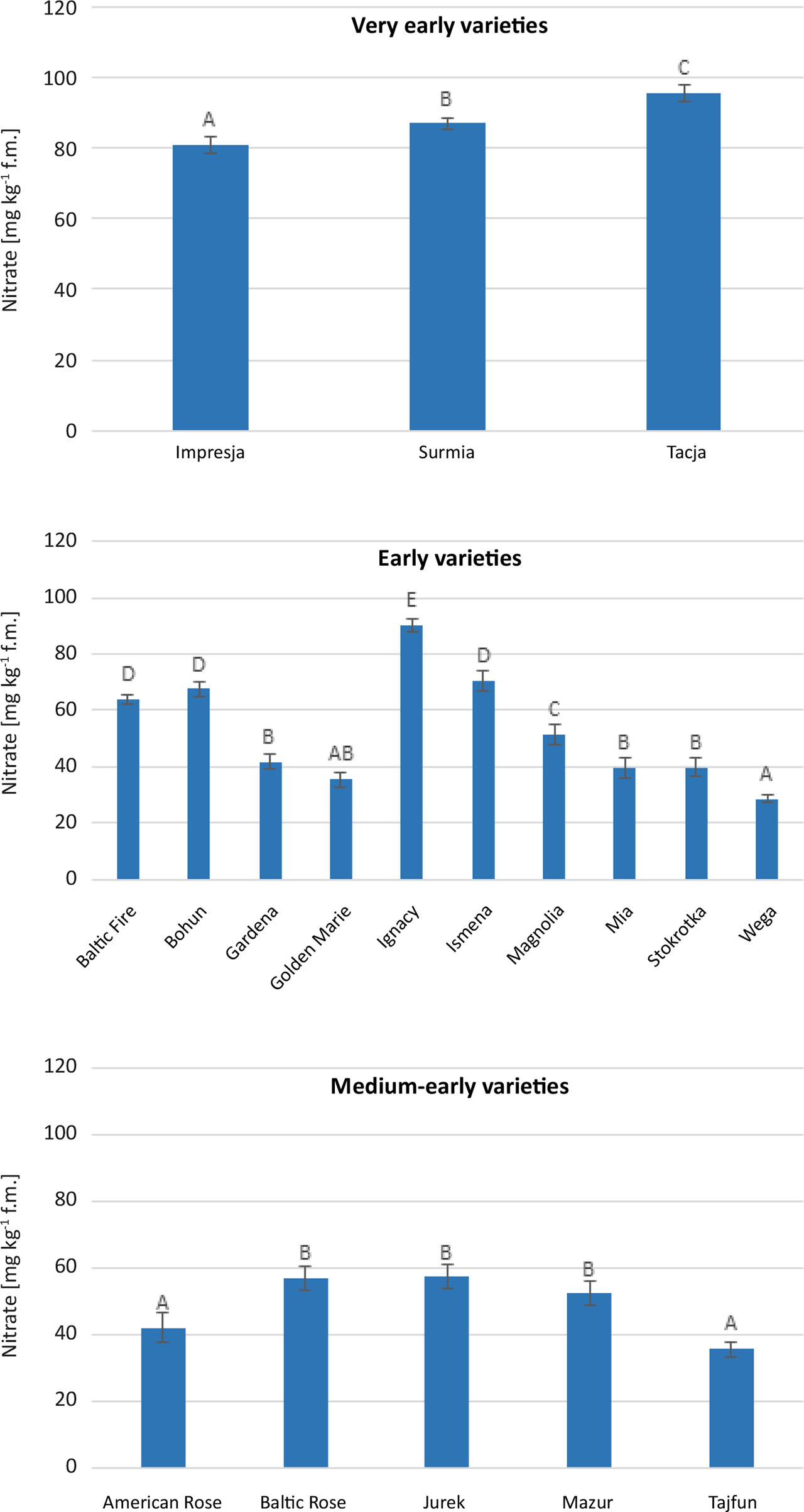
Figure 1.
Content of nitrates in potato tubers depending on genotype and earliness group. Means sharing the same letter are not significantly different (p<0.05)
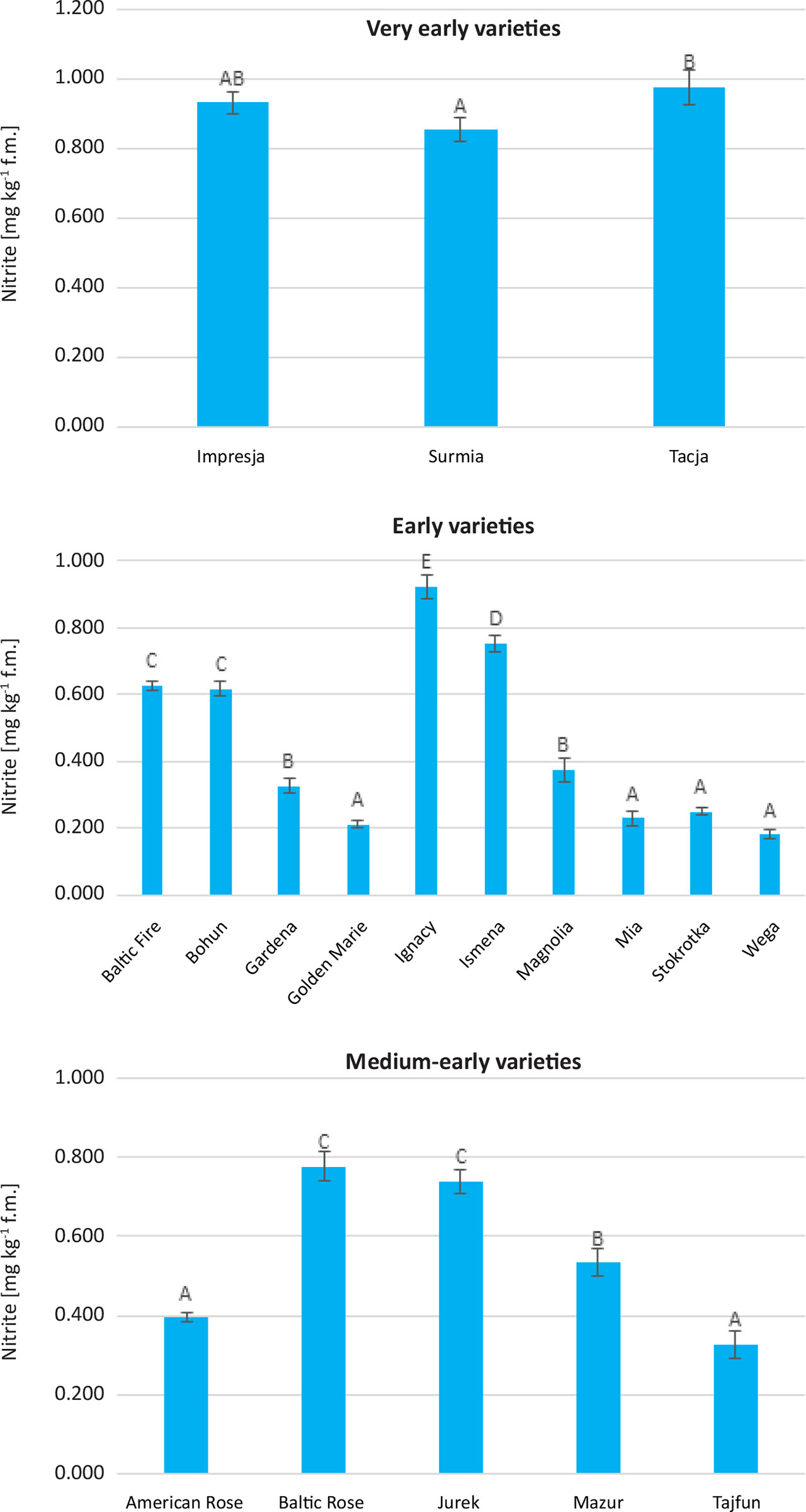
Figure 2.
Content of nitrites in potato tubers depending on genotype and earliness group. Means sharing the same letter are not significantly different (p<0.05)
In the study by Trawczyński (2016), the nitrate content for the Jurek variety was obtained at 41.5 mg kg−1 f.m., which is similar to the value obtained in our own study (57.4 mg kg−1 f.m.). In another study, Trawczyński (2020) reports that the nitrate content for the Impresja and Mazur varieties is 59.1 and 27.3 mg kg−1 f.m., respectively. Slightly higher results for these varieties were obtained in our own study (81.1 and 52.3 mg kg−1 f.m.). In contrast, for the Tajfun variety, the literature data are significantly different. In the study by Wszelaczyńska et al. (2022), the nitrate and nitrite contents were 183.6 and 4.20 mg kg−1 f.m., respectively, which is almost 6 times higher for nitrate and almost 13 times higher for nitrite, compared to those obtained in our own study. Such large differences may be due to environmental conditions including meteorological conditions and agronomic practices. The study indicates an increase in the intensity of nitrate accumulation in potato tubers grown in years when low rainfall was observed during the growing season. During excessive precipitation, mineral forms of nitrogen move to deeper layers of the soil and are less available to the plant and thus lower nitrate levels are observed in tubers (Trawczyński, 2016). Particularly high risk for nitrate accumulation in potato tubers occurs when excessive amounts of nitrogen fertilizers are applied, which effectively improve the yield of potato tubers, but on the other hand have the effect of increasing nitrate content (Elrys et al., 2018; Abdo et al., 2020).
It was shown that potato tubers belonging to the very early group were characterized by a significantly higher content of the tested compounds compared to tubers from the early and medium-early groups (Fig. 3). The average content of nitrates and nitrites for tubers in the very early group was equal to 87.9 and 0.92 mg kg−1 f.m., for the early group 52.9 and 0.45 mg kg−1 f.m., respectively, and for the medium-early group 48.9 and 0.55 mg kg−1 f.m., respectively (Fig. 3). Among the tubers in the very early group, the highest nitrate content was characterized by the variety Tacja (95.6 mg kg−1 f.m.) and the lowest by Impresja (81.1 mg kg−1 f.m.), in the group of early varieties, respectively, Ignacy (90.1 mg kg−1 f.m.) and Wega (28.4 mg kg−1 f.m.) and in the group of medium-early varieties, respectively, Jurek (57.4 mg kg−1 f.m.). and Tajfun (35.8 mg kg−1 f.m.) (Fig. 1). A strong positive correlation between nitrate and nitrite concentrations was observed across all samples (r² = 0.94; p = 0.05), suggesting that the accumulation of these compounds in potato tubers is interdependent. Only in the case of tubers in the medium-early group, the highest nitrite content was characterized by the Baltic Rose variety (0.78 mg kg−1 f.m.) and in the very early group the lowest content was recorded for the Surmia variety (0.85 mg kg−1 f.m.) (Fig. 2).
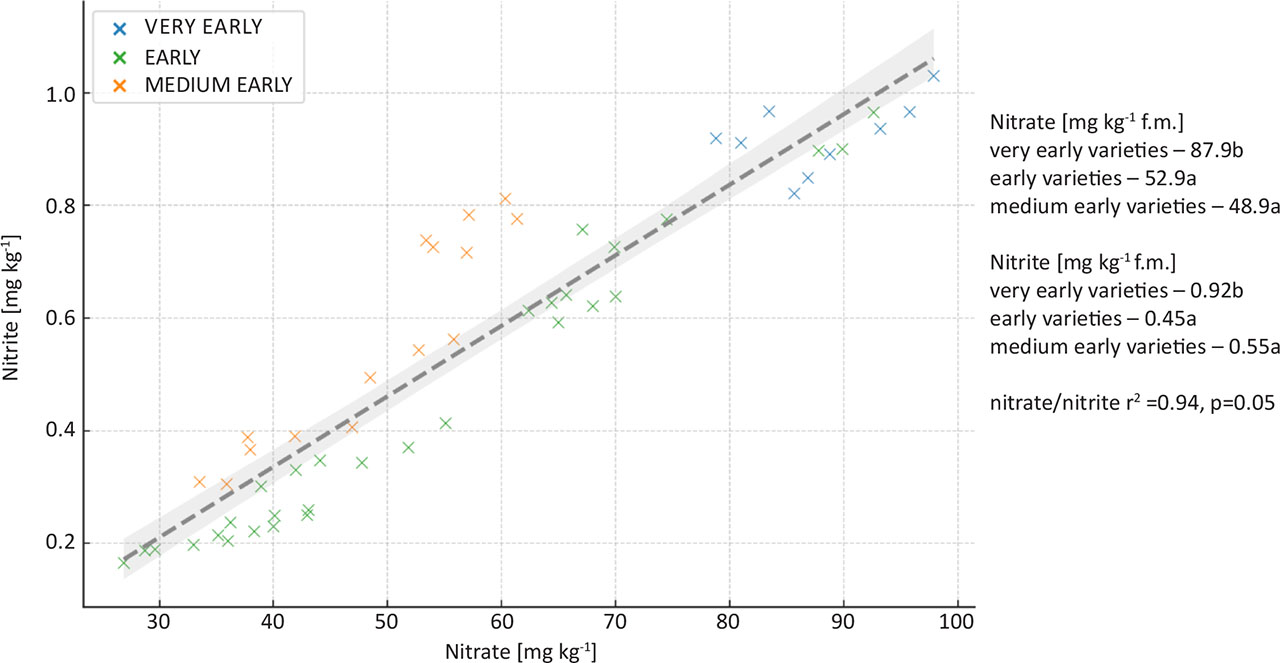
Figure 3.
Relationship between nitrate and nitrite content in potato tubers of different earliness groups. Statistically significant differences in nitrate and nitrite levels among the earliness groups are annotated beside the graph. Means sharing the same letter are not significantly different (p<0.05).
Our research confirms other reports that there is a relationship between decreasing nitrate levels and extending the growing season of potato tubers. In the study of Trawczyński (2021), the nitrate content in tubers of the group of very early, early and medium-early varieties was 127.7 102.4 and 86.3 mg kg−1, respectively. On the other hand, in the study of Mazurczyk and Lis (2000), the nitrate content in tubers of the group of very early and early varieties was much higher and amounted to 224 mg kg−1, in the group of medium-early varieties it was 108 mg kg−1. The nitrate content in the group of medium-late and late varieties was similar to the results we obtained in our study for varieties in the medium-early group, and amounted to 44 mg kg−1 f.m. (Mazurczyk, Lis, 2000).
According to many authors, unsuitable storage conditions (elevated temperature, inadequate humidity, lack of oxygen) increase the nitrate content of vegetables (Luo et al., 2022; Mahmoudzadeh, Atefi, 2022). Changes in the nitrate and nitrite content of fresh vegetables during storage are highly dependent on temperature due to its strong influence on the activity of nitrate and nitrite reductases (Luo et al., 2022). In our study, potato tubers were stored under controlled conditions and a decrease in nitrate and nitrite content was observed. Average losses in nitrate and nitrite content, occurred by 6.4 and 20.2%, respectively. Among the varieties that showed the smallest decrease in nitrate and nitrite content after storage are Bohun (4.8 and 16.7%, respectively), Golden Marie (4.8 and 14.3%, respectively) and Impresja (5.4 and 17.1%, respectively) (Table 3). On the other hand, the largest decrease in nitrates was recorded for the varieties Tajfun (8.4%), American Rose (8.3%), and Baltic Fire (7.6%). Meanwhile, for nitrite, the largest decrease was observed in Baltic Fire (24.4%), American Rose (23.8%) and Tajfun (23.8%) varieties (Table 3). The earliness group influenced the change in the magnitude of nitrate and nitrite losses after storage. The group of medium-early varieties had the greatest decrease in nitrates and nitrites at 6.9% and 20.3%, respectively. In a study by Pobereżny et al. (2012) nitrate content decreased by 37.5% after 6-month storage. In another study by the author (Pobereżny et al., 2023), no changes in nitrate and nitrite content were observed during long-term storage. Such variable results in the content of harmful compounds after storage may be due to differences in the cultivation technology used. Fertilization, mainly with nitrogen, cultivation system, location and also meteorological conditions may be of great importance (Pobereżny et al., 2015; Kyriacou et al., 2019).
Table 3.
Percentage decrease in nitrate and nitrite content in potato tubers after storage during 6 months depending on genotype and earliness group
| Earliness Group | Varieties | Nitrate [%] | Nitrite [%] |
|---|---|---|---|
| Very early varieties | Impresja | 5.4 | 17.1 |
| Surmia | 6.5 | 22.4 | |
| Tacja | 6.5 | 21.2 | |
| Average | 6.1 | 20.2 | |
| Early varieties | Baltic Fire | 7.6 | 24.4 |
| Bohun | 4.8 | 16.7 | |
| Gardena | 7.5 | 23.2 | |
| Golden Marie | 4.8 | 14.3 | |
| Ignacy | 6.3 | 22.1 | |
| Ismena | 5.5 | 19.2 | |
| Magnolia | 5.5 | 19.5 | |
| Mia | 6.6 | 22.9 | |
| Stokrotka | 7.5 | 22.8 | |
| Wega | 5.4 | 17.2 | |
| Average | 6.1 | 20.2 | |
| Medium-early varieties | American Rose | 8.3 | 23.8 |
| Baltic Rose | 5.7 | 17.2 | |
| Jurek | 5.8 | 17.3 | |
| Mazur | 6.5 | 19.7 | |
| Tajfun | 8.4 | 23.8 | |
| Average | 6.9 | 20.3 |
CONCLUSIONS
The research highlights the key influence of potato variety – along with its intrinsic earliness classification – on nitrate and nitrite content, ensuring both consumer safety and high-quality tuber production.
The raw tubers of the tested potato varieties exhibited low nitrate and nitrite levels, ranging from 28.4 to 95.6 mg kg−1 for nitrate and 0.18 to 0.98 mg kg−1 for nitrite, respectively. All these values are well below the maximum acceptable daily intake (ADI) limits set by the FAO/WHO Expert Committee, which are 0–3.7 mg per kilogram of body weight for nitrate and 0–0.7 mg per kilogram of body weight for nitrite. This confirms the safety of these potato varieties for consumers. Among them, the variety Tacja showed the highest nitrate and nitrite concentration, while Wega had the lowest.
Controlled storage conditions reduce nitrate and nitrite levels, underscoring the need to optimize storage for food safety.
Early identification of varieties prone to nitrate and nitrite accumulation allows for better crop management and yield quality.