

1. Introduction
Migration is one of the most significant demographic processes in the contemporary world, directly influencing the size, structure, and spatial distribution of populations. In the context of globalization, economic transformation, and regional instability, migration increasingly affects not only demographic development, but also the social, economic, and security environment of modern states. For countries experiencing long-term demographic decline, such as Bulgaria, migration has become a strategic factor with direct implications for labor force sustainability, economic resilience, social cohesion, and national security.
Over the past three decades, Bulgaria has faced persistent emigration, accelerated population aging, low birth rates, and growing regional demographic disparities. These processes have contributed to continuous population decline and intensified territorial imbalances between major urban centers and peripheral regions. Large-scale emigration of young and highly qualified individuals reduces labor force capacity, weakens economic productivity, and affects the long-term sustainability of social systems and regional development.
Contemporary security studies increasingly recognize that security threats extend beyond traditional military risks and include demographic, economic, and societal dimensions. Within this framework, migration may function both as a source of demographic vulnerability and as a potential strategic resource, depending on the effectiveness of governance, integration mechanisms, and demographic planning.
The purpose of this study is to analyze migration as a factor influencing Bulgaria’s demographic and national security and to assess its role both as a demographic risk and as a potential resource for sustainable development and national resilience. The object of the study is migration processes in Bulgaria, while the subject of the study concerns the demographic and social security implications of internal and international migration, as well as the policies related to their management.
The central thesis of the study is that migration represents a dual factor for national security. In the absence of effective governance and long-term demographic policies, migration intensifies demographic decline, regional disparities, and social vulnerability. At the same time, through effective migration management, integration policies, and demographic planning, migration can be transformed into a strategic resource contributing to demographic resilience and national security.
The scientific contribution of the study lies in integrating demographic analysis with the concept of extended national security through the analytical framework “Migration-Demographic Security Nexus”. This framework allows migration to be examined as a structural factor affecting demographic sustainability, social cohesion, regional stability, and state resilience under conditions of prolonged demographic decline.
The following sections examine the theoretical foundations of migration and demographic security, the effects of migration processes, demographic risks, migration management policies, international experience, and the broader security implications of migration for Bulgaria and the Balkan region.
2. Research Methodology
This study applies a qualitative and policy-oriented research design aimed at examining the relationship between migration processes and demographic security in the Republic of Bulgaria. The research focuses on the impact of internal and international migration on demographic sustainability, social cohesion, regional stability, and national resilience under conditions of prolonged demographic decline.
The study adopts an interdisciplinary approach combining perspectives from demography, migration studies, security studies, and public policy analysis. Particular attention is paid to the interaction between migration dynamics and the broader concept of extended national security, which includes demographic, social, economic, and societal dimensions of security (Buzan, Wæver & de Wilde, 1998).
The analytical framework “Migration-Demographic Security Nexus” is conceptually developed through the integration of demographic security theory, migration studies, and the extended security framework formulated by Buzan, Wæver, and de Wilde (1998). This framework allows migration to be examined not only as a demographic process, but also as a structural factor affecting demographic sustainability, social cohesion, regional stability, and long-term national resilience.
3. Theoretical Approaches to Migration and Demographic Security
Migration is the subject of study across various scientific disciplines, each emphasizing specific aspects of the process. In line with the work of Lee (1966), demography regards migration as a key component of the mechanical movement of population, while economic approaches interpret it as a factor in the redistribution of labor resources. Lee’s classical push-pull theory explains migration through a combination of push factors from the place of origin – such as unemployment, poverty, and political instability – and pull factors from the receiving country, including higher incomes, social security, and opportunities for development. This model is particularly applicable to the analysis of Bulgarian emigration, where the sustained outflow of young and skilled people is driven primarily by economic and social disparities.
In contemporary security studies, migration is viewed as a strategic factor affecting both societal resilience and national security. Buzan, Wæver and de Wilde (1998) emphasize that the expanded concept of security is not limited solely to military threats, but also includes social, economic, and demographic dimensions of stability. The concept of societal security emphasizes society’s ability to preserve its identity and structural integrity under conditions of transformation. Demographic processes, including migration, are a key component of this sector of security because they directly affect population reproduction, age structure, labor force sustainability, and cultural continuity.
The present study introduces the analytical framework “Migration-Demographic Security Nexus,” which integrates classical demographic models with the concept of extended national security. This framework allows migration to be examined not only as a short-term socio-economic phenomenon, but also as a structural factor shaping the long-term resilience of the state and society. In this way, migration may be assessed either as a potential risk to national security or as a strategic resource, depending on the effectiveness of governance and integration policies.
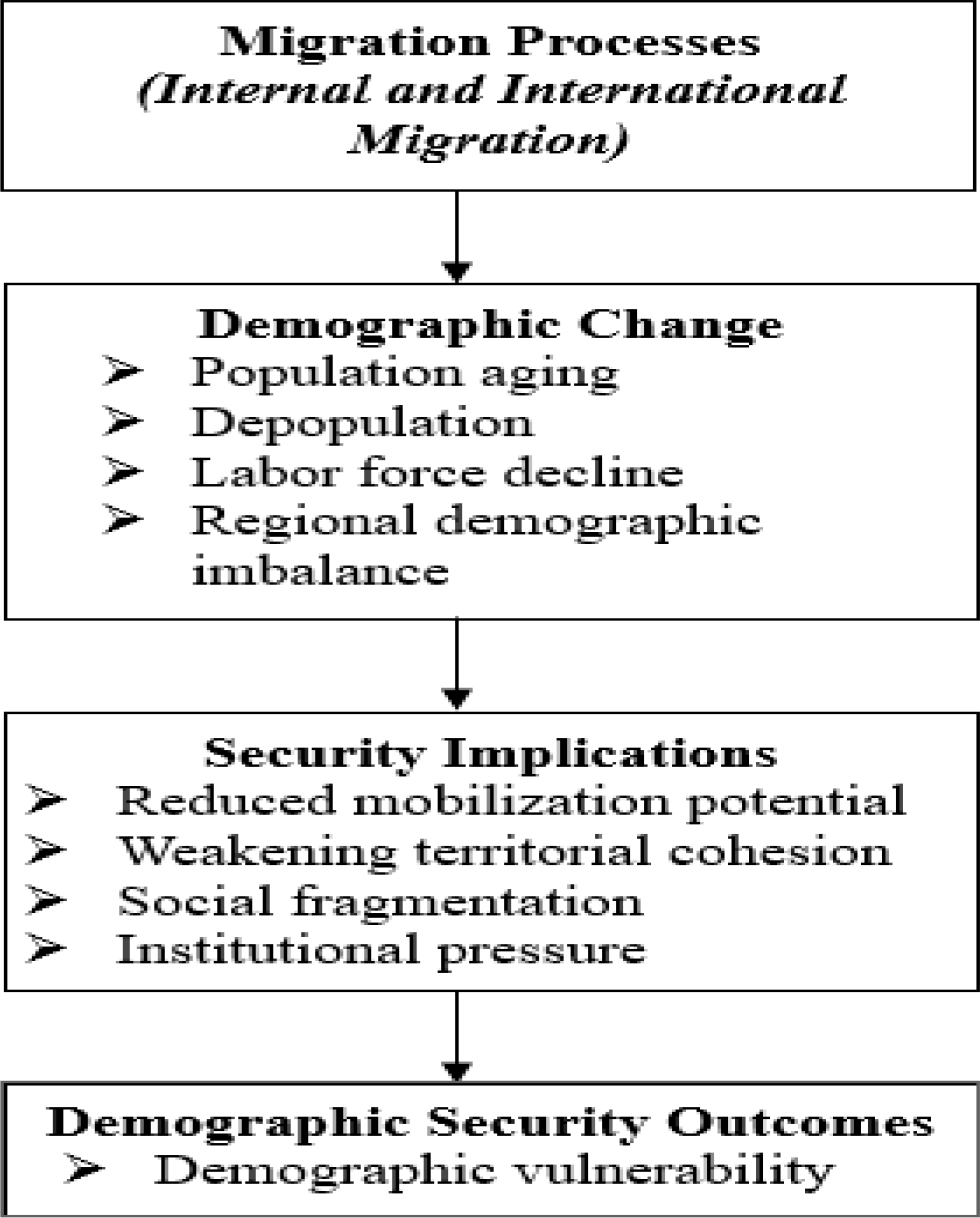
Figure no.1:
Migration-Demographic Security Nexus Framework
(Source: Developed by the author based on Buzan, Wæver & de Wilde, 1998)
4. Types of Migration and Their Significance for Security
4.1. Internal Migration
Internal migration in Bulgaria refers to the permanent relocation of population groups from rural, peripheral, and economically underdeveloped areas toward major urban centers. The primary drivers of this process include the pursuit of better economic opportunities, access to education, higher living standards, and improved social services. As a result, human and economic resources have become increasingly concentrated in large urban regions, while peripheral territories continue to experience demographic decline and economic marginalization.
Over the past three decades, internal migration has contributed significantly to depopulation in Northwestern Bulgaria, mountainous areas, and border municipalities, creating territorial imbalances and long-term demographic vulnerabilities. These processes affect infrastructure sustainability, access to public services, labor force availability, and the administrative capacity of local institutions. In strategically sensitive regions, prolonged depopulation may also reduce the effectiveness of territorial management and regional development policies.
The effects of internal migration are multidimensional. On the one hand, urbanization stimulates economic concentration, innovation, labor market expansion, and access to education and healthcare services. On the other hand, the depopulation of peripheral regions contributes to economic stagnation, social fragmentation, and increasing regional disparities (Dimitrova, 2020). Studies indicate that areas characterized by low population density are more difficult to manage effectively and often experience reduced institutional capacity and limited economic sustainability, particularly in border and mountainous regions.
Internal migration also has broader implications for demographic security and national resilience. The concentration of young and economically active populations in a limited number of urban centers intensifies regional demographic asymmetries and weakens the long-term sustainability of rural communities. This process contributes to labor shortages, declining local economic activity, and increased dependence on social support mechanisms in depopulated regions.
Policy measures aimed at mitigating the negative effects of internal migration include stimulating regional economic development, supporting small and medium-sized enterprises, investing in infrastructure and education, and implementing programs designed to retain young people in peripheral areas through social and economic incentives. Academic research emphasizes that only comprehensive and long-term regional policies can reduce the adverse demographic consequences of internal migration and strengthen territorial cohesion (Marinov & Stoykov, 2019).
4.2. International Migration
International migration includes emigration, immigration, return migration, and refugee flows. Since the political and economic transformations after 1989, emigration has remained the dominant migration process affecting Bulgaria. Large numbers of Bulgarian citizens, particularly young and highly qualified individuals, have migrated to other European countries in search of better economic opportunities, higher incomes, and improved living conditions.
Unlike internal migration, international migration has direct implications not only for demographic development, but also for labor force sustainability, economic competitiveness, and long-term national resilience. The outflow of economically active and educated individuals contributes to labor shortages, accelerated population aging, and reduced demographic reproduction capacity.
At the same time, immigration and return migration may partially compensate for these demographic deficits. The return of Bulgarian citizens with acquired professional experience and educational qualifications abroad creates opportunities for restoring human capital and supporting economic development. In addition, immigration may contribute to labor market stabilization in sectors experiencing workforce shortages, provided that effective integration policies are implemented.
International migration is also closely connected to regional security and political stability. Research shows that unmanaged migration flows may increase economic pressure, social tensions, and political polarization, especially in countries with limited institutional and integration capacity. In this context, migration management requires a balance between demographic needs, labor market demands, social cohesion, and security considerations.
Contemporary migration policies increasingly emphasize selective immigration of skilled professionals, integration programs, language and vocational training, and incentives for the return of qualified emigrants. Such measures aim to transform migration from a source of demographic vulnerability into a strategic resource for economic development and demographic sustainability.
Migration affects national security through several interconnected dimensions:
1. Mobilization potential – the reduction of the working-age population limits both economic productivity and military mobilization capacity.
2. Territorial stability and administrative capacity – depopulation in peripheral and border regions weakens the state’s ability to maintain effective territorial governance and public services.
3. Social cohesion – insufficient integration of immigrants and refugees may contribute to social tensions, cultural fragmentation, and societal polarization.
4. Economic resilience – migration alters the structure and availability of the labor force, while shortages of qualified professionals create risks for strategically important sectors of the economy.
Specialized literature emphasizes the importance of integrated migration management policies that combine economic incentives, social integration mechanisms, demographic planning, and regional development strategies in order to transform migration into a factor supporting national resilience and demographic security (Buzan & Wæver, 2009).
5. Migration and Demographic Risk
Migration represents one of the major factors influencing the demographic structure and long-term demographic sustainability of Bulgaria. Persistent emigration of young and economically active individuals contributes to accelerated population aging, declining birth rates, labor force shortages, and reduced demographic reproduction capacity. These processes affect not only demographic indicators, but also economic productivity, social stability, and national resilience (Dimitrova, 2020).
In the Bulgarian context, migration-related demographic risks are intensified by prolonged population decline, regional disparities, and uneven territorial development. As a result, migration should be viewed as a structural factor with direct implications for demographic security, social cohesion, and the long-term sustainability of public systems.
5.1. Demographic Effects of Internal Migration
Internal migration directed from peripheral and rural regions toward major urban centers creates significant territorial and demographic imbalances. Population density in Northwestern Bulgaria, mountainous areas, and border regions continues to decline, while limited access to healthcare, education, transportation infrastructure, and social services increases the risk of economic stagnation and social instability.
Urbanization is accompanied by a substantial reduction in the young and economically active population in rural areas, which negatively affects long-term demographic resilience and local economic sustainability. Depopulation of peripheral regions is associated with declining labor activity, lower economic productivity, reduced investment attractiveness, and increased dependence on social support mechanisms.
The concentration of population and economic activity in a limited number of urban centers also intensifies regional demographic asymmetries. Smaller municipalities and strategically sensitive border areas face difficulties in maintaining administrative capacity, public services, and sustainable economic development. In the long term, these processes may weaken territorial cohesion and increase regional vulnerabilities related to demographic decline.
5.2. Demographic Effects of International Migration
International migration exerts a substantial influence on Bulgaria’s demographic security and labor force sustainability. Emigration remains one of the principal demographic challenges facing the country, particularly due to the large-scale outflow of young and highly qualified individuals. According to official statistical data, more than 1.25 million Bulgarian citizens currently reside abroad, the majority of whom are of working age (NSI Bulgaria, 2024).
The demographic consequences of emigration include labor force reduction, accelerated population aging, declining fertility potential, and increased pressure on pension and social security systems. The departure of economically active individuals also contributes to shortages of qualified professionals in strategically important sectors such as healthcare, engineering, education, and information technology.
At the same time, return migration and immigration may partially offset these demographic losses by restoring human capital and supporting labor market stability. During the period 2023-2024, Bulgaria registered positive net migration trends in certain regions as a result of the return of young specialists and economically active individuals (Ministry of Interior Bulgaria, 2024).
The data presented in Table no. 1 demonstrate the dynamic relationship between emigration, immigration, and return migration in Bulgaria during the period 2019-2024. Although emigration remained a significant demographic trend throughout the analyzed period, its scale declined after 2020, while return migration and immigration gradually increased. These trends indicate partial demographic stabilization in certain regions, particularly after 2022, driven by the return of Bulgarian citizens and increased inflows of foreign nationals. Nevertheless, the continued outflow of economically active individuals remains a major demographic and economic challenge for Bulgaria.
Table no. 1
International Migration Trends in Bulgaria (2019-2024)
| Year | Emigration (international migration) | Return migration of Bulgarian citizens and immigration | Immigration |
|---|---|---|---|
| 2019 | 39,900 | 12,000 | 37,000 |
| 2020 | 15,000 | 18,000 | 45,000 |
| 2021 | 18,000 | 16,500 | 39,000 |
| 2022 | 24,000 | 17,000 | 43,000 |
| 2023 | 13,500 | 17,800 | 55,000 |
| 2024 | 13,002 | 18,214 | 52,189 |
1 (Source: NSI Bulgaria, 2024/2025; Ministry of Interior Bulgaria, 2024; OECD, 2024)
Refugee flows from conflict zones, including Syria and Ukraine, also possess demographic significance. In addition to increasing population numbers in the short term, refugee movements require comprehensive integration and social adaptation policies in order to prevent social tensions, cultural fragmentation, and long-term marginalization (UNHCR, 2023). International experience demonstrates that successful integration depends on coordinated policies related to education, vocational training, language preparation, and access to social services (Marinov & Stoykov, 2019).
The demographic impact of international migration should therefore be viewed as multidimensional, affecting population structure, labor force sustainability, economic resilience, and broader national security dynamics.
5.3. Long-Term Demographic Risks
Migration-driven demographic changes generate significant long-term risks for demographic security and national resilience. One of the most serious consequences is the continuous decline of the working-age population, which affects economic productivity, labor market sustainability, and the long-term viability of pension and social support systems.
Accelerated population aging further intensifies these challenges by increasing dependency ratios and reducing economic and mobilization capacity. At the same time, regional demographic imbalances weaken territorial cohesion and limit the ability of local institutions to maintain effective public services and administrative capacity in depopulated areas.
Migration may also contribute to social and cultural fragmentation, particularly in situations characterized by insufficient integration capacity, economic inequality, or limited institutional resources. Such processes may increase the risk of political polarization, social tensions, and societal instability.
In this context, migration should be understood as a dual-factor process. In the absence of effective governance and long-term demographic planning, migration deepens structural demographic vulnerabilities. However, when supported by coordinated migration management, integration strategies, and demographic policies, migration may also function as a resource for demographic sustainability and national resilience.
Academic literature increasingly emphasizes the importance of integrated policies combining demographic planning, economic incentives, labor market adaptation, regional development, and social integration in order to mitigate long-term demographic risks and strengthen national security.
6. Migration Management Policies
Migration management represents a strategic instrument for reducing demographic risks and strengthening demographic security and national resilience. In the Bulgarian context, effective migration policy requires an integrated and long-term approach combining regulation of emigration, support for return migration, selective attraction of skilled immigrants, and comprehensive integration of newcomers into the social and economic environment.
One of the principal objectives of migration management is limiting the negative demographic effects of emigration. Reducing outward migration depends largely on the creation of favorable conditions for professional realization, economic stability, and quality of life within the country. Improving wages, social protection mechanisms, healthcare accessibility, educational opportunities, and labor market conditions may reduce the emigration of young and highly qualified individuals.
At the regional level, investments in infrastructure, local economic development, and support for small and medium-sized enterprises are important instruments for retaining population in peripheral and economically vulnerable areas. Policies encouraging entrepreneurship and employment opportunities outside major urban centers may contribute to reducing regional demographic disparities and strengthening territorial cohesion.
The return of emigrants represents another important component of migration management policy. Financial incentives, professional reintegration programs, social guarantees, and career development opportunities increase the likelihood that Bulgarian citizens with education and professional experience acquired abroad will return to the country. In sectors experiencing labor shortages, including healthcare, information technology, engineering, and education, return migration may contribute to restoring human capital and improving economic sustainability.
The experience of European Union member states demonstrates that the effectiveness of return migration policies depends on long-term institutional coordination among national authorities, regional administrations, labor market institutions, and educational systems. Successful migration management therefore requires a coordinated policy framework rather than isolated administrative measures.
Selective immigration policies also represent an important mechanism for compensating for labor force shortages and supporting demographic sustainability. The attraction of qualified immigrants capable of adapting to the local labor market may strengthen economic resilience and reduce pressure on strategically important sectors. Effective integration policies, including language training, vocational education, social support, and labor market adaptation programs, increase the probability of successful long-term integration and retention of immigrants (Dimitrova, 2020).
International experience demonstrates the effectiveness of such approaches in countries such as Canada and Germany, where selective immigration policies contribute to economic growth, labor market stabilization, and demographic sustainability. These examples illustrate that migration can function as a strategic demographic resource when supported by effective institutional and integration mechanisms.
The integration of newcomers and refugees is equally important for maintaining social cohesion and societal security. Comprehensive integration policies focused on education, vocational training, language preparation, and access to social services reduce the risks of social fragmentation, marginalization, and cultural tensions. Studies show that only integrated strategies combining economic participation with social adaptation can transform migration from a potential security risk into a factor supporting national resilience and demographic sustainability.
In this context, migration management should not be viewed solely as an administrative or demographic issue, but rather as a long-term strategic component of national security and demographic resilience. Effective migration governance requires a systemic approach combining demographic planning, economic policy, regional development, labor market adaptation, and social integration mechanisms. The successful implementation of such policies depends on long-term planning, institutional coordination, and adaptation to the specific demographic and socio-economic conditions of Bulgaria.
7. International Experience
The analysis of international experience in migration management provides important insights into the relationship between migration, demographic sustainability, and national resilience. Different countries have developed migration policies aimed at transforming migration from a potential demographic and social challenge into a strategic resource supporting economic development, labor market stability, and societal cohesion.
Germany represents one of the most prominent examples of a state using selective immigration policies to address demographic decline and labor shortages. Due to population aging and increasing demand for qualified labor, Germany has implemented programs focused on attracting skilled migrants in sectors such as healthcare, engineering, manufacturing, and information technology. These policies are closely linked to professional qualification mechanisms, language training, and social integration programs designed to facilitate migrants’ adaptation to the labor market and broader social environment (Zimmermann, 2019; Brücker et al., 2002). As a result, migration policy has become an important component of Germany’s demographic and economic sustainability strategy.
Canada also demonstrates a long-term and highly selective migration management model. Canadian immigration policy emphasizes the admission of migrants based on professional qualifications, educational background, work experience, age, and integration potential. The country applies a points-based immigration system that seeks to align migration inflows with labor market and demographic needs. In addition, integration policies focused on education, employment, language preparation, and access to public services contribute to reducing social fragmentation and increasing migrants’ long-term participation in economic and social life.
Sweden provides another relevant example through its approach to refugee reception and social integration. Swedish migration policy combines humanitarian protection with active integration measures aimed at promoting social inclusion and economic participation. Programs supporting education, vocational training, employment access, and social adaptation contribute to reducing the risks of marginalization and social conflict while strengthening societal cohesion and resilience (Bevelander & Pendakur, 2014).
In the regional context of Eastern Europe and the Balkans, migration management is strongly influenced by persistent emigration, demographic decline, and labor force reduction. Countries in the region, including Bulgaria, Romania, and Serbia, face similar demographic challenges associated with outward migration of young and economically active populations. International experience demonstrates that successful migration policies in such contexts require integrated approaches combining demographic planning, labor market adaptation, regional development, and selective immigration mechanisms.
Comparative analysis indicates that effective migration management policies share several common characteristics. These include clearly defined demographic and economic objectives, long-term institutional coordination, integration programs for migrants and refugees, labor market adaptation strategies, and continuous monitoring of migration flows with the capacity for flexible policy adjustment when necessary.
For Bulgaria, international experience provides valuable lessons regarding the importance of balancing migration control with demographic and economic sustainability objectives. Policies focused on retaining young people, encouraging return migration, attracting qualified immigrants, and strengthening integration mechanisms may contribute to reducing demographic vulnerabilities and improving long-term national resilience.
The comparative perspective demonstrates that migration can function either as a source of demographic instability or as a strategic resource, depending on the effectiveness of governance, institutional coordination, and integration capacity. Consequently, the development of flexible and adaptive migration strategies remains essential for strengthening demographic security and ensuring sustainable socio-economic development under conditions of ongoing demographic.
8. Discussion: Migration, Demographic Security, and Regional Challenges
Within the broader framework of contemporary security studies, the findings of the present study should be interpreted not merely as evidence of demographic change, but as indicators of deeper structural transformations affecting the security environment of Southeastern Europe. Bulgaria represents a characteristic example of a state located on the demographic periphery of the European Union, where migration functions simultaneously as both a consequence and an accelerator of demographic, economic, and regional vulnerabilities.
From the perspective of the extended concept of security developed within the Copenhagen School, migration should be understood as a process with long-term implications for societal security, state capacity, and national resilience. Unlike traditional military threats, demographic insecurity develops gradually through sustained population decline, labor force reduction, regional depopulation, and weakening social cohesion. Although these processes evolve slowly, their cumulative effects may significantly affect economic sustainability, mobilization potential, territorial balance, and institutional stability.
The regional context of the Balkans further intensifies these demographic and security-related challenges. Similar migration patterns characterized by sustained emigration, population aging, and labor force decline can be observed in Romania, Serbia, North Macedonia, and other countries in Southeastern Europe. As a result, the region increasingly faces a broader zone of demographic instability on the periphery of the European Union. These developments raise important questions regarding the long-term ability of states in the region to maintain demographic sustainability, social cohesion, and economic resilience without coordinated national and supranational policy responses.
The findings of the study indicate that the emigration of young and highly qualified individuals cannot be addressed solely through short-term economic incentives or isolated labor market measures. Instead, migration should be incorporated into long-term strategic planning related to demographic policy, regional development, labor market adaptation, and national security. In this context, migration should not be viewed as an isolated socio-economic phenomenon, but rather as a structural factor directly affecting demographic security and state resilience.
The analysis also demonstrates that migration possesses a dual character. In the absence of effective governance and integration policies, migration may intensify demographic decline, regional disparities, labor shortages, and social fragmentation. At the same time, when supported by coordinated migration management strategies, selective immigration policies, return migration programs, and effective integration mechanisms, migration may contribute to demographic stabilization, labor force sustainability, and economic development.
Reducing migration-related demographic risks requires the implementation of integrated and long-term migration management policies focused on demographic sustainability, regional development, and social cohesion. One of the principal priorities involves encouraging the return of qualified emigrants through financial incentives, professional reintegration programs, and improved career opportunities in strategically important sectors of the economy.
At the same time, reducing regional demographic disparities requires investments in infrastructure, education, healthcare, transportation connectivity, and local economic development in peripheral and depopulated regions. Policies aimed at retaining young people through social and economic incentives may contribute to strengthening regional resilience and territorial cohesion.
Selective immigration policies may also help compensate for labor shortages in sectors such as healthcare, engineering, information technology, and industry. However, the effectiveness of immigration policies depends largely on successful integration mechanisms, including language training, vocational education, access to social services, and labor market adaptation programs.
In this context, migration management should be viewed not solely as a demographic or economic issue, but as an essential component of long-term national security and demographic resilience. Effective migration governance requires coordinated policies combining demographic planning, labor market adaptation, regional development, economic sustainability, and social integration.
The present study contributes to the academic literature by demonstrating how demographic security may function as an analytical framework for examining migration processes in states experiencing prolonged demographic decline. In this regard, the study expands the applicability of the Copenhagen School beyond traditional security concerns by emphasizing the long-term structural implications of demographic and migration-related transformations for national and regional security.
9. Conclusions
Migration represents a strategic factor affecting Bulgaria’s demographic security, economic sustainability, and national resilience under conditions of prolonged demographic decline and regional instability. The analysis demonstrates that migration processes significantly influence population structure, labor force sustainability, territorial cohesion, and social stability.
The findings indicate that, in the absence of integrated migration and demographic policies, migration contributes to labor force decline, population aging, regional depopulation, and weakening social cohesion. At the same time, effective migration management, selective immigration, return migration policies, and successful social integration may transform migration into a strategic resource supporting demographic resilience and sustainable national development.
The comparative analysis of international experience confirms that successful migration management requires coordinated policies combining demographic planning, labor market adaptation, regional development, and social integration. In this context, migration should be viewed not only as a demographic or socio-economic issue, but also as an important component of national and regional security.
The study is limited by its qualitative nature and focus on Bulgaria as a single national case. Future research may expand the analysis through comparative regional studies or quantitative assessments of the relationship between migration and security.
In conclusion, the integration of migration into demographic and national security planning is essential for strengthening the long-term resilience of Bulgaria and the Balkan region. Viewing migration through the perspective of demographic security provides a broader understanding of the long-term risks and strategic opportunities facing states located on the demographic periphery of the European Union.