
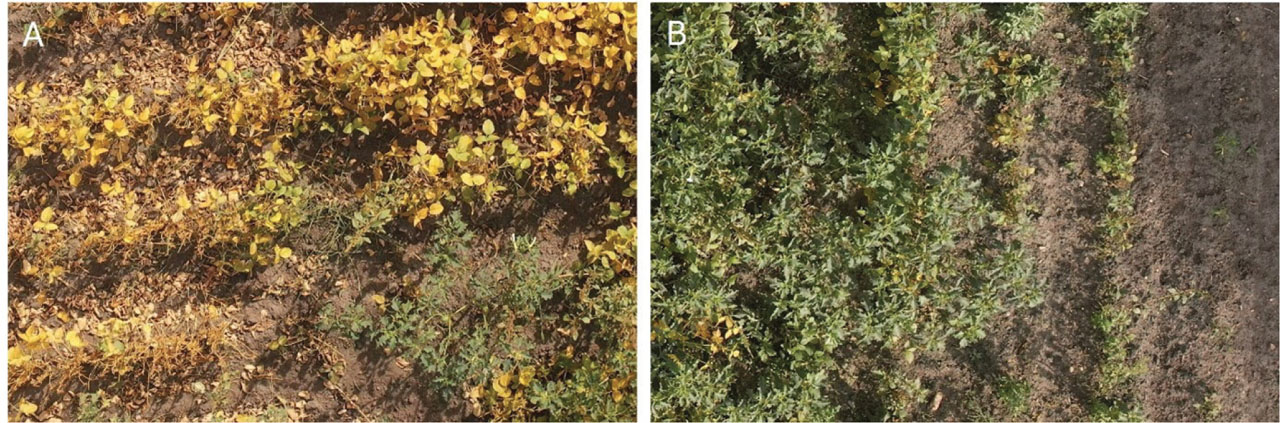
Figure 1.
Images of an infestation of soybeans (bird's-eye view): Datura stramonium (A) in the field core and (B) at the field edge (© M. Treiblmeier).
Abbildung 1. Bilder eines Befalls von Sojabohne aus der Vogelperspektive: Datura stramonium (A) im Feldinneren und (B) am Feldrand (© M. Treiblmeier).
Table 1.
Metrics for determining the model accuracy.
Table 1. Metriken zur Bestimmung der Modellgenauigkeit.
| Accuracy | Precision | Recall | F1 score | Intersection over union |
|---|---|---|---|---|
| 0.999 | 0.868 | 0.926 | 0.896 | 0.813 |
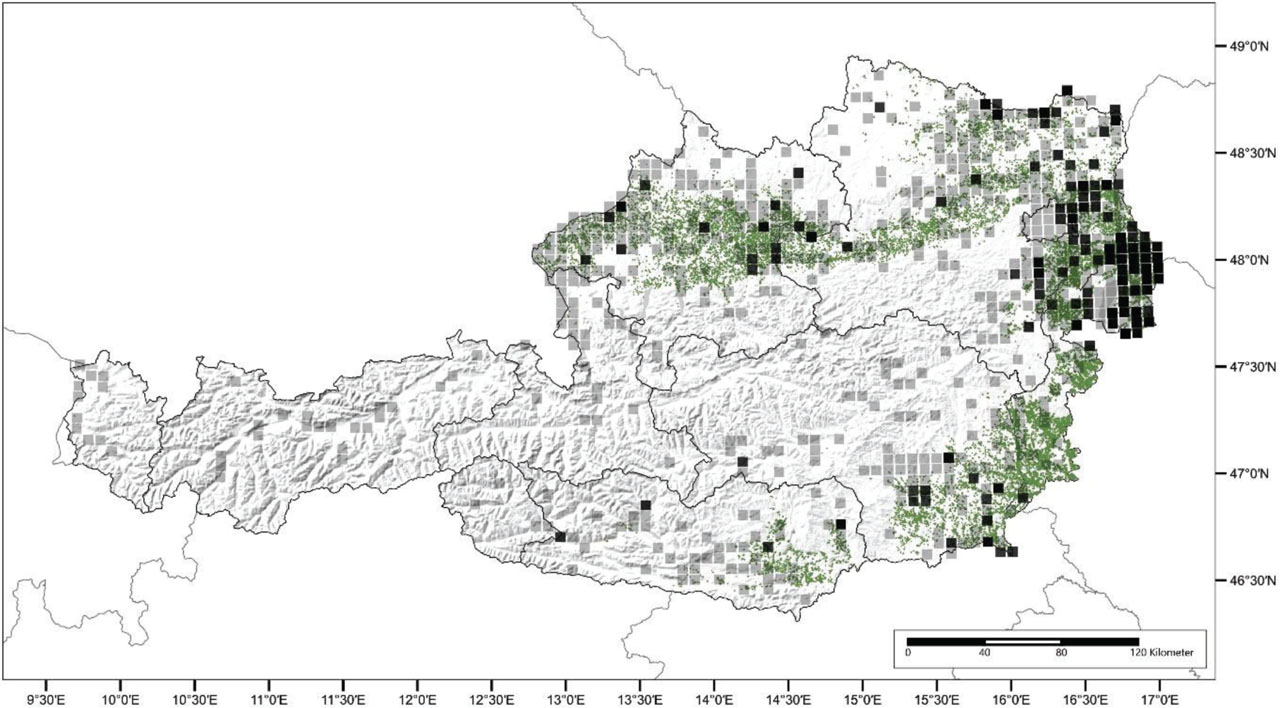
Figure 2.
Distribution map of Datura stramonium in fields (black squares) (1965 to 2024) in Austria based on the grid cells of the Floristic Mapping of Central Europe (cell size: 5 × 3 geographic minutes, ~33 km2). The light gray grid cells show the overall distribution (GBIF.org., 2026). The cultivation areas of soybean in 2024 are shown in green (Open Government Data, 2025).
Abbildung 2. Verbreitungskarte von Datura stramonium auf landwirtschahlichen Flächen (schwarze Quadrate) in Österreich (1965 bis 2024) basierend auf den Rasterzellen der Floristischen Kartierung Mitteleuropas (Zellengröße: 5 × 3 geographische Minuten, ~33 km2). Die hellgrauen Rasterzellen zeigen die Gesamtverbreitung (GBIF.org., 2026). Die Anbauflächen der Sojabohne im Jahr 2024 sind grün dargestellt (Open Government Data, 2025).
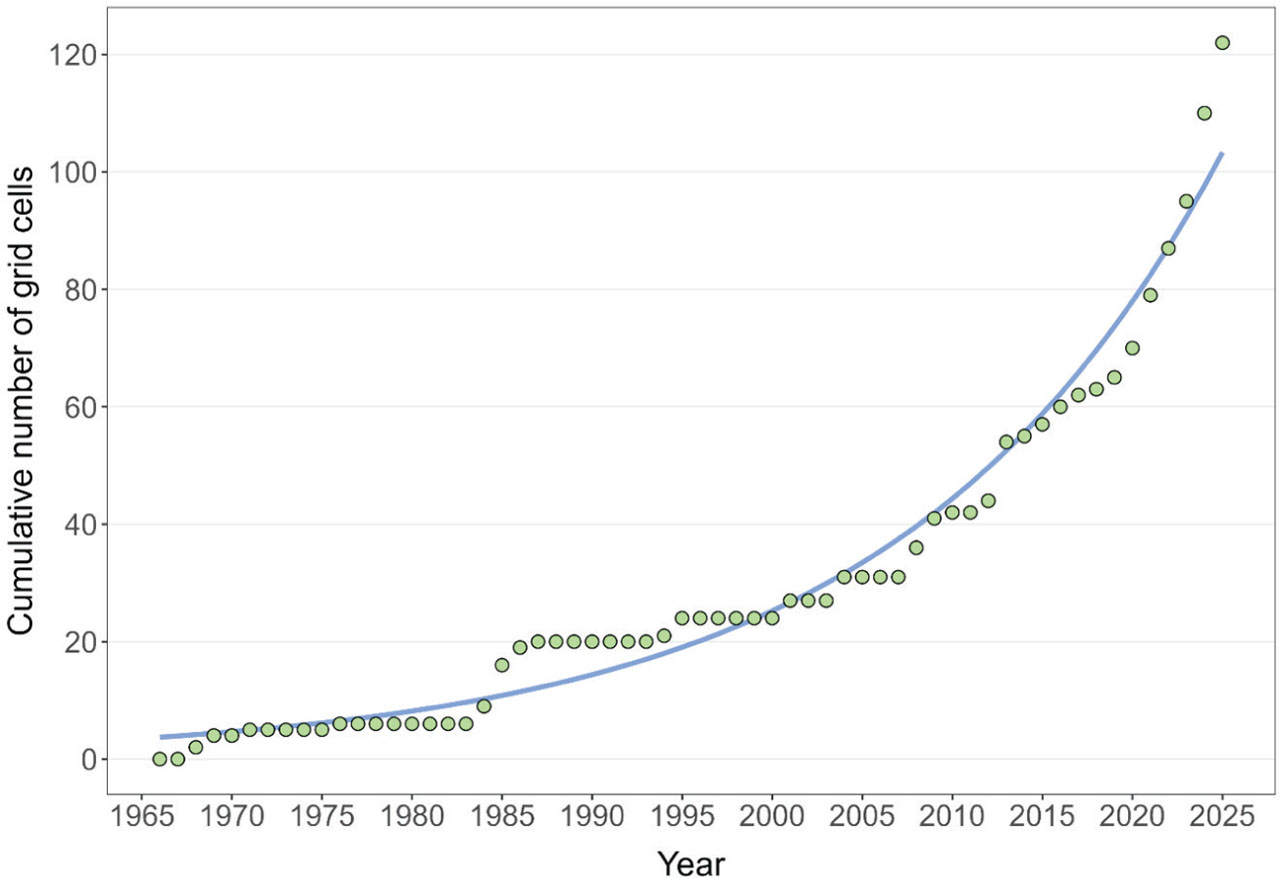
Figure 3.
Observed cumulative number of grid cells (5 × 3 geographic minutes, ~33 km2) occupied by Datura stramonium in fields in Austria (data points), and the expected cumulative number of grid cells occupied by year derived from the Poisson model (line). The increase in the cumulative number of grid cells occupied per year was significant (<0.001).
Abbildung 3. Beobachtete kumulative Anzahl von Rasterzellen (5 × 3 geografische Minuten, ~33 km2), die von Datura stramonium auf landwirtschah-lichen Flächen in Österreich besetzt sind (Datenpunkte) und die erwartete kumulative Anzahl der besetzten Rasterzellen pro Jahr, abgeleitet aus dem Poisson-Modell (Linie). Die Zunahme der kumulativen Anzahl der besetzten Rasterzellen pro Jahr war signifikant (<0,001).
Table 2.
Summarized data from the descriptive analysis of the infestation of soybean fields (n = 159) with Datura stramonium: detections per ha (n), detection area per field (m2), and percentage of the total field area infested based on the detection area.
Tabelle 2. Daten der deskriptiven Analyse des Befalls von Sojabohnenfeldern (n = 159) mit Datura stramonium: Detektionen pro ha (n), Detektionsfläche pro Feld (m2) und prozentualer Anteil der Detektionsfläche an der Feldfläche.
| Parameter | Mean | SD | Median | Min | Max | IQR | Q0.25 | Q0.75 |
|---|---|---|---|---|---|---|---|---|
| Detections per ha | 316.2 | 957.1 | 40.3 | 0.3 | 9398.2 | 213.4 | 10.9 | 224.2 |
| Detection area per field (m2) | 45.4 | 215.9 | 6.0 | <0.01 | 2587.6 | 23.1 | 1.0 | 24.1 |
| Percentage of total area infested | 0.3 | 1.5 | 0.02 | <0.01 | 16.8 | 0.08 | 0.01 | 0.09 |
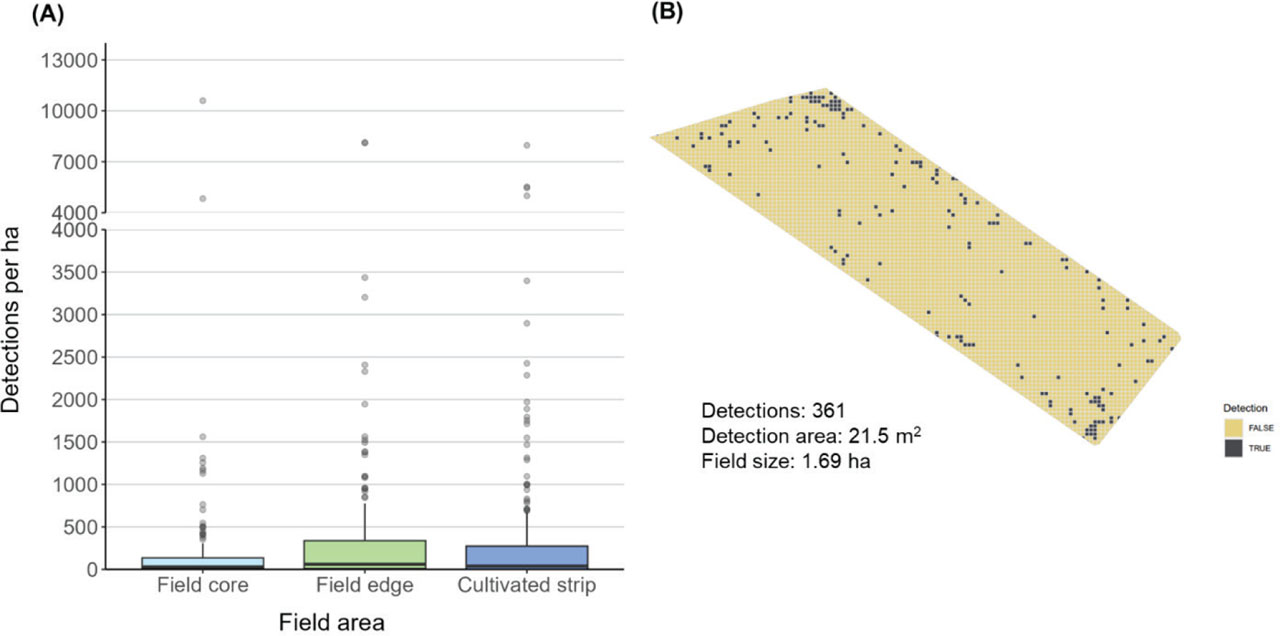
Figure 4.
Influence of the field area on the infestation of soybeans with Datura stramonium (A) and an example of the spatial distribution of D. stramonium in a soybean field (B) (parameter: detections per ha). Note that there is a break on the y-axis.
Abbildung 4. Einfluss des Feldbereichs auf den Befall von Sojabohne mit Datura stramonium (A) und ein Beispiel für die räumliche Verbreitung von D. stramonium in einem Sojabohnenfeld (B) (Parameter: Detektionen pro ha). Auf der y-Achse tritt ein Skalenbruch auf.
Table 3.
Estimated model parameters of the Generalized Linear Mixed Model. The dependent variable is detection per ha. Those categories with a parameter estimator of 0 are the reference category for the respective independent variable.
Table 3. Geschätzte Modellparameter des Generalisierten Linearen Gemischten Modells. Die abhängige Variable sind die Detektionen pro ha. Jene Kategorien mit Parameterschätzer 0 sind die Referenzkategorie der jeweiligen unabhängigen Variable.
| Parameters | Estimate | 95% confidence interval | p-value |
|---|---|---|---|
| (Intercept) | 3.669 | [2.694; 4.643] | < 0.001 |
| Field position | |||
| - Cultivated strip | 0.560 | [0.319; 0.801] | <0.001 |
| - Field edge | 0.606 | [0.387; 0.824] | <0.001 |
| - Field core | 0 | ||
| Crop sequence diversity | |||
| - High | −1.020 | [−1.808; −0.232] | 0.011 |
| - Medium | −0.235 | [−0.967; 0.498] | 0.530 |
| - Low | 0 | ||
| Preceding crops | |||
| - Soybean | 1.041 | [0.308; 1.775] | 0.005 |
| - Maize | 1.137 | [0.217; 2.056] | 0.015 |
| - Others | 0.274 | [−1.116; 1.664] | 0.700 |
| - Winter cereals | 0 | ||
| Spring crops | |||
| - High | −0.403 | [−1.119; 0.314] | 0.271 |
| - Low | 0 |
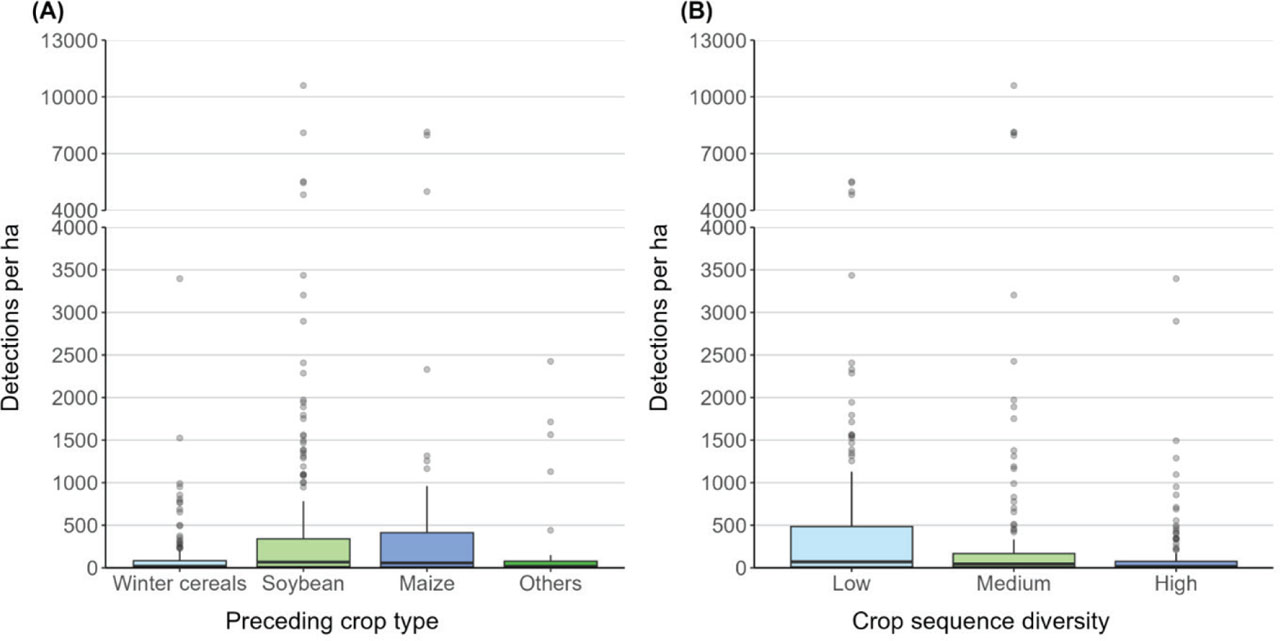
Figure 5.
Influence of the previous crop type (A) and crop sequence diversity (B) on the infestation of soybeans with Datura stramonium (parameter: detections per ha). Note that there is a break on the y-axis.
Abbildung 5. Einfluss der Vorfrucht (A) und der Kulturpflanzenvielfalt (B) auf den Befall von Sojabohne mit Datura stramonium (Parameter: Detektionen pro ha). Auf der y-Achse tritt ein Skalenbruch auf.