
1. Introduction
Soybean (Glycine max (L.) Merr.) has become an important crop in Austria, and the production of high-quality soybean is essential for processing. In 2024, soybeans were cultivated on 87,607 ha, while the share of organic soybeans is comparatively high at 39% (34,146 ha) (Agrarmarkt Austria, 2025). Weeds are a regular threat to its production, as soybeans are considered a weak competitor due to the slow juvenile development (Datta et al., 2017; Richard et al., 2023).
Datura stramonium L. (Solanaceae) is an annual weed species that has become increasingly common in summer crops, including soybean, in Central and Eastern Europe in recent decades (Pinke et al., 2016; Follak et al., 2017). Its height plasticity and canopy architecture, with leaves concentrated in the upper part of the plant, give it a high competitive ability (Stoller and Woolley, 1985). On average, plants yield 1,300–1,500 seeds; however, vigorous isolated individuals can produce thousands of long-lived seeds (Weaver and Warwick, 1984; Söchting and Clauß, 2022). Most importantly, D. stramonium is a source of toxic tropane alkaloids (Doncheva et al., 2006). Atropine and scopolamine are the most abundant alkaloids found in the aerial parts of the plant, while their content varies greatly depending on the plant part and growth stage (Blank-Landeshammer et al., 2025).
The plant regularly causes late-season infestations that result in yield losses and contribute to seed bank persistence (Koger et al., 2003; Bagavathiannan and Norsworthy, 2012; Figure 1). In addition, these late-season escapes are responsible for cross-contamination of crops during harvest. The origin of such contamination is generally twofold: (1) seeds entering the harvested crop (seed contamination) and (2) sap entering the harvested crop (sap contamination). While the seeds of D. stramonium can in principle be removed from the harvest by sieving (Abia et al., 2021), the problem of sap contamination remains. The process of plant sap contamination has already been demonstrated and proven in a few studies (Söchting and Zwerger, 2020; Blank-Landeshammer et al., 2025), and at the same time, reports of tropane alkaloids contamination of soybean and other crops have already been documented in Austria (and elsewhere) and are considered to increase (de Nijs et al., 2023; RASFF, 2025). To deal with this threat, maximum levels for unprocessed sorghum, millet, maize, buckwheat as well as for herbal infusions were imposed by the European Commission (Commission Regulation (EU) 2023/915). However, there are currently no maximum levels for soybeans.
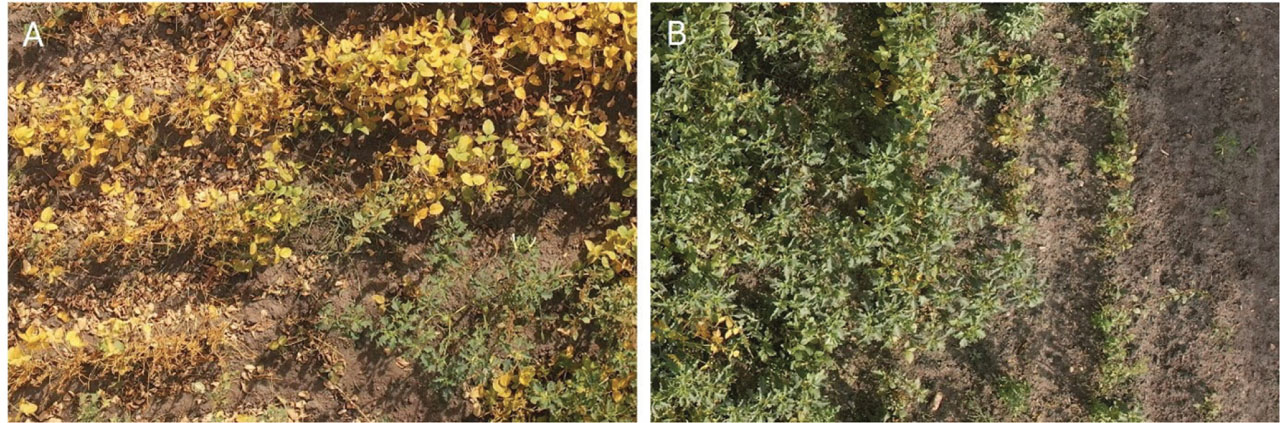
Figure 1.
Images of an infestation of soybeans (bird's-eye view): Datura stramonium (A) in the field core and (B) at the field edge (© M. Treiblmeier).
Abbildung 1. Bilder eines Befalls von Sojabohne aus der Vogelperspektive: Datura stramonium (A) im Feldinneren und (B) am Feldrand (© M. Treiblmeier).
It is therefore particularly important to raise awareness among farmers and stakeholders by describing the spread dynamics and identifying the hotspots and risk areas of D. stramonium in Austria, as well as providing information on the extent and determining factors of late-season soybean infestation and control measures. In this respect, chemical and mechanical methods are not always successful, which makes cultural methods increasingly relevant for controlling D. stramonium, particularly in organic farming. Thus, the study aimed to (1) provide an update on the current distribution and spread dynamics of D. stramonium in Austria, based on an exhaustive distribution dataset, (2) analyze the extent of late-season infestation and distribution patterns of D. stramonium in soybeans in a selected area in eastern Austria using drone images and an automated image recognition method, and (3) provide recommendations for controlling D. stramonium.
2. Material and Methods
2.1. Current distribution and spread dynamics
The distribution data from Follak et al. (2017) form the basis for the analysis of the spatial-temporal distribution of D. stramonium on agricultural land in Austria. This dataset was up-dated as part of this study, that is, data from 2017 to 2024 were included using various sources (unpublished records, floristic literature and databases, such as JACQ consortium, 2004+; Glaser et al., 2022; iNaturalist, 2025 and ZOBODAT, 2025). All records collected only refer to D. stramonium in fields (i.e., present along the edge and/or in the core of an arable field). The analysis of the dataset is presented in abbreviated form (Follak et al., 2017): The records were assigned to a grid cell (5 × 3 geographic minutes, ~33 km2) of the Floristic Mapping Project of Central Europe. A map indicating the spatial distribution of D. stramonium on agricultural land was produced based on the grid cells occupied. The INVEKOS dataset (Open Government Data, 2025) was used in order evaluate the soybean cultivation area at risk of being invaded based on the grid cells occupied. In addition, distribution data (> 1965) from the GBIF database (GBIF.org., 2026) were used to illustrate the overall distribution of D. stramonium in Austria. An invasion curve was constructed by calculating the cumulative number of grid cells occupied plotted against time. A Poisson regression model was used to model the cumulative number of grid cells occupied.
2.2. Infestation, distribution patterns, and management factors
The soybean fields were located in northern Burgenland and parts of Lower Austria (districts of Bruck an der Leitha, Neusiedl am See). It is a highly agriculturally used area with intensive soybean cultivation, where D. stramonium has long been established as a weed (Follak et al., 2017). A drone with a RGB camera (BLICKWINKEL – Digital Service, Kirchdorf am Inn, Austria) was used for late-season aerial mapping of D. stramonium. It was conducted in the study area from 14th September to 2nd October 2023, when the soybean's foliage had begun to dry out. The soybean fields (n = 159; average field size: 3.1 ± 3.3 ha) were organically farmed and selected for organizational reasons (i.e., flight permits from field owners and field accessibility) and on the basis of on-site field inspections assessing the suspected infestation with D. stramonium.
The images obtained (Figure 1) went through a two-step image processing pipeline, which is briefly described here. More details on the methodology can be found in Riegler-Nurscher et al. (2023) and Biçici and Riegler-Nurscher (2024). In the first step, the images were analyzed by a deep learning-based semantic segmentation algorithm, which detects the regions in the images that belong to areas infested with D. stramonium. The PointRend (Point-based Rendering) algorithm was used (Kirillov et al., 2020). It focuses on ambiguous or detailed regions (like object boundaries) by sampling specific points for refinement. It combines coarse mask predictions with high-resolution image features to produce fine-grained results efficiently. This two-stage approach – generating a coarse mask first and refining it point-by-point – ensures both computational efficiency and high accuracy. The second step included the application of a terrain-aware monoplotting step. This step is required to map the aerial images processed by the segmentation algorithm to be mapped on the geographically correct locations. The monoplotting technique from Biçici and Riegler-Nurscher (2024) is used for georeferencing, which facilitates monoplotting without Ground Control Points (GCPs). The algorithm employs ray tracing to deter-mine where rays from the camera intersect with the terrain by passing through image pixels. To reduce geometric error, a least-squares method is used to fit a plane parallel to the xz-plane, enabling a straightforward affine transformation between the image and the geographical coordinates.
The detection sensitivity was assessed based on human inspection of the images and the algorithm classification. The most common metrics for semantic segmentation were used to evaluate the model performance (Fernandez-Moral et al., 2017). The metrics were based on the results on test images (n = 30) from different fields, that is, on data that the model had not “seen” before during training. Table 1 summarizes the metrics for the evaluation of the test dataset.
Table 1.
Metrics for determining the model accuracy.
Table 1. Metriken zur Bestimmung der Modellgenauigkeit.
| Accuracy | Precision | Recall | F1 score | Intersection over union |
|---|---|---|---|---|
| 0.999 | 0.868 | 0.926 | 0.896 | 0.813 |
To describe the extent of infestation of soybeans by D. stramonium, three parameters were recorded, namely, detections per ha, detection area (m2) per field, and percentage of total area infested (based on the detection area and individual field size). To determine the distribution pattern of D. stramonium (i.e., the area in the fields that are most infested), a grid of 2 × 2 meters was placed over the soybean fields and divided them into three areas (sensu Andrade et al., 2021): cultivated strip (0–1 m), field edge/headland (>1–6 m), and field core (>6 m). The cultivated strip is the area immediately before the last soybean row, which consists mainly of bare soil and is usually colonized by weed species. The field edge/headland refers to the outermost few meters, where chemical and mechanical disturbances are less intense. Studies have shown that cultural methods (e.g., crop rotation, share of spring crops) are an important factor in determining the occurrence and abundance of summer annual weeds including D. stramonium (Teasdale et al., 2019; Pinke et al., 2024). Therefore, a Generalized Linear Mixed Model (GLMM) was applied with negative binomial distribution and log linkage to analyze how field area, preceding crops (in 2022; grain maize, soybean, winter cereals, others), and the crop sequence diversity (number of crop types during the reporting period from 2018 to 2023, low n = ≤ 3, medium = 4, high = ≥ 5; number of spring crops: low ≤3, high ≥4) affected the infestation of D. stramonium in soybean fields (parameter used: detections per ha). Data on cultivated crops were taken from the INVEKOS dataset (Open Government Data, 2025). Due to incomplete data, only 158 fields were included in the model. All analyses were conducted in R version 4.5.0 (R Core Team, 2025) using package lme4 (Bates et al., 2015) for modeling. The R packages ggplot2 (Wickham, 2016) and ggbreak (Xu et al., 2021) were used for the graphical representation, and emmeans (Lenth, 2025) was used for calculating estimated marginal means. The model has been checked regarding multicollinearity, overdispersion, and zero-inflation with R package performance (Lüdecke et al., 2021).
3. Results
3.1. Current distribution and spread dynamics
In total, 400 records of D. stramonium in fields from 1965 to 2024 within 122 grid cells have been compiled. This corresponds to 4.6% of all grid cells (n = 2625) in Austria. The main area of distribution of D. stramonium in agriculture are currently in the warm lowlands of northern Burgenland and eastern Lower Austria. The cultivation areas in the districts of Gänserndorf, Bruck an der Leitha, and Neusiedl am See are particularly affected by D. stramonium (Figure 2). It can be locally found in north-western and southern Austria, while western Austria is free from populations in fields based on the dataset. The map probably only shows part of the current distribution in fields; a wider distribution can be assumed. Figure 2 shows that D. stramonium is generally widespread in Austria if all records are considered (n = 632 grid cells; corresponds to 24.9%), that is, also its presence in habitats other than fields (ruderal sites, semi-natural areas). As shown in Figure 3, the cumulative number of occupied grid cells by D. stramonium in fields increased continuously, rising by 5.6% each year (p < 0.001). This suggests that the species has spread on agricultural land in Austria. Comparing the area under soybean cultivation with the occurrence of D. stramonium based on the occupied grid cells indicates that the center of soybean cultivation in eastern Austria and along the Danube (i.e., in the Federal Provinces of Lower Austria, Burgenland, and Upper Austria) is particularly at risk of being infested. Of the total 87,109 ha of soybeans in 2024, 19,388 ha are in the occupied grid cells, that is, 22% (Figure 2).
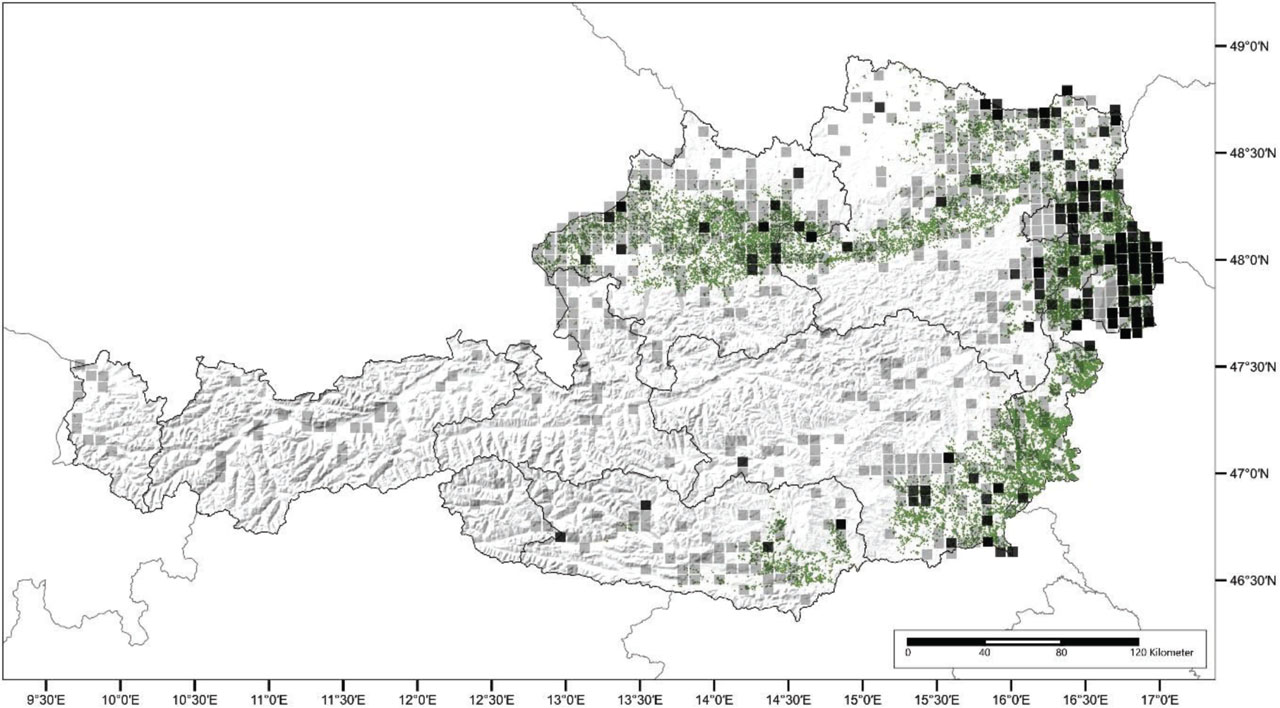
Figure 2.
Distribution map of Datura stramonium in fields (black squares) (1965 to 2024) in Austria based on the grid cells of the Floristic Mapping of Central Europe (cell size: 5 × 3 geographic minutes, ~33 km2). The light gray grid cells show the overall distribution (GBIF.org., 2026). The cultivation areas of soybean in 2024 are shown in green (Open Government Data, 2025).
Abbildung 2. Verbreitungskarte von Datura stramonium auf landwirtschahlichen Flächen (schwarze Quadrate) in Österreich (1965 bis 2024) basierend auf den Rasterzellen der Floristischen Kartierung Mitteleuropas (Zellengröße: 5 × 3 geographische Minuten, ~33 km2). Die hellgrauen Rasterzellen zeigen die Gesamtverbreitung (GBIF.org., 2026). Die Anbauflächen der Sojabohne im Jahr 2024 sind grün dargestellt (Open Government Data, 2025).
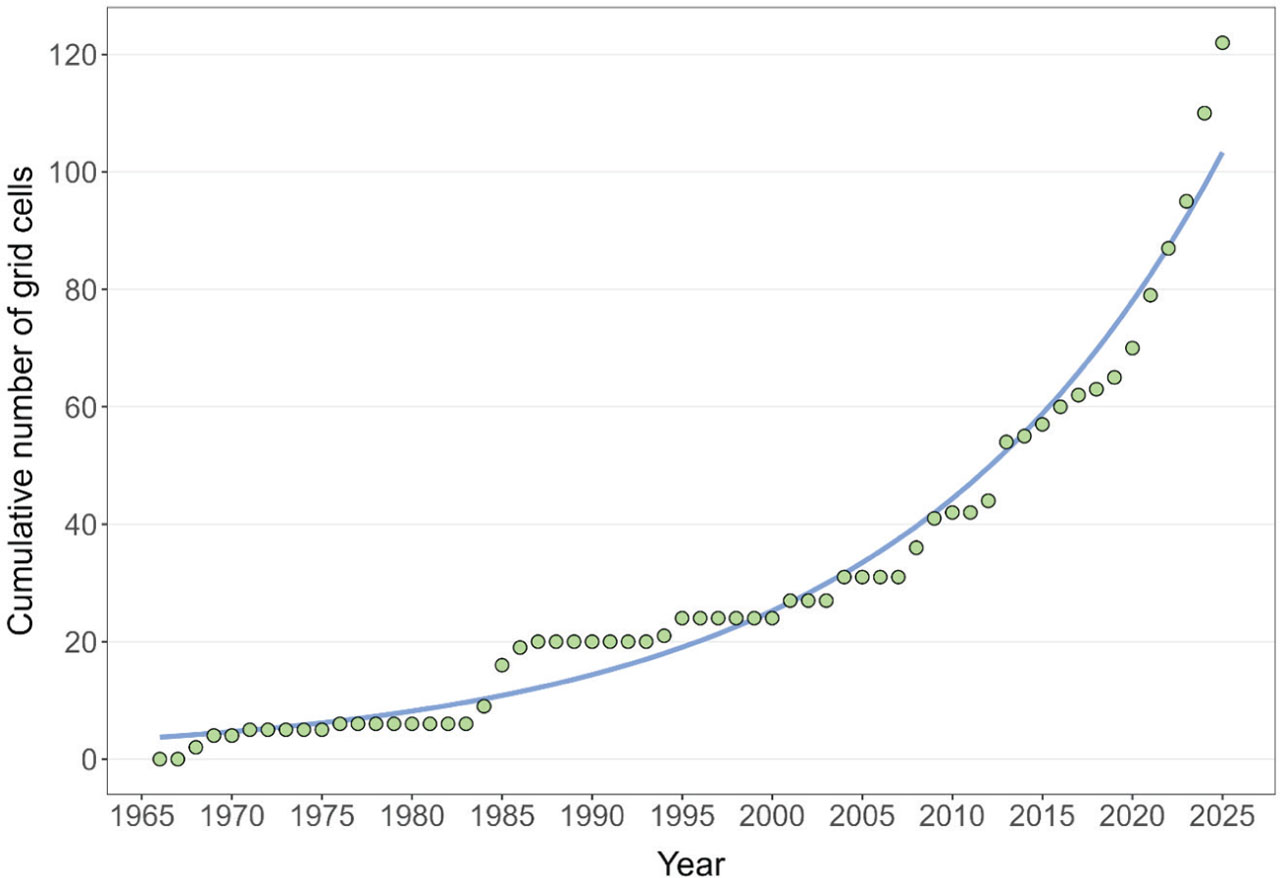
Figure 3.
Observed cumulative number of grid cells (5 × 3 geographic minutes, ~33 km2) occupied by Datura stramonium in fields in Austria (data points), and the expected cumulative number of grid cells occupied by year derived from the Poisson model (line). The increase in the cumulative number of grid cells occupied per year was significant (<0.001).
Abbildung 3. Beobachtete kumulative Anzahl von Rasterzellen (5 × 3 geografische Minuten, ~33 km2), die von Datura stramonium auf landwirtschah-lichen Flächen in Österreich besetzt sind (Datenpunkte) und die erwartete kumulative Anzahl der besetzten Rasterzellen pro Jahr, abgeleitet aus dem Poisson-Modell (Linie). Die Zunahme der kumulativen Anzahl der besetzten Rasterzellen pro Jahr war signifikant (<0,001).
3.2. Infestation, distribution patterns, and management factors
The soybean fields show a wide range of infestation considering the three parameters (Table 2). On average, there were 316.2 detections per ha (median: 40.3). The values for the detection area and the percentage of the total area infested showed broadly similar results (Table 2). On average, 0.3% (± 1.5%) of the field area was covered by D. stramonium, with half of the fields examined showing a value between 0.01% and 0.09%. Few fields (n = 7) were more severely infested (> 1%). The most heavily infested soybean field had an area of 16.8% covered by D. stramonium (detection area: 2500 m2).
Table 2.
Summarized data from the descriptive analysis of the infestation of soybean fields (n = 159) with Datura stramonium: detections per ha (n), detection area per field (m2), and percentage of the total field area infested based on the detection area.
Tabelle 2. Daten der deskriptiven Analyse des Befalls von Sojabohnenfeldern (n = 159) mit Datura stramonium: Detektionen pro ha (n), Detektionsfläche pro Feld (m2) und prozentualer Anteil der Detektionsfläche an der Feldfläche.
| Parameter | Mean | SD | Median | Min | Max | IQR | Q0.25 | Q0.75 |
|---|---|---|---|---|---|---|---|---|
| Detections per ha | 316.2 | 957.1 | 40.3 | 0.3 | 9398.2 | 213.4 | 10.9 | 224.2 |
| Detection area per field (m2) | 45.4 | 215.9 | 6.0 | <0.01 | 2587.6 | 23.1 | 1.0 | 24.1 |
| Percentage of total area infested | 0.3 | 1.5 | 0.02 | <0.01 | 16.8 | 0.08 | 0.01 | 0.09 |
In the soybean fields, the infestation with D. stramonium decreased with greater distance from the field border. The field edge and the cultivated strip had statistically significantly more detections per ha than the field core (Table 3, Figures 1 and 4A). The estimated detections for 1 ha field of soybeans are 39.0 ± 9.4 (estimated mean ± standard error) for the field core, 71.4 ± 17.2 for the field edge, and 68.2 ± 16.7 for the cultivated strip, respectively. The species typically forms larger clusters in the corners of the soybean field and along the field border (Figure 4B).
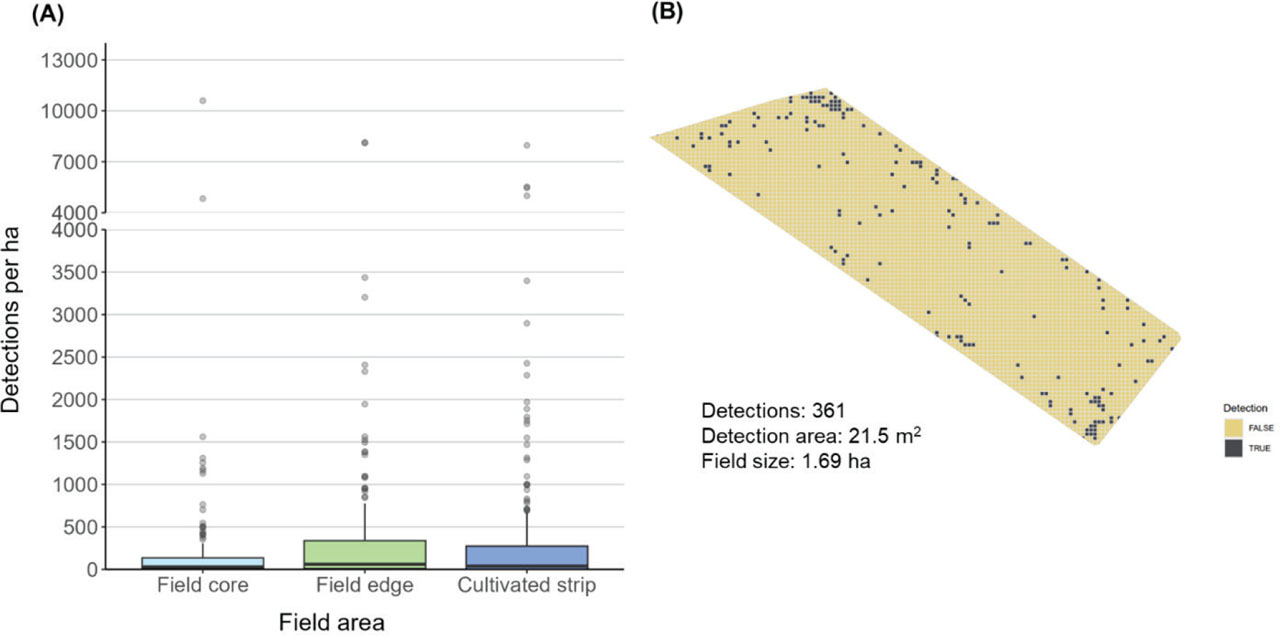
Figure 4.
Influence of the field area on the infestation of soybeans with Datura stramonium (A) and an example of the spatial distribution of D. stramonium in a soybean field (B) (parameter: detections per ha). Note that there is a break on the y-axis.
Abbildung 4. Einfluss des Feldbereichs auf den Befall von Sojabohne mit Datura stramonium (A) und ein Beispiel für die räumliche Verbreitung von D. stramonium in einem Sojabohnenfeld (B) (Parameter: Detektionen pro ha). Auf der y-Achse tritt ein Skalenbruch auf.
Table 3.
Estimated model parameters of the Generalized Linear Mixed Model. The dependent variable is detection per ha. Those categories with a parameter estimator of 0 are the reference category for the respective independent variable.
Table 3. Geschätzte Modellparameter des Generalisierten Linearen Gemischten Modells. Die abhängige Variable sind die Detektionen pro ha. Jene Kategorien mit Parameterschätzer 0 sind die Referenzkategorie der jeweiligen unabhängigen Variable.
| Parameters | Estimate | 95% confidence interval | p-value |
|---|---|---|---|
| (Intercept) | 3.669 | [2.694; 4.643] | < 0.001 |
| Field position | |||
| - Cultivated strip | 0.560 | [0.319; 0.801] | <0.001 |
| - Field edge | 0.606 | [0.387; 0.824] | <0.001 |
| - Field core | 0 | ||
| Crop sequence diversity | |||
| - High | −1.020 | [−1.808; −0.232] | 0.011 |
| - Medium | −0.235 | [−0.967; 0.498] | 0.530 |
| - Low | 0 | ||
| Preceding crops | |||
| - Soybean | 1.041 | [0.308; 1.775] | 0.005 |
| - Maize | 1.137 | [0.217; 2.056] | 0.015 |
| - Others | 0.274 | [−1.116; 1.664] | 0.700 |
| - Winter cereals | 0 | ||
| Spring crops | |||
| - High | −0.403 | [−1.119; 0.314] | 0.271 |
| - Low | 0 |
In our study, the preceding crop was a driver of the infestation of D. stramonium in the soybean fields (Table 3, Figure 5A). The detections per ha were statistically significantly higher in soybean fields with a preceding crop of grain maize or soybean than in fields with a preceding crop of winter cereals (p = 0.015 and p = 0.005). The estimated detections for 1 ha of soybean field are 97.0 ± 37.3 with the preceding crop maize, 88.2 ± 21.6 with soybean, 31.1 ± 9.0 with winter cereals, and 40.9 ± 27.0 with other crops. Additionally, the number of crop types appeared to be relevant (Figure 5B). The results show that a greater number of crop types in the rotation reduces the level of infestation. A low, medium, and high crop sequence diversity had 61, 50, and 47 fields, respectively. The estimated detections for 1 ha field of soybeans are 87.3 ± 27.7 for a low, 69.0 ± 22.3 for a medium, and 31.5 ± 10.4 for a high crop sequence diversity, respectively. In our study, the proportion of spring crops in the reporting period had no significant influence on the infestation (p = 0.271).
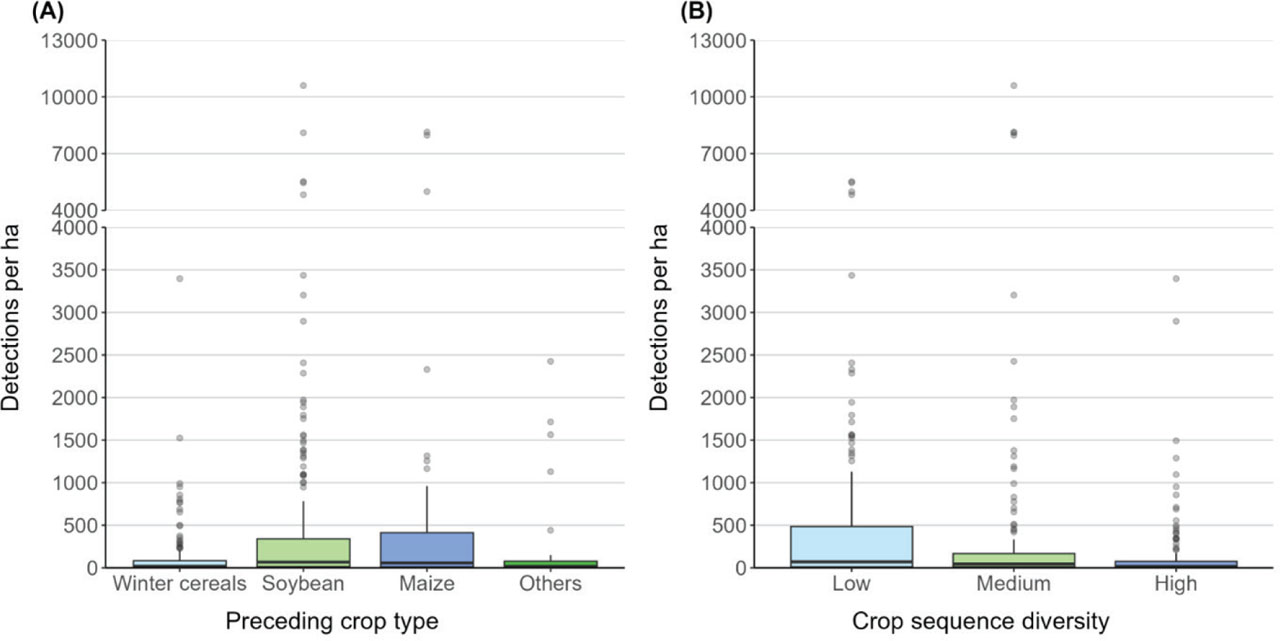
Figure 5.
Influence of the previous crop type (A) and crop sequence diversity (B) on the infestation of soybeans with Datura stramonium (parameter: detections per ha). Note that there is a break on the y-axis.
Abbildung 5. Einfluss der Vorfrucht (A) und der Kulturpflanzenvielfalt (B) auf den Befall von Sojabohne mit Datura stramonium (Parameter: Detektionen pro ha). Auf der y-Achse tritt ein Skalenbruch auf.
4. Discussion
4.1. Current distribution and spread dynamics
Our results show that D. stramonium has spread on agricultural land in Austria, with the number of occupied grid cells having increased substantially over the last decades. Its spread on agricultural land will certainly continue, especially considering the overall distribution of D. stramonium in Austria (Figure 2) and the fact that the plant naturally invades fields from neighboring infested habitats or by human activity, for example, via movement of soil material contaminated with seeds. At present, D. stramonium shows a compact distribution in fields in the lowlands and warmer parts of eastern Austria and along the Danube River, particularly in regions with intensive farming. Datura stramonium finds optimal conditions here, as it prefers the warm, dry end of the topoclimatic spectrum (Pinke et al., 2024). Moreover, it seems likely that due to the connectivity of fields in this region, spread across grid cells occurred quickly. Its spread may also have been supported by the considerable expansion of soybean, oil pumpkin, and millet cultivation areas in recent years (Agrarmarkt Austria, 2025). Datura stramonium is particularly prevalent in oil pumpkins (Pinke et al., 2018). This distribution pattern suggests that the species has spread due to frequent unintentional human-mediated dispersal. Harvesting machines are known to facilitate the spread of Datura species. Ballaré et al. (1987) demonstrated that the seeds of a related species, Datura ferox L., were dispersed up to 98 m from the source during crop harvesting. D. stramonium seeds can be transported over long distances from one field to another by agricultural machinery, creating nascent foci in uninfested areas and continuing the spread. In regions that are already infested, it is likely that there will be densification, that is, an increase in abundance and area. In addition, the high seed production of D. stramonium, with several thousand seeds of individual plants (Weaver and Warwick, 1984), further supports propagule pressure. Interestingly, D. stramonium is comparatively less common in fields in southern and southeastern Austria. There may be multiple factors involved here, such as farming practices (e.g., tillage, weed control, intensive maize cultivation) and less favorable climatic or edaphic conditions for D. stramonium (Pinke et al. 2016; Pinke et al., 2024). For example, base-rich soils, which are considered favorable for D. stramonium (Pinke et al., 2024), are particularly prevalent in eastern Austria compared to acidic soils in southeastern and southern Austria (BFW, 2023).
4.2. Infestation, distribution patterns, and management factors
Our results show that late-season infestation of soybeans by D. stramonium is common in the study area. Therefore, there is clearly a risk of seed and plant sap contamination during the harvest of soybeans. Furthermore, individual fields were heavily infested and significant yield losses can be expected, as demonstrated by numerous studies on D. stramonium interference in soybeans, primarily in North America (e.g., Henry and Bauman, 1991).
The presence of D. stramonium was higher within the first 6 meters of the field border than in the field core. The observation provides useful information, identifying areas where infestation originates before spreading, as well as areas that are particularly resilient to an infestation. The occurrence and abundance of weeds are known to decline from the field border to the field core. This gradient is likely caused by farming practices being performed less successfully (i.e., soil cultivation, sowing, fertilization, and weed control) at the field edge (Wilson and Aebischer, 1995; Essl et al., 2025). In addition, higher light availability at the field edge creates conditions that favor the germination and growth of D. stramonium. The species often colonizes field margins, paths, and ruderal sites in the study region (Follak pers. obs., 2025), allowing the seeds to easily reach the cultivated strip and field edge through natural dispersal.
The extent of late-season infestation varied considerably be-tween the fields surveyed. This could be due to various factors such as crop management (e.g., intensity of weed control, crop rotation) and environmental variables, in addition to other characteristics such as field topography and landscape heterogeneity (Pinke et al., 2016; Essl et al., 2025). As such, both chemical and mechanical control is crucial, because the efficacy of these control tactics in soybean varies depending on the timing of application and environmental conditions (Miller et al., 2012), resulting in D. stramonium individuals likely surviving these interventions. Herbicide use has been shown to impact weed composition in soybeans and to affect the occurrence of certain weeds, such as D. stramonium (Pinke et al., 2016). Thus, it can be assumed that the level of infestation in conventionally farmed soybean fields is likely to be lower than in organically farmed fields, provided that the correct herbicides are used. According to Bagavathiannan and Norsworthy (2012), late-season or preharvest application of herbicides is a viable control option, but there is a lack of approved herbicides in Austria.
Thus, successful management of D. stramonium also requires input from preventive and cultural methods. Research demonstrated that the weed flora of a field is significantly affected by the preceding crop (Fried et al., 2008; Pinke et al., 2018; Pinke et al., 2024). In our study, cultivating winter cereals as a preceding crop significantly reduced the abundance of D. stramonium in soybeans. This can be attributed to differences in sowing time, as autumn-sown crops offer D. stramonium (almost) no opportunity to germinate. Datura stramonium emergence is concentrated in the period from May to June, when the soil is sufficiently warm. This typically coincides with planting dates of spring-sown crops (Kolářová et al., 2017). The long season of maize and soybeans allows D. stramonium to produce viable seed before harvest and to replenish the soil seed bank.
Rotating crops with different life cycles disrupt the development of weed-crop associations and ultimately, can reduce the abundance of dominant species (Blackshaw et al., 2007; Fried et al., 2008). Likewise, soybean fields that had a lower number of crop types in the crop sequence also had a higher incidence of D. stramonium. Teasdale et al. (2019) highlighted that under a continuous spring planting regime (maize–soybean), D. stramonium had optimum conditions to multiply annually and become a dominant species within a few years. At the same time, the integration of wheat in the crop rotation was sufficient to break this cycle and prevent an increase in infestation, which corresponds to our results (Table 3). Certainly, other management and environmental variables have likely also influenced the occurrence of D. stramonium in the study area. For example, it has been demonstrated that greater row spacing and base-rich soils are positively correlated with the presence of the species in crops (Pinke et al., 2016; Pinke et al., 2024).
4.3. Awareness raising and management implications
Our results provide an opportunity to raise awareness of D. stramonium among farmers, regulatory bodies, and food and feed producers. Late-season infestation of fields poses a risk to soybean and other summer crop harvests (e.g., millet, maize) in the study area. Further spread of D. stramonium is likely, putting other, not yet infested cultivation areas of soybean at risk (Figure 2).
Our findings may have also several practical implications. Research suggests that a few plants are sufficient to cause contamination of the harvest with tropane alkaloids (Söchting and Zwerger, 2020), so the general rule is that – as far as possible – all plants should be removed from the field (sensu “every plant counts”). Crop checks before harvest – even earlier, before capsule formation – is thus essential, and (manual) removal can be applied with the help of infestation maps derived from the applied drone imagery methodology (Figure 4B). Due to the presence of areas at high risk of infestation close to field borders, it is recommended that monitoring and control efforts focus on these areas, ultimately reducing management efforts. Most of the population of D. stramonium could be controlled with specific treatments along the field borders (e.g., additional cultivation/mechanical control up to approx. 6 m). This can be done in the currently cultivated crop or in the subsequent crop. However, this approach would ignore numerous small patches and individual plants in the field core, which would still have to be removed by, for example, hand chopping. Organic farming in particular is dependent on cultural weed management compared to conventional farming. The proper selection of the preceding crop (autumn-sown crop prior to soybean) and diverse crop rotations could be efficient tools for reducing the infestation of D. stramonium. In the case of heavy infestation, it is advisable to refrain from growing a “susceptible” spring crop and to include a winter cereal.
Our study has shown that drone images are practical for late-season mapping of D. stramonium and can therefore be used for regular monitoring of soybean fields. Further work may involve collecting data on soybean fields over several years to analyze the development of infestations over time, as well as investigating the impact of other factors (e.g., weed management) on the extent of infestation. This will provide further information on the most effective ways to control D. stramonium and minimize contamination of the harvest.
Acknowledgments
We thank the two anonymous reviewers for their helpful comments on the manuscript.
Notes
[1] Financial disclosure Funding
The study was conducted as part of the Stop Datura project (https://dafne.at/projekte/stopdatura). This project is funded by the Federal Ministry of Agriculture and Forestry, Climate and Environmental Protection, Regions and Water Management via dafne.at. The BMLUK supports applied, problem-oriented research in its area of expertise.