
1. Introduction
The important role of earthworms for the functioning of ecosystems is well recognised (Bhadauria and Saxena, 2010; Carpenter et al., 2008; Edwards and Arancon, 2022; Sharma et al., 2017). In addition, the sensitivity of earthworm populations and species diversity to modifications of their environments has widely been investigated (Emmerling, 2014; Singh et al., 2019; Smith et al., 2008). While changes in land use impact earthworms the most (Betancur-Corredor et al., 2024; Spurgeon et al., 2013), differences between management practices within the same land use category are also highly important. Examples include tillage (Briones and Schmidt, 2017; Rothwell et al., 2011), fertilisation (Spiegel et al., 2018; Valdez et al., 2020) and pesticide use (Goritschnig et al., 2024; Pelosi et al., 2021).
However, research on earthworms is highly geographically biased, with systematic studies at the national or regional scale lacking. Although Europe has the most comprehensive coverage globally (Phillips et al., 2019), most studies originate from just a few countries: primarily France, the Netherlands (Rutgers et al., 2016) and the United Kingdom (Barnes et al., 2023). In Austria, no systematic national study of earthworms has been conducted until now. Despite its diverse landscape, heterogenous pedoclimatic conditions and diversity in agricultural practices, little is known about the distribution of earthworm species inhabiting different habitats in Austria. Relative to the size of the country (83,878 km2), Austria has a comparatively diverse earthworm fauna of about 60 species (Christian and Zicsi, 1999); however, the last (not systematic) census was conducted over 30 years ago (Zicsi, 1994).
The aim of this study was twofold: first, to summarise research on earthworms conducted in Austria between 2000 and 2025 and second, to assess the extent to which different land use types can explain the species diversity and sizes of earthworm communities. The outcome of this research is particularly relevant given the upcoming implementation of the European Soil Monitoring Law (European Parliament and Council of the European Union, 2025; Riggi et al., 2025) and Austria’s National Biodiversity Strategy 2030+ (Bundesministerium Klimaschutz, Umwelt, Energie, Mobilität, Innovation und Techologie, 2022), both of which allude to the potential of earthworms as indicators of soil health.
2. Materials and Methods
A systematic review of the literature was performed in Scopus (www.scopus.com), an abstract and citation database of peer-reviewed literature including scientific journals, books and conference proceedings; access was provided through a subscription of BOKU University. The final search was conducted in September 2025 using the following search query: (earthworm OR lumbricidae OR regenwurm OR regenwürmer) AND (austria OR österreich OR tirol OR tyrol OR vorarlberg OR burgenland OR steiermark OR styria OR kärnten OR carinthia OR oberösterreich OR niederösterreich OR wien OR vienna OR salzburg). The search yielded 46 studies. An additional search with the terms (earthworm OR lumbricidae) and the filter ‘Country/Territory = Austria’ resulted in 200 potential studies.
These studies were then screened independently by two people, at first by only screening titles and abstracts, using the following inclusion criteria:
field studies only (many experimental studies were excluded);
primary focus on earthworm diversity, abundance or biomass in response to land use (e.g., studies focussing on earthworms as prey for other animals or chemical contamination of earthworms were excluded);
studies published only after the year 2000 to keep only recent literature and
studies embedded in multi-country studies were included if the Austrian results were discernible.
This screening resulted in 24 studies being reviewed in depth. A further four studies were consequently excluded as they did not meet the inclusion criteria after a more thorough review. This left 20 studies for the final review.
Due to the limited number of studies and their heterogeneity, it was not possible to perform a statistical comparison based on the collected data. Instead, the studies were only compared descriptively, providing an overview of the current state of research on earthworms in Austria.
3. Results and discussion
3.1. Earthworms in different land uses
Most earthworm studies conducted in Austria focussed solely on earthworms in a single land use type – either arable land (nine studies), grassland (six studies), vineyards (three studies) or forest (one study) (Figure 1a), with only a single study comparing several agricultural land use types in one study (Mittmannsgruber et al., 2025b). However, the latter study did not find any significant differences in earthworm abundance across the studied land use types. Among the studies performed solely in arable land, some reported data from the same long-term experimental site over several years. Among the grassland studies, one was conducted in a semi-natural grassland in a protected Natura 2000 area (Kerschbaumer et al., 2024). No studies were found for urban ecosystems since the year 2000. Most studies were conducted in the last decade, with only two studies published before 2014 (Figure 1b). Thirteen of the 20 studies included species-level results, and out of the 60 earthworm species known for Austria (Christian and Zicsi, 1999), 21 were reported. However, many species were only observed in a single study (Table 1). The lowest number of different species was found in the single forest study (Behringer et al., 2025), with five species identified. This was followed by five studies on arable land, which found an average of 5.2 species. One vineyard study (Buchholz et al., 2017) found six species, while five grassland studies found an average of seven species.
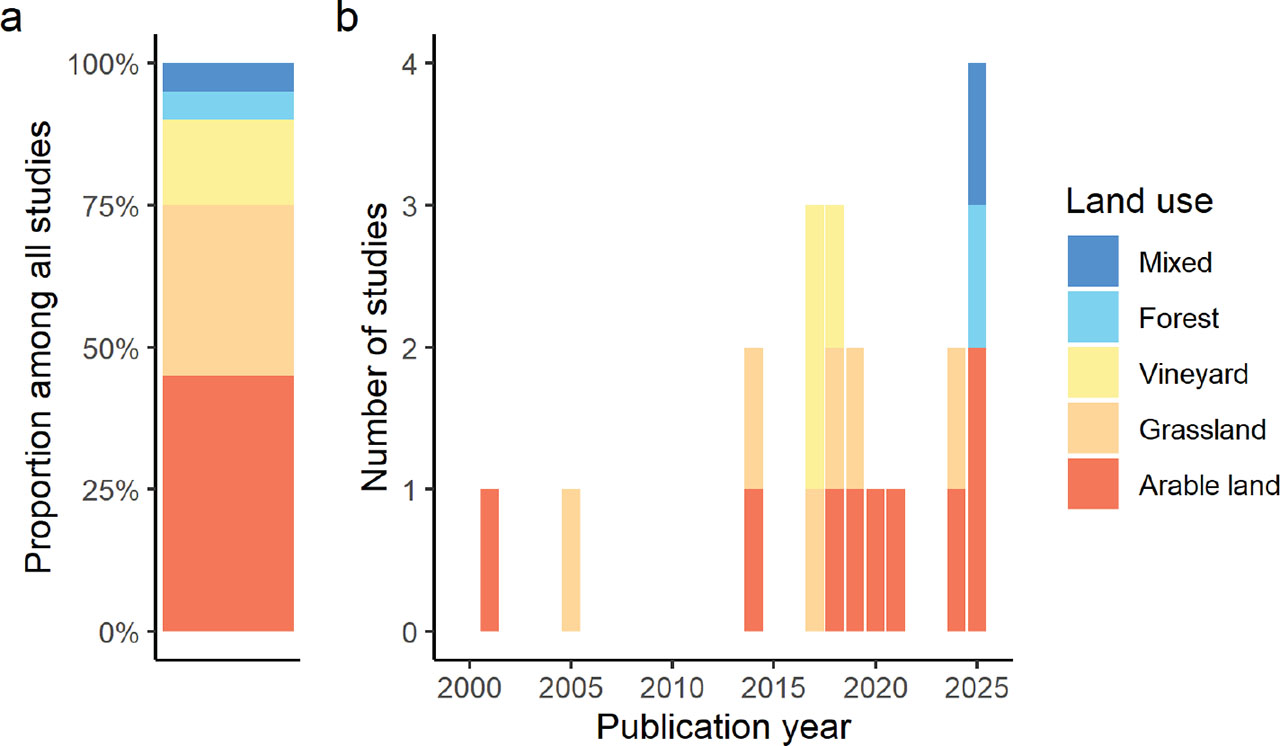
Figure 1.
(a) Proportion of different land uses in the 20 reviewed studies. (b) Distribution of studies over time based on publication year, with land uses also indicated by colour. Search conducted in September 2025.
Abbildung 1. (a) Anteile von verschiedenen Landnutzungstypen in den 20 behandelten Studien. (b) Zeitliche Verteilung der Studien basierend auf dem Jahr der Veröffentlichung, die Landnutzungstypen sind auch hier farblich ausgewiesen. Literatursuche im September 2025.
Table 1.
Overview of earthworm species found in all Austrian earthworm studies since 2000, listed per land use type. Total number of studies including species-specific information = 13. Outdated species nomenclature was updated whenever necessary according to Csuzdi (2012).
Tabelle 1. Übersicht über die Regenwurmarten, die in allen österreichischen Regenwurmstudien seit 2000 gefunden wurden, gelistet für den jeweiligen Landnutzungstyp. Die Gesamtanzahl der Studien, die Informationen auf Artniveau enthalten = 13. Veraltete Artnamen wurden anhand von Csuzdi (2012) aktualisiert.
Overall, the most commonly found species was Aporrectodea rosea, which was found in 11 of the 13 studies with species-level results (Table 1). This was followed by Aporrectodea caliginosa, Lumbricus rubellus and Octolasion lacteum (nine studies each). As these species are common not only in Austria but also in Europe (Zeiss et al., 2024) and globally (Phillips et al., 2019), this was expected. Especially A. rosea was found across all land use types, demonstrating its tolerance of different environmental conditions. In contrast, litter-dwelling species such as Dendrobaena octaedra, L. rubellus, and Lumbricus castaneus were predominantly found in grasslands as they are sensitive to soil disturbance and litter removal in arable systems (Sutri et al., 2025). In one study, the large deep-burrowing species Dendrobaena platyura, Dendrobaena depressa, Aporrectodea longa and Lumbricus polyphemus were also found in arable land (Rampazzo and Mentler, 2001), which is generally uncommon (van Eekeren et al., 2010). The authors discuss that this was likely due to the land use history of the site, as it had only been converted to arable land a few years earlier (Rampazzo and Mentler, 2001).
3.1.1. Arableland
Nine studies were relevant for arable land (Table 2). The most common theme was a comparison of organic/conservation and conventional agriculture. In general, tillage was found to have the greatest impact on the characteristics of earthworm communities (Euteneuer et al., 2024; Euteneuer and Butt, 2025; Simon et al., 2025), while no significant differences were observed between organic and conventional farming methods (Jeanneret et al., 2021; Schneider et al., 2014). Two studies (Euteneuer et al., 2019, 2020) examined the effect of cover cropping but produced opposing results with the general conclusion that cover crops have neutral to slightly positive effects on earthworm communities.
Table 2.
Overview of studies investigating different environmental and management patterns in arable soils. A = abundance, B = biomass, S = species richness, N/A = not available, n. s. = no significant differences reported.
Tabelle 2. Übersicht über Studien zu verschiedenen Umwelt- und Managementeinflüssen in Ackerböden. A = Abundanz, B = Biomasse, S = Artenzahl, N/A = Information nicht vorhanden, n. s. = keine statistisch signifikanten Unterschiede berichtet.
| Study | Comparison | Response | Significance | Effect |
|---|---|---|---|---|
| Simon et al., 2025 | No-tillage cultivation, plough | A, B, S | p < 0.001, p < 0.001, p = 0.045 | High tillage intensity decreases all tested earthworm parameters |
| Euteneuer and Butt, 2025 | Conservation, conventional | A, B, S | p < 0.05, p < 0.05, p < 0.05 | Conservational land use positively impacts earthworms in terms of all three tested parameters |
| Rampazzo and Mentler, 2001 | Undisturbed non-agricultural land, conventional tillage | A, B, S | N/A | |
| Euteneuer et al., 2024 | Plough, cultivation, no-till | A, B | p = 0.006, p = 0.024 | No-till increases B and A |
| Jeanneret et al., 2021 | European study that includes Austria. Organic farming, conventional farming | S | n. s. | |
| Euteneuer et al., 2020 | Different cover crops, irrigation versus rainfed, different seasons | A, B, S | p < 0.01, n. s., n. s. | Under rainfed conditions, higher earthworm A in bare fallow compared to black oat and Sudan grass Cover crops are supporting earthworm B in winter |
| Euteneuer et al., 2019 | Cover crops, sclerotia, different seasons | A, B | p = 0.007, n. s. | Higher A under oil seed compared to bare fallow and oat. No effect of sclerotia |
| Spiegel et al., 2018 | Organic fertilisation, organic–mineral fertilisation, mineral fertilisation, control | A, B | n. s., n. s. | |
| Schneider et al., 2014 | European study that includes Austria. Organic farming, conventional farming | A, S | n. s., n. s. |
The negative effect of tillage intensity on earthworm communities, as observed in the included studies, is also evident in the wider literature (Crittenden et al., 2014; Dekemati et al., 2019). Furthermore, while two Austrian studies did not find a significant difference between conventional and organic farming, several other studies from elsewhere have shown a positive impact of organic farming on earthworms compared to conventional management (Crittenden et al., 2014; Henneron et al., 2015). However, this is likely due to the application of organic fertilisers in organic farming systems (Birkhofer et al., 2012).
Overall, given that approximately 16% of Austrian territory is used for arable production (Statistics Austria, 2024), the low number of studies is concerning, given that intensive land use is known to be one of the most important factors impacting earthworms (Smith et al., 2008).
3.2. Grasslands
Six studies concerning grasslands, including alpine grassland, were conducted in Austria. A common theme was the abandonment of grassland management in comparison to the effects of different mowing and pasturing intensities on earthworms. The literature appears to be biased towards alpine grasslands, as four out of the six studies were conducted there. In addition, three of the studies were conducted in long-term socioeconomic and ecosystem research regions (Jernej et al., 2019; Seeber et al., 2005; Steinwandter et al., 2017).
With respect to management practices, the reported effects on earthworms were inconsistent across studies. Often, different intensities of grassland management (e.g., different mowing/pasturing intensities, mowing vs. pasturing, or abandonment vs. continued management) had no significant effect on the various earthworm parameters or it was not tested for significance (Table 3). However, where significant differences were found, lower-intensity management tended to be associated with lower earthworm abundance (Jernej et al., 2019; Steinwandter et al., 2017), although in the former study, this was only marginally significant.
Table 3.
Overview of studies investigating different environmental and management patterns in grasslands. A = abundance, B = biomass, S = species richness, N/A = not available, n. s. = no significant differences reported, ↑ = positive effect/relationship, ↓ = negative effect/relationship.
Tabelle 3. Übersicht über Studien zu verschiedenen Umwelt- und Managementeinflüssen im Grünland. A = Abundanz, B = Biomasse, S = Artenzahl. N/A = Information nicht vorhanden, n. s. = keine statistisch signifikanten Unterschiede berichtet, ↑ = positiver Effekt/Zusammenhang, ↓ = negativer Effekt/Zusammenhang.
| Study | Type | Comparison | Response | Significance | Effect |
|---|---|---|---|---|---|
| Kerschbaumer et al., 2024 | Lowland grassland | Mowing frequency | A, B, S | n. s. | |
| Vegetation types (dry, fresh, moist) | B, S | p < 0.05 | ↓ Moist meadow | ||
| Jernej et al., 2019 | Montane grassland | Mowing versus abandonment | A | p < 0.1 | ↓ Abandoned |
| Vegetation characteristics | A | n. s. | |||
| Steinwandter et al., 2017 | Alpine grassland | Mowing versus pasturing | A | p < 0.01 | ↓ Pasture |
| Managing versus abandonment | A | n. s. | |||
| Seeber et al., 2005 | Alpine grassland | Mowing versus pasturing, managing versus abandonment | A, | p < 0.01 | ↑ Managed and abandoned meadows, abandoned pasture |
| B | n. s. | ↓ Managed pasture | |||
| Geitner et al., 2014 | Alpine grassland | Mowing versus pasturing | A, | n. s., | |
| B | n. s. | ||||
| Site characteristics | A (endogeic, epigeic, hemiedaphic groups) | Several significant ones | ↑ Humus, pH, parent rock, altitude | ||
| ↓ Thickness litter layer | |||||
| Steinwandter et al., 2018 | Alpine grassland | Grazing intensity (sheep) | A | N/A | Tendency: highest A at medium grazing intensity, lowest A at high grazing intensity |
Parameters relating to the characteristics of the site and the soil sometimes showed significant relationships, such as the consistent positive effects of humus content, pH and altitude on the abundance of different earthworm ecological groups (Geitner et al., 2014). Regarding the vegetation at the site, one study found no significant patterns of vegetation characteristics in relation to earthworm abundance (Jernej et al., 2019), while another conducted in a Natura 2000 protected area reported that moist meadows dominated by the grass Molinia caerulea tended to have lower earthworm biomass and species richness (Kerschbaumer et al., 2024).
3.3. Vineyards
Three studies focussed on earthworms in vineyards, specifically in relation to management of vegetation in inter-rows (Buchholz et al., 2017; Faber et al., 2017) and within rows (Zaller et al., 2018). Regarding inter-row management, the studies compared different tillage methods with maintaining a green cover in the inter-row. Regarding within-row management, one study compared the effectiveness of different herbicides and mechanical weeding, but did not find any significant effects on earthworm abundance, biomass or species richness (Table 4). One study showed that soil quality (Austrian soil field index) and plant biomass positively influenced earthworm abundance, biomass and species richness (Buchholz et al., 2017).
Table 4.
Overview of studies investigating environmental and management patterns in vineyards. A = abundance, B = biomass, S = species richness, N/A = not available, n. s. = no significant differences reported, ↑ = positive effect/relationship, ↓ = negative effect/relationship.
Tabelle 4. Übersicht über Studien zu verschiedenen Umwelt- und Managementeinflüssen in Weingärten. A = Abundanz, B = Biomasse, S = Artenzahl. N/A = Information nicht vorhanden, n. s. = keine statistisch signifikanten Unterschiede gefunden, ↑ = positiver Effekt/Zusammenhang, ↓ = negativer Effekt/Zusammenhang.
| Study | Comparison | Response | Significance | Effect |
|---|---|---|---|---|
| Zaller et al., 2018 | Within rows: herbicides versus mechanical weeding | A, B | n. s., n. s. | |
| Buchholz et al., 2017 | Inter-rows: permanent green cover versus tillage | A, B, S | N/A | None |
| Site characteristics | A, B, S | N/A | ↑ Soil quality and plant biomass | |
| Faber et al., 2017 | Inter-rows: different tillage methods | A, B | n. s. |
No other studies dealing with earthworms in perennial agroecosystems such as apple orchards have been published in Austria.
3.4. Forests
A single recent study focussing on earthworms in forests was identified (Behringer et al., 2025). The study was focussed primarily on the impact of soil compaction caused by forestry machinery on earthworms and found that conditions in old, abandoned trails were favourable for earthworms as they resembled the conditions in natural pit-and-mound structures. In contrast, fresh machine tracks were almost completely devoid of earthworms.
The low number of earthworm studies in Austrian forests is surprising, given that forests cover 48% of the countries land area (Statistics Austria, 2023), and besides Behringer et al. (2025), the second most recent study conducted in forests is more than 30 years older (Meyer and Steinberger, 1994). This clearly highlights the lack of knowledge regarding earthworms in Austrian forests.
4. Conclusions
Since the year 2000, a very limited number of field studies on earthworms was conducted in Austria, resulting in the identification of 21 species, which is approximately one-third of those known to exist in Austria (Christian and Zicsi, 1999). These studies focussed on four types of land uses: arable land, grasslands, vineyards and forest, and different aspects related to their management. However, only few management aspects showed consistent effects on earthworm communities across studies, such as tillage in arable crop production, while most other aspects showed inconsistent (e.g., cover crops in arable land, mowing vs. abandonment of grasslands) or insignificant (e.g., organic vs. conventional farming) effects. However, our most important finding is the blatant lack of research on earthworms in forests and nature conservation areas, with only one study conducted in each since the year 2000. There has also been a lack of studies in urban ecosystems over the last 25 years.
Future research should consider a more systematic approach to be able to make scientifically valid analyses of the effects of land use and other potential influencing factors on earthworms and overall soil health (Riggi et al., 2025). First steps for such a systematic earthworm study on a national scale have recently been made, though again only in agroecosystems (Mittmannsgruber et al., 2025a). It would also be necessary to expand earthworm research systematically in ecosystems that have so far reached insufficient attention in Austrian research, such as forests and their microhabitats (e.g., dead wood), natural and semi-natural ecosystems (including protected areas) and urban ecosystems (including parks and household gardens). Alpine ecosystems are another under-researched area, even though two-thirds of grassland studies we found were conducted there. Older studies conducted in Austria have shown that earthworms can be found at an altitude of up to 2500 m (Franz, 1950). Given that alpine ecosystems are highly susceptible to climate change (Chersich et al., 2015), a systematic evaluation of changes in earthworm communities at different altitudes could provide valuable insights into the dynamics of soil ecosystems in the context of climate change. The European Union (EU) has recently approved the Soil Monitoring Law, which aims to achieve healthy soils by 2050 and assist the EU in meeting its climate and biodiversity goals (European Parliament and Council of the European Union, 2025). Consequently, each Member State must implement measures for harmonised soil biodiversity monitoring, with earthworm abundance and diversity being explicitly listed as indicators for detecting soil biodiversity loss. Therefore, a systematic earthworm monitoring programme with a long-term perspective seems advisable in Austria. Such a monitoring programme would yield valuable insights into how earthworm communities respond to the impact of land use across different ecosystems and enable the analysis of its effects on ecosystem services and climate change. Apart from the requirements of European legislation, there are also national requirements, such as those set out in Austria’s National Biodiversity Strategy 2030+ (Bundesministerium Klimaschutz, Umwelt, Energie, Mobilität, Innovation und Techologie, 2022). Ultimately, more systematic research on earthworms would enable us to assess the level of endangerment of different earthworm species in Austria and the degree to which various ecosystem types contribute to safeguarding these vital soil organisms.
Notes
[1] Financial disclosure 5. Funding
This work was performed in the framework of the project ‘BodenBiodiv’ (project number C321079), funded by the Austrian Federal Ministry of Climate Action, Environment, Energy, Mobility, Innovation and Technology (Biodiversitätsfonds) and the European Union (NextGenerationEU).