
1. What are long-term experiments?
Long-term studies are methodically designed, often also experimental investigations for the empirical acquisition of information/data (Silvertown et al., 2010). The investigations necessarily cover an extraordinarily long period of time, as it is expected that the processes of plant/environment interactions with management may take place extremely slowly. Therefore, it is essential that the set-up of long-term experiments (LTEs) usually remains unchanged during the intended study period. In general, a distinction is made between purely observational studies (monitoring), on the one hand, in which there is no intervention in the observed system, and the long-term experiment in the sense of an ‘intervention study’, on the other hand, in which a wide variety of questions and hypotheses are addressed within the framework of a defined experimental concept with active manipulations of a single or several factors (Knapp et al., 2012).
Long-term experiments on grassland significantly differ in their characteristics from those on arable land in that the effect–response function is retarded by comparably slow processes among the compartments, soil, plant and atmosphere. In addition, grassland vegetation is composed of numerous different plant species depending on management intensity and site conditions, and grassland as a permanent crop is usually used for many years without any tillage. What is an extraordinarily long period of time and at what point can a field experiment be called a long-term experiment? Knapp et al. (2012) offer an interesting approach to the term ‘long term’ and argue that ideally, ecological or life-history criteria (e.g., process and turnover rates, life span of organisms) or the time scales of ecological phenomena should be considered to define an experiment as being long term. But, since there is no official definition, it is ultimately up to the investigator or supervisor to assign the term ‘long term’. Tilman et al. (2001), for example, refer to a seven-year grassland trial as a ‘long-term experiment’, while Grosse et al. (2020) define long-term agricultural trials as such only from a minimum duration of 20 years. Rasmussen et al. (1998) also presuppose a trial duration of more than 20 years and, according to these authors, one can only speak of a long-term experiment when:
A conversion phase has been completed from the original status to an equilibrium in nutrient fluxes, botanical composition, soil biome, or other effects, or responses have been established.
The variation in yields and botanical composition, as well as the expression of different traits after the complete conversion of the sward, are induced only by the prevailing environmental or management conditions and not by an unfinished and ongoing response of the vegetation and soil to the experimental treatments.
The originally planned treatments and the management of the experiment are kept constant.
And finally, the maintenance and continuation of the experiment as well as its sampling, analysis and documentation is ensured.
The continued maintenance of a field experiment and consistent treatment and management of the experimental plots in accordance with the original scientific concept appear to be the central basic prerequisite for being able to use these valuable and irreplaceable resources in the future, even if surveys and sampling are missing for a certain timespan (Freye and Thomas, 1991). In the ideal case, there is a continuous experimental procedure including comprehensive surveys, analyses, documentation and a backup of reserve samples for future studies. However, even if the original experimental design is modified or eventually terminated, scientifically interesting analyses and surveys can still be carried out (Schaumberger et al., 2020), especially using modern, advanced analytical methods and techniques. Jenkinson et al. (1994) commented in a paper on the usefulness of the oldest European permanent experiments at Rothamsted (UK), which were set up in the mid-19th century: ‘Would Lawes and Gilbert (the two founders of the world’s oldest agricultural research station) ever have thought that the soil samples they took so carefully in 1881 would be analysed 100 years later using the radiocarbon method to determine carbon turnover?’ So, it also takes trust in the further development of science and a certain farsightedness to recognize the value of long-term experiments for future projects and research activities.
Long-term experiments, however, also enjoy great esteem that goes far beyond purely scientific prestige. Janzen (2009) describes them as so-called listening places, places where you can feel the pulse of the earth and wait patiently until you can hear and see the slowly emerging development trends in our ecosystems. Long-term experiments not only allow the collection of data that could never be obtained without them. They also guide us to numerous questions that are dealt with on a smaller scale in the field of basic research. Findings from such process studies (e.g., belowground carbon allocation of plants, carbon transfer to soil microbes) stimulate new measurements and surveys in the long-term experiments, which in turn give rise to new questions. Janzen (2009) sees in this interplay an important stimulation of productive cooperation between different scale and time levels, in which long-term experiments in any case occupy an important and central position ( Figure 1). Beyond this integration of LTEs into the research framework on grassland, he also points out that such experiments will be increasingly needed in the coming decades due to increasing (especially man-made) stresses. He proposes seven questions to right their best possible conservation for our descendants:
Can additional sensitive indicators for the vitality of ecosystems be found?
Are the recorded metrics suitable for global application?
Is there a need for new experiments or should existing ones be expanded?
Can long-term experiments become a laboratory for basic research?
Can we better include human sciences in our studies?
Can we better communicate the nature and scientific value of long-term experiments?
Can we inspire our successors for long-term trials?
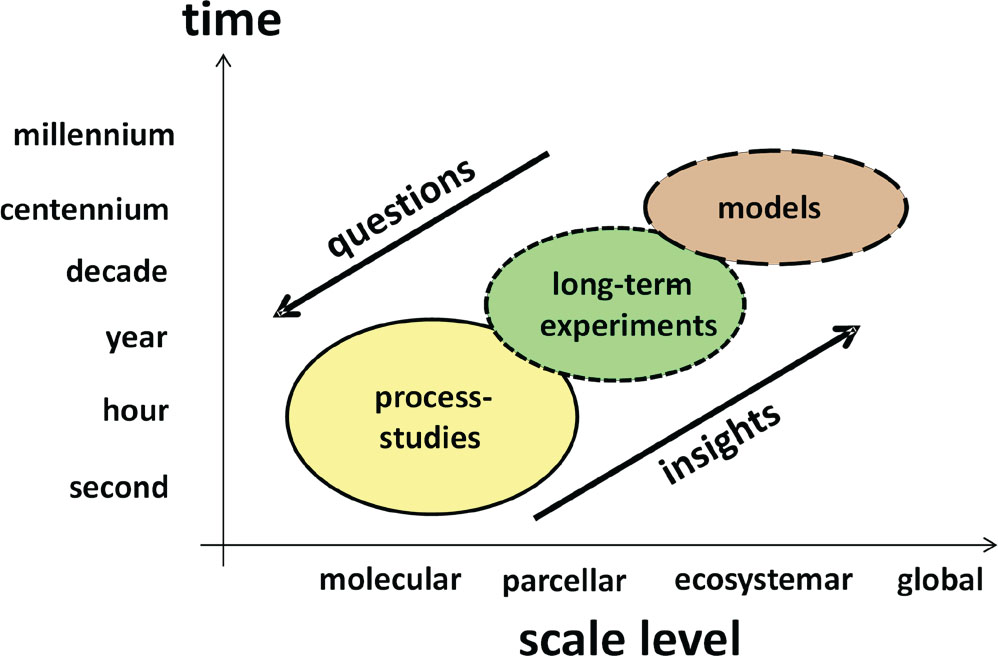
Figure 1.
Relationship between long-term experiments and basic research (after Janzen, 2009)
Abbildung 1. Beziehung zwischen Langzeitversuchen und Grundlagenforschung (nach Janzen, 2009)
This last question would probably also involve the donors who ultimately provide the human and material resources for the LTEs. Seen in this light, their questions about the meaningfulness of its continuation that are still in existence are entirely justified and give cause for serious consideration.
2. A brief historical review of the beginnings of grassland field experiments in Austria
Almost 150 years ago, the Tyrolean priest and itinerant preacher Adolf Trientl (1818–1897) wrote in a treatise on the improvement of Alpine farming [sic]: ‘What are the best Alpine grasses? We don’t know more about them than the alpine dairymen and shepherds tell us from their observations. No attempt has ever been made to cultivate them on a large scale and to feed them individually in order to experience their special nutritive value and effect. This would actually be the task of an alpine research station, which would probably take several years to solve’. With this statement, Trientl (1869) not only initiated the establishment of an alpine experimental station in the Salzkammergut (Weinzierl, 1902) but at the same time also speculated that a longer period of time would be required to answer the questions posed. In 1890, an experimental garden with a total of 574 plots was finally established on the Vorder-Sandlingalm at 1,400 m above sea level. In the first few years, 580 individual species (including annuals) as well as 15 grassland mixtures were planted and tested there (Weinzierl, 1909).
The model for this was an experimental field set-up in 1881 on the Fürstenalpe near Chur in Switzerland, which Weinzierl visited several times. The subsequent very intensive experimental and survey activities were discontinued as a result of the First World War and a strong landslide that occurred in 1920. But even almost a hundred years later, the traces of this alpine field experiment are still recognizable, at least to some extent. At the beginning of the 20th century, the Moorland Management Institute in Admont was founded under the aegis of the Imperial-Royal Ministry of Arable Farming in Vienna, and intensive experimental activity on various arable and grassland issues took place here.
It was precisely during the economically difficult and politically unstable period of the Second World War and the subsequent occupation that two field experiments (fertilization experiment and meadow fertilization experiment) were planned and set up at the Admont experimental field in 1944 and 1946, respectively. At that time, these experiments were embedded in a national agricultural policy with the objective of improving and securing the nutrition of humans and animals. Today, these ‘leftovers’ have taken on a different but also enormously important function and form the core of the long-term grassland experiments at Admont, still maintained and managed by AREC Raumberg-Gumpenstein.
2.1. About the current status and use of long-term grassland experiments in Austria
All still existing grassland experiments at the AREC Raumberg-Gumpenstein listed in Tables 1 and 2 can indeed be described as LTEs with a duration of between 50 and 80 years. Some of them have been conceptually modified in the course of time with regard to the treatments and so been adapted to current requirements or research questions of today’s agricultural practice. Others, such as the two oldest experiments in Admont, have remained completely unchanged and have increasingly been in the focus of scientific interest for some years. It is worth noticing here that even with the best of intentions, it might be difficult to maintain original treatments in LTEs on grassland ad infinitum. For instance, chemical composition of fertilizers, if continuously available at all, may vary. Technical equipment for cutting and harvesting has been modified, with some effects on defoliation and soil. Beyond such human-induced interference, atmospheric deposition – mainly of nitrogen – and the increasing atmospheric CO2 concentration must be considered as external but strongly interacting factors in the original experimental design.
Table 1.
Long-term grassland experiments at the Gumpenstein site *
Tabelle 1. Langzeitversuche im Grünland an der HBLFA Raumberg-Gumpenstein
| Experiment designation/basic information | Nutrient deficiency experiment | Cutting frequency experiment | Fertilization utilization experiment | Farm manure experiment |
|---|---|---|---|---|
| Internal code | 432.A | 434.A | 433 | 484 |
| Country | Austria | Austria | Austria | Austria |
| Acronym | GG1 | GG2 | GG3 | GG4 |
| Location | Gumpenstein | Gumpenstein | Gumpenstein | Gumpenstein |
| Co-ordinates | 47°29′40″/14°06′11″ | 47°29′34″/14°06′13″ | 47°29′36″/14°06′12″ | 47°29′38″/14°06′10″ |
| Altitude (m a.s.l.) | 698 | 713 | 702 | 699 |
| Exposition | South-west | North-east | North | North |
| Inclination | 1% | 2% | 2% | 2% |
| Year of establishment | 1960 | 1961 | 1961 | 1966 |
| No. of treatments | 14 | 10 | 18 | 21 |
| No. of replications | 3 | 4 | 3 | 4 |
| Factor fertilization | Mineral fertilizers | Mineral and organic | Mineral and organic | Mineral and organic |
| Factor cutting Frequency/year | 3 | 2, 3, 4, 6 | 1, 2, 3 | 3 |
| Design | Split-plot | Block | Split-plot | Block |
Table 2.
Long-term grassland experiments at Admont and Zachenschöberl (alpine site)
Tabelle 2. Langzeitversuche im Grünland in Admont und Zachenschöberl (Almstandort)
| Experiment designation/basic information | Nitrogen experiment | Meadow fertilization experiment | Liming experiment | Alm fertilization experiment |
|---|---|---|---|---|
| Internal code | 317 | 320 | 469 | 470.B |
| Country | Austria | Austria | Austria | Austria |
| Acronym | GG5 | GG6 | GG7 | GG8 |
| Location | Admont | Admont | Zachenschöberl | Zachenschöberl |
| Co-ordinates | 47°34′60″/14°27′04″ | 47°34′58″/14°27′02″ | 47°27′48″/14°04′19″ | 47°27′48″/14°04′19″ |
| Altitude (m a.s.l.) | 633 | 633 | 1,297 | 1,297 |
| Exposition | S | S | W | W |
| Inclination | 1% | 1% | 30% | 30% |
| Year of establishment | 1944 | 1946 | 1964 | 1964 |
| No. of treatments | 4 | 24 | 8 | 16 |
| No. of replications | 4 | 4 | 4 | 4 |
| Factor fertilization | Mineral | Mineral and organic | Mineral and organic | Mineral and organic |
| Factor cutting Frequency/year | 3 | 3 | 2 | 2 |
| Design | Block | Block | Block | Block |
Of course, the research projects, on which the field experiments listed in Tables 1 and 2 were originally based, have since long been completed and published accordingly (Schechtner, 1978; 1993a; 1993b). Thus, on sober reflection, one might suggest the demand to abandon the field experiments and to use the resources (personnel, funds, land) thus freed up for other purposes. However, there are a number of arguments against this. Existing LTEs can, for example, be used to process or answer the following aspects:
Retrospective recording of the influence of weather extremes and climate changes as an actual and important contribution to applied climate impact research
Determination of adaptation strategies (phenotypic, genotypic) of grassland plant species to long-term experimental and environmental conditions (fertilizer application, utilization, climate) with the help of genome analyses
Variability, influence and prediction of ecosystem services in permanent grassland in relation to functional diversity
Identification of functional plant traits with relevance for ecosystem services, functions and processes
Today, modern measurement and analysis methods can be used for this purpose, rendering invaluable information to deepen the statements already made or to understand processes and interrelationships. Long-term data series are also excellently suited for modelling, which is applied today for the most diverse areas. Figure 2 displays the integration of quite different research activities that have been carried out at only one site, that is, the AREC Raumberg-Gumpenstein LTEs. Results from these projects were incorporated, for example, into the current Austrian guidelines for good fertilization practice (Bundesministerium für Land- und Forstwirtschaft, Regionen und Wasserwirtschaft, 2023; Gruber and Pötsch, 2007).
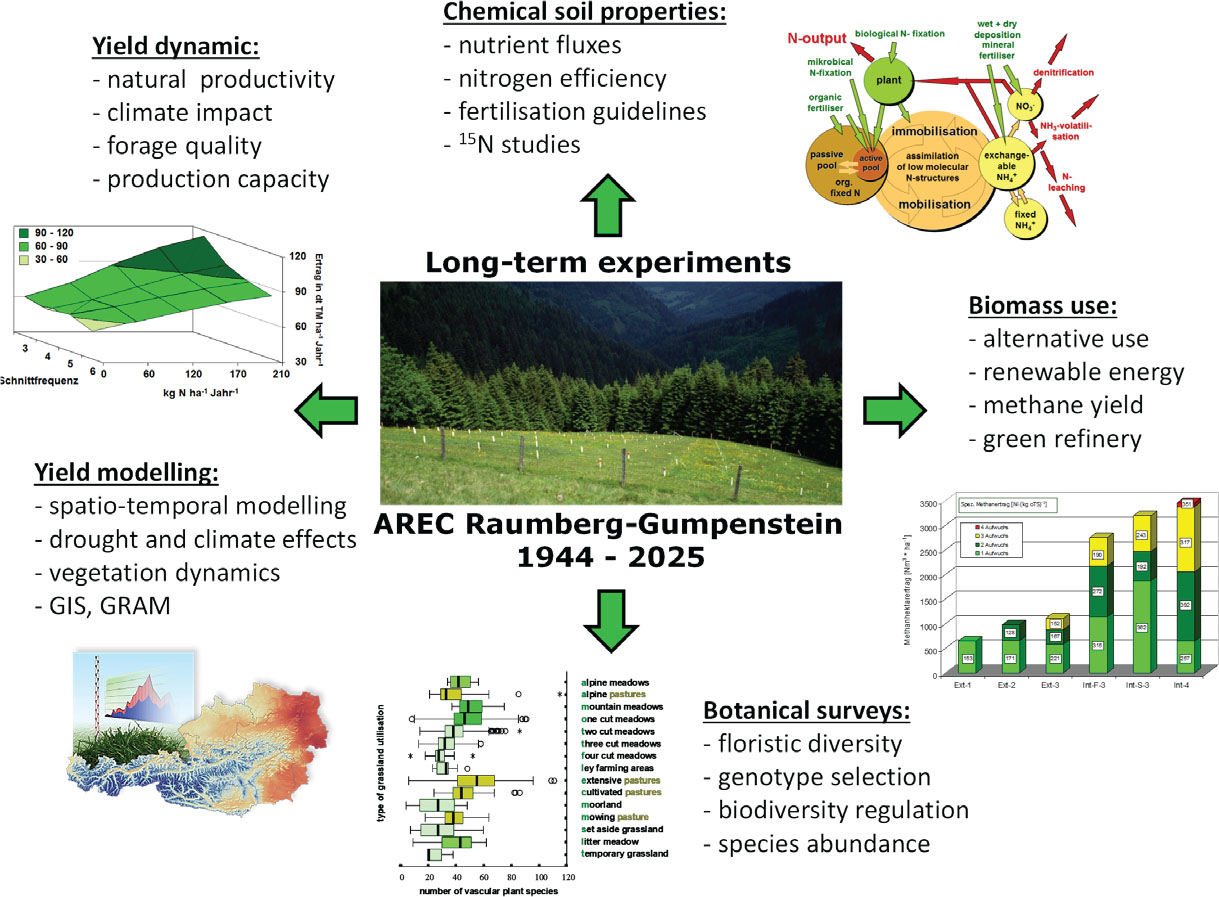
Figure 2.
Recent research activities based on various long-term grassland experiments at AREC Raumberg-Gumpenstein
Abbildung 2. Forschungsaktivtäten basierend auf unterschiedlichen Grünlandlangzeit-versuchen an der HBLFA Raumberg-Gumpenstein
Investigations at the Gumpenstein cutting frequency experiment (no. 434.A) and the farm manure experiment (no. 484) showed for the first time that the natural δ15N signature of agricultural ecosystems is not only influenced by type (organic, mineral) and amount (0–200 kg N/ha and year) of fertilizer nitrogen that is supplied. They also indicated that plant and soil δ15N can best be explained by an input–output accounting of nitrogen (Watzka et al., 2006). The same long-term experiment and others in Admont and Piber were used in a study of Trnka et al. (2006). There, it took advantage of the interactions between weather, soil conditions and grassland management allowing to derive a reliable statistical grassland model (GRAM) that integrates various management regimes, thereby using polynomial regressions (GRAM-R) and neural networks (GRAM-N). It was found that, with the GRAM-N or GRAM-R methodology, up to 78% of the variability in harvested herbage DM production could be explained with a systematic bias of only 1.1%–2.3%. These models have proven stable performance across a subset of dry and wet years. Generalized GRAM models were also successfully used to estimate daily herbage growth during the season, explaining between 63% and 91% of variability in individual cases.
The nutrient deficiency experiment in Gumpenstein (no. 432.A) has been in the focus of several studies, including the functional analysis of non-symbiotic nitrogen fixers in the soil (Angel et al., 2018). In the long term, highly variable fertilizer application of the experimental plots together with the associated change in soil properties resulted in measurable differences in the diversity and activity of N2 fixers, which never would have been detectable in any other than in LTEs. Generally, applicable analysis protocols and standards for the study of environmental diazotrophs were provided by this study. Further, some of the important pitfalls and caveats of studying the genetically conserved dinitrogenase reductase (nifH) gene together with other functional genes in the environment were identified.
In another study, a multilevel assessment of the single and interactive effects of different long-term fertilization treatments, plant species and vicinity to roots on the free-living diazotroph community in relation to the general microbial community in grassland soils was carried out (Dietrich et al., 2024). Overall, fertilization showed the strongest effect on the diazotroph and general microbial community structure; however, with vicinity to the root, the plant effect increased. Despite the long-term fertilization, plants strongly influence the diazotroph communities, emphasizing the complexity of soil microbial communities’ responses to changing nutrient conditions in temperate grasslands.
In this long-term experiment, the microbial carbon use efficiency and the time of microbial biomass turnover in the soil were also investigated, indicating that N fertilizer application did decrease not only microbial respiration but also microbial C-uptake (Spohn et al., 2016). The function and importance of acidobacteria in grassland soils were also examined in more detail, finding out that the ability to oxidize atmospheric H2 is more widely distributed among soil bacteria than previously recognized (Giguere et al., 2020).
In the farm manure experiment (no. 484), changes in crude protein fractionation (Gierus et al., 2016) and the content of metabolizable energy in the functional plant species groups were investigated at different N fertilizer application levels. The experiment exhibited highly significant differences among the treatments (0–240 kg nitrogen per ha and year) in the proportion of grass and legumes, the metabolizable energy concentration of grass and the total yearly metabolizable energy production of grass and legume (Wahyuni et al., 2018 Wahyuni et al., 2020). Treatments of this experiment as listed in Table 1 also influenced protein fractionation, especially the C fraction (unavailable protein for ruminants) for all plant functional groups (grasses, legumes and herbs).
A strong focus was also placed on the influence of different fertilizer application levels and utilization frequencies on yield dynamics and forage quality, which play an important role in grassland-based livestock farming (Gruber et al., 2006; Buchgraber et al., 2011; Pötsch, 2012; Schaumberger, 2011; Schaumberger et al., 2012). The influence of different management systems on floristic composition and diversity of the grassland vegetation was also investigated (Pötsch, 1996; Pötsch, 1998). Specific measures in the Austrian agri-environmental programme ÖPUL were co-developed from the results of these long-term experiments to preserve and increase the floristic diversity of managed grassland, which is threatened by both intensification and land abandonment (Pötsch and Schwaiger, 2009; Bohner and Starlinger, 2011). Less intensively managed grassland offers significantly higher species and habitat diversity and can also be used as a source for improving biodiversity (Krautzer and Pötsch, 2009; Krautzer et al., 2011) or as a source of genotypes for further breeding activities (Krautzer et al., 2007). Some of the Gumpenstein long-term experiments were also used to test, for example, strategies for alternative biomass utilization, for example, methane production, hay pellets as fuel or the concept of a green bio-refinery to obtain valuable lactic and amino acids (Pötsch et al., 2009).
The aforementioned oldest permanent grassland experiments at AREC Raumberg-Gumpenstein in Admont ( Table 2) have also been in the focus of an intensive sampling and survey phase for several years, in close cooperation with the Universities of Bonn, Prague, Vienna, BOKU (Vienna) as well as AREC Raumberg-Gumpenstein (Pavlů et al., 2016; Pavlů et al., 2021; Spiegel et al. 2021, Jenab et al., 2021, Jenab et al., 2023; Jenab et al., 2026). All these examples impressively and once again underline the current benefit and importance of long-term grassland experiments!
3. Long-term grassland experiments – current situation in Europe
There are still numerous ongoing long-term experiments with a duration of >20 years on grassland (n = 39), arable land (n = 397) and agroforestry (n = 8) in Europe ( Figure 3). As part of the BonaRes project, at least essential information is available for these experiments, such as location, altitude, climatic conditions, starting date, experiment duration, treatments, responsible institutions, contact details or specific literature. However, the completeness of the locations listed in Figure 3 cannot be verified, and it would probably be the task of a separate project to create an up-to-date overview. In terms of current research activities, the long-term grassland experiments in Rengen play a prominent role in grassland research. Numerous publications from a wide range of disciplines testify to the unbroken importance of this experiment, which was established in 1941 and in which scientists from several countries were involved (Schellberg et al., 1999; Hejcman et al., 2007; Hejcman et al., 2009; Chytry et al., 2009; Ponsens et al., 2010; Hejcman et al., 2010a, 2010b; 2010c; 2010d; 2011 ; Pavlů et al., 2011; Schellberg and Pontes, 2012; Titera et al., 2020; Lussem et al., 2020; Pätzold et al., 2024). In this context, great similarities in the experimental design of Rengen (Germany) with Admont (Austria) appear remarkable, thus allowing certain comparative studies. Such similarities also exist between the nutrient deficiency experiment at AREC Raumberg-Gumpenstein and the oldest grassland field experiment in continental Europe in Steinach/Straubing (Hejcman et al., 2014).
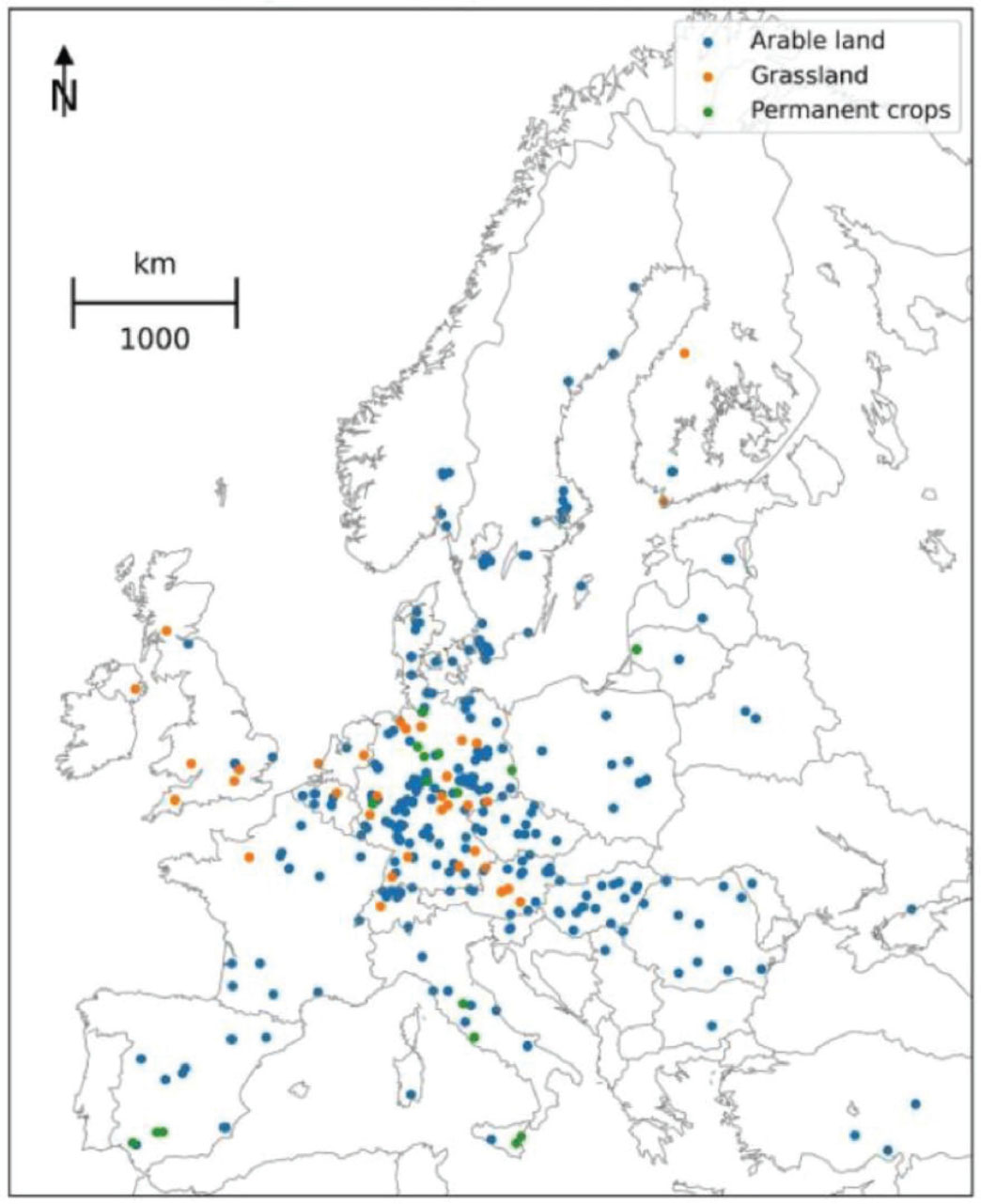
Figure 3.
Geographical distribution of ongoing long-term experiments on permanent grassland, arable land and other crops in Europe (https://www.bonares.de/service-portal/data-repository; last access: 09/2025)
Abbildung 3. Geografische Verteilung von bestehenden Langzeitversuchen im Dauergrünland, Ackerland und anderen Kulturarten in Europa (https://www.bonares.de/service-portal/data-repository; letzter Zugriff: 09/2025)
Of course, the oldest European grassland experiments at Rothamsted in the United Kingdom (Park Grass Experiment, established already in 1856) should also be mentioned here. These extraordinary experiments are still subject of basic and applied grassland research (Jenkinson et al., 2008; Xu et al., 2020; Liang et al, 2020, Cabrera et al., 2021; Poulton et al., 2021; Semchenko et al., 2021; Balfour et al., 2025; Cooke et al., 2025). The scientific community benefits considerably from the comprehensive electronic data archive (Perryman et al., 2018; www.era.rothamsted.ac.uk) and an archive of plant and soils samples, some of which are dating back to the 19th century. Stroud and Ratcliff (2025) have recently pointed out that long-term studies such as the British Park Grass Experiment even provide unique insight into evolution.
4. Nostalgia or waste of resources?
To be quite honest, the considerable period of time and the history behind the long-term experiments naturally also give rise to a certain amount of nostalgia. After all, several generations of renowned scientists have dealt with exactly the same experimental plots and processed them with existing analytical and statistical means/tools. Building on the respect and esteem for the remarkable achievements of the original experimentalists, curiosity and interest develop into an ever-increasing obligation and responsibility not only to preserve this heritage but to make the best possible use of it (Jenkinson, 1991). Taking into account current activities described above and in view of the omnipresent climate change discussion, the primary question in this regard is not whether we can financially afford to continue these long-term experiments but rather whether we can afford to irretrievably abandon such valuable resources.
It is particularly painful when long-term experiments are sacrificed to short-term business or political interests, such as the experimental field at the Austrian site at Piber, which has existed since 1945 and which has been operated as a research branch of AREC Raumberg-Gumpenstein. This area with numerous valuable long-term experiments had to make way entirely for short-term infrastructural plans for the 2003 Styrian provincial exhibition, which ironically never came to fruition. This makes it all the more important to do everything in our power to preserve such areas and experiments and to lobby for them in the best sense of the word.
5. Supportive arguments for the continuation and maintenance of long-term experiments in grassland
The recent past has shown that due to the rapid development of laboratory analytics (some of them with a very low sample requirement), measurement technology (especially minimal invasive or non-invasive techniques such as spectroscopy including use of satellites, micro dialysis), statistics and mathematics, new and, up to now, unexpected possibilities for dealing with burning research questions are constantly opening up. With the final abandonment of long-term experiments, the chance to find answers to future questions would be given up because it would take decades for the hypothesized long-term effects to occur. A good example of this is provided by questions on the effects of management on soil biota, which on grassland is largely unexplored on the one hand but makes a significant contribution to crop productivity and resource use on the other.
Without LTEs, future issues and challenges will be more difficult to predict and solve. Fifty years ago, for example, hardly anyone looked at the consequences of climate change because it could not be foreseen in this way. It is thanks to long-term experiments that we can make such effects visible today, given the numerous limitations to which short-term experiments are subject (Deroche et al., 2021; Emadodin et al., 2021, Schils et al., 2024).
Biocenoses in long-term agronomic experiments on grassland are usually not recorded and evaluated as a whole. Rather, current questions are limited to plant–soil relationships as a function of management. However, LTEs offer a unique opportunity to study biocenoses because they have been able to undergo undisturbed development throughout a long period of time and are now in equilibrium with their biotic and abiotic environment. Today, there is a much greater demand for system studies partly because simulation models offer the possibility of depicting biocenoses in their complexity. This is only possible when very different biocenoses are contrasted at the same site through long-term manipulation of the environment.
While the original scientific questions, for which LTEs have been established, often outlived their usefulness, new questions are permanently arising. Depending on the conception and design of the LTES, these new questions can be worked on, thereby leading to the creation of new experiments or – in special cases – also to a careful adaptation of the LTE.
Disciplines such as ecology, biology, microbiology, environmental systems science, remote sensing, hydrogeology and others are showing increasing interest in grassland and grassland-management experiments. Ecologists and soil scientists have, for instance, worked out research approaches for studies where remote sensing and geographic information systems are used to monitor properties of plant communities and soil, which again allow the identification of traits that are linked to processes and ecosystem services (Barrios, 2007; Wenzel, 2013). In this context, LTEs offer an optimal platform for interdisciplinary research as well as for an interweaving of basic and applied research. Strong interdisciplinary research can substantially contribute to a much better understanding of functions and processes in the entire system (Schellberg and Pötsch, 2014).
In view of ever-tighter budgetary resources for research, it takes appropriate lobbying of the responsible ministries and the relevant research funding bodies at national and EU level. But it also takes a high level of personal commitment and tireless persuasion to preserve these valuable experiments for future generations.
6. What are the most important requirements for the maintenance and future use of long-term experiments?
First of all, the ownership of the area in question needs to be clarified. As an alternative to taking over ownership, it is also possible to conclude long-term lease agreements with the land owners.
An important minimum requirement is the marking or geo-referenced location to determine the exact position of the entire experiment area and the individual plots. Securing, preserving and making available the experimental plans, the scientific concept and relevant experimental records (e.g., work diaries, documentation on changes and on unusual events such as pest infestation, feeding damage or flooding) make an invaluable contribution to the continued scientific use of long-term experiments. This allows scientifically interesting aspects to be determined even a long time after the abandonment of experimental management, such as the long-term effects of the original experimental design on various botanical, agronomic and soil-specific characteristics. Interviews with contemporary witnesses, who were in some way involved in the management, development or processing of these experiments, can also be very useful.
In the best case, of course, consistent management of the experiment according to the original scientific concept including fertilization, utilization (harvest or grazing) or other management measures would ideally be combined with a yield survey as well as appropriate sampling scheme (biomass, soil) for immediate or later analysis. Even if yield and quality analyses of biomass and soil analyses are only carried out at regular intervals throughout several years, this still provides an invaluable source of information in LTEs.
It is important to mention here that the resource input into grassland experiments is generally much lower than that on arable land. Mowing and/or grazing plus fertilizer application are the only basic management efforts required on most LTEs on grassland to provide the setting on which research activities can be introduced, whereas crop rotations, tillage, sowing and pesticide application are not required. Many LTEs on grassland have survived decades only because of a minimum of management effort until research activities have been reactivated. On the other hand, comprehensive LTEs on arable land had to be given up as the high input needed for their continuation could not be provided.
To this end, Janzen (2009) proposes, among other things, the establishment of a common, web-based database. This should be some kind of a common sample library that also enables the exchange of subsamples and the development of uniform sampling protocols. The establishment of such a network could indeed make an essential contribution that goes far beyond the mere preservation and continuation of LTEs. Grosse et al. (2020), for example, have classified agricultural LTEs in Germany and analysed them according to a wide range of criteria (type of crop, main question, parameters collected, availability of reserve samples, etc.). Such summaries provide a very good basis for interested scientists to get an overview of still existing experiments and to find out more about them. Of course, the ideal would be to set up a network to record all agronomic grassland experiments along the lines of the global (ILTER) or the European network of Long-Term Ecological Research sites (LTER-Europe), in which individual long-term agronomic experiments are even included (Mirtl et al, 2015; Mollenhauser et al, 2018). A very important contribution in this context is made by BonaRes (https://tools.bonares.de/ltfe/), which provides detailed information on the latest LTEs including overview maps as well as data in PDF or table format for download (Blanchy et al, 2024; Donmez et al., 2022, 2023, 2024).
7. The great appeal of grassland research
Permanent grassland expels by at least three main characteristics: (i) spatial and temporal variability, (ii) multifunctionality and (iii) extraordinary adaptability to management and environment, often interpreted as the result of plasticity of its plant traits. It is a matter of fact that there are no two grassland areas that are absolutely identical. Even within one management unit, variability of floristic and functional composition in interaction with soil nutrient content and soil biota – to mention only one example – can be considerable. Further, it is well proven that short-term analyses in grassland may not explain the interplay of environmental conditions with the functionalities of plants and soil. Moreover, even after more than 150 years of research in LTE sites, we are still far from understanding the biological, physical and chemical mechanisms that may explain such variation. Working with LTEs on grassland is so appealing because they motivate us to continue with our search for answers to questions that we would not have been pointed to at other sites, for example:
Can we quantify the contribution of climate change to the variability of forage yield and quality?
What is the long-term response of soil biota to intensification?
What is the storage capacity for soil carbon at different intensity levels over a long term?
What factors drive plasticity of plant traits in a multi-species community?
Can gene drift in plant traits on permanent grassland explain a change in canopy functions?
How can we best identify the input variables to improve our mechanistic simulation models for yield and quality in order to improve our predictions?
These questions are only examples, and some of them are already dealt with. Especially, the final one, the improvement of models, is burning because not only the scientific community but also the decision-makers and the public ask for projections on future existence of grassland as an indispensable source of any kind of ecosystem services.
Grassland research is a complex but exciting subject, which even after many years still brings new surprises and challenges. In any case, it provides considerably more joy and variety than was granted to John Mainstone in the so-called pitch drop experiment, which he started in Australia in 1927. At that time, pitch was filled into a glass funnel taking a whole 3 years for it to settle. The glass funnel was then opened so that the pitch could drip out. In 83 years, a total of only eight drops of pitch dripped down, although this was never actually observed. Mainstone – head of the physics department at the University of Queensland/Australia – supervised this experiment for more than 50 years and finally passed away without having observed a single drop. One year after his death, the ninth drop touched the eighth drop; however, it was still attached to the funnel (Webb, 2014). In comparison, research on long-term grassland experiments guarantees much more success.
In conclusion, it should be mentioned once again that it is not primarily a question of whether we can afford to maintain LTEs that still exist. Rather, the question is whether, from a scientific point of view, we can afford to abandon them simply to save money.