
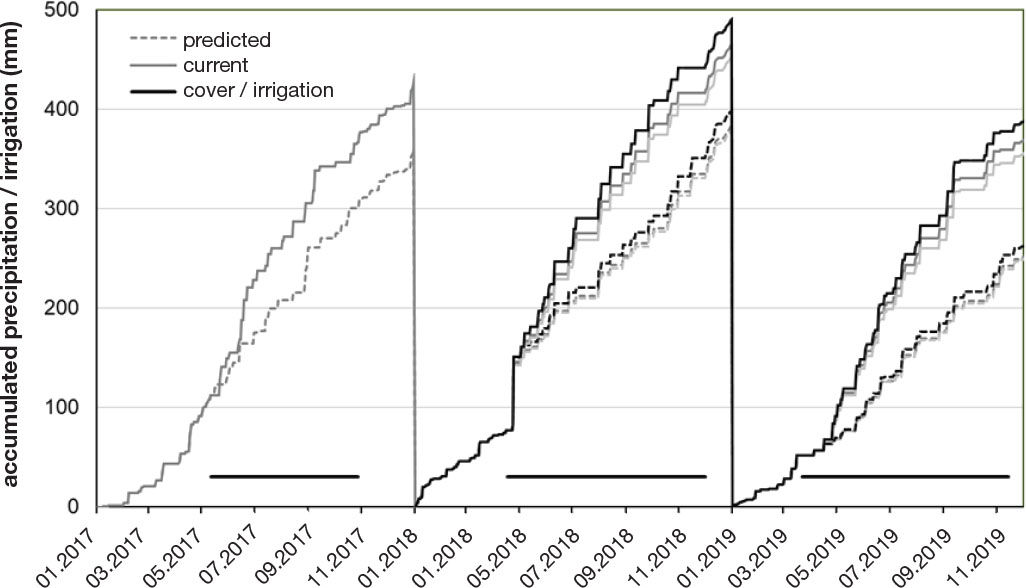
Figure 1.
Period of cover/irrigation (black line) and precipitation and irrigation applied to the lysimeter soil from 2017 until 2019. From 2018 onward, the variation of irrigation – the minimum (light gray) and the maximum (black) on lysimeter replicates – besides the average (dark gray) irrigation is illustrated.
Abbildung 1. Folienabdeckung der Lysimeteranlage und Bewässerung (schwarze Linie) sowie die akkumulierte Niederschlags- und Bewässerungsmenge in den Jahren 2017, 2018 und 2019. Ab 2018 wurde die Schwankung - Minimum (hellgrau), Maximum (schwarz), Mittelwert (dunkelgrau) – der Lysimeterbewässerung dargestellt.
Table 1.
Crop rotation and management of the lysimeters
Tabelle 1. Fruchtfolge und Bewirtschaftung der Lysimeteranlage
| Crop | Sowing | Harvest | Crop residue management |
|---|---|---|---|
| Spring wheat (Triticum turgidum subsp. durum (Desf.) Husn) cv. Floradur | 04.04.2017 | 20.07.2017 | Crop residues removed |
| White mustard (Sinapis alba L.) catch crop | 24.08.2017 | 07.03.2018 | Mustard residues were mulched and incorporated into the soil on 09.04.2018 |
| Spring barley (Hordeum vulgare L. cv. Cerbinetta) | 09.04.2018 | 23.07.2018 | Crop residues removed |
| Winter wheat (Triticum aestivum L.) cv. Capo | 11.10.2018 | 03.07.2019 | Crop residues incorporated |
Table 2.
Application rates of N fertilizer in kg N ha−1 dependent on the soil type (calcaric Phaeozem - PS; calcic Chernozem – Ch; gleyic Phaeozem – Pg)
Tabelle 2. Stickstoffdüngung in kg N ha−1 angepasst an den Bodentyp (calcaric Phaeozem - PS; calcic Chernozem – Ch; gleyic Phaeozem – Pg)
| Fertilization date | Pg | Ps | Ch |
|---|---|---|---|
| 04.04.2017 | 55 | 40 | 55 |
| 08.05.2018 | 50 | 50 | 50 |
| 20.03.2019 | 40 | 35 | 40 |
| 16.04.2019 | 65 | 45 | 65 |
| 16.05.2019 | 45 | 40 | 45 |
Table 3.
Harvests of cultivated crops and weeds per plant species and year for the different soil types and precipitation treatments in g m−2
Tabelle 3. Ernteertrag (g m−2) von Getreide, Zwischenfrucht und Beikräutern aus den Jahren 2017, 2018 und 2019 für die verschiedenen Bodentypen und Niederschlagsszenarien
| Crop (year) | Gleyic Phaeozem | Calcaric Phaeozem | Calcic Chernozem | |||
|---|---|---|---|---|---|---|
| Current | Predicted | Current | Predicted | Current | Predicted | |
| Spring wheat (2017) | 112 (19) | 35 (4) | 150 (38) | 73 (56) | 81 (19) | 33 (30) |
| Mustard (2017–2018) | 351 (38) | 360 (43) | 199 (63) | 177 (17) | 247 (88) | 351 (81) |
| Spring barley (2018) | 542 (56) | 352 (56) | 247 (104) | 145 (122) | 327 (68) | 249 (44) |
| Weed (2018) | 119 (47) | 104 (53) | 121 (36) | 100 (40) | 118 (88) | 70 (27) |
| Winter wheat (2019) | 953 (119) | 562 (118) | 456 (12) | 242 (83) | 625 (140) | 564 (37) |
| Weed (2019) | 12 (10) | 6 (7) | 33 (16) | 3 (0) | 35 (14) | 8 (9) |
[i] Given are the average values (n = 3; standard deviation in brackets) of aboveground dry plant biomass.
Table 4.
Two-way ANOVA table of the impact of soil and precipitation on the plant biomass of cash and catch crops, grain yield, and weeds in the years 2017–2019
Tabelle 4. 2-Wege-ANOVA-Tabelle zum Einfluss von Boden und Niederschlag auf die Pflanzenbiomasse von Haupt- und Zwischenfrüchten, Ertrag und Beikräuter für die Jahre 2017 bis 2019
| Parameter | Unit | Soil | Precipitation | ||
|---|---|---|---|---|---|
| F | p | F | p | ||
| Spring wheat | g m−2 | 4.47/PS | 0.035 | 19.6/curr | <0.001 |
| - Grain | g m−2 | 2.60 | 0.115 | 12.8/curr | 0.004 |
| - Straw | g m−2 | 6.17/PS | 0.014 | 19.2/curr | <0.001 |
| Mustard | g m−2 | 12.0 | 0.001 | 1.14 | 0.306 |
| Spring barley | g m−2 | 12.4/Pg | 0.001 | 8.76/curr | 0.012 |
| - Grain | g m−2 | 12.2/Pg | 0.001 | 8.73/curr | 0.012 |
| - Straw | g m−2 | 4.09/Pg | 0.044 | 6.97/curr | 0.022 |
| Weed | g m−2 | 0.208 | 0.815 | 1.29 | 0.279 |
| Winter wheat | g m−2 | 18.6/Pg | <0.001 | 16.3/curr | 0.002 |
| - Grain | g m−2 | 28.6/Pg | <0.001 | 27.6/curr | <0.001 |
| - Straw | g m−2 | 14.3/Pg | <0.001 | 9.15/curr | 0.011 |
| Weed | g m−2 | 2.27 | 0.146 | 17.0/curr | 0.001 |
[i] F indicates the mean square of the treatment divided by the mean square of the residuals and p is the significance value. The treatment (soil and precipitation) with the higher value is indicated after F. Values with p ≤ 0.05 are highlighted in bold. Pg – gleyic Phaeozem; Ps – calcaric Phaeozem; Ch – calcic Chernozem; curr – current precipitation scenario; pre – predicted precipitation scenario;
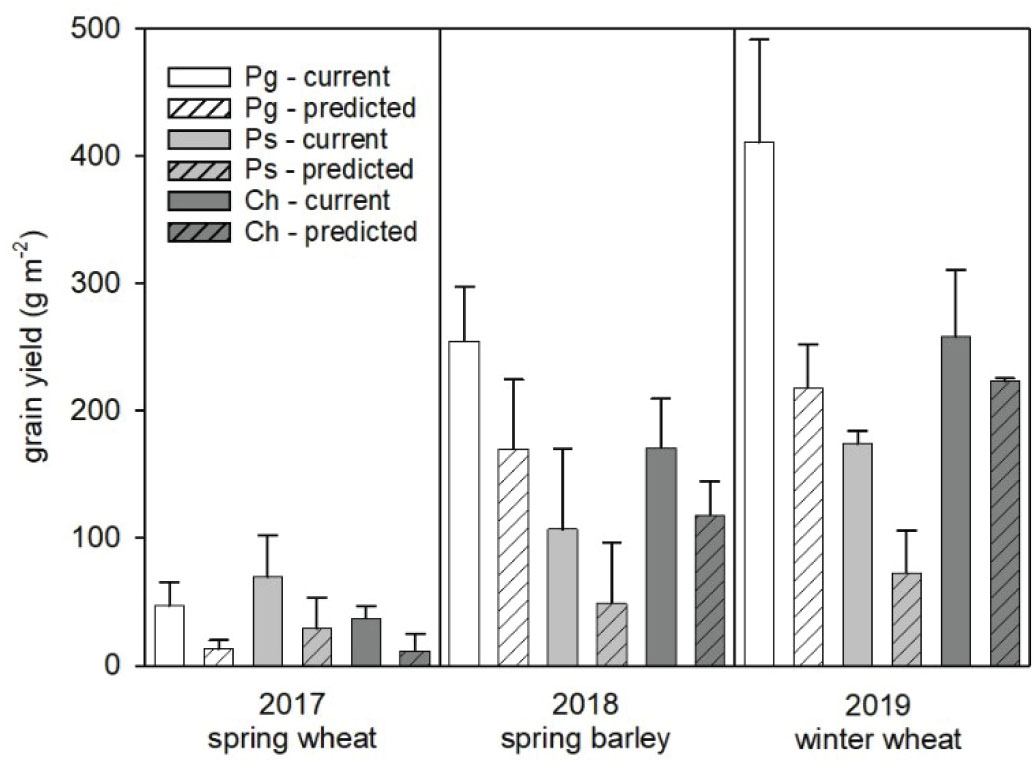
Figure 2.
Grain yield of spring wheat (2017), spring barley (2018), and winter wheat (2019) for the different soil types and precipitation treatments in g m−2. Given are the arithmetic mean values (n = 3), and the error bars represent the standard deviation.
Abbildung 2. Ertrag von Sommerweizen (2017), Sommergerste (2018) und Winterweizen (2019) für die verschiedenen Bodentypen und Niederschlagsszenarien in g m−2. Gegeben sind die arithmetischen Mittelwerte (n=3) und die Standardabweichung als Fehlerbalken.
Table 5.
Delta13C values of cultivated crops per plant species and year for the different soil types and precipitation treatments in ‰
Tabelle 5. Delta13C Werte der Kulturpflanzen pro Jahr für die verschiedenen Bodentypen und Niederschlagsszenarien in ‰
| Crop (year)/part | Gleyic Phaeozem | Calcaric Phaeozem | Calcic Chernozem | |||
|---|---|---|---|---|---|---|
| Current | Predicted | Current | Predicted | Current | Predicted | |
| Spring wheat (2017)/grain | −25.3 (0.6) | −23.6 (0.8) | −24.8 (0.8) | −23.7 (0.4) | −25.1 (1.0) | −24.4 (1.0) |
| Spring wheat (2017)/straw | −27.2 (1.0) | −26.0 (0.3) | −26.9 (0.3) | −26.0 (0.4) | −26.5 (0.6) | −25.5 (0.3) |
| Spring barley (2018)/grain | −27.1 (0.2) | −26.0 (0.3) | −25.2 (1.0) | −24.6 (0.7) | −27.9 (0.4) | −27.5 (0.3) |
| Spring barley (2018)/straw | n.d. | n.d. | −26.5 (0.3) | −25.7 (0.2) | −28.0 (0.3) | −27.1 (0.1) |
| Winter wheat (2019)/grain | −26.4 (0.1) | −24.6 (0.1) | −24.4 (0.1) | −23.6 (0.9) | −26.9 (0.8) | −25.1 (0.0) |
| Winter wheat (2019)/straw | −28.3 (0.8) | −27.5 (0.4) | −27.6 (0.5) | −26.7 (0.3) | −28.2 (0.4) | −27.6 (0.6) |
[i] Given are the average values (n = 3; standard deviation in brackets) n.d. not determined
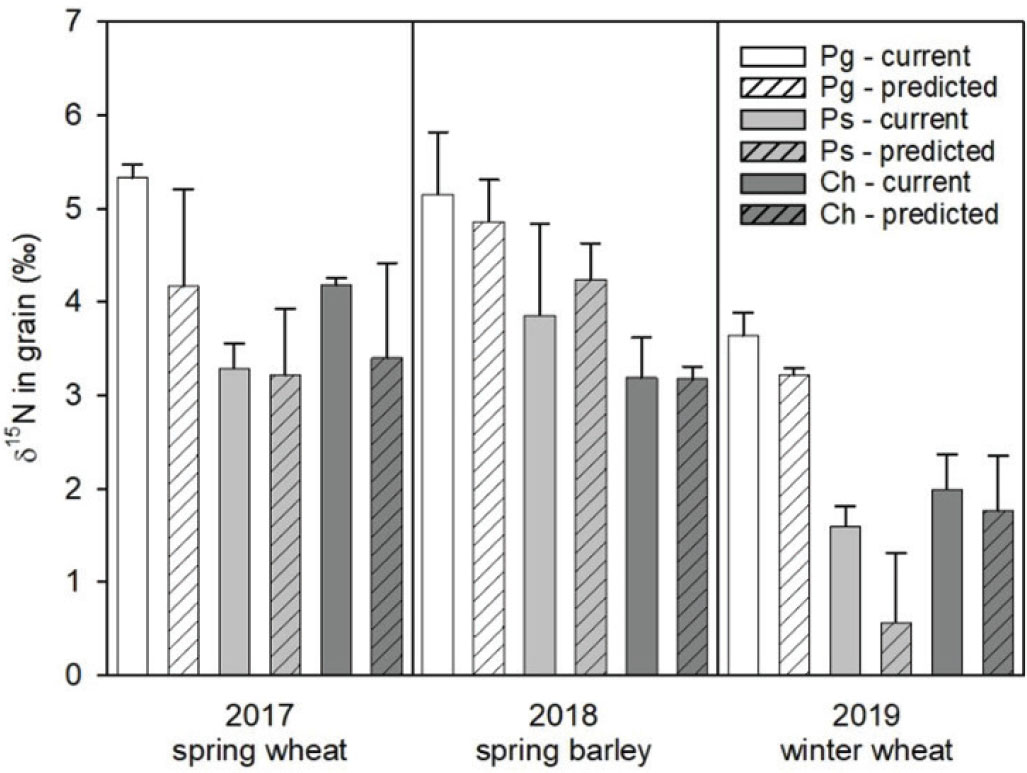
Figure 3.
Grain δ15N values of spring wheat (2017), spring barley (2018), and winter wheat (2019) for the different soil types and precipitation treatments in ‰. Given are arithmetic mean values (n = 3), and the error bars represent the standard deviation.
Abbildung 3. Korn δ15N Werte von Sommerweizen (2017), Sommergerste (2018) und Winterweizen (2019) für die verschiedenen Bodentypen und Niederschlagsszenarien in ‰. Gegeben sind die arithmetischen Mittelwerte (n = 3) und die Standardabweichung als Fehlerbalken.
Supplemental Table 1.
Chemical and physical soil characteristics (n = 6) of gleyic Phaeozem (Pg), sandy calcaric Phaeozem (Ps), and calcic Chernozem (Ch) in the upper 10 cm.
Ergänzungstabelle 1. Chemische und physikalische Bodeneigenschaften (n = 6) des gleyic Phaeozem (Pg), des sandigen calcaric Phaeozem (Ps) und des calcic Chernozem (Ch) in den oberen 10 cm.
| Parameter | Pg | Ps | Ch |
|---|---|---|---|
| pH | 7.92 ± 0.04 | 7.93 ± 0.03 | 7.94 ± 0.03 |
| CaCO3 (%) | 29.0 ± 1.0 | 13.9 ± 0.4 | 20.9 ± 1.0 |
| Total organic C (%) | 2.32 ± 0.09 | 1.93 ± 0.12 | 2.91 ± 0.04 |
| Total N (%) | 0.211 ± 0.012 | 0.102 ± 0.005 | 0.227 ± 0.005 |
| Available N (mg/kg/7 d) | 57.9 ± 5.7 | 37.5 ± 5.5 | 59.2 ± 4.5 |
| Available P (mg/kg) | 62.5 ± 5.2 | 134.3 ± 3.8 | 81.0 ± 6.2 |
| Available K (mg/kg) | 82.02 ± 13.5 | 57.0 ± 8.5 | 73.5 ± 8.0 |
| CEC (cmolc/kg) | 25.9 ± 1.2 | 13.8 ± 0.4 | 28.9 ± 0.3 |
| Ca (% from CEC) | 76.5 ± 1.4 | 78.1 ± 0.7 | 78.4 ± 1.0 |
| Mg (% from CEC) | 19.8 ± 1.2 | 18.0 ± 0.6 | 18.6 ± 0.9 |
| K (% from CEC) | 1.1 ± 0.1 | 1.5 ± 0.2 | 0.9 ± 0.1 |
| Na (% from CEC) | 2.5 ± 0.4 | 2.4 ± 0.4 | 2.1 ± 0.3 |
| Aggregate stability (%) | 21.3 ± 5.5 | 23.2 ± 8.5 | 30.7 ± 6.8 |
[i] Available N determined using anaerobic incubation (ÖNORM L1204); Available K and P determined using a calcium lactate acetate extraction; CEC = cation exchange capacity determined using BaCl2 extraction; H, Mn, Fe, and Al were not detected in the BaCl2 extractant.
Supplemental Table 2.
Three-way ANOVA tables of the overall impact of soil, precipitation, and year (2017, 2018, and 2019) on crop yield, carbon and nitrogen content, and carbon and nitrogen isotope signature
Ergänzungstabelle 2. 3-Wege-ANOVA-Tabellen der Auswirkungen von Boden, Niederschlag und Jahr (2017, 2018 und 2019) auf Ernteertrag, Kohlenstoff- und Stickstoffgehalt sowie Kohlenstoff- und Stickstoffisotopensignatur.
| Parameter | Unit | Soil | Precipitation | Year | ||
|---|---|---|---|---|---|---|
| F | p | F | p | p | ||
| Crop | g m−2 | 25.8/Pg, Ch | <0.001 | 34.1/curr | <0.001 | <0.001 |
| - Grain | g m−2 | 30.9/Pg, Ch | <0.001 | 42.9/curr | <0.001 | <0.001 |
| - Straw | g m−2 | 16.4/Pg | <0.001 | 20.5/curr | <0.001 | <0.001 |
| Harvest index | 2.004 | 0.150 | 7.98/curr | 0.008 | 0.031 | |
| Weed** | g m−2 | 0.08 | 0.924 | 3.75 | 0.065 | <0.001 |
| Grain N | % | 0.76 | 0.474 | 0.60 | 0.444 | 0.005 |
| Straw N* | % | 0.79 | 0.461 | 12.3/pre | 0.001 | <0.001 |
| Grain δ15N | ‰ | 40.3/Pg | <0.001 | 6.09/curr | 0.019 | <0.001 |
| Straw δ15N* | ‰ | 11.0/Ch | <0.001 | 0.16 | 0.688 | <0.001 |
| Grain C | % | 4.19/PS, Ch | 0.024 | 0.248 | 0.662 | 0.061 |
| Straw C* | % | 5.94/PS | 0.006 | 0.50 | 0.485 | <0.001 |
| Grain δ13C | ‰ | 28.4/PS | <0.001 | 33.8/pre | <0.001 | <0.001 |
| Straw δ13C* | ‰ | 10.2/PS | <0.001 | 38.7/pre | <0.001 | <0.001 |
F indicates the mean square of the treatment divided by the mean square of the residuals and p is the significance value. The treatment (soil and precipitation) with the higher value is indicated after F. Values with p ≤ 0.05 are highlighted in bold.
Supplemental Table 3.
Two-way ANOVA table of the impact of soil and precipitation on carbon and nitrogen content and isotope signature of spring wheat and mustard cultivated in 2017
Ergänzungstabelle 3. 2-Wege-ANOVA-Tabelle zum Einfluss von Boden und Niederschlag auf den Kohlenstoff- und Stickstoffgehalt und die Isotopensignatur von Sommerweizen und Senf (2017)
| Parameter | Unit | Soil | Precipitation | ||
|---|---|---|---|---|---|
| F | p | F | p | ||
| Spring wheat – harvest 20.07.2017 | |||||
| Grain N | % | 16.8/Pg, Ch | <0.001 | 5.11/pre | 0.043 |
| Straw N | % | 13.4/Pg, Ch | <0.001 | 9.65/pre | 0.009 |
| Grain δ15N | ‰ | 7.61/Pg | 0.007 | 4.46 | 0.056 |
| Straw δ15N | ‰ | 10.1/Pg, Ch | 0.003 | 2.78 | 0.121 |
| Grain C | % | 8.11/Pg, Ch | 0.006 | 0.61 | 0.450 |
| Straw C | % | 4.49 | 0.035 | 0.71 | 0.416 |
| Grain δ13C | ‰ | 0.61 | 0.561 | 8.83/pre | 0.012 |
| Straw δ13C | ‰ | 2.16 | 0.158 | 15.2/pre | 0.002 |
| Spring wheat – leaf 06.07.2017 | |||||
| Leaf N | % | 19.0/Pg, Ch | <0.001 | 5.11/pre | 0.043 |
| Leaf δ15N | ‰ | 8.96/Pg | 0.004 | 14.0/curr | 0.003 |
| Leaf C | % | 0.088 | 0.916 | 3.97 | 0.070 |
| Leaf δ13C | ‰ | 2.13 | 0.161 | 30.8/pre | <0.001 |
| Mustard leaf 24.10.2017 | |||||
| Mustard N | % | 41.3/Pg | <0.001 | 17.1/pre | 0.003 |
| Mustard δ15N | ‰ | 0.52 | 0.609 | 1.52 | 0.241 |
| Mustard C | % | 3.59 | 0.063 | 4.50 | 0.057 |
| Mustard δ13C | ‰ | 0.65 | 0.538 | 4.18 | 0.064 |
[i] F indicates the mean square of the treatment divided by the mean square of the residuals and p is the significance value. The treatment (soil and precipitation) with the higher value is indicated after F. Values with p ≤ 0.05 are highlighted in bold. Pg – gleyic Phaeozem; PS – sandy Phaeozem; Ch – Chernozem; curr – current precipitation scenario; pre – predicted precipitation scenario
Supplemental Table 4:
Two-way ANOVA tables of the impact of soil and precipitation on yield, carbon and nitrogen content, and isotope signature of spring barley cultivated in 2018
Ergänzungstabelle 4. 2-Wege-ANOVA-Tabelle zum Einfluss von Boden und Niederschlag auf den Kohlenstoff- und Stickstoffgehalt und die Isotopensignatur von Sommergerste (2018)
| Spring barley – harvest 23.07.2018 | |||||
|---|---|---|---|---|---|
| Parameter | Unit | Soil | Precipitation | ||
| F | p | F | p | ||
| Grain N | % | 0.24 | 0.792 | 3.11 | 0.103 |
| Straw N* | % | 7.71/PS | 0.024 | 1.76 | 0.221 |
| Grain δ15N | ‰ | 15.2/Pg | <0.001 | 0.01 | 0.919 |
| Straw δ15N* | ‰ | 0.05 | 0.834 | 4.92 | 0.057 |
| Grain C | % | 1.39 | 0.286 | 0.46 | 0.512 |
| Straw C* | % | 7.11/PS | 0.028 | 0.76 | 0.409 |
| Grain δ13C | ‰ | 37.5/PS Pg | <0.001 | 7.15/pre | 0.020 |
| Straw δ13C* | ‰ | 117/PS | <0.001 | 40.5/pre | <0.001 |
F indicates the mean square of the treatment divided by the mean square of the residuals and p is the significance value. The treatment (soil and precipitation) with the higher value is indicated after F. Values with p ≤ 0.05 are highlighted in bold.
Supplemental Table 5.
Two-way ANOVA tables of the impact of soil and precipitation on yield, carbon and nitrogen content, and isotope signature of winter wheat cultivated in 2019
Ergänzungstabelle 5. 2-Wege-ANOVA-Tabelle zum Einfluss von Boden und Niederschlag auf den Kohlenstoff- und Stickstoffgehalt und die Isotopensignatur von Winterweizen (2019)
| Parameter | Winter wheat – harvest 03.07.2019 | |||||
|---|---|---|---|---|---|---|
| Unit | Soil | Precipitation | ||||
| F | p | F | p | |||
| Grain N | % | 0.77 | 0.488 | 0.41 | 0.536 | |
| Straw N | % | 2.10 | 0.166 | 4.92/pre | 0.047 | |
| Grain δ15N | ‰ | 36.8/Pg, Ch | <0.001 | 5.74/curr | 0.038 | |
| Straw δ15N | ‰ | 5.22/Pg | 0.023 | 0.17 | 0.688 | |
| Grain C | % | 91.6/Pg | <0.001 | 0.00 | 0.987 | |
| Straw C | % | 5.79/PS, Ch | 0.017 | 0.60 | 0.452 | |
| Grain δ13C | ‰ | 13.2/PS | 0.002 | 21.1/pre | 0.001 | |
| Straw δ13C | ‰ | 4.05/PS | 0.045 | 8.38/pre | 0.013 | |
[i] F indicates the mean square of the treatment divided by the mean square of the residuals and p is the significance value. The treatment (soil and precipitation) with the higher value is indicated after F. Values with p ≤ 0.05 are highlighted in bold. Pg – gleyic Phaeozem; PS – sandy Phaeozem; Ch – Chernozem; curr – current precipitation scenario; pre – predicted precipitation scenario
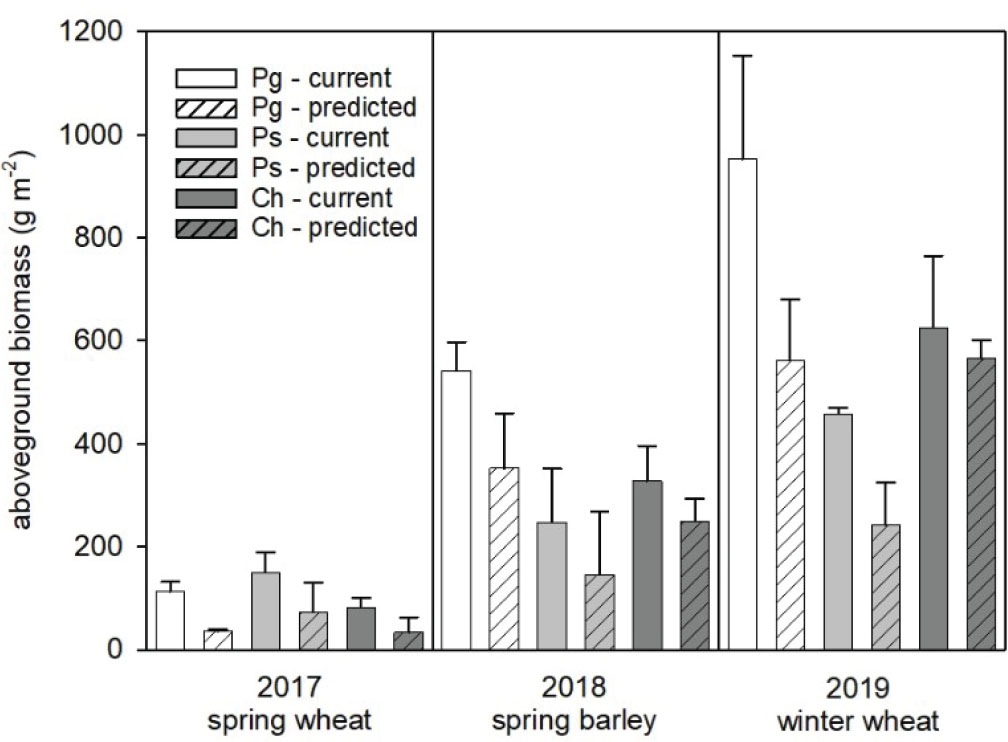
Supplemental Figure 1.
Harvests of spring wheat (2017), spring barley (2018), and winter wheat (2019) for the different soil types and precipitation treatments in g m−2. Given are the arithmetic mean values (n = 3) of the aboveground dry biomass, and the error bars represent the standard deviation.
Ergänzungsabbildung 1. Ernten von Sommerweizen (2017), Sommergerste (2018) und Winterweizen (2019) für die verschiedenen Bodentypen und Niederschlagsbehandlungen in g m−2. Gegeben sind die arithmetischen Mittelwerte (n=3). Die Fehlerbalken stellen die Standardabweichung dar.
Supplemental Figure 2.
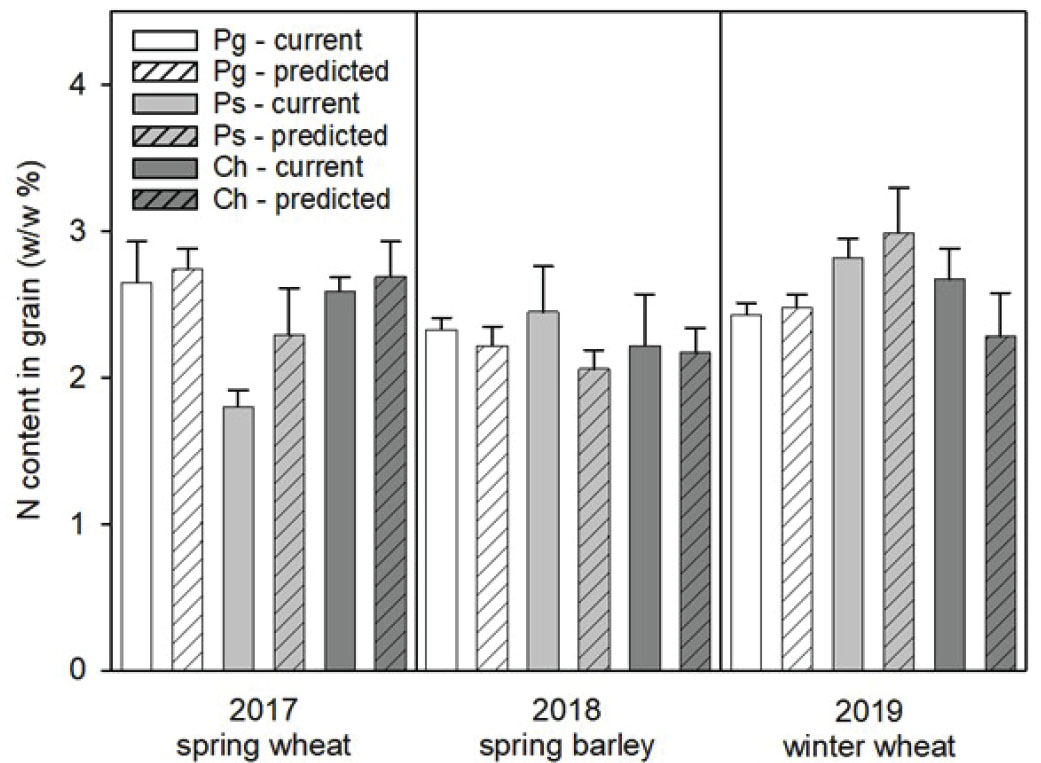
Grain N content of spring wheat (2017), spring barley (2018), and winter wheat (2019) for the different soil types and precipitation treatments in ‰. Given are the arithmetic mean values (n = 3), and the error bars represent the standard deviation.
Ergänzungsabbildung 2. Stickstoffgehalt im Korn von Sommerweizen (2017), Sommergerste (2018) und Winterweizen (2019) für die verschiedenen Bodentypen und Niederschlagsbehandlungen in ‰. Gegeben sind die arithmetischen Mittelwerte (n = 3). Die Fehlerbalken stellen die Standardabweichung dar.
Supplemental Figure 3.
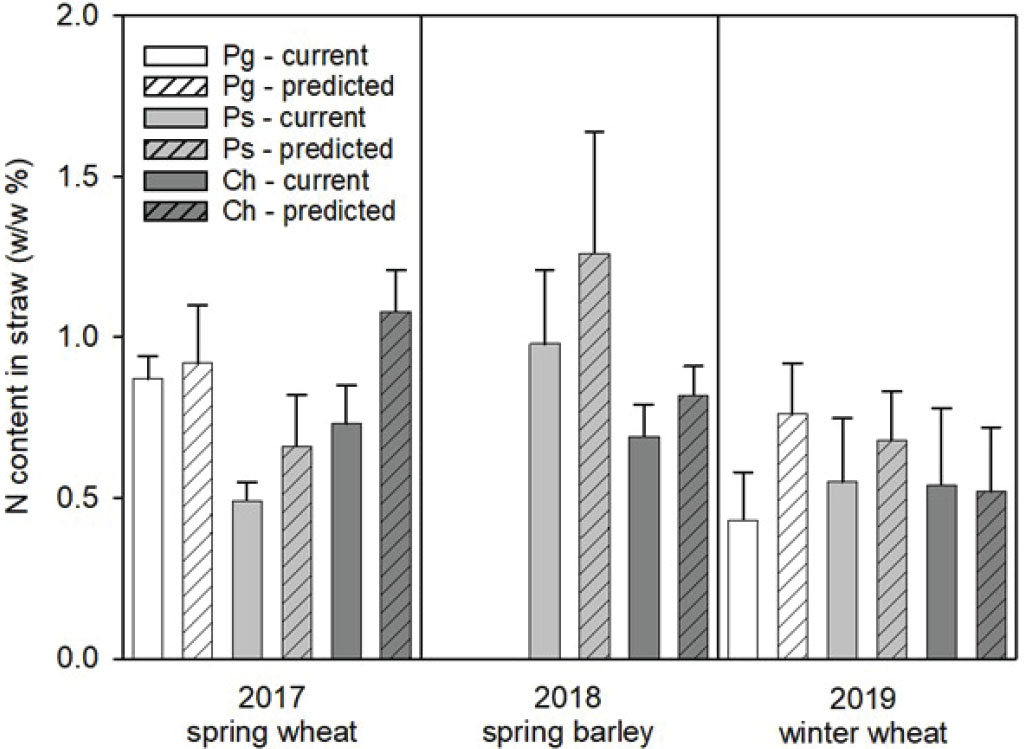
Straw N content of spring wheat (2017), spring barley (2018), and winter wheat (2019) for the different soil types and precipitation treatments in ‰. Given are the arithmetic mean values (n = 3), and the error bars represent the standard deviation.
Ergänzungsabbildung 3. Stickstoffgehalt des Strohs von Sommerweizen (2017), Sommergerste (2018) und Winterweizen (2019) für die verschiedenen Bodentypen und Niederschlagsbehandlungen in ‰. Gegeben sind die arithmetischen Mittelwerte (n = 3). Die Fehlerbalken stellen die Standardabweichung dar.
Supplemental Figure 4.
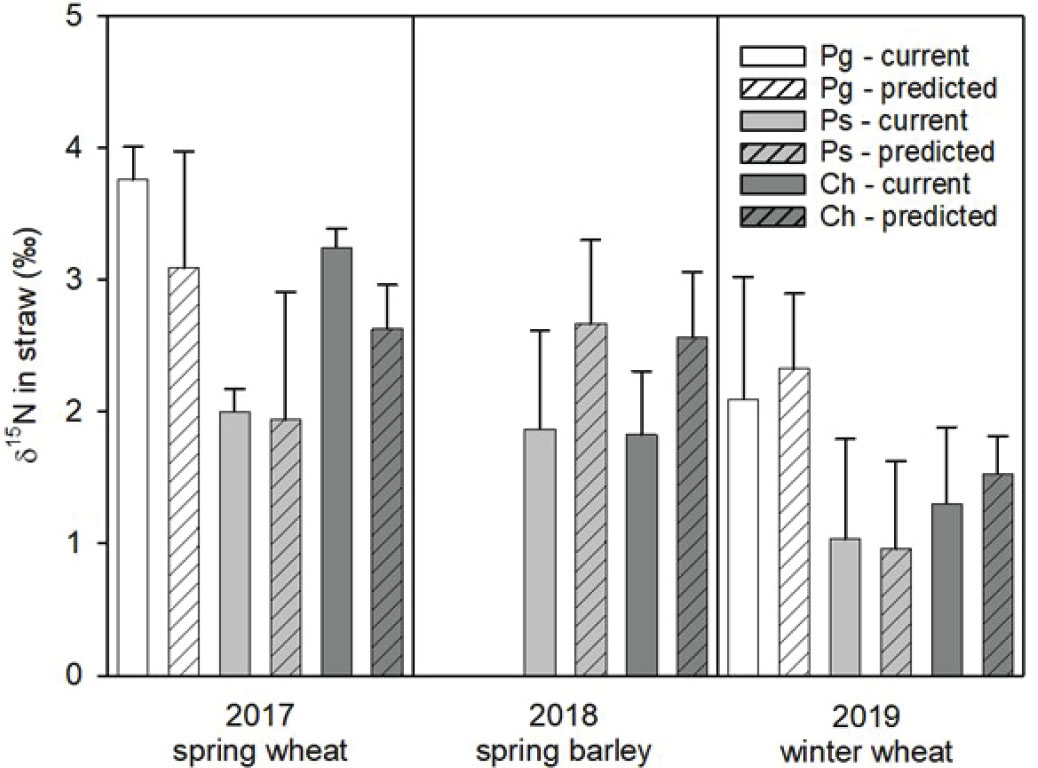
Straw δ15N values of spring wheat (2017), spring barley (2018), and winter wheat (2019) for the different soil types and precipitation treatments in ‰. Given are the arithmetic mean values (n = 3), and the error bars represent the standard deviation.
Ergänzungsabbildung 4. Delta15N-Werte des Strohs von Sommerweizen (2017), Sommergerste (2018) und Winterweizen (2019) für die verschiedenen Bodentypen und Niederschlagsbehandlungen in ‰. Gegeben sind die arithmetischen Mittelwerte (n = 3). Die Fehlerbalken stellen die Standardabweichung dar.