
Table 1
Major chemical constituents of the studied phytogenics
Tabelle 1. Chemische Hauptbestandteile der untersuchten phytogenen Substanzen
| Phytogenic | Compositiona |
|---|---|
| Garlic oil | Diallyl disulfid (59.1%), diallyl trisulfid (11.7%), and methyl propyl trisulfid (1.1%) |
| Thymol | Thymol (100%) |
| Carvacrol | Carvacrol (100%) |
| Thyme oil | p-Cymene (26.9%), γ-terpinene (7.7%), linalool (5%), 4-terpineol (0.7%), thymol (41.1%), and carvacrol (3%) |
| Cinnamaldehyde | trans-Cinnamaldehyde (99.4%) |
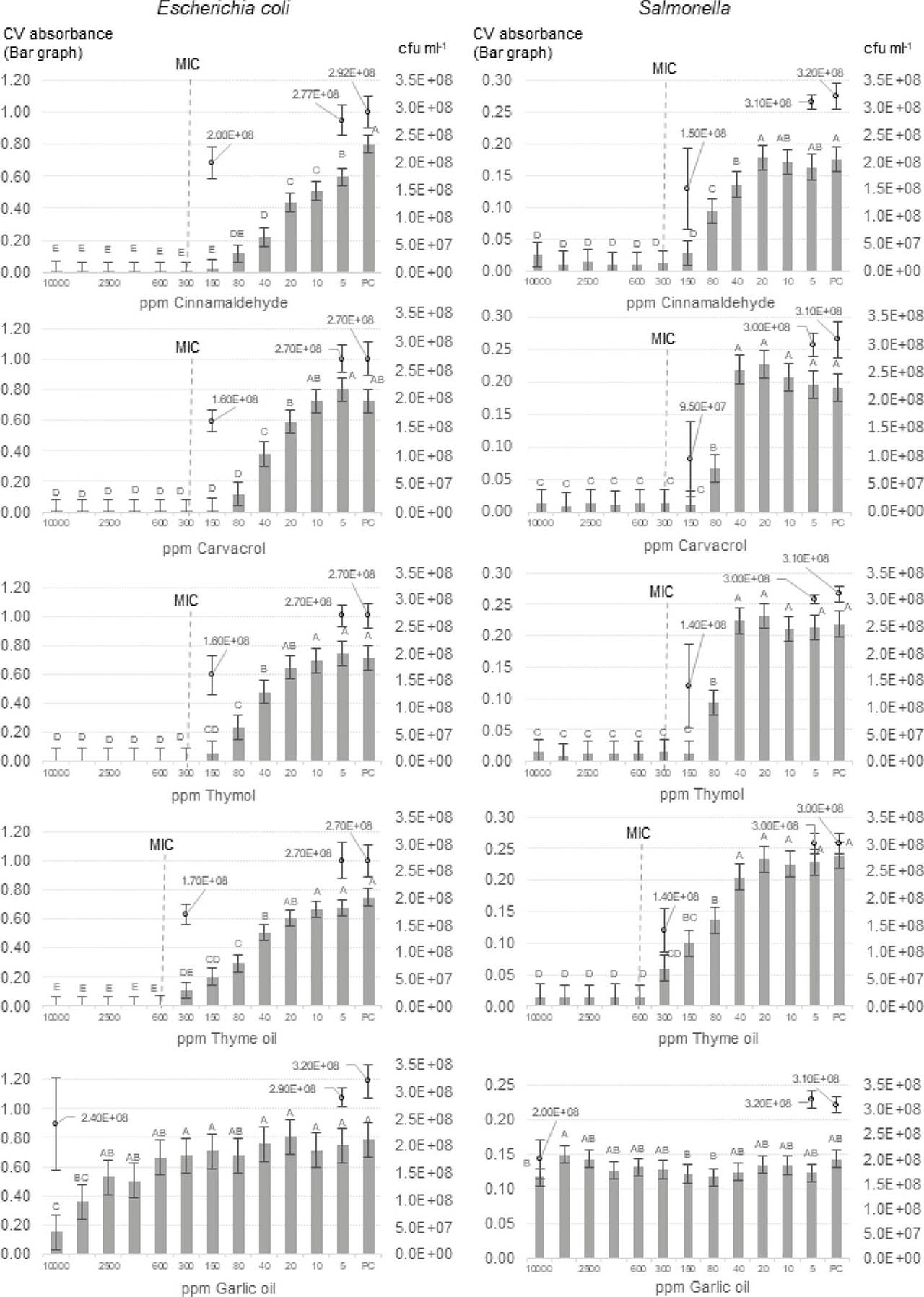
Figure 1
CV biofilm and viable counts (CFU ml−1) of E. coli and Salmonella exposed to the phytogenics garlic oil, cinnamaldehyde, carvacrol, thymol, and thyme oil. The different letters above the bars (CV absorption) indicate significant differences (P ≤ 0.05) within a chart. The viable counts of the PCs as well as those at the first sub-MIC and at 5 ppm were quantified and plotted as dots.
Figure 1. CV-Biofilm und Zellzahlen (KBE ml−1) von E. coli und Salmonella behandelt mit den phytogenen Substanzen Knoblauchöl, Zimtaldehyd, Carvacrol, Thymol und Thymianöl. Die unterschiedlichen Buchstaben über den Balken (CV-Absorption) zeigen signifikante Unterschiede (P ≤ 0,05) innerhalb eines Diagramms. Die Zellzahlen der Wachstumskontrollen (PC), der ersten sub-MICs und jene bei 5 ppm wurden quantifiziert und als Punkte dargestellt.