
1. Introduction
Regular exercise has been shown to maintain and improve physical and mental health (World Health Organization, 2020). In particular, its benefits on positive affect and cognitive function have gained increasing attention as new aspects of exercise benefits (Chang et al., 2025). However, these benefits depend on appropriate conditions, including frequency, intensity, time, type, volume, and progression (Zhang et al., 2023).
One key benefit of exercise in enhancing cognitive function is arousal (Byun et al., 2016; Lambourne & Tomporowski, 2010). Sensory stimuli, such as music and aroma, that induce positive affect and arousal may further augment this benefit (Fukuie et al., 2023; Suwabe et al., 2021). “Green exercise”, defined as exercise in environments enriched with sensory stimuli (Wooller et al., 2016), has been shown to enhance positive affect (Barton & Pretty, 2010; Pretty et al., 2005; Yeh et al., 2016). However, access to such environments is not always feasible due to constraints related to residential settings (e.g., urban areas), work environments (e.g., desk jobs), and weather conditions (e.g., rain or snow). Adapting sensory stimuli such as music and aroma to indoor settings may enable the development of a sensory-enriched exercise program, thereby expanding accessible exercise options.
Groove music – defined as music that induces a “pleasurable urge to move” (Madison, 2006; Matthews et al., 2023) – is well-suited for exercise contexts. According to Senn’s model, multiple factors, including rhythmic bodily synchronization, positive affect, and arousal, collectively influence the induction of groove sensations (Senn et al., 2024). In our previous study, a groove-inducing drum pattern (groove rhythm [GR]) and very-light-intensity bicycle exercise with GR enhanced prefrontal cortex activity and executive function, only in participants who reported higher levels of groove sensation, subjective audiomotor entrainment, and arousal (Fukuie et al., 2022, 2023). These findings suggest that GR may promote exercise-related benefits in brain function by simultaneously increasing groove sensation, positive affect, and arousal.
Peppermint (PM) has been shown to improve respiratory efficiency and exercise performance (Meamarbashi & Rajabi, 2013; Miranda Neto et al., 2023), indicating its compatibility with exercise. PM contains 1,8-cineole, a compound associated with improved alertness and cognitive function (Hoult et al., 2019; Meamarbashi & Rajabi, 2013; Moss et al., 2008; Moss & Oliver, 2012). Thus, PM may enhance exercise-related cognitive benefits by improving affect and arousal through its psychological and pharmacological effects.
To maximize positive affect and arousal during exercise accompanied by GR or PM, Exercise duration should also be considered. Green exercise has been reported to produce greater improvements in mood for 5 min than after 10 min or longer (Barton & Pretty, 2010), even though the standard duration for examining the effects of exercise on mood and cognitive function is 10 min or longer (Byun et al., 2014; Chan et al., 2019; Yanagisawa et al., 2010). It is therefore reasonable to assume that boredom increases as exercise duration lengthens. Boredom during exercise has been associated with negative affect and decreased exercise participation (Bieleke et al., 2025). Accordingly, a shorter exercise duration may be optimal if the focus is on increasing positive affect. However, the changes in boredom, affect, and arousal induced by 10 min of exercise with music or aroma stimuli remain unclear.
In this study, we aimed to examine the changes in boredom, affect, and arousal induced by 10 min of exercise with music or aroma stimuli. We hypothesized that, even within this relatively short duration, boredom would increase over time, whereas positive affect and arousal would be greater with shorter exercise durations. The findings of this study may inform the development of exercise programs that promote cognitive function by using sensory stimuli to increase positive affect.
2. Material and methods
2.1. Participants
A total of 48 healthy young adults participated in this study. Each participant completed between one and three experimental conditions, and 25 participants were included in each condition. Twenty-two participants completed only one condition (five in the PM condition, five in the GREX condition, six in the GR condition, and six in the PMEX condition), whereas 26 participants completed three conditions. An a priori power analysis was conducted using G*power 3.1 software (effect size f = 0.25, α = 0.05, 1 − β = 0.80). In the absence of previous studies examining psychological changes during exercise with music or aroma lasting ≤10 min, a conventional medium effect size (f = 0.25) was assumed. The analysis indicated that 24 participants per condition would be sufficient to detect significant differences across five repeated measurements within a condition. All participants were students at the Health Sciences University of Hokkaido, Japan. The study protocols were approved by the Institutional Ethics Committee of the Health Sciences University of Hokkaido (approval no. 22N026025R1) and were conducted in accordance with the principles of the latest version of the Declaration of Helsinki. Before participation, the study procedures were explained, and written informed consent was obtained from all participants. Table 1 summarizes the demographic characteristics of the participants.
Table 1
Demographics of the participants
| Measure | All | Male | Female |
|---|---|---|---|
| Sample Size | 48 | 13 | 35 |
| Age (yr) | 20.08 (2.24) | 20.07 (2.62) | 20.08 (2.13) |
| Height (cm) | 161.02 (8.87) | 171.23 (7.27) | 157.23 (5.95) |
| Weight (kg) | 56.20 (11.49) | 66.72 (12.67) | 52.30 (8.24) |
| BMI (kg/m2) | 21.56 (3.39) | 22.60 (2.96) | 21.18 (3.49) |
Values are shown as mean (SD). BMI: body mass index.
Source: Authors’ contribution.
2.2. Experiment procedure
Participants visited the laboratory on two to four occasions. During the first visit, the study procedures were explained, and written informed consent was obtained. Participants then completed a questionnaire regarding their demographic information, including age, biological sex, height, and weight. During the second to fourth visits, participants completed one or three of the four conditions: GR, GREX, PM, or PMEX, with one condition administered per visit. Both condition allocation and the order of administration (for participants completing three conditions) were determined using Excel’s RAND and RANK functions. For participants who completed three conditions, a washout period of at least 48 h was implemented between conditions; in most cases, the interval was 1–2 weeks. For each condition, an interview was conducted upon arrival to confirm compliance with the instructions (i.e., intense exercise, alcohol consumption, and staying up late the night before the experiment, caffeine intake on the day of the experiment, and exercise or eating immediately before the experiment). Participants were then asked about their baseline physical condition and mood. Physical condition was assessed using an 11-point scale (0–10) based on the statement “I feel well” (0 = not at all, 5 = neutral, 10 = extremely). Mood was evaluated using the Two-dimensional Mood Scale (Sakairi et al., 2013), with scores derived from eight items to assess vitality levels. Participants were fitted with a heart rate monitor around the epigastric region.
In the PM and PMEX conditions, a cotton pad soaked in three drops of PM essential oil was placed beneath the nose. In the GR and PM conditions, participants were instructed to remain seated and at rest for 10 min. In the GR condition, a drum pattern designed to evoke a sense of groove was played through monitor speakers. This stimulus consisted of a 10-min arrangement adapted from a drum pattern used in previous studies (Fukuie et al., 2022). Participants were instructed not to tap along to the rhythm with any part of their bodies. In the GREX and PMEX conditions, participants were maintained in a standing position for 10 min. In the GREX condition, participants were instructed to tap their feet and clap their hands in time with the GR. This form of exercise was selected because it is easy to synchronize with the beat and because its familiarity helps enhance the groove sensation (Fukuie, et al., 2025). In the PMEX condition, participants performed the same movements in synchrony with an electronic metronome set to 120 bpm, matching the tempo of the GR. At 1, 3, 5, and 7 min, as well as at 9 min and 30 s (hereafter referred to as “10 min”) following the start of each condition, participants verbally reported their current psychological state using numerical ratings.
2.3. Measurements
Demographic information, including biological sex, age, height, and weight, was recorded. Body mass index (BMI) was calculated as weight (kg) divided by height (m2). During the 10-min intervention, heart rate and heart rate variability (root mean square of successive differences [RMSSD]) were recorded as physiological responses. One-minute interval means were calculated from 30-s segments immediately preceding and following the 1-, 3-, 5-, 7-, and 10-min time points during the intervention. Psychological responses were assessed at 1, 3, 5, 7, and 10 min after the onset of the intervention. Because repeated measurements were obtained during the intervention, single-item ratings were used instead of validated multi-item scales to minimize disruption to the intervention and allow rapid assessment. The core items assessed across all conditions were “having fun,” “excitement,” “clear-headed,” and “bored” (affective state). In the GR and GREX conditions, “good nori” and “feeling the body resonate with the beat (audiomotor entrainment)” were assessed as music-specific items. In the PM and PMEX conditions, “good smell” and “ease of breathing” were assessed as aroma-specific variables. All psychological response items were rated on an 11-point scale (0 = not at all, 5 = neutral, and 10 = extreme). Psychological changes resulting from music and exercise were detected using a similar questionnaire based on an 11-point scale (Fukuie et al., 2022, 2023).
2.4. Statistical analysis
The mean values for demographic information, physiological responses, and psychological responses were calculated for all participants and each sex. For physiological and psychological responses, changes over the 10-min period were examined relative to the 1-min time point. A one-way repeated-measures analysis of variance (ANOVA) was performed. When a significant main effect was observed, subsequent tests were conducted, and the Bonferroni method was used for multiple comparison correction.
To examine the associations between baseline conditions, boredom increase, positive affect, and arousal, Pearson correlation analyses were conducted across all conditions. The variables included baseline physical condition and vitality mood, Δboredom, Δhaving fun, Δexcitement, and Δclear-headedness, where Δ represents the change from 1 to 10 min. All statistical analyses were performed using Jamovi (version 2.6; Jamovi, Sydney, Australia), and statistical significance was set at p < 0.05.
3. Results
3.1. Mean values of physiological and psychological response
Table 2 shows the mean values for heart rate and RMSSD over the 10-min period, whereas Table S1 (supplementary material) shows the mean values of the psychological parameters over the same period.
Table 2
Mean values of physiological parameters
| Heart rate | |||||
|---|---|---|---|---|---|
| Time(min) | 1 | 3 | 5 | 7 | 10 |
| GR | 81.73 (14.10) | 83.25 (13.81) | 82.85 (12.26) | 82.43 (11.79) | 82.97 (12.36) |
| GREX | 102.85 (12.44) | 102.60 (13.85) | 103.70 (14.94) | 104.64 (15.63) | 104.92 (14.72) |
| PM | 79.82 (12.88) | 80.93 (11.04) | 81.14 (10.87) | 80.88 (11.08) | 80.82 (10.48) |
| PMEX | 100.76 (13.45) | 99.73 (13.02) | 101.63 (13.44) | 100.72 (13.01) | 102.07 (13.46) |
| RMSSD | |||||
|---|---|---|---|---|---|
| Time (min) | 1 | 3 | 5 | 7 | 10 |
| GR | 28.84 (20.66) | 27.85 (20.44) | 26.97 (17.85) | 27.49 (19.08) | 27.13 (18.25) |
| GREX | 12.45 (7.12) | 12.32 (7.88) | 12.26 (6.92) | 11.59 (6.61) | 11.77 (6.66) |
| PM | 31.78 (18.76) | 30.11 (18.75) | 29.46 (17.63) | 30.44 (17.73) | 29.06 (16.32) |
| PMEX | 16.38 (8.66) | 16.66 (9.51) | 15.54 (9.25) | 15.82 (9.28) | 14.65 (8.19) |
RMSSD: root mean square of successive differences.
Source: Authors’ contribution.
3.2. Changes in physiological and psychological responses
Heart rate did not change significantly over time in the GR, GREX, and PM conditions (GR: F[2.41, 45.74] = 1.44, p = 0.24, n 2 p = 0.07; GREX: F[2.52, 42.82] = 0.85, p = 0.45, n 2 p = 0.04; PM: F[2.64, 60.78] = 0.76, p = 0.50, n 2 p = 0.03). In contrast, heart rate in the PMEX condition increased significantly over time (F[2.36, 42.42] = 7.6, p < 0.001, n 2 p = 0.29), with post hoc analyses indicating higher values at 5 and 10 min compared with 3 min (3 min vs. 5 min: p = 0.005; 3 min vs. 10 min: p = 0.03). RMSSD did not show significant changes over time in any conditions (GR: F[1.7, 32.31] = 0.36, p = 0.66, n 2 p = 0.01; GREX: F[1.98, 33.61] = 0.42, p = 0.65, n 2 p = 0.02; PM: F[2.92, 67.27] = 1.8, p = 0.15, n 2 p = 0.07; PMEX: F[2.42, 43.63] = 0.75, p = 0.50, n 2 p = 0.04).
Figure 1 presents changes in boredom during the intervention. In the GR condition, boredom increased significantly at 7 and 10 min compared with 1 min (F[1.97, 47.38] = 12.2, p < 0.001, n 2 p = 0.33; 7 min: p = 0.006; 10 min: p = 0.004) and 3 min (7 min: p = 0.008; 10 min: p = 0.008) and increased at 7 min compared with 5 min (p = 0.01). In the PM condition, boredom also increased significantly at 5, 7, and 10 min compared with 1 min (F[1.56, 37.48] = 18.6, p < 0.001, n 2 p = 0.43; 5 min: p = 0.007; 7 min, p = 0.001; 10 min, p < 0.001) and 3 min (5 min: p = 0.006; 7 min: p = 0.002; 10 min: p = 0.002). In addition, boredom was higher at 7 and 10 min compared with 5 min (7 min: p = 0.04; 10 min: p = 0.009). In the GREX condition, boredom increased significantly at 3, 5, 7, and 10 min compared with 1 min (F[2.19, 52.65] = 35.9, p < 0.001, n 2 p = 0.59; 3 min: p = 0.007; 5 min: p < 0.001; 7 min: p < 0.001; 10 min: p < 0.001) and increased at 5, 7, and 10 min compared with 3 min (5 min: p = 0.01; 7 min: p < 0.001; 10 min: p < 0.001) and increased at 7 and 10 min compared with 5 min (7 min: p = 0.005; 10 min: p = 0.003). Similarly, in the PMEX condition boredom increased significantly at 3, 5, 7, and 10 min compared with 1 min (F[2.61, 62.73] = 44.6, p < 0.001, n 2 p = 0.65; 3 min: p = 0.005; 5 min: p < 0.001; 7 min: p < 0.001; 10 min: p < 0.001); increased at 5, 7, and 10 min compared with 3 min (5 min: p < 0.001; 7 min: p < 0.001; 10 min: p < 0.001), and increased at 7 and 10 min compared with 5 min (7 min: p = 0.001; 10 min: p = 0.01).
Source: Authors’ contribution.
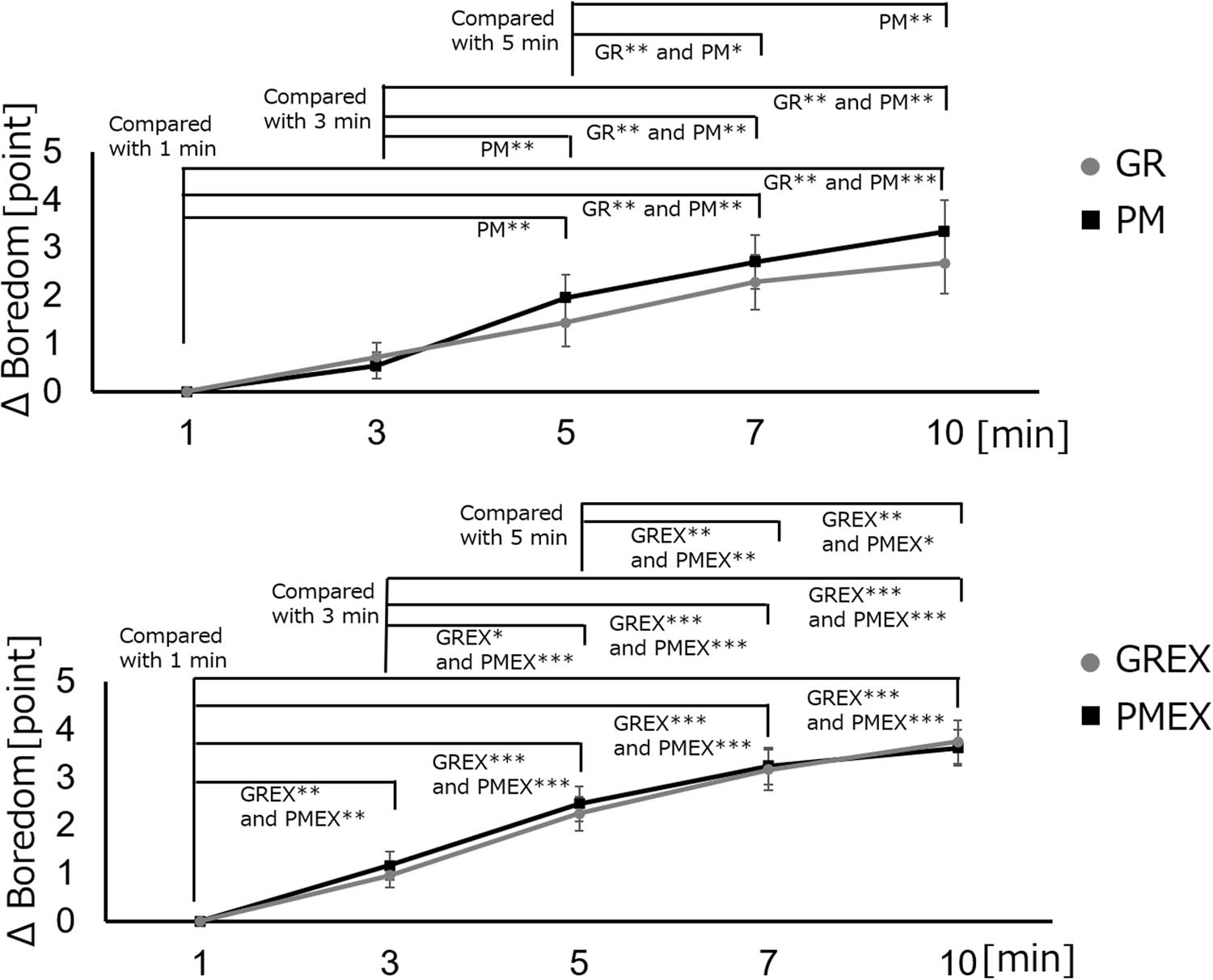
Figure 1
Changes in boredom during the intervention. Boredom increased significantly over the 10-min period across all conditions. In the exercise conditions (GREX and PMEX), increases in boredom were evident at the 3-min time point (GREX: p = 0.007; PMEX: p = 0.005). Data are presented as means ± SE. ***p < 0.001, **p < 0.01, *p < 0.05. Black lines: PM condition, PMEX condition; gray lines: GR condition, GREX condition
Figure 2 presents changes in clear-headedness in the PMEX condition. In the PMEX condition, clear-headedness increased significantly at 3, 5, and 7 min compared with 1 min (F[1.8, 43.22] = 6.15, p = 0.006, n 2 p = 0.20; 3 min, p = 0.01; 5 min: p = 0.01; 7 min: p = 0.02). No significant changes were observed in the GR, GREX, or PM conditions (GR: F[1.8, 43.3] = 0.71, p = 0.48, n 2 p = 0.02; GREX: F[2.57, 61.65] = 1.24, p = 0.30, n 2 p = 0.04; PM: F[2.25, 53.96] = 1.86, p = 0.16, n 2 p = 0.07).
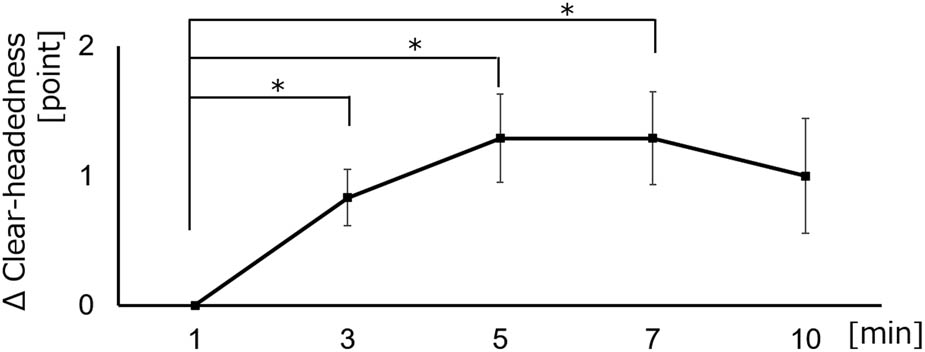
Figure 2
Changes in clear-headedness in the PMEX condition. Clear-headedness increased significantly beginning at the 3-min time point and remained elevated through 7 min (3 min: p = 0.01; 5 min: p = 0.01; 7 min: p = 0.02). Data are presented as means ± SE. ***p < 0.001, **p < 0.01, *p < 0.05
Source: Authors’ contribution.
No significant changes over time were observed for fun, excitement, good nori, good smell, audiomotor entrainment, or ease of breathing in any conditions. Specifically, for fun, no significant effects were found in GR (F[1.81, 43.51] = 1.48, p = 0.24, n 2 p = 0.05), GREX (F[2.6, 62.43] = 1.16, p = 0.32, n 2 p = 0.04), PM (F[2.55, 61.18] = 1.36, p = 0.26, n 2 p = 0.05), PMEX, (F[2.84, 68.26] = 0.11, p = 0.94, n 2 p = 0.005). Similarly, no significant effects were observed for excitement (GR, F[2.34, 56.1] = 1.67, p = 0.19, n 2 p = 0.06), GREX (F[2.67, 64.15] = 1.22, p = 0.30, n 2 p = 0.04), PM (F[2.39, 57.45] = 1.41, p = 0.25, n 2 p = 0.05), PMEX (F[1.52, 36.41] = 0.91, p = 0.38, n 2 p = 0.03), good nori (GR, F[2.94, 70.62] = 0.39, p = 0.75, n 2 p = 0.01; GREX: F[2.73, 65.5] = 0.48, p = 0.67, n 2 p = 0.02), good smell (PM: F[1.61, 38.74] = 2.00, p = 0.15, n 2 p = 0.07; PMEX: F[2.12, 50.77] = 0.37, p = 0.69, n 2 p = 0.01), and audiomotor entrainment (GR: F[1.67, 40.06] = 2.11, p = 0.14, n 2 p = 0.08; GREX: F[1.73, 41.54] = 5.05, p = 0.01, n 2 p = 0.17; post hoc comparisons were not significant). For ease of breathing, no significant changes were observed in the PM (F[2.47, 59.37] = 3.24, p = 0.03, n 2 p = 0.11; post hoc comparisons were not significant) or PMEX conditions (F[2.19, 52.51] = 1.95, p = 0.14, n 2 p = 0.07).
3.3. Correlation between baseline state, boredom, positive affect, and arousal
Figure 3 shows the correlations between the baseline conditions, boredom increase, positive affect, and arousal. There was a significant correlation between baseline physical condition and vitality (r = 0.31, p = 0.002). Baseline vitality mood was significantly correlated with Δboredom (r = −0.35, p < 0.001). Furthermore, Δboredom was significantly correlated with Δhaving fun (r = −0.31, p = 0.001) and Δclear-headedness (r = −0.24, p = 0.01). There was no significant correlation between baseline physical condition and Δboredom (r = −0.08, p = 0.42) and between Δboredom and Δexcitement (r = −0.09, p = 0.37).
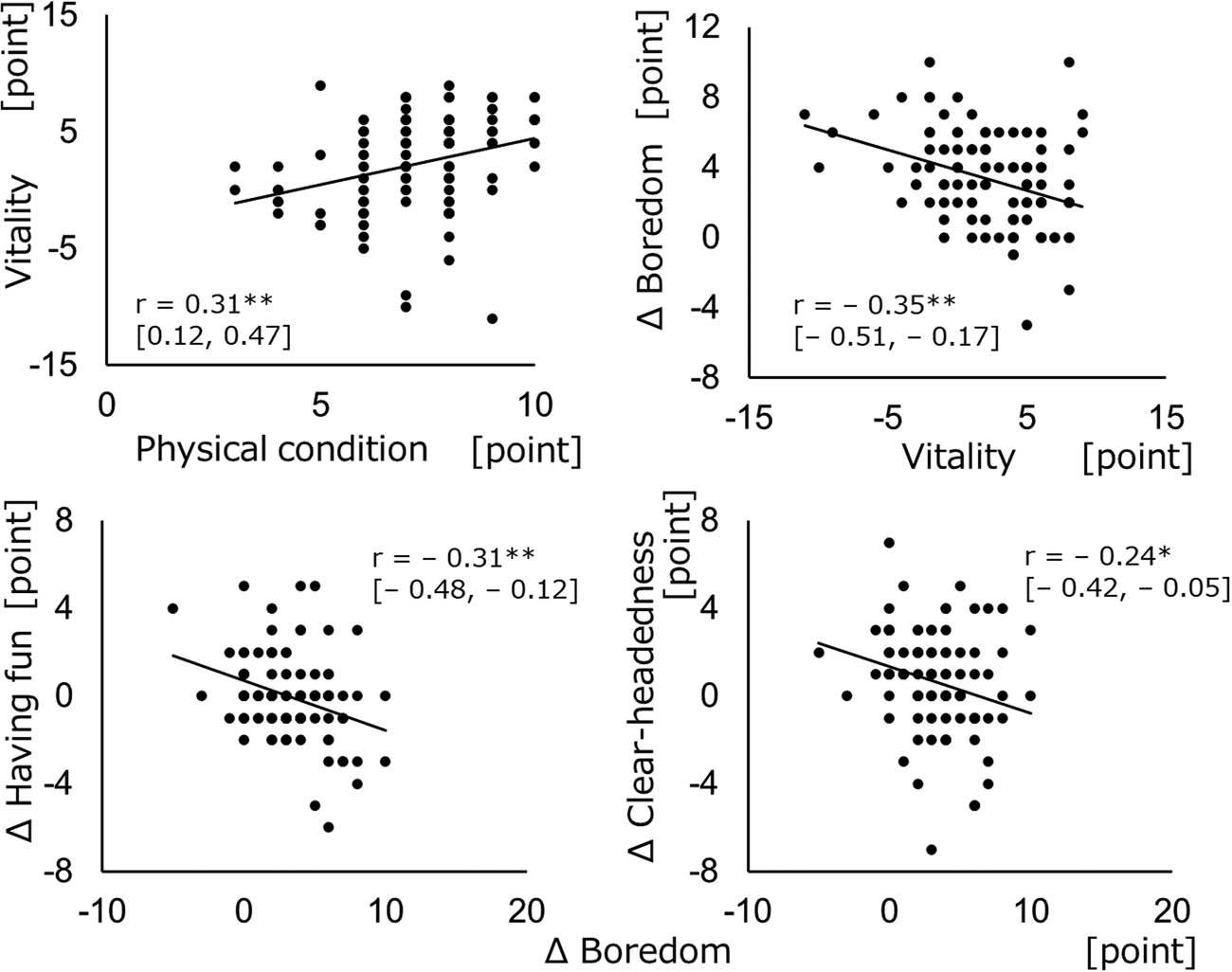
Figure 3
Correlations among baseline state, boredom, positive affect, and arousal. Baseline physical condition was significantly correlated with vitality mood (r = 0.31, p = 0.002). There was a significant negative correlation between vitality mood and Δboredom during exercise (r = −0.35, p < 0.001). As boredom during exercise increased, feelings of fun (r = −0.31, p = 0.001) and clear-headedness (r = −0.24, p = 0.01) decreased. ***p < 0.001, **p < 0.01, *p < 0.05. 95% confidence interval [lower, upper]
Source: Authors’ contribution.
4. Discussion
This study aimed to examine changes in boredom, affect, and arousal within 10 min of exercise accompanied by music or aroma stimuli. To our knowledge, this is the first study to demonstrate that boredom increased significantly over a 10-min period across all conditions, with increases beginning at the 3-min time point under exercise conditions. In the PMEX condition, both physiological and psychological arousal increased within the 10-min period. Baseline physical condition was correlated with baseline vitality, and baseline vitality was correlated with increases in boredom. Furthermore, increases in boredom were associated with decreased fun and clear-headedness.
As hypothesized, boredom increased over time even within the 10-min period, with this increase becoming apparent at the 3-min time point under exercise conditions. Furthermore, greater increases in boredom were associated with a reduction in positive affect and arousal. Boredom has been proposed to arise when cognitive demands are either too low or too high, or when the costs (e.g., mental or physical effort and time) are not commensurate with its perceived rewards (Wolff et al., 2025). Engaging in physical activity requires both physical and mental effort (Audiffren & André, 2019), and physical effort may increase attention to proprioceptive sensations relative to external stimuli, potentially leading to negative subjective experiences, such as boredom (Bieleke et al., 2025; Wolff et al., 2025). This mechanism may explain why boredom increased earlier under exercise conditions than when sensory stimulation was provided alone. Although conventional exercise prescriptions – primarily focused on physiological outcomes – typically recommend exercise sessions lasting 10 min or longer, the present findings suggest that shorter durations (≤3 min) may be preferable to achieve psychological outcomes.
Baseline conditions influence the increase in boredom. Physical condition was correlated with vitality mood level, which showed a negative correlation with increased boredom. Previous studies have shown that inducing mental fatigue before exercise causes individuals to perceive the required effort for exercise as greater (Harris & Bray, 2021), suggesting that pre-exercise state influences one’s psychological state during exercise. When baseline conditions are suboptimal, shortening exercise sessions or incorporating sessions beforehand to improve physical condition and vitality mood levels may be important. For example, stretching presents a lower psychological barrier than aerobic exercise (Fukuie et al., 2026) and has been reported to improve vitality mood levels during cognitive fatigue (Fukuie, et al., 2025). Future research should examine whether optimizing baseline conditions, in addition to exercise conditions, can maximize the effectiveness of indoor sensory-enriched exercise programs.
Under the PMEX condition, psychological arousal increased at the 3-min time point and remained elevated through 7 min. An increase in heart rate was also observed at the 5- and 10-min time points, indicating physiological arousal. PM contains 1,8-cineole, which possesses pharmacological arousal effects (Moss & Oliver, 2012); furthermore, positive psychological, physiological, and cognitive effects have been reported (Hoult et al., 2019; Meamarbashi & Rajabi, 2013; Moss et al., 2008). Given that exercise itself induces both psychological and physiological arousal, the PMEX condition, which combined PM exposure with exercise, may have produced a stronger arousal effect within a shorter period of time. Regarding the GREX condition, previous studies conducted under similar conditions have reported substantial inter-individual variability in the responses to the GREX (Fukuie et al., 2023; Fukuie, et al., 2025), which may explain the absence of significant short-term positive psychological effects at the group mean level in the present study. Therefore, PM may be a promising sensory stimulus for developing exercise programs aimed at enhancing arousal and improving cognitive function within a shorter time frame.
This study has several limitations. First, all interventions were conducted over a 10-min period. Strictly speaking, the effect on psychological state may differ at the 3-min time point between exercises lasting only 3 min and those lasting for 10 min. Future studies should compare conditions in which the exercise duration itself is varied. Second, the first measurement was obtained at 1 min; therefore, changes occurring within the first few seconds or tens of seconds were not captured. Given that boredom was found to increase within a relatively short period (i.e., 3 min), future research should employ methods with higher temporal resolution to examine early-phase changes more precisely. Third, single-item ratings were used rather than validated multi-item scales to enable repeated assessments within a short period during the intervention. In future validation studies that refine the assessment focus and reduce the frequency of measurements based on present findings, it will be necessary to determine whether the observed results can be reproduced using established validated scales. Fourth, music and aroma were applied separately during exercise. Although the effects of GREX were not detected under these conditions, GR produced effects distinct from those of PM, particularly in evoking a pleasurable urge to move. Furthermore, because positive affect–enhancing effect increases as the number of different types of sensory stimuli increases (Wooller et al., 2016), it is worthwhile to verify the additive and synergistic effects of combining music and aroma simultaneously with exercise when developing an indoor version of a sensory-enriched exercise program. Fifth, previous studies have reported that individual differences regarding physical effort influence boredom during exercise (Martarelli et al., 2026). Future research should account for these factors and individual differences. Finally, the current study did not evaluate the effects on cognitive function. Future research is necessary to verify the highly significant effects on cognitive function in daily life.
5. Conclusion
Boredom increased within 3 min of exercise onset during exercise combined with music or aroma and continued to increase over time. This increase in boredom was associated with reduced positive affect and lower arousal levels. Based on these findings, future research should investigate whether shorter exercise sessions (≤3 min) can be more effective for achieving psychological benefits. PM has emerged as a promising candidate for sensory stimulation to enhance the arousal response to short-duration exercise. Given that baseline vitality has been shown to be negatively associated with increases in boredom during exercise, future research should examine whether interventions or preparatory strategies aimed at optimizing baseline vitality before exercise can enhance the psychological benefits of short-duration exercise. The findings of this study may contribute to the development of indoor sensory-enriched exercise programs designed to provide psychological and cognitive benefits within a brief exercise duration.
Acknowledgments
We would like to thank Editage (www.editage.com) for the English language editing.
Funding information
This work was supported by JSPS KAKENHI (grant no. 25K20994) and a Cooperative Research Grant from the Advanced Research Initiative for Human High Performance of the University of Tsukuba.
Author contributions
Takemune Fukuie: Conceptualization, Data curation, Formal analysis, Funding acquisition, Investigation, Visualization, and Writing – original draft. Koshiro Inoue: Supervision and Writing – review & editing. Masahiro Okamoto: Project administration, Supervision, and Writing – review & editing. Akihiko Yamaguchi: Supervision and Writing – review & editing. Hideaki Soya: Methodology, Project administration, Supervision, and Writing – review & editing.
Conflict of interest statement
Authors state no conflict of interest.
Data availability statement
The datasets used and/or analyzed in the current study are available from the corresponding author upon reasonable request.