
1. Introduction
Resistance training is used to increase muscle mass (Bernárdez-Vázquez et al., 2022). It may have a positive impact on mortality, health outcomes, muscle strength, and physical function (Bernárdez-Vázquez et al., 2022; El-Kotob et al., 2020). Additionally, hypertrophy is a primary objective for athletes due to its potential impact on performance (Bernárdez-Vázquez et al., 2022). However, despite being a relatively safe mode of exercise, resistance training is not exempt from injuries (Serafim et al., 2023). For example, the squat can be safe when performed correctly, but injury risk may increase if technique is compromised, which may occur due to fatigue (Schoenfeld, 2010). Neuromuscular fatigue, in particular, may lead to altered movement patterns (Gathercole et al., 2015).
On the other hand, caffeine (CAFF) is among the few sports supplements that have sufficient evidence supporting its ergogenicity and safety (Kerksick et al., 2018; Maughan et al., 2018). Its performance-enhancing effects are mainly attributed to its actions on the central nervous system, although other physiological mechanisms may also contribute (Guest et al., 2021). In this sense, CAFF may be ergogenic in strength efforts (Grgic et al., 2019; Guest et al., 2021), including squat performance (Grgic et al., 2019). However, evidence remains mixed (Kerksick et al., 2018). Moreover, in resistance exercise, CAFF may also improve movement velocity or power, including mean and peak movement velocity, in both upper body and lower body, across low, moderate, and high loads (Guest et al., 2021; Raya-González et al., 2020).
However, few studies have comprehensively examined the impact of CAFF on the biomechanics of resistance exercises (Montalvo-Alonso et al., 2025 a, 2025 b; Montalvo-Alonso et al., 2024 a, 2024 b; Ruiz-Fernández et al., 2023). These studies have reported alterations in the kinematic and kinetic characteristics of exercise execution. Various physiological explanations have been proposed for these modifications, including the capacity of CAFF to increase motor unit recruitment and calcium release from the sarcoplasmic reticulum, which may enhance muscle force production (Montalvo-Alonso et al., 2024 a; Raya-González et al., 2020), particularly in larger muscle groups (Ruiz-Fernández et al., 2023). Therefore, CAFF might also be able to alter other parameters of the squat technique, such as joint angulations. CAFF may also improve performance through increased alertness and vigilance, as well as a reduction in perceived exertion (Guest et al., 2021; Maughan et al., 2018). Accordingly, it may be of interest to examine whether these effects help maintain technique under fatigue.
In light of this context, there are potential negative consequences of only measuring the effect of CAFF on performance and neglecting its impact on technique. These may include an increased risk of injury or impaired adaptations. Therefore, the goal of this study is to assess the impact of CAFF on squat technique and performance, under both fatigued and non-fatigued conditions, in naïve-low CAFF consumers. The outcomes will be compared with control (CON) and placebo (PLA) sessions. Our hypothesis is that CAFF modifies squat technique in both fatigued and unfatigued conditions due to its physiological effects, which may be beneficial for neuromuscular patterns (e.g., injury risk reduction) and performance.
2. Material and methods
2.1. Participants
Fourteen volunteers completed the study. Their baseline characteristics, by sequence, are presented in Table 1. The main inclusion criteria were good technique in the assessed exercises and an uninterrupted training time of ≥1 year in their sports modality. These criteria were established according to parameters previously associated with an advanced training level (Santos Junior et al., 2021). The exclusion criteria were defined to reduce potential variability in the individual effect of CAFF (Pickering & Kiely, 2018). Specifically, exclusion criteria included not being a naïve-low CAFF consumer (habitual CAFF consumption of >25 mg/day–0.99 mg/kg/day) (Filip et al., 2020), pregnancy, smoking, being <18 or >30 years old, relevant medical conditions, and regular medication or supplementation intake before or during the study.
Table 1
Participants’ baseline data, grouped by sequence
| CON-PLA-CAFF treatment order | CON-CAFF-PLA treatment order | |
|---|---|---|
| Regular CAFF consumption from foodstuffs | 0.25 ± 0.31 mg/kg/day | 0.20 ± 0.35 mg/kg/day |
| Regular CAFF consumption as an ergogenic aid | 0.00 ± 0.00 mg/kg/day | 0.00 ± 0.00 mg/kg/day |
| Sex | Male = 4 (57.14%) | Male = 7 (100%) |
| Female = 3 (42.86%) | Female = 0 (0%) | |
| Body mass | 62.31 ± 6.33 kg | 75.53 ± 8.06 kg |
| Body fat | 22.26 ± 8.88 % | 19.59 ± 4.34 % |
| Height | 1.69 ± 0.07 m | 1.76 ± 0.06 m |
| Age | 22.14 ± 3.08 years | 22.00 ± 3.32 years |
| Sport modality | Badminton = 1 (14.29%) | Basketball = 2 (28.57%) |
| Cycling = 2 (28.57%) | Football = 2 (28.57%) | |
| Running = 3 (42.86%) | Rink hockey = 1 (14.29%) | |
| Tennis = 1 (14.29%) | Running = 1 (14.29%) | |
| Triathlon = 1 (14.29%) |
Sex is presented in terms of its frequency and percentage, while the remaining variables are expressed as their mean values and standard deviations. The sport modality total percentage may slightly exceed 100% due to rounding. mg = Milligrams. kg = Kilograms. m = Meters
Source: Author’s contribution.
2.2. Experimental framework
This study used a randomized, controlled, double-blind design. It also included a crossover to optimize sample size (Dwan et al., 2019). The study is reported according to CONSORT guidelines and their extension for crossover trials (Dwan et al., 2019; Hopewell et al., 2025) (Supplementary Material 1). The trial and its protocol were prospectively registered on ClinicalTrials.gov (registered September 15, 2023; Identifier: NCT06039358 (https://clinicaltrials.gov/study/NCT06039358)). No relevant modifications were made to the planned methods specified in the prospectively registered protocol. The design, conduct, and reporting of the trial did not involve patient or public participation. The University of Vic-Central University of Catalonia Research Ethics Committee approved the protocol of this study (238/2022). The trial was conducted in accordance with the principles of the Declaration of Helsinki and its ensuing amendments. Participants’ rights were preserved throughout the study. All participants signed an informed consent form before being included in the study. No interim analyses were planned or conducted. The only criterion for premature trial termination was the manifestation of severe side effects.
The trial was conducted at the facilities of the University of Vic-Central University of Catalonia (Vic, Spain). Participants were recruited using posters displayed at sports teams’ facilities in Vic, as well as at the University, from October to November 2023. Potential participants were requested to visit the center on five occasions. The first visit was the enrollment session, in which eligibility criteria were verified, the informed consent process was completed, and baseline data were collected. Baseline measures included body mass and body fat assessed using a scale (Omron, Kyoto, Japan); habitual use of CAFF as a performance enhancer for physical exercise; habitual CAFF consumption from foodstuffs assessed using a questionnaire (Bühler et al., 2014); sex; age; and height assessed using a stadiometer (GIMA, Gessate, Italy). The CAFF dose that participants would ingest was adjusted based on body mass measured during the enrollment session.
Afterwards, the subsequent sessions were conducted at least 7 days apart to allow for proper recovery and a wash-out period, thereby avoiding carry-over effects (Magkos & Kavouras, 2005). Each of the remaining four sessions lasted ≈3 h. These sessions were: familiarization, no substance consumption (CON), CAFF consumption (Harrison Sport Nutrition, Granada, Spain), and PLA consumption (Guinama, Valencia, Spain). The PLA and CAFF protocols had the same presentation and format, and the investigators verified their consumption. The two substances were orally administered in the form of three opaque capsules with 200 ml of water. Cellulose was used as PLA, and both substances were manually encapsulated (Guinama, Valencia, Spain). In accordance with the general recommendations, participants ingested 6 mg of anhydrous CAFF powder/kg 60 min before the beginning of exercise (Maughan et al., 2018).
All the sessions were conducted at a consistent time of day for each athlete. Participants were asked to avoid fatiguing physical activity and CAFF ingestion for 48 h before the sessions. During the 24 h before each session, participants were also instructed to follow a diet as consistent as possible and to avoid alcohol. This dietary consistency was verified using the ASA24 Dietary Assessment Tool, version 2022 (National Cancer Institute, 2022), which recorded athletes’ 24-hour dietary recall. Additionally, participants consumed their habitual pre-exercise meal 2–4 h before the sessions.
The familiarization session began with participants performing the ASA24 dietary assessment and the 48-h CAFF consumption assessment. The subjects were instructed to replicate these records for the remainder of the sessions. Participants were then briefed about the ergogenicity of CAFF to promote a consistent PLA effect across the sample. Next, the athletes standardized the size of elastic bandages used in the rest of the sessions and practiced the warm-up protocol to be used in the following sessions. Afterwards, participants fine-tuned the squat execution for the rest of the sessions. To do so, first they established their preferred foot position for the squat, and its outline was drawn on a cardboard to be used in all the squats performed in the study. Second, the load required to achieve a mean propulsive bar velocity (MPBV) close to 1 m/s in the barbell back squat was determined, as previously suggested (Sánchez-Medina et al., 2017). Participants performed the concentric portion of the lift with maximal intended velocity. Heel lift was allowed, but jumping was not. The initial load was 20 kg, and the weight was progressively increased until the desired MPBV was reached. In the last part of the familiarization session, the exercises performed during the other visits were explained and repeated until proper technique was shown.
CAFF and PLA sessions were performed in randomized order using a double-blind approach. The CON, PLA, and CAFF sessions shared an identical experimental design, except that no capsules were consumed in the CON session (Figure 1). The warm-up protocol included jogging at 10 km/h on a treadmill (5 min), a general dynamic stretching routine (5 min), and specific protocols for the assessed movements (5 min). The sequence of the assessed exercises was randomized for each subject (Haahr, 1998) and remained unchanged throughout the sessions. Neuromuscular fatigue was induced using a Yo-Yo squat protocol, based on previous research (Lesinski et al., 2016). Participants executed Yo-Yo squats until they could no longer achieve a cadence of 70 beats per minute while reaching 90° of knee flexion in each repetition. After a 1-min break, they performed another set using the same criteria. This cycle was repeated until participants could not complete 60% of the repetitions achieved in the first set. To ensure a high level of exertion, participants rated their perceived effort using the 6–20 Borg scale after each set. The assessed exercises were performed without rest between them or the fatigue protocol. The environment of the sessions was controlled (mean temperature: 21.5°C ± 2.2°C, mean humidity: 48.4% ± 10.1%). During the sessions, participants freely consumed water.
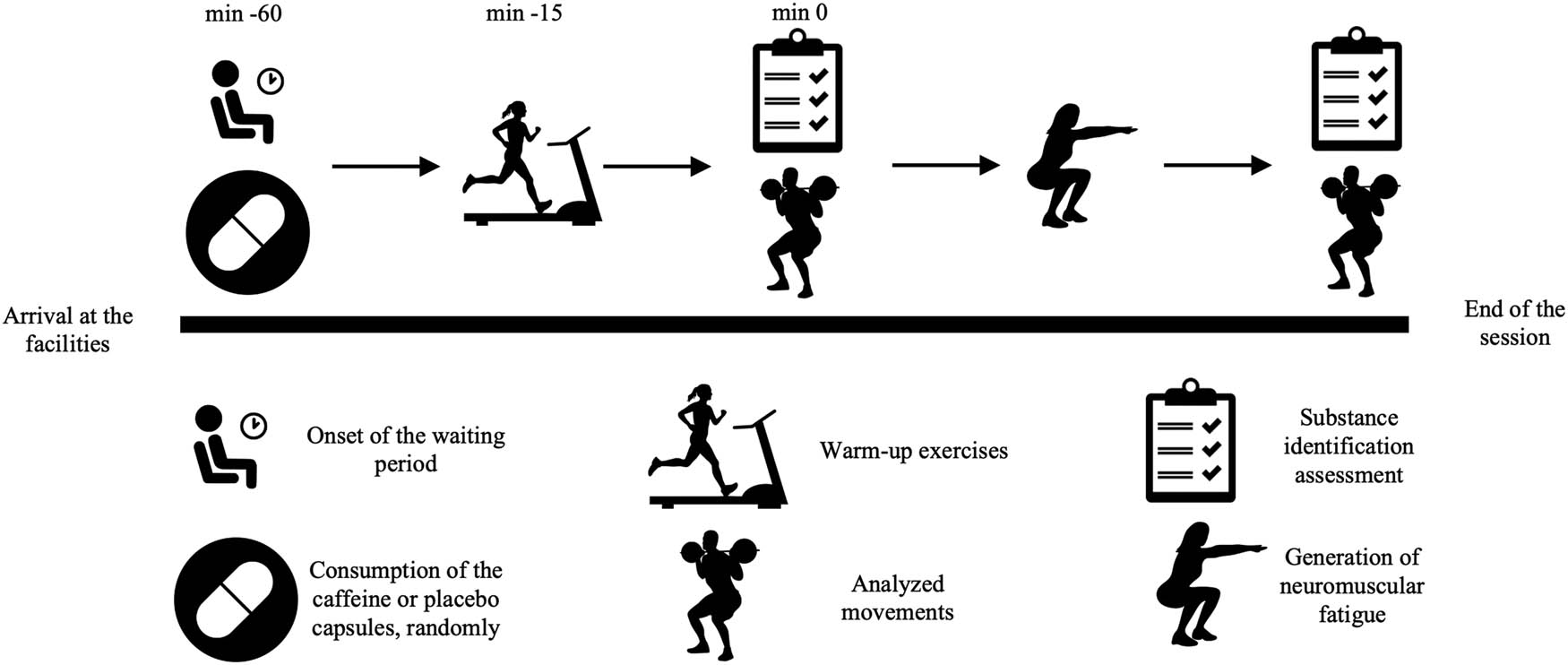
Figure 1
Organization of the assessed sessions
Source: Author’s contribution.
2.3. Adverse reactions and CAFF detection
Participants reported adverse reactions related to CAFF ingestion during the hours after CAFF and PLA sessions using an online questionnaire with eight yes/no items (Muñoz et al., 2020). This questionnaire was self-administered on the morning following each session. Additionally, as previously described (Saunders et al., 2017), during these sessions, participants identified which substance they believed they had ingested (“caffeine,” “placebo,” or “I don’t know”) and explained their choice. This online survey was completed immediately before the assessed exercises and again after the session. The responses to these questionnaires were analyzed as secondary outcomes, with comparisons conducted between the CAFF and PLA sessions.
2.4. Allocation concealment and blinding
A fixed simple randomization without restrictions was employed in this study, based on a random allocation sequence generated by an external researcher using a list of computer-generated random numbers (Urbaniak & Plous, 1999). This external researcher was the only person with access to the random allocation sequence. To implement the procedure, the investigator responsible for enrolling the participants (present during all sessions) coded and wrote their identities according to enrollment order and sent this list to the external researcher. The external researchers then shuffled the enrollment order (Haahr, 1998) and linked the randomized identity order to the random allocation sequence (e.g., pairing the first code with the first number). Participants were assigned to a sequence accordingly (e.g., even numbers – CAFF-PLA; odd numbers – PLA-CAFF), with a final allocation ratio of 1:1 (e.g., seven subjects per sequence). The allocation list was then saved in a site not accessible to the rest of the researchers.
The same external researcher also prepared envelopes containing the CAFF or PLA supplements, with the participant’s coded name and the corresponding session in which they had to be consumed written on the outside. Consequently, all participants, as well as the researchers involved in the sessions, data collection and analysis, and outcome assessment, were blinded. The unblinding occurred after data analyses and outcome adjudication were finalized.
2.5. Squat evaluation and data processing
The primary outcomes of this study comprise several kinematic and kinetic variables from the squat. These were compared across the CON, CAFF, and PLA sessions under both fatigued and unfatigued conditions. The squat protocol consisted of six high-bar back squats using the load that elicited ≈1 m/s MPBV during the familiarization session, with 2 min of rest between repetitions. The analyses were based on the mean values of the six repetitions, and all outcomes were assessed by the same researcher. The subjects were instructed to perform the eccentric phase in a self-selected manner to maximize concentric velocity, while reaching at least 90° of knee flexion before initiating the upward movement. Participants were encouraged to perform the concentric phase with maximal intended velocity. Jumping off the ground or losing contact with the bar was not allowed; however, heel lift was permitted. Nonetheless, no additional technique details were controlled during the squat execution to help reveal modifications in movement patterns (Hooper et al., 2014). The athletes also received standardized verbal feedback and encouragement to maximize performance.
The squat performance outcome was MPBV, given that it can be used to estimate the relative load, expressed as a percentage of one-repetition maximum (%1RM), and monitor fatigue and exertion (Sánchez-Medina et al., 2017). MPBV was measured using a linear position transducer (Chronojump Boscosystem, Barcelona, Spain) attached to the barbell. This instrument is valid and reliable for assessing movement velocity during resistance exercises (Moreno-Villanueva et al., 2024). Execution time, peak vertical force (PVF), and rate of force development (RFD) for the eccentric and concentric phases of the squat were also measured using the same device.
For the remaining variables, a 2D analysis was performed. All the repetitions were filmed in slow motion at 240 fps using a smartphone (iPhone 11 Pro Max, Apple, Cupertino, USA). The device was placed on a portable tripod 2.08 m from the squat platform and at a height of 1.16 m, perpendicular to the sagittal plane. Recordings were analyzed by one researcher using Kinovea (version 0.9.5), which has demonstrated validity and reliability (Puig-Diví et al., 2019). The same researcher placed reflective markers on specific anatomical landmarks of the participants to facilitate the 2D analysis. These landmarks were the greater trochanter (GT), the lateral femoral epicondyle (LFE), the lateral malleolus (LM), and the head of the fifth metatarsal (FM). To prevent marker detachment, adhesive spray, tape, and elastic bandages were used. All landmarks were identified with the participants standing, although the LFE was determined with the subjects seated and the knee flexed at 90°. In addition, a marker was placed at the center of the lateral barbell circumference (LBC).
All the 2D variables were analyzed on the same frame at three time points: (1) Initial position (the frame immediately before the descending movement of the squat began); (2) Bottom position (the frame at which the barbell reached its lowest position); and (3) Final position (the frame at which the barbell reached its highest position). Additionally, the range of motion (ROM) for the eccentric (bottom position angle – initial position angle) and concentric (final position angle – bottom position angle) phases was calculated. The analyzed variables were measured only on the right side of the body: hip angle (angle formed by the LBC – GT line and the GT – LFE line (↓ angle; ↑ hip flexion)), knee angle (angle formed by the GT – LFE line and the LFE – LM line (↓ angle; ↑ knee flexion)), and ankle angle (angle formed by the LFE – LM line and the LM – FM line (↓ angle; ↑ ankle dorsiflexion)) (Figure 2). Before the study, the feasibility of all variables was verified.
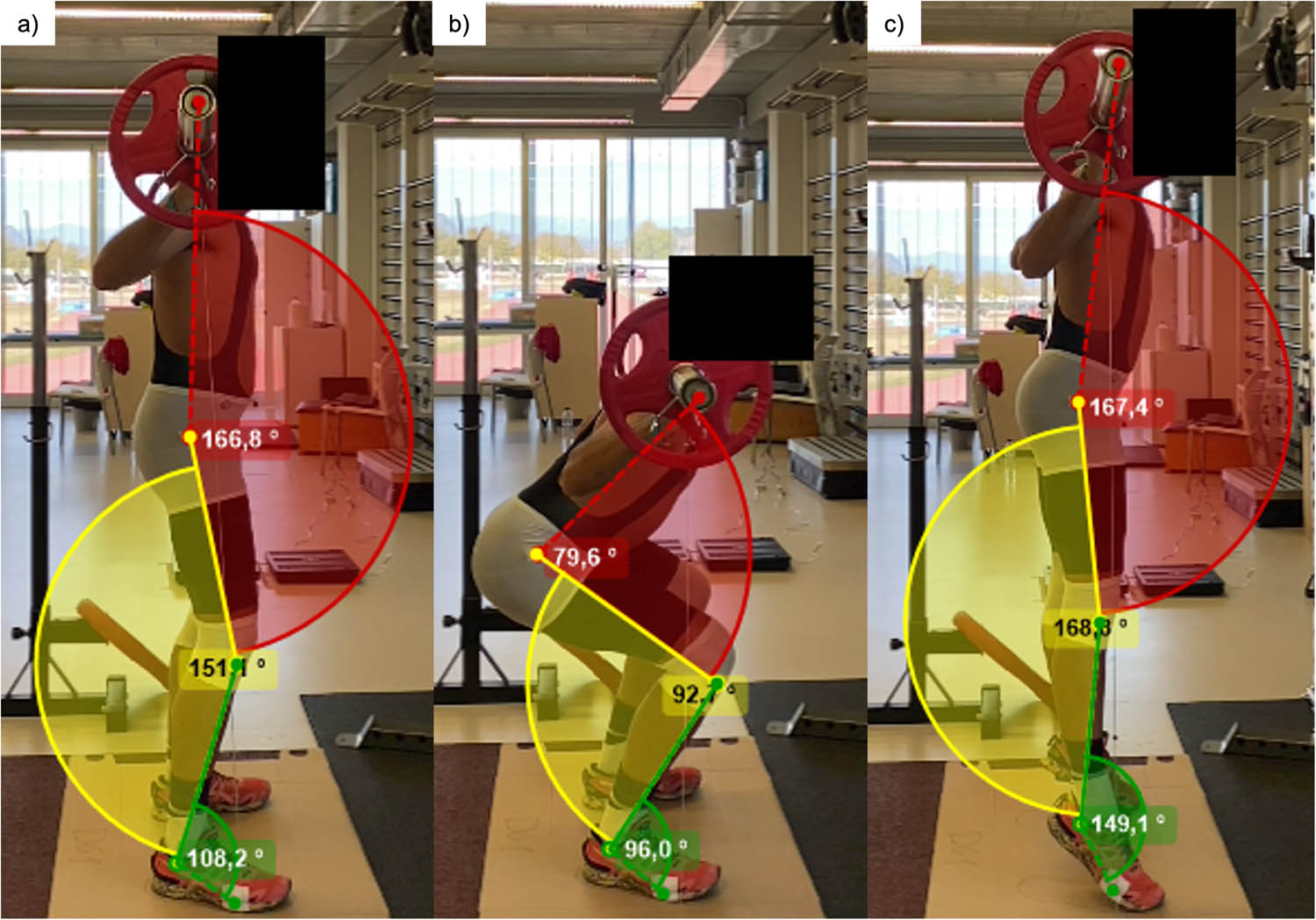
Figure 2
Hip, knee, and ankle angles, measured at the initial position (a), the bottom position (b), and the final position (c)
Source: Author’s contribution.
2.6. Statistical analysis
An a priori sample size power analysis was performed in G*Power (version 3.1.9.6). This analysis determined that 11 participants were required. The calculation considered the following inputs: (1) A within repeated measures ANOVA; (2) An effect size (ES) of 0.15 (f) and a correlation among repeated measures of 0.90 (Grgic, 2022); (3) Six measurements in one group (e.g., CON, PLA, and CAFF, pre- and post-fatigue); and (4) A power of 0.80 and an α of 0.05. Therefore, we recruited 15 participants to compensate for potential withdrawals. One participant discontinued participation before the familiarization session due to an injury not associated with the trial; therefore, 14 subjects completed the trial (Supplementary Material 2). This article is derived from a broader project that assessed the effects of CAFF during squatting, running, and jumping. The overall sample size was determined based on the effect of CAFF on jumping performance, since it required a larger sample size. For context, the expected squat performance ES would be 0.33 (Ruiz-Fernández et al., 2023), with a correlation of 0.87 (Grgic et al., 2020). As discussed, this article reports the results of the project’s squat tests.
Statistical analyses were conducted in R (v. 4.4.2, R Foundation for Statistical Computing, Vienna, Austria) using RStudio (v. 2023.06.0 + 421) (Supplementary Material 2). All analyses used the outcome data from the 14 participants who completed the trial, according to the randomization sequence. Statistical significance was defined as p < 0.05.
For the variables related to squat technique and performance, data are reported as their median and 25–75 centile range (IQR) for non-normally distributed variables, or their mean and standard deviation for normally distributed variables. Normality was assessed for each outcome using the Shapiro–Wilk test and Q–Q plots of its non-standardized residuals. Outliers were identified numerically. If the data contained outliers or were not normally distributed, an Aligned Rank Transform (ART) ANOVA was used (Wobbrock et al., 2011). If the data contained no outliers and were normally distributed, a two-way repeated measures ANOVA was conducted. In this case, Mauchly’s test was used to assess the sphericity, and when this assumption was violated, the Greenhouse-Geisser correction was applied. When significant differences were found in the ART ANOVA or ANOVA, post-hoc pairwise comparisons were performed using Bonferroni correction. For the ART ANOVA, the ART-C procedure was applied (Elkin et al., 2021). Partial eta squared (ηp2) was calculated as the ES of the ANOVAs and interpreted as small (0.01), medium (0.06), and large (0.14). The pairwise comparisons are presented with the adjusted simple ES (differences in means or in the aligned-rank means, as appropriate) and their 95% confidence interval (CI). Cohen’s d ES is also reported and categorized as trivial (<0.2), small (0.2–<0.6), moderate (0.6–<1.2), large (1.2–<2.0), very large (2.0–<4.0), and extremely large ( ≥ 4). It is important to note that the ES obtained from ART and ART-C are based on aligned rank-transformed data and should therefore be interpreted with caution.
The Bang Blinding Index was used to determine blinding effectiveness and is reported as the estimate, its 95% CI, and the frequency of responses in each situation. To evaluate the reliability of the 2D analysis outcomes, ICC(2,1) was estimated (two-way mixed effects, absolute agreement, single rater). ICC values were interpreted as poor (<0.50), moderate (0.50–<0.75), good (0.75–0.90), or excellent (>0.90), according to their 95% CI. Differences in adverse reaction frequencies were analyzed using the McNemar test, and p-values and case counts are reported. For this analysis, ES and CI are not presented because most variables showed minimal or no occurrences.
3. Results
3.1. CAFF impact on performance and technique variables
The full results from the analyses are reported in Supplementary Material 2. Only the knee angle at the bottom position was normally distributed. The significant results are summarized in Table 2. Some of the key findings are also presented in Figures 3–5. No additional significant effects were identified beyond those reported in Table 2.
Table 2
Summary of significant differences from the ANOVA or ART ANOVA and the pairwise tests
| Variables | Significant comparisons of the ANOVA or ART ANOVA | Post-hoc significant results | Interpretation of the effect |
|---|---|---|---|
| Hip angle at the bottom position | Treatment (p = 0.0225, ηp2 = 0.11) | PLA – CON (p = 0.0283, d = −0.72) | ↓ hip angle (↑ hip flexion) in PLA |
| Hip angle at the final position | Fatigue (p = 0.0344, ηp2 = 0.07) | PRE – POST (p = 0.0344, d = 0.47) | ↓ hip angle (↑ hip flexion) in POST |
| Hip angle eccentric ROM | Treatment (p = 0.0001, ηp2 = 0.28) | PLA – CON (p = 0.0001, d = 1.32) | PLA ↑ hip ROM than CON |
| CAFF – CON (p = 0.0024, d = 0.94) | CAFF ↑ hip ROM than CON | ||
| Fatigue (p = 0.0082, ηp2 = 0.10) | PRE – POST (p = 0.0082, d = 0.60) | ↓ hip ROM in POST | |
| Hip angle concentric ROM | Treatment (p = 0.0013, ηp2 = 0.18) | PLA – CON (p = 0.0011, d = 1.01) | PLA ↑ hip ROM than CON |
| CAFF – CON (p = 0.0403, d = 0.68) | CAFF ↑ hip ROM than CON | ||
| Fatigue (p = 0.0003, ηp2 = 0.19) | PRE – POST (p = 0.0003, d = 0.84) | ↓ hip ROM in POST | |
| Knee angle at the bottom position | Fatigue (p = 0.0242, ηp2 = 0.33) | PRE – POST (p = 0.0242, d = −0.21) | ↑ knee angle (↓ knee flexion) in POST |
| Knee angle at the final position | Fatigue (p = 0.0182, ηp2 = 0.08) | PRE – POST (p = 0.0182, d = 0.53) | ↓ knee angle (↑ knee flexion) in POST |
| Knee angle eccentric ROM | Treatment (p = 0.0153, ηp2 = 0.12) | PLA – CON (p = 0.0135, d = 0.79). | ↑ knee ROM in PLA |
| Knee angle concentric ROM | Fatigue (p = 0.0001, ηp2 = 0.22) | PRE – POST (p = 0.0001, d = 0.94) | ↓ knee ROM in POST |
| Ankle angle at the initial position | Treatment (p = 0.0293, ηp2 = 0.10) | The differences became not significant | — |
| Ankle angle at the bottom position | Treatment (p = 0.0017, ηp2 = 0.18) | PLA – CON (p = 0.0044, d = 0.89) | PLA ↑ ankle angle (↓ dorsiflexion) than CON |
| CAFF – CON (p = 0.0067, d = 0.85) | CAFF ↑ ankle angle (↓ dorsiflexion) than CON | ||
| Ankle angle at the final position | Treatment (p = 0.0031, ηp2 = 0.16) | PLA – CON (p = 0.0141, d = 0.78) | PLA ↑ ankle angle (↓ dorsiflexion) than CON |
| CAFF – CON (p = 0.0062, d = 0.86) | CAFF ↑ ankle angle (↓ dorsiflexion) than CON | ||
| Concentric execution time of the movement | Treatment (p = 0.0007, ηp2 = 0.20) | PLA – CON (p = 0.0005, d = 1.07) | ↑ concentric time in PLA |
| Eccentric PVF | Fatigue (p = 0.0107, ηp2 = 0.10) | PRE – POST (p = 0.0107, d = 0.57) | ↓ PVF in POST |
| Concentric PVF | Treatment (p = 0.0233, ηp2 = 0.11) | PLA – CON (p = 0.0214, d = −0.74) | ↓ PVF in PLA |
| Fatigue (p = 0.0022, ηp2 = 0.14) | PRE – POST (p = 0.0022, d = 0.70) | ↓ PVF in POST | |
| Concentric RFD | Treatment (p = 0.0067, ηp2 = 0.14) | PLA – CON (p = 0.0049, d = −0.88) | ↓ RFD in PLA |
| Fatigue (p = 0.0363, ηp2 = 0.07) | PRE – POST (p = 0.0363, d = 0.47) | ↓ RFD in POST | |
| MPBV | Fatigue (p = 0.0037, ηp2 = 0.12) | PRE – POST (p = 0.0037, d = 0.66) | ↓ MPBV in POST |
Abbreviations: PLA = Placebo session. CON = Control Session. CAFF = Caffeine session. PRE = Values before fatigue. POST = Values after fatigue. ROM = Range of Motion. PVF = Peak Vertical Force. RFD = Rate of Force Development. MPBV = Mean Propulsive Bar Velocity. ηp2 = Partial eta squared. d = Cohen’s d. ↑ = More. ↓ = Less.
Source: Author’s contribution.
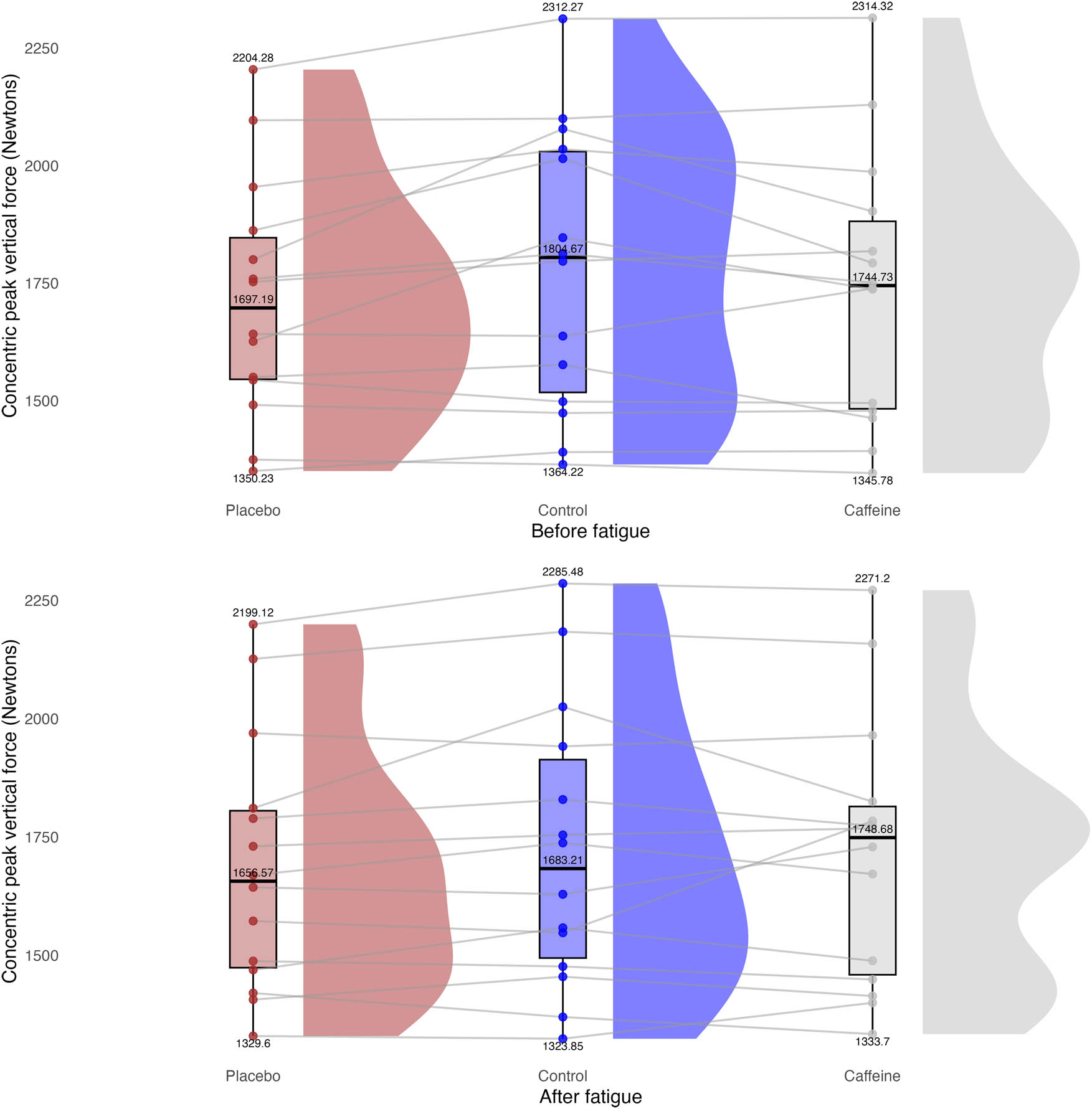
Figure 3
Comparison of the concentric PVF in N across the PLA, CON, and CAFF sessions, before (top) and after (bottom) the fatiguing protocol. The connected dots represent individual participant data
Source: Author’s contribution.
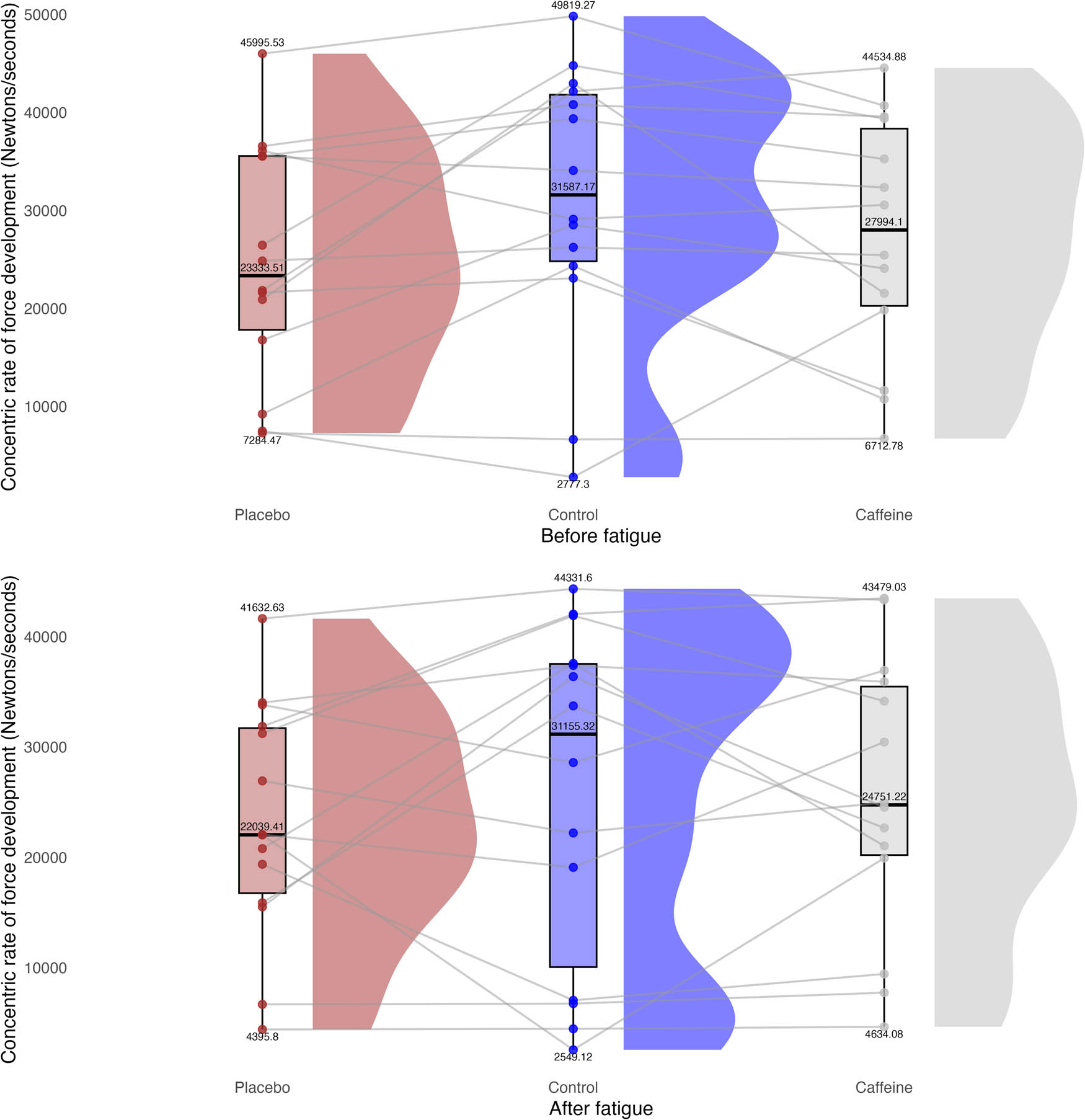
Figure 4
Comparison of the concentric RFD in N/s across the PLA, CON, and CAFF sessions, before (top) and after (bottom) the fatiguing protocol. The connected dots represent individual participant data
Source: Author’s contribution.
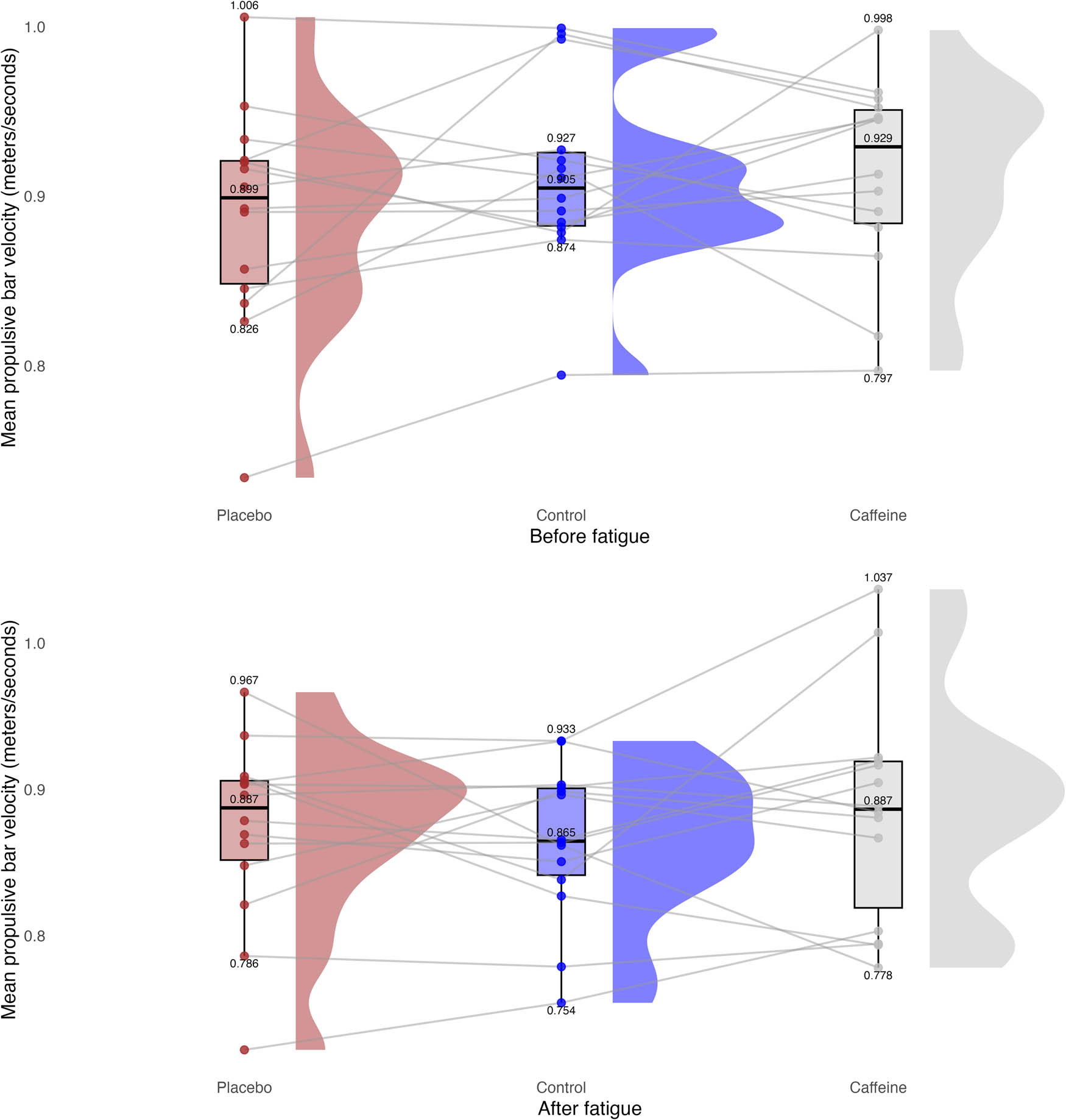
Figure 5
Comparison of the MPBV in m/s across the PLA, CON, and CAFF sessions, before (top) and after (bottom) the fatiguing protocol. The connected dots represent individual participant data
Source: Author’s contribution.
3.2. Assessment of adverse reactions, blinding, and measurement reliability
Detailed results for adverse reactions, blinding, and reliability analyses are provided in Supplementary Material 2. Regarding adverse reactions, there were no significant differences in the incidence across treatments (all contrasts p > 0.05). In terms of blinding, before the beginning of the sessions, CAFF was correctly identified by four subjects, and PLA was correctly identified by six subjects. After the sessions, CAFF and PLA were each correctly identified by four subjects. Additionally, intrarater reliability was excellent for all 2D variables (ICC: 0.99–1.00), except for the ankle angle at the initial position, which showed good-to-excellent reliability (ICC: 0.95).
4. Discussion
The main goal of this study was to assess the effect of CAFF on squat performance and technique. The results do not support our hypothesis. Although CAFF altered the squat technique, it did not have a clear impact on acute performance. In addition, the analyses indicated that PLA and fatigue affected both technique- and performance-related variables. To our knowledge, compared with prior evidence, this study provides a particularly comprehensive analysis of CAFF’s impact on movement technique, including joint angulations.
Regarding hip angle, PLA elicited greater hip flexion than in CON at the bottom position. Hip flexion at the final position was also greater under fatigue, whereas eccentric and concentric hip ROM were greater in PLA and CAFF than in CON. By contrast, eccentric and concentric hip ROM were lower in the fatigued state. Although reduced hip flexion at the bottom position of the squat has been reported as fatigue accumulates (Hooper et al., 2014), we did not observe this effect, possibly due to protocol differences. Increases in hip ROM have been linked to greater trunk flexion (Hooper et al., 2014). Accordingly, maintaining the torso as vertical as possible has been recommended to reduce back injury risk and optimize squat technique (Hooper et al., 2014; Myer et al., 2014). Moreover, increased hip flexion during the ascent of the squat may be caused by the hips rising faster than the shoulders, which is considered a technical fault (Myer et al., 2014). Thus, PLA may negatively impact squat technique due to increased hip flexion at the bottom position. Both CAFF and PLA also increased eccentric and concentric hip ROM, which may contribute to higher injury risk. However, this may be less concerning in the CAFF condition, as only PLA affected hip flexion at the bottom position. Finally, the increased hip flexion at the final position and the reduced ROM under fatigue may reflect exhaustion.
For the knee angle, fatigue was associated with reduced knee flexion at the bottom position and reduced concentric ROM, but greater knee flexion at the final position. The greater knee flexion at the final position and the lower concentric ROM under fatigue may reflect reduced movement control and an inability to fully extend the knees due to weariness. In addition, eccentric knee ROM was greater in PLA than in CON. Contrary to our findings, greater knee flexion at the bottom position has been reported as fatigue accumulates during a workout, although this may not always be the case (Hooper et al., 2014). People with pre-existing knee conditions (e.g., patellofemoral disorders) should avoid high knee flexion angles while squatting (Schoenfeld, 2010). However, training the quadriceps, gluteus maximus, and adductors at more elongated muscle lengths (e.g., deeper squats) may promote greater hypertrophy (Kassiano et al., 2023). Therefore, the observed increase in eccentric knee ROM in PLA could be interpreted as potentially beneficial for hypertrophy-related adaptations. Nevertheless, this interpretation should be made with caution because the differences were observed only in ROM, which may limit the strength of this conclusion.
Concerning the ankle angle, less dorsiflexion was observed at both the bottom and final positions in PLA and CAFF compared to CON. When squatting with the feet fixed on the floor, anterior tibial translation should be unrestricted, allowing the movement to be initiated by moving the hips back; however, excessive translation or restriction of the tibial progression angle may modify the forces applied at the hip, the lumbar spine, and the knee (Myer et al., 2014). Reduced ankle dorsiflexion ROM may be related to a greater risk of medial knee displacement, which increases injury risk (Schoenfeld, 2010) and is recognized as a functional deficit (Myer et al., 2014). Moreover, limiting knee translation may increase forward trunk lean (Myer et al., 2014), and adequate ankle mobility is needed to perform a controlled and balanced squat during both the descent and ascent phases (Myer et al., 2014; Schoenfeld, 2010). Consequently, CAFF and PLA may negatively impact squat safety. However, reduced dorsiflexion at the final position may also reflect greater ankle extension (e.g., plantarflexion).
The squat concentric phase duration was greater in PLA than in CON. During continuous repetitions, CAFF may reduce squat movement duration compared with PLA (Ruiz-Fernández et al., 2023). However, in our study, which involved single repetitions, CAFF did not affect squat duration. Faster lifting speeds may be beneficial for sports performance, whereas slower speeds may reduce joint-related shear and compressive forces (Schoenfeld, 2010). Therefore, the longer concentric time observed in PLA may be detrimental for performance, although it may represent a safer approach.
Eccentric and concentric PVF were lower in the fatigued state, and concentric PVF was also lower in PLA than in CON. The reduction with fatigue was expected, given the high level of exertion. In contrast, during continuous repetitions, CAFF may improve back squat concentric peak force, although this effect may not occur in single-repetition sets (Ruiz-Fernández et al., 2023), as observed in our study. Due to the large mass of the upper body, its position can have a substantial influence on the location and magnitude of the resultant vertical force (Glassbrook et al., 2019). Therefore, the changes in hip angle observed in PLA may have influenced the squat PVF.
In addition, concentric RFD was lower in PLA than in CON and was also lower in the fatigued state. RFD is relevant for activities of daily living and sports performance (Grgic & Mikulic, 2022; Ruiz-Fernández et al., 2023). Therefore, PLA and fatigue were associated with reduced performance. CAFF may be ergogenic for RFD during resistance exercise (Grgic & Mikulic, 2022). Moreover, CAFF may improve back squat RFD at different loads, although not during continuous repetitions (Ruiz-Fernández et al., 2023). This evidence contrasts with our results, which may be due to differences in the experimental approaches. Notably, the results for execution time, PVF, and RFD may reflect expectancy effects (e.g., a potential nocebo effect) in PLA sessions (Ortiz-Sánchez et al., 2024; Saunders et al., 2017).
Regarding MPBV, it was reduced in the fatigued state, as expected due to physiological strain. However, neither CAFF nor PLA affected it. CAFF has been reported to improve mean and peak movement velocity across a variety of resistance exercises and loads (Guest et al., 2021; Raya-González et al., 2020). More specifically, CAFF may improve back squat mean velocity, particularly with moderate to high loads (e.g., >75% 1RM) (Ruiz-Fernández et al., 2023). Therefore, the lack of a CAFF effect in our study may be related to the protocol, as a load lifted at an MPBV of 1 m/s may correspond to approximately 60% 1RM (Sánchez-Medina et al., 2017). Interindividual variability in CAFF responses should also be considered (Figures 3–5), as its ergogenic effects may depend on several factors, including habitual intake, supplementation and exercise protocols, genetics, and training status (Grgic, 2018; Guest et al., 2021; Kerksick et al., 2018; Pickering & Kiely, 2018), which highlights the need for individualized supplementation strategies (Guest et al., 2021; Maughan et al., 2018).
With respect to adverse reactions, no statistically significant differences were detected between conditions, although most reported side effects occurred after CAFF consumption. Regarding blinding, effectiveness appeared higher in the CAFF sessions. Specifically, after the session, CAFF was incorrectly guessed in the PLA condition by nearly 50% of the sample, and an equal proportion correctly identified PLA before the sessions.
4.1. Limitations
First, the results of this trial should be generalized with caution to contexts that differ from those assessed. Second, although multiple primary outcomes may increase analytical complexity in this study (e.g., multiplicity of analyses) (Hopewell et al., 2025), we considered that the comprehensive evaluation of the squat warranted this approach. Third, the CON session was always performed first. Although it was distinguishable and a familiarization session was conducted, the fixed order may have introduced bias due to learning effects between CON and subsequent PLA and CAFF sessions. Nevertheless, comparable designs have been reported in the literature (Filip-Stachnik et al., 2022). In addition, any learning-related bias would be expected to affect CAFF and PLA similarly due to the 1:1 allocation ratio across intervention sequences. Similarly, carry-over effects were not expected because of the wash-out period between sessions and were therefore unlikely to bias the results.
5. Conclusion
The results of this study suggest that CAFF may not be ergogenic for squats performed with moderate loads. However, CAFF may modify certain aspects of squat technique, some of which may increase injury risk. Furthermore, PLA may negatively affect squat injury risk and performance. Therefore, including a CON session in sports supplements research may provide additional information on the effects of the tested substance and the PLA comparator. Moreover, the use of PLA in real-world resistance training settings should be implemented with caution. Future research should assess whether similar responses to CAFF and PLA occur with different loads and resistance exercises.
Acknowledgements
The authors would like to thank Jordi Vicens-Bordas for his assistance with the blinding and the randomization processes.
Funding information
The capsules of caffeine and placebo were manufactured with the assistance of a local pharmacy (Farmàcia Torroella, Granollers, Spain) during the weeks and days preceding their use. This publication and other results derived from it are supported by the predoctoral program “AGAUR-FI ajuts Joan Oró” [grant number 2025 FI-3 00250] from the Generalitat de Catalunya, as well as the European Social Fund Plus. This financial support implies that the University of Vic-Central University of Catalonia has hired Arnau Baena-Riera for a period of 3 years (June 2023 – June 2026), and as such, this article has been developed within the context of the Sports and Human Movement Sciences Doctoral Program at the University of Vic-Central University of Catalonia. These agents had no role, involvement, or influence in the design, development, analyses, and reporting of the trial, the writing, the editing or the approval of the article, or the decision to submit it for publication, and they had no vested interests in it.
CRediT authorship contribution statement
ABR: Conceptualization, methodology, validation, formal analysis, investigation, resources, data curation, writing - original draft, visualization, supervision, project administration, funding acquisition.; XBB: conceptualization, methodology, validation, formal analysis, investigation, resources, writing - review & editing, visualization, supervision.; JP: conceptualization, methodology, validation, formal analysis, investigation, writing - review & editing, visualization, supervision, funding acquisition.
Conflicts of interest statement
The authors declare that there is no conflict of interest regarding the publication of this article.
Data availability statement
The data that support the results and the findings of this study are openly available in CORA.RDR at https://doi.org/10.34810/data2459.