
1. Introduction
Type 2 diabetes mellitus (T2DM) is a disease caused by a combination of the declining function of pancreatic β-cells and insulin resistance. Almost 10.5% world’s population is affected by T2DM. As many as 240 million patients with T2DM are undiagnosed and 537 million patients diagnosed with T2DM in 2021 according to International Diabetes Federation. Estimation of prediabetic patient is 541 million in 2021. More than 6.7 million patients, aged of 20–79 years, died due to T2DM in 2021 (Ruze et al., 2023). The prevalence of T2DM in Indonesia based on data from Riset Kesehatan Dasar (RISKESDAS) 2018 was 10.9%. One of its risk factors is obesity, with a prevalence of 21.8% in 2018. The T2DM complications are classified as macrovascular and microvascular. Macrovascular complications generally affect the heart, brain, and blood vessels, while microvascular occurs in the eyes and kidneys. Neuropathy complications are also common, both motor, sensory, and autonomic neuropathy (Kementerian Kesehatan Republik Indonesia, 2020).
Hyperglycemia and hyperlipidemia are often present in T2DM, which can induce lipotoxicity, glucotoxicity, and glucolipotoxicity, causing metabolic and oxidative stress, and β-cell dysfunction, respectively (Dunmore & Brown, 2013; Galicia-Garcia et al., 2020). The progression of T2DM is associated with adipokine deregulation. Adiponectin is one of the adipokines released from adipose tissue that has antidiabetic and anti-atherogenic properties, and its levels are lower in diabetic patients (Dunmore & Brown, 2013; Fisman & Tenenbaum, 2014; Galicia-Garcia et al., 2020; Kraemer et al., 2003). Adiponectin increases insulin sensitivity and fatty acid oxidation through binding to its receptors (AdipoR1 and AdipoR2) and subsequently activating AMPK, p38-MAPK, and PPAR-α, which enhances glucose uptake in the skeletal muscle, inhibits gluconeogenesis in the liver, and promotes the survival of β-cell function through the production of an anti-apoptotic metabolite (Fisman & Tenenbaum, 2014; Khoramipour et al., 2021; Ruan & Dong, 2016).
Aerobic exercise is a physical activity, which engages larger muscles and relies on energy from aerobic metabolism, namely, running, jogging, cycling, or swimming. Its intensity ranges from mild to vigorous, and the duration is long. American Diabetes Association recommends physical activity more than 150 min/week and dietary intervention for T2DM (Amanat et al., 2020; Muscella et al., 2020). Aerobic exercise is known to increase adiponectin in prediabetic and diabetic individuals (Becic et al., 2018; Cao et al., 2019; Sokolovska et al., 2020), and several recent studies have revealed that insulin sensitivity and β-cell function improves with exercise (Becic et al., 2018; Kim & Jeon, 2020; Madsen et al., 2015; Malin et al., 2013). The HOMA-β (Homeostasis Model Assessment of β-cell function) method is a widely used calculation for estimating pancreatic β-cell function based on fasting insulin and fasting plasma glucose (FPG) levels. It is a measure of insulin secretion capacity, with higher values indicating better β-cell function (Khalili et al., 2023). Physical activity can also improve glucose uptake and reverse inflammation and oxidative stress, which are predisposing factors for the development of T2DM (Galicia-Garcia et al., 2020). In contrast to the multitude of studies examining insulin sensitivity, there are limited studies that have investigated the potential effects of exercise on β-cell function in type 2 diabetes. Moreover, the relationships between exercise, adiponectin, and β-cell function have not been fully elucidated. Thus, the current study aims to investigate the impacts of moderate exercise on adiponectin and β-cell function through HOMA-β in diabetic men.
2. Methods
2.1. Study design and participants
A parallel randomized controlled trial study was done to men with a T2DM from July to September 2019. This study was approved by the ethics committee registered on INA-registry (INA-WRENB65) was carried out in accordance with the Declaration of Helsinki. All subjects were informed of the nature of the study and completed an informed consent form. This randomized controlled trial was conducted and reported in accordance with the CONSORT (Consolidated Standards of Reporting Trials) guidelines.
The inclusion criteria for men patients included age between 35 and 55 years, a history of T2DM treated with standard medications without consideration on duration of diabetes, systolic blood pressure within 110–130 mmHg, and a willingness to sign an informed consent form. The exclusion criteria were previous diagnosis of a chronic condition – including restrictive/obstructive respiratory tract disease, cardiac, kidney, thyroid, and liver disease or cancer – erythema, ulcers, or gangrene in one or both legs, peripheral diabetic neuropathy, the long-term use of steroids, neuromusculoskeletal disease, vestibular or proprioceptive disturbances, and participating in routine aerobic exercise at least two times per week. The dropout criteria were ischemia or cardiac disease identified by electrocardiogram during exercise, and complaints of hypoglycemia, chest pain, or tightness during or after exercise.
Subjects were assigned to either receive an intervention (trial group) or not (the control group) through simple randomization by using standard computer-based procedures (random number generator) in SPSS.
The minimum sample size was calculated through the formula below:
α/4 g/mL (combined standard deviation) (Jeon et al., 2013)
= 17.17 α/4 g/mL (adiponectin mean value on trial group) (Jeon et al., 2013)
= 13.6 α/4 g/mL (adiponectin mean value on control group) (Jeon et al., 2013)
Anticipating dropped-out subjects, additional subjects were added to the minimum samples, which makes up 11 subjects in each group.
Twenty-two subjects were eligible for inclusion in the study. The subjects were randomly divided into the trial (n = 11) and control (n = 11) groups. Blinding was not applicable in this study given the nature of the intervention. Both groups continued with their routine medications, and the control group was asked to maintain their lifestyle during the study period according to standard care for diabetes management provided at the clinic. Clinical and biochemical measurements were obtained before and after 4 weeks of training, including weight, height, body mass index (BMI), serum insulin, FPGadiponectin, and the homeostatic model assessment of β-cell function (HOMA-β).
BMI was calculated using the standard formula: weight (kg)/height (m2) (Nuttall, 2015). Blood pressure was measured using an automated sphygmomanometer after participants had been seated for at least 5 min. Hypertension was defined according to the American College of Cardiology and American Heart Association guidelines, with systolic blood pressure (SBP) ≥130 mmHg or diastolic blood pressure ≥80 mmHg indicating hypertension (Jones et al., 2025).
Insulin-dependent T2DM subject regulated his insulin dosage independently at home. Insulin can be titrated up or down as many as 2 units, adjusting to blood glucose target levels. Fasting blood glucose target levels were 90–130 mg/dL and blood glucose 2 h postprandial levels were 140 mg/dL up to less than 180 mg/dL.
2.2. Exercise protocol
The trial group underwent a supervised aerobic exercise program for 4 weeks at a moderate intensity, with a duration of 30 min per session and a frequency of three sessions per week. The training protocol was modified from the Bruce test, with a progressive increase in speed and incline over seven stages (Bruce et al., 2004; Porszasz et al., 2003). Each exercise session started with a 5-min warm-up, followed by 20 min of walking–running with increasing speed and inclination periodically every 3 min to reach a target heart rate (60–75% maximum heart rate). The maximum heart rate (HR max) of participants was determined using the standard formula of 220 minus age (in years). The session ended with 5 min period of cooling down. Blood pressure, heart rate, and oxygen saturation were measured before and after each session. A Treadmill EN-Mill® 2007 was used for walking–running during the sessions and Polar H10 heartbeat sensors were used to measure the heart rate. Participants were allowed to exercise if their blood glucose level was between 100 and 250 mg/dL. No protocol deviations were observed.
2.3. Blood sampling
In both groups, FPG, insulin, and adiponectin levels were measured at baseline, 1 week before the exercise intervention, and after the last session. Random blood glucose was measured 30 min before each exercise session to ensure that participants’ blood glucose levels were stable before starting the exercise. Blood was collected into plain tubes and stored at −80°C until processing. Adiponectin was measured using an enzyme-linked immunosorbent assay (ELISA) kit (Elabscience, cat no: E-EL-H5811 96 T). Blood glucose was measured using easy-touch glucometer. Insulin concentrations were determined by measuring fasting insulin levels using an ELISA kit. HbA1c levels were measured using high-performance liquid chromatography, a gold-standard method for determining average blood glucose levels over the past 2–3 months. For more information on HbA1c testing, we followed the guidelines in American Diabetes Association (American Diabetes Association Professional Practice Commitee, 2025). Dyslipidemia was assessed by measuring total cholesterol, triglycerides, high density lipoprotein, and low density lipoprotein cholesterol levels through standard enzymatic assays. Pancreatic β-cell function was determined by HOMA-β using the following formula: [20 × fasting insulin (μU/mL)]/[FPG (mmol/L) − 3.5)] (Matthews et al., 1985)
2.4. Statistical analysis
SPSS v.26 was used for all statistical analyses. Continuous variables were expressed as mean ± standard deviation for normally distributed data. Continuous variables with nonnormally distributed data were presented as median (minimum–maximum). The Shapiro–Wilk test was used to test for normality. Continuous variables with normal distributions were compared between groups using independent t-tests, and Mann–Whitney U tests were used when the distributions of the variables were not normal. The pre and post effects of treadmill exercise in each group were analyzed using paired t-tests (for normally distributed variables) or Wilcoxon signed-rank tests (for nonnormally distributed variables). Fisher’s exact tests were used to compare categorical variables between groups. Linearity test was performed for adiponectin to HOMA-β changes. A p < 0.05 was considered statistically significant.
3. Results
Of the 22 patients initially recruited for the study, one patient from trial group dropped out due to hypoglycemia, and one patient from control group did not participate to the end of study, leaving 20 patients at the end of the study. No significant differences were observed for HbA1c, FPG, insulin levels, adiponectin levels, and HOMA-β between the two groups at baseline.
The general characteristics of the participants are shown in Table 1. Type of drugs used in the two groups is listed in Table 2. Only age was significantly different between the trial and control groups (p = 0.015). Table 3 shows the changes in metabolic parameters after 4 weeks of moderate exercise. The postexercise adiponectin serum levels in the trial group were significantly higher compared to the control group (p = 0.003), supported by the fact that the adiponectin changes were significantly different (p = 0.017) in the trial group compared to the control group. There was significant difference in HOMA-β level between the trial and control groups (p = 0.013) after 4 weeks, but no difference in HOMA-β changes between the trial and control groups (Table 3). From the linearity test, there was no linearity of HOMA-β changes and adiponectin changes. The postexercise FPG levels were significantly higher in the trial group compared to the control group. BMI and insulin levels in trial and control groups had no difference after 4 weeks of moderate exercise (Table 3).
Table 1
Baseline characteristics of the participants
| Parameter | Trial group | Control group | p |
|---|---|---|---|
| Age (years) | 51 (40–55) | 47 (40–52) | 0.015a |
| Duration of diabetes (years) | 5.55 ± 4.70 | 4.55 ± 4.66 | 0.691b |
| RPG (mg/dL) | 180.7 ± 50.35 | 159.3 ± 32 | 0.272b |
| HbA1c (%) | 6.55 ± 1.18 | 7.93 ± 2.13 | 0.092b |
| SBP (mmHg) | 116 ± 6.99 | 114 ± 6.99 | 0.519b |
| BMI (kg/m2) | 23.89 ± 3.56 | 26.67 ± 4.45 | 0.141b |
| FPG (mmol/L) | 8.20 ± 3.99 | 6.14 ± 1.15 | 0.148b |
| Adiponectin (pg/mL) | 456 (393–546) | 448 (400–695) | 0.631a |
| HOMA-β (%) | 103.79 ± 137.5 | 115.68 ± 127.89 | 0.450b |
| Fasting insulin (µU/ml) | 11.28 ± 6.17 | 18.35 ± 17.31 | 0.545a |
| Dyslipidemia (%) | 20 | 20 | 0.709c |
| Hypertension (%) | 40 | 20 | 0.314c |
| Insulin usage (%) | 40 | 20 | 0.314c |
aMann–Whitney U test.
bIndependent t-test.
cFisher’s exact test.
RPG: random plasma glucose, SBP: systolic blood pressure, BMI: body mass index, FPG: fasting plasma glucose; HOMA-β: homeostatic model assessment of β-cell function. Statistically significant at p < 0.05
Source: Author’s contribution.
Table 2
List of drugs used in trial and control groups
| Antidiabetic agents | Trial group n (%) | Control group n (%) |
|---|---|---|
| Insulin | 5 (50) | 3 (20) |
| Sulfonylureas | 3 (30) | 5 (50) |
| Biguanides | 3 (30) | 4 (40) |
| Thiazolidinediones | 1 (10) | 1 (10) |
| α-glucosidase inhibitors | 3 (30) | 1 (10) |
Source: Author’s contribution.
Table 3
Changes in the parameters after 4 weeks of exercise
| Trial group | Control group | p | ||
|---|---|---|---|---|
| BMI (kg/m2) | Pre | 23.89 ± 3.56 | 26.67 ± 4.45 | |
| Post | 24.89 ± 4.04 | 27.40 ± 5.32 | 0.250c | |
| p | 0.285a | 0.128b | ||
| BMI changes | 0.99 ± 2.33 | 0.73 ± 1.38 | 0.486c | |
| FPG (mmol/L) | Pre | 8.20 ± 3.99 | 6.14 ± 1.15 | |
| Post | 7.15 ± 2.28 | 5.06 ± 1.08 | 0.018c | |
| p | 0.029 b | 0.250b | ||
| Adiponectin (pg/mL) | Pre | 456 ± 31 | 466 ± 70 | |
| Post | 586.31 ± 87.79 | 471.79 ± 58.95 | 0.003c | |
| p | 0.377b | 0.942b | ||
| Adiponectin changes (pg/mL) | 129.99 (± 108.52) | 5.09 (± 104.64) | 0.017c | |
| HOMA-β (%) | Pre | 103.79 ± 137.5 | 115.68 ± 127.89 | |
| Post | 197.77 ± 245.60 | 343.38 ± 349.86 | 0.013c | |
| p | 0.027b | 0.006b | ||
| HOMA-β changes (%) | 93.98 ± 159.34 | 227.7 ± 284.08 | 0.076c | |
| Insulin (µU/mL) | Pre | 11.28 ± 6.18) | 11.03 ± 6.75 | |
| Post | 18.36 ± 17.31 | 14.03 ± 7.59 | 0.940b | |
| p | 0.245b | 0.057b | ||
| Insulin changes | 7.07 ± 12.99 | 3.0 ± 4.12 | 0.058c |
aWilcoxon signed-rank test.
bPaired t-test.
cIndependent t-test.
BMI: Body Mass Index, FPG: Fasting Plasma Glucose, HOMA-β: Homeostatic Model Assessment of β-cell function. Statistically significant at p < 0.05.
Source: Author’s contribution.
4. Discussion
The current findings indicate that 4 weeks of moderate-intensity aerobic exercise increases adiponectin levels, but adiponectin improvement does not affect β-cell function in patients with T2DM. Adiponectin levels postexercise were significantly higher in the trial group (p = 0.003) compared to the control group, and exhibited significant changes compared to the control group (p = 0.017) (Table 3). These results were in agreement with previous studies where T2DM patients took part in aerobic running or biking and swimming for 4 weeks (Oberbach et al., 2006) or 12 weeks of maximal fat oxidation (FATmax) intensity exercise (Cao et al., 2019). The current findings are also consistent with other studies of prediabetic adults participating in short-term high-intensity exercise (Heiston et al., 2020), overweight men following 10 weeks of moderate aerobic exercise (walking–jogging) (Kriketos et al., 2004), and research in healthy men (Karajibani et al., 2018). Periodic resistance training has also been reported to increase adiponectin levels (Davis et al., 2015). Adiponectin has an important role in patients with T2DM through several effects. It reduces gluconeogenesis and enhances glycolysis and fatty acid oxidation in the liver, therefore affecting glucose uptake and lipid metabolism. The underlying mechanism is through interactions with AdipoR1 and hepatic AdipoR2 expression, and it has been observed that moderately intense-to-intense exercise can upregulate AdipoR1 and AdipoR2 expression (Kraemer et al., 2003; Lee et al., 2015). Adiponectin also enhances glucose uptake and fatty acid oxidation in the skeletal muscle (Khoramipour et al., 2021). This is proven by the significant difference of FPG between the trial and control groups after 4 weeks of exercise (Table 3). High levels of adiponectin can also preserve β-cell mass by inhibiting the apoptosis of β-cells or by increasing proliferation (Chetboun et al., 2012; Dunmore & Brown, 2013).
Previous studies have identified the effects of exercise training on β-cell function in obese, prediabetic, or T2DM individuals using a disposition index, HOMA-β, or insulin secretion rate as measures of β-cell function, and showed increased β-cell function despite different exercise modes (Ha et al., 2015; Heiskanen et al., 2018; Madsen et al., 2015; Malin et al., 2013; Nieuwoudt et al., 2017; Slentz et al., 2009; Solomon et al., 2013). The present study used the HOMA method to measure β-cell function instead of a euglycemic–hyperglycemic clamp (considered the gold standard for measurement of β-cell function) as the HOMA method correlates well with the results of clamping and is less invasive (Wallace et al., 2004).
While another study of older individuals with impaired glucose tolerance showed improved β-cell function through aerobic exercise (Bloem & Chang, 2008), this study could not conclude that exercise and the increase in adiponectin enhance β-cell function in 4 weeks, as HOMA-β did not differ between trial and control groups postexercise, and there is no difference in HOMA-β changes between both groups (Table 3). The observed significant changes in β-cell function in the control group can be attributed to the standard care for diabetes management that was maintained throughout the study. This included continued use of antidiabetic medications, adherence to standard dietary guidelines, and the application of lifestyle interventions, as they are known to positively affect insulin sensitivity and β-cell function, even in the absence of the specific exercise intervention applied to the trial group.
The study by Omidi et al. (2017), supported our study, stated that their training had no significant effect on the β-cell function by HOMA-β. The relation between insulin resistance and HOMA-β cell in T2DM is still not established yet (Omidi & Moghadasi, 2017). Rajizadeh et al. (2023) found that serum level adiponectin, T2DM, and hippocampal level of adiponectin receptor 1 (APNR1) were higher and HOMA-IR was lower in female than male rats (p < 0.05). After 8 weeks of high intensity interval training, hippocampal levels of APNR1 were lower (p < 0.05) (Rajizadeh et al., 2023). The correlation of adiponectin changes and HOMA-β through exercise could not be concluded because there was no linearity, which means adiponectin increase after exercise does not affect HOMA-β level. The finding of unaffected HOMA-β level after exercise is in line with a previous study in women with T2DM, where the pancreatic β-cell function (determined by HOMA-β) did not change following 8 weeks of aerobic exercise, but there is improvement in FPG and HOMA-IR (Omidi & Moghadasi, 2017). Another study on Korean obese women shows that 12 weeks of supervised combined exercise (aerobic & resistance) results in reduced HOMA-β and HOMA-IR. A significant reduction in FPG was observed in the trial group in the current study after aerobic exercise (Table 3), consistent with other reports (Cao et al., 2019; Oberbach et al., 2006; Pan et al., 2018). The previous study findings and the improvement of FPG in this study without significant changes in insulin level and HOMA-β indicated that there was an increase in glucose uptake or insulin sensitivity following aerobic exercise, although there was no effect on β-cell function. Exercise increases glucose uptake through the expression of glucose-transporter type 4 and improvement in insulin-stimulated glucose clearance (Borghouts & Keizer, 2000). Hence, exercise can improve insulin resistance, which allows less insulin amount for glucose clearance. There is still an issue in the occurrence of diabetes, whether insulin resistance or HOMA-β precedes one another. Some stated that malfunction of β-cell is the primary cause of diabetes (Ha et al., 2015; Haffner et al., 1996), which means if exercise can improve insulin sensitivity, then β-cell of the pancreas do not have to excessively secrete insulin. Another issue to discuss is the HOMA-β correlation with β-cell function. The β-cell function is related to insulin secretion and insulin sensitivity. Measuring peripheral insulin without considering changes in insulin sensitivity can underestimate the effects of changes in insulin secretion (Curran et al., 2020). Hence, future studies should assess insulin sensitivity along with measuring β-cell function. β-cell mass also has not been studied previously in humans.
Theoretically, adiponectin values correlate inversely with BMI and percent body fat are lower with gestational diabetes, menopause, metabolic syndrome, cardiovascular diseases, and in obese and diabetic subjects, and increase with weight loss (Fisman & Tenenbaum, 2014; Nguyen, 2020). Despite the increase in adiponectin, the present study showed no decrease in BMI and showed no correlation between adiponectin with BMI changes. Some studies also have observed increases in adiponectin in the absence of weight loss (Boudou et al., 2003; Davis et al., 2015; Kriketos et al., 2004; Olson et al., 2007). In another study in men with T2DM, despite a decrease in abdominal adiposity and an improvement in insulin sensitivity, intensive training did not affect adiponectin levels (Boudou et al., 2003). The other studies and our finding indicate that exercise can increase adiponectin regardless of BMI reduction. Acute hyperglycemia can also affect adiponectin levels independently of body weight (Metin Aksu et al., 2020). In addition, the slight increase in BMI and fasting insulin observed in both groups may be attributed to the continued use of standard antidiabetic medications – particularly insulin and sulfonylureas – which are well documented to cause weight gain and elevate circulating insulin levels as part of their therapeutic mechanism. Because participants were instructed to maintain their usual diabetes management and dietary patterns according to the standard clinical care, and no structured dietary intervention was implemented, it is unlikely that dietary intake contributed to these changes. Thus, medication-related effects represent a more plausible explanation for the increases in BMI and fasting insulin observed in both groups. It should also be noted that body fat percentage was not measured in this study; thus, potential changes in adiposity may not have been adequately captured by BMI alone.
The increase in insulin secretion despite decreased blood glucose after exercise can also be explained by the relationship between insulin sensitivity and insulin secretion. Exercise improves insulin sensitivity, meaning glucose is utilized more efficiently in peripheral tissues, reducing the need for insulin. However, acute exercise can also increase insulin secretion through muscle contractions and metabolic stress (Borghouts & Keizer, 2000; Malin et al., 2013). Furthermore, insulin secretion may remain elevated as β-cells continue to respond to glucose demands, even if insulin resistance improves (Solomon et al., 2013; Heiskanen et al., 2018). This adaptive response reflects improved glucose uptake and insulin efficiency, while pancreatic β-cells adjust to the metabolic demands postexercise. Therefore, the increase in insulin secretion observed despite a reduction in FPG suggests that exercise improves insulin efficiency, yet β-cell function did not significantly improve in the short term, as measured by HOMA-β.
The present study has some strengths and limitations. To our knowledge, this is the first study to examine the correlation of adiponectin with β-cell function following exercise in T2DM patients. While the American Diabetes Association recommends a moderate-to-vigorous exercise intensity for at least 150 min/week for adults (Colberg et al., 2016), this study had participants exercise only for 90 min per week with a significant effect on adiponectin.
There are limitations to the study: First, there were no adjustments in dietary patterns. Exercise combined with dietary changes has been shown to produce better results on FPG levels than exercise alone (Zheng et al., 2016). Second, the mean baseline BMI in the control group was higher, though BMI alone does not represent body fat distribution, and serum adiponectin levels are determined predominantly by visceral adipose tissue (Bacha et al., 2004; Kanaya et al., 2004). The baseline profile showed a significant difference in age across groups (Table 1). However, the patients included in both groups were still in the middle-aged range. For the middle-aged and the elderly, the most common aerobic intensities range from 60 to 85% of maximal oxygen uptake (VO2 max) or 60 to 75% of maximum heart rate, as this study follows (Pan et al., 2018). The absence of women in the study is another limitation, as the effects of exercise on women may show different results. The measurement of β-cell function in this study using HOMA-β also has limitations, since it is not dynamic because it is estimated only from fasting samples and does not include insulin resistance which may affect insulin secretion at any given time. Furthermore, HOMA-β does not consider other factors such as amino acids, nonesterified fatty acids, cortisol, and growth hormone, which may affect insulin secretion (Boyko & Jensen, 2007) (Figure 1).
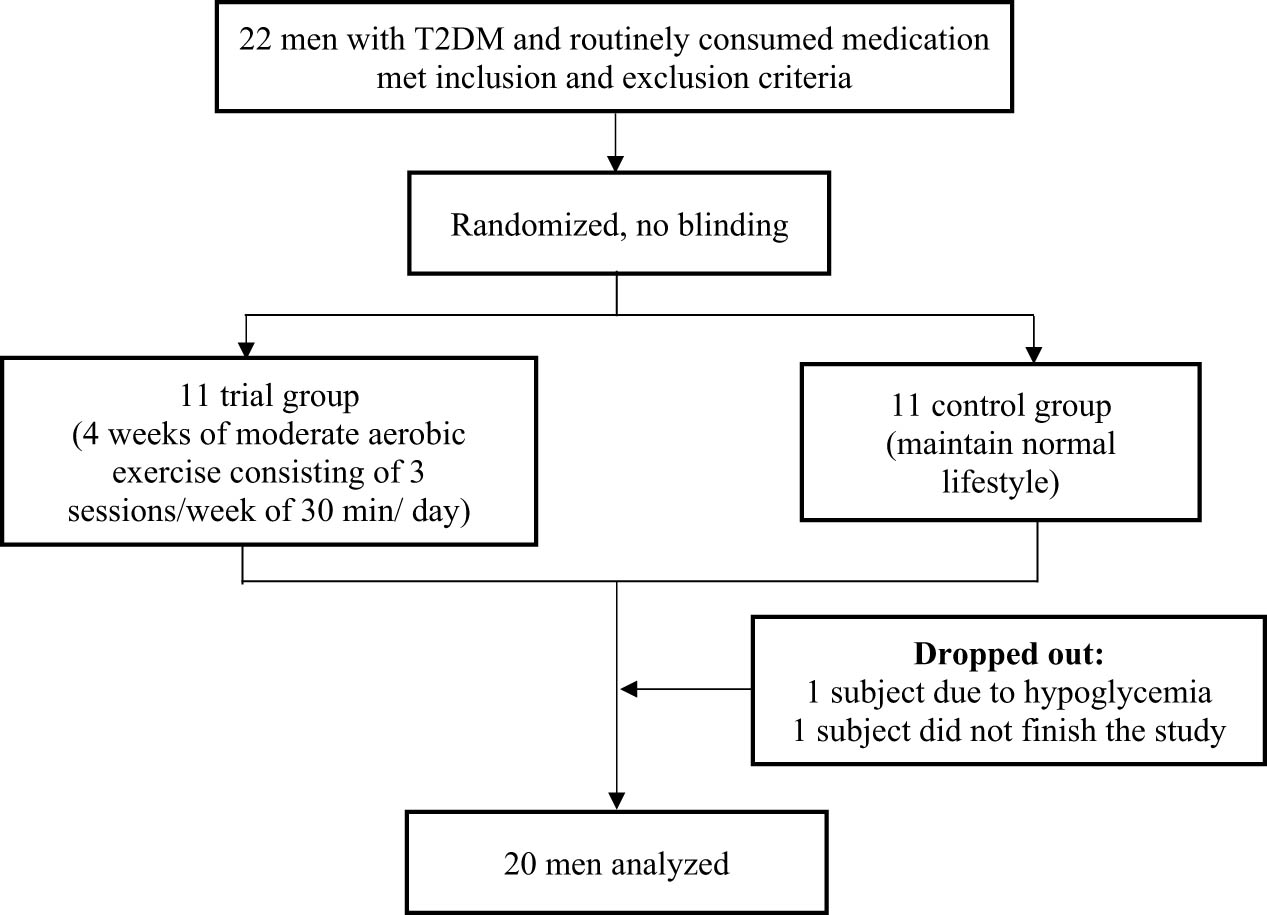
Figure 1
Participant selection
Source: Author’s contribution.
5. Conclusion
The results of this study indicate that short-term moderate-intensity aerobic exercise, which consists of 4 weeks of 90 min/week results in an increase of adiponectin, which is beneficial for patients with T2DM. There was no effect of exercise and increase of adiponectin on β-cell function determined by HOMA-β, but there might be an improvement in glucose uptake. To uncover any effects of exercise on β-cell function and adiponectin on β-cell function following exercise, a longer period of observation (more than 4 weeks) or more than 90 min/week of exercise may be necessary, along with measuring insulin sensitivity and dietary adjustments.
Funding information
This publication was prepared without any external source of funding.
Author contributions
The first author contributed in developing the study design, data analysis, data interpretation, article drafting and final approval; the second author contributed in developing the study design, data collection, data analysis, article drafting and final approval; the third author contributed in data analysis, data interpretation, article drafting, and final approval; the fourth author contributed in developing the study design, data collection, data interpretation, article drafting, and final approval. All authors have approved the final article.
Conflict of interest statement
The authors confirm that there are no known conflicts of interest associated with this publication.
Data availability statement
The data that support the finding of this study are available from the corresponding author upon reasonable request. The data are not publicly available due to restrictions containing information that could compromise the privacy of research participant.
Publisher’s note
All claims expressed in this article are solely those of the Authors and do not necessarily represent those of their affiliated organization, or those of the publisher, the editors and the reviewers. Any product that may be evaluated in this article, or claim that may be made by its manufacturer, is not guaranteed or endorsed by the publisher.