
1. Introduction
Boxing is a combat sport where the ability to generate high punching force and acceleration is a critical determinant of performance, influencing both the outcome of individual exchanges and the overall result of a bout. Punch impact not only contributes to the probability of achieving a knockout but also affects tactical dominance and scoring in amateur competition, where judges assess the number of effective punches landed, technical superiority, and control of the fight (Pierce et al., 2006) As a consequence, the biomechanics of punching has become an important focus of contemporary sport science, aiming to better understand the physical underpinnings of performance and to optimize training methods (Kacprzak et al., 2025).
A central technical factor in boxing is the fighting stance. In boxing, two basic stances are used. The orthodox stance places the left leg and left hand in front, while the southpaw stance mirrors this position with the right leg and right hand leading. This asymmetry has been studied from both a biomechanical and tactical perspective. The fighting hypothesis suggested that left-handed athletes may have an advantage because right-handed opponents are less accustomed to their movements (Richardson & Gilman, 2019). Indeed, large-scale statistical analyses have shown that southpaw fighters are overrepresented in boxing and other combat sports relative to their proportion in the general population, and in some cases, they also display higher win rates (Richardson & Gilman, 2019). Importantly, lateral preferences in combat sports did not necessarily reflect general handedness, as athletes may adopt a southpaw stance independently of their dominant hand (Loffing et al., 2016). Limb dominance also played a fundamental role in stance-related asymmetries. Most athletes were right-handed and right-leg dominant, which meant that their preferred stance assigned distinct mechanical functions to each limb: the rear, dominant side typically generated force and contributed to trunk rotation, whereas the lead, non-dominant side provided stabilization, reach, and rapid initiation of movement. Previous research indicated that mismatches between hand dominance and stance orientation could influence coordination patterns and force production, offering an additional explanation for inter-individual differences observed in punching performance (Loffing et al., 2016; Richardson & Gilman, 2019).
While much of this literature has emphasized the psychological and tactical dimensions of the southpaw advantage, relatively little is known about its biomechanical underpinnings. If orthodox and southpaw stances are not biomechanically equivalent, then differences in force production, acceleration, and coordination could provide an additional explanation for the performance asymmetries observed at the population level. Only a few studies have explicitly addressed this question. Some research studies reported that punches delivered from the orthodox stance were associated with higher forces and velocities than those from the southpaw stance, particularly in straight punches, whereas differences in hooks were less pronounced (Sorokowski et al., 2014). Other studies have focused more specifically on the biomechanics of hooks, analyzing the technical factors involved in teaching and executing hook punches, emphasizing the importance of body rotation and coordination for generating effective force (Bingul et al., 2018). Similarly, recent EMG analyses of hook punches suggested largely similar patterns of muscular activation between the two stances, with only subtle differences in lower-limb recruitment (Kumar et al., 2025). These findings suggested that stance-related differences, if present, may depend on the type of punch and on the kinetic contribution of different body segments. Biomechanical analyses from other striking disciplines (e.g., karate, taekwondo) similarly highlighted the importance of coordinated lower-to-upper limb sequencing, although their techniques differ from boxing (Cherifi et al., 2023; Neto et al., 2007).
The role of the lower limbs is particularly noteworthy. Previous studies have consistently shown that punching force is strongly correlated with lower-body strength and power (Dunn et al., 2020), with ground reaction forces and rapid force development in the legs serving as the foundation for effective transfer of momentum through the kinetic chain. Previous investigations confirmed that effective mass and acceleration are key determinants of punching performance, with rear-hand punches typically achieving higher forces and accelerations than lead-hand punches (Mosler et al., 2024a). Further, it was demonstrated that the relationship between force and acceleration can be explained by the concept of effective mass, providing a more nuanced understanding of why certain punches achieve greater impact despite similar arm kinematics (Mosler et al., 2024b). Recent methodological advances have also demonstrated that effective mass can be integrated into three-dimensional force calculations, enabling reliable estimations of impact forces on the head and neck during boxing punches (Birk et al., 2024). Accelerometer-based systems have also been applied in combat-sport research using instrumented punching bags to estimate punch and kick forces (Buśko, 2019; Buśko et al., 2016). These findings collectively highlighted that differences in stance – which alter the functional role of each leg and each arm – could systematically influence both straight and hook punches.
Another emerging line of research has emphasized differences between boxers of varying competitive levels, showing that elite athletes generate higher peak velocities, impulses, and rates of force development than junior counterparts, particularly through the lead leg during straight punches (Liu et al., 2023). This observation was critical because in the orthodox stance, the left leg serves as the lead, whereas in the southpaw stance, it is the right leg. Therefore, switching stance not only changes tactical orientation but also reassigns biomechanical roles between dominant and non-dominant limbs. Such asymmetries may interact with training history, hand dominance, and lateral preferences, offering a potential explanation for observed differences in performance.
Despite these advances, comparative studies of orthodox and southpaw stances remained scarce. Most existing research has examined single techniques, small samples, or indirect indicators of performance. No study has systematically compared four fundamental punches – jab, cross, lead hook, and rear hook – performed in both orthodox and southpaw stances by the same group of athletes. Such an approach would eliminate inter-individual variability and directly isolate the effect of stance on biomechanical outputs.
In previous work, the explanatory value of effective mass for force–acceleration relationships in punching was demonstrated (Mosler et al., 2024a, 2024b). In the present study, four fundamental boxing techniques were selected – jab, cross, lead hook, and rear hook – because they represent the two primary mechanical categories of punching. The jab and cross involve predominantly linear acceleration and rely on efficient force transfer along the forward-directed kinetic chain (Sorokowski et al., 2014), whereas hook punches require substantial trunk rotation and generate higher forces through transverse-plane motion (Bingul et al., 2018). Including both straight and rotational techniques allowed us to examine whether the effect of stance depends on the underlying biomechanical demands of each punch. These four punches also constituted the core elements of boxing training and are the most frequently analyzed strikes in biomechanical research (Mosler et al., 2024a, 2024b).
Therefore, the aim of the present study is to obtain knowledge about differences in the punching force and fist acceleration by evaluating four fundamental boxing techniques in orthodox and southpaw stances.
By analyzing the same athletes across both positions, this study seeks to provide novel insights into whether the observed southpaw advantage may have a biomechanical component, in addition to psychological and tactical explanations. The main research question is whether boxing stance systematically influences the kinetics of fundamental punches. We hypothesize that there are boxing techniques that demonstrate a clear biomechanical advantage when executed in the southpaw stance compared to the orthodox stance. Furthermore, the findings are expected to have practical implications for coaches and practitioners, informing decisions about stance training, bilateral development, and preparation for opponents of different orientations.
2. Materials and methods
2.1. Participants
The study included 30 male boxers (mean body mass: 86.4 ± 1.4 kg; height: 175.8 ± 7.9 cm; age: 29.2 ± 1.4 years; and training experience: 6.0 ± 2.1 years), all recruited from local boxing clubs in Częstochowa, Poland. Eligibility criteria required athletes to have at least 1 year of boxing practice or recognized national-level achievements. Participants also had to be injury-free, in an active training phase, and in good physical condition on the day of testing.
Hand and leg dominance, as well as preferred boxing stance, were recorded before testing using a standardized self-report form. All athletes were right-handed and reported right-leg dominance, and the majority preferred to box in the orthodox stance. These data were collected to contextualize potential asymmetries related to dominance–stance interactions.
Inclusion criteria included the following:
(1) a minimum of one year of organized boxing training;
(2) regular participation in training at the time of the study;
(3) self-reported absence of injury or movement restrictions that could affect punching performance.
Exclusion criteria included the following:
(1) any acute or chronic upper- or lower-limb injury reported prior to testing;
(2) illness or physical discomfort on the day of the session; and
(3) inability to perform the familiarization punches correctly.
2.2. Sample size justification
A priori sample size estimation was conducted in G*Power (version 3.1). For a Wilcoxon signed-rank test detecting medium effect sizes (dz = 0.50) with α = 0.05 and 1 − β = 0.80, the required sample size was calculated as N = 27. The final sample of 30 participants, therefore, provided sufficient statistical power to detect meaningful stance-related differences in punching kinetics.
2.3. Ethics and funding
The study was conducted in full accordance with the ethical standards of the Declaration of Helsinki. The research design received formal approval from the Human Subjects Research Committee of Jan Długosz University (KE-O/4/2022), ensuring compliance with ethical guidelines. Before participation, athletes were thoroughly informed about the experimental procedures and gave their written informed consent. Their health status and absence of injuries were confirmed through self-report prior to testing. This research received no external funding.
2.4. Equipment
To capture punching force (pressure force), researchers employed an AMTI MC12-2K force plate (2000 series; Watertown, MA, USA), mounted on a stable frame and covered with a protective surface to avoid direct impact (Figure 1). The plate’s aluminum structure measured 305 × 406 × 79 mm. Data were synchronized through the Noraxon MyoSync system (MR 3.18, Scottsdale, AZ, USA). For recording fist acceleration, a Noraxon Ultium EMG wireless inertial sensor was used. This device, capable of registering accelerations up to 4,000g at a 2,000 Hz sampling rate, was fixed to the hand with Velcro straps and covered by a 16-ounce boxing glove. All participants used the same gloves to ensure consistency.
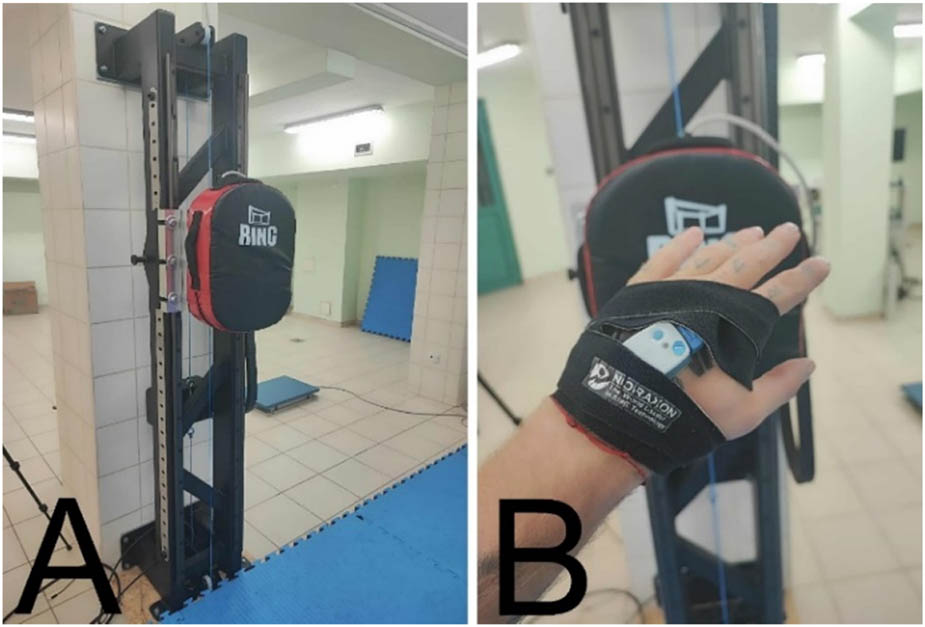
Figure 1
Research equipment: (A) force plate AMTI MC12-2K with a strike pad; (B) EMU sensor on upper limb
2.5. Protocol
The methodological design built upon previous work (Mosler et al., 2024b), which analyzed effective mass in straight punches executed without gloves. The present study expanded this approach by incorporating hook techniques and using standard 16-ounce gloves, thus creating conditions closer to real training and competition. Prior to testing, participants underwent a preliminary health screening and provided written confirmation that they were free from injury or medical conditions that might interfere with the results. After signing informed consent, each athlete completed a 10-min dynamic warm-up consisting of jumps, torso rotations, and shadow boxing. This was followed by several familiarization strikes delivered to the force-plate target to ensure correct alignment and comfort with the apparatus.
For the main trials, participants wore 16-ounce gloves (Orthodox Wear) and had the inertial sensor attached to the striking hand. Participants were verbally instructed to deliver each punch with maximal force and speed while maintaining correct boxing technique. Each boxer performed five maximum-force repetitions of four punching techniques – jab, cross, lead hook, and rear hook – first in the orthodox stance. After completing this series, they rested for 10 min to minimize fatigue effects before switching to the southpaw stance, where they repeated the same protocol with five repetitions of each of the four punches. This two-phase design ensured within-subject comparability between stances. The order of stances was not randomized; all participants performed the orthodox condition first, followed by the southpaw condition, reflecting typical training progression. Although no physiological or RPE indices were collected, the low total number of strikes, the 10-min rest interval, and the advanced training status of the boxers made substantial fatigue effects unlikely. For clarity, each technique was executed according to standardized boxing practice. The jab is a quick, straight punch delivered with the lead hand, relying on a push from the front leg and slight torso engagement, with rapid retraction to guard after impact. The cross is a rear-hand straight punch involving substantial hip and torso rotation, transferring force from the rear foot through the core to the arm in a direct trajectory. The lead hook begins with a pivot of the front foot and rotation of the torso, delivering a curved strike with the elbow raised at shoulder height. The rear hook mirrors this motion on the dominant side, using a rear-leg pivot and full-body rotation to generate maximum force. After each strike, the arm quickly returned to guard. All trials were supervised by an experienced boxing coach and a biomechanist, who monitored execution and provided corrective feedback to ensure adherence to standard technique.
The sequence of punches was standardized, with short pauses of 2–5 s between individual strikes to allow for data saving and sensor stabilization. A 10-min interval separated the orthodox and southpaw conditions, ensuring adequate recovery. This approach was consistent with the training capacity of experienced boxers, who are accustomed to performing dozens of punches within a single session. These procedures minimized the likelihood that fatigue could affect performance during testing. All four punches and their execution patterns in both stances are presented in Figure 2.
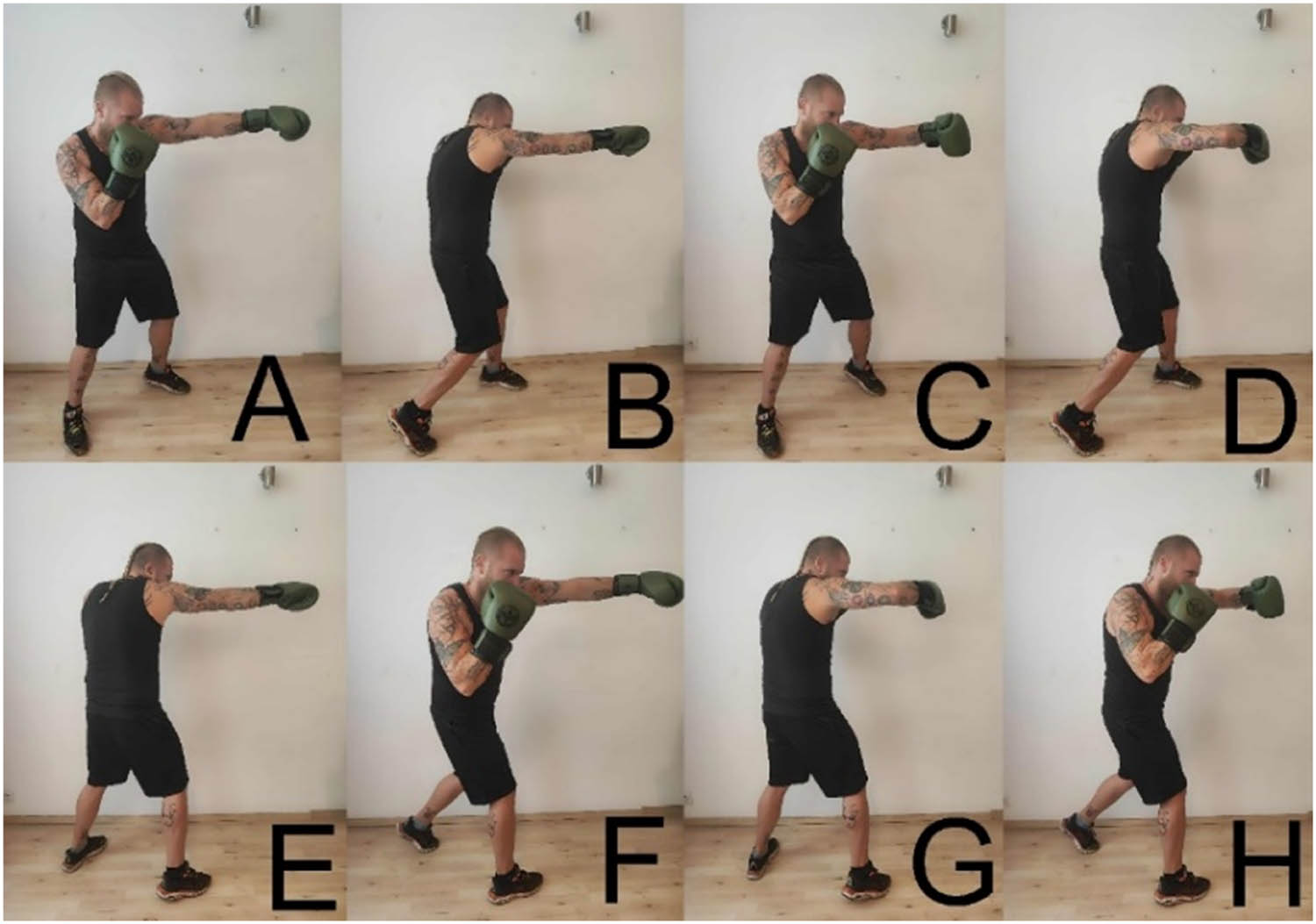
Figure 2
Illustration of recorded boxing techniques in orthodox stance: (A) jab, (B) cross, (C) lead hook, (D) rear hook and southpaw stance: (E) jab, (F) cross, (G) lead hook, and (H) rear hook
2.6. Data processing and analysis
Each participant performed five repetitions of every punch type. The recordings were first exported from Noraxon MR 3.18 in.slk format and then transformed into.xlsx files for analysis. A dedicated Python 3.10 routine (SciPy, signal.find_peaks) was used to identify peak force for each attempt and to determine fist acceleration at the instant of maximum force. The entire workflow was implemented on the Deepnote platform to ensure transparency and reproducibility.
To improve event detection and minimize noise, only movements exceeding an acceleration of 12 m/s2 were classified as punches, which prevented the inclusion of artifacts close to gravitational acceleration. A strike was defined as beginning when this threshold was crossed and ending when the highest pressure force value was registered. For signal conditioning, residual checks were applied, and the data were processed with a Butterworth band-pass filter (20–250 Hz), chosen after evaluating several alternative cut-off configurations between 1 and 60 Hz. In addition, recordings containing obvious errors – such as abnormal values caused by sensor tremors or collection glitches – were excluded to preserve the integrity and reliability of the dataset. The full dataset, summary table used for statistical analysis, and Python code for calculations are openly accessible at: https://doi.org/10.5281/zenodo.17186871.
2.7. Statistical analysis
Peak detection and data aggregation were implemented in Python 3.10, whereas the final statistical analyses were conducted in Statistica 13 (TIBCO Software, Palo Alto, CA, USA). Descriptive statistics were reported exclusively as medians and interquartile ranges (IQR), in accordance with the non-normal distribution of all primary variables. The Shapiro–Wilk test confirmed non-normality for all outcomes (p < 0.05), and therefore non-parametric methods were applied. Accordingly, all stance comparisons were interpreted based on median differences.
Given the within-subject design, Wilcoxon signed-rank tests served as the primary analyses for comparing orthodox and southpaw stances across techniques. To control for Type I error inflation across the four a priori stance comparisons, p-values were adjusted using the Benjamini–Hochberg false discovery rate procedure. To maintain continuity with previous reports, Kruskal–Wallis tests were also conducted to examine between-technique differences. Effect sizes were calculated using epsilon squared (ε 2_H), interpreted as small (0.01), medium (0.06), or large (≥0.14).
All tests were two-tailed with statistical significance set at p < 0.05 (BH-adjusted for Wilcoxon tests).
3. Results
Because all kinetic variables violated normality, results are reported as medians and interquartile ranges (IQR). Wilcoxon signed-rank tests with Benjamini–Hochberg correction were used for stance comparisons, and effect sizes were interpreted using epsilon squared (ε 2_H).
The jab produced significantly greater force in the southpaw stance (median = 1387.8 N, IQR: 1205.9–1658.6) compared to orthodox (1292.8 N, 1129.1–1581.7; BH-adjusted p = 0.021). In contrast, both the cross (orthodox: 1863.4 N, 1594.3–2307.7 vs southpaw: 1589.7 N, 1363.4–1941.0) and the rear hook (orthodox: 2198.8 N, 1888.2–2580.6 vs southpaw: 2007.5 N, 1680.5–2262.3) produced greater forces in the orthodox stance (both BH-adjusted p < 0.001). Lead hook force did not differ between stances (orthodox: 2090.0 N, 1768.8–2394.6 vs southpaw: 2060.2 N, 1812.1–2426.1; BH-adjusted p = 0.38) (Figure 3–5).
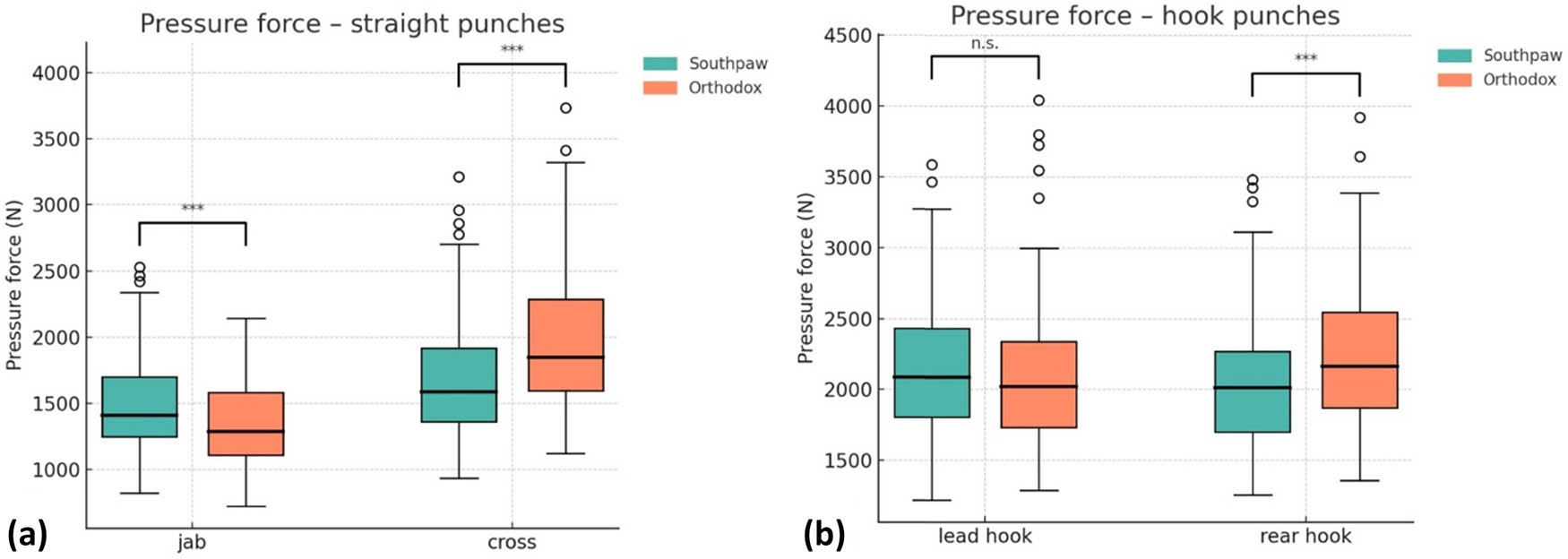
Figure 3
Pressure force across straight punches (Panel a: jab, cross) and hook punches (Panel b: lead hook, rear hook) performed in orthodox and southpaw stances. Boxplots display medians and interquartile ranges (IQR). Horizontal brackets and asterisks denote significant stance differences after Benjamini–Hochberg correction (*p < 0.05, **p < 0.01, ***p < 0.001; n.s. = non-significant)
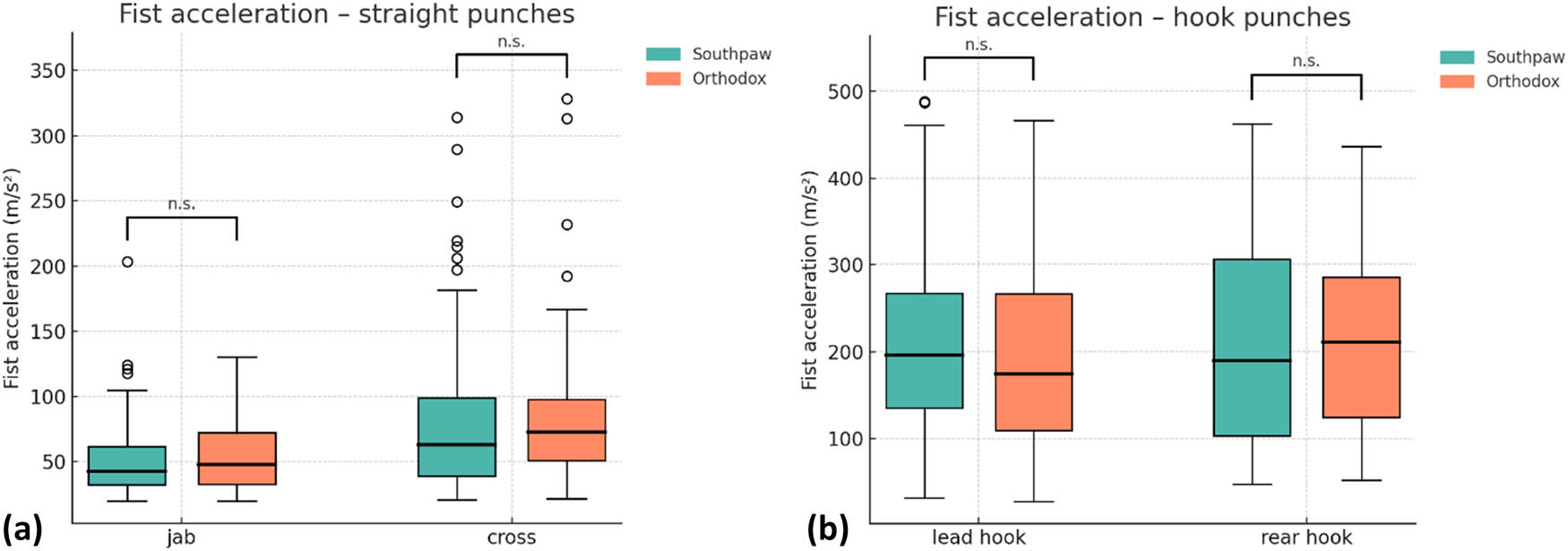
Figure 4
Fist acceleration across four boxing punches (jab, cross, lead hook, and rear hook) performed in orthodox and southpaw stances. Panel a shows straight punches (jab and cross), and Panel b shows hook punches (lead and rear). Boxplots present median and interquartile ranges, with whiskers representing 1.5 × IQR and points indicating outliers. Asterisks denote significant stance differences based on Benjamini–Hochberg-corrected Wilcoxon tests (*p < 0.05; **p < 0.01; ***p < 0.001; n.s. = non-significant)
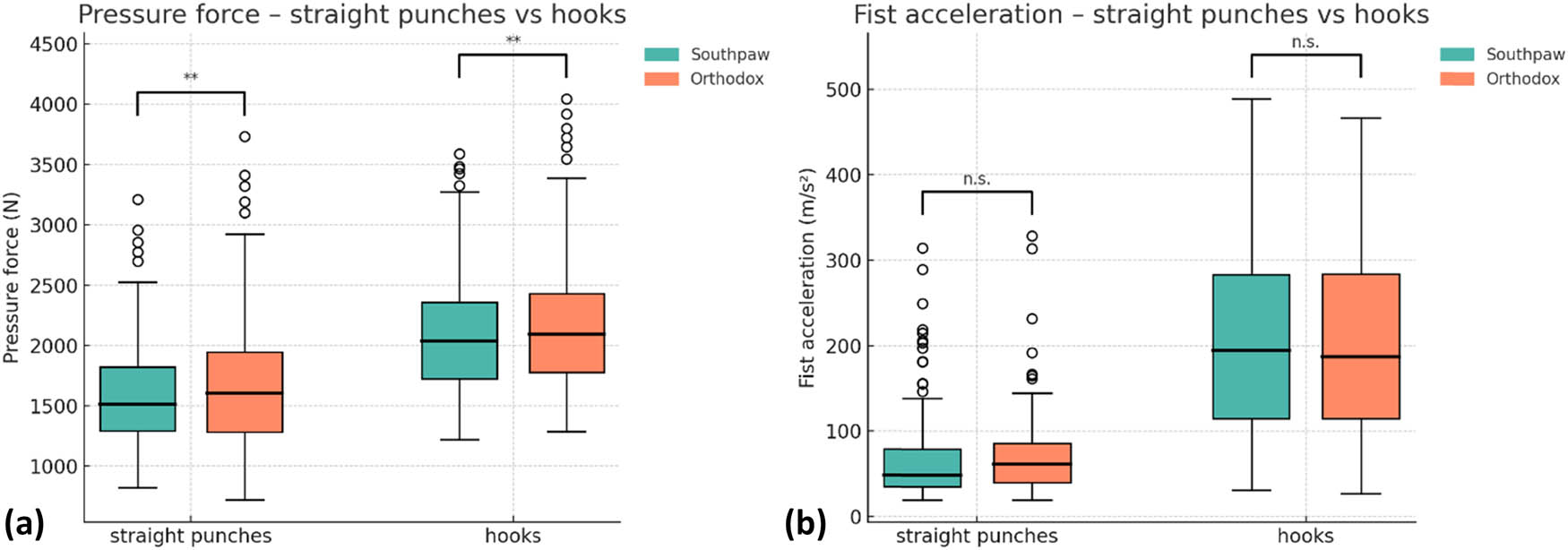
Figure 5
Combined boxplots illustrating aggregated comparisons of straight punches (jab + cross) and hook punches (lead + rear) across orthodox and southpaw stances. Panel a presents the pressure force, and Panel b shows fist acceleration. Boxplots display medians and interquartile ranges (IQR), with whiskers representing 1.5 × IQR and outliers shown as individual points. Horizontal brackets denote stance comparisons within each punch category, with significance levels based on Benjamini–Hochberg–corrected Wilcoxon tests (*p < 0.05; **p < 0.01; ***p < 0.001; n.s. = non-significant)
For fist acceleration, no stance differences were observed in jab (southpaw: 42.3 m/s2, 32.2–62.5 vs orthodox: 49.7 m/s2, 33.8–69.7), cross (61.8 m/s2, 37.1–91.9 vs 73.0 m/s2, 51.1–98.4), or rear hook (201.6 m/s2, 104.3–315.3 vs 200.2 m/s2, 122.4–283.6) (all BH-adjusted p > 0.20). The only exception was the lead hook, where southpaw produced slightly higher values (201.8 m/s2, 136.1–266.9 vs 183.8 m/s2, 110.4–285.0), but the difference was not statistically significant after correction (BH-adjusted p = 0.11).
When straight punches (jab + cross) were combined, no stance difference emerged for force (southpaw: 1506.7 N, 1285.6–1824.0 vs orthodox: 1589.8 N, 1282.6–1935.1, BH-adjusted p = 0.13). Hooks (lead + rear) likewise showed no stance effect on force (southpaw: 2026.0 N, 1724.1–2345.4 vs orthodox: 2150.0 N, 1817.8–2448.0, BH-adjusted p = 0.19). For acceleration, neither straight punches (southpaw: 48.8 m/s2, 34.4–78.4 vs orthodox: 60.3 m/s2, 41.3–85.3) nor hooks (southpaw: 201.8 m/s2, 118.5–291.5 vs orthodox: 189.0 m/s2, 115.7–283.9) differed significantly between stances (all BH-adjusted p > 0.10).
In both orthodox and southpaw stances, hooks produced substantially greater force and acceleration than straight punches (all p < 0.001). These differences were accompanied by large effect sizes, with ε 2_H values exceeding 0.14 for force and above 0.50 for acceleration, indicating robust kinetic distinctions between punch types.
Overall, stance effects were punch-specific: the jab favored the southpaw stance, the cross and rear hook favored orthodox, the lead hook showed no force difference and only a small, non-significant acceleration trend.
Hooks consistently produced markedly higher kinetic outputs than straight punches.
4. Discussion
The findings of this study demonstrate that the impact of stance on punching performance is dependent on punch type rather than universal. Among straight punches, the jab produced higher forces when executed from the southpaw stance, whereas both the cross and the rear hook were more powerful in the orthodox orientation. The lead hook did not exhibit significant stance-related differences in force but showed higher fist acceleration in the southpaw position. These results suggest that the biomechanical consequences of switching stance are heterogeneous and may depend on the interplay between limb dominance and the technical characteristics of each punch. These stance-dependent differences in straight punches align with prior boxing research showing that linear strikes rely more on coordinated forward transfer of momentum, whereas hooks depend predominantly on rotational mechanics (Bingul et al., 2018; Sorokowski et al., 2014). Previous biomechanical investigations also highlighted that straight punches tend to show clearer asymmetries between stances. Consistent with this, other studies reported significantly higher peak forces, accelerations, and impulse for straight punches executed from the orthodox stance versus southpaw in elite boxers, reinforcing the stance-specific sensitivity of linear strikes (Bergün et al., 2017). Focusing on hooks, researchers emphasized rotational mechanics, while other studies have reported greater velocities and impact forces for straight punches delivered from the orthodox stance, while differences in hooks were less pronounced (Bingul et al., 2018). Stance changes, whereas hooks rely more on rotational dynamics and appear less affected by lateral orientation. This was reflected by the jab gaining a relative advantage in southpaw, whereas the cross retained its superiority in orthodox, confirming that linear punches are more sensitive to stance configuration.
The present findings also align with the broader literature on the so-called “southpaw advantage.” Large-scale analyses have demonstrated that left-handed or southpaw fighters are overrepresented and often more successful in combat sports (Baker & Schorer, 2013; Richardson & Gilman, 2019). However, these advantages have generally been attributed to negative frequency-dependent effects – opponents’ lack of familiarity with southpaw techniques – rather than to biomechanical superiority. The data support this interpretation by showing that stance-related differences in force and acceleration are limited and highly technique-dependent, rather than consistently favoring the southpaw.
A closer inspection of the mechanisms underlying these results provides further insights. Previous experimental work has consistently shown that rear-hand punches generate greater forces than lead-hand punches. Previous studies demonstrated that the rear straight hand delivered significantly higher peak forces than the lead hand, regardless of target (Dyson et al., 2005). The results mirror this relationship: the cross was stronger than the jab, and the rear hook surpassed the lead hook, independent of stance.
The influence of the lower limbs on punch execution is also critical. While the jab was stronger in the southpaw, this pattern should be interpreted cautiously. Some studies suggest that the lead leg can contribute meaningfully to force transfer during straight punches, which may partially relate to stance-dependent changes in limb roles (Liu et al., 2022). However, the present study did not include direct measurements of lower-limb kinetics, and therefore, no causal mechanism can be confirmed. This interpretation should therefore be viewed as a hypothesis rather than a confirmed mechanism.
In contrast, hooks are more dependent on trunk and hip rotation than on limb asymmetry. Electromyographic analyses of hook punches indicated broadly similar activation patterns across stances, with only subtle differences in lower-limb recruitment (Kumar et al., 2025). Similarly, the importance of rotational synchronization and stride length in teaching hook punches, rather than lateral dominance, was emphasized (Bingul et al., 2018). The present study corroborates these findings: hook force values did not differ significantly between stances, while only minor differences emerged in acceleration. The lack of significant stance differences in hook force supports the view that trunk–hip coordination, rather than lateral orientation, is the primary determinant of hook effectiveness.
These observations must also be considered in the wider context of lateralization. It is important to note that adopting a southpaw stance does not always correspond to left-handedness. Some researchers stressed that sport-specific lateral preferences may be independent of general handedness (Baker & Schorer, 2013). Furthermore, other work suggested that the competitive success of southpaws is more likely attributable to tactical unfamiliarity than to inherent biomechanical advantages (Gursoy, 2009). The results, which show no consistent superiority of southpaws in biomechanical terms, reinforce this perspective.
From a practical standpoint, the findings underline the importance of bilateral stance training. From a coaching perspective, these findings allow for punch-specific emphasis. Jab in southpaw: drills focused on enhancing lead-side stabilization and force transfer (e.g., lead-leg RFD drills, step-in jabs). Cross and rear hook in orthodox: exercises emphasizing rear-leg loading, hip rotation, and timing of proximal-to-distal sequencing. Hooks in general: rotational medicine-ball throws and trunk coordination drills appear beneficial across stances. Lead hook acceleration: The slightly higher values in southpaw indicate that rotational timing work performed bilaterally may translate effectively between orientations.
Several limitations must be acknowledged. The study was conducted under laboratory conditions with controlled protocols, which do not fully replicate the dynamic and reactive environment of a boxing match. Additionally, the order of stance testing was not randomized, which may have introduced sequence or fatigue effects despite the recovery intervals. The sample consisted of male athletes without stratification by weight class, and results may differ across divisions or between sexes. Importantly, only male boxers were analyzed, so the findings may not generalize to female athletes. Moreover, although force plates and inertial sensors provide precise measurements, they cannot capture tactical and perceptual variables that influence punching performance in competition. Another limitation is the relatively small sample size, which reduces the statistical power of the analyses. In addition, the use of a fixed target on a force plate, while precise, does not fully reflect the variability and adaptability required when striking a moving opponent. These factors limit the ecological validity of the experiment, even if the internal measurement accuracy was high. Future research should incorporate additional biomechanical tools, such as electromyography, to provide further insights into neuromuscular coordination between orthodox and southpaw positions. The use of wearable sensors during sparring or competitive bouts also represents a promising direction, as it would enable the collection of kinetic data in ecologically valid contexts. Moreover, longitudinal studies focused on bilateral stance training could clarify whether systematic practice in both orientations reduces asymmetries and enhances tactical versatility.
5. Conclusions
This study showed that stance-related differences in punching performance are technique-specific rather than universal. The jab produced significantly greater force in the southpaw stance (median = 1387.8 N, IQR: 1205.9–1658.6) compared with orthodox (1292.8 N, 1129.1–1581.7; BH-adjusted p = 0.021). In contrast, the cross and rear hook generated higher forces in the orthodox stance (cross: 1863.4 N, 1594.3–2307.7 vs 1589.7 N, 1363.4–1941.0; rear hook: 2198.8 N, 1888.2–2580.6 vs 2007.5 N, 1680.5–2262.3; both BH-adjusted p < 0.001). The lead hook showed no stance-related difference in force.
For fist acceleration, no significant stance effects were found for the jab, cross, or rear hook. The lead hook displayed slightly higher acceleration in the southpaw stance (201.8 m/s2, 136.1–266.9 vs 183.8 m/s2, 110.4–285.0), although this difference was not significant after correction (BH-adjusted p = 0.11).
Aggregated analyses confirmed that straight punches (jab + cross) and hooks (lead + rear) did not differ significantly in force or acceleration between stances. However, hooks consistently produced substantially greater force and acceleration than straight punches across both orientations, highlighting the kinetic dominance of rotational techniques.
Overall, the findings indicate that boxing stance does not provide a global biomechanical advantage. Instead, stance modifies performance in a punch-specific manner, particularly affecting straight punches. Because all participants in this study were right-handed and predominantly orthodox-trained, these conclusions apply only to this specific population and should not be generalized to naturally left-handed or southpaw-dominant athletes. From a practical perspective, these results underscore the value of bilateral stance training aimed at strengthening both linear and rotational mechanics and enhancing athletes’ adaptability when facing opponents of different orientations.
Funding information
The authors confirm that no external funding was received for the completion of this study. The research was carried out as part of the authors institutional scientific activity.
Author contributions
Conceptualization, J.K., D.M. and J.W.; methodology, D.M. and J.W.; software, D.M.; validation, J.K., D.M. and J.W.; formal analysis, J.W.; investigation, J.K.; resources, J.K. and J.W.; data curation, J.K.; writing – original draft preparation, J.K.; writing – review and editing, J.K., D.M., and J.W.; visualization, J.K. and J.W.; supervision, J.W.; project administration, J.W.; funding acquisition, J.W. All authors have read and agreed to the published version of the manuscript.
Conflict of interest statement
Authors state no conflict of interest.
Ethical approval
The authors hereby declare that the above-mentioned study was conducted in full accordance with the ethical standards of the Declaration of Helsinki. The research protocol received formal approval from the Human Subjects Research Committee of Jan Dlugosz University in Częstochowa, Poland (approval code: KE-O/4/2022). All participants were thoroughly informed about the purpose, procedures, and potential risks of the experiment and voluntarily provided their written informed consent prior to participation. Their health status and absence of injuries were confirmed through self-report before data collection.
Data availability statement
The data supporting the findings of this study are available from the corresponding author upon reasonable request.