
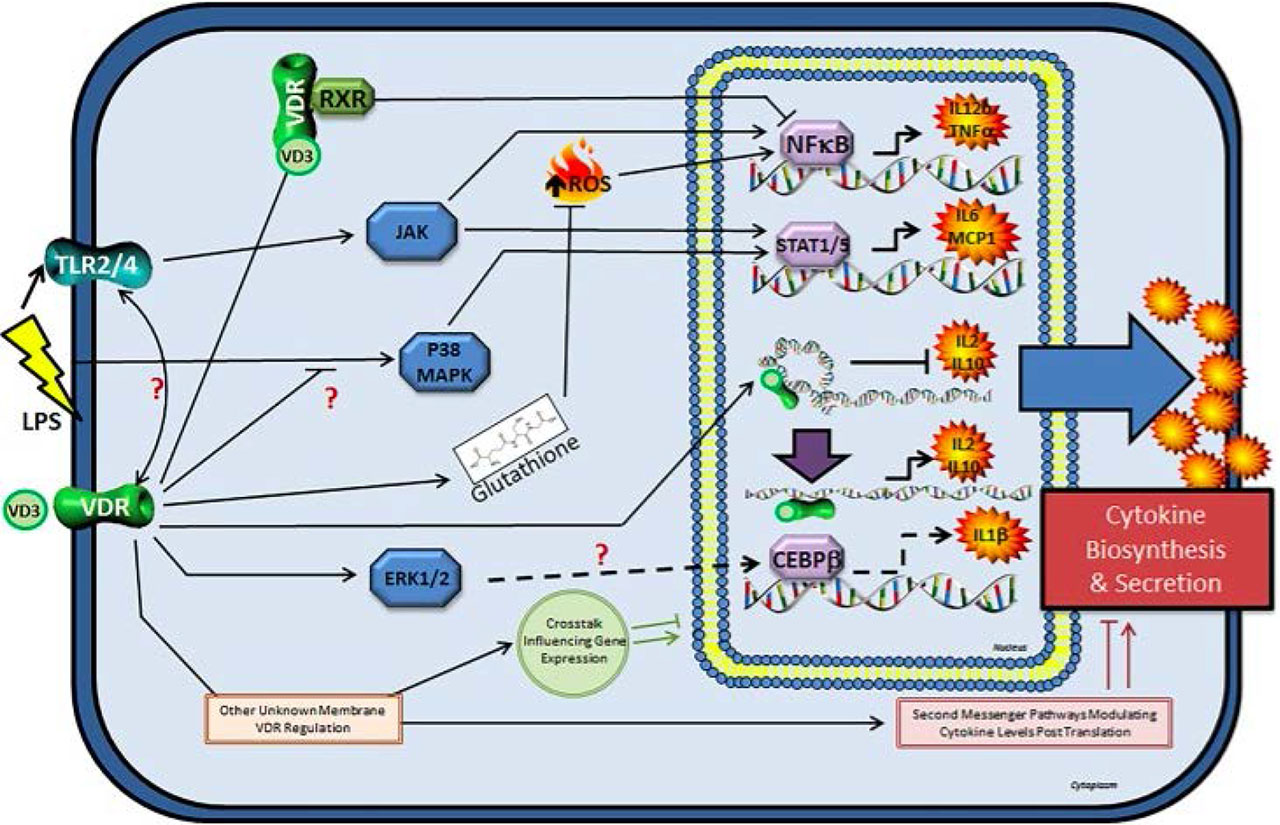
Figure 1.
Overview of VDR-mediated regulation of cytokine transcription, production and secretion in immune cells [9].
Table 1.
Impact of Vitamin D on key inflammatory markers and adipokines in adipose tissue.
| Marker / Parameter | Effect of Deficiency | Effect of Supplementation | Molecular Mechanism | Evidence (Models, References) |
|---|---|---|---|---|
| IL-6 & TNF-∝ | Increased | Decreased | Inhibition of the NF-κB signaling pathway in macrophages infiltrating adipose tissue as well as in adipocytes themselves. | in vitro, in vivo (animal models), human studies; [9, 10,11] |
| CRP | Elevated | Reduced | Downregulation of systemic low-grade inflammation. | human studies; [9, 10] |
| Adiponectin | Reduced | Increased | Activation of VDR leading to enhanced adiponectin gene expression. | in vitro, human studies; [11, 12] |
| Leptin | Elevated | Modulated/Lowered | Improvement in leptin sensitivity and reduction of pro-inflammatory output. | in vivo (animal models), human studies; [11, 12] |
| MCP-1 | Increased | Decreased | Reduced recruitment of macrophages into adipose tissue. | in vitro, in vivo (animal models); [10, 11] |
Table 2.
Current recommendations of the Polish Society of Endocrinology regarding vitamin D supplementation management in patients with obesity, prediabetes, and type 2 diabetes [28].
| Recommendations | |
|---|---|
| 1. 25(OH)D Screening | Mandatory for all patients with obesity, prediabetes, and Type 2 Diabetes (T2D). |
| 2. Target Serum Concentration | >30–50ng/ml |
| 3. Dose Personalization | Dosage should be tailored to body weight (BMI) and baseline serum 25(OH)D concentrations. |
| 4. Obesity-Specific Dosing | Often requires doses exceeding the standard 2,000 IU/day; typically 4,000 IU/day or intermittent regimens of 20,000–50,000 IU/week. |
| 5. Therapeutic Monitoring | Follow-up assessment of serum 25(OH)D and calcium levels after 4 weeks, followed by subsequent dose titration. |
| 6. Alternative Pharmacotherapy | Calcifediol, Alfacalcidol or Calcitriol in cases of renal or hepatic impairment. |