
Introduction
Obesity represents a global health challenge of increasing significance and remains one of the primary issues addressed by modern medicine. It is estimated that by 2035, nearly one in four individuals (24%) worldwide will be affected by obesity.
The objective of this review is to provide an overview of current perspectives on the impact of vitamin D supplementation on obesity. To gather the relevant data, a comprehensive search of scientific literature was conducted across Polish and English-language electronic databases. The analyzed sources included meta-analyses, randomized controlled trials (RCTs), and epidemiological data from the World Health Organization (WHO), Statistics Poland (GUS), and the National Health Fund (NFZ). Scientific databases, including PubMed and Google Scholar, were systematically searched using a combination of the following keywords: “obesity,” “overweight,” “vitamin D,” “inflammation,” “vitamin D supplementation,” “BMI,” and “VDR.” The analysis encompassed 31 scientific articles, 16 of which were published from 2025 onwards.
Overweight and obesity are diagnosed by calculating the patient’s weight-to-height ratio, defined as the Body Mass Index (BMI): weight (kg)/height2 (m2). According to the WHO criteria, adults are classified as overweight when their BMI≥ 25 and as having obesity when their BMI≥30. Importantly, the clinical definition of obesity is fundamentally based on the excessive accumulation and/or dysfunction of adipose tissue. Therefore, while BMI remains a standard and accessible diagnostic tool, it fails to account for actual body composition and fat distribution, which can occasionally lead to diagnostic misclassification [1–2]. According to 2022 WHO data, 43% of adults were overweight, while 16% were diagnosed with obesity. In 2024, overweight affected 35 million children under the age of five [3]. According to Statistics Poland (GUS), in 2019, 56.6% of the Polish population aged 15 and over had excessive body weight, with obesity accounting for 18.5% of the population (17.6% among women and 19.5% among men). It is projected that by 2035, individuals with obesity will constitute 33% of the Polish population [4–5].
Vitamin D in the Pathophysiology of the Inflammatory Component of Obesity
Obesity, characterized by low-grade chronic inflammation (LGCI), significantly contributes to the development of metabolic disorders. The expansion of adipocytes (hypertrophy) and the infiltration of immune cells, particularly macrophages, trigger the release of a pro-inflammatory cytokine cascade, including TNF-α, IL-6, and IL-1β. Subsequently, the activation of the JNK and NF-κB signaling pathways leads to systemic insulin resistance, cardiovascular complications, and other metabolic derangements [6].
Vitamin D is a hydrophobic compound with pleiotropic effects, stored primarily in adipocytes. By interacting with the vitamin D receptor (VDR)—present in nearly all cell types, including those in adipose tissue—it regulates systemic homeostasis. A high body mass index (BMI) and the associated hypertrophy of adipose tissue correlate with an intensive uptake of cholecalciferol by fat cells. This process disrupts vitamin D kinetics, thereby reducing the substrate pool available for enzymatic biotransformation in hepatocytes mediated by 25-hydroxylase (e.g., CYP2R1). Consequently, individuals with obesity experience vitamin D sequestration, a phenomenon where vitamin D is captured and stored within adipocytes, leading to decreased circulating serum levels and reduced bioavailability. Furthermore, vitamin D deficiency in this population likely results from volumetric dilution, a consequence of the expanded volume of adipose tissue, serum, liver, and muscle tissue [7–8].
Vranić et al. suggest that a low vitamin D status cannot be ruled out as a potential triggering factor for obesity, given the complex and non-obvious effects of vitamin D on the VDRs located within the adipose tissue itself [7].
Crucially, beyond its altered pharmacokinetics, vitamin D actively modulates the course of obesity-related inflammation. The active form of vitamin D exerts potent immunomodulatory effects by binding to VDRs expressed on immune cells, particularly the macrophages infiltrating adipose tissue. As illustrated in Figure 1, the vitamin D3-VDR complex directly inhibits the activation of the NF-κB and STAT1/5 signaling pathways, resulting in the suppression of the transcription and subsequent release of pro-inflammatory cytokines, such as TNF-α, IL-12β, IL-6, and MCP-1. Concurrently, the complex stimulates the transcription and release of anti-inflammatory cytokines, namely IL-10. In summary, at the cellular level, vitamin D induces the polarization of macrophages from a pro-inflammatory to an anti-inflammatory phenotype. Through these molecular mechanisms, adequate vitamin D levels actively mitigate the severity of the chronic inflammation that drives metabolic derangements in obesity [9–10].
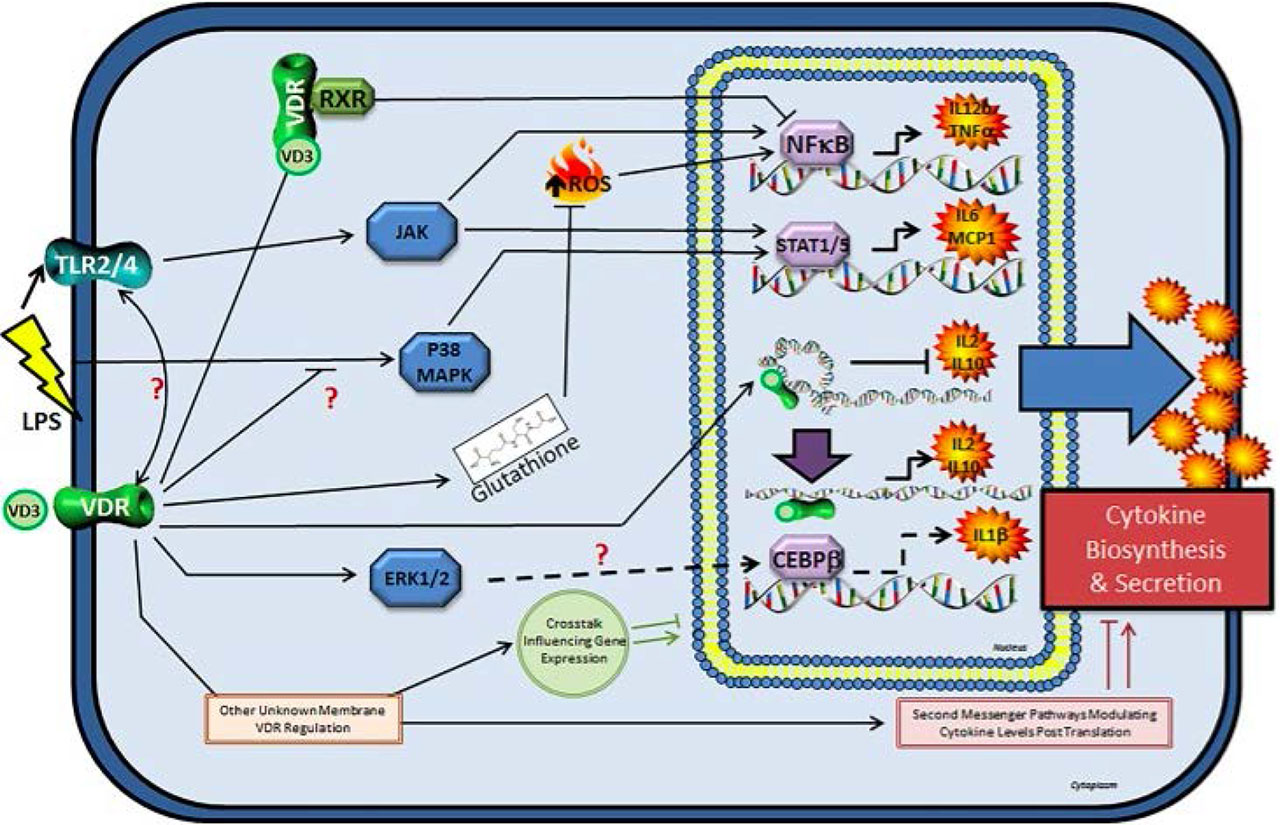
Figure 1.
Overview of VDR-mediated regulation of cytokine transcription, production and secretion in immune cells [9].
Analysis of the Impact of Vitamin D Supplementation on Inflammation
Adipose tissue functions as both an endocrine and immune organ, secreting a wide array of hormones and cytokines, including leptin, adiponectin, omentin, interleukin-6 (IL-6), and tumor necrosis factor-alpha (TNF-α) [11].
Table 1 summarizes the effects of vitamin D on key inflammatory parameters. It is noteworthy that cholecalciferol not only reduces the levels of pro-inflammatory markers, such as IL-6 and C-reactive protein (CRP), but also actively stimulates the secretion of adiponectin. This suggests a pleiotropic effect of vitamin D within dysfunctional adipose tissue, contributing to the modulation of its metabolic and immunological activity [12].
Table 1.
Impact of Vitamin D on key inflammatory markers and adipokines in adipose tissue.
| Marker / Parameter | Effect of Deficiency | Effect of Supplementation | Molecular Mechanism | Evidence (Models, References) |
|---|---|---|---|---|
| IL-6 & TNF-∝ | Increased | Decreased | Inhibition of the NF-κB signaling pathway in macrophages infiltrating adipose tissue as well as in adipocytes themselves. | in vitro, in vivo (animal models), human studies; [9, 10,11] |
| CRP | Elevated | Reduced | Downregulation of systemic low-grade inflammation. | human studies; [9, 10] |
| Adiponectin | Reduced | Increased | Activation of VDR leading to enhanced adiponectin gene expression. | in vitro, human studies; [11, 12] |
| Leptin | Elevated | Modulated/Lowered | Improvement in leptin sensitivity and reduction of pro-inflammatory output. | in vivo (animal models), human studies; [11, 12] |
| MCP-1 | Increased | Decreased | Reduced recruitment of macrophages into adipose tissue. | in vitro, in vivo (animal models); [10, 11] |
It is worth noting a randomized controlled trial conducted by Hasific et al., which demonstrated that two-year supplementation with vitamins D3 (25 μg) and K2 (720 μg), while improving dp-ucMGP status (a biomarker of vascular calcification), did not reduce epicardial or pericoronary adipose tissue volume, nor did it modulate systemic inflammatory markers. This suggests limited efficacy of vitamin D intake alone in inhibiting localized inflammatory processes within adipocytes [9, 13].
In a study by Gwenzi et al., it was demonstrated that in vitamin D-deficient patients with colorectal cancer (CRC), personalized vitamin D supplementation lowers serum concentrations of IL-6, a pro-inflammatory biomarker associated with a poor prognosis. Specifically, patients received a personalized loading dose of 20,000 or 40,000 IU/day for the first 11 days (based on baseline 25(OH)D and BMI), followed by a maintenance dose of 2,000 IU/day until the end of the 12-week study [14].
Data from a study by Wu et al. indicate that vitamin D supplementation significantly reduces indices such as HOMA-IR (Homeostatic Model Assessment of Insulin Resistance), hs-CRP (high-sensitivity C-reactive protein), fasting serum insulin (FSI) levels, and total testosterone (TT) in patients with Polycystic Ovary Syndrome (PCOS). However, fasting plasma glucose (FPG), dehydroepiandrosterone sulfate (DHEAS), the free androgen index (FAI), sex hormone-binding globulin (SHBG), total cholesterol (TC), triglycerides (TG), high-density lipoprotein cholesterol (HDL-C), and low-density lipoprotein cholesterol (LDL-C) remained unchanged. The aforementioned meta-analysis encompasses 10 scientific articles, with vitamin D supplementation dosages ranging from 3,200 IU/week to 12,000 IU/day (equivalent to 84,000 IU/week), administered over study durations of 8 to 24 weeks [15].
Nugroho et al. investigated the impact of calcitriol on inflammation reduction and renal protection in patients with diabetic kidney disease. In this study, 120 patients were randomized to receive either 0.25 μg/d of calcitriol or a placebo for six months. The effect of calcitriol on renal injury was assessed using kidney injury molecule-1 (KIM-1), interleukin-6 (IL-6), and the urinary albumin-to-creatinine ratio (UACR). A significantly smaller increase in IL-6 levels was observed in the calcitriol group (baseline: 0.72 pg/ml to 0.87 pg/ml) compared to the placebo group (1.03 pg/ml to 2.94 pg/ml, p = 0.006), along with lower KIM-1 levels (0.36 to 0.51 ng/ml vs. 0.55 to 0.99 ng/ml, p = 0.020). Although the UACR decreased more prominently in the calcitriol group, the difference did not reach statistical significance (p = 0.099). These findings suggest that by attenuating inflammation and reducing tubular damage, calcitriol supplementation may provide nephroprotection in patients with early-stage chronic kidney disease (CKD) [16].
A meta-analysis by Wang et al. showed that the addition of calcipotriol (a synthetic vitamin D analog) to acetretin significantly influences the inflammatory mediator profile in psoriasis. The combination therapy, consisting of topical calcipotriol ointment applied once or twice daily alongside oral acitretin (20–30 mg/day), markedly reduced serum levels of TNF-α, IL-23, IL-17, IFN-γ, and IL-6, while simultaneously increasing levels of the anti-inflammatory cytokines IL-4 and IL-10, compared to acetretin monotherapy. These results highlight the anti-inflammatory potential of vitamin D, which, by interacting with VDRs in the skin and immune cells, helps suppress the pro-inflammatory cytokine cascade, leading to improved clinical outcomes in patients with chronic inflammatory skin diseases [17].
The anti-inflammatory potential of vitamin D is further supported in the treatment of chronic pruritus associated with conditions such as atopic dermatitis and chronic kidney disease. The meta-analysis by Kuo et al. encompasses both topical treatment with vitamin D3 analogues (e.g., 0.005% calcipotriol cream applied once or twice daily) and long-term oral supplementation involving high loading doses (e.g., 100,000–200,000 IU) followed by maintenance doses (e.g., 20,000 IU weekly or 100,000 IU monthly). The authors indicates that vitamin D3, acting through VDR, modulates the cytokine profile and strengthens the epidermal barrier, resulting in a clinically significant reduction in pruritus. The authors emphasize that this mechanism relies on the suppression of the inflammatory mediator cascade (reducing cytokines such as TNF, IL-6, and hs-CRP), positioning vitamin D as an effective adjunctive therapy in disorders with a dominant pro-inflammatory component [18].
The Impact of Vitamin D Supplementation on Obesity
In a meta-analysis by Bruna-Mejías et al., it was demonstrated that vitamin D supplementation exerts a beneficial effect on glycemic markers, lipid profiles, and inflammatory status in patients with diabetes and prediabetes. Vitamin D supplementation significantly improved glycemic control parameters, including HbA1c%, HOMA-IR, fasting insulin, and fasting glucose. Furthermore, improvements were observed in lipid profile parameters—namely LDL-cholesterol, total cholesterol, and triglycerides—as well as the inflammatory marker C-reactive protein (CRP). Additionally, supplementation increased the rate of normoglycemia restoration in individuals with prediabetes [19].
Serum vitamin D concentration correlates inversely with BMI and body fat percentage. A meta-analysis by Hajhashemi et al. linked each 25 nmol/L increase in vitamin D levels to a 10% lower risk of central obesity (OR: 0.90; 95% CI [0.82, 0.99]). However, this reflects an observational association rather than causality. It should be noted that this relationship remains unclear due to highly probable reverse causality (where excess adipose tissue actively dilutes circulating 25(OH)D), highlighting the need for further studies [20].
The prevalence of vitamin D deficiency was found to be 35% higher in individuals with obesity compared to control groups and 24% higher than in individuals with overweight. These findings confirm a higher incidence of vitamin D deficiency in populations with abnormal body mass. This deficiency was associated with obesity regardless of age, latitude, diagnostic thresholds for deficiency, or the Human Development Index (HDI) of the study location [21]. Furthermore, Huang et al. showed that among individuals with BMI≥25, those with vitamin D deficiency exhibit elevated levels of triglycerides, total cholesterol, and LDL compared to control groups with a matched BMI but sufficient vitamin D levels. Additionally, it was observed that HDL levels are inversely correlated with vitamin D deficiency [22].
Conversely, another meta-analysis revealed that vitamin D supplementation did not significantly improve BMI, BMI-Z score, fasting blood sugar (FBS), insulin, HOMA-IR, the QUICKI index, triglycerides, total cholesterol, or LDL-C. Notably, it was associated with a significant reduction in HDL-C. Subgroup analysis showed that vitamin D2 led to a greater reduction in HOMA-IR compared to vitamin D3; however, while statistically significant, this does not conclusively prove a beneficial effect of vitamin D on cardiometabolic risk factors [23].
In a randomized controlled trial (RCT), Andersen et al. demonstrated that high pre-pregnancy BMI was associated with increased levels of IL-6 and MCP-1 in groups receiving both 400 IU and 3600 IU of vitamin D. While IL-1β levels rose alongside BMI in the 400 IU/day group, high-dose regimens (3600 IU) mitigated the impact of BMI on IL-1β concentrations [24]. Similarly, an RCT involving vitamin D-deficient children in Mongolia showed that weekly supplementation of 14,000 IU of cholecalciferol over three years successfully raised serum D3 levels but had no impact on height, BMI, waist-to-height ratio, body fat percentage, fat mass, lean mass, or Tanner scale scores [25].
A meta-analysis by Oussaada et al. provided new insights into the relationship between vitamin D and human anthropometry. It concluded that supplementation with calcitriol (the active form of vitamin D) does not lead to significant changes in body weight, BMI, or tissue composition, regardless of the patients’ health status. These results suggest that the anti-inflammatory benefits of correcting vitamin D deficiency in individuals with obesity stem from the reduction of the pro-inflammatory cytokine storm rather than a decrease in adipose tissue volume [26].
In a 24-week RCT by Mesinovic et al. involving adults with overweight or obesity and vitamin D deficiency, it was found that a daily dose of 4,000 IU, when combined with physical activity, contributed to a reduction in waist circumference, an improved waist-to-hip ratio, and enhanced functional performance (stair climbing time). However, no significant improvements were noted in other metabolic parameters or overall body weight. This may be attributed to the fact that visceral fat mass exhibits a stronger correlation with 25(OH)D levels than subcutaneous fat. The study suggests that while vitamin D is a valuable adjunct to obesity management—alongside physical activity, increased energy expenditure, and incretin-based therapies—it is not a standalone remedy for elevated BMI [27]. To fully understand these mixed results, it is crucial to differentiate between studies treating clinical vitamin D deficiency [25, 27] and those merely assessing the impact of general supplementation on anthropometric parameters. [19, 23–24, 26]. The discrepancies across the discussed studies stem mainly from differences in baseline vitamin D levels. Supplementation provides the greatest benefits in severe deficiency, while in patients with optimal levels, a physiological ceiling effect inhibits further metabolic improvement.
According to current Polish guidelines, daily vitamin D intake should be tailored to age, body weight, sun exposure, dietary habits, and lifestyle. Due to the phenomena of sequestration and volumetric dilution, higher doses of vitamin D are recommended for patients with obesity, ideally following the assessment of serum 25(OH)D3 levels [28]. These doses often exceed the standard recommendations for the general population within the same age groups [29].
When discussing the treatment of vitamin D deficiency, calcifediol warrants special attention, particularly in patients with obesity and metabolic dysfunction-associated steatotic liver disease (MASLD). In the course of liver diseases, the activity of the CYP2R1 enzyme is reduced, which impairs the conversion of cholecalciferol to calcifediol. The administration of calcifediol bypasses this dysfunctional hepatic pathway and, due to its lower lipophilicity, minimizes the risk of sequestration in adipose tissue. Recent studies confirm that circumventing these barriers ensures a faster and more predictable increase in serum 25(OH)D levels compared to standard cholecalciferol supplementation [30–31].
Table 2.
Current recommendations of the Polish Society of Endocrinology regarding vitamin D supplementation management in patients with obesity, prediabetes, and type 2 diabetes [28].
| Recommendations | |
|---|---|
| 1. 25(OH)D Screening | Mandatory for all patients with obesity, prediabetes, and Type 2 Diabetes (T2D). |
| 2. Target Serum Concentration | >30–50ng/ml |
| 3. Dose Personalization | Dosage should be tailored to body weight (BMI) and baseline serum 25(OH)D concentrations. |
| 4. Obesity-Specific Dosing | Often requires doses exceeding the standard 2,000 IU/day; typically 4,000 IU/day or intermittent regimens of 20,000–50,000 IU/week. |
| 5. Therapeutic Monitoring | Follow-up assessment of serum 25(OH)D and calcium levels after 4 weeks, followed by subsequent dose titration. |
| 6. Alternative Pharmacotherapy | Calcifediol, Alfacalcidol or Calcitriol in cases of renal or hepatic impairment. |
Conclusions
The present review of current literature demonstrates that the impact of vitamin D on obesity remains a complex and ambiguous subject. It is undisputed that obesity is a pathological entity characterized by low-grade chronic inflammation (LGCI); furthermore, the analyzed studies highlight the well-documented anti-inflammatory properties of vitamin D. Recent literature includes findings that support the role of vitamin D supplementation in reducing adipose tissue volume and improving insulin resistance indices, while other studies indicate that such supplementation does not significantly contribute to BMI reduction. Analysis of the available evidence suggests that, despite the confirmed anti-inflammatory systemic effects of vitamin D, its clinical translation into adipose tissue reduction is not straightforward. This observation underscores the fact that obesity is a highly sophisticated pathophysiological entity, in which chronic inflammation represents only one of many intersecting metabolic pathways.
Undoubtedly, vitamin D supplementation alone cannot be utilized as a monotherapy. It is essential to emphasize the critical role of promoting health-promoting behaviors among patients with obesity, including dietary modulation, regular physical activity, adequate sleep, and effective stress management. Collectively, these components contribute to the significant reduction of systemic inflammation [32].
Discussion
The fundamental research problem addressed in this review is the so-called “vitamin D paradox” in obesity. On the one hand, biochemical and molecular evidence confirms its strong immunomodulatory potential, which involves the suppression of the NF-κB and JNK pathways, leading to a decrease in the concentration of pro-inflammatory cytokines (TNF-α, IL-6) [6, 9–10]. On the other hand, clinical outcomes regarding the reduction of BMI and total adipose tissue mass remain inconsistent, as clearly demonstrated in the reviewed meta-analyses [23, 25–26].
The key to understanding this dichotomy lies in the kinetics of cholecalciferol in individuals with obesity. Study results indicate that the lack of effect of supplementation on weight loss in many clinical trials may be directly related to the underestimated dosages. Vitamin D sequestration in hypertrophic adipocytes and volumetric dilution render standard doses of 2,000 IU per day insufficient to achieve the serum concentrations (>30–50 ng/mL) required to obtain a clinically significant anti-inflammatory effect. These conclusions align with the current guidelines of the Polish Society of Endocrinology, which mandate the use of doses of 4,000 IU or higher [28].
It is also worth noting that adipose tissue in obesity is highly dysfunctional. Analyzed interventions prove that vitamin D improves the lipid profile and lowers the HOMA-IR index [15, 19]. This implies that cholecalciferol supplementation does not primarily induce weight loss in the patient, but rather “treats” the adipose tissue itself, restoring partial insulin sensitivity and inhibiting the cytokine storm at both the local (adipocyte microenvironment) and systemic levels.
When analyzing these phenomena, it must be clearly stated that the beneficial impact of vitamin D on immune system function and the attenuation of inflammation does not imply a direct effect on the regulation of energy homeostasis, including energy intake and expenditure [33]. Since generating a negative energy balance is an absolute and fundamental prerequisite for weight loss, the sharp contrast observed in the study results should not be surprising. Therefore, the reduction of excess adipose tissue and the improvement of anthropometric parameters (e.g., BMI) constitute a more fundamental intervention than merely improving biochemical inflammatory markers and alleviating the metabolic consequences associated with obesity [34].
A limitation to the efficacy of vitamin D administration alone is the fact that the inflammatory process in obesity (LGCI) is a multifactorial mechanism. Vitamin D acts as a protective factor (reducing the risk of cardiometabolic complications); however, it is unable to independently reverse the body’s energy balance. Current research clearly points to the appropriate therapeutic direction: supplementation yields the best biometric results (such as waist circumference reduction) only when combined with physical activity [32].
In conclusion, the discussion regarding the role of vitamin D in the treatment of obesity should shift its focus from expectations of weight reduction to its role as an essential adjunctive therapy. Its primary objective is cardio – and nephroprotection, as well as inhibiting the progression of metabolic syndrome through the modulation of the cytokine environment, thereby creating optimal metabolic conditions for the implementation of further behavioral and pharmacological treatments.
Notes
Abbreviations
low-grade chronic inflammation (LGCI)
randomized controlled trial (RCT)
Statistics Poland (GUS)
National Health Fund (NFZ)
vitamin D receptor (VDR)
body mass index (BMI)
tumor necrosis factor-alpha (TNF-α)
interleukin-6 (IL-6)
C-reactive protein (CRP)
colorectal cancer (CRC)
Homeostatic Model Assessment of Insulin Resistance (HOMA-IR)
high-sensitivity C-reactive protein (hs-CRP)
fasting serum insulin (FSI)
total testosterone (TT)
Polycystic Ovary Syndrome (PCOS)
fasting plasma glucose (FPG)
dehydroepiandrosterone sulfate (DHEAS)
free androgen index (FAI)
sex hormone-binding globulin (SHBG)
total cholesterol (TC)
triglycerides (TG)
high-density lipoprotein cholesterol (HDL-C)
low-density lipoprotein cholesterol (LDL-C)
kidney injury molecule-1 (KIM-1)
urinary albumin-to-creatinine ratio (UACR)
chronic kidney disease (CKD)
Human Development Index (HDI)
fasting blood sugar (FBS)
Type 2 Diabetes (T2D)
metabolic dysfunction-associated steatotic liver disease (MASLD)