Have a personal or library account? Click to login
Aggressive B-cell lymphoma with bilateral adrenal involvement and overlapping features of DLBCL and pleomorphic MCL Cover

Aggressive B-cell lymphoma with bilateral adrenal involvement and overlapping features of DLBCL and pleomorphic MCL

Open Access
|Dec 2025

Figures & Tables

Figure 1.

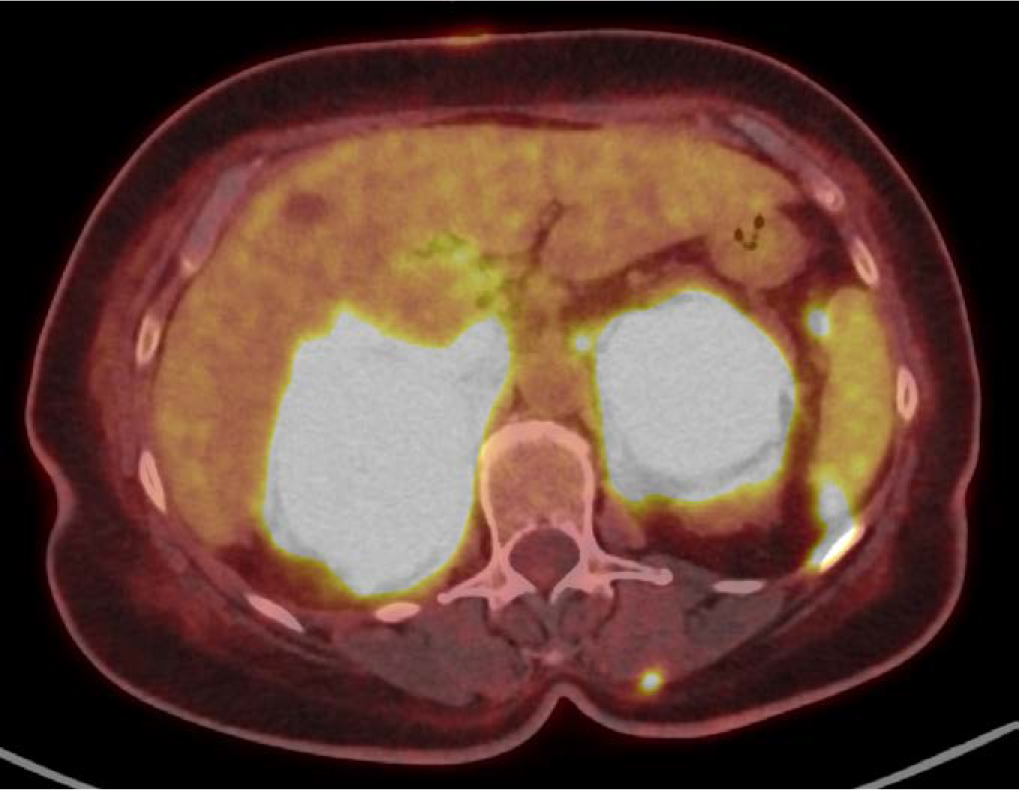
[18F]FDG PET/CT, axial plane – the image shows increased radiotracer uptake in the bilateral polycyclic adrenal masses, infiltrating the liver and the left diaphragmatic crus. Focal increased uptake is also visible in the spleen, peritoneum, back muscles, and paraaortic and hepatic hilar lymph nodes.
[18F]FDG PET/CT, axial plane – the image shows increased radiotracer uptake in the bilateral polycyclic adrenal masses, infiltrating the liver and the left diaphragmatic crus. Focal increased uptake is also visible in the spleen, peritoneum, back muscles, and paraaortic and hepatic hilar lymph nodes.

Figure 2.

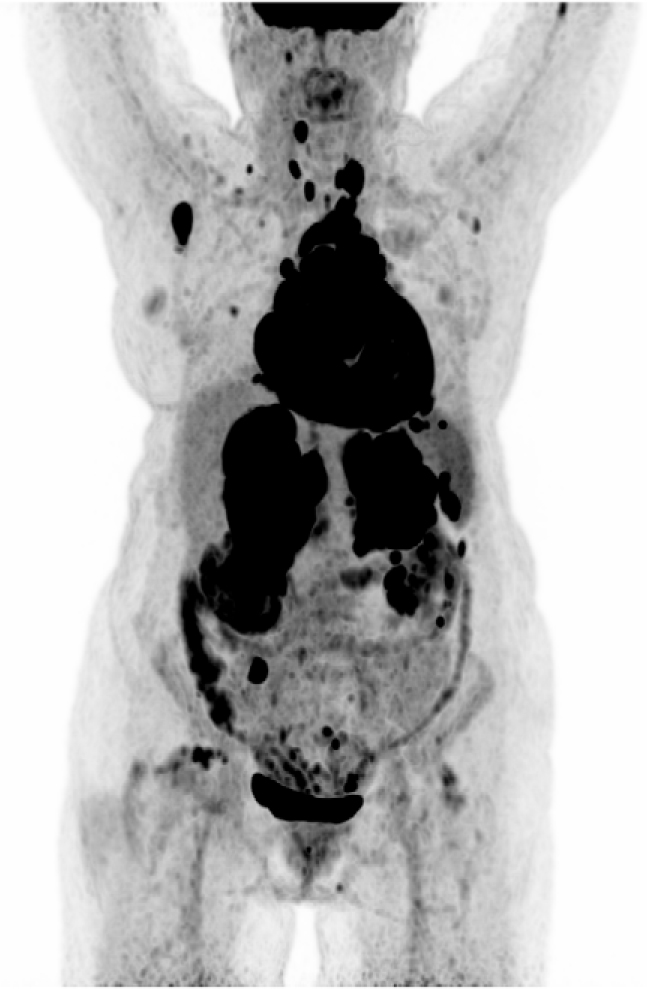
[18F]FDG PET/CT, Maximum Intensity Projection (MIP) image – shows disseminated areas of increased radiotracer uptake in the whole body, including the adrenals, liver, spleen, intestines, bones, thyroid, heart, and multiple lymph nodes.
[18F]FDG PET/CT, Maximum Intensity Projection (MIP) image – shows disseminated areas of increased radiotracer uptake in the whole body, including the adrenals, liver, spleen, intestines, bones, thyroid, heart, and multiple lymph nodes.

Figure 3.

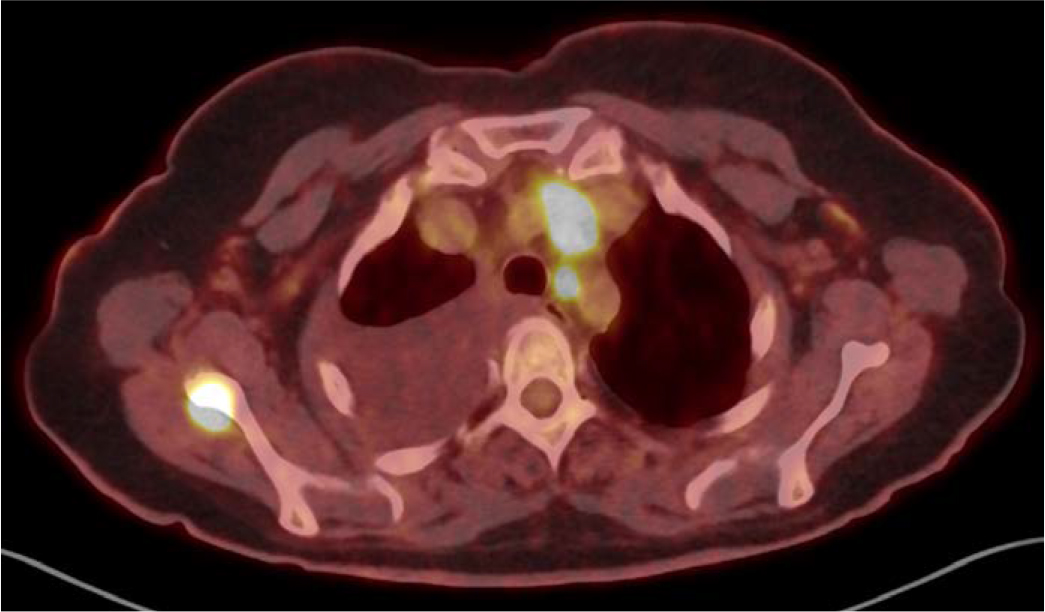
[18F]FDG PET/CT, axial plane – increased radiotracer uptake in the superior aortic recess, non-enlarged left upper paratracheal lymph node, and right scapula – with no corresponding lesions in the scapula in the contrast-enhanced CT performed later. Additionally, the non-contrast CT scan shows a large amount of fluid in the right pleural cavity.
[18F]FDG PET/CT, axial plane – increased radiotracer uptake in the superior aortic recess, non-enlarged left upper paratracheal lymph node, and right scapula – with no corresponding lesions in the scapula in the contrast-enhanced CT performed later. Additionally, the non-contrast CT scan shows a large amount of fluid in the right pleural cavity.

Figure 4.

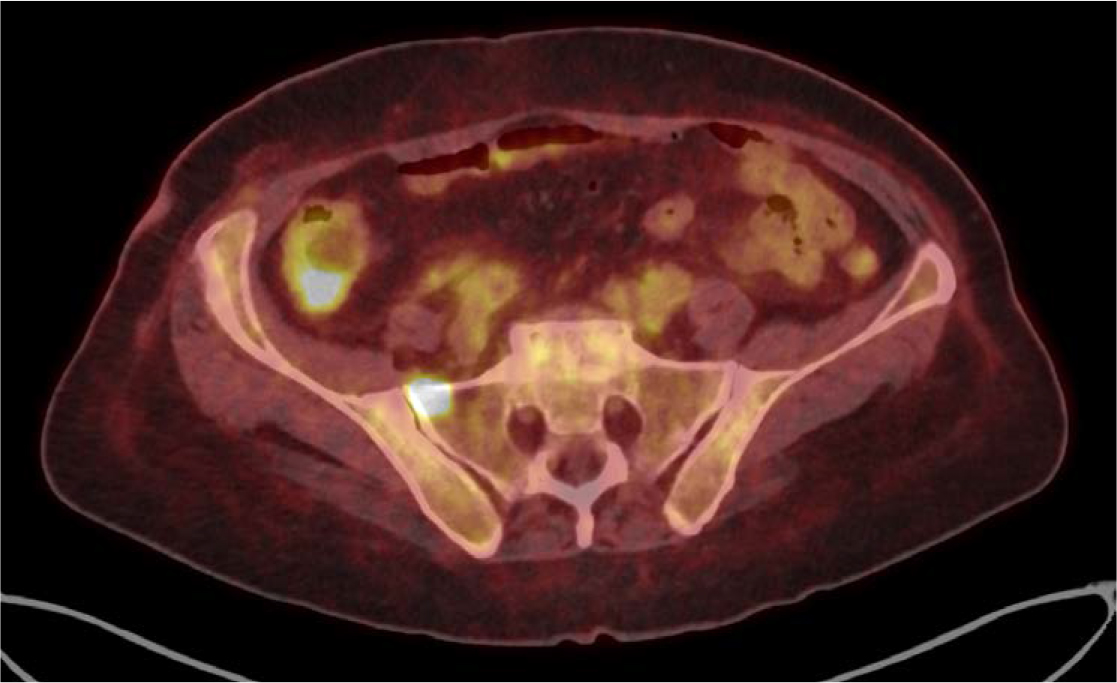
[18F]FDG PET/CT, axial plane – the image shows focal increased uptake in the sacral bone. The uptake did not correspond with any suspicious lesions in the contrast-enhanced CT examination performed later. Increased radiotracer uptake in the cecal wall is also visible, with thickening of the intestinal wall on the non-contrast CT.
[18F]FDG PET/CT, axial plane – the image shows focal increased uptake in the sacral bone. The uptake did not correspond with any suspicious lesions in the contrast-enhanced CT examination performed later. Increased radiotracer uptake in the cecal wall is also visible, with thickening of the intestinal wall on the non-contrast CT.

Figure 5.

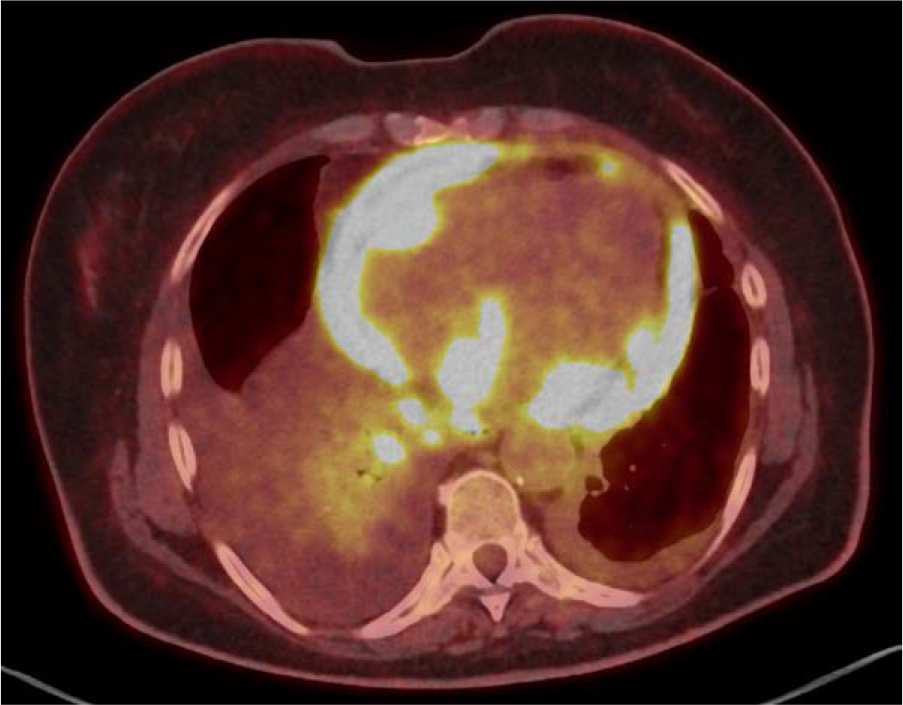
[18F]FDG PET/CT, axial plane – increased radiotracer uptake in the pericardium with pericardial infiltration in a non-contrast CT scan – features of pericarditis. Additionally, increased radiotracer uptake in the right pulmonary hilum is also visible. The non-contrast CT shows fluid accumulation in both pleural cavities, with more fluid on the right.
[18F]FDG PET/CT, axial plane – increased radiotracer uptake in the pericardium with pericardial infiltration in a non-contrast CT scan – features of pericarditis. Additionally, increased radiotracer uptake in the right pulmonary hilum is also visible. The non-contrast CT shows fluid accumulation in both pleural cavities, with more fluid on the right.

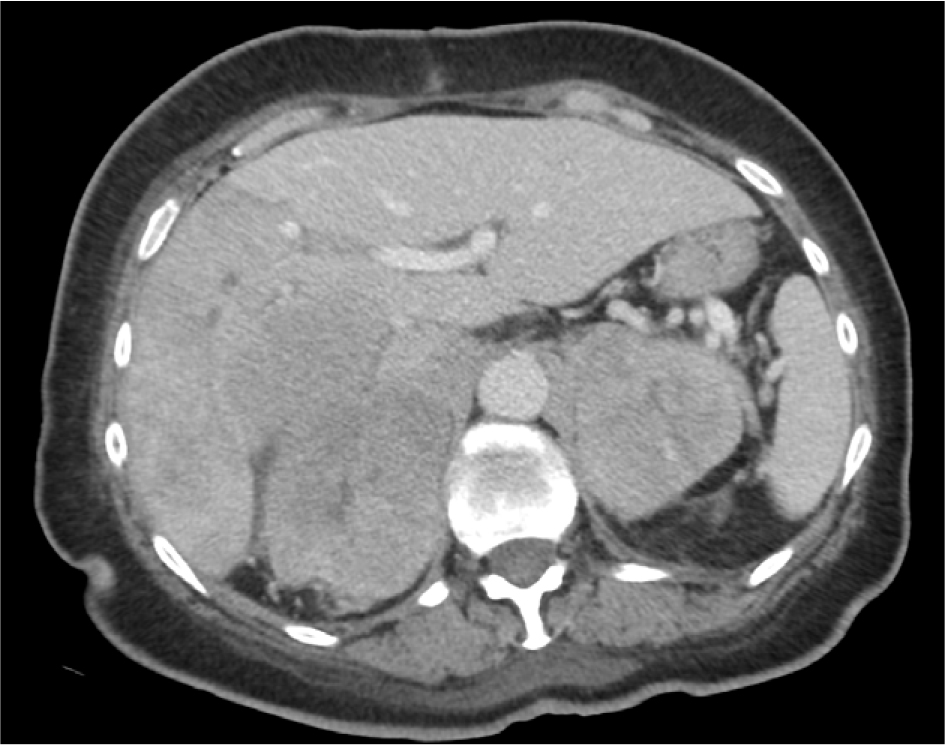
Figure 6.

CT, contrast-enhanced, axial plane – the image shows bilateral polycyclic adrenal masses with heterogeneous enhancement. The left adrenal mass infiltrates the left diaphragm crus. On the right side, the mass most likely infiltrates the inferior vena cava and adheres to lesions in the liver.
DOI: https://doi.org/10.2478/bgbl-2025-0021 | Journal eISSN: 2956-6851 | Journal ISSN: 0373-174X
Language: English
Page range: 113 - 122
Published on: Dec 16, 2025
Published by: The Medical Library named after S. Konopka in Warsaw
In partnership with: Paradigm Publishing Services
Publication frequency: 2 issues per year

© 2025 Jędrzej Ksepka, Aleksandra Nowakowska, published by The Medical Library named after S. Konopka in Warsaw
This work is licensed under the Creative Commons Attribution-NonCommercial-NoDerivatives 4.0 License.