
Introduction
Since Photo 51 – an X-ray image of the deoxyribonucleic acid (DNA) fibres taken by Rosalind Franklin – and the discovery of the double-helix DNA structure in 1953 by Crick and Watson, a lot of research has been conducted to develop gene editing technologies. To date, approximately 6000 to 8000 hereditary diseases have been defined (1). However, the development of molecular research and the continuous improvement of molecular tools have expanded the application of gene-editing technologies beyond hereditary disorders. More than 250 new and rare hereditary disorders are described every year, and gene editing technologies are progressively being explored not only for the treatment of genetic diseases but also for the treatment of, inter alia, infectious diseases and cancer (1). Thus, the role of gene editing in clinical medicine has received increased attention across several medical specialities in recent years. Methods such as TAL effector nucleases (TALENs) (2), zinc finger nucleases (ZFNs) (3), and CRISPR-Cas9 (4) have dramatically changed and modernized genetic engineering. The introduction of new genes or repairing faulty genes facilitates the modification of the genome by targeted genome editing (5). Precise medicine approach to patients heavily relies on genetic engineering that is used to create animal and cell models of human diseases that are infectious or hereditary as well as cancers. Disease models allow an analysis of molecular and cellular bases of pathogenesis that contribute to the development of potential drugs and/or treatment targets (6). With the development of molecular tools DNA editing progressed from the use of mutagens such as chemical or physical agents to modify DNA to the use of engineered tools that are capable of creating gene knock-in and knock-out (5). The rapid development of medicine requires modern therapeutic tools, and genome editing technologies offer a unique opportunity to treat diseases at their genetic root, thereby justifying the use of genetic editing tools in clinical practice. However, gene editing and molecular research raise a lot of ethical questions. In the literature on gene editing, the relative importance of ethical considerations has been subject to considerable discussion. Issues such as genetic privacy, informed consent and the implications of using molecular tools are the main concerns (7). This paper analyses the three types of molecular tools mentioned above and how the use of the older methods, such as TALENs, ZFNs and the newer method – CRIPR-Cas9 can potentially affect the future of clinical medicine. Moreover, the ethical concerns of gene editing are going to be discussed too.
Methodology
A comprehensive search was conducted using databases with academic publications, such as PubMed and Google Scholar. Keywords used for the search of relevant literature include “gene editing”, “CRISPR-Cas9”, “ZFNs”, “personalised medicine”, and “TALENs”. Boolean operators such as AND and OR were applied to improve search results. Articles were included if they were published between 2012 and 2024 with the exception of two articles – one published in 2005 and the other one in 2009. The articles published outside of the selected time frame were included because of the important information they provide. The inclusion criteria for publications were reviews, meta-analysis and original research papers, all written in English, focusing on gene editing tools and their mechanism as well as their applications in disease research and therapy. The exclusion criteria were publication without full-text availability, non-peer-reviewed publications, and materials published outside of the selected time frame. Findings, methodology and key themes were extracted from all included sources.
Molecular tools
Zinc finger nucleases
ZFNs are programmable nucleases that were commonly used in past genome-editing research. Nowadays, other methods are used more often that require less labour to achieve similar results. ZFNs are made of synthetic enzymes conceding at least three zinc finger domains. Each domain binds 3 bp of DNA, and when connected, they generate an artificial DNA binding protein which binds >=9 bp of DNA (8). One-half of the Fokl nuclease bonds to the zinc finger domains in a matter that when two ZFNs bind the two distinctive 9 bp sites that are divided by a spacer are capable of cleaving within the spacer to create double-strand breaks (DSB) (8). Originally, when this method was developed, naturally occurring zinc finger domains were used to detect the DNA sequence in the genome of the Escherichia coli bacteriophage lambda (8). Results from further studies demonstrate that ZFNs can be programmed to target fundamentally any target site in the human genome. Moreover, it results in a precise repair of the mutations in the interleukin-2 receptor [gamma] chain gene by homology-directed repair (HDR) in ~20% of transfected cells (9). Figure 1 provides a visual representation of this mechanism. Various proof-of-concept studies have been conducted using this method for gene editing. According to Geurts, gene-targeted animals can be created with ZFNs by editing embryos that were fertilized in vitro 10. This approach of DNA editing was later used to model human diseases by various researchers in, inter alia, rodents (11) and zebrafish (12), to understand the pathology of the diseases. According to a study from 2017, gene editing displayed a real therapeutic potential in vivo, as haemostasis was restored following the repair of a mutant F.IX gene in a mouse model of haemophilia B. Furthermore, this method can possibly correct various disease-causing mutations that occur within the same gene if ‘superexon’ is used (8). However, ZFNs have a couple of limitations. The ratio of off-target mutations is relatively high. Because each ZFN can recognise only 3 bp, unintentional mutations can occur at sites that are relatively similar to the target site because of an exhibition of similar sequences. Moreover, immunogenicity can occur in the host body during the use of ZFNs, which are considered a foreign body. ZFNs can cause a cell-mediated or humoral immune response in the host organism (13).
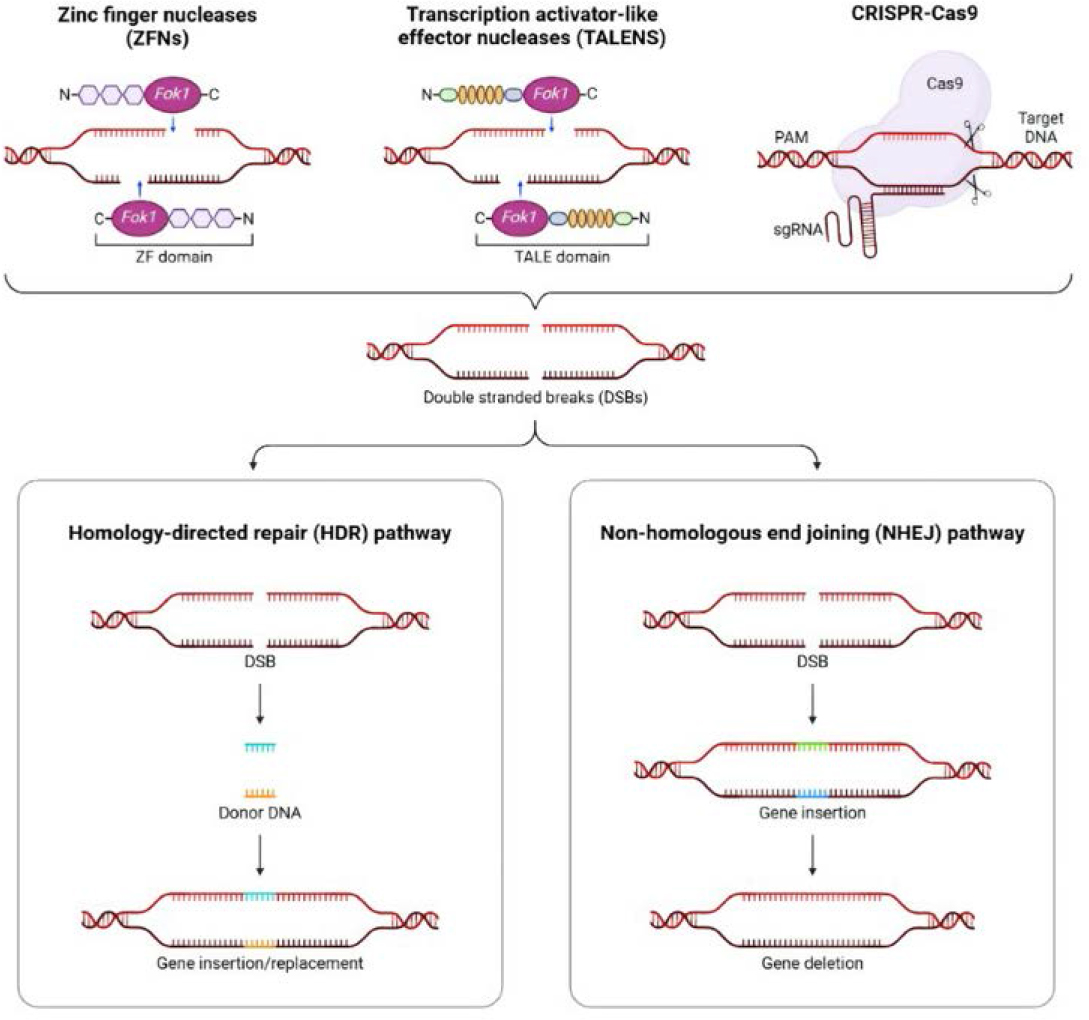
Figure 1.
Comparison of mechanisms of action of genome editing tools: ZFNs, TALENs and CRISPR-Cas9 and repair pathways. Obtained from BioRender.com
TAL effector nucleases
Developed in 2010, TAL effector nucleases also referred to as TALENs is another method of gene editing that followed in the footsteps of ZFNs but as a method, TALENs are easier to execute. They can be used for modification in crops, livestock, non-model and model organisms (2). In 2015 it was used to cure cancer in humans (14). TALENs are a combination of activator-like effectors (TALE) and the catalytic domain of the restriction endonuclease Fokl. TALEs are plant proteins that come from pathogenic Xanthomonas bacteria. When TALEs are injected into cells from plants they can locate the nucleus and bind to target promoters and as a result, induce gene expression. TALE proteins have three functional domains. The C-terminal (the end of the protein) domain contains an interaction interface for the plant transcription factor IIA, two functional nuclear localization signals, and an acidic activation domain (15). The N-terminal (the beginning of the protein) contains the bacterial secretion signal and a non-specific DNA-binding activity (16). Those are necessary to create the affinity of the protein to DNA (16). The central repeat section of TALE is key to the programmable DNA binding. The central repeat region is usually made of 33-35 amino acid-long tandem repeats and the acids that are located at positions 12 and 13 of each repeat are the ones that define the DNA specify of the TALE, the repeat-variable di-residues (RVD) (17). All possibilists of RDV combinations have been decoded (18). The evidence shows that unique/specific combinations detect only a single nucleotide. Furthermore, more flexible combinations can recognize two, three or all four nucleotides (19). Because of that DNA biding attributes of TALENs can be adjusted as desired via re-arraignment of the repeats (14). According to further single-molecule research, it was discovered that TALEs search for DNA target sites by wrapping around DNA and performing a quick, one-dimensional, non-rotational and unbiased search (19, 20). Figure 1 provides a visual representation of this mechanism. TALENs have been successfully used to cure a human patient from cancer via genome editing in 2015 (21). Cellectis, a French biopharmaceutical company, used TALENs to inactivate genes that trigger non-self-immune reactions from immune cells. A foreign person donated their cells as a source for the gene transfer to create chimeric antigen receptor T lymphocyte cells (CAR-T immune cells) (21). Those cells edited via TALENs were used to eliminate tumour cells and treat two individuals from leukaemia who were 11 and 16 months old (21). This therapy has proven real-life implications in medicine and the effects of the use of gene editing tools in patients. However, one of the limitations of TALENs is that it is significantly bigger than for example, ZFNs. This means the delivery of TALENs to targets is not as express and it could be especially when using vectors such as viral one with size limitation. Moreover, since TALENs need a specific sequence at the target it can limit the number of potential target sites. For example, a thymine nucleotide must come before the target region’s sequence (22).
CRISPR-Cas9
Clustered regularly interspaced short palindromic repeats (CRISPR) – CRISPR-associated (Cas) system is a natural process. It is a bacterial protection mechanism against phage infection and plasmid transfer. However, it has been converted to a ribonucleic acid-guided (RNA-guided) DNA targeting tool for gene editing, epigenetic mutation, transcriptional perturbation, and genome imaging (23). CRISPR-Cas9 has revolutionized the biotechnology field due to its precise gene editing capabilities. The two main components are: clustered regularly interspaced short palindromic repeats and Cas proteins responsible for cleaving the DNA (23, 24). In a bacterium, when it is invaded by a virus, the Cas protein will cut out a segment of the virus’s DNA and attach it to the bacteria’s CRISPR region seizing a molecular outline of the infection. Next, the virus’s DNA is copied into short pieces of RNA. In CRISPR, the role of RNA is to bind to Cas9. It results in the creation of a complex that latches onto free-floating genetic material and scouts for a match to the virus (25). When the virus infects the bacteria again, it is recognized instantly by the complex of RNA and Cas9. As a result, Cas9 exterminates the viral DNA (23). In 2012, it was established how to use CRISPR to target any DNA in any organism and, it became a gene editing tool. The mechanism of CRISPR-Cas-9 genome editing: recognition, cleavage, and repair (25). To edit a chosen gene, a guide RNA is designed to match the target gene. Then, the RNA is attached to Cas9. The guide RNA leads Cas9 to the target gene and, Cas9 cleaves the DNA. In other words, via an injection of Cas9 that is bound to a custom guide RNA essentially any gene can be edited in the genome (24). After the DNA is cleaved the cell will try to repair it. Proteins called nucleases are responsible for trimming the broken ends and joining them together. This process is called nonhomologous end joining (NHEJ). However, if a mistake occurs during that process there can be an extra or missing base making the target gene unusable or turned off (23). Thus, a distinct sequence of DNA templates is added to CRISPR to trigger the proteins to perform homology-directed repair and use the DNA template as an instruction to the repair process of the target gene (24). Figure 1 provides a visual representation of this mechanism. This method can be used to create new treatment methods for diseases strictly caused by genetic mutations such as blood disorders like sickle or genetic disorders such as sickle cell anaemia (26), cystic fibrosis (27), and Duchene Muscular Dystrophy (28) and potentially neurological disorders such as Huntington’s Disease (29). Exagamglogene autotemcel therapy which is based on CRSPR-Cas9 has been approved in Great Britain and the United States of America in 2023 (30). In Great Britain, exagamglogene autotemcel therapy can be used in patients with transfusion-dependent β Thalassemia and in patients with sickle cell anaemia aged 12 years or older who need hematopoietic stem cell transplantation but lack a suitable donor (30). In the United States, exagamglogene autotemcel can be used in sickle cell anaemia patients aged ≥ 12 years with recurrent vaso-occlusive crises and in patients with transfusion-dependent β Thalassemia (30). Moreover, it is a tool to create genetic models to study the human genome and observe what happens when certain genes are, for example, silenced or modified. However, there are some concerns regarding the routine use of CRISPR-Cas9 such as the toxic and immune response of treated cells to CRISPR-Cas9 components. Furthermore, further research is necessary to establish high-specific guide RNAs and use high-specificity Cas enzymes to limit the off-target impact (31).
The future of clinical medicine and gene editing
According to CRISPR Medicine News from January 2025, in 2024 239 gene-editing or gene-editing therapeutic studies were identified and 152 of them at that time were active including recruiting, not yet recruiting and enrolling by invitation. Those studies were dominated by therapeutic candidates for blood and solid cancers making up almost half of all trials (32).
Various fields in medicine can benefit from gene editing tools and create new treatments and therapies for affected patients. One of the fields in infectious diseases. Molecular tools could be used for the treatment by using them to remove viruses’ genetic material that is integrated into the host’s cell’s genome (6). The second approach to infectious diseases can be a modification of the host’s cellular receptors that viruses use to enter the host’s cells (6). This could be applied specifically to human immunodeficiency virus (HIV). Encoding chemokine receptor 5 (CCR5) is a protein located in T cells. HIV binds to CCR5 and it is a critical co-receptor for HIV entry into host cells alongside CD4 (33). An experiment has been carried out on two embryos using CRISPR-Cas9 to remove the gene from their genome and prevent HIV infection. The experiment was conducted unethically and illegally in China (34). However, there is a potential for the knock-out approach to prevent viral infections.
The hereditary diseases field is another category of medicine that can benefit from the use of gene editing tools (6). Genetic mutations can lead to the acquisition or loss of function of the mutated genes. In the case of gain of harmful function in autosomal dominant disorder such as achondroplasia (a bone growth disorder), creating a double-stranded break in the affected gene allele would lead to a deletion or insertion post nonhomologous end joining process (NHEJ) resulting in a frameshift and shortened protein that would not modify the patient’s phenotype (35). Another solution for correcting the kind of pathogenic variant is restoring the wild-type phenotype via the induction of homologous recombination (35). Hereditary diseases that are characterised by prolonged short tandem repeats (STR) could be potentially corrected by a two-site cleave on both sides of the sequence. This approach could be used to delete it from the gene allele. Moreover, in the case of STR producing a deleterious protein that disturbs normal cellular functions, induction of NHEJ could be used to remove the harmful protein. So far, this approach has been investigated for Huntington’s disease (36).
Another branch of hereditary diseases is autosomal and X-linked recessive disorders. Those diseases are more complex because both alleles have pathogenic mutations (37). In that case, using the non-homologous end-joining method will not be effective because it would cause a loss of protein function. Thus, a programmable endonuclease system a donor DNA portion (crucial for homologous recombination) and an unmodified gene sequence are incorporated into the cell. Then, they are used by proteins responsible for the HR process to reconstruct the pathogenic variants (38). Furthermore, certain recessive disorders may benefit from the eradication of exon/exons that have premature stop codons and restoring most of the protein sequence and partially restoring the function of the protein according to research performed on cells obtained from patients with Duchenne muscular dystrophy (39).
Another field of medicine that can benefit from gene editing is oncology, specifically the treatment of malignant tumours. During the last decade, the link between T cells and their use for cancer treatment has been at the centre of much attention. Results from a previous study demonstrate that chimeric antigen receptor T lymphocyte cells (CAR-T cells) therapy could be used for cancer treatment (40). The principle of this therapy is to create T lymphocytes that are capable of recognising with precision and then fighting cancer cells. To develop those cells, T lymphocytes of cancer patients are adoptively transferred with chimeric protein receptor genes that are expressed by malignant cells; therefore, they are recognised and destroyed by immune cells. Genetically engineered T cells are called ‘living drugs’ (40, 41). However, T cells could undergo a few changes to make them more viable. To prevent graft-versus-host reaction, the T cell genome can be edited via the inactivation of the genes coding the T cell receptor. Moreover, to reduce immunogenicity, T cells can be edited to eliminate HLA-I antigens. Changes in the T cell receptor and HLA-I elimination give scientists the opportunity to create all-encompassing CAR-T cells that could be used for the treatment and management of multiple types of tumours (42, 43).
Ethical consideration
Gene editing and the use of molecular tools in medicine raise a lot of questions. One of the main concerns is editing the human germline, who would have access to that, and how it would affect future generations and the lives of those who underwent this procedure. Since gene editing is a relatively new science, there are also not many legal definitions and policies of those treatments and how they can be used (6). As mentioned in the section above, a germline editing experiment has already been carried out in China by Jiankui He in 2018, and two twin sisters were born. He was immediately criticised for his unprofessional approach and illegal practice after presenting the details of his investigation during the Second International Summit of Human Genome Editing (6). The long-term effects of his actions are currently unknown. Moreover, since future generations cannot consent to heritable genetic modifications, we cannot predict at his moment how this modification will affect the offspring of the twin girls (44). According to the statement of The American Society for Human Genetics from 2017, at this time, considering the number of unanswered scientific, ethical and policy questions, germline editing should not be performed (45). Furthermore, it is also discussed who and how will be able to access those tools. Although sequencing and gene editing are getting cheaper, people from low-income countries may be excluded from the opportunity to access those tools; therefore, one of the ethical questions is whether gene editing will cause further social inequalities (45). Also, as of yet, we are aware that some of the molecular tools can still lead to off-target effects that could cause unpredictable and harmful effects that could potentially be heritable for the next generations (45). Further research is required to understand in depth the complex side effects of gene editing and with the progressive development of gene editing technologies, it is crucial to balance academic and scientific pursuits with the possible impact on the human race.
Conclusions
The number of diseases caused by genetic mutations highlights the need for molecular tools that would enable more effective and efficient modelling and treatment of those diseases. Genetic engineering tools such as zinc finger nucleases, TAL effector nucleases and CRISPR-Cas9 have changed molecular engineering, allowing us to model diseases to understand the pathological mechanism as well as allow us to use a personalised medicine approach to treat patients with genetic disorders. Although those technologies have much potential, each method has potential side effects, and, in general, modifying human DNA raises a lot of ethical and legal questions. ZFNs have therapeutic potential and can correct mutations, such as, in haemophilia B, and they are also used to model diseases in animals. However, the drawbacks are that there is a relatively high chance of off-target mutation and the risk of an immune response against the proteins used in this method since ZFNs are recognised as outsider proteins. TALENs have been successfully used before in clinical medicine for the treatment of cancer patients via engineered immune cells. However, the limitation is that TALENs are large, which makes their delivery challenging. Moreover, they additionally need a specific DNA sequence to narrow the target sites. CRISPR-Cas9 is the latest molecular tool that uses a bacterial defence mechanism for cleaving and editing DNA. This technology uses the Cas9 protein and programs it to target a specific sequence. It is a groundbreaking method, but the drawback is the risk of unintended off-target mutations and the possibility of an immune response to the Cas9 protein. In clinical medicine, gene editing can be used in various fields such as infectious diseases, hereditary diseases or oncology. However, the main ethical questions cover concerns such as privacy, consent of current and future generations, availability and accessibility of those methods and social impact as well as safety concerns. Currently, there are not enough legal frameworks and consensus on who should access and how gene editing could be used daily in clinical medicine. Further research is necessary to improve the tools before applying them in medical practice.
Notes
[1] Conflicts of interest Conflict of Interest Statement:
The authors declare no conflict of interest
[2] Contributed by Authors’ Contributions:
Wiera Magdalena Tołczyk: conceptualization, study design, data collection, data analysis, writing – original draft; Gabriela Maria Piech: data collection, writing – original draft; Igor Lis: data collection, writing – original draft.
Abbreviations
- DNA
deoxyribonucleic acid
- TALENs
TAL effector nucleases
- ZFNs
zinc finger nucleases
- DSB
double strands breaks
- HDR
homology-directed repair
- TALE
activator-like effector
- RVD
repeat-variable di-residues
- CRISPR
clustered regularly interspaced short palindromic repeats
- RNA
ribonucleic acid
- STR
short tandem repeats
- NHEJ
nonhomologous end joining
- CAR-T
chimeric antigen receptor T lymphocyte cell
- CCR5
encoding chemokine receptor 5
- HIV
human immunodeficiency virus