
Introduction
Although awareness is increasing, sleep health is still an unmet universal issue [1]. We now know that healthy sleep is an indispensable requirement for physical, mental, and social well-being [2], public safety, and performance. Sleep is a biological necessity, indispensable for lifelong well-being [3]. An unrefreshing sleep determines poor cognitive functioning, poor immune response, poor brain and mental health, and cardiometabolic dysfunction including obesity, diabetes, coronary heart disease, cardiovascular impairment, and kidney disease [1–4]. Baden et al. have demmonstrated that [5] sleep is an important factor to grant cardiovascular well-being. Furthermore, poor sleep has been linked to impaired memory, cognitive functioning problem-solving, anxiety disorders, and burnout, and is identified as cause of a state of low-level exhaustion that has an economic cost. In fact, it has been recently stressed by economists that “One-hour of weekly sleep” can reduce individual’s economy by five percent [6].
The goal of the paper is to highlight the contributions to modern Sleep Medicine of Elio Lugaresi (1926-2015), physician scientist of the University of Bologna who having created a nurtured studied sleep life-long with success receiving all possible scientific honors and awards in his field.
Biography
Elio Lugaresi (Figure 1) was born in Cervia on July 1, 1926, and registered at the University of Bologna where he received the MD in 1952. During his residency in Neurology (1952-1958), he trained two years at Marseille in the laboratory of Henri Gastaut. After residency, he was enrolled as a specialist for the neurology service and in 1970 became Director of the Laboratory for Sleep Disorders. From 1971 onward, he and his group were among the leaders of sleep disorders [8] and in 1972 organized an international event in Rimini with qualified international reputation where they showed an impressive amount of innovative data on sleep, systemic blood pressure, and a pulmonary arterial pressure in obese patients. He became Professor of Neurology in 1975, Director of the Institute of Neurology and of the Postgraduate School of Neurology in 1977 that he held till 1999. The emeritus status (2001) did not reduce participation in teaching, checking patients, and research. He was active [7] till the last day (December 22, 2015).
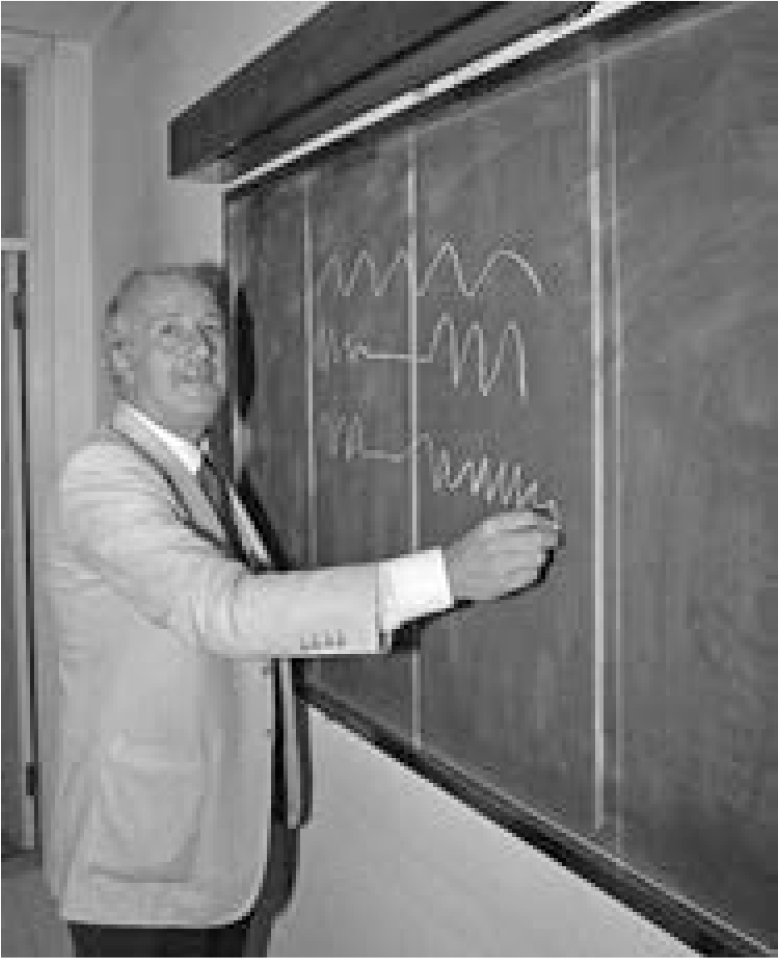
Figure 1.
Elio Lugaresi (07.01.1926-12.22.2015) Photographer: Paolo Ferrari, Archivio Ferrari, Genus Bononiae. “Collections of Arts and History, Foundation Cassa Risparmio, Bologna”.
The initial innovative contributions to sleep disorders
In the years 1971-1972, Lugaresi and his group acquired international reputation for their studies on sleep disorders with periodic breathing [8–12].
Sleep Apnea
All started in 1971 with a study on blood pressure during sleep in normal subjects (8) and showed that systemic arterial pressure progressively and significantly falls in successive stages of NREM sleep, whereas in REM it increases to the levels observed in stage 2 sleep. The observed fall of blood pressure was 20-23%.
In 1972, at Rimini, Lugaresi and his group showed data on pulmonary arterial pressure, arterial blood pressure, and heart rate in patients with periodic breathing (central, obstructive, mixed). Patients were studied overnight, during spontaneous breathing. A total of 10 patients, 5 of them obese, were studied by simultaneously recording EEG, Horizontal Nasal and Oral Respirogram, Systemic Arterial Blood Pressure, and Blood Gases (pH, PO2, PaCO2), Oculogram, EMG of mylohyoid muscle, ECG, cardiotachigram, and thoracic respiratory movements [9]. They showed [10] that the time spent in apneas increases progressively in the course of NREM sleep and reaches its highest values during REM sleep. The ventilatory insufficiency which arises during sleep is directly related to the time spent in apnea.
They also showed [11] a progressive, linear, statistically significant increase of pulmonary arterial pressure from wakefulness to sleep stage 3-4 and REM. The contemporary registration of systemic blood pressure also showed a progressive, linear increase from wakefulness through sleep stage 1,2,3,4 and REM.
Blood gases analysis [11] demonstrated a decrease of pH and PaO2 from wakefulness through stages 1-4 and REM, whereas PaCO2 increased up to stage 3 and declined with REM [12]. Tracheostomy, that reduced arterial blood pressure and pulmonary arterial pressure and normalized blood gases [12] and advanced pathophysiological clinical a nosographic interpretation of the whole findings [12]. Only central apneas persisted during sleep and the pulmonary arterial pressure increased slightly. Systemic arterial pressure after tracheotomy in patients with periodic breathing, as it occurred in normal people.
In 1975, Lugaresi et al. studied 8 heavy snorers and showed that blood pressure failed to diminish as it does in normal subjects but tends to rise slightly, a finding that led to the suspicion that snoring could favor the onset of hypertension [13]. This paper was highly acknowledge by Dement, placing the study of normal sleep in a historical perspective [14] wrote: “Obstructive sleep apnoea was discovered in Europe in 1965 by two separate groups, Gastaut et al. and Young and Kuhlo, who are credited with performing the first tracheostomy with the intention of bypassing airway obstruction that occurred during sleep in the upper airway of those very obese patients”…”It is not clear what would have happens if an Italian neurologist, Elio Lugaresi, had not become very interested in obstructive sleep apnoes, which he called hypersomnia with periodic breath. He pursued the problem with unusual zeal, although he did not publish his seminal study [14] documenting an association between snoring and hypertension until 1975”.
Studies on epidemiology of snoring and blood pressure
The paper on the heavy snorers led Lugaresi and his group to hypothesize that snoring could cause hypertension and cardiovascular accidents. He wrote various applications for such a project that were not funded. Finally, his friend and estimators William C. Dement, provided a personal support for a survey in the Republic of San Marino. The data showed that arterial blood pressure was more frequent in heavy snorers than in non-snorers, independently of body weight [15]. Subsequently, a case control study at the University of Bologna in 1990 showed that myocardial infarction was more frequent in heavy snorers compared to a control population [16].
Fatal Familial Insomnia
Fatal Familial Insomnia (FFI) was described by Lugaresi et al. [17] in 1986 in New England Journal of Medicine as a disease characterized by inability to sleep, dysautonomia, and motor disturbance (characterized by myoclonus, ataxia, and pyramidal signs). Later, with Goldfarb, Montagna, and Gambetti et al. [18] demonstrated in Science FFI, and a subtype of familial Creutzfeldt-Jakob Disease (CJD) are both characterized by a mutation at codon 178 (Asn178) of the prion protein gene. Finally in 2003 Lugaresi et al. were able to distinguish – in Lancet Neurology – Fatal Familial Insomnia from Sporadic Fatal Insomnia [19].
The history of FFI started with a patient, who came to consult Lugaresi, telling him that he hadn’t slept for two months, that he had seen both his mother and sister die in the same way, and that he too would die within 6 months. Naturally, Lugaresi admitted him to sleep ward immediately, and said: “I have never heard anything like it.” And so, we began to study this gentleman, who was called Silvano, and I was the one who followed him until the last day.
We then discovered, through pathological anatomy studies, that this disease - which Lugaresi later called Fatal Familial Insomnia, essentially involved lesions in a particular part of the thalamus, which is an organ located inside the brain, and was genetic” [20].
Lugaresi, having discovered Fatal Familial Insomnia, was very impressed by reading, in, García Márquez’s One Hundred Years of Solitude, about Macondo, an unknown place in Colombia (transposition of Aracataca?), made of 20 houses made clay and wild cane, built on the bank of a river, where all were affected by insomnia, loss of the memory, and inability to dream.
A global look into Lugaresi’s work into sleep disorders
Lifelong Elio Lugaresi, one of the leading scientists in neurology of his time, studied sleep clinically on the variety of patients who asked help at the Neurology Clinic of the University of Bologna. An incomplete list of his achievements in sleep disorder is reported in Table 1. His method was observation, description of data and analysis of clinical findings [8,21].
Table 1.
Elio Lugaresi’s main contributions to sleep disorders
| Propriospinal myoclonus |
| Restless legs syndrome |
| Periodic limb movements in sleep |
| Snoring as cause of hypertension and cardiac dysfunction |
| Sleep apnea |
| Links between snoring and sleep apnea |
| Hypnogenic paroxysmal dystonia/nocturnal epileptic syndrome/nocturnal frontal lobe epilepsy |
| Fatal Familial Insomnia (sporadic autosomal dominant) |
| Morvan Syndrome |
| Delirium Tremens |
| Agrypnia excitata |
| Catathrenia (nocturnal groaning) |
| Endozepine stupor |
| Hypersomniac-hypo-ventilatory syndromes |
| Obesity-hypoventilation-hypersomnia |
| Primary alveolar hypoventilation |
| Slow sleep narcolepsy |
| Sleep and movement disorders |
| Startle syndrome |
| Hyperekplexia |
Lugaresi in Scopus
Elio Lugaresi with his group, published 462 items that were cited by 20,208 times in 12,792 documents. The h-index was 76, the D-index 91 (Scopus). As stated by the Bologna Neurological School, “Elio Lugaresi undertook the first, still unrivalled polysomnographic studies on what initially he called “nocturnal myoclonus” and was the first to study hemodynamic ventilatory effects of sleep apneas recognizing the close pathophysiologic relationship between apparently trivial snoring and full-blown obstructive apnea syndrome” [8]. It should be stressed that he was focused on patients, and his research was based on clinical observations.
Scientific Societies
He presided over the Italian EEG Society, the Italian League against Epilepsy, the Italian Society of Neurology, and Italian Association of Sleep Medicine.
He was Ambassador for Epilepsy of the International League against Epilepsy and Honorary Member of the Association for Sleep Disorders Centers, the German EEG Society, the French Society of Neurology, the Spanish League against Epilepsy, the American Association of Sleep Research, and Corresponding Member of the American Neurological Association.
Honors
The list of recognitions is impressive. It starts with the 1983 Award of the American Association of Sleep Disorders, that was followed by the Ottorino Rossi Award for Neurology (Mondino Foundation at the University of Pavia) and the Potamkin Prize, regarded as the “Nobel Prize for Dementia Research” of the American Academy of Neurology. In addition, he was also declared Founder of the Field of Modern Sleep Research by the Sleep Research Society.
He was subsequently bestowed the William C. Dement Academic Achievement Award (from the American Academy of Sleep Medicine), and the very important Interbrew-Baillet-Latour de la Santé, Foundation Award of the Belgian Academy of Science.
He, also, received the Giuseppe Moruzzi Award of the World Federation of Clinical Neurophysiology, and the Giuseppe Caruso Award of the Italian Society of Clinical Neurophysiology. Finally, in recognition of his achievements the Elio Lugaresi Award for Sleep Medicine was established by the World Association of Sleep Medicine.
The greatest legacy of Elio Lugaresi
Exegi monumentum aere perennius/
I have built a monument more eternal than bronze
Horace: Odes III, 30
Elio Lugaresi in 1975, won, by national contest, the second chair of neurology at the University of Bologna, and this event had significant impact on research initially dedicated to epilepsy and human sleep. New diseases and syndromes were identified and studied with innovative and original polygraphic method. The activity was so impressive and productive and was followed with great attention from the university due to international recognition. Thus, new chairs were created for Carlo Alberto Tassinari, Giorgio Coccagna and Paolo Pazzaglia. Pierluigi Gambetta belongs to the same group, who after specializing in Neurology, first attended the Bunge Institute in Antwerp, then moving to the USA, to Boston, to Philadelphia and finally to Cleveland, where he assumed the role of “Full Professor of Neuropathology”. Paola Giovanardi Rossi, in those years, became Chief of the Unit for Child Neuropsychiatry [22].
The scientific productivity, the international recognition, the parallel increase of neurological care on the territory led to the creation of new units for emergency, epilepsy, and neurovascular disease.
In the meantime, many new units were starting up in the region. Progress continued with Lugaresi’s followers, Agostino Baruzzi (1998-2007) and Pasqual Montagna (2007-2010), who was able to create the Neurosciences pole at the Bellaria Hospital in Bologna in 2011.
This idea, a winning idea, was born out of the need to bring together all the activities relating to neurological sciences in the same institute. It allowed a scientific hospitalization and treatment institute, unique in the region as regards neurological sciences, and one of the most important in Italy. And this has made it possible to put a new institute institution into the old efficient institution, with modern laboratories, serving the innovative concept for hospitalization and the study of the patient, thus hospitalization rooms and laboratories for studying patients are in the same structure, on the same floor, so the technicians can talk to the nurses and so can the different specialists [21].
On Lugaresi’s honors and awards
Lugaresi obtained all possible awards in the field of sleep disorders and probably he deserved the Nobel Prize for promoting research falling on patients. The explanation is in the fact that his work did not promote general interest on a leading health problem. His work was published in very specialized journal. Only later did publications appear in New England Journal of Medicine, Science and Lancet. For the majority of his productive days, his research remained confined in the niche of very specialized work, thus his studies needed time to influence everyday practice of medicine [23].
Acknowledgements
The paper was presented to the 49th Congress of the International Society of History of Medicine, Salerno, Italy, October 8-12, 2024.
I would like to express my gratitude to Alessandra Lugaresi, Associate Professor, Department of Biomedical and Neuromotor Sciences at the University of Bologna, Director of the School of Specialization in Neurology. Warmest thanks are due to Federica Provini, Associate Professor, Department of Biomedical and Neuromotor Sciences at the University of Bologna, Coordinator of the Degree Course in Neurophysiopathology Techniques. My final thanks are for Professor Joseph Sepe for editing the manuscript.