
1. INTRODUCTION
The ionosphere is an extremely sensitive layer of the atmosphere, which can be disturbed by various effects such as earthquakes, thunderstorms, tropical cyclones or geomagnetic storms (see, e.g. Fukunishi, 2002; Parrot et al., 2006, 2013; Błęcki et al., 2009, 2011). Powerful and radiated electromagnetic pulses, with maximum intensity in the extremely low frequency/very low frequency (ELF/VLF) range, cause heating and ionisation of the lower ionosphere, mostly affecting layer D. As many thunderstorms develop into a strong cloud cluster such as mesoscale convective systems or supercells (Martynski et al., 2021), transient luminous events (TLEs) such as sprites, blue jets, elves or whistlers are often excited.
1.1. Thunderstorms
Atmospheric thunderstorms are one of the most powerful disturbances in the Earth’s environment, impulsively coupling the Earth’s atmosphere with the ionosphere–magnetosphere system above active storm cells with considerable energy. The total energy associated with charge separation within a thundercloud is in the order of 1–10 GJ. Part of this energy is released in one lightning discharge on time scales of less than 1 s, making lightning one of the most dangerous phenomena. The important aspects of lightning phenomena are that the energy is released in localised regions of space, leading to the formation of plasma channels with temperatures ∼25,000 K and electron densities exceeding 1017 cm−3.
According to Parrot et al. (2013), powerful discharges should induce many types of effects in the ionosphere that are given below. Powerful radiated electromagnetic pulses, with maximum intensity in the ELF/VLF range, cause direct heating and ionisation of the lower ionosphere. Whistler waves launched into the magnetosphere induce precipitation of electrons in the radiation band, known as lightning-induced electron precipitation events. These cause heating and ionisation of the D region, with scattering of sub-ionospheric propagating VLF waves from transmitters. The ELF part (slow tail) of intense sferics produces transient Schumann resonances. Quasi-electrostatic (QE) fields, which occur at mesospheric/lower ionospheric altitudes following intense lightning discharges, become sources of heating and ionisation of the stratosphere and mesosphere, producing transient luminous discharges known as ‘sprites’, ELF pulses induced by intense currents flowing in the sprite, runaway electrons and gamma-ray emissions. Lightnings are also sources of acoustic gravity waves, which can propagate over long distances. Earlier discussions focused on disturbances in the lower layer of the ionosphere. The DEMETER satellite has shown that effects also occur in the upper ionosphere above intense thunderstorms.
1.2. Geomagnetic storms
Solar activity also influences the response of the ionosphere and magnetosphere, and during geomagnetic storms, we monitor disturbances in the H component (Dst index) of the magnetic field, which can last up to a few days. This parameter is based on recordings of the horizontal component of the geomagnetic field made at several observatories in both hemispheres, but not far from the equator. The characteristic changes of this parameter during a strong geomagnetic storm are shown in Figure 1. Another parameter is the index Kp, which has values up to 9. Superstorms are assumed when Kp exceeds 8. The intensity of the storm is characterised by the value of Dst; superstorms are assumed when Dst is <−200 nT, intense storms are assumed with −200 nT < Dst < −100 nT, moderate storms are assumed with −100 nT < Dst < −50 nT and weak storms are assumed with −50 < Dst < −30 nT.
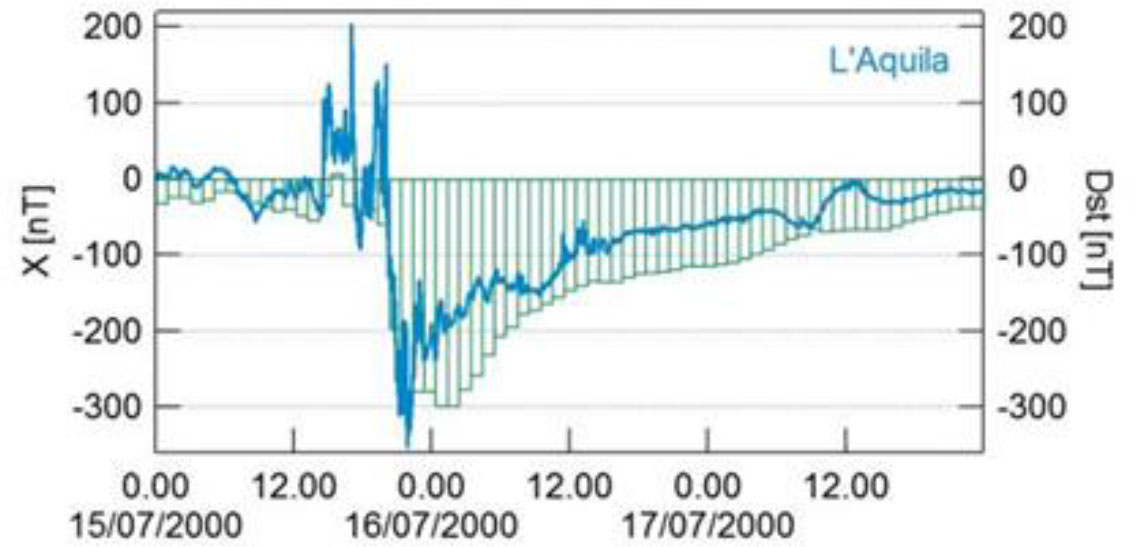
Figure 1.
Example of the typical time dependence of the Dst index during a geomagnetic superstorm
More than 30 storms have been recorded during the lifetime of the DEMETER satellite (2004–2010), including three superstorms. The superstorms in May and October 2024 are particularly interesting. The registrations from the Swarm satellites related to the May 2024 events are presented. Detailed descriptions of the instrumentation on DEMETER and Swarm are given in Berthelier et al. (2006), Parrot et al. (2006) and Olsen et al. (2013).
2. EFFECTS OF THUNDERSTORMS
The DEMETER and Swarm satellites record the phenomena during thunderstorms in different regions – in the mid-latitudes and over the African thunderstorm centre. Figure 2 presents registrations of the disturbances in the middle latitude ionosphere caused by the thunderstorms over Poland. The strong thunderstorm registered by Perun system took place on 30 June 2009. Table 1 gives the time, locations and parameters of the strokes related to registrations of ionospheric disturbances by the DEMETER satellite.
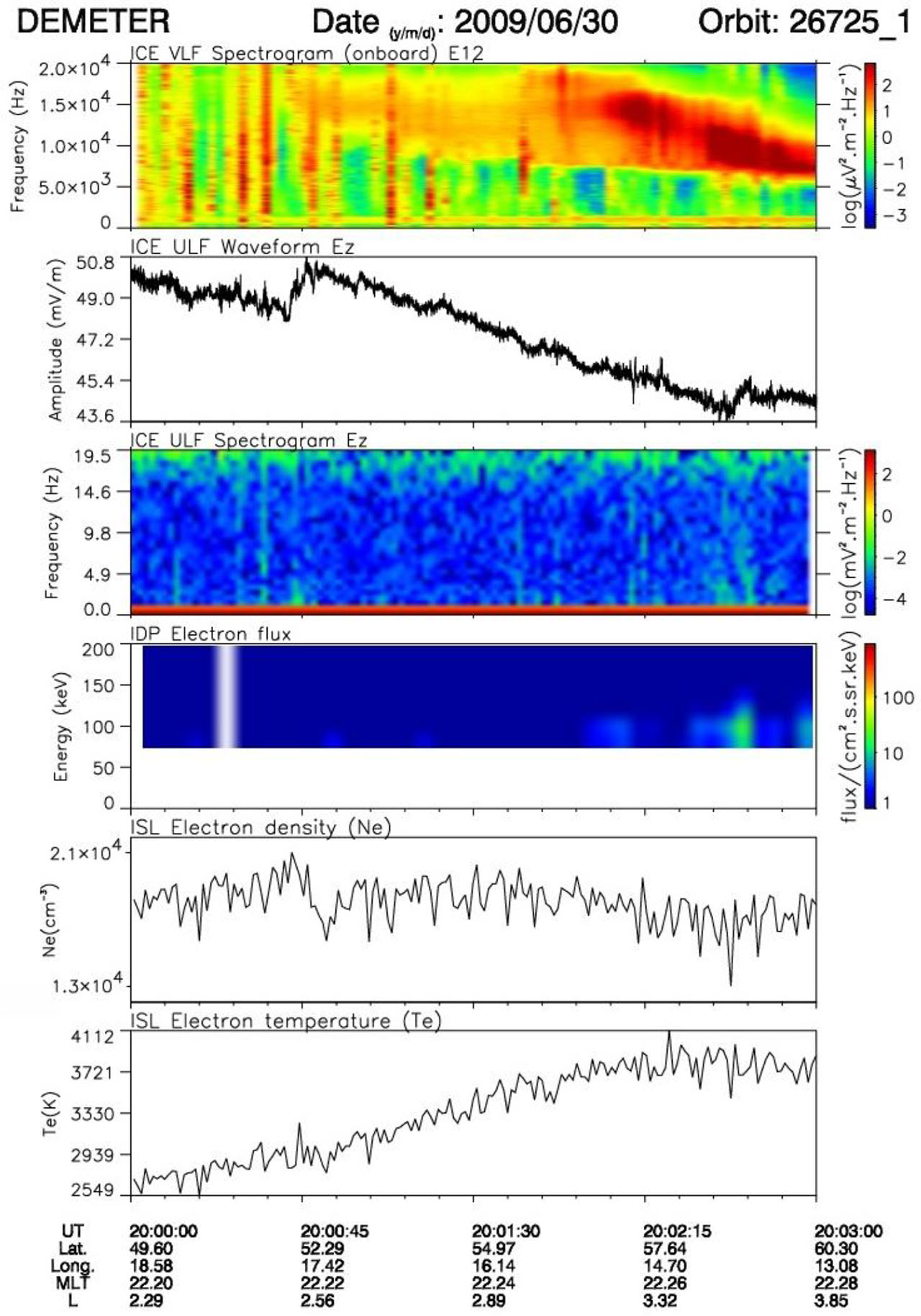
Figure 2.
DEMETER’s registrations of: electric field fluctuations spectrogram in the VLF range (first panel from the top), waveform (second panel) and spectrogram (third panel) in the ULF range spectrogram of electrons energy (fourth panel). The last two panels present electron density and temperature, respectively. The registrations were done during a thunderstorm over Poland on 30 June 2009.
Table 1.
Parameters of strokes on 30 June 2009
| Day | Time (UT) | Latitude | Longitude | Curent (kA) |
|---|---|---|---|---|
| 30/06/2009 | 20:00:47 | 53.0546 | 23.4310 | −107.170 |
| 30/06/2009 | 20:02:07 | 51.9554 | 21.0176 | −63.700 |
| 30/06/2009 | 20:02:32 | 52.4673 | 15.3552 | −60.980 |
Registration within the time interval from 20:00 till 20:03UT when DEMTER was passing over the region is shown in Figure 2. Three upper panels present variations of the electric field in the ranges VLF and ULF, respectively. The strong wave activity is present during the entire time of DEMETER’s flight over the thunderstorm region. The vertical lines in the VLF spectrogram are sferics, which are generated by strokes when the satellite was just above stroke. As one can see in the selected section of the DEMETER’s track, the satellite registered significantly more strokes than Perun. These emissions were present throughout DEMETER’s flight over the thunderstorm area. The lightning on 20:02:32UT was not very strong, but the effects in the ionosphere were significant. The third panel shows the spectrogram of ELF variations in the ULF range, and wide emission related to stroke on 20:02:32 is seen. The spectrogram of energetic electrons (fourth panel) shows the appearance of energetic electrons with energy up to 120 keV just at the time of the intensification of waves in the ULF range. This broadening of spectrum of energetic electrons is likely a result of acceleration of electrons by low-frequency waves.
Strong variations in both electron density and temperature are present during the discussed time interval. Characteristic time of these variations is below 1 s and likely is related to presence of irregularities with size from hundreds metres to 2 km. Such irregularities cause disturbances in the propagation of radiowaves due to scattering and diffraction seen often as the scintillations of radiosignals on the ground coming from the telecomunication and navigation satellites.
Central Africa is the focal point of these studies, since it serves as the most active thunderstorm region in the world. Figure 3 shows the statistics of thunderstorms occurrence in the entire globe. Three regions with high thunderstorm activity clearly stand out, that is, South America, Central Africa and Far East (southern part of China, Indochina and Indonesia), but the highest frequency of occurrence of thunderstorms is seen in Central Africa (more than 200 stormy days per year), and we focus our attention on this region.
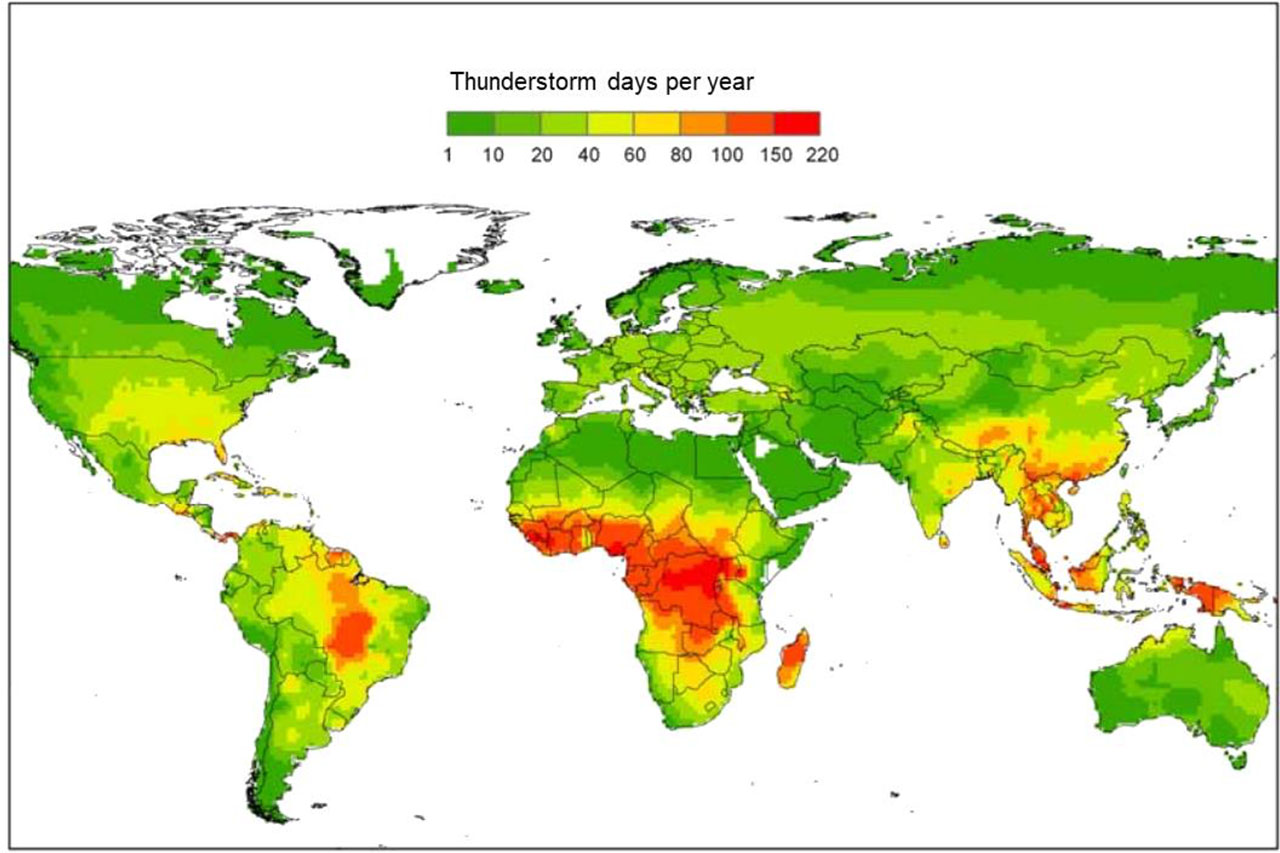
Figure 3.
Map of the global distribution of thunderstorm days/year (Isaksson and Wern, 2010)
Figure 4 shows the measurements of wave perturbations of the electric field, spectrograms of high-energy electrons, and concentration and temperature of thermal electrons collected by DEMETER during a 5-min interval of flight over the African centre. The vertical lines in the VLF spectrograms are related to lightning; there are many strokes, but the most intense are concentrated in the time interval between 20:04:45 and 20:05:30. The geographical coordinates of the satellite were the latitude 28.87S and the longitude 32.71E, and DEMETER crossed this time African thunderstorm and registered a significant increase in energy of the electrons. The ULF/ELF waves with frequencies of 15–19.5 Hz are present throughout the time interval. They probably accelerate the electrons (see Zhou et al., 2025 and literature therein). The parameters of thermal electrons show similar fluctuations as in the previous case and create ionospheric irregularities.
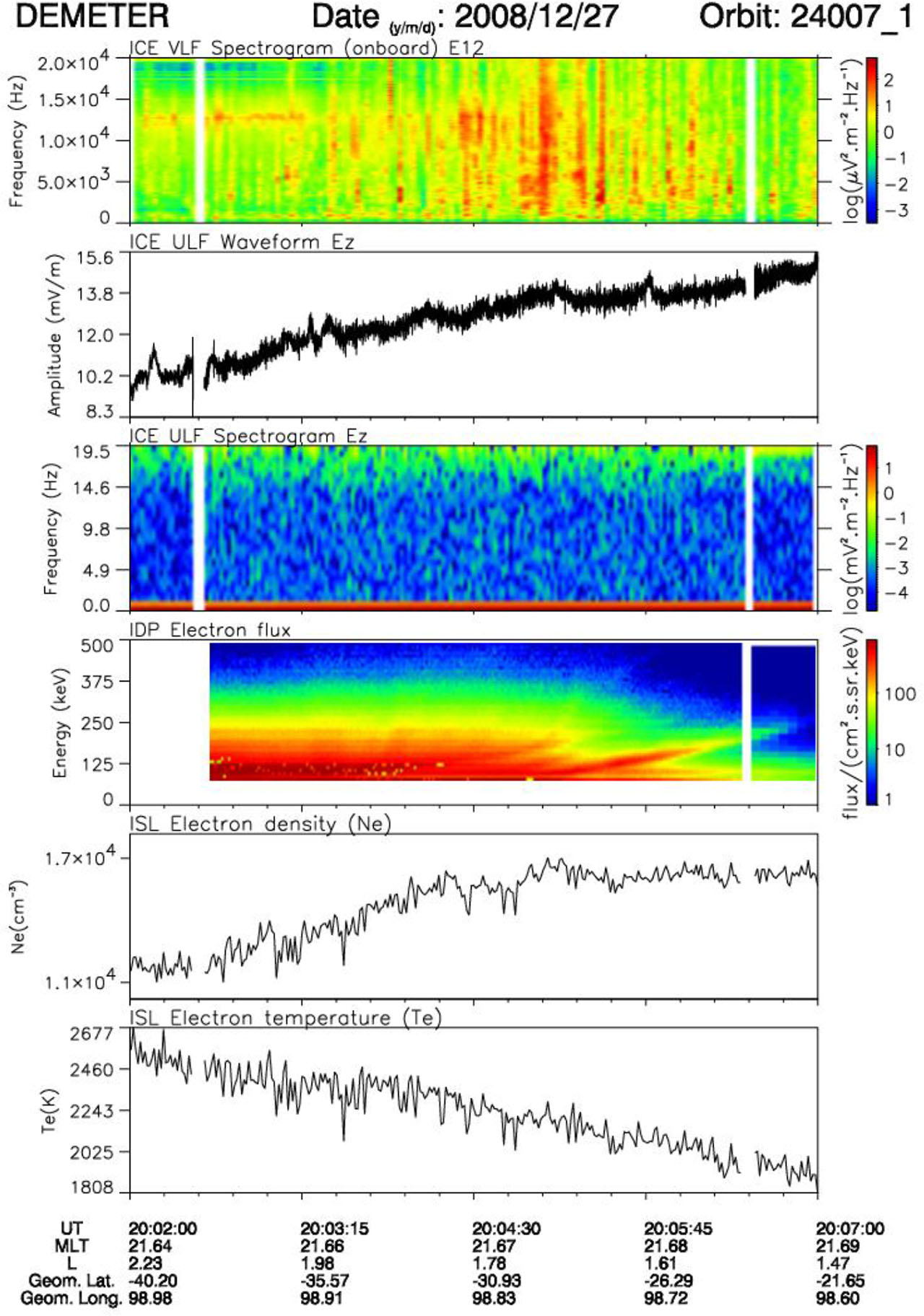
Figure 4.
Same as Figure 2, but taken during the DEMETER flight over the African thunderstorm centre on 27 December 2008
The next example of thunderstorm effects in the ionosphere comes from the Swarm A satellite. The Swarm mission consists of three satellites, two of which (Swarm A + C) are in a similar plane of 87.4° inclination and fly at an average altitude of 450 km. A higher orbiting satellite (Swarm C) is in a circular orbit with an inclination of 88° and an initial altitude of 530 km. The payload used in our studies consists of the absolute scalar magnetometer, the vector field magnetometer and the Langmuir probe. The magnetometers measure the magnetic field with a sampling rate of 50 Hz. This limits our studies to the ULF/ELF range. The Langmuir probe provides information on electron temperature and concentration.
Figure 5 shows the measurements recorded by Swarm A on 1 April 2016 during flight over the African thunderstorm centre. The upper panel shows the orbit of the satellite, corresponding to 10 min of registrations. The second panel contains two lines – black one represents electron concentration and the red one represents electron temperature. The strongest variations are seen twice – the first time between 20:37 and 20:38 and the second time between 20:39 and 20:42UT close to equator; values of these parameters are extremely variable and are presented by dots. The characteristic time of the variations is similar as in previously discussed cases, but amplitudes are much higher, which is likely caused by two factors: smaller distance to the source of disturbances resulting from the lower orbit and the satellite path crossing through equatorial humps, typically populated with plasma irregularities such as plasma bubbles. The lower panel of Figure 5 presents a spectrogram of ULF/ELF disturbances of the magnetic field accompanying variations of plasma parameters and are probably the cause of them. Plasma heating by ULF/ELF is a very common process in space (Zhou et al., 2025, Treumann and Baumjohann, 1997).
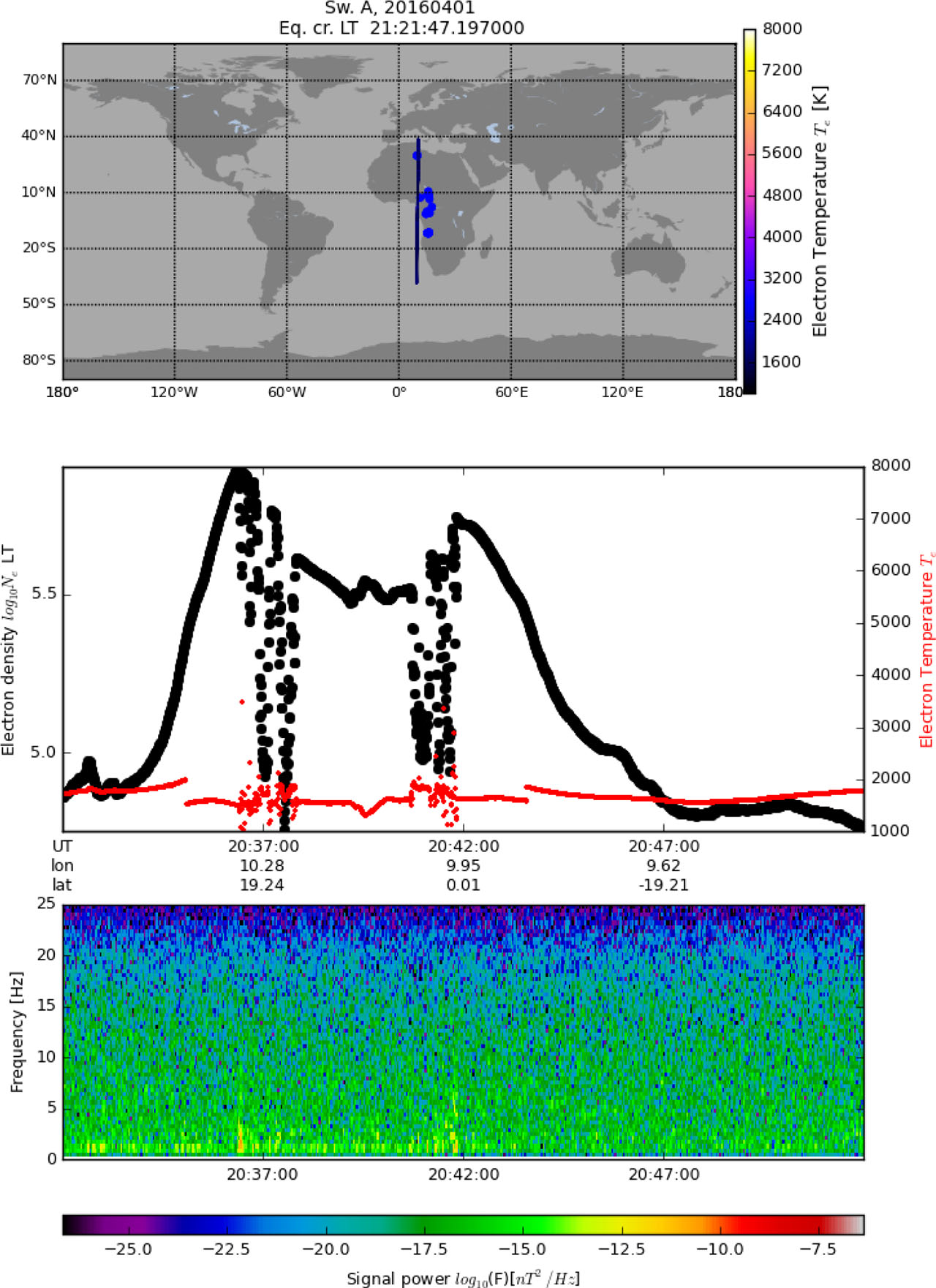
Figure 5.
Upper panel depicts a section of Swarm A satellite orbit marked with points denoting electron temperature measurements along the path on 1 April 2016. Satellite data overlay registrations of the lightning discharges (scattered blue points) derived from the ground-based stations. Measurements of the electron temperature (red line) and concentration (black line) are presented in the middle panel. The bottom panel shows the dynamic spectrogram of the magnetic field variations.
The cases of registrations of ionospheric effects gathered by the DEMETER and Swarm A satellites presented in this section clearly confirm that thunderstorms have significant influence on the ionosphere generating small-scale irregularities, heating electrons, and intensifying flux of energetic electrons.
3. EFFECTS OF GEOMAGNETIC STORM
Geomagnetic storms are multifaceted phenomena that originate at the solar corona and occur in the solar wind, the magnetosphere, the ionosphere and the thermosphere. One of the important questions in the domain of space studies is ‘How do changes in the magnetosphere–ionosphere system affect the Earth’s ionosphere throughout the chain of storm processes?’ The satellite measurements are crucial in studies of this problem. The characteristic signature of a geomagnetic storm is a depression in the H component of the magnetic field lasting normally over one to several days. This depression is caused by the ring current flowing westwards in the magnetosphere and can be monitored by the Dst index.
Extremely strong geomagnetic storm on 11 May 2024 persuaded authors to revisit registration of DEMETER satellite during its entire time of operation in 2004–2010 to study ionospheric effects occurring during strong magnetic storm. Three superstorms were found after examination of the geomagnetic data from Kyoto database for the time of DEMETER operation – 8 November 2004 with Dst −374 nT, 15 May with Dst −247 nT and 24 August 2005 with Dst −184 nT. The strongest of them was analysed in detail, and results are presented in this section. In addition, measurements recorded by Swarm B during storm on 11 May 2024 are also given.
Geomagnetic storm on 8 November 2004 started with the double sudden commencement phase and sudden enhancement around 21:05UT on 7 November. The main phase developed between 0:00 and 9:00UT, reaching a maximum value of disturbance, that is, −374 nT, around 7:00UT. Next, the recovery phase developed. Figure 6 shows a plot of Dst for November 2004 (left panel) and Kp index for the day of geomagnetic superstorm (right panel). The bottom part presents the Kp index for preceding storm days.
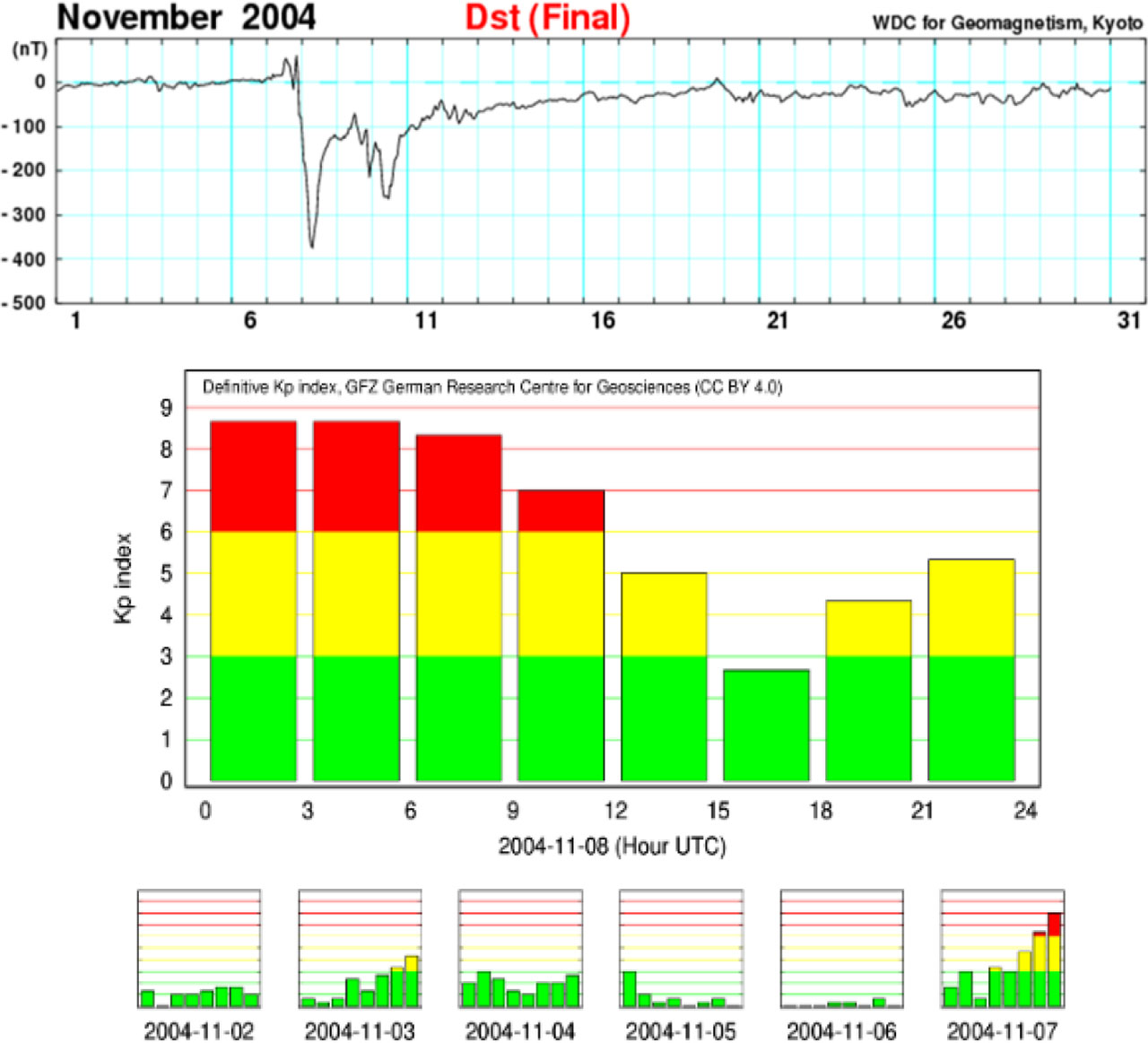
Figure 6.
Magnetic indexes Dst (top panel) and Kp (bottom panel) for geomagnetic superstorm on 8 November 2004 (courtesy Kyoto World Data Center (WDC))
The effects of the sudden commencement registered by DEMETER in the region of the middle latitude ionosphere are presented in Figure 7. Dramatic increase in the flux of electrons with energy up to 2.5 MeV is seen at 21:05:45UT. It is likely the effect of magnetosphere compression during the arrival of a coronal mass ejection (CME) and precipitation of electrons from the inner radiation belt. Ionospheric plasma experiences strong variations in electron density and temperature. These violent changes of the energetic electron flux are followed by generation of extremal strong waves in ULF/ELF/VLF ranges seen around 21:07UT. It corresponds to secondary heating of plasma seen at the same time. This is a strongly non-linear process leading to the turbulence. A particularly interesting effect of two-step interaction between ELF and VLF waves with electrons and subsequent generation of higher frequency waves due to instability of accelerated electrons has been registered. Analysis of this strongly non-linear process will be the subject of our next paper.
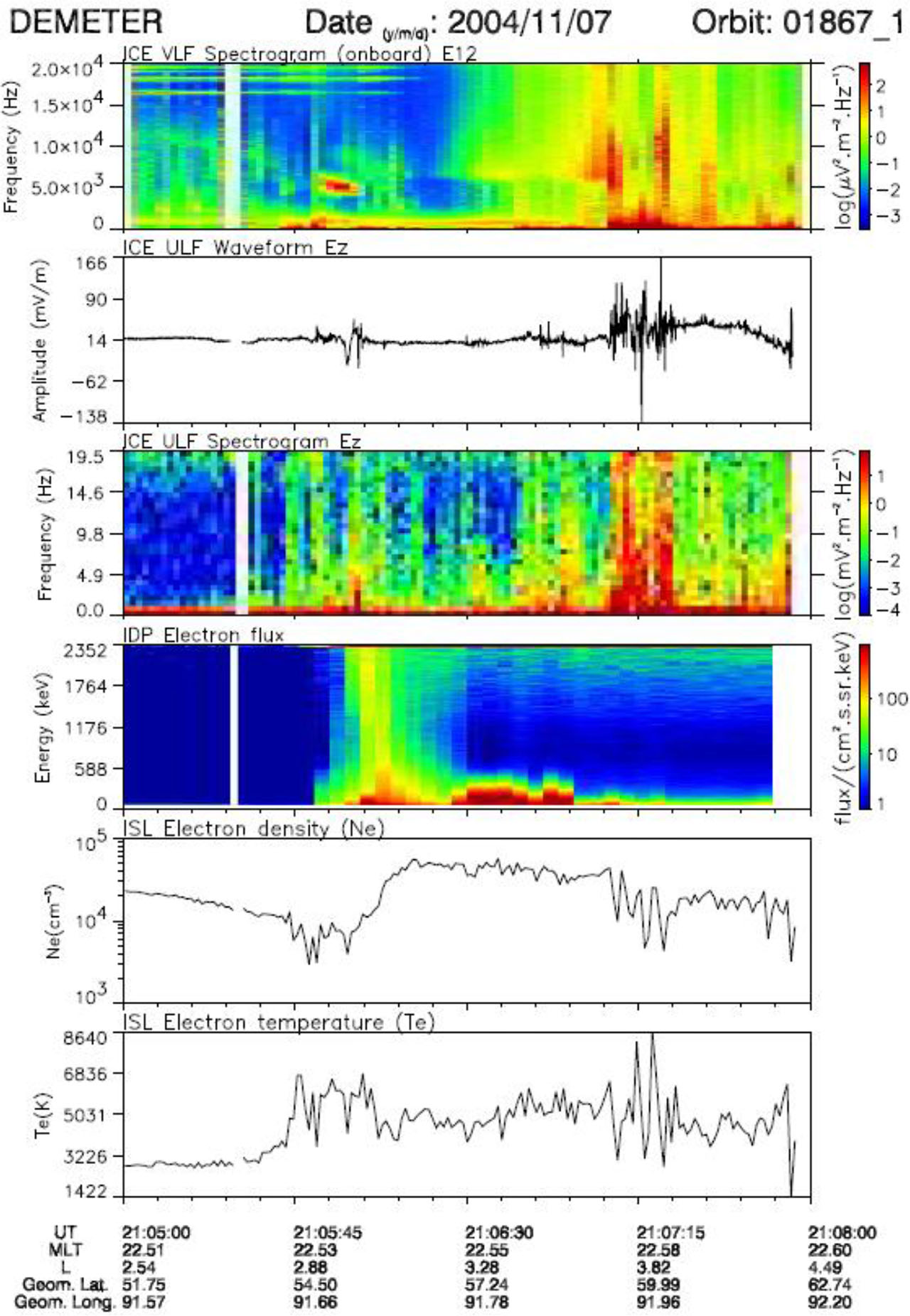
Figure 7.
Same as Figure 4, but during the sudden commencement phase of the magnetic storm on 8 November 2004
The registrations done during the main phase of the discussed storm are shown in Figure 8. The 34 min sample corresponds to almost half orbit from 70° southern latitude to 53° northern latitude. The most intensive effects including increase of energetic electron flux, excitation of waves with extremely high amplitudes and variations in electron concentration and temperature are present in the auroral region on the southern hemisphere and in the ionospheric through on the northern hemisphere. The intensive flux of energetic electron seen on 1:36–1:40UT is connected with the South Atlantic anomaly. Strong variations in electron temperature and density are present in the equatorial anomaly at 1:41UT.
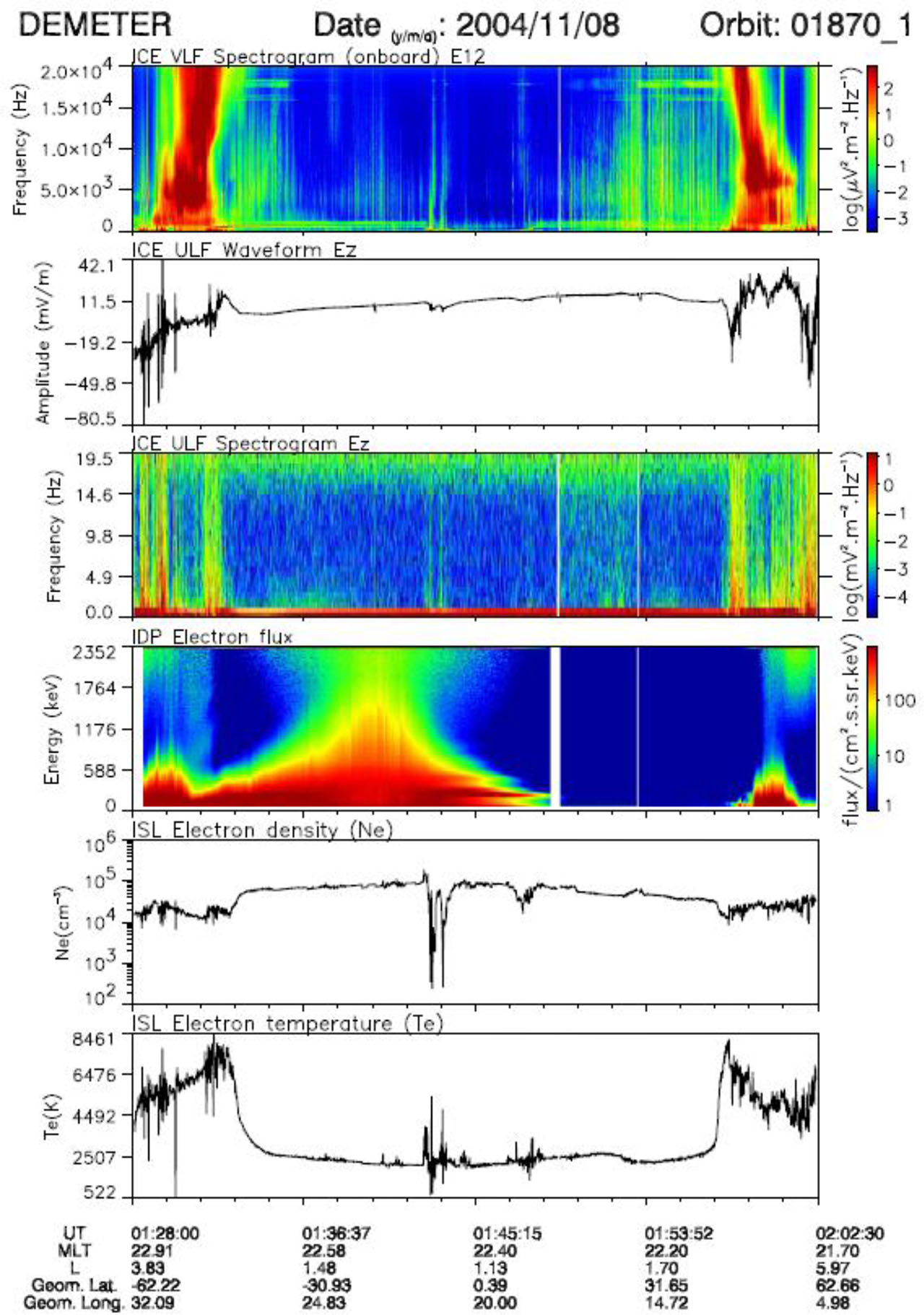
Figure 8.
Same as Figure 4, but during the main phase of the magnetic storm on 8 November 2010
The region of ionosphere around the geomagnetic equator is characterised by special behaviour of electron concentration with minimum just over the equator. It is an called ionospheric equatorial anomaly. This effect was registered by Swarm B satellite during the Mother’s Day storm on 11 May 2024 (see Figure 9) when the satellite was passing over an equatorial anomaly. Indexes characterising this very strong geomagnetic superstorm are provided in Figure 10. Strong flux of the energetic electron was registered, which was accompanied by two spikes of electron temperature just before entering into this anomaly. The quick variations of both temperature and concentration of electrons are present inside the anomaly. Despite limited time resolution on both satellites, it can be assumed with high probability that the observed fluctuations are produced by ion acoustic waves. Increase of electron temperature is a necessary condition for developing of these waves, which is clearly seen in Figure 11. There are no fluctuations of the magnetic field because these waves are electrostatic.
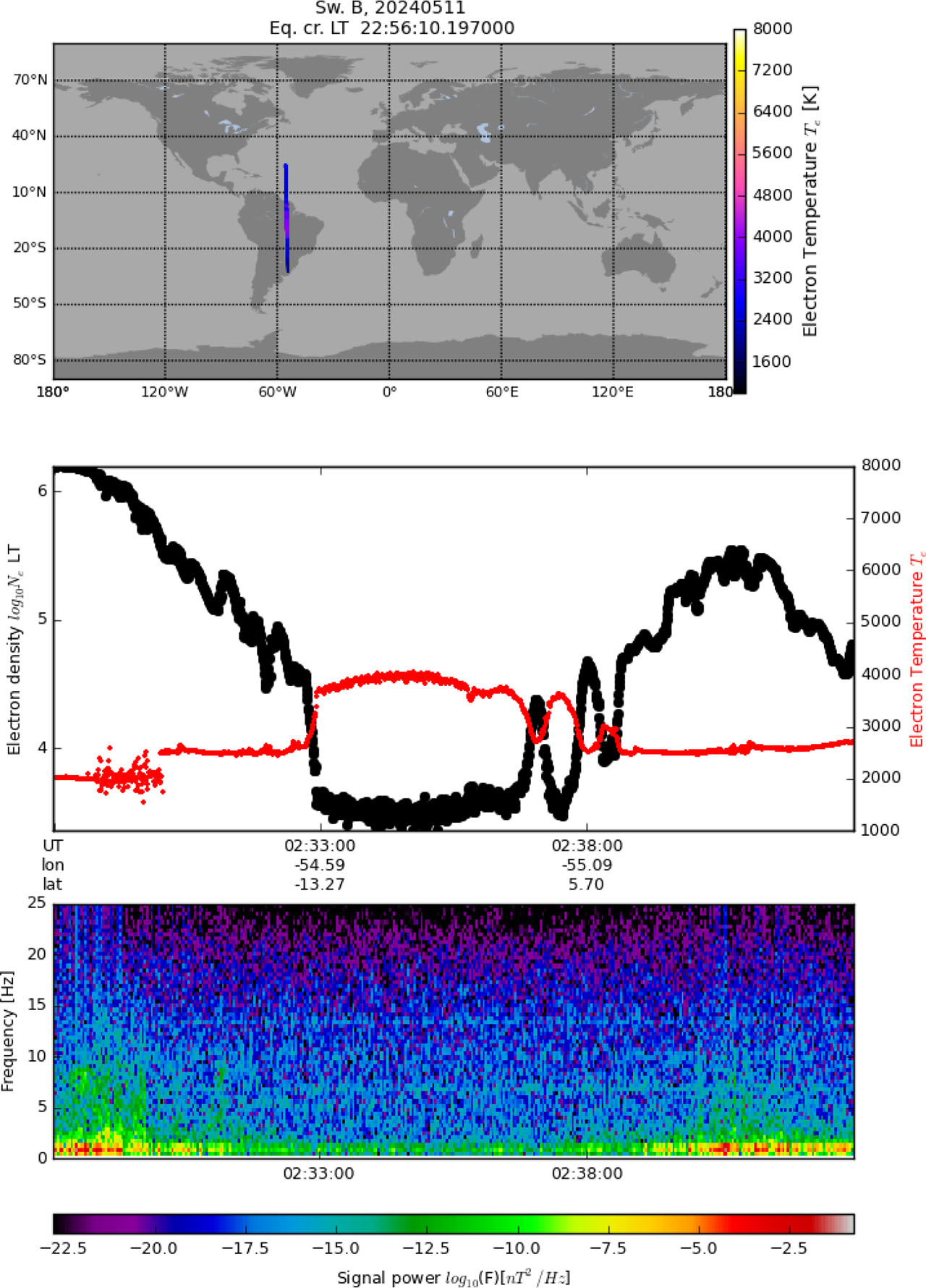
Figure 9.
A plot of electron temperature and concentration as well as spectrogram of ULF variations of scalar magnetic field measured by Swarm B satellite in equatorial anomaly on 11 May 2024 during the main phase of the storm. The upper panel shows the satellite orbit. The values of the temperature and concentration are shown by dots with different colours. Measurements of the electron temperature (red line) and concentration (black line) are presented in the middle panel. The bottom panel shows the dynamic spectrogram of the magnetic field variations.
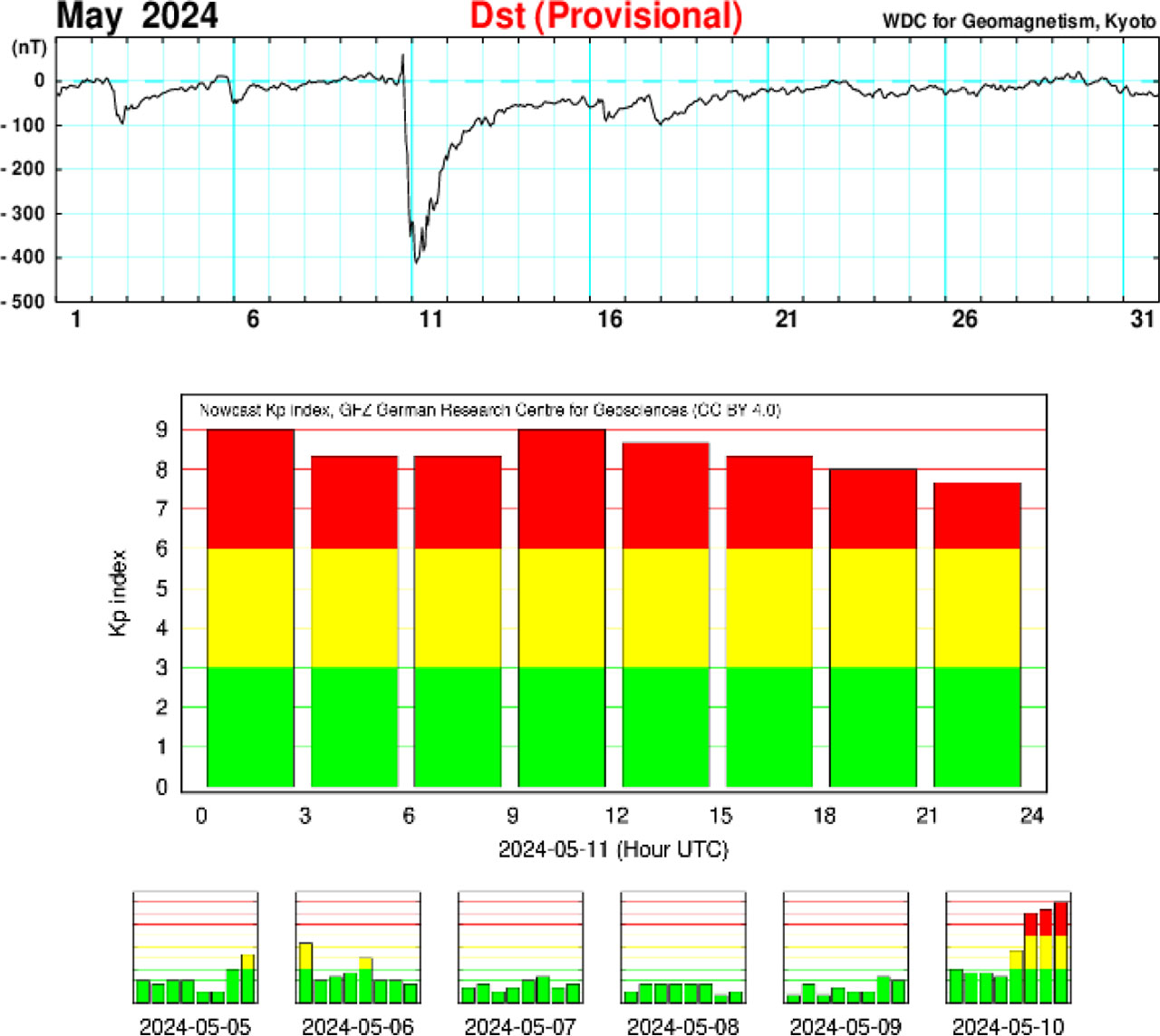
Figure 10.
Same as in Figure 6 for superstorm on 11 May 2024
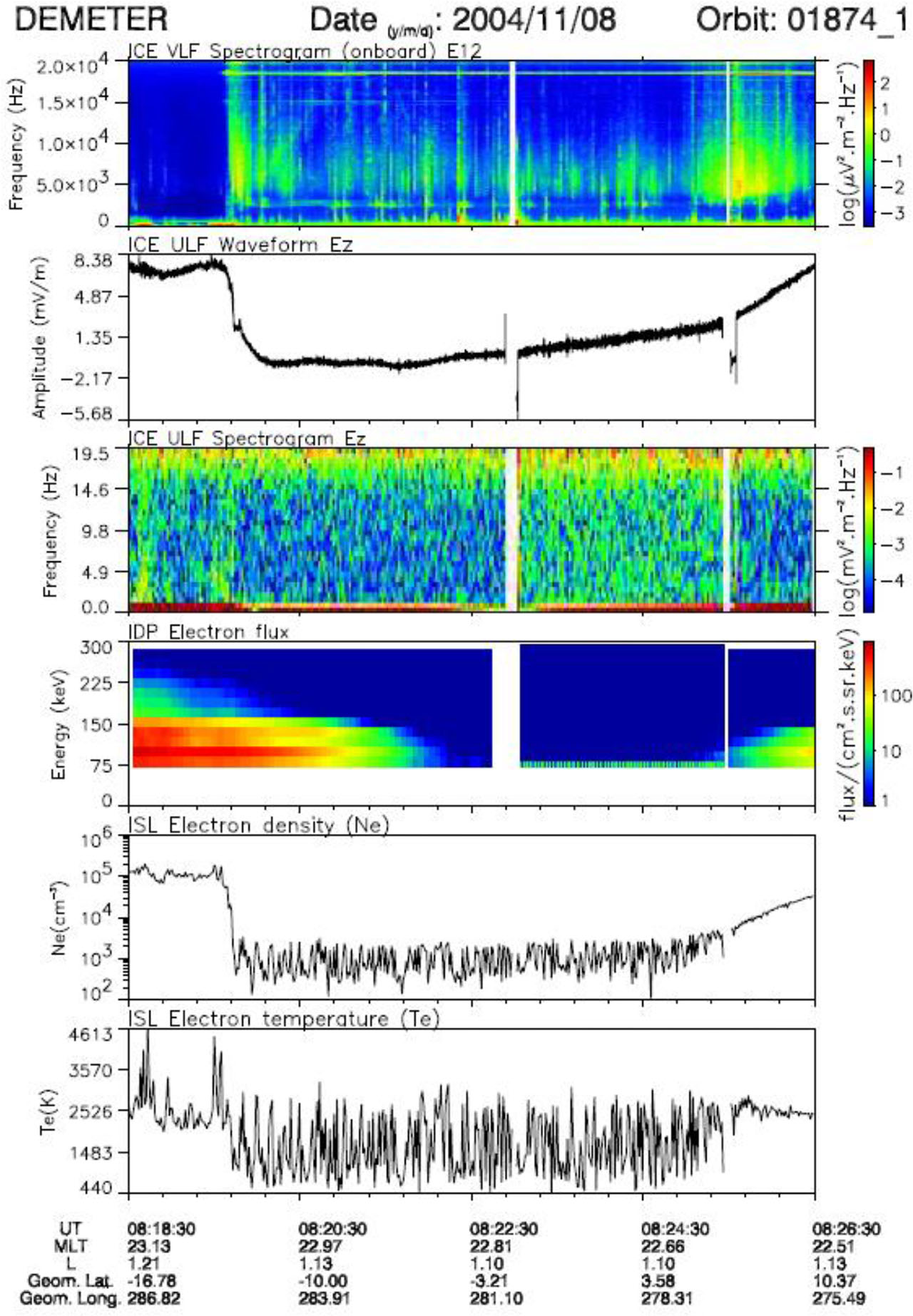
Figure 11.
Same as in Figure 4, but for equatorial anomaly during the end of main phase of the magnetic storm on 8 November 2010
The ionosphere is very sensitive for any disturbance. Many plasma processes can be studied there, and sometimes it is considered as a plasma laboratory (Erukhimov, 1992), but some regions are much more interesting from this point of view than others. The auroral oval and polar cusp are the most dynamic regions of the magnetosphere (see, e.g., Fritz, 2001, Błęcki et al., 2007). The ionosphere reacts violently to any disturbance in these regions.
Figure 12 shows registrations of the disturbances during the main phase of the 8 November 2004 storm done in the auroral region and its vicinity. Extremely strong variations in electron temperature reaching values more than 60% are seen. Electron concentration indicates variations in the order of 103 cm−3 correlating with temperature variation. The electron temperature is more sensitive than concentration for disturbance as it was seen in equatorial anomaly (Figure 11) and is seen in auroral region in the present case. The flux of electrons with the highest energy (around 2 MeV) was registered before arrival of VLF/high frequency (HF) waves, but afterwards we see strong increase of this flux, mainly in the lower energy range (below 1 MeV). It is likely the effect of resonant interactions waves – electrons leading to precipitation of electrons. Since Swarm does not provide registrations of energetic particles, only electron density and temperature measured during the magnetic superstorm on 11 May 2024 confirm the effects seen by DEMETER 10 years earlier (Figure 13). Furthermore, Swarm magnetometers reveal intensified magnetic disturbances, manifested by the broadband emissions below 25 Hz, when the satellite enters the auroral oval and the edge of polar cusp in the Australian sector.
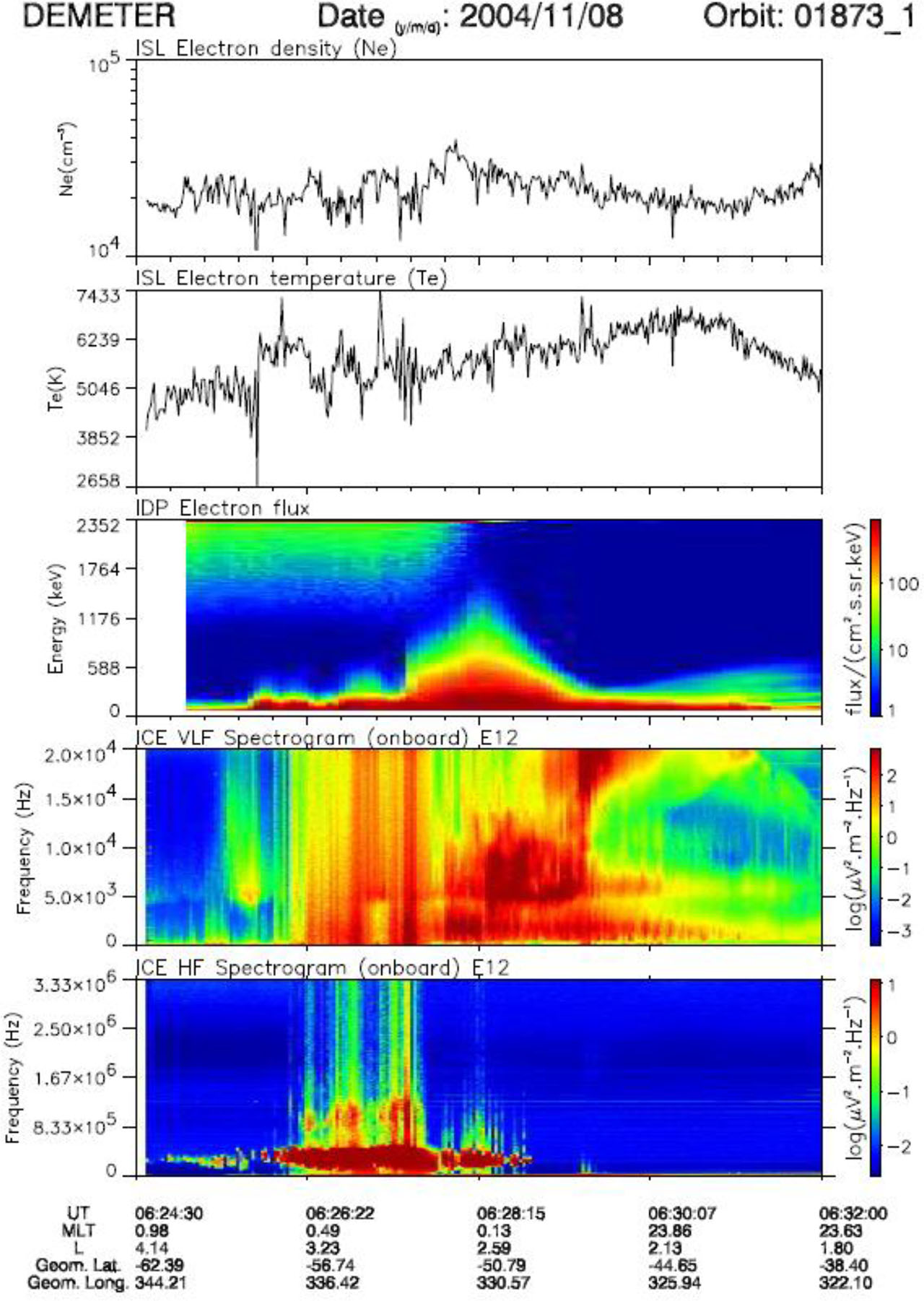
Figure 12.
DEMETER registrations of the electron density and temperature variations (upper panels), spectrogram of energetic electrons (middle panel) and spectrograms of electric field variations in VLF and HF ranges in the auroral zone and its vicinity during the main phase of the magnetic storm on 8 November 2010
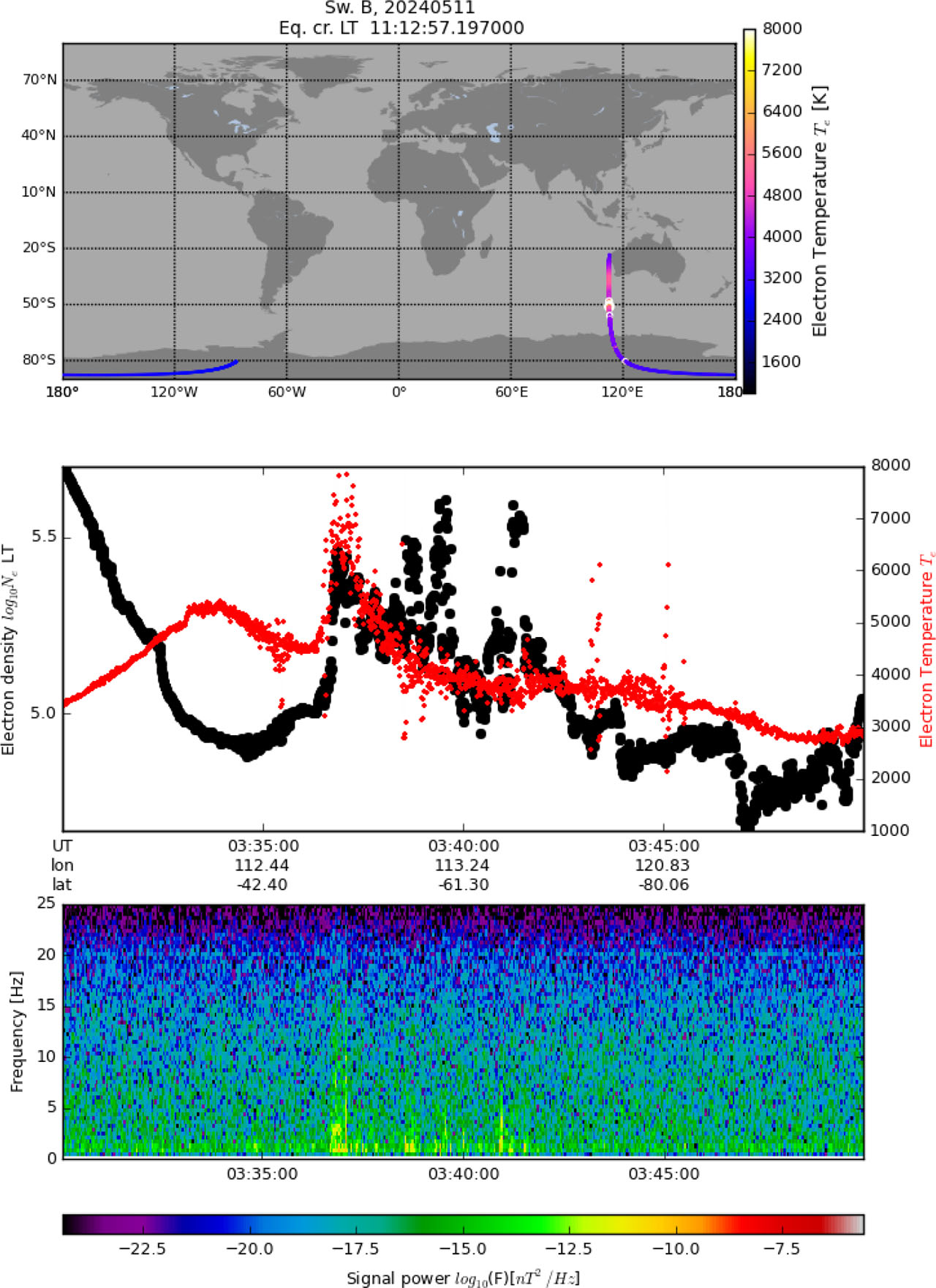
Figure 13.
Same as Figure 9, but measurements are done in the auroral oval and at the edge of polar cusp
4. CONCLUSIONS
The disturbances of the electron temperature and concentration during thunderstorms in mid-latitude and African thunderstorm centre together with fluxes of energetic electrons and plasma waves in ULF/ELF/VLF ranges have been discussed in the present paper. Variations in thermal plasma with spatial size in the order of tens to hundreds of metres have been registered. Variations in temperature are stronger and reach a value of about 10%–15%, while concentration below 10% with respect to the mean background during a quiet time. The increase in temperature correlates with increase in the energetic electron flux and intensification of low-frequency waves. The effects close to equator are stronger.
Similar information on disturbances in the ionosphere was obtained after analysis of data gathered by DEMETER satellite during superstorm in November 2004 and Swarm B satellite during superstorm in May 2024, but the fundamental difference was in the intensity of the registered disturbances. The variations in temperature and concentration reach values up to 60%. They are strongest in higher latitudes, particularly in the ionospheric regions close to auroral and polar cusp. The spatial scale is deduced from the temporal scales and movement of the satellites. One of the conditions leading to observed discrepancies result mainly from the altitudinal difference of two considered missions.
The fluxes of electrons with energy up to MeV’s were present during both thunderstorms as well as magnetic superstorms.
The problem which should be mentioned in this discussion is locality of the thunderstorms versus globality of the geomagnetic storms. The discharge of the energy during a lightning is localised in the area of hundreds meters to kilometre, while a geomagnetic storm induces the energy in the entire ionosphere with specific distribution of energy between individual ionospheric areas. But considering global distribution of frequency of appearance of lightnings around the Earth (see Figure 3), one can state the significant influence they have on the ionosphere. Global thunderstorm centres play a crucial role in the formation of the Earth’s global electric circuit. According to lightning climatology, there are roughly 2000 thunderstorms in progress around the world at any time, and measurements show that slow diurnal variations of the Earth’s electric field are in good agreement with the variations in global thunderstorm activity. Thus, taking into account the spatial and temporal distribution of lightning occurrence, one can state that it may have a significant impact on the ionospheric layers.
Another issue is the presence of plasma turbulence in the electric and magnetic fields, particularly in low-frequency range during thunderstorms as well as geomagnetic storms. It is usually associated with the presence of energetic electrons and is likely a cause of it. A discussion of this will be given in our next paper, which is in preparation.
Acknowledgements
We express our gratitude to M. Parrot, J-A. Sauvaud, J-J. Berthelier, J-P. Lebreton, the PI’s of DEMETER instruments from which the data was used. ESA is acknowledged for access to Swarm data. One of the authors has been supported by the National Science Centre, Poland (NCN), through grant No. 2021/41/B/ST10/00823.