
1. INTRODUCTION
The masses of the currently used reference ellipsoids (GRS80 or WGS84), which are models of the Earth's gravity field, also include the masses of Earth's entire atmosphere (Moritz, 1980; NIMA Agency, 2000). This means that the values of normal gravity also include a component resulting from all masses of the atmosphere shifted inside the ellipsoid. The atmospheric component of the actual gravity at any point located on the terrain surface (assuming that above the analysed point, the atmosphere consists of spherical, constant density layers) contains only the atmospheric masses lying below this point (e.g. Torge, 1989). To take into account differences in the influence of atmospheric masses on normal and actual gravity, it is recommended to introduce a gravitational atmospheric correction (Moritz, 1980; Hinze et al., 2005). This correction is small, but significantly higher than the measurement accuracy of currently used gravimeters, and it is normally determined by the so-called International Association of Geodesy (IAG) method based on the following approximate equation (Hinze et al., 2005):
where h is the height of the point in metres and the correction result is in milligals.The correction (Eq. 1) added to the measured gravity increases its value by the influence of atmospheric masses contained within the reference ellipsoid and reduces it by the influence of a simplified model of the actual atmospheric masses. Eq. (1) was given by Wenzel (1985) based on the concept proposed by Ecker and Mittermayer (1969). This concept assumes that the atmospheric masses constitute spherical homogeneous layers extending from the surface of the sphere as the lower boundary. Atmospheric corrections to gravity and geoid, which take into account the topographic surface as the lower surface of the atmosphere on a global scale, were first estimated by Anderson et al. (1975) and Anderson (1976). This approach was later extensively studied in various contexts. Sjöberg (1993) estimated a gradient of influence of atmospheric masses on gravity at the level of 0.05 mGal/km. Sjöberg (1998, 1999) and Sjöberg and Nahavandchi (2000) investigated the atmospheric gravity effect in Stokes’ formula, delivering formulas for the direct atmospheric gravity and geoid effects based on spherical harmonic representation of the topography. This approach was than improved by Nahavandchi (2004) by including local topography in the calculations. The effect of atmospheric masses for the Stokes’ problem was also discussed by Tenzer et al. (2006). The authors determined the direct and secondary indirect atmospheric effects for the area of Canada. Novak and Grafarend (2005) analysed the effect of atmospheric masses on spaceborne observables of the geopotential gradient vector and gravity gradient tensor. The atmospheric effects on the gravity field quantities at a global scale were determined by Tenzer et al. (2009). The authors used the expressions for spectral analysis of a gravitational field. In turn, Mikuška et al. (2008) demonstrated in several examples the importance of topography for the determined atmospheric gravity corrections. A detailed analysis of the gravitational effect of the topography-bounded atmosphere in New Zealand was carried out by Tenzer et al. (2010). The authors used the calculation approach based on an analytical integration procedure described in detail by Mikuška et al. (2006). The values of the gravitational effect of the topography-bounded atmosphere that they determined varied from −0.009 mGal (offshore) up to 0.203 mGal for the highest peak. They also compared their results with the IAG approach and showed differences more than 0.1 mGal.
The main goal of this study is to conduct analyses analogous to Tenzer et al. (2010) for a different type of terrain and using a slightly different approach. In our analyses, the topography-bounded atmospheric gravity corrections were calculated using procedures known for topographic reduction of the gravity.
2. METHODOLOGY AND DATA
2.1. The Approach
The atmospheric correction (Eq. 1) is the difference of two components. The first is the normal gravity component defined by the atmospheric masses contained within the reference ellipsoid (the normal gravity component gNA), which can be defined as (e.g. Sjöberg, 1993):
where G is Newton’s gravitational constant, Ma is the mean mass of the Earth’s atmosphere and r is the geocentric radius of the computation point.The second component (spherical atmospheric component gSA) is determined by the atmospheric masses constituting spherical, homogeneous layers extending from the surface of the reference sphere as the lower boundary, and it can be written as
where M(r−R) denotes the sum of the masses of homogeneous, spherical layers of the atmosphere located between the reference sphere of the radius R and the computation point.Hence, in general, we will define Eq. (1) as
If topography is adopted as the lower boundary of the atmosphere, the gravity effect of atmospheric masses (gETA) will be defined as (Figure 1)
whereIn Eq. (6), Ω is the volume of integration, ρA is the atmosphere density distribution function, l is the distance between the attracting masses and the attracted point and dVΩ is the element of volume. The Ω volume covers the masses of the atmosphere from the surface of the topography to a height at least equal to the highest mountain peaks.
Alternatively, the gETA component can be determined from the difference (Mikuška et al., 2008)
where gTA is the topographic–atmospheric correction equal to the gravity of all Earth topography, assuming its density is equal to the density of the atmospheric masses (Figure 1): whereIn Eq. (9), Θ represents the volume of all Earth topography.
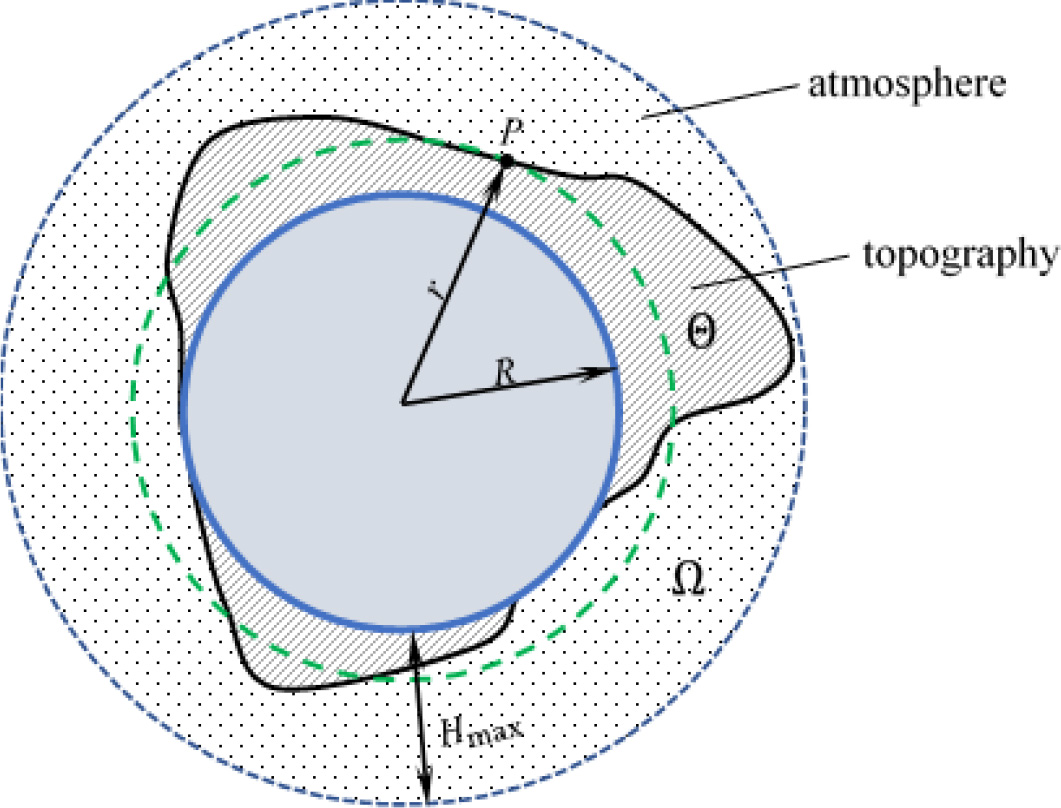
Figure 1.
The Ω and Θ volumes adopted to determine the gETA component
Now, the topography-bounded atmospheric correction will be defined as
Let us note that taking into account the computational costs, determining the gETA component according to Eq. (7) is more advantageous than according to Eq. (5) due to the much smaller integration domain (in areas of seas and oceans, there is no topography, so they can be omitted). For this reason, we used it in further investigations.
The method of determination of Eq. (8) depends on the assumptions made regarding the coordinate system, available digital elevation model (DEM) and the atmospheric density distribution model. Assuming a spherical, geocentric coordinate system, DEM will be defined as a regular grid of spherical tesseroids.
By assigning each tesseroid a constant density , the gTA component can be determined based on
In Eq. (11), n is the number of tesseroids used in the calculations and δgi is the component of gravity determined based on a single tesseroid defined as (Heck and Seitz 2007)
where φ′, λ′ and r′ are coordinates of the running integration point; , , , , and are the coordinates defining thesseroid i of DEM and ψ is the angle between the computation point (with coordinates φ, λ, r) and the running point:Because there is no solution of the integral in Eq. (12) and the area of integration is very large and includes very distant masses, the δgi components were determined using three approximations. In the immediate vicinity of the calculation point (up to 5 km), tesseroids were replaced by rectangular prisms of the same mass, for which a closed solution of the appropriate integral is known (Nagy et al., 2000). For tesseroids located further away (5 − 500 km), we used the approximate solution of the integral in Eq. (12) in the form proposed by Heck and Seitz (2007). For further masses, tesseroids were replaced by point masses located in their centres.
Due to changes of atmospheric density in the vertical direction, determination of the gTA component will also require vertically dividing individual DEM blocks into segments of appropriate height.
2.2. The Atmosphere Model
The United States Standard Atmosphere 1976 model (USSA76) was used to estimate the density of the atmosphere, , needed to implement Eq. (12). Based on the tabular values included in model USSA76, an analytical model was determined using the least squares method in the form:
where ρA is determined in kg/m3, H is the height in metres and ai is a coefficient given in Table 1.Table 1.
The coefficients of model (Eq. 14) used in the calculations
| Coefficient | Value |
|---|---|
| a0 | 1.22499986 |
| a1 | −1.17606554 × 10⁻⁴ |
| a2 | 4.32023892 × 10⁻⁹ |
| a3 | −7.34343434 × 10⁻¹⁴ |
| a4 | 5.18648018 × 10⁻¹⁹ |
Based on the model (Eq. 14) and assuming H = r − R, the M(r−R) value can be written as the integral:
Its solution is given in the form:
where:;
;
;
;
.
Eq. (16) allows determining the exact values of the gSA component (Eq. 3), taking into account vertical atmospheric density changes in form of the model given by Eq. (14).
As delineated in the preceding section, owing to variations in atmospheric density along the vertical, the computation of the gTA component according to Eqs (11) and (12), also requires the vertical partitioning of each individual DEM block into segments of suitable heights and constant density. To assess the vertical resolution of such segmentation, we will use the gSA component, whose exact values can be determined. Let us note that the gSA component (Eq. 3) can also be represented in an approximate form through the division of the atmosphere into m homogenous layers characterised by constant density and altitude. The M(r−R) value can, therefore, be expressed in the following form:
where rj = R + dh × (j − 1), is the height of a single layer and is the density of the atmosphere in the middle of the height of the layer j determined on the basis of Eq. (14).The error in determining the gSA component caused by using the approximate M(r−R) value defined by Eq. (17) instead of the exact value provided by Eq. (16) can be estimated by considering the difference:
where and represent the gSA components determined using the M(r−R) values in their approximate form (Eq. 17) and exact form (Eq. 16), respectively.To estimate the δgSA errors for different dh, the values were determined using Eqs (3) and (17) for one point situated at a height of 2,500 m (the highest point in the area of Poland) and for another point situated at a height of 8,500 m (the highest point on the Earth). Similarly, using Eqs. (3) and (16), the values were determined for the same points. The determined δgSA values are presented in Figure 2.
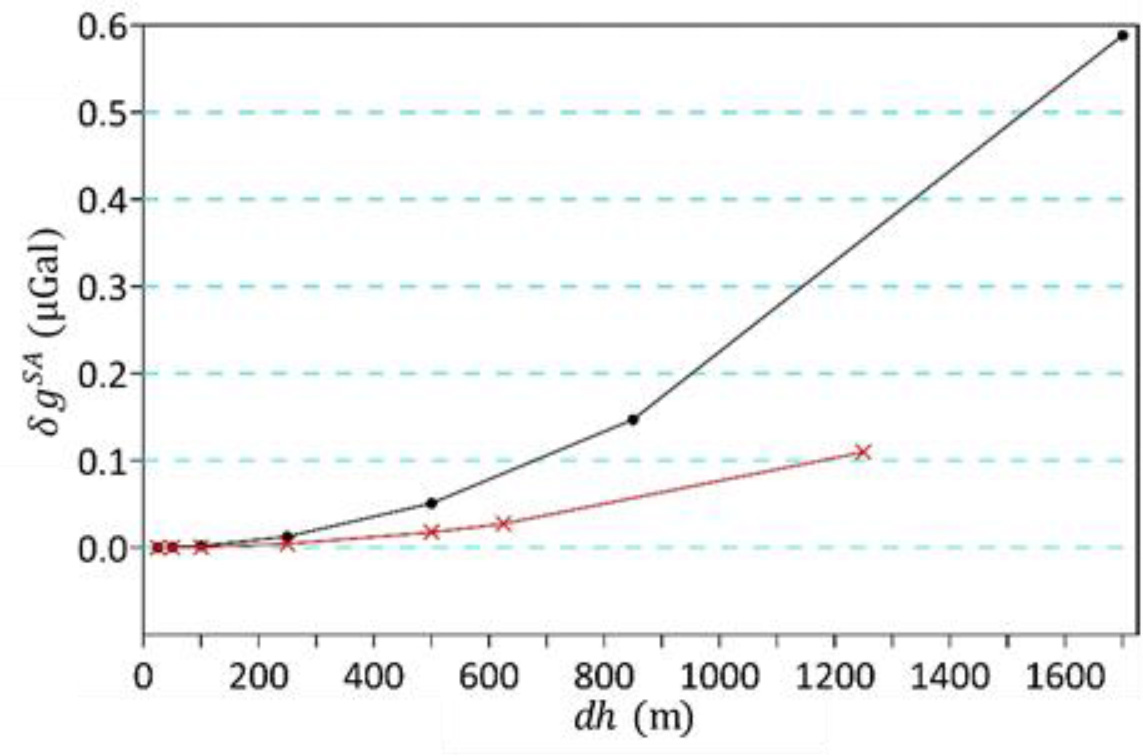
Figure 2.
The δgSA values for points with Hp = 2,500 m (red line) and Hp = 8,500 m (black line). The symbols in both charts indicate the dh values for which the calculations were performed.
Initially, it is noteworthy that the δgSA error values are almost equal to 0 for dh ≤ 100 m (in both analysed cases), whereas for dh > 100 m, they are noticeably larger for the point located at a higher elevation. This indicates that for points with heights lower than those examined, the δgSA errors will not exceed the levels depicted in Figure 2. For instance, for points situated within the geographic boundaries of Poland (not exceeding 2,500 m in altitude), assuming dh = 500 m, the component can be computed with the δgSA errors not exceeding 0.02 μGal (as depicted by the red graph). Whereas, for locations not exceeding 8,500 m in elevation (i.e. points on the Earth's surface), the δgSA errors may ascend to 0.05 μGal (as indicated by the black graph). Given that our calculations maintain an accuracy of approximately 1 μGal, such discrepancies remain within acceptable bounds.
The above discussed gSA component errors also mirror those of the gTA component, determined with the same vertical division of tesseroids constituting DEM. These errors will be equal if the topography consists of layers with constant heights (either 2,500 or 8,500 m, respectively). Consequently, the ascertained δgSA errors for a height of 8,500 m can be considered the maximum errors in determining the gTA component (for any point on the Earth's surface), resulting from the need to take into account changes in atmospheric density in the vertical direction by dividing tesseroids that constitute DEM into segments with constant of both atmospheric density and dh values. Considering the topography in the study area is generally lower overall, with the highest mountains situated at considerable distances, covering only a fraction of the Earth's surface, the error resulting from adopting dh = 500 m for the vertical tesseroids division will be substantially lower than the 0.05 μGal pointed above. Hence, dh = 500 m was selected to compute the gTA component. Naturally, the gSA component was determined in its exact version, based on Eqs (3) and (16).
2.3. The Study Area and DEM
The calculations were based on two DEMs: the SRTM v4.1 (3″ × 3″ model) (Jarvis et al. 2008) and the ETOPO1 (1′ × 1′ model) (NOAA National Geophysical Data Center 2009). Based on these models, five sets of DEM were prepared and directly used in the calculations for various distances from the calculation point:
3″ × 3″ - model for calculations at a distance of up to approximately 10 km;
15″ × 15″- model for calculations at a distance of approximately 10 − 50 km;
30″ × 30″- model for calculations at a distance of approximately 50 − 167 km;
1′ × 1′- model for calculations at a distance of approximately 167 − 500 km;
6′ × 6′- model for calculations carried out for topographic masses located further than 500 km.
The primary study area was located between parallels 48.4° − 55.1° and meridians 13.7° − 24.5° (Figure 3a). For this area, the calculations were performed for a regular grid of points with a resolution of 93″ × 90″. The area is mostly lowland. In the north, it covers a part of the Baltic Sea and in the south, it covers the Carpathian Mountains and the Sudetes (in the southwest). The highest region in the analysed area is the Tatra Mountains, with peaks reaching 2,499 m (Rysy) for the Polish part and 2,655 m (Gerlach) for the Slovak part of the Tatra Mountains. For part of the Tatra Mountains, marked in Figure 3a with a red rectangle, calculations were performed in a grid of points with a resolution of 12″ × 9″. This area is shown in Figure 3b.
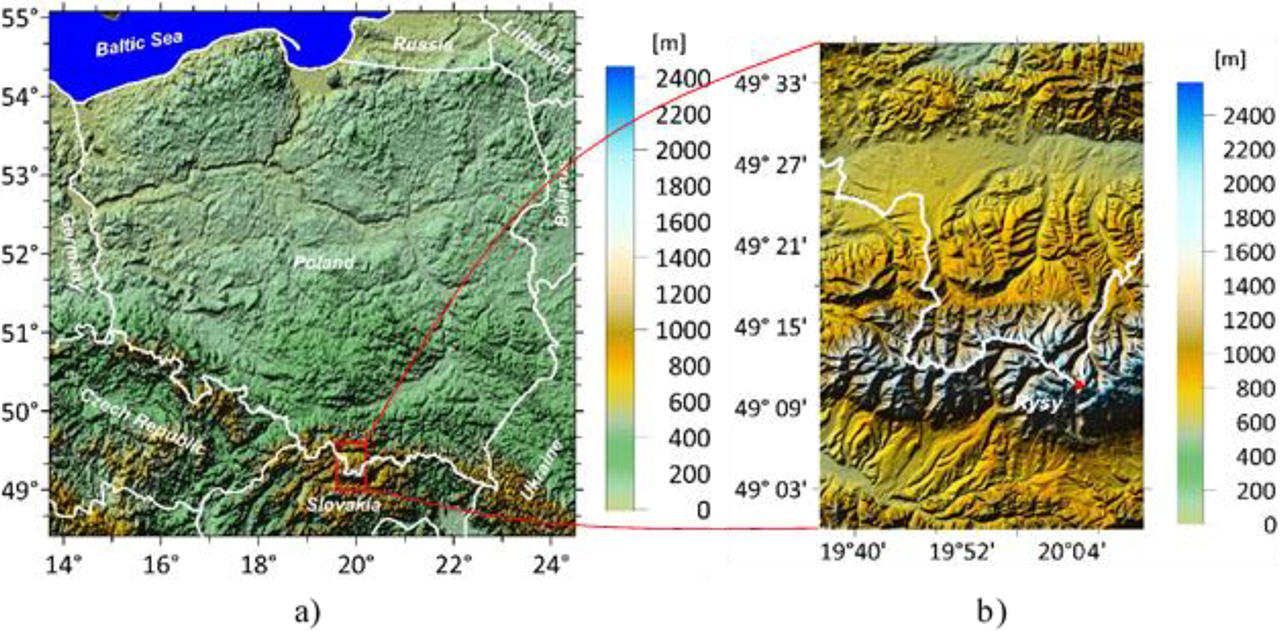
Figure 3.
Relief maps of the study areas for a) the whole areas of elaboration and b) the Tatra mountains
3. RESULTS OF THE ANALYSES
First, the components gTA, gSA and gETA were determined. The statistics of these values are presented in Table 2.
Table 2.
The statistics of the determined components of atmospheric gravity correction (mGal)
| min | max | mean | st dev | ||
|---|---|---|---|---|---|
| gTA | 0.012 | 0.108 | 0.033 | 0.019 | |
| gSA | 0.000 | 0.233 | 0.042 | 0.040 | |
| gETA | −0.012 | 0.125 | 0.009 | 0.021 | |
All these components are strongly correlated with the height of the calculation point. These correlations are presented in Figure 4. Note that the gTA component and, consequently, the gETA component depend not only on the height of the point, but also on the topography of its surroundings. This can be seen in the discrepancies in components for points of the same heights.
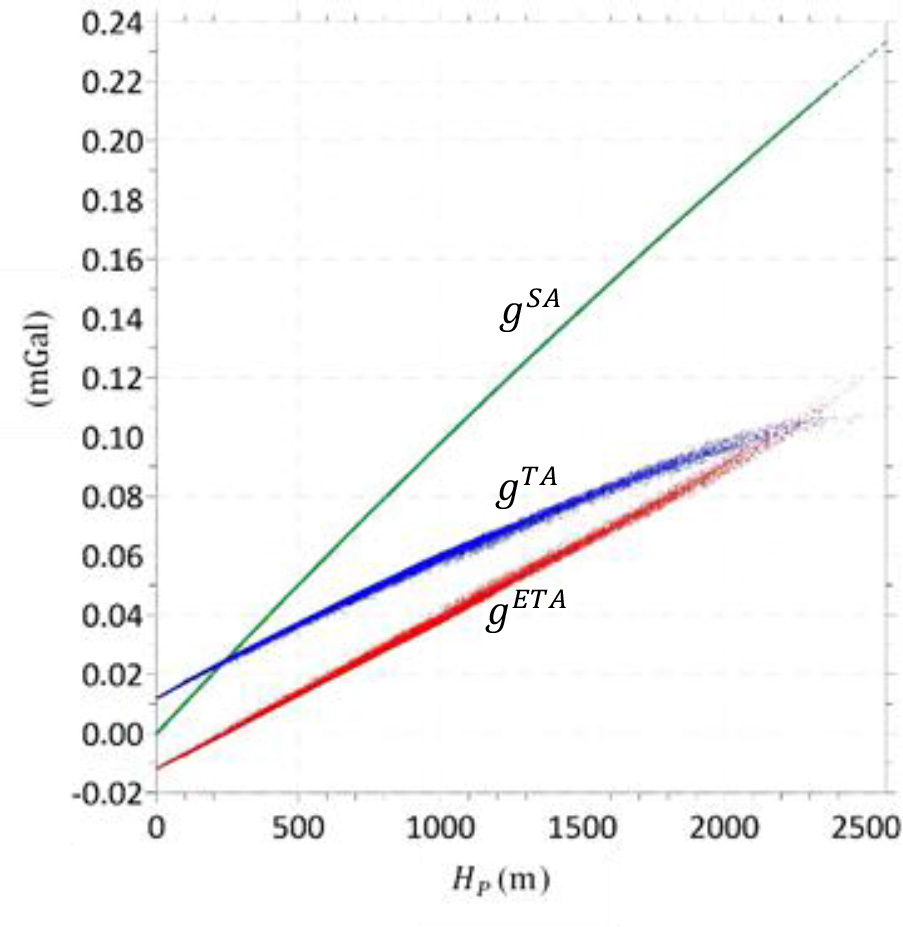
Figure 4.
The correlation between the height of computation points and the values of gTA – navy blue, gSA – green and gETA – red
Component gETA, according to Eq. (7), is the difference of the two other components. The horizontal distribution of this component is shown in Figure 5.
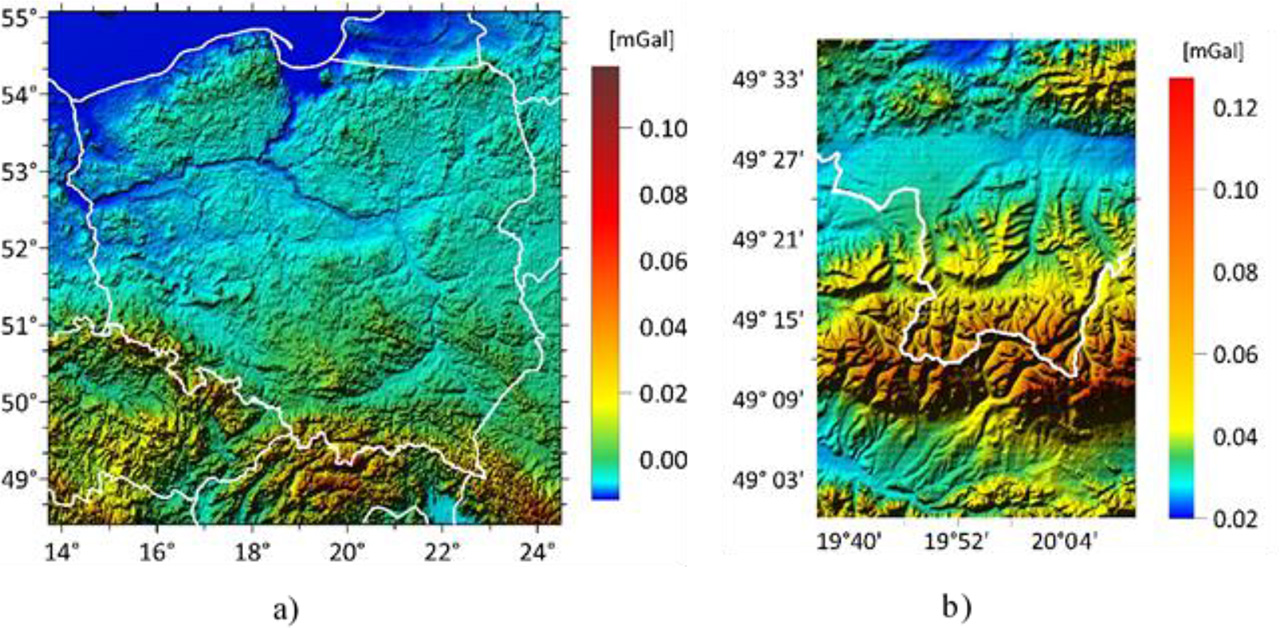
Figure 5.
The gETA component: a) for the whole area of elaboration and b) for the Tatra mountains
The values of the gETA component are negative at points located on the sea surface (the lowest value was −0.012 mGal) and in low-altitude areas, up to approximately 220 m (Figure 4). For higher areas, the value is positive and reaches a value of 0.125 mGal for points with heights of 2600 m. As can be seen in Figure 5a and b, the values of this component reflect the topography of the area in detail.
Based on Eqs (1) and (10), the approximate (δgatm) and topography-bounded ( ) atmospheric corrections were respectively determined. These values were compared to each other. Statistics of the corrections and the differences, as defined in the following equation:
are presented in Table 3.Table 3.
The statistics of the δgatm and corrections as well as the differences, Δδgatm (mGal)
| min | max | max − min | mean | st dev | |
|---|---|---|---|---|---|
| δgatm | 0.643 | 0.875 | 0.232 | 0.833 | 0.039 |
| 0.748 | 0.886 | 0.138 | 0.865 | 0.021 | |
| Δδgatm | −0.105 | −0.011 | 0.094 | −0.032 | 0.018 |
Both corrections are strongly correlated with the heights of the analysed points. These correlations are presented in Figure 6.
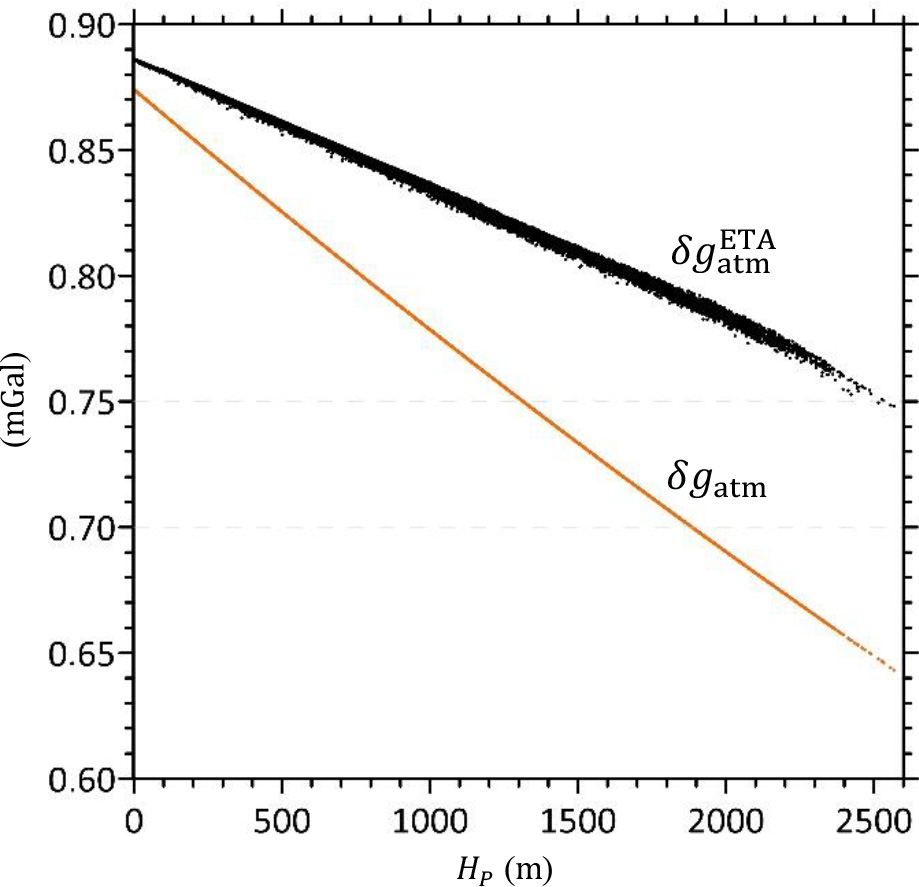
Figure 6.
The correlations between the height of computation points and the corrections: – black and δgatm– orange
As shown in Figure 6, the correction (like the gETA component) takes slightly different values for points with the same height. This proves that its value is also influenced by relief of the point's surroundings. The most important differences, however, are between the approximate and topography-bounded corrections. For points located at the sea level, the differences are small and reach 0.011 mGal. They clearly increase with the height of the points, exceeding 0.1 mGal for points with heights of 2600 m. In relation to the total values of this correction, the differences shown can be considered as not very large. Please note, however, that the corrections vary only within a range of 0.138 mGal; hence, the differences at the level of 0.1 mGal should be assessed as significant. Let us also note that the results shown for the gETA component and the correction are consistent with those shown by Tenzer et al. (2010).
The horizontal distribution of the corrections and the Δδgatm differences are presented in Figures 7 and 8, respectively.
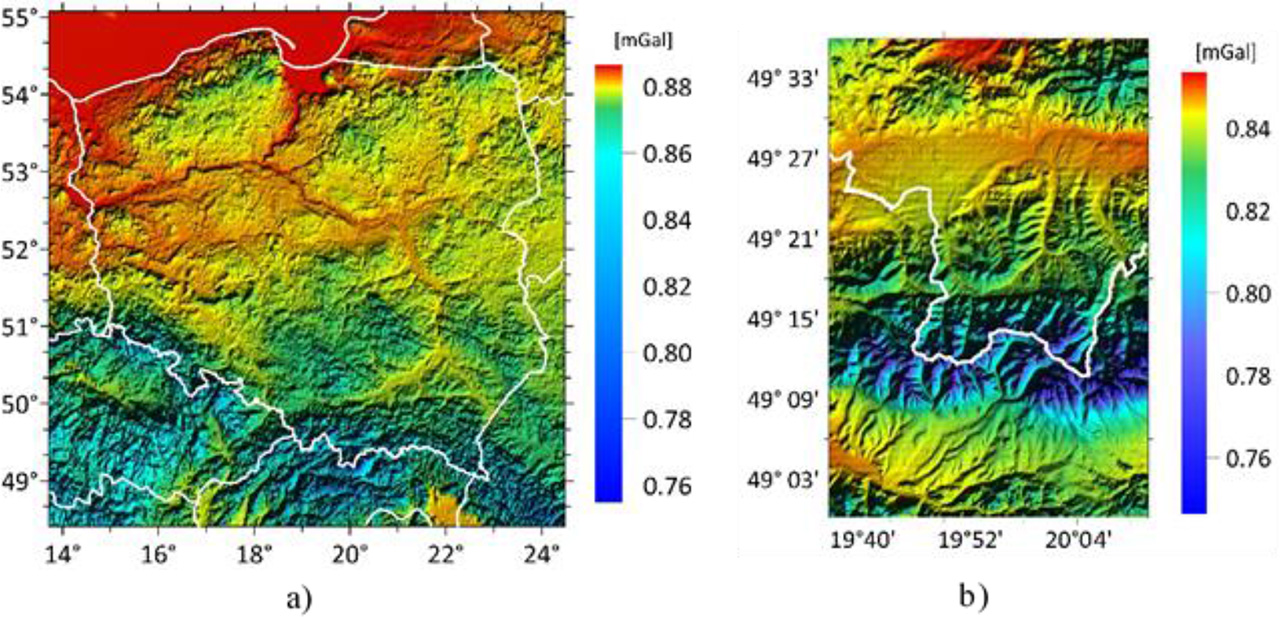
Figure 7.
The corrections a) for the whole area of elaboration and b) for the Tatra mountains
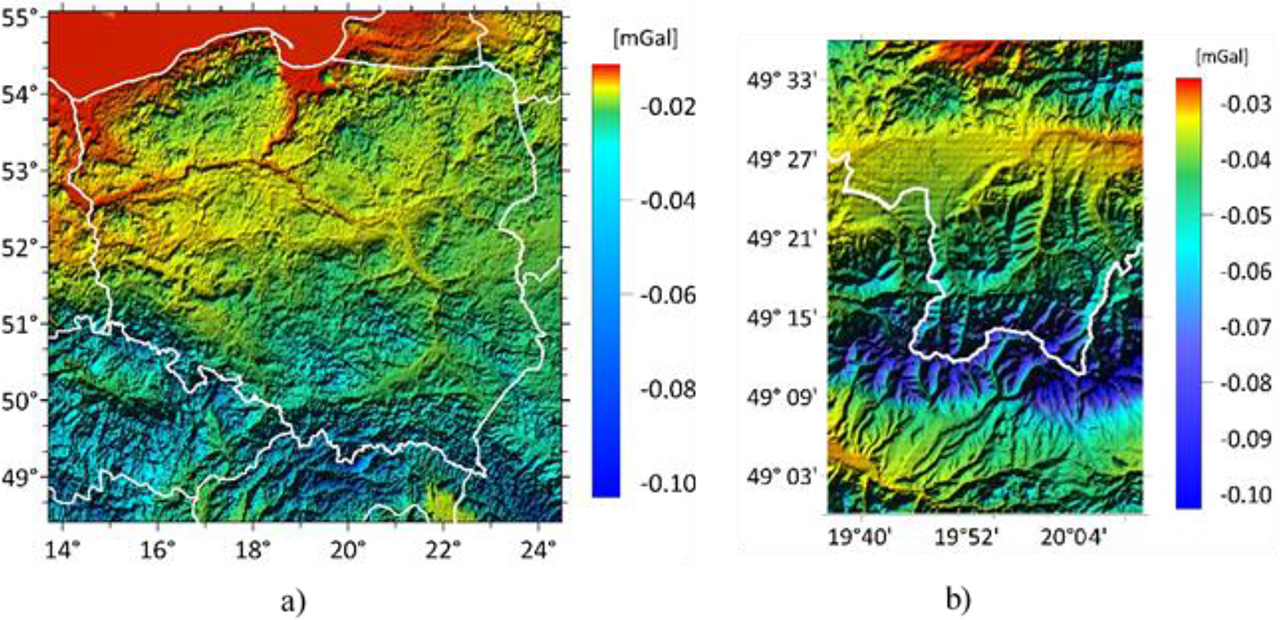
Figure 8.
The differences Δδgatm a) for the whole area of elaboration and b) for the Tatra mountains
4. CONCLUSIONS
The analyses performed showed that the values of the gETA component are negative (the lowest value was −0.012 mGal) at points located on the sea surface and for lowland areas, up to approximately 220 m (Figure 4). For higher located areas, it is positive and reaches a value of 0.125 mGal for points with heights of 2600 m. These values are strongly correlated with the heights of the points, but they also depend on the terrain relief around the computation point.
The topography-bounded gravity atmospheric correction ( ) in the elaboration area ranges from 0.748 to 0.886 mGal. Like the gETA component, the values of this correction are strongly correlated with the heights of the points and also depend on the surrounding relief. Values of this correction are different from the commonly used approximate atmospheric correction, δgatm, ranging from 0.011 mGal for points at the sea level up to 0.105 mGal for points located at an altitude of approximately 2600 m. These discrepancies are a trend and should be considered significant. The results obtained within this article confirm previous studies on the computation of the atmospheric gravity corrections (e.g. Tenzer et al., 2010).