
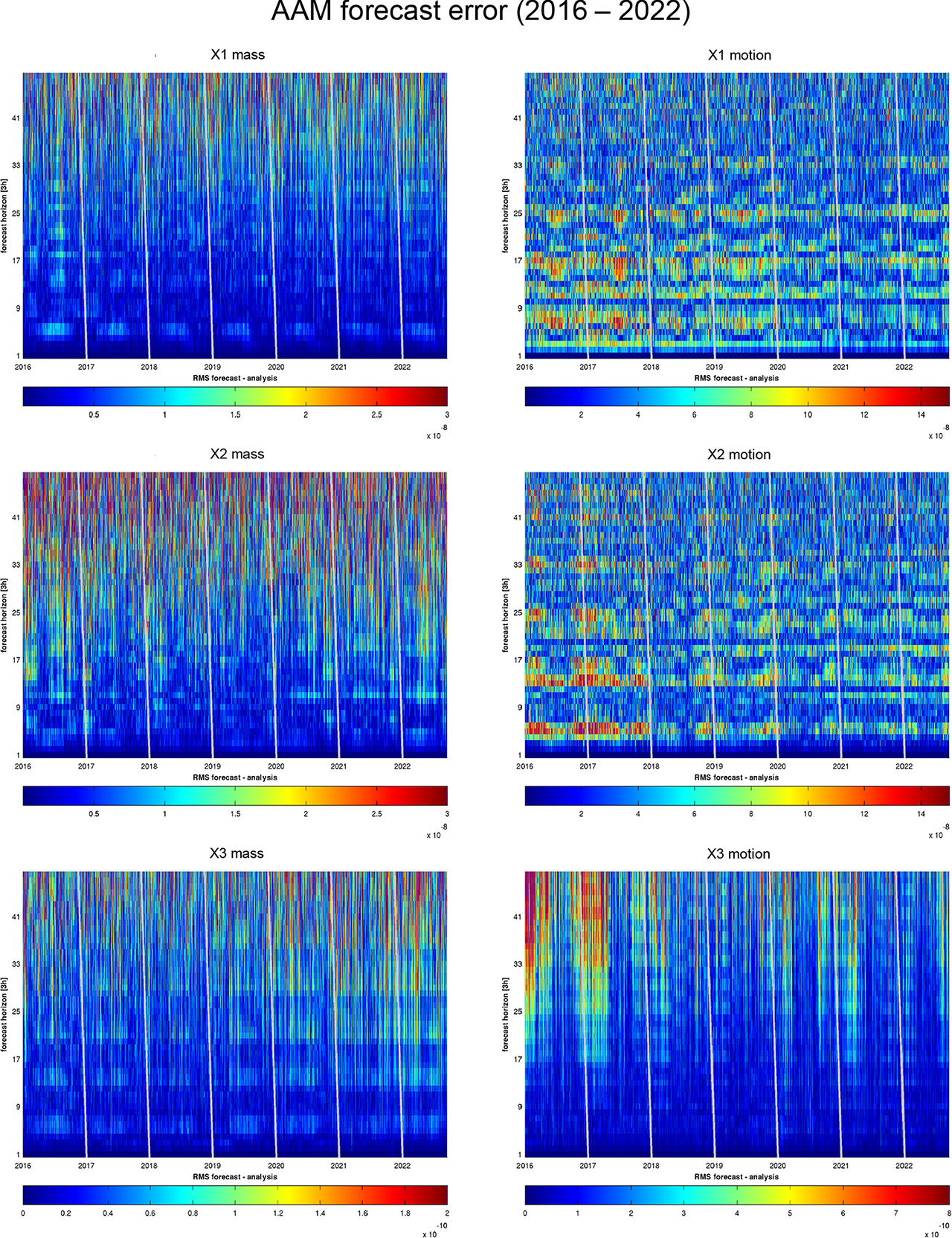
Figure 1.
Root mean squared error (RMS) between AAM forecast and subsequent AAM analysis representing the forecast error for daily 6-day forecasts sampled every 3 hours from January 2016 until December 2022: AAM mass terms (left), AAM motion terms (right) for X1 (top), X2 (middle), and X3 (bottom).
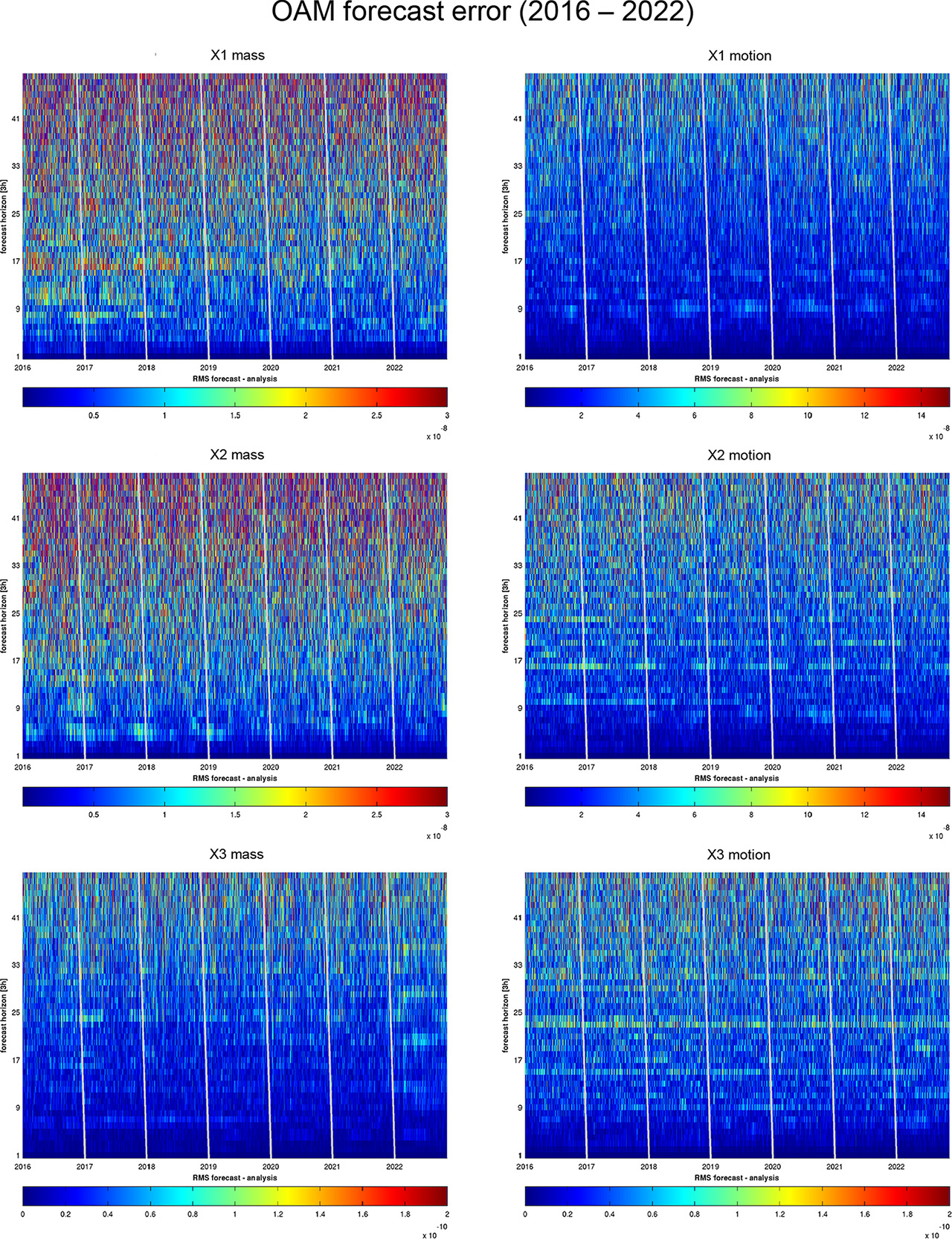
Figure 2.
Root mean squared error (RMS) between OAM forecast and subsequent OAM analysis representing the forecast error for daily 6-day forecasts sampled every 3 hours from January 2016 until December 2022: OAM mass terms (left), OAM motion terms (right) for X1 (top), X2 (middle), and X3 (bottom).
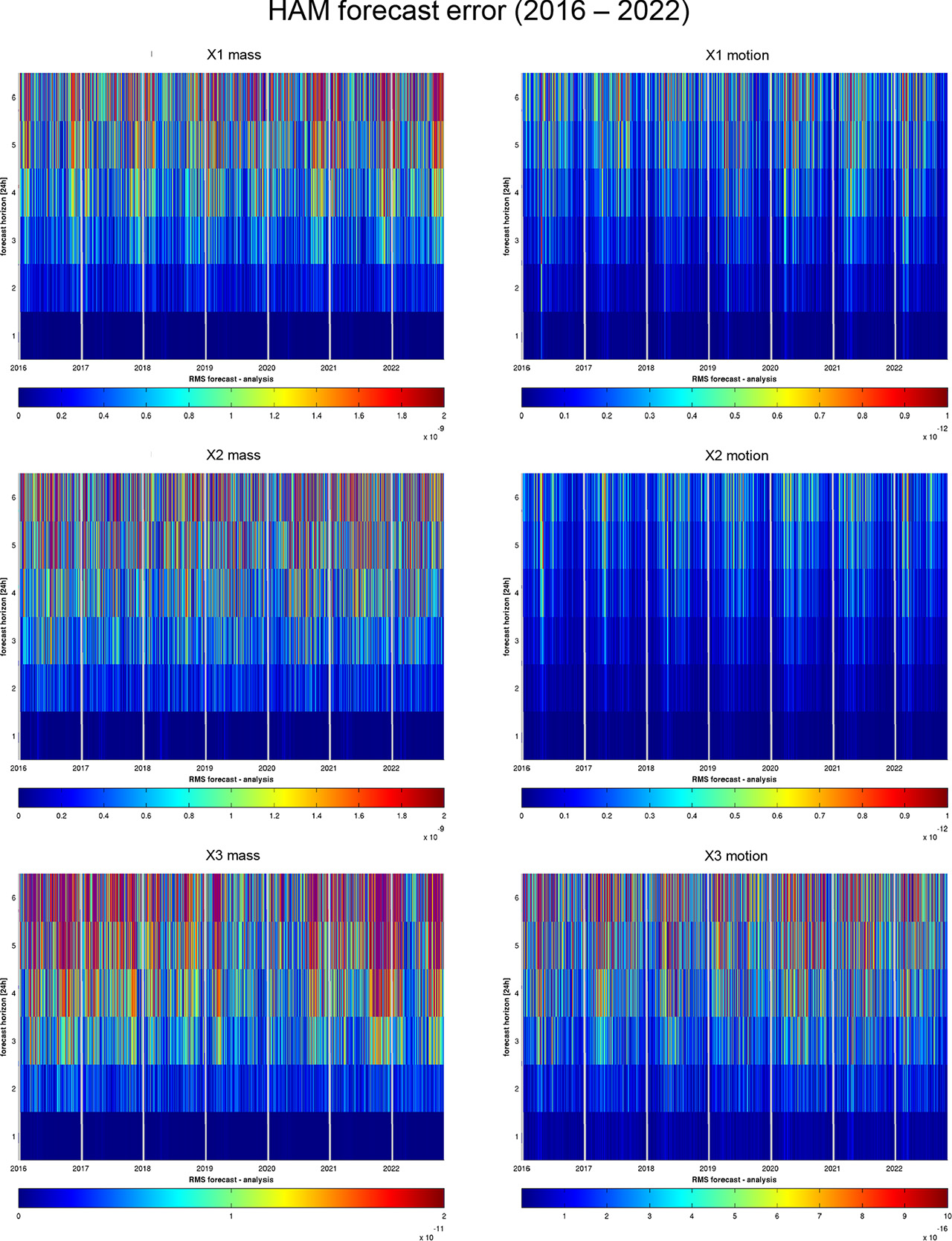
Figure 3.
Root mean squared error (RMS) between HAM forecast and subsequent HAM analysis representing the forecast error for daily 6-day forecasts sampled every 24 hours from January 2016 until December 2022: HAM mass terms (left), HAM motion terms (right) for X1 (top), X2 (middle), and X3 (bottom).
Table 1.
RMS prediction error in polar motion for forecast horizons of 5, 10, 40, and 90 days in x-pole, y-pole coordinate and 2D polar motion vector for different EAM forecast input. Black line: prediction approach using erroneous EAM forecasts; purple line: using perfect EAM forecast without any deviation from EAM analysis; yellow line: using EAM forecasts with corrected AAM X1 and X2 motion terms. The percentages give the improvement in RMS compared to the original RMS (black).
| RMS [mas] | X pole | Y pole | X+iY pole | |||||||||
| 2016–2020 | 5d | 10d | 40d | 90d | 5d | 10d | 40d | 90d | 5d | 10d | 40d | 90d |
| LS + AR + EAM forecast | 0.93 | 1.92 | 8.65 | 15.76 | 0.65 | 1.30 | 5.14 | 10.85 | 1.13 | 2.32 | 10.05 | 19.13 |
| perfect EAM forecasts | 0.88 | 1.68 | 8.56 | 15.80 | 0.66 | 1.28 | 5.10 | 10.74 | 1.10 | 2.11 | 9.97 | 19.10 |
| −5.4% | −12.5% | −1.0% | 0.25% | 1.5% | −1.5% | −0.8% | −1.0% | −2.7% | −9.1% | −0.8% | −0.2% | |
| corrected AAM | 0.89 | 1.82 | 8.63 | 15.77 | 0.65 | 1.31 | 5.09 | 10.77 | 1.12 | 2.25 | 10.03 | 19.11 |
| −4.3% | −5.2% | −0.2% | 0.1% | 0.0% | 0.8% | −1.0% | −0.7% | −0.9% | −3.0% | −0.2% | −0.1% | |
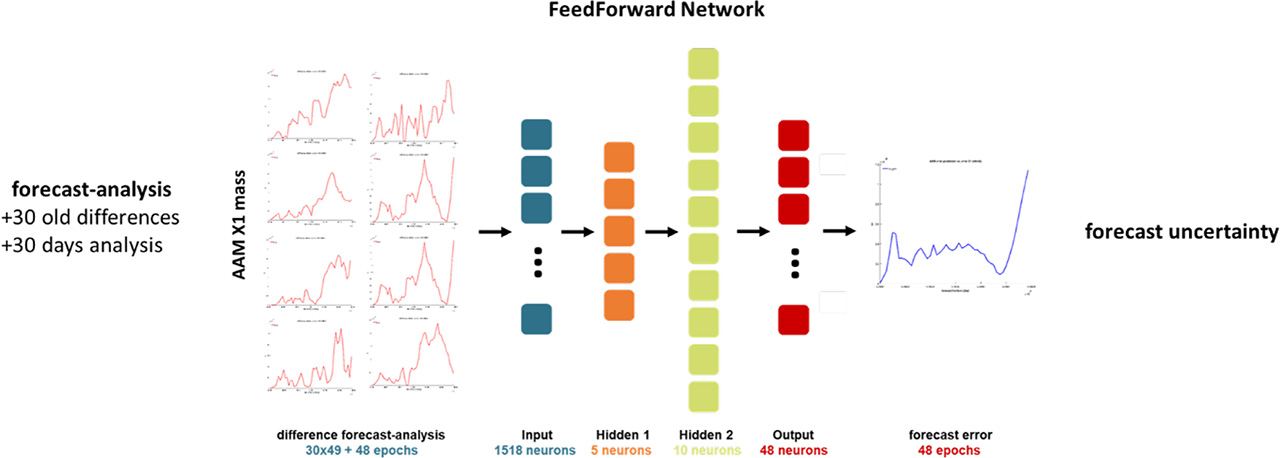
Figure 4.
Neural network to predict level of uncertainty of EAM forecast. Training and input data are the absolute values of the differences between EAM forecast and EAM analysis. The target and output is the level of uncertainty of the EAM forecast. AAM and OAM forecasts are three-hourly sampled with 48 epochs for days. The input series also include one initial epoch before the forecast starts. For HAM and SLAM with only 24-hourly sampling, the input and output neurons are reduced accordingly.
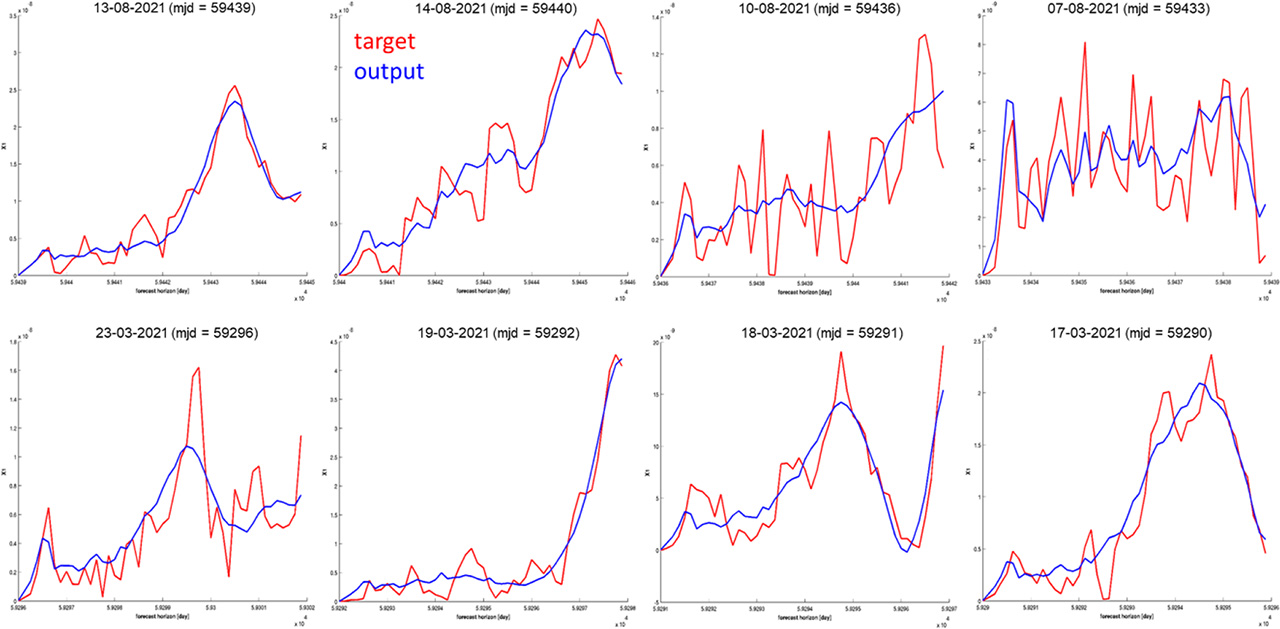
Figure 5.
Neural network to predict the level of uncertainty of EAM forecast. Training and input data is the absolute value of the difference between EAM forecast and EAM analysis. The target and output is the level of uncertainty of the EAM forecast.