
1. INTRODUCTION
Satellite-based positioning has been the most widely used positioning technique for the past 30 years with billions of users and increased applications each day. Orbiting earth satellites continuously send radio signals which can be received by a receiver instrument on the earth’s surface. The receiver uses the signals received to compute positions to a certain degree of accuracy, which differs based on some factors. Satellite position-fixing accuracy varies depending on the positioning technique used, the receivers used, as well as the number/distribution of visible satellites (Dilution Of Precision (DOP) values). Differential positioning considers the most widely used technique where two receivers are used to collect simultaneous observations at a reference station (known coordinates) and a rover station (unknown coordinates).
Differential GPS (DGPS) positioning considers the most accurate positioning technique. The limitations for DGPS are the need for a reference station, the distance limitation between the rover and reference station, and the need for simultaneous observations between the reference and rover stations, which increases the cost of DGPS over autonomous positioning (Hofmann-Wellenhof and Lichtenegger, 2008).
PPP is a standalone precise point positioning approach that uses undifferenced and differenced single- and dual-frequency pseudorange and carrier phase observations along with precise satellite orbit and clock products to produce decimeter to sub-centimeter positioning in real time and post-processing mode (Bisnath and Gao, 2008; Cai, 2009; Ding et al., 2018; Du et al., 2021). PPP is a cost-effective technique, requires a single user GNSS receive, to achieve sub-centimeter horizontal and few centimeters vertical positioning accuracy. Static and kinematic data processing can be done using the PPP technique either in post-processing or real-time mode (Chen and Gao, 2005; Leandro, 2009; Du et al., 2021).
PPP accuracy depends on many factors, but mainly on the used systems (single or mixed), observations type (single or dual frequency), observations duration, satellites geometry, and processing software capabilities (Farah, 2013, 2014, 2016). The advancement and modernization of various satellite constellations results in more visible satellites and more observations. A combined use of various satellite systems in PPP is expected to improve the positioning accuracy, reliability, and solution convergence period (Soycan, 2012).
PPP users obtain optimum accuracy on using dual-frequency receivers with a high cost. Using dual-frequency observations is the most accurate technique to mitigate the ionospheric delay which considers the largest source of error faced by GNSS observations. PPP positioning technique could be implemented using low-cost single-frequency receivers, where other techniques could be used to mitigate the ionospheric delay, such as IGS-global ionospheric maps (IGS-GIMs). PPP positioning using single-frequency receiver is a cost-effective alternative to PPP positioning using dual-frequency receiver. The cost of dual-frequency receivers is more than single-frequency receivers. So, inexpensive single-frequency receivers already available at a cost of a hundred to a few hundred dollars offer an interesting alternative (Krietemeyer et al., 2018; Farah, 2017).
GLONASS is a global radio-based satellite navigation system operated for the Russian government by the Russian Aerospace Defense Force (Aggrey, 2014). GLONASS system could be used as an alternative to GPS system. Using mixed single-frequency observations from GPS and GLONASS could improve PPP positioning accuracy as well.
This research aims at investigating PPP positioning accuracy using single-frequency observations from GPS, GLONASS, and mixed GPS/GLONASS. This research investigates singe-frequency/static-PPP accuracy variation in KSA based on different factors: the system used (GPS or GLONASS or GPS/GLONASS), satellites geometry, observations duration, and ionosphere activity state. Two sets of 24 h of mixed observations (from 2 days of different ionospheric activity states (Table 2)) were used for this research from three Continuous Operating Reference Stations (CORS) stations of different latitudes (Table 1) (KSA-CORS network) (KSACORS, 2021). KSA-CORS consists of 212 stations and is operated by the General Authority for Survey and Geospatial Information (GASGI) (KSA-GASGI, 2021) (Figure 1). GASGI offers different services for public users, such as network Real-Time Kinematic (RTK) positioning, single station RTK positioning, differential GNSS positioning, and online GNSS post-processing. GASGI also offers products such as GNSS raw data files and virtual rinex files (KSACORS, 2021).
Table 1.
Tested stations’ geographic coordinates
| KSA-CORS station | Latitude (deg. min. sec) | Longitude (deg. min. sec) | Ellipsoidal height (m) |
|---|---|---|---|
| NB03 | N 32° 08′ 18.30054″ | E 39° 11′ 53.66771″ | 960.417 |
| RY99 | N 24° 40′ 26.82870″ | E 46° 41′ 39.29147″ | 644.579 |
| NJ04 | N 17° 28′ 28.02108″ | E 47° 05′ 14.51550″ | 716.362 |
Table 2.
The characteristics of the two tested days related to ionosphere activity (SILSO, 2021; STCE, 2021; GFZ, 2021)
| Ionosphere state of activity | Date | GPS day | SSN | VTEC (TECu) | Kp | F10.7obs |
|---|---|---|---|---|---|---|
| Quiet | 03-01-2021 | 21,390 | 0 | 15 | 0.333 | 80.4 |
| Active | 31-10-2021 | 21,820 | 68 | 29 | 4 | 102.7 |
1 SSN: sunspot number; VTEC: vertical total electron content; TECu: 1 × 10¹⁶ electron; Kp: derived from the standardized K index (Ks) of 13 magnetic observatories, designed to measure solar particle radiation by its magnetic effects and a proxy for the energy input from the solar wind to earth; F10.7obs: local noontime observed (F10.7obs) and adjusted (F10.7adj) solar radio flux F10.7 in s.f.u. (10−22 W m−2 Hz−1).
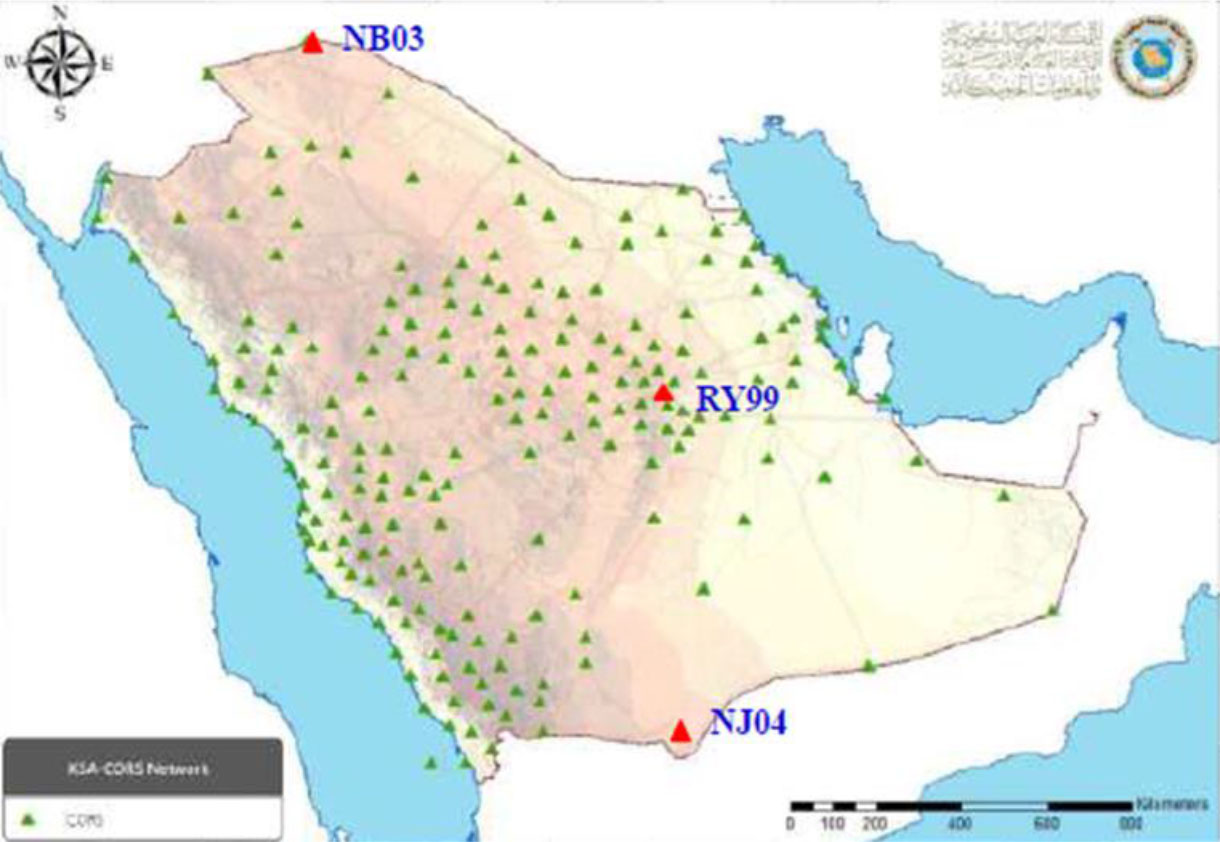
Figure 1.
KSA-CORS network with tested stations marked in it (GASGI, 2021)
2. SCOPE OF THE TEST STUDY
The study investigates the effects of different parameters on precision of static-PPP using single-frequency observations. These parameters are ionospheric activity state, the system used (GPS or GLONASS or mixed GPS/GLONASS), observations duration, and satellites geometry (number of visible satellites and DOP). Two days were considered, in which one day reflects quiet ionosphere (GPS day 21,390 [03-01-2021]) and the other day reflects active ionosphere (GPS day 21,820 [31-10-2021]) (Table 2) (SILSO, 2021; STCE, 2021; GFZ, 2021). The geomagnetic activity of the earth reached the minor storm level (NOAA Kp 5) when the Interplanetary Coronal Mass Ejection (ICME) passed earth on 31-10-2021 (STCE, 2021). For each day, three observation sets of 24 h from three KSA-CORS tested stations were collected with Trimble NetR9 receivers (Trimble, 2021) using 1 sec observation interval and 10° cut-off elevation angle. The six observation sets were divided into different lengths of observation duration using TEQC software (TEQC, 2021). The different sets of observations were processed, and the PPP solutions were estimated through Canadian Spatial Reference System (CSRS)-PPP service (CSRS-PPP, 2021), which could process single and dual frequency observations from GPS, GLONASS, and mixed GPS/GLONASS.
Mission planning process was investigated for the six sets of observations collected during the observation days. Table 3 presents the statistical study for the average number of visible satellites and average Position DOP (PDOP) values from tested systems (GPS, GLONASS, and mixed GPS/GLONASS) for tested stations on the two tested days (Trimble planning, 2021).
Table 3.
Average number of visible satellites and average PDOP values for tested stations on tested days; GPS days 21,390 and 21,820
| Date | Station | System | Average no. visible satellites | Average PDOP |
|---|---|---|---|---|
| (03-01-2021) (quiet ionosphere) | NB03 | GPS | 8 | 1.888 |
| GLONASS | 6 | 2.765 | ||
| GPS/GLONASS | 15 | 1.388 | ||
| RY99 | GPS | 8 | 1.970 | |
| GLONASS | 6 | 5.003 | ||
| GPS/GLONASS | 15 | 1.432 | ||
| NJ04 | GPS | 9 | 1.957 | |
| GLONASS | 6 | 2.721 | ||
| GPS/GLONASS | 15 | 1.415 | ||
| (31-10-2021) (active ionosphere) | NB03 | GPS | 8 | 2.002 |
| GLONASS | 6 | 3.527 | ||
| GPS/GLONASS | 15 | 1.439 | ||
| RY99 | GPS | 8 | 1.947 | |
| GLONASS | 6 | 4.250 | ||
| GPS/GLONASS | 15 | 1.436 | ||
| NJ04 | GPS | 9 | 1.921 | |
| GLONASS | 6 | 4.123 | ||
| GPS/GLONASS | 15 | 1.418 |
3. STUDY RESULTS
3.1. Quiet Ionosphere (GPS day 21,390)
Variation of static-PPP precision with observation duration for different single-frequency observations from GPS, GLONASS, and mixed GPS/GLONASS from three tested stations for GPS day 21,390 resulting from this study are presented numerically (Tables 4–6) and graphically (Figures 2–4).
Table 4.
Static-PPP accuracy variation with observation duration from single-frequency observations (quiet ionosphere) (GPS day 21,390) (station NB03)
| Duration of observations | GLONASS | GPS | Mixed GPS/GLONASS | ||||||
|---|---|---|---|---|---|---|---|---|---|
| Lat. (m) | Long. (m) | Ellip. height (m) | Lat. (m) | Long. (m) | Ellip. height (m) | Lat. (m) | Long. (m) | Ellip. height (m) | |
| 15 min | 3.789 | 4.922 | 7.551 | 1.313 | 1.437 | 2.061 | 1.190 | 1.371 | 2.017 |
| 30 min | 2.502 | 4.720 | 4.432 | 0.856 | 1.437 | 1.241 | 0.785 | 1.371 | 1.278 |
| 1 h | 1.217 | 3.338 | 1.859 | 0.528 | 1.437 | 0.736 | 0.508 | 1.371 | 0.843 |
| 2 h | 0.489 | 2.035 | 0.870 | 0.345 | 1.366 | 0.704 | 0.224 | 0.812 | 0.453 |
| 4 h | 0.251 | 1.032 | 0.516 | 0.142 | 0.481 | 0.292 | 0.121 | 0.424 | 0.250 |
| 6 h | 0.207 | 0.650 | 0.424 | 0.102 | 0.296 | 0.234 | 0.091 | 0.269 | 0.204 |
| 8 h | 0.174 | 0.333 | 0.395 | 0.089 | 0.243 | 0.210 | 0.079 | 0.196 | 0.185 |
| 10 h | 0.167 | 0.316 | 0.362 | 0.104 | 0.238 | 0.234 | 0.089 | 0.191 | 0.198 |
| 12 h | 0.148 | 0.310 | 0.332 | 0.099 | 0.222 | 0.220 | 0.083 | 0.181 | 0.184 |
| 14 h | 0.133 | 0.262 | 0.304 | 0.086 | 0.201 | 0.193 | 0.073 | 0.160 | 0.164 |
| 16 h | 0.129 | 0.236 | 0.293 | 0.072 | 0.186 | 0.168 | 0.064 | 0.146 | 0.146 |
| 18 h | 0.110 | 0.217 | 0.264 | 0.064 | 0.165 | 0.151 | 0.056 | 0.132 | 0.132 |
| 20 h | 0.091 | 0.209 | 0.233 | 0.059 | 0.149 | 0.139 | 0.050 | 0.122 | 0.121 |
| 22 h | 0.085 | 0.189 | 0.220 | 0.057 | 0.132 | 0.132 | 0.047 | 0.109 | 0.114 |
| 24 h | 0.083 | 0.171 | 0.213 | 0.053 | 0.121 | 0.123 | 0.045 | 0.099 | 0.107 |
Table 5.
Static-PPP accuracy variation with observation duration from single-frequency observations (quiet ionosphere) (GPS day 21,390) (station RY99)
| Duration of observations | GLONASS | GPS | Mixed GPS/GLONASS | ||||||
|---|---|---|---|---|---|---|---|---|---|
| Lat. (m) | Long. (m) | Ellip. height (m) | Lat. (m) | Long. (m) | Ellip. height (m) | Lat. (m) | Long. (m) | Ellip. height (m) | |
| 15 min | 4.171 | 6.356 | 8.762 | 1.151 | 1.399 | 2.112 | 1.070 | 1.377 | 2.052 |
| 30 min | 2.339 | 4.984 | 4.448 | 0.855 | 1.399 | 1.254 | 0.779 | 1.377 | 1.317 |
| 1 h | 0.984 | 3.294 | 1.895 | 0.478 | 1.399 | 0.801 | 0.472 | 1.377 | 0.870 |
| 2 h | 0.372 | 2.037 | 0.921 | 0.344 | 1.399 | 0.943 | 0.225 | 0.899 | 0.577 |
| 4 h | 0.258 | 1.117 | 0.662 | 0.144 | 0.492 | 0.379 | 0.124 | 0.439 | 0.323 |
| 6 h | 0.232 | 0.785 | 0.559 | 0.110 | 0.334 | 0.285 | 0.098 | 0.307 | 0.252 |
| 8 h | 0.200 | 0.498 | 0.518 | 0.123 | 0.351 | 0.317 | 0.100 | 0.257 | 0.265 |
| 10 h | 0.247 | 0.590 | 0.622 | 0.175 | 0.435 | 0.443 | 0.135 | 0.317 | 0.345 |
| 12 h | 0.224 | 0.596 | 0.577 | 0.166 | 0.391 | 0.417 | 0.125 | 0.297 | 0.320 |
| 14 h | 0.212 | 0.491 | 0.558 | 0.142 | 0.343 | 0.352 | 0.108 | 0.247 | 0.279 |
| 16 h | 0.217 | 0.446 | 0.570 | 0.118 | 0.311 | 0.302 | 0.095 | 0.221 | 0.247 |
| 18 h | 0.186 | 0.424 | 0.500 | 0.104 | 0.288 | 0.271 | 0.082 | 0.204 | 0.216 |
| 20 h | 0.160 | 0.394 | 0.447 | 0.095 | 0.266 | 0.245 | 0.072 | 0.188 | 0.193 |
| 22 h | 0.151 | 0.347 | 0.423 | 0.088 | 0.237 | 0.227 | 0.067 | 0.165 | 0.179 |
| 24 h | 0.142 | 0.302 | 0.397 | 0.081 | 0.213 | 0.211 | 0.062 | 0.146 | 0.167 |
Table 6.
Static-PPP accuracy variation with observation duration from single-frequency observations (quiet ionosphere) (GPS day 21,390) (station NJ04)
| Duration of observations | GLONASS | GPS | Mixed GPS/GLONASS | ||||||
|---|---|---|---|---|---|---|---|---|---|
| Lat. (m) | Long. (m) | Ellip. height (m) | Lat. (m) | Long. (m) | Ellip. height (m) | Lat. (m) | Long. (m) | Ellip. height (m) | |
| 15 min | 3.987 | 6.421 | 9.192 | 1.050 | 1.404 | 2.388 | 0.977 | 1.375 | 2.221 |
| 30 min | 2.378 | 4.863 | 4.491 | 0.808 | 1.404 | 1.304 | 0.744 | 1.375 | 1.315 |
| 1 h | 1.001 | 3.324 | 1.938 | 0.564 | 1.404 | 0.968 | 0.513 | 1.375 | 0.933 |
| 2 h | 0.355 | 1.952 | 0.978 | 0.298 | 1.097 | 0.858 | 0.220 | 0.811 | 0.580 |
| 4 h | 0.278 | 1.203 | 0.755 | 0.138 | 0.488 | 0.389 | 0.121 | 0.442 | 0.337 |
| 6 h | 0.215 | 0.827 | 0.522 | 0.133 | 0.429 | 0.359 | 0.113 | 0.383 | 0.296 |
| 8 h | 0.182 | 0.511 | 0.479 | 0.105 | 0.331 | 0.286 | 0.089 | 0.259 | 0.245 |
| 10 h | 0.175 | 0.478 | 0.452 | 0.109 | 0.302 | 0.303 | 0.090 | 0.242 | 0.249 |
| 12 h | 0.169 | 0.533 | 0.455 | 0.104 | 0.285 | 0.293 | 0.083 | 0.230 | 0.231 |
| 14 h | 0.163 | 0.448 | 0.446 | 0.094 | 0.253 | 0.258 | 0.075 | 0.198 | 0.210 |
| 16 h | 0.173 | 0.415 | 0.475 | 0.080 | 0.232 | 0.228 | 0.068 | 0.180 | 0.191 |
| 18 h | 0.155 | 0.400 | 0.424 | 0.074 | 0.218 | 0.212 | 0.062 | 0.170 | 0.174 |
| 20 h | 0.142 | 0.395 | 0.401 | 0.069 | 0.202 | 0.194 | 0.057 | 0.161 | 0.160 |
| 22 h | 0.133 | 0.349 | 0.373 | 0.065 | 0.180 | 0.181 | 0.053 | 0.143 | 0.149 |
| 24 h | 0.123 | 0.290 | 0.347 | 0.060 | 0.160 | 0.169 | 0.049 | 0.124 | 0.139 |
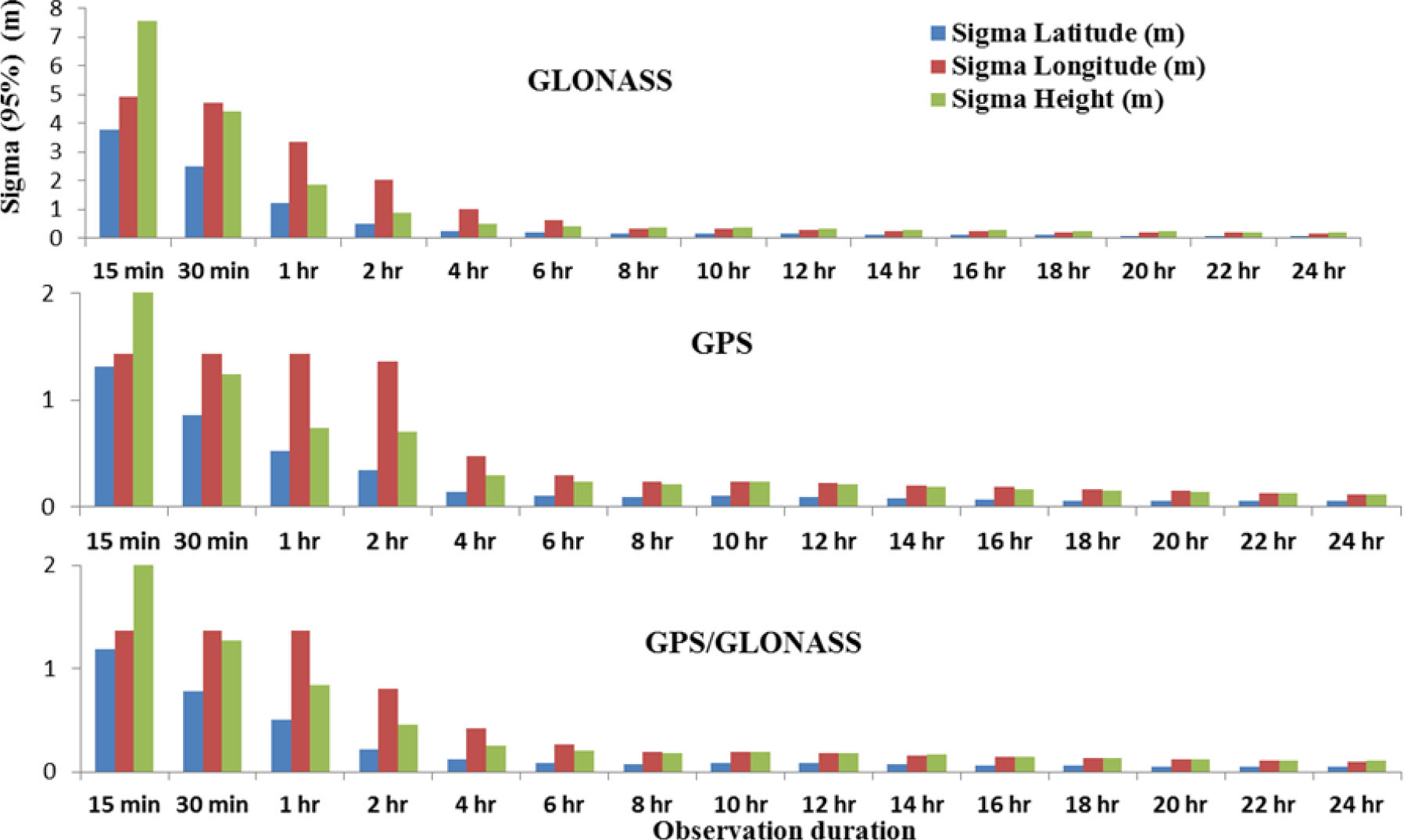
Figure 2.
Static-PPP positioning precision as a function of observation duration for single-frequency observations (quiet ionosphere) (GPS day 21,390) (station NB03)
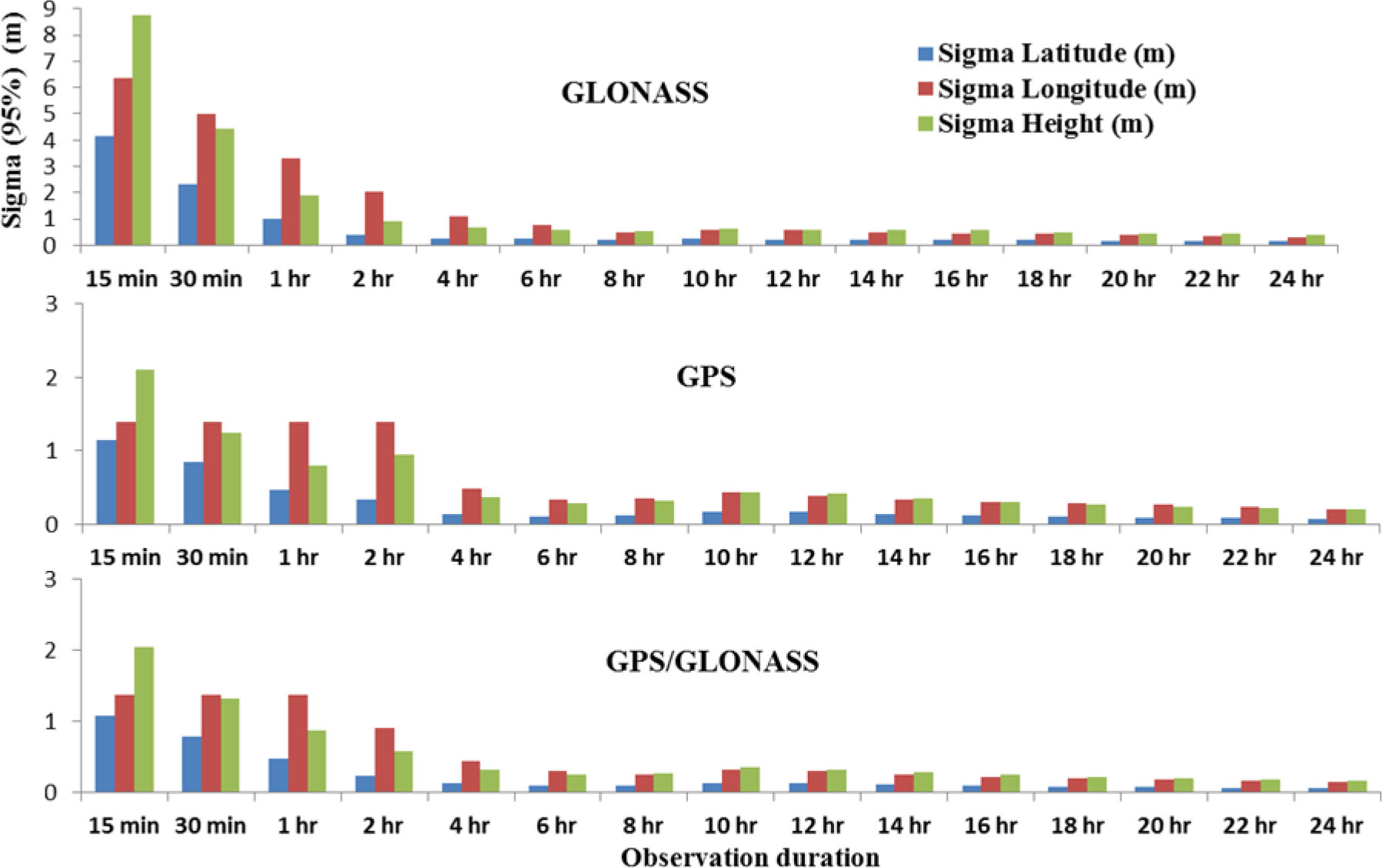
Figure 3.
Static-PPP positioning precision as a function of observation duration for single-frequency observations (quiet ionosphere) (GPS day 21,390) (station RY99)
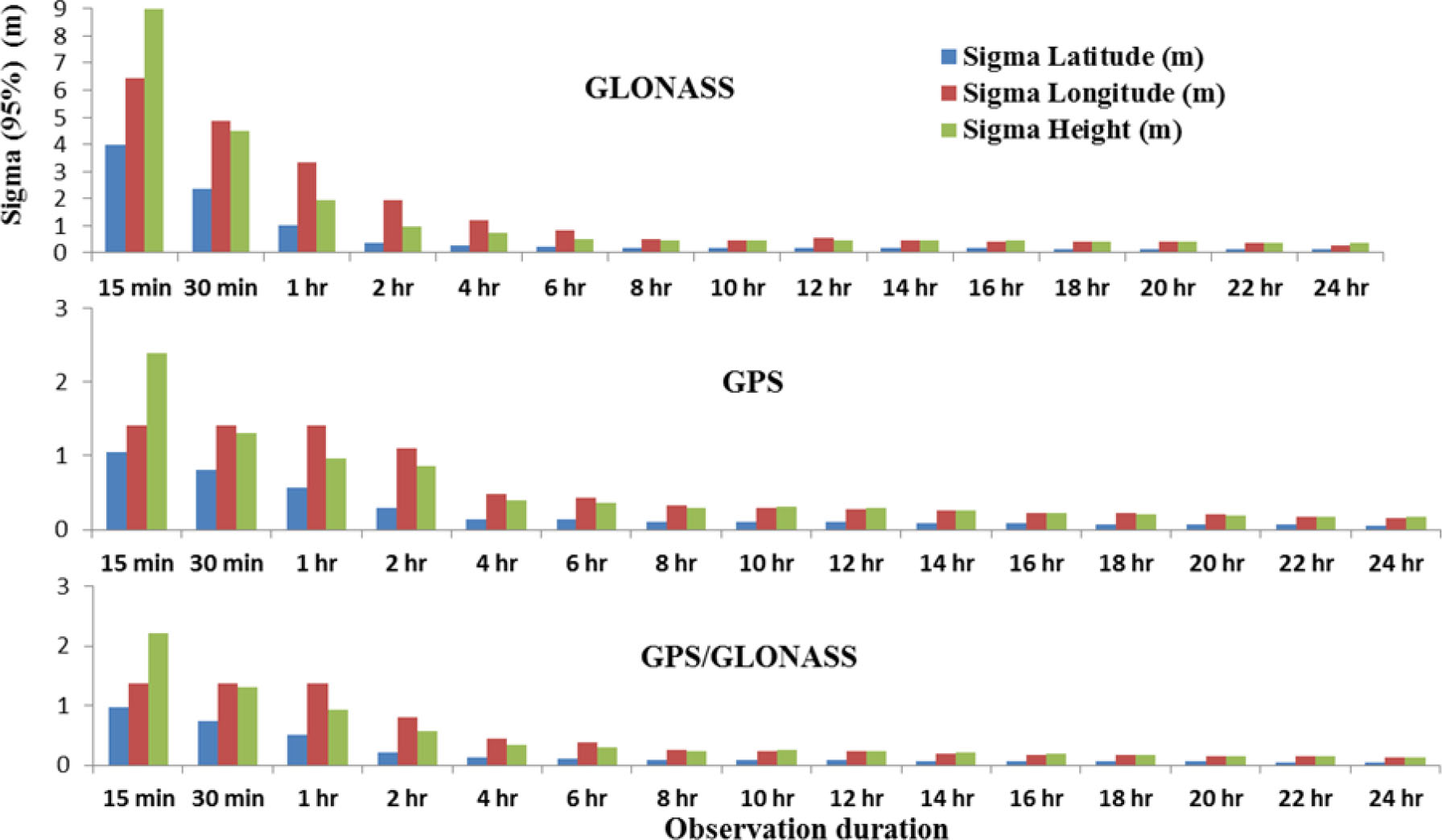
Figure 4.
Static-PPP positioning precision as a function of observation duration for single-frequency observations (quiet ionosphere) (GPS day 21,390) (station NJ04)
3.2. Active Ionosphere (GPS day 21,820)
Variation of static-PPP precision with observation duration for different single-frequency observation from GPS, GLONASS, and mixed GPS/GLONASS from three tested stations for GPS day 21,820 resulting from this study are presented numerically (Tables 7–9) and graphically (Figures 5–7).
Table 7.
Static-PPP accuracy variation with observation duration from single-frequency observations (active ionosphere) (GPS day 21,820) (station NB03)
| Duration of observations | GLONASS | GPS | Mixed GPS/GLONASS | ||||||
|---|---|---|---|---|---|---|---|---|---|
| Lat. (m) | Long. (m) | Ellip. height (m) | Lat. (m) | Long. (m) | Ellip. height (m) | Lat. (m) | Long. (m) | Ellip. height (m) | |
| 15 min | 2.551 | 3.361 | 8.322 | 1.404 | 1.384 | 3.096 | 1.336 | 1.336 | 3.117 |
| 30 min | 2.007 | 2.594 | 2.594 | 1.172 | 1.384 | 2.180 | 1.132 | 1.336 | 2.259 |
| 1 h | 1.200 | 1.725 | 2.844 | 0.777 | 1.231 | 1.273 | 0.642 | 0.981 | 1.150 |
| 2 h | 0.702 | 0.816 | 1.607 | 0.331 | 0.678 | 0.628 | 0.297 | 0.507 | 0.577 |
| 4 h | 0.310 | 0.376 | 0.726 | 0.155 | 0.367 | 0.386 | 0.129 | 0.242 | 0.309 |
| 6 h | 0.203 | 0.356 | 0.490 | 0.106 | 0.317 | 0.272 | 0.091 | 0.216 | 0.224 |
| 8 h | 0.125 | 0.306 | 0.352 | 0.107 | 0.322 | 0.255 | 0.088 | 0.224 | 0.211 |
| 10 h | 0.137 | 0.295 | 0.384 | 0.119 | 0.314 | 0.284 | 0.094 | 0.213 | 0.231 |
| 12 h | 0.145 | 0.275 | 0.400 | 0.135 | 0.324 | 0.315 | 0.100 | 0.204 | 0.247 |
| 14 h | 0.137 | 0.266 | 0.373 | 0.140 | 0.309 | 0.329 | 0.098 | 0.196 | 0.243 |
| 16 h | 0.125 | 0.258 | 0.337 | 0.130 | 0.269 | 0.307 | 0.091 | 0.189 | 0.222 |
| 18 h | 0.128 | 0.254 | 0.337 | 0.117 | 0.249 | 0.282 | 0.088 | 0.182 | 0.212 |
| 20 h | 0.122 | 0.233 | 0.317 | 0.106 | 0.229 | 0.256 | 0.081 | 0.170 | 0.195 |
| 22 h | 0.113 | 0.220 | 0.293 | 0.099 | 0.208 | 0.240 | 0.075 | 0.158 | 0.181 |
| 24 h | 0.104 | 0.204 | 0.269 | 0.090 | 0.187 | 0.219 | 0.070 | 0.147 | 0.169 |
Table 8.
Static-PPP accuracy variation with observation duration from single-frequency observations (active ionosphere) (GPS day 21,820) (station RY99)
| Duration of observations | GLONASS | GPS | Mixed GPS/GLONASS | ||||||
|---|---|---|---|---|---|---|---|---|---|
| Lat. (m) | Long. (m) | Ellip. height (m) | Lat. (m) | Long. (m) | Ellip. height (m) | Lat. (m) | Long. (m) | Ellip. height (m) | |
| 15 min | 2.492 | 2.695 | 8.157 | 1.274 | 1.509 | 2.898 | 1.290 | 1.429 | 3.246 |
| 30 min | 1.774 | 2.220 | 4.843 | 1.608 | 1.509 | 2.136 | 1.081 | 1.431 | 2.374 |
| 1 h | 1.451 | 1.974 | 3.308 | 0.766 | 1.360 | 1.277 | 0.649 | 1.061 | 1.148 |
| 2 h | 0.676 | 0.839 | 1.526 | 0.332 | 0.658 | 0.635 | 0.299 | 0.516 | 0.588 |
| 4 h | 0.382 | 0.518 | 0.790 | 0.146 | 0.320 | 0.409 | 0.130 | 0.252 | 0.342 |
| 6 h | 0.224 | 0.494 | 0.583 | 0.123 | 0.330 | 0.359 | 0.105 | 0.247 | 0.283 |
| 8 h | 0.202 | 0.502 | 0.587 | 0.148 | 0.410 | 0.411 | 0.122 | 0.305 | 0.319 |
| 10 h | 0.225 | 0.477 | 0.646 | 0.215 | 0.534 | 0.579 | 0.155 | 0.342 | 0.414 |
| 12 h | 0.261 | 0.489 | 0.728 | 0.231 | 0.518 | 0.604 | 0.172 | 0.345 | 0.453 |
| 14 h | 0.256 | 0.489 | 0.712 | 0.243 | 0.502 | 0.641 | 0.177 | 0.341 | 0.464 |
| 16 h | 0.253 | 0.476 | 0.691 | 0.225 | 0.443 | 0.600 | 0.169 | 0.321 | 0.435 |
| 18 h | 0.249 | 0.463 | 0.670 | 0.216 | 0.408 | 0.572 | 0.164 | 0.311 | 0.415 |
| 20 h | 0.245 | 0.453 | 0.653 | 0.193 | 0.367 | 0.515 | 0.151 | 0.297 | 0.381 |
| 22 h | 0.236 | 0.439 | 0.619 | 0.181 | 0.333 | 0.476 | 0.142 | 0.282 | 0.352 |
| 24 h | 0.210 | 0.391 | 0.545 | 0.161 | 0.303 | 0.423 | 0.129 | 0.258 | 0.320 |
Table 9.
Static-PPP accuracy variation with observation duration from single-frequency observations (active ionosphere) (GPS day 21,820) (station NJ04)
| Duration of observations | GLONASS | GPS | Mixed GPS/GLONASS | ||||||
|---|---|---|---|---|---|---|---|---|---|
| Lat. (m) | Long. (m) | Ellip. height (m) | Lat. (m) | Long. (m) | Ellip. height (m) | Lat. (m) | Long. (m) | Ellip. height (m) | |
| 15 min | 2.619 | 2.649 | 7.834 | 1.808 | 2.182 | 4.205 | 1.588 | 1.763 | 4.009 |
| 30 min | 1.983 | 2.437 | 4.855 | 1.482 | 2.051 | 3.254 | 1.189 | 1.568 | 2.704 |
| 1 h | 1.266 | 1.638 | 2.479 | 0.845 | 1.473 | 1.554 | 0.702 | 1.085 | 1.312 |
| 2 h | 0.629 | 0.925 | 1.413 | 0.388 | 0.791 | 0.771 | 0.330 | 0.600 | 0.680 |
| 4 h | 0.345 | 0.534 | 0.767 | 0.160 | 0.398 | 0.469 | 0.143 | 0.305 | 0.389 |
| 6 h | 0.212 | 0.496 | 0.545 | 0.177 | 0.493 | 0.534 | 0.137 | 0.332 | 0.368 |
| 8 h | 0.177 | 0.475 | 0.481 | 0.165 | 0.486 | 0.484 | 0.126 | 0.338 | 0.334 |
| 10 h | 0.160 | 0.374 | 0.432 | 0.151 | 0.444 | 0.434 | 0.115 | 0.286 | 0.305 |
| 12 h | 0.160 | 0.339 | 0.437 | 0.141 | 0.391 | 0.397 | 0.109 | 0.255 | 0.294 |
| 14 h | 0.145 | 0.329 | 0.411 | 0.152 | 0.392 | 0.428 | 0.107 | 0.251 | 0.295 |
| 16 h | 0.147 | 0.329 | 0.412 | 0.143 | 0.365 | 0.410 | 0.107 | 0.250 | 0.288 |
| 18 h | 0.147 | 0.327 | 0.401 | 0.136 | 0.338 | 0.383 | 0.105 | 0.247 | 0.278 |
| 20 h | 0.150 | 0.332 | 0.401 | 0.125 | 0.314 | 0.352 | 0.100 | 0.242 | 0.261 |
| 22 h | 0.144 | 0.322 | 0.374 | 0.118 | 0.286 | 0.325 | 0.095 | 0.229 | 0.242 |
| 24 h | 0.130 | 0.290 | 0.345 | 0.105 | 0.252 | 0.289 | 0.086 | 0.208 | 0.223 |
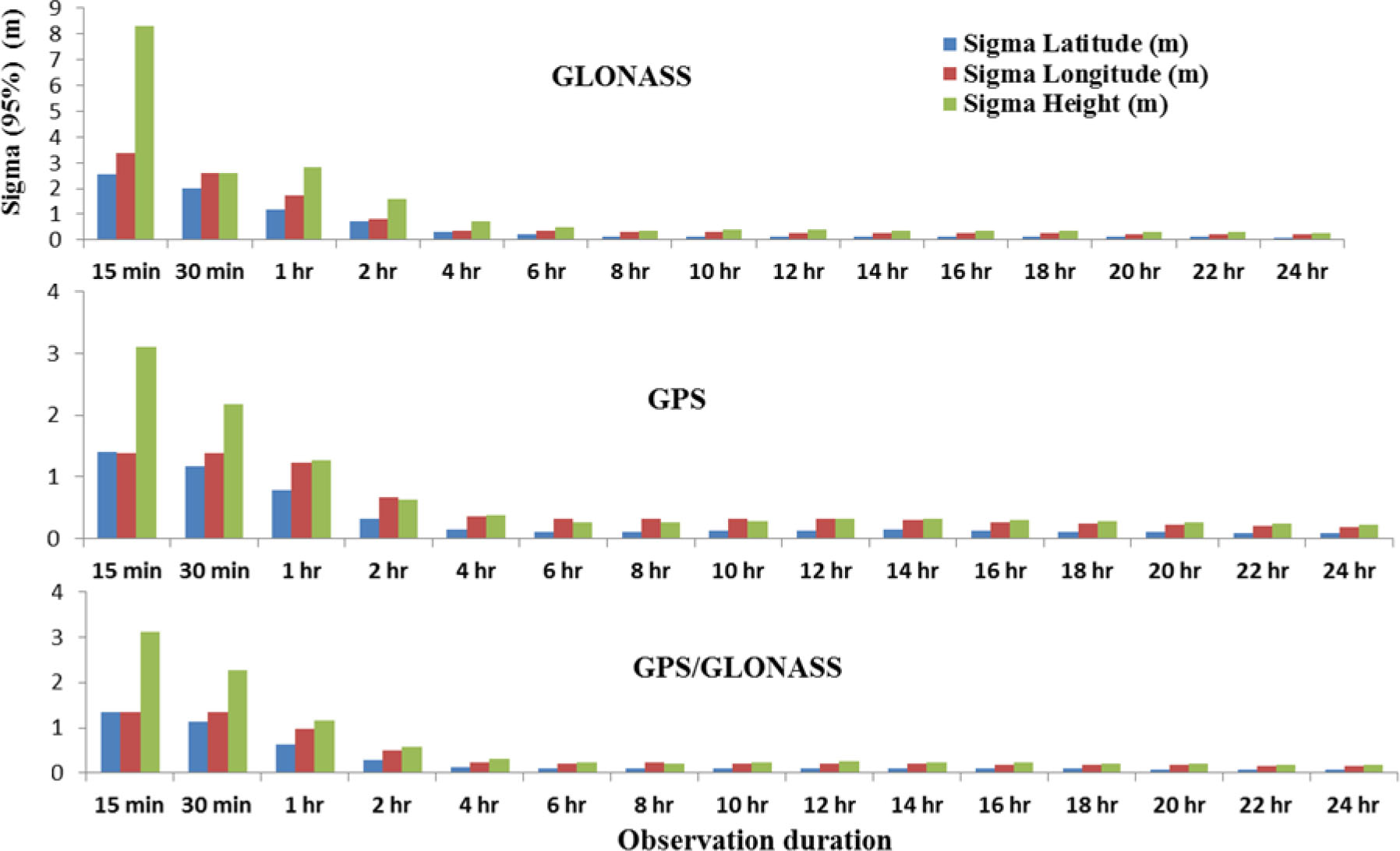
Figure 5.
Static-PPP positioning precision as a function of observation duration for single-frequency observations (active ionosphere) (GPS day 21,820) (station NB03)
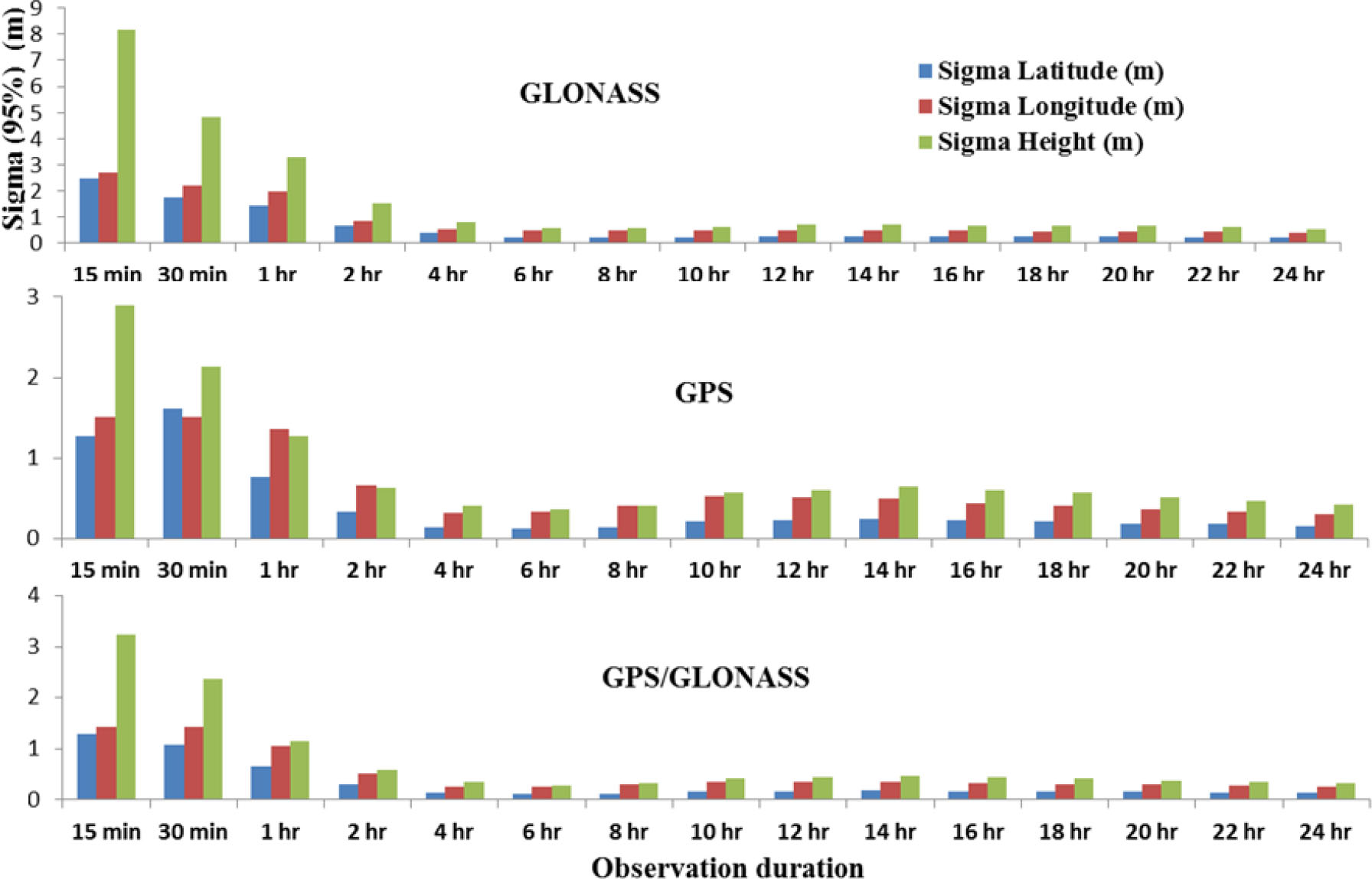
Figure 6.
Static-PPP positioning precision as a function of observation duration for single-frequency observations (active ionosphere) (GPS day 21,820) (station RY99)
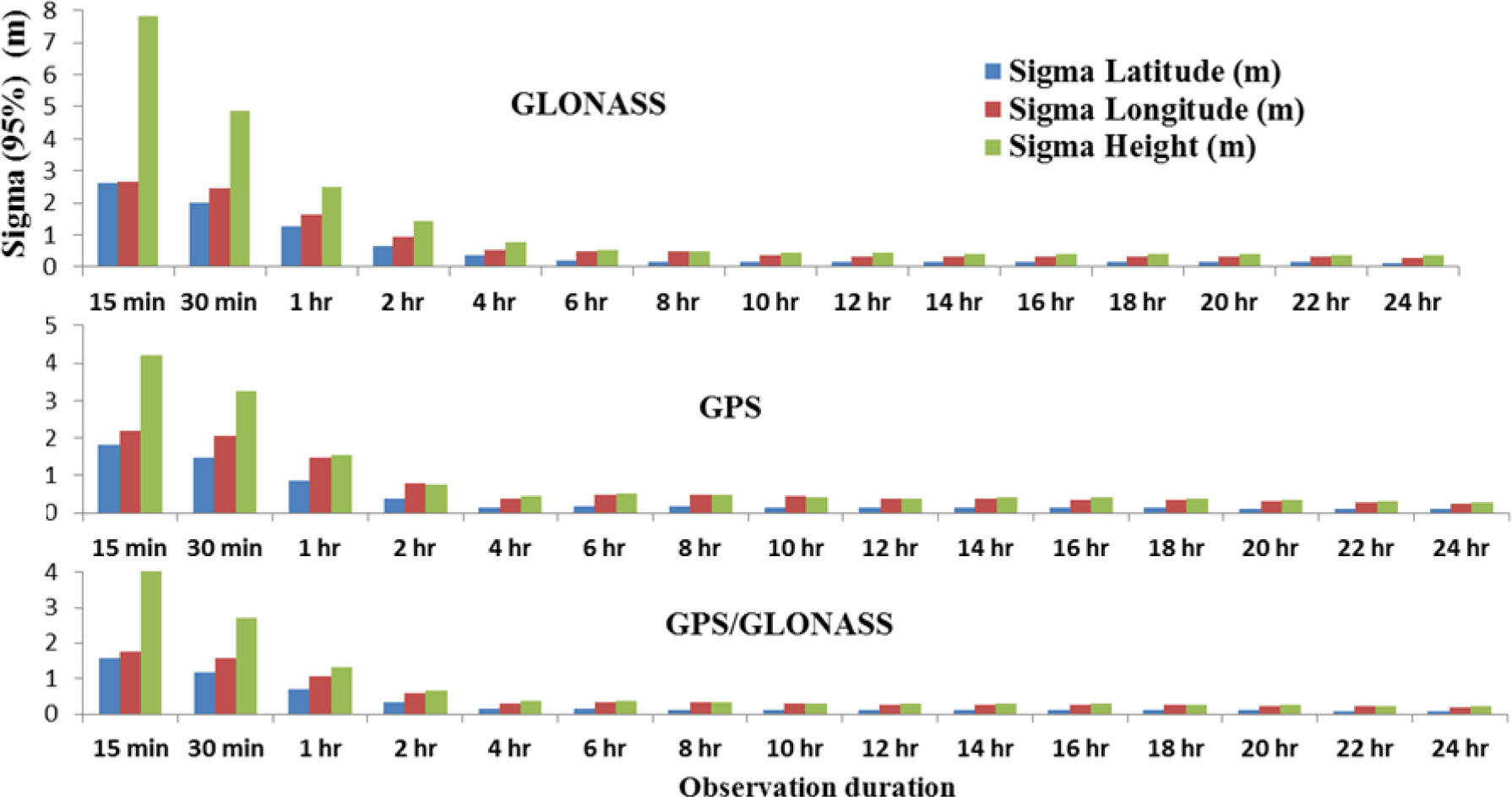
Figure 7.
Static-PPP positioning precision as a function of observation duration for single-frequency observations (active ionosphere) (GPS day 21,820) (station NJ04)
3.3. Comparison of (static-PPP single-frequency mixed GPS/GLONASS observations) station coordinates with true station coordinates
3.3.1. Quiet Ionosphere (GPS day 21,390)
Comparison of stations’ true coordinates with their coordinates from static-PPP single-frequency mixed GPS/GLONASS observations for different observation duration for GPS day 21,390 resulting from this study are presented numerically (Table 10) and graphically (Figure 8).
Table 10.
Static-PPP accuracy variation comparing true coordinates for different observation duration from single-frequency mixed GPS/GLONASS observations (quiet ionosphere) (GPS day 21,390) for the three tested stations
| Duration of observations | Station (NB03) | Station (RY99) | Station (NJ04) | ||||||
|---|---|---|---|---|---|---|---|---|---|
| Lat. (m) | Long. (m) | Ellip. height (m) | Lat. (m) | Long. (m) | Ellip. height (m) | Lat. (m) | Long. (m) | Ellip. height (m) | |
| 15 min | −0.052 | −0.329 | −0.06 | −0.132 | 0.001 | −0.19 | −0.266 | −0.404 | −0.149 |
| 30 min | −0.064 | −0.338 | −0.006 | −0.008 | −0.136 | −0.327 | −0.129 | −0.394 | −0.107 |
| 1 h | −0.059 | −0.232 | −0.15 | −0.045 | −0.008 | −0.261 | −0.107 | −0.017 | 0.045 |
| 2 h | −0.013 | −0.179 | −0.051 | 0.001 | −0.13 | −0.14 | −0.032 | −0.096 | −0.058 |
| 4 h | −0.005 | −0.063 | −0.02 | 0.014 | −0.036 | −0.07 | −0.005 | −0.016 | −0.002 |
| 6 h | −0.004 | −0.033 | −0.025 | 0.005 | −0.023 | −0.059 | −0.008 | −0.034 | −0.032 |
| 8 h | −0.007 | −0.028 | −0.037 | 0 | −0.021 | −0.066 | −0.004 | −0.026 | −0.012 |
| 10 h | −0.009 | −0.035 | −0.051 | −0.004 | −0.023 | −0.076 | −0.005 | −0.034 | −0.007 |
| 12 h | −0.012 | −0.036 | −0.053 | −0.007 | −0.02 | −0.07 | −0.003 | −0.042 | 0.002 |
| 14 h | −0.015 | −0.034 | −0.048 | −0.01 | −0.013 | −0.072 | −0.003 | −0.048 | 0.003 |
| 16 h | −0.014 | −0.029 | −0.045 | −0.008 | −0.012 | −0.074 | −0.003 | −0.045 | 0.006 |
| 18 h | −0.016 | −0.017 | −0.04 | −0.009 | −0.003 | −0.072 | −0.003 | −0.036 | 0.006 |
| 20 h | −0.016 | −0.014 | −0.035 | −0.007 | −0.015 | −0.065 | 0 | −0.032 | 0.007 |
| 22 h | −0.016 | −0.011 | −0.036 | −0.008 | −0.014 | −0.07 | 0.002 | −0.02 | 0.006 |
| 24 h | −0.015 | −0.01 | −0.038 | −0.006 | −0.014 | −0.069 | 0.001 | −0.016 | 0.004 |
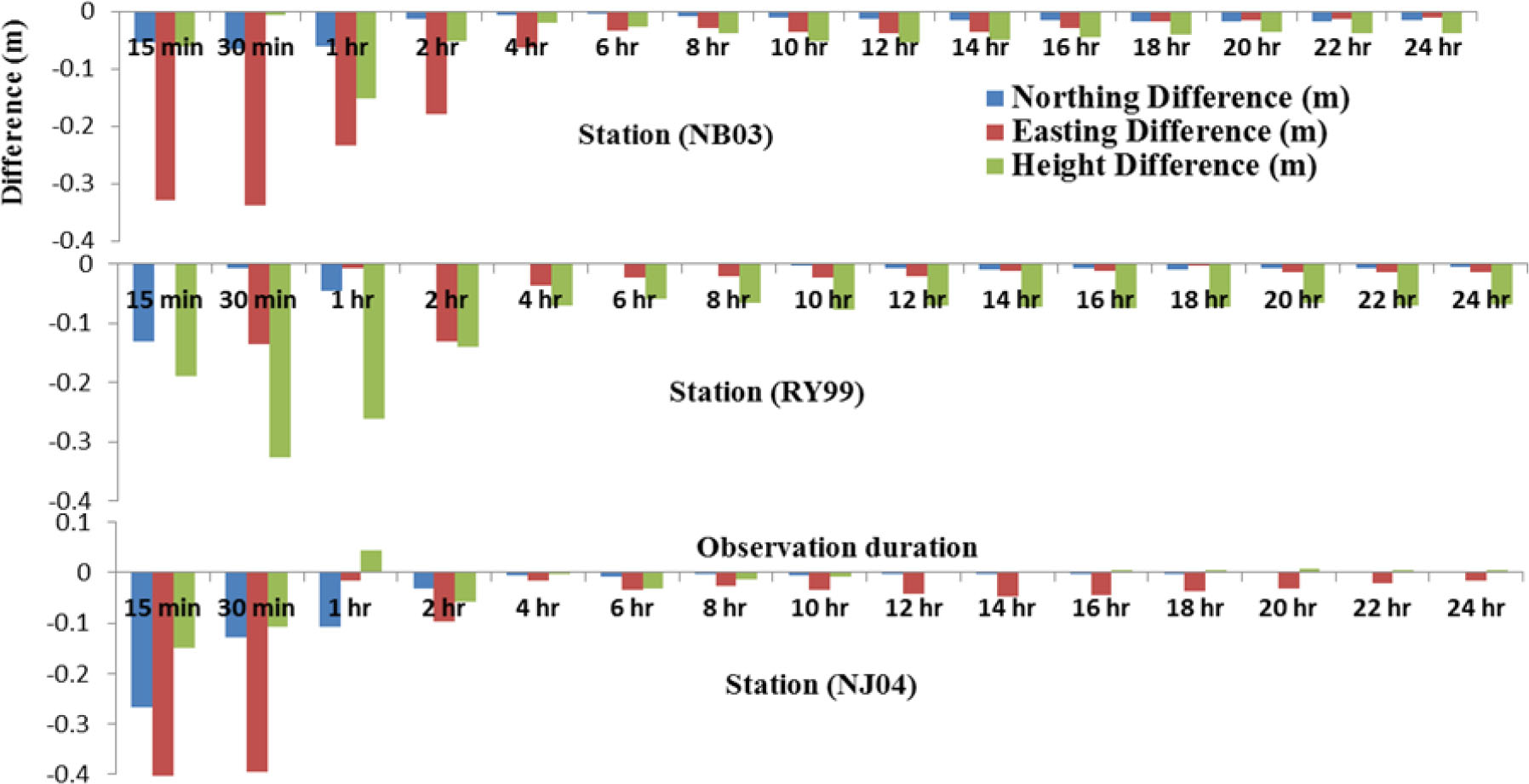
Figure 8.
Static-PPP accuracy variation comparing true coordinates for different observation duration from single-frequency mixed GPS/GLONASS observations (quiet ionosphere) (GPS day 21,390) for tested stations
3.3.2. Active ionosphere (GPS day 21,820)
Comparison of stations’ true coordinates with their coordinates from static-PPP single-frequency mixed GPS/GLONASS observations for different observation duration for GPS day 21,820 resulting from this study are presented numerically (Table 11) and graphically (Figure 9).
Table 11.
Static-PPP accuracy variation comparing true coordinates for different observation duration from single-frequency mixed GPS/GLONASS observations (active ionosphere) (GPS day 21,820) for the three tested stations
| Duration of observations | Station (NB03) | Station (RY99) | Station (NJ04) | ||||||
|---|---|---|---|---|---|---|---|---|---|
| Lat. (m) | Long. (m) | Ellip. height (m) | Lat. (m) | Long. (m) | Ellip. height (m) | Lat. (m) | Long. (m) | Ellip. height (m) | |
| 15 min | 0.166 | −0.048 | −0.718 | −0.74 | 0.614 | −0.403 | 0.252 | 0.018 | −0.834 |
| 30 min | 0.153 | −0.048 | −0.55 | −0.508 | 0.556 | −0.072 | 0.161 | −0.02 | −0.612 |
| 1 h | 0.01 | −0.026 | −0.231 | −0.201 | 0.259 | −0.123 | 0.031 | −0.039 | −0.232 |
| 2 h | −0.014 | −0.012 | −0.176 | −0.084 | 0.032 | −0.068 | 0.02 | −0.115 | −0.097 |
| 4 h | −0.017 | −0.057 | −0.087 | −0.011 | −0.019 | −0.126 | −0.002 | −0.046 | −0.069 |
| 6 h | −0.026 | −0.06 | −0.065 | −0.017 | −0.033 | −0.11 | −0.004 | −0.049 | −0.094 |
| 8 h | −0.025 | −0.046 | −0.05 | −0.021 | −0.023 | −0.088 | 0.009 | −0.033 | −0.102 |
| 10 h | −0.022 | −0.065 | −0.056 | −0.025 | −0.05 | −0.069 | 0.006 | −0.028 | −0.095 |
| 12 h | −0.016 | −0.087 | −0.038 | 0.001 | −0.155 | −0.081 | 0.005 | −0.028 | −0.087 |
| 14 h | −0.015 | −0.079 | −0.034 | 0.015 | −0.117 | −0.125 | 0.01 | −0.031 | −0.091 |
| 16 h | −0.018 | −0.074 | −0.034 | 0.017 | 0.007 | −0.087 | 0.008 | −0.036 | −0.075 |
| 18 h | −0.026 | −0.073 | −0.021 | 0.018 | −0.047 | −0.086 | 0.005 | −0.023 | −0.066 |
| 20 h | −0.027 | −0.07 | −0.03 | 0.014 | −0.051 | −0.117 | 0.007 | −0.046 | −0.068 |
| 22 h | −0.024 | −0.075 | −0.038 | 0.015 | −0.074 | −0.11 | 0.008 | −0.009 | −0.065 |
| 24 h | −0.024 | −0.079 | −0.04 | 0.011 | −0.089 | −0.093 | 0.006 | −0.015 | −0.058 |
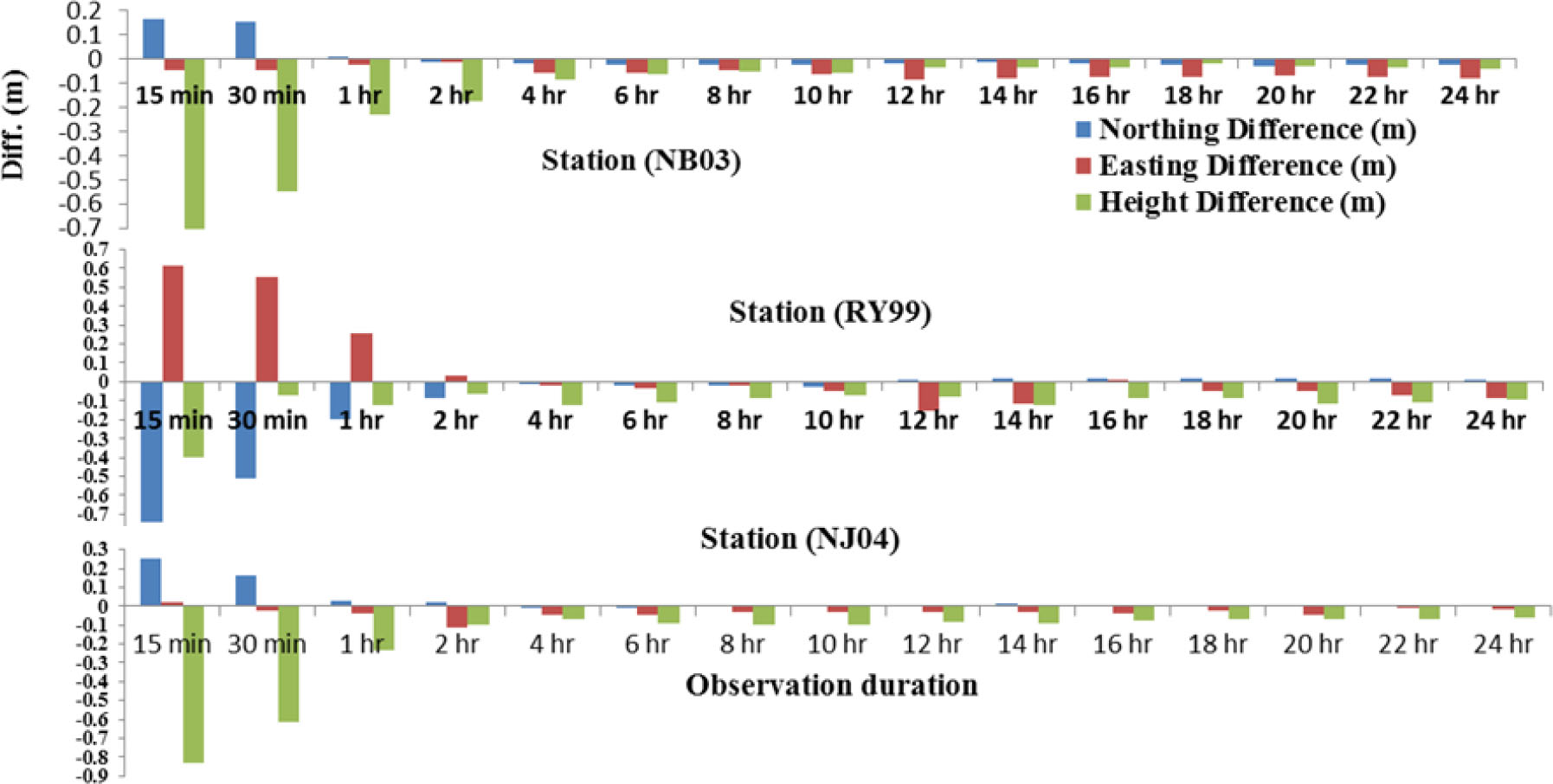
Figure 9.
Static-PPP accuracy variation comparing true coordinates for different observation duration from single-frequency mixed GPS/GLONASS observations (active ionosphere) (GPS day 21,820) for three tested stations
4. DISCUSSION
Single-frequency static-PPP accuracy depends basically on satellite geometry, the system used, observations duration, and ionosphere activity state. These are the parameters that have been studied in this research. Six 24-h sets of observations were collected from three KSA-CORS stations of different latitudes on 2 days (21,390 and 21,820 GPS days) to reflect different ionosphere activity states as well as different satellite geometry (Tables 1 and 2 and Figure 1). The collected observations from GPS, GLONASS, and mixed GPS/LONASS were processed separately to reflect the effect of the system used on static-PPP accuracy. The observations were processed in different observation durations starting from 15 min to 24 h to identify the effect of observation duration on the attained accuracy.
Satellites geometry (number of visible satellites and DOP values) had a noticeable effect on the static-PPP accuracy obtained using single-frequency observations. Under good satellite geometry, static-PPP accuracy could be improved with more observation duration; however, this is not the case where the satellite geometry is poor, as the accuracy could not improve even with more observation duration. Table 3, which presents satellite geometry parameters for three tested stations, remarkably reflects on the output static-PPP accuracy from three tested constellations (Tables 4–9). It is worth mentioning that on the test dates (GPS days 21,390 and 21,820), GPS has 31 working satellites while GLONASS has only 23 working satellites. It can be shown that GPS alone gives better accuracy than GLONASS alone in the three stations. GLONASS alone gives better accuracy for the two stations, NB03 and NJ04, other than station RY99. It is proved from Tables 4 to 9 that mixed GPS/GLONASS single-frequency observation provides optimum consistent accuracy, which reflects the fact, that optimum satellites geometry depends on both constellations GPS and GLONASS.
Table 4 provides the output accuracies from station NB03 for quiet ionosphere (GPS day 21,390). Station NB03 has the best satellites geometry for the three tested constellations. GPS provides static-PPP accuracy of 0.53 m lat., 1.44 m long., and 0.74 m height for 1 h observation duration. While GPS could provide an accuracy of 0.14 m lat., 0.48 m long., and 0.29 m height for 4 h observation duration. After processing 10 h of observations, GPS provides an accuracy of 0.11 m lat., 0.24 m long., and 0.23 m height. GPS provides optimum accuracy for 24 h of observations, which is 0.05 m lat., 0.12 m long., and 0.12 m height.
From NB03 station as well (GPS day 21,390), GLONASS provides static-PPP accuracy of 1.22 m lat., 3.34 m long., and 1.86 m height for 1 h observation duration, while GLONASS could provide accuracy of 0.25 m lat., 1.03 m long., and 0.52 m height for 4 h observation duration. After processing 10 h of observations, GLONASS provides accuracy of 0.17 m lat., 0.32 m long., and 0.36 m height. GLONASS provides optimum accuracy for 24 h of observations, which is 0.08 m lat., 0.17 m long., and 0.21 m height.
From NB03 station (GPS day 21,390) as well, mixed GPS/GLONASS provides static-PPP accuracy of 0.51 m lat., 1.37 m long., and 0.84 m height for 1 h observation duration, while mixed GPS/GLONASS could provide accuracy of 0.12 m lat., 0.42 m long., and 0.25 m height for 4 h observation duration. After processing 10 h of observations, mixed GPS/GLONASS provides accuracy of 0.09 m lat., 0.19 m long., and 0.20 m height. Mixed GPS/GLONASS provides optimum accuracy for 24 h of observations, which is 0.05 m lat., 0.10 m long., and 0.11 m height.
The effect of ionosphere activity state is shown by comparing static-PPP precision resulting from quiet ionosphere (GPS day 21,390; Figures 2–4 and Tables 4–6) with active ionosphere (GPS day 21,820; Figures 5–7 and Tables 7–9). For quiet ionosphere (GPS day 21,390), the average precision for static-PPP using 24 h-mixed GPS/GLONASS observations from the three tested stations were 0.05 m lat., 0.12 m long., and 0.13 m height, while during active ionosphere state (GPS day 21,820), the average precision values were 0.09 m lat., 0.20 m long., and 0.23 m height. It is clear that the precision became a little bit worse with increase in ionospheric activity, yet these types of accuracies are adequate for many types of civil engineering applications.
Tables 10 and 11 present a comparison of tested stations’ true coordinates with stations’ coordinates resulting from static-PPP single-frequency mixed GPS/GLONASS observations for two ionosphere activity states (quiet and active). For quiet ionosphere (GPS day 21,390), the average accuracies for static-PPP using 24 h-mixed GPS/GLONASS observations from the three tested stations were 0.01 m lat., 0.01 m long., and 0.03 m height, while for active ionosphere (GPS day 21,820), the average accuracies were 0.01 m lat., 0.06 m long., and 0.06 m height.
5. CONCLUSIONS
This research presents a cost-effective positioning technique (static-PPP using single-frequency observations), based on the fact that dual-frequency receivers are more expensive compared to single-frequency receivers. This research examines the factors that affect accuracy of static-PPP using single-frequency observations such as the system used (GPS or GLONASS or mixed GPS/GLONASS), satellites geometry, observations duration, and ionosphere activity state. The study uses observations from three KSA-CORS networks.
It can be concluded that satellites geometry has a noticeable impact on output accuracy, so mission planning process is essential. Currently, GPS is the most reliable system for PPP users compared to GLONASS as it has larger number of working satellites compared to GLONASS, which has lesser number of working satellites. However, GLONASS current constellation provides a strong alternative for PPP users. Mixed GPS/GLONASS gives optimum static-PPP accuracy using single-frequency observations.
Under quiet ionosphere, GPS provides average accuracy of 0.06 m lat., 0.16 m long., and 0.16 m height for 24 h of observation duration. GLONASS provides average accuracy of 0.11 m lat., 0.25 m long., and 0.32 m height for 24 h of observation duration. Mixed GPS/GLONASS provides optimum accuracy for 24 h of observations, which is 0.05 m lat., 0.12 m long., and 0.13 m height.
Under active ionosphere, GPS provides average accuracy of 0.11 m lat., 0.24 m long., and 0.31 m height for 24 h of observation duration. GLONASS provides average accuracy of 0.14 m lat., 0.29 m long., and 0.38 m height for 24 h of observation duration. Mixed GPS/GLONASS provides optimum accuracy for 24 h of observations, which is 0.09 m lat., 0.20 m long., and 0.23 m height.
The coordinates differences between station true coordinates and attained coordinates resulting from static-PPP using mixed GPS/GLONASS single-frequency observations are 0.01 m lat., 0.01 m long., and 0.03 m height (under quiet ionosphere) and 0.01 m lat., 0.06 m long., and 0.06 m height (under active ionosphere) for 24 h of observation duration. Ranges of accuracies attained in this research are meeting the demands for many engineering and non-engineering applications with efficient cost-effective positioning technique (static-PPP using single-frequency observations). The study conclusions are in agreement with (Farah, 2021).
Acknowledgements
The author is grateful for the KSA-General Authority for Survey and Geospatial Information (KSA-GASGI) for providing the observations from three KSA-CORS that were used in this research.