
Table I
Search Strategy and Keywords Used Across Different Databases
| Search engine | Keywords |
|---|---|
| PubMed | ((impact* OR unerupt* OR ectopic*) AND (canine* OR cuspid*) AND (surgery OR surgical* OR expos*)) AND ((functional OR aesthetic OR health OR obliteration OR outcome) OR (piggyback OR nickel titanium OR NiTi OR magnet* OR removable appliance)) |
| Scopus | ((impact* OR unerupt* OR ectopic*) AND (canine* OR cuspid*) AND (surgery OR surgical* OR expos*)) AND ((functional OR aesthetic OR health OR obliteration OR outcome) OR (piggyback OR nickel titanium OR NiTi OR magnet* OR removable appliance)) |
| ClinicalTrials.gov | ((impact* OR unerupt* OR ectopic*) AND (canine* OR cuspid*) AND (surgery OR surgical* OR expos*)) AND ((functional OR aesthetic OR health OR obliteration OR outcome) OR (piggyback OR nickel titanium OR NiTi OR magnet* OR removable appliance)) |
| Cochrane | ((impact* OR unerupt* OR ectopic*) AND (canine* OR cuspid*) AND (surgery OR surgical* OR expos*)) AND ((functional OR aesthetic OR health OR obliteration OR outcome) OR (piggyback OR nickel titanium OR NiTi OR magnet* OR removable appliance)) |
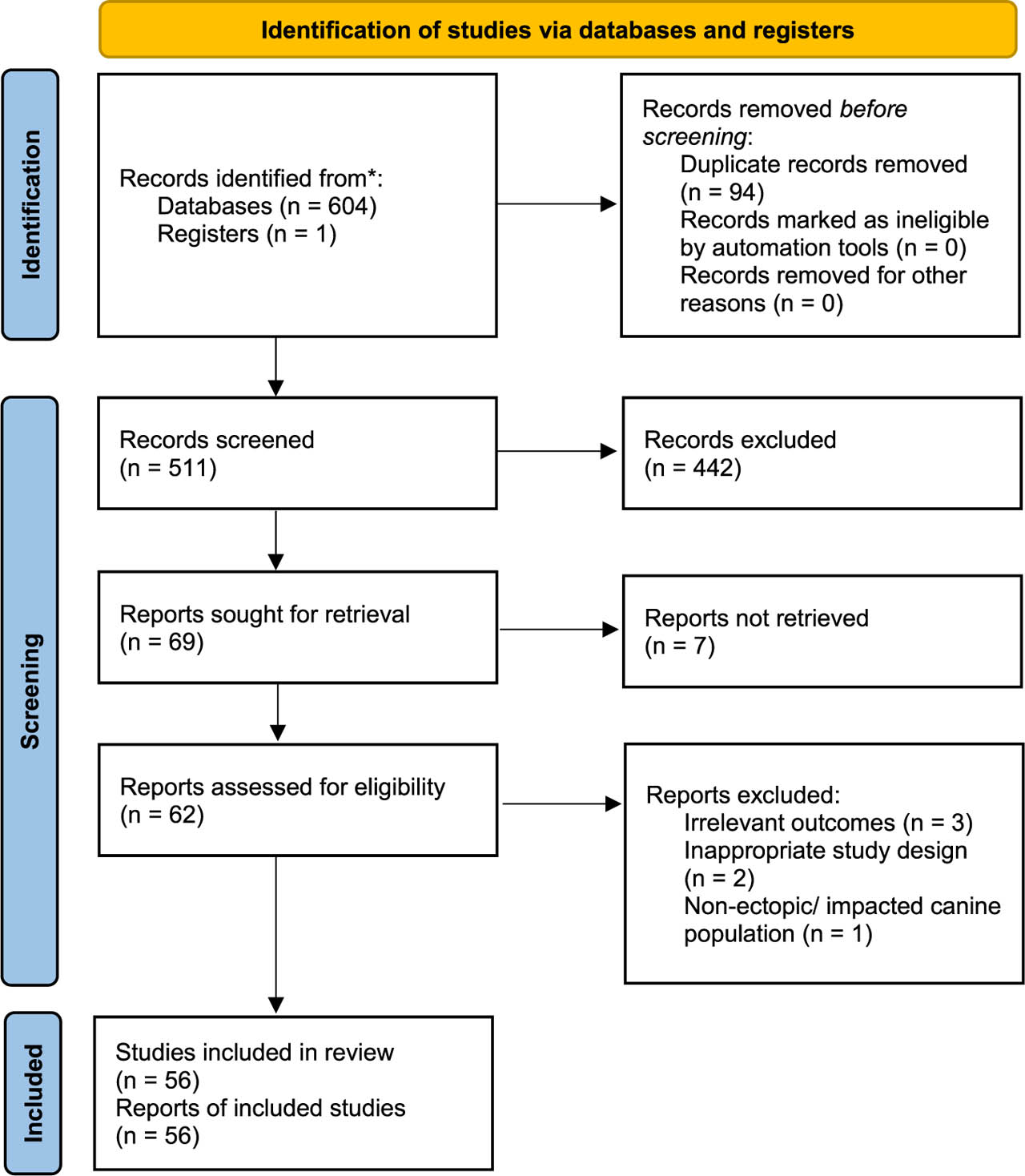
Figure 1.
PRISMA diagram.
TABLE II
Summary of evidence comparing open and closed surgical exposure for impacted maxillary canines
| Outcome | Summary findings |
|---|---|
| Eruption success | Both techniques achieve comparable eruption rates. No evidence supports superiority of either approach |
| Alignment duration | Conflicting. One systematic review favours open exposure. Discrepancy between reviews attributable to differences in study inclusion. Evidence remains inconclusive |
| Periodontal parameters | No clinically significant difference in probing depth, attachment level, or keratinised tissue width between the techniques |
| Gingival recession | Closed technique theoretically favoured through flap repositioning preserving keratinised gingiva, but this is not confirmed by clinical outcome data |
| Pain and discomfort | No difference in systematic reviews. One randomised-controlled trial reported greater pain and discomfort during active orthodontic traction in closed exposure |
| Aesthetic | No significant difference overall. One retrospective study reported darker crown colour following closed exposure |
| Surgery time and cost | No significant difference in operative time or cost between techniques |
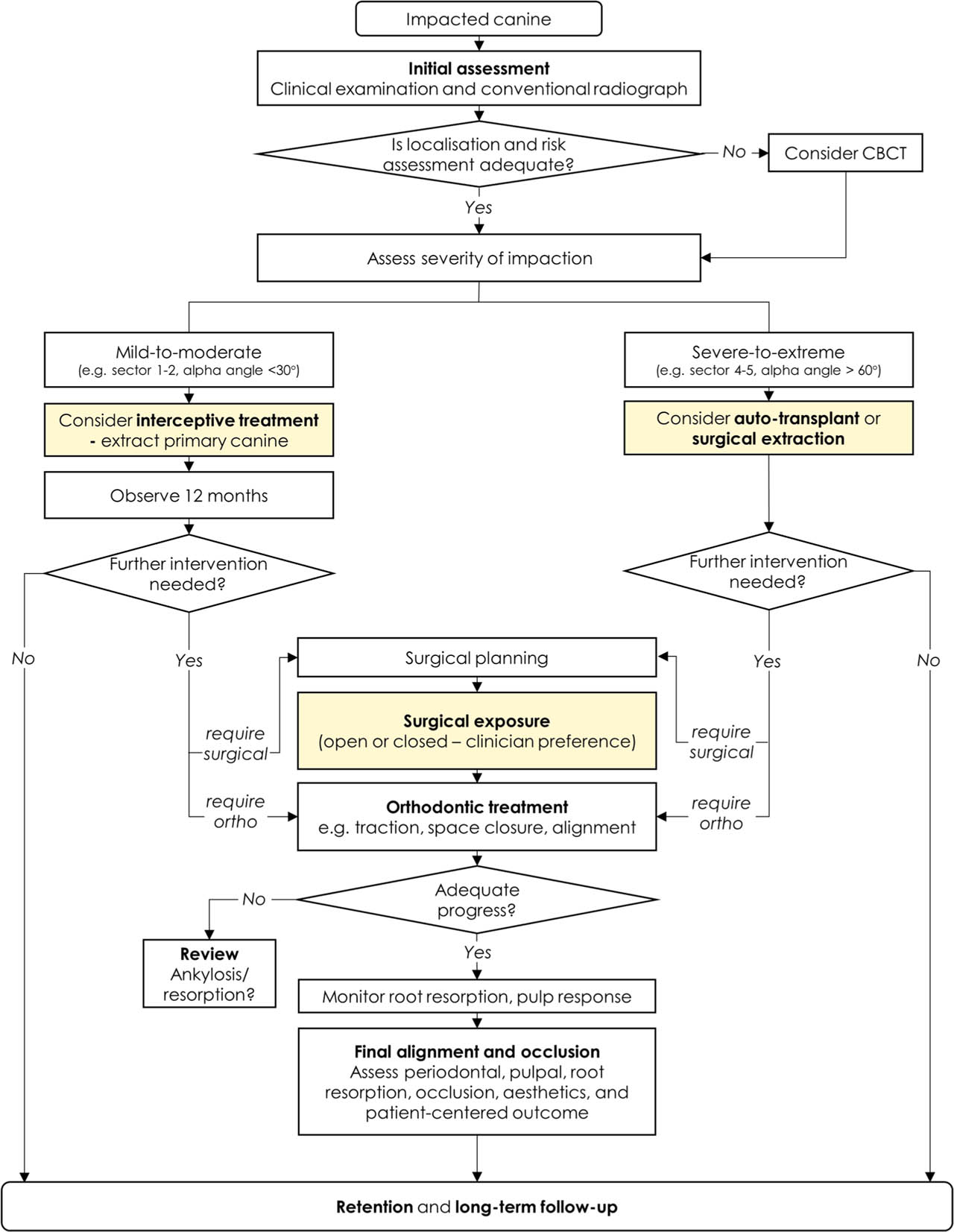
Figure 2.
Proposed algorithm for diagnosis and management of impacted maxillary canines.