
Introduction
In recent years, increasing public awareness of oral health and rising aesthetic expectations have significantly contributed to the growing demand for orthodontic treatment of adults.1 Orthodontics, once regarded as a specialty primarily associated with childhood and adolescence, is attracting substantial interest from adults seeking improvements in both oral function and appearance. According to data from the American Association of Orthodontists, approximately one in four orthodontic patients is an adult.2 This demographic shift has introduced unique clinical challenges and prompted modifications to conventional orthodontic protocols. A critical consideration in adult orthodontic treatment is the presence of pre-existing fixed prosthetic or restorative dental work, such as crowns, bridges, or implant-supported restorations. Unlike the natural enamel commonly encountered in adolescent patients, restorative materials exhibit different chemical compositions, surface characteristics, and bonding behaviours. As a result, when orthodontic brackets must be bonded to these surfaces, the properties of the underlying restorative material play a pivotal role in determining the long-term success and predictability of the treatment.3
Of contemporary restorative approaches, the use of permanent crowns fabricated through computer-aided design (CAD) and computer-aided manufacturing (CAM) technologies has become increasingly prevalent. These crowns are produced by using either of two primary techniques: subtractive manufacturing (SM), which involves milling from a solid block, and additive manufacturing (AM), commonly known as three-dimensional (3D) printing.4 In particular, AM has gained substantial popularity in recent years due to its advantages, including reduced material waste, faster production times, and the capability of fabricating highly customised restorations within a single appointment.5
The growing adoption of 3D printing technologies in dentistry has driven the development of various resin-based materials designed specifically for permanent restorations. These include glass filler-reinforced resin composites and hybrid resin composites, which may be clinically applied as single-unit crowns, inlays, onlays, and endocrowns.6 Glass filler-reinforced composites generally provide smoother and more homogeneous surface morphologies, attributed to the uniform distribution of fine glass particles. In contrast, hybrid composites typically incorporate ceramic filler particles within a methacrylic ester matrix, resulting in more complex and heterogeneous surface features.7,8 These structural differences influence the physical and chemical interactions between the restorative material and the orthodontic bracket during bonding.8
The clinical significance of understanding these interactions cannot be overstated. Adult orthodontic patients with 3D-printed permanent crowns require bonding protocols that ensure adequate bracket retention without compromising the integrity of the restoration. Inadequate bonding may result in bracket detachment, necessitating repeated clinical interventions, prolonging overall treatment duration, increasing chairside costs, and potentially leading to patient dissatisfaction. More critically, improper bonding or debonding techniques can cause irreversible damage to the restoration surface thereby requiring additional prosthetic repairs.
A commonly-used parameter to evaluate bracket retention is shear bond strength (SBS), defined as the maximum force required to dislodge a bonded bracket under a shear load. Clinically, this value must be high enough to withstand normal masticatory forces and the mechanical stresses generated by orthodontic tooth movement. However, it must also remain within a safe range to avoid damaging restorative surfaces during bracket removal. Previous studies suggest that SBS values between 6 and 8 megapascals are generally considered clinically acceptable for metal brackets.9
In addition to SBS, the Adhesive Remnant Index (ARI) is frequently used to assess the failure pattern of the bonded interface following debonding. This index provides valuable insight into whether bond failure occurred at the bracket–adhesive interface, within the adhesive itself, or at the adhesive–restoration interface. These patterns have practical implications for ease of cleanup, potential surface damage, and overall bracket stability throughout treatment.10
The adhesion mechanisms contributing to bracket retention are multifactorial and can be categorised into three primary types:11 The first is mechanical interlocking, which involves the penetration of adhesive resin into microscopic surface irregularities which promotes physical retention. The second is chemical bonding, arising from interactions between functional monomers in the adhesive and reactive groups present on the surface of the restorative material or the bracket. The third involves microstructural interactions, encompassing factors such as surface energy, wettability, and the nanoscale distribution of filler particles, each of which influences the adhesive’s ability to spread, penetrate, and establish stable bonds with the substrate.12
Despite the increasing use of 3D-printed restorative materials in clinical practice, particularly in adult orthodontic patients, scientific data regarding the bonding performance of permanent crown resins remains limited. While several studies have examined the bond strength of temporary 3D-printed materials, research specifically focusing on permanent resin composites produced via AM is still lacking.10,13–15
The present study was therefore designed to address this gap by investigating the SBS and adhesive behaviour of metal brackets bonded to anatomical crowns fabricated from three commercially available 3D-printed permanent restorative resins. The null hypothesis was that differences in material composition would not significantly influence shear bond strength.
The findings of this study are intended to support clinicians in selecting suitable restorative materials and surface conditioning protocols, ultimately helping to minimise treatment delays, reduce the risk of restoration damage, and enhance the overall effectiveness and comfort of adult orthodontic care. Furthermore, the results are expected to contribute to the development of evidence-based guidelines for interdisciplinary treatment planning that integrates prosthetic and orthodontic considerations.
Materials and methods
Ethical approval
The experimental protocols of the present in vitro study were approved by the Clinical Research Ethics Committee of Afyonkarahisar Health Sciences University (Approval No: 2024/138).
Digital design
A maxillary right central incisor (Frasaco, AG-3 ZSDP) was scanned using an intraoral scanner (TRIOS 3, 3Shape A/S, Copenhagen, Denmark) and saved in the standard tessellation language (.stl) format. The digital impression was imported into 3D design software (Ansys SpaceClaim 2022R1, ANSYS Inc. Cannonsburg, PA, USA). To ensure adequate retention for the debonding test, a customised crown design was created for the maxillary right central incisor. Additionally, to standardise the bracket bonding area, a groove matching the bracket’s outer boundaries was created in the middle third of the vestibular surface of the crown (Figure 1A).
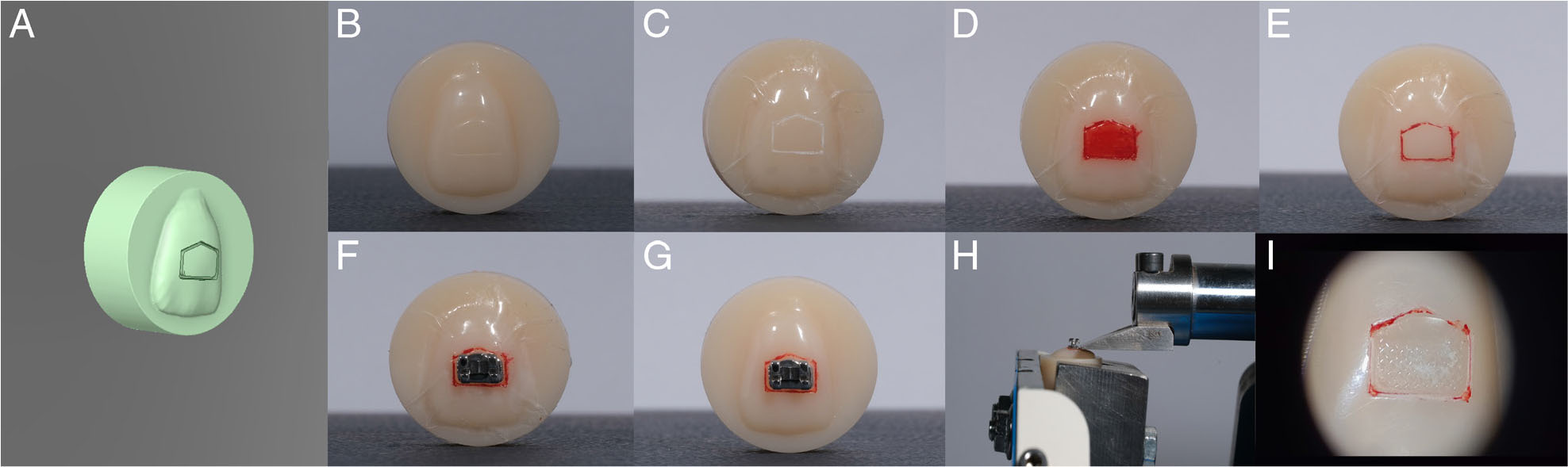
Figure 1.
Schematic overview of the workflow. A, Digital design of the samples; B, 3D printing of the samples using three different permanent restorative resins and surface polishing; C, Isolation of areas outside the bonding site of the bracket; D, Painting of the area to be sandblasted; E, Sandblasting of the painted area; F, Bonding of the brackets to the sandblasted area; G, Removal of the isolation; H, Application of the shear bond strength test; I, Evaluation of ARI scores.
The finalised design was transferred into slicing software (ChituboxPro V1.4.1, CBD-Tech, Shenzhen City, Guangdong, PR China) for preparation according to resin-specific printing parameters. Support structures were added within the software to optimise the printing process. The printing parameters for each resin group were determined based on the manufacturer’s guidelines, using a layer thickness of 50 μm and a printing angle of 45°.16
Sample groups
The required sample size was calculated using G*Power version 3.1.9.7 (Heinrich Heine Universität, Düsseldorf, Germany). Based on a comparable in vitro study with a similar three-group design, the effect size (f = 0.48) was determined using reported means and standard deviations. Using an α level of 0.05 and a desired power of 0.95, the analysis indicated that a total of 69 specimens (n = 23 per group) would be required to detect statistically significant differences between the groups.17
3D Manufacturing
The finalised design files were transferred to a 3D printer utilising LCD technology (Phrozen Sonic Mini 8K MSLA, Phrozen Tech Co., Hsinchu City, Taiwan). Three different permanent restorative resins were used: Saremco Print Crowntec (CR) (Saremco Dental AG), Varseosmile Crown Plus (VS) (Bego GmbH) and P-Crown V3 (PC) (Senertek LTD). Prior to fabrication, the printing parameters were individually adjusted for each resin group. Once fabrication was complete (n = 40 per group), the restorations were cleaned of excess resin and detached from the build platform using a metal spatula. Support structures were manually removed, and the restorations were cleaned using isopropyl alcohol (IPA >99%).
The restorations for the VS and PC groups underwent ultrasonic cleaning in an alcohol bath (TriClean Ultrasonic Cleaner, Plano, TX, USA) for 3 minutes, followed by a second rinse in fresh alcohol for an additional 2 minutes. For the CR group, alcohol was applied in spray form following the manufacturer’s instructions. After the washing procedure, all samples were dried using compressed air and cotton pellets.
To ensure complete polymerisation, all samples underwent a post-curing process in a nitrogen gas atmosphere (1.5 bar) using a polymerisation unit (Otoflash G171; NK Optik, Baierbrunn, Germany) emitting 4,000 flashes. At the midpoint of the curing cycle, the samples were flipped to ensure uniform polymerisation.
Surface treatment protocol
Polishing was performed using abrasive discs (Sof-Lex, 3M ESPE, St. Paul, MN, USA), diamond paste (Diamond Excel, FGM, Vernon, CA, USA), and felt discs (Diamond Flex, FGM, Vernon, CA, USA) (Figure 1B). To prevent sandblasting and adhesion procedures from affecting areas outside the designated bracket bonding groove, the regions were isolated using thick adhesive tape (Figure 1C). The grooved area was marked with an acetate pen (Figure 1D).
In a circular motion, a Micro Etcher II intraoral sandblasting device (Danville Materials, San Ramon, CA, USA) was used to apply Al2O3 sand (TruEtch™ Aluminium Oxide 50 Micron White, Ortho Technology, Carlsbad, CA, USA) at 2 bar pressure from a 1.5 cm distance. Care was taken to ensure uniform sandblasting without excessive application. To ensure controlled sandblasting, the process continued until the marked surface was completely removed within the target area while preventing unwanted surface modifications (Figure 1E).
Following sandblasting, the samples were washed in distilled water and dried with compressed air. A Transbond™ XT Primer (3M Unitek) was applied to the dried surface and light-cured for 20 seconds.18 Universal stainless steel brackets (0.022-inch Metal Twin Brackets, American Orthodontics, Sheboygan, WS, USA) designed for central incisors were bonded to the sandblasted area using a bis-acrylic-based light-cured adhesive composite (Transbond XT, 3M Unitek, Monrovia, CA, USA) under manual pressure. Excess adhesive around the brackets was removed using an explorer, and the specimens were light-cured for 20 seconds using a LED curing device (VALO Cordless, Elexxion, Utah, USA). After bonding, the adhesive tape used for isolation was removed (Figure 1F and G).19
Thermocycling
The specimens underwent 10,000 thermal cycles between 5°C and 55°C using a thermocycling machine (Esetron, MOD Dental LTD, Ankara, Türkiye). Each specimen was immersed in either cold or hot water for 30 seconds, with a 5-second waiting period between consecutive immersions.20
Shear bond strength (SBS) testing
SBS testing was conducted using a universal testing machine (Esetron, MOD Dental LTD, Ankara, Türkiye) equipped with Mod Dental software (MOD Dental LTD, Ankara, Türkiye). Mod Dental software, the interface program of the universal testing machine, was used to control the device and record the shear bond strength (SBS) values during testing. Each specimen was positioned horizontally with the vestibular surface facing upward. Before each test, the shearing blade was aligned horizontally with the base of the bracket to ensure that force application was directed at the bracket base rather than its wings (Figure 1H).
During testing, the shear force was applied at 0.5 mm/min until debonding occurred. The software recorded the maximum force applied (Newton, N) before failure. SBS (MPa) was calculated using the formula: τ = F/A, where τ = shear stress (MPa), F = shear force (N), and A = bracket base area (mm2).21 To determine the bracket base area (A), the brackets were digitised using an intraoral scanner and analysed with reverse engineering software (Geomagic Control 3D, 3D Systems, Inc., Rock Hill, SC, USA).
Adhesive Remnant Index (ARI) scoring
Bond failure mode and restorative surface integrity were evaluated using a modified 5-category ARI scoring system.10 The specimens were examined under a reflected light microscope (Zumax, OMS2380, Jiangsu, PR China) at 10 × magnification and photographed using a digital camera (Fujifilm XH2, Tokyo, Japan). Subsequently, the specimens were evaluated by three independent observers (Figure 1I) and ARI scores were assigned according to: Score 1: 100% of adhesive remained on the restoration surface (bracket imprint fully visible). Score 2: ≥90% of adhesive remained. Score 3: 10–90% of adhesive remained. Score 4: ≤10% of adhesive remained. Score 5: No adhesive remained on the surface. For specimens with inter-observer discrepancies, the evaluators conducted a joint review to reach a consensus.
Statistical analysis
Statistical analyses were conducted using SPSS v24.0 (IBM Corporation, Armonk, NY, USA). The Shapiro-Wilk test was used to assess data normality, while Levene’s test evaluated variance homogeneity. Since the data followed a normal distribution and exhibited homogeneous variances, ANOVA was performed to assess the effect of different resin types on SBS. A Fisher–Freeman–Halton exact test with Monte Carlo simulation of random sampling was used to compare ARI scores between the groups. The significance level was set at p < 0.05.
Results
Descriptive statistics for each group (Table I) indicated that the highest mean SBS was observed in the VS group (13.92 ± 1.60 MPa), followed by PC (13.33 ± 2.75 MPa) and CR (13.28 ± 2.85 MPa). The minimum and maximum SBS values were PC group: 8.82 – 18.63 MPa, CR group: 9.05 – 17.57 MPa, VS group: 11.67 – 16.33 MPa.
Table I.
Descriptive data for each group
| Grup | N | Mean | Std. Deviation | Std. Error | 95% Confidence Interval | Minimum | Maximum | |
|---|---|---|---|---|---|---|---|---|
| Lower Bound | Upper Bound | |||||||
| PC | 40 | 13.33 | 2.75 | 0.67 | 11.92 | 14.75 | 8.82 | 18.63 |
| CR | 40 | 13.28 | 2.85 | 0.65 | 11.90 | 14.65 | 9.05 | 17.57 |
| VS | 40 | 13.92 | 1.60 | 0.43 | 13.00 | 14.85 | 11.67 | 16.33 |
ANOVA results (Table II) indicated no statistically significant difference in mean SBS among the groups (p = 0.738). This finding suggests that CR, VS, and PC resins exhibited comparable SBS performance.
Table II.
Comparison of mean shear bond strength in the studied grups
| ANOVA | |||||
|---|---|---|---|---|---|
| Sum of Squares | df | Mean Square | F | Sig. | |
| Between Groups | 3.93 | 2 | 1.96 | 0.306 | 0.738 |
| Within Groups | 301.47 | 47 | 6.41 | ||
| Total | 305.39 | 49 | |||
Following the SBS test, one specimen from the VS group and two specimens from both the CR and PC groups were excluded from the ARI data analysis due to fractures on the restoration surface. The distribution of ARI scores across the three groups is presented in Figure 2. Notably, no specimens received an ARI score of 4 or 5, indicating that at least 10% of the adhesive remained on the restoration surface after bracket debonding in all samples. In the comparison of ARI scores of the different resin types, no statistically significant differences were observed between the groups (Table III).
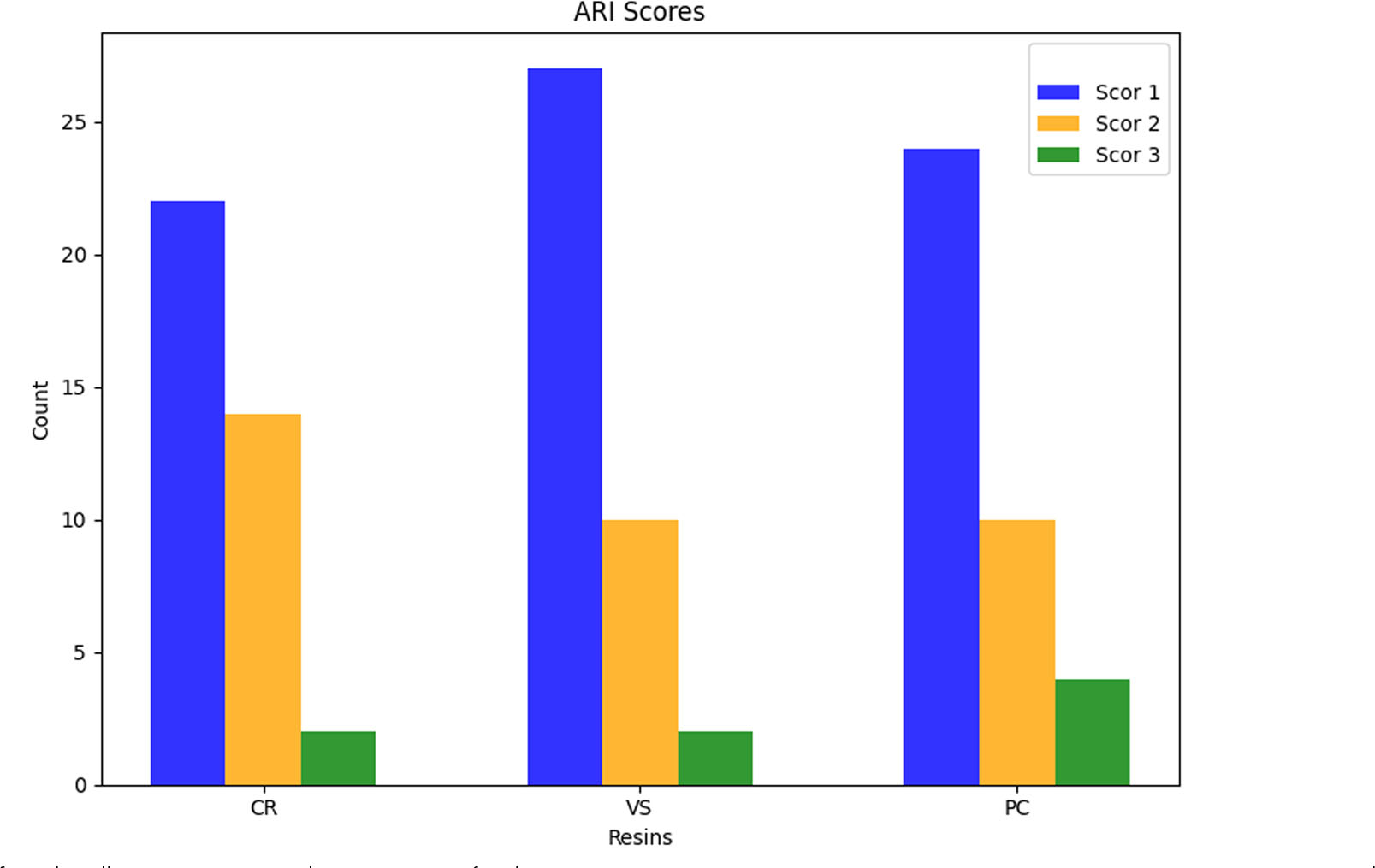
Figure 2.
Frequency of each adhesive remnant index (ARI) score for the test groups. PC: P-Crown V3, CR: Seramco print crowntec, VS: Varseosmile crown plus.
Discussion
In modern dentistry, adhesion is crucial for the success of a wide range of treatments, as it ensures the effective bonding of restorative materials to dental structures. In orthodontics, achieving sufficient SBS is essential, as brackets must withstand masticatory forces and parafunctional activities throughout treatment. Beyond the selection of high-performance adhesive materials, adherence to standardised adhesion protocols is equally important.
With the increasing adoption of 3D-printed restorations, the range of materials used in clinical practice has expanded. In patients possessing printed resin restorations, ensuring a reliable bracket bond is required for the success of orthodontic treatment. While resin-based materials are increasingly preferred for permanent restorations, research on their compatibility with orthodontic bracket bonding remains limited.
Ideally, brackets bonded to permanent crowns should exhibit SBS values that provide adequate stability throughout treatment while allowing for safe debonding without causing damage to the restoration. The bond between the bracket and the crown material is primarily achieved through chemical or mechanical retention mechanisms, depending on the material composition. In the present study, it was hypothesised that a combination of sandblasting and adhesive application would enhance the SBS of brackets bonded to permanent resin crowns.22 To achieve this, Al2O3 sandblasting was performed to create micromechanical retention, followed by the application of a universal adhesive primer to further improve bond strength.
In the present study, Transbond XT (3M Unitek, Monrovia, CA, USA), a bis-acrylic-based, light-cured orthodontic adhesive, was selected due to its widespread clinical use and well-documented performance in bracket bonding procedures. Its high filler content and favourable handling characteristics allow for precise bracket placement and controlled polymerisation. Additionally, it demonstrates strong adhesion to both enamel and various restorative materials when used in conjunction with appropriate surface conditioning protocols.23
Given the increasing use of resin-based restorative materials in adult orthodontic patients, the choice of a light-cured composite with proven clinical reliability across different substrate types provides a practical and standardised approach to bracket bonding. Furthermore, using a widely studied adhesive, such as Transbond XT, facilitates meaningful comparison with previous literature and enhances the external validity of the findings.
During SBS testing, the applied force was expected to be uniformly transmitted to the bracket base. However, misalignments or angular deviations in bracket positioning can alter force distribution, leading to inaccurate SBS measurements and potentially underestimate the true bond strength.
To minimise variability, the brackets were manually positioned with controlled pressure during bonding to ensure full adaptation to the restoration surface. Additionally, the universal testing machine’s shear blade was precisely aligned parallel to the bracket base and positioned at its edge (Figure 3). This setup ensured accurate and consistent application of shear force.10
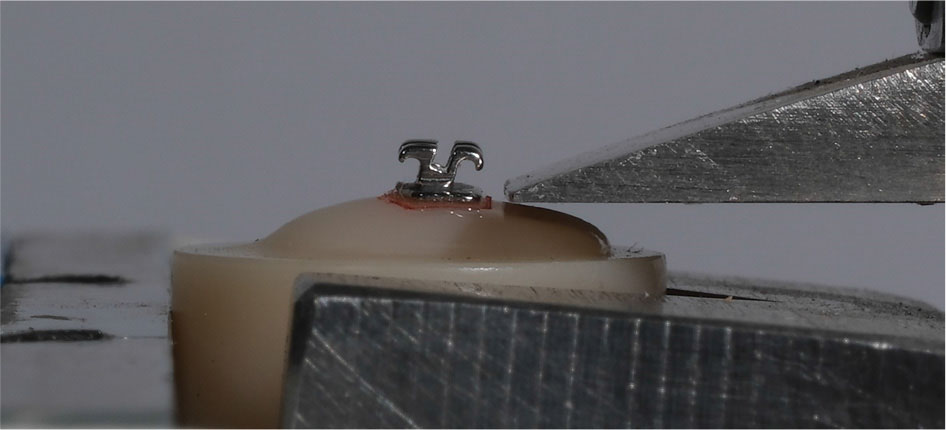
Figure 3.
Ideal positioning of the bracket during shear bond strength testing.
To further enhance the accuracy of bond strength measurements, the bracket base was scanned using a TRIOS 3 intraoral scanner, and the stl file was analysed using Geomagic Control 3D software (3D Systems, Inc., Rock Hill, SC, USA). This method enabled precise measurement of the bracket pad’s surface area thereby ensuring reliable SBS calculations.24
In line with this accuracy objective, an additional critical factor influencing the reliability of the results is the precise delineation of treated surface areas. Previous studies have shown that undefined sandblasted and adhesive-applied regions can increase the effective adhesive surface area, leading to variations in SBS values.10 To address this issue, the present study standardised the bonding area, ensuring that non-target regions were effectively isolated from sandblasting and adhesive application.
The minimum recommended SBS range for orthodontic treatment is widely established in the literature as 6–8 MPa.9 However, this threshold does not fully account for real-world factors affecting adhesive resin performance in the oral environment, such as fatigue, temperature fluctuations, pH variations, and microbial degradation. Studies by Hajrassie and Murray have demonstrated that SBS values in clinical settings are typically lower than those obtained in laboratory conditions.25,26 Additionally, Gange proposed that bracket adhesives should withstand forces of approximately 20 MPa, a recommendation supported by Proffit’s research on occlusal forces.27 These findings highlight the discrepancies between laboratory and clinical conditions, and emphasise the importance of simulating intraoral conditions more accurately in in-vitro studies. To approximate clinical reality, the present study applied 10,000 thermal cycles to the specimens to simulate aging. According to Gale et al.28 10,000 and 20,000 thermal cycles correspond to approximately one and two years of clinical use, respectively.
The findings indicate that the SBS values of samples produced with the three resin types ranged between 8.82 and 18.63 MPa, which falls within the clinically acceptable SBS range.9,25 This range ensures sufficient bracket retention throughout treatment while minimising the risk of restoration damage during debonding.10
The three resin materials evaluated in the preasent study are commercially available 3D-printed permanent crown resins intended for long-term intraoral application.29 Each was selected based on its CE certification, clinical availability, and distinct formulations representing two primary categories of printable resins.
The resins differ in their polymer matrix composition, filler type, and ceramic content, as detailed in Table IV.30 Furthermore, each manufacturer specifies unique printing parameters optimised for their respective materials and making them suitable representatives for evaluating bracket bonding performance across different material types.31,32
Table IV.
General properties of permanent resins
| Material | Manufacturer | Fillers | Water Absorption | Flexural strength | Viscosity | Matrix components |
|---|---|---|---|---|---|---|
| VarseoSmile Crown Plus (VS) | Bego Bremen | Total fillers by weight 30–50 wt%. | 3.6 μg/mm3 | 116 MPa | 2.500–6.000 MPa | 4.4’-isopropylphenol, ethoxylated and esterification products of 2-methylprop-2enoic acid, dental glass silica, methyl benzoylformate, diphenyl (2,4,6-trimethylbenzoyl) phosphine oxide |
| Saremco Print Crowntec (CR) | Saremco Dental AG | Up to 50 wt%. (silanized dental glass, pyrogenic silica, particle size 0.7 μ m) | 0.6 μg/mm3 | 135 MPa | 2.500–6.000 MPa | 4.4’-isopropylphenol esterification products, ethoxylated 2-methylprop-2enoic acid, dental glass silica, pyrogenic silica, initiators |
| P-crown Version 3 (PC) | Senertek | 65 wt% nano ceramic rate | 1.2 μg/mm3 | 240 MPa | 3500 MPa | No information available |
Despite the compositional variations, the absence of statistically significant differences in shear bond strength (SBS) values bewteen the three resins may be attributed to several factors. First, all materials possess similar surface energies and are based on methacrylate chemistry, which may lead to comparable interactions with the adhesive system. Secondly, standardised surface conditioning and bonding procedures were uniformly applied, possibly minimising inter-material differences. Finally, the filler distribution and resin matrix composition, while structurally distinct, may not significantly influence macro-scale bond performance under the controlled in vitro conditions of the present study. This outcome suggests that clinically acceptable bonding can be achieved across various permanent 3D-printed resins when appropriate protocols are followed.
In addition to the SBS analysis, ARI scores provide quantitative insight into failure patterns when metal brackets are bonded to different resin-based permanent restorations. In the present study, all ARI scores ranged between 1 and 3, indicating that at least 10% of the adhesive remained on the restoration surface after bracket debonding in all cases.
The ARI index, developed by Artun et al.33 is widely used as a standard method for analysing bond failure patterns. By simplifying the complexity of debonding events, ARI facilitates statistical comparisons across studies. However, previous literature reviews have indicated that many researchers modify the ARI system by adjusting scoring methods or criteria. In the present study, ARI scores were assessed using the comprehensive criteria developed by Bishara et al.34
According to Proffit, to prevent enamel damage during bracket removal, failure should ideally occur either within the adhesive resin or at the bracket-adhesive interface, allowing the remaining adhesive to be safely removed from the enamel.35 Studies analysing SBS in 3D-printed restorations have frequently reported cohesive failures, often attributed to the lower mechanical strength of 3D-printed materials.36,37 However, in the present study, adhesive failures were predominant, likely due to the higher durability of the permanent restorative resins used. This finding suggests that bonding mechanisms vary depending on resin properties, and adhesive failures may be more common in permanent restorations.
The strong bond between metal brackets and permanent resin restorations provides significant clinical advantages, improving both aesthetic and functional outcomes during orthodontic treatment. A robust bracket bond reduces the risk of debonding, thereby enhancing treatment efficiency and minimising the need for re-bonding procedures.
The comparable bond strengths observed between the three tested permanent resin materials offer several clinical advantages in adult orthodontics. Although no statistically significant differences were found, the generally strong bracket adhesion to all resins suggests reliable performance in routine clinical settings. This outcome enables clinicians to bond brackets directly onto existing 3D-printed crowns without requiring prosthetic replacement nor complex surface pretreatment, which is especially relevant in time-sensitive or budget-constrained cases.38
For instance, in a clinical scenario involving a middleaged patient with multiple posterior restorations fabricated from different 3D-printed materials, knowing that all three materials offer similar bonding behaviour allows orthodontic treatment to proceed without modifying or replacing existing crowns, thereby preserving both time and cost efficiency. In addition, an adult patient with a resin-based anterior crown who requires short-term aesthetic alignment, confidence in bracket adhesion strength can allow conservative treatment without risking irreversible damage to the restoration.
Compared to ceramic restorations, which are prone to catastrophic failure upon bracket debonding, resin-based materials offer more forgiving clinical handling. Surface roughening procedures can be reversed by polishing, and minor surface damage or fractures can be clinically repaired without crown replacement. These properties contribute to minimally invasive workflows, reduced treatment interruptions, and greater patient satisfaction, particularly for those seeking discreet and cost-effective care.39,40
Despite its strengths, the present study has limitations. Given that different 3D printing technologies and post-processing methods can alter surface characteristics, the impact of processing conditions on SBS was not fully elucidated. Furthermore, although thermal cycling was applied, intraoral conditions could not be fully replicated, leaving uncertainty regarding the long-term clinical behaviour of 3D-printed permanent restorations.
Conclusions
The null hypothesis, which posited that different permanent crown resins would not affect bond strength, was accepted. The SBS values between orthodontic metal brackets and permanent resin restorations were within clinically acceptable limits. Additionally, structural differences between the resins did not influence the bond strength.
Notes
[4] Contributed by Authors’ contributions
The authors contributed to this project equally and read and approved the final manuscript.
[5] Ethics approval
This study was approved by (2024/138) Clinical Research Ethics Committee of Afyonkarahisar Health Sciences University.
[6] Consent for publication
Written consent for publication was obtained from each participant.
[7] Availability of data and materials
Data and materials are available at the Orthodontic Department in the Faculty of Dentistry, University of Afyonkarahisar Health Sciences University.
[8] Conflicts of interest Conflicts of interest
The authors declare that they have no competing interests.
Acknowledgment
Not applicable