
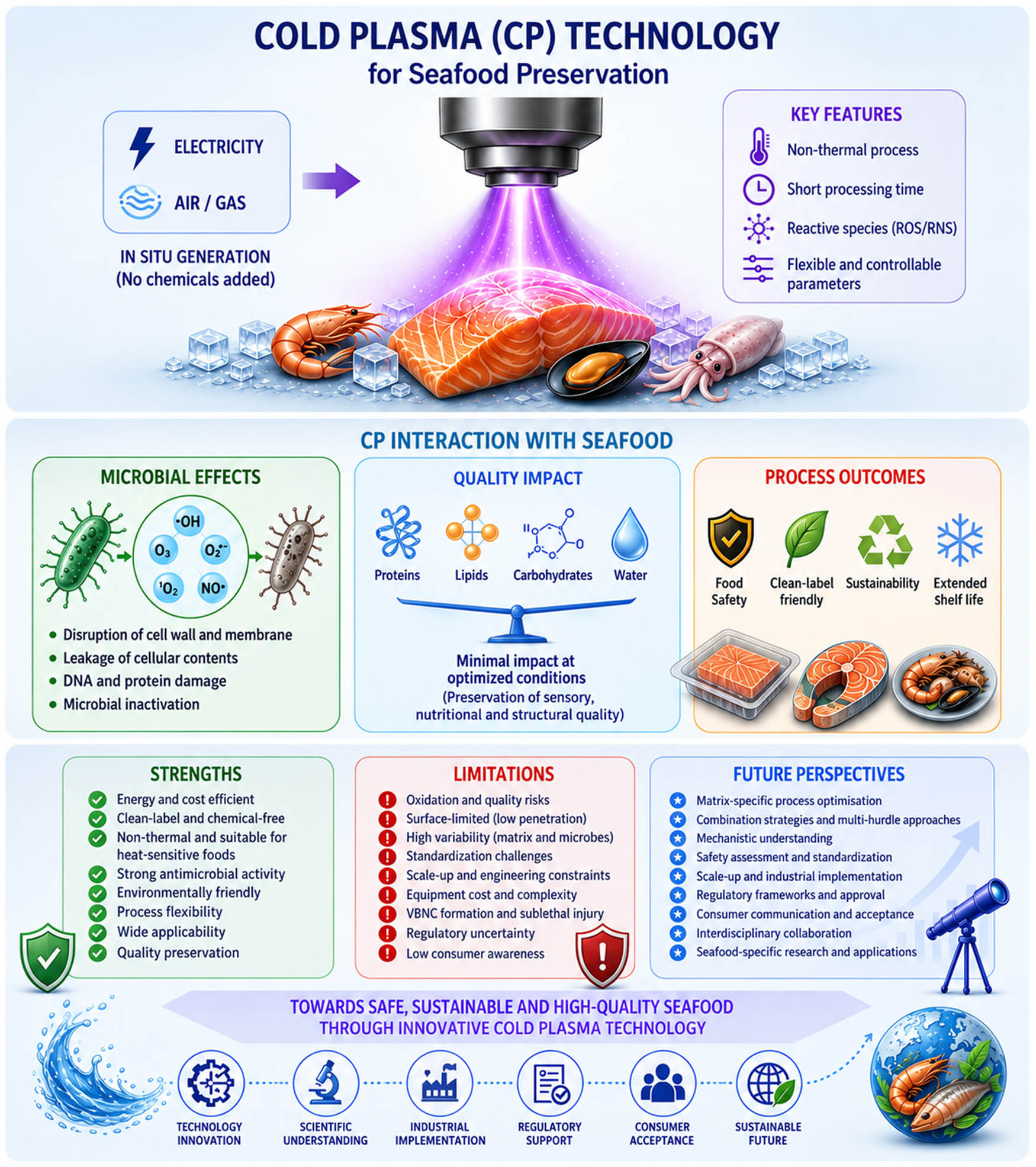
Figure 1
Schematic overview of CP technology for seafood preservation.
Source: Authors’ contribution, based on the literature cited in the manuscript.
Table 1
Standalone CP applications in seafood and their implications for hurdle-based preservation strategies
| Seafood matrix | Treatment | Main results | Rationale for hurdle applications | Reference |
|---|---|---|---|---|
| Mackerel | CP (70 and 80 kV) and treatment times of 1, 3 and 5 min | CP maintained quality while reducing spoilage bacteria associated with fatty fish deterioration. | Antioxidant-supported hurdle strategies are needed to mitigate potential plasma-induced oxidation in fatty fish while maintaining microbial control. | Albertos et al. (2017) |
| Sea bass | Air CP | Air CP achieved significant reductions in Salmonella Enteritidis (2.71 log CFU/g) and L. monocytogenes (2.98 log CFU/g) after 4 min treatment. | Combination with natural antioxidants is recommended to limit TBARS increase during prolonged CP exposure while preserving antimicrobial efficacy | Tosun et al. (2024) |
| Dried blackmouth angler (Lophiomus setigerus) | CP (1−30 min) | CP achieved limited to moderate microbial reduction while maintaining colour, pH, and overall sensory quality; longer treatments slightly increased thiobarbituric acid (TBA) and reduced texture. | Additional physical or non-thermal hurdles may enhance microbial inactivation, as standalone CP produced only limited to moderate reductions despite acceptable quality retention. | Choi et al. (2020) |
| Live oysters | Plasma-activated simulated seawater (PASW) for depuration | PASW reduced total coliforms and E. coli during oyster depuration without affecting oyster quality or viability. | Low-temperature depuration may act as an additional hurdle to improve bacterial reduction in live bivalves treated with PASW. | Campbell et al. (2023) |
| Sea bass | Air and helium CP | CP using air or helium achieved limited (∼0.90–1.13 log CFU/g at 10 min) Salmonella reduction on sea bass; sensory quality was maintained at ≤ 10 min, whereas longer treatments did not improve inactivation and reduced sensory scores. | Combination with complementary preservation techniques should be evaluated to improve antimicrobial efficacy, since longer CP exposure did not further enhance Salmonella reduction and reduced sensory scores. | Üçok et al. (2024) |
Source: Authors’ compilation based on the literature cited in the table.
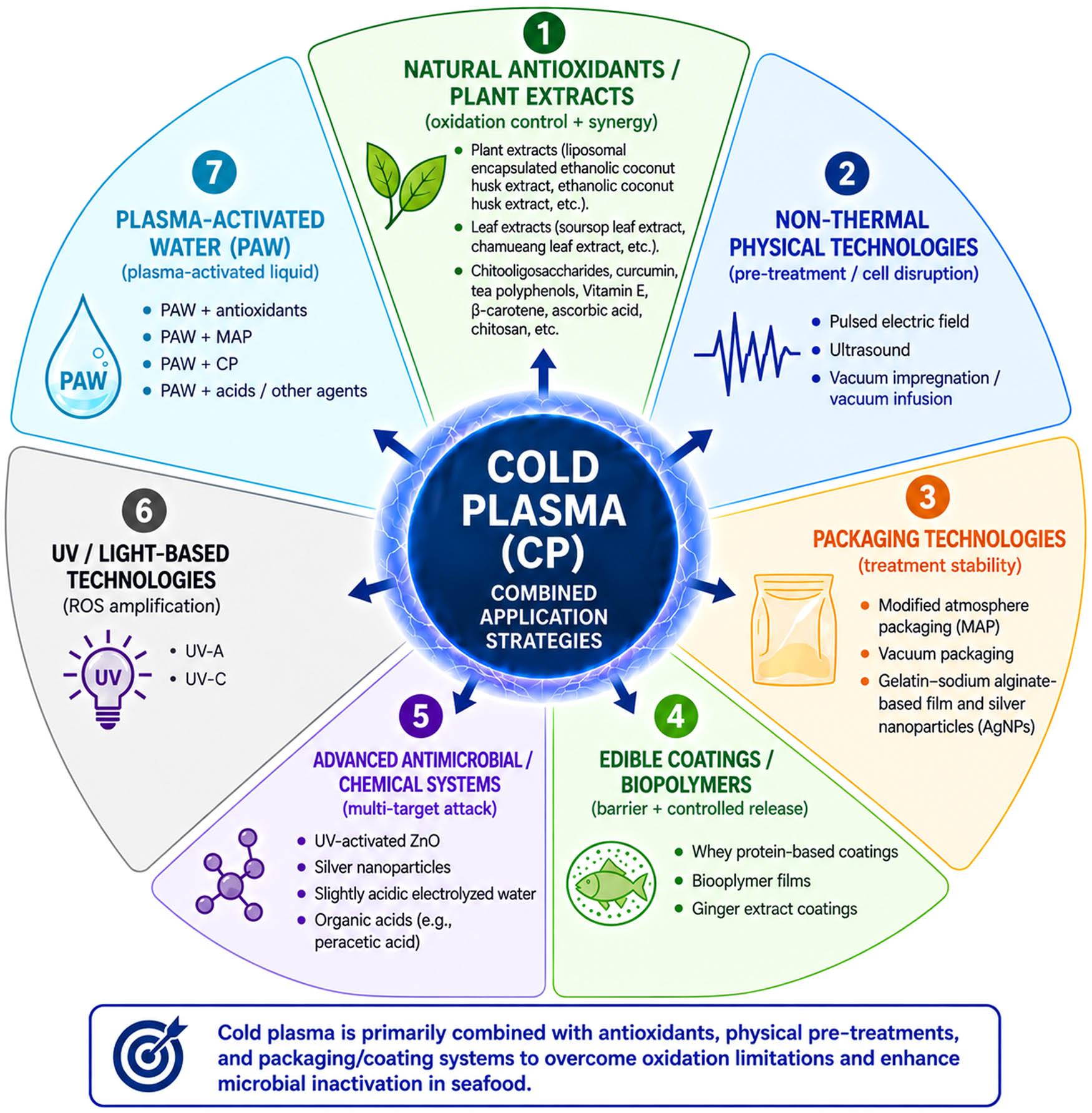
Figure 2
Functional and mechanistic classification of CP-based combination strategies for seafood preservation.
Source: Authors’ contribution, based on the literature cited in the manuscript.
Table 2
Oxidation-mitigating CP-based combination strategies applied in seafood systems
| Seafood matrix | Treatment | Main results | Implications/recommendations | Reference |
|---|---|---|---|---|
| Golden pompano | PAW, CF | PAW + CF delayed microbial spoilage, lipid oxidation, and TVB-N increase; improved colour and texture stability. CF pre-treatment followed by PAW was more effective. | Treatment sequence is critical. Natural antioxidants can complement PAW to improve microbial and oxidative stability. | Gao et al. (2024) |
| Rainbow trout | CP, phycocyanin | CP + phycocyanin inhibited microbial growth, delayed TVB-N and TMA-N formation, improved antioxidant activity, preserved fatty acids, and extended shelf life beyond 15 days at 4°C. | Phycocyanin can act as an antioxidant hurdle with CP; process conditions should be optimized for quality and safety. | Seyedalangi et al. (2024) |
| Pacific white shrimp | CP, CLE | CP + CLE reduced microbial load, melanosis, TVB, pH, TBARS, peroxide value (PV), and protein carbonyls; mitigated EPA and DHA oxidation and extended shelf life to ∼15 days at 4°C. | Natural antioxidant extracts can reduce plasma-induced oxidation while supporting microbial control and sensory quality. | Shiekh and Benjakul (2020) |
| Asian sea bass | Squid pen, COS, CP | CP + COS reduced microbial load, spoilage/pathogenic bacteria, TBARS, PV, carbonyl content, and PUFA oxidation; maintained sensory acceptability and extended shelf life to ≥ 12 days at 4°C. | COS provides dual antimicrobial and antioxidant protection; concentration should be optimized to maintain sensory quality. | Singh and Benjakul (2020) |
| Sea bass | CP, COS (0.05–0.2%) | CP + COS enhanced Pseudomonas reduction and decreased PV, TBARS, carbonyl content, TVB-N, and plasma-induced oxidation. | COS can improve microbial inactivation and oxidation control; gas composition and COS concentration should be optimized. | Singh et al. (2020) |
| White shrimp (Litopenaeus vannamei) | CP, chitosan oligosaccharide | CP + chitosan oligosaccharide inhibited microbial growth, reduced total viable count (TVC), TVB-N, and pH increase, delayed spoilage, maintained moisture and water activity, and extended shelf life. | Chitosan oligosaccharide can enhance microbial stability and shelf life while supporting physicochemical quality. | Yu et al. (2023) |
| Asian sea bass | CP, antioxidant (ascorbic acid), ECHE | CP + antioxidants, especially ECHE at 200 ppm, enhanced microbial reduction, delayed protein oxidation and degradation, preserved fatty acid profile, and extended shelf life to ≥ 15 days at 4°C. | Coconut husk extract can mitigate plasma-induced oxidation; antioxidant type and concentration require optimization. | Olatunde et al. (2019) |
| Asian sea bass | Liposomal encapsulated ECHE, CP | Liposome-encapsulated ECHE + CP reduced microbial load, lowered lipid oxidation compared with CP alone, maintained sensory quality, and extended shelf life. | Encapsulated plant extracts can improve oxidative stability and shelf life while preserving sensory quality. | Olatunde et al. (2020b) |
| Asian sea bass | Liposomal encapsulated ECHE, CP generated from O2/CO2/Ar gas mixture | Liposome-encapsulated ECHE + CP reduced microbial load, extended shelf life, reduced protein and lipid oxidation, and prevented discolouration compared with CP alone. | Liposomal encapsulation can enhance antioxidant efficacy and limit plasma-related quality defects. | Olatunde et al. (2020b) |
| Fish oil | Antioxidants (curcumin, tea polyphenols, vitamin E, β-carotene), CP | CP increased peroxide value, malondialdehyde (MDA), singlet oxygen formation, and unsaturated fatty acid loss in fish oil; antioxidants mitigated oxidation, with vitamin E showing the strongest protection. | Antioxidants, particularly vitamin E, can reduce CP-induced oxidation in lipid-rich systems; voltage and treatment time should be controlled. | Wang et al. (2024a) |
Source: Authors’ compilation based on the literature cited in the table.
Table 3
Microbial inactivation-enhancing CP-based combination strategies applied in seafood systems
| Seafood matrix | Treatment | Main results | Implications/Recommendations | Reference |
|---|---|---|---|---|
| Pacific white shrimp | PEF, VI with CLE (2%), CP | Reduced melanosis, microbial load, TVB, lipid oxidation, and protein carbonyls; preserved sensory quality and extended shelf life to ∼18 days at 4°C. | PEF and VI can enhance CP with natural extracts; PEF intensity, VI time, and extract concentration should be optimized. | Shiekh et al. (2021a) |
| Litopenaeus vannamei | PEF, CLE, CP | Reduced melanosis and microbial load; delayed PV, TBARS, TVB, and protein carbonyl content (PCC) formation; improved sensory quality and shelf life. | PEF-assisted CLE pre-treatment can improve microbial control and oxidation stability before CP. | Shiekh et al. (2021b) |
| Pacific white shrimp | Soursop leaf extract, CP, PEF, VI, MAP | Reduced pH, TVB-N, and microbial growth; improved quality preservation compared with less complex treatments. | Multi-hurdle systems integrating non-thermal technologies, plant extracts, and packaging can improve stability and shelf life. | Ahmad et al. (2025) |
| Smoked salmon and brain heart infusion (BHI) agar | UV-C light (UV-C), CP | UV-C or CP alone gave limited reductions on smoked salmon; UV-C + CP improved inactivation, but high intensity increased lipid oxidation and antagonism. | UV-C + CP may enhance decontamination, but intensity should be optimized to avoid oxidation and antagonism. | Colejo et al. (2018) |
| Fish processing water | ultraviolet A (UV-A), CP | UV-A + CP improved microbial inactivation and compound degradation compared with CP alone through enhanced reactive species formation. | UV-A-assisted CP is promising for seafood processing water decontamination; efficacy should be validated under industrial conditions. | Zorzi et al. (2023) |
| Steamed fish cake | UV-activated ZnO, in-pack CP | UV-A + CP improved microbial inactivation and compound degradation compared with CP alone through enhanced reactive species formation. | Treatment sequence is critical; photocatalytic pre-treatment followed by CP can improve ready-to-eat (RTE) seafood safety. | Lee et al. (2022) |
| Mackerel | Ultrasound, PAW, and peracetic acid | Increased reactive species generation and microbial inactivation, although reductions on fish were not always greater than individual treatments. | Combined chemical/non-thermal treatments require optimization as higher reactive species do not always increase inactivation on seafood. | Zhao et al. (2021) |
Source: Authors’ compilation based on the literature cited in the table.
Table 4
Shelf-life-oriented and stability-enhancing CP-based combination strategies applied in seafood systems
| Seafood matrix | Treatment | Main results | Implications/recommendations | Reference |
|---|---|---|---|---|
| Nile tilapia (Oreochromis niloticus) | Liposome loaded with Betel leaf ethanolic extract (L/BLEE), MAP (CO2 60%, Ar 30%, O2 10%), CP (80 KV-RMS, 5 min) | L/BLEE + MAP + CP inhibited microbial growth, induced bacterial cell damage, and extended shelf life to ∼12 days at 4°C. | Encapsulated plant extracts with MAP and CP can enhance antibacterial efficacy; process conditions should be optimized. | Tagrida and Benjakul (2022) |
| Nile tilapia (Oreochromis niloticus) | L/BLEE or unencapsulated BLEE (U/BLEE), MAP (CO2 60%, Ar 30%, O2 10%), CP (80 KV-RMS, 5 min) | L/BLEE or U/BLEE with MAP + CP extended shelf life and maintained sensory acceptability for ∼12 days at 4°C. | BLEE-based MAP + CP combinations can be used as hurdle strategies to extend fish shelf life. | Tagrida et al. (2021) |
| Steamed fish paste | Whey protein coating containing malic acid (MA-WPI), CP | MA-WPI coating + in-package CP enhanced Salmonella and Listeria monocytogenes inhibition during storage; CP promoted malic acid diffusion from the coating. | CP-enhanced diffusion from active coatings can improve microbial safety and storage stability of RTE seafood. | Jeon et al. (2022) |
| Asian sea bass (Lates calcarifer) | Prior PAW, WPI–ginger extract coating | PAW + WPI–ginger extract coating reduced discolouration, drip loss, texture softening, off-flavour compounds, and lipid/protein/myoglobin oxidation. | PAW + WPI–ginger extract coating reduced discolouration, drip loss, texture softening, off-flavour compounds, and lipid/protein/myoglobin oxidation. | Chaijan et al. (2022) |
| Half-smooth tongue sole (Cynoglossus semilaevis) | PAW, packaging (vacuum/air/various MAP combinations), superchilling | PAW followed by MAP, especially 75% CO2/5% O2/20% N2, reduced microbial growth and TVB-N increase and improved protein stability. | Optimized MAP after PAW can enhance preservation, but high CO2 may cause packaging and sensory defects. | Qiu et al. (2026) |
| Asian sea bass (Lates calcarifer) | CP, PAW | PAW + CP delayed microbial growth, reduced Pseudomonas, pH, and TBARS, improved sensory quality and water-holding capacity, and extended shelf life. | PAW–CP can enhance disinfection and shelf-life extension; industrial application requires process optimization. | Wang et al. (2024c) |
| Asian sea bass (Lates calcarifer) | CP, PAW | PAW + CP increased volatile flavour compounds but promoted lipid oxidation by increasing saturated and decreasing unsaturated fatty acids. | PAW–CP may modify flavour, but lipid changes should be controlled through optimized treatment conditions. | Wang et al. (2024b) |
| Atlantic salmon | PAW, SAEW | PAW + SAEW enhanced antimicrobial efficacy and cell damage while maintaining colour and texture and limiting lipid oxidation. | Plasma-activated SAEW is a promising green approach for microbial control without major quality loss. | Zhu et al. (2023) |
| Trout | Gelatin and sodium alginate (GSA) based packaging film, AgNPs, CP | CP-treated GSA-AgNP films improved barrier properties and antimicrobial activity and reduced TBARS, TVN, and microbial load. | AgNP-incorporated biodegradable films with CP can improve fish preservation; AgNP level and CP conditions require optimization. | Tahmouzi et al. (2025) |
Source: Authors’ compilation based on the literature cited in the table.