
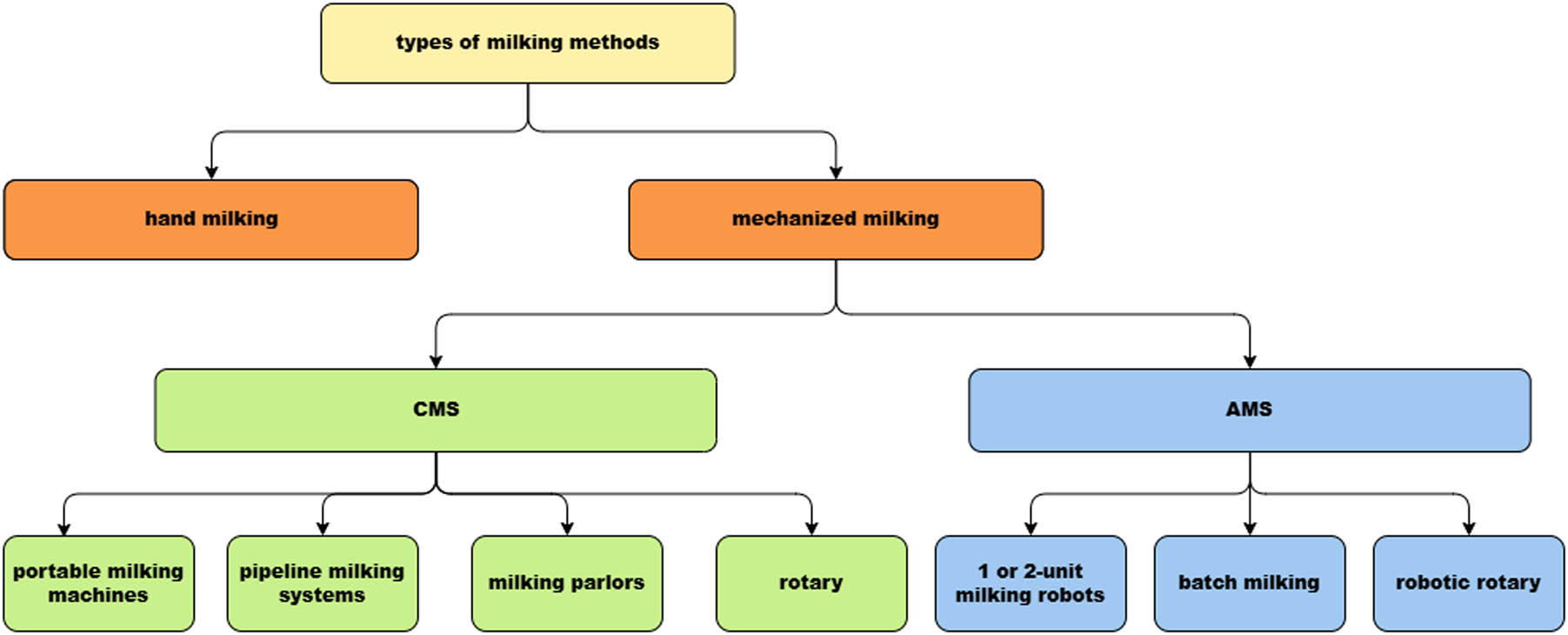
Figure 1
Types of milking methods.
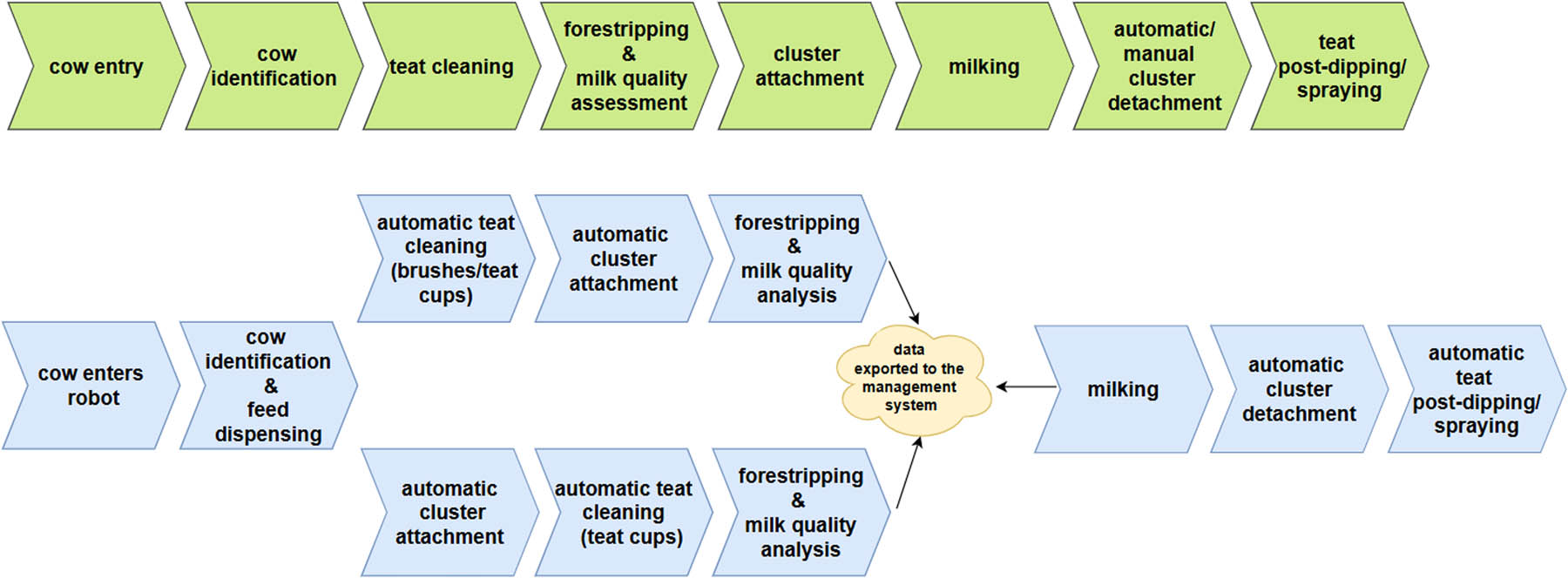
Figure 2
Workflow comparison between CMS (green) and AMS (blue).
Source: data adapted from Simões Filho et al., 2020 and Meijering et al. (2004).

Figure 3
AMS sensor framework and mastitis detection pipeline.
Source: data from Boerman et al. (2025).
Table 1
Criteria used by different AMS manufacturers to generate alerts for potential udder health problems (Bausewein et al., 2022)
| AMS manufacturer | Basis for mastitis alert generation |
|---|---|
| DeLaval | Mastitis detection index, a composite indicator combining quarter-level EC, detection of blood in milk, and milking interval. Threshold values are set at ≥1.4 for further examination and ≥2.0 for acute alerts. MCA sensor. |
| GEA Farm Technologies | Udder health monitoring relies on lists generated from deviations in EC: List 1 includes cows with inter-quarter EC differences of at least 30% (with a minimum EC value above 400), while List 2 captures intra-quarter deviations of ≥110%. Cows present on both lists are classified as acute cases. |
| Lely | A multi-factor approach is applied, incorporating milk yield, EC, milk temperature, and SCC. Alerts are generated when milk yield drops by ≥4 kg or 20% (or more than 7 kg/day), EC changes by at least 20% relative to the previous milking or 3 days average with an absolute value ≥100, temperature exceeds a deviation factor of 2.0, and SCC reaches ≥500 (measured by the MQC-C system). |
| Lemmer-Fullwood | The 4QCM system detects potential cases by monitoring quarter-level EC, with alerts triggered when values rise by ≥35% compared to the 10 days average or exceed 7.5 mmho during the ongoing milking. |
Source: data from Bausewein et al. (2022).