
1. Introduction
For several decades, the number of animals kept in dairy cattle herds has been increasing. The size of dairy cattle herds in the past was limited by the number of people needed to manage the herd, particularly for the milking process (Clay et al., 2020). Milking using conventional milking systems (CMSs) usually takes place twice a day (TAD) (Uí Chearbhaill et al., 2024), in the early morning and in the afternoon. Due to the time-consuming nature of the work and sometimes the distance from the place of residence, it is increasingly difficult for owners of dairy herds to find suitable employees to hire. A less popular system involves milking once a day (OAD) (O’Driscoll et al., 2012). This system is very convenient for farmers because it saves time and financial outlays for employee salaries. However, milking OAD compared to TAD tends to raise the individual cow’s somatic cell count (SCC) (Lacy-Hulbert et al., 2005). In contrast to this, in barns with an automatic milking system (AMS), the three-times-a-day milking model is common. Milk from cows milked using this model has a lower SCC than that from cows milked TAD (Bortacki et al., 2017). The number of milkings per day varies among different cows in a herd equipped with AMS. In their research, Lambrecht-Szambelan et al. (2025) proved that the lowest number of milkings per day occurs for primiparous cows, averaging 2.84 milkings/day, followed by cows in early lactation, at 3.00 milkings/day, and with the highest frequency, 3.09 milkings/day, for cows producing ≥45 L milk/day.
The milking process consists of a number of tasks. In a CMS, udder cleaning, pre-dipping, cluster attachment, post-dipping, and other milking-related activities are performed by farm staff. Proper performance of these procedures is crucial for milking hygiene. The milker’s personal hygiene is the second important factor aimed at preventing udder inflammation caused by infectious factors (Raisatulhaq et al., 2025). Unfortunately, in CMSs, the milking routine is often not maintained or it is performed in an improper way. This is due to a lack of awareness or insufficient knowledge among people involved in the milking process and the lack of availability of courses on this subject.
A study by Rodriguez et al. (2025) based on the assessment of the milkers’ knowledge before and after specialized training showed that this knowledge is insufficient and requires supplementation. One hundred and twelve dairy farm workers participated in a study covering specialized training. Topics included such issues as mastitis definition, milking routine, identification of clinical udder inflammation, and abnormal milk. The participants’ knowledge about milking hygiene increased from only 49.3 to 67.6% after the training (Rodriguez et al., 2025). Improving the skills of dairy farm workers is very important for reducing the incidence of mastitis.
Some of these problems can be solved by AMSs. First, AMS reduces the number of people needed for milking process without the need to reduce the frequency of milking the cow on a daily basis. Second, robotic milking is a fully automated, sequential process that allows inconsistencies related to human workforce to be avoided. Cows voluntarily enter the milking box and are identified via a radio-frequency identification system or electronic tag. The next steps involve cleaning the udder and attaching the milking cups. During the main phase of the milk harvesting, milk flow is monitored in real time. At the same time, a number of sensors monitor the milk for its quality and udder health indicators. After milking, the cluster is removed and post-dipping procedures are performed, after which the cow exits the milking unit. The data are recorded and processed in a computer management system, supporting herd management and health monitoring.
2. Objectives
In many dairy herds around the world where cows are milked in traditional parlors, farmers are not able to personally check the udder health of each cow in the herd every day. This means they must rely on employees who do not always perform their duties with due diligence due to the reasons pointed out previously. This entails an increased risk for more frequent occurrence of udder inflammations in herds. It is worth noting that mastitis is recognized as one of the most financially damaging diseases of dairy cattle worldwide.
Adoption of AMSs may help to solve many problems that dairy farmers face. Thanks to the possibility of monitoring the milk parameters of every cow in the herd in real-time, robotic milking creates opportunities that are crucial for dairy farmers. First, AMS gives the chance for ongoing monitoring of udder health status. Second, due to the use of advanced algorithms in related computer applications, it reduces the time that is necessary to identify sick cows and make a decision. In practice, this means that the farmer can see on the screen of his PC or smartphone which animal requires veterinary intervention due to suspected mastitis in real-time (Deng et al., 2020a).
Quick detection of the disease gives the animal a chance to recover. It also reduces financial losses related to treating sick animals, milk losses during the withdrawal period, the drop in milk production, culling, and also limits transmission of infectious pathogens causing udder gland inflammation. This review aims to present AMSs as a tool for quick detection and control of mastitis in dairy cattle herds.
3. Types of milking systems
Cow milking is divided into manual (hand milking) and mechanized systems. Mechanized milking is categorized into CMSs where the milking process is performed by farm staff, and AMSs where the milking process is automated and performed by robotic units (Figure 1).
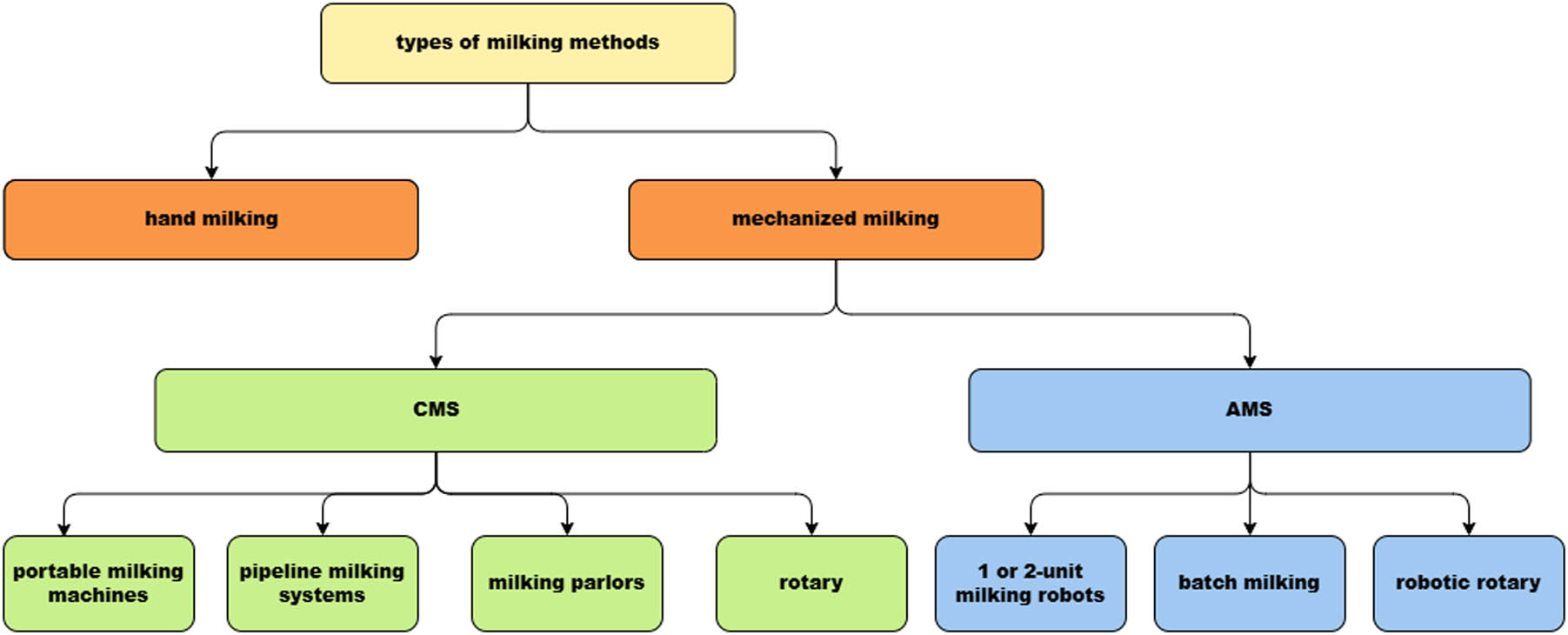
Figure 1
Types of milking methods.
There are four main types of milking parlors in a CMS: herringbone, tandem or side open, parallel, and rotary. To avoid economic losses or underutilization of the milking parlor’s potential, it should be selected for each farm individually (Chiumenti et al., 2020). In robotic milking applications, the number of the milking units depends on herd size. In most cases, farms are equipped with 1 or 2 units, less often several boxes that can be found in larger herds. In herds of several hundred dairy animals, so-called “batch milking” is becoming increasingly popular. This option is indicated as an automated alternative to traditional rotary systems.
4. AMS
The first commercial AMS was implemented in 1992 in the Netherlands (Meijering et al., 2004). There are three very common types of milking robots, which can handle one to four cows at a time, depending on their design. Integrated AMS, the most prevalent system, performs the milking process on one animal at a time. The second category is industrial robotic AMS, which can handle the milking process at various stages for two cows at a time. The last one is the automatic milking rotary system. This system can handle four animals at a time, including pre-milking hygiene, milking, and post-milking hygiene (Jiang et al., 2017).
In barns where AMS has been installed, cows can move in different traffic systems – free, forced, and guided. A free traffic system means that the cows can move freely around the barn and choose how often and when they will visit the milking robot without having to be milked in order to access feed or other resources. In the forced or guided traffic system, a cow is directed through one-way gates (forced traffic system) or through gates that use selection criteria to control access to different parts of the barn – such as the lying or feeding area – in various configurations, either before or after milking (guided traffic system) (Busanello, 2024).
The choice of the traffic system can impact farm productivity. Some researchers confirm that cows in a barn where they move freely produce more milk than cows in a barn with forced traffic system (Unal et al., 2017; Tremblay et al., 2016). The prevalence of particular traffic systems differs around the world. In Europe and other regions (Canada, Chile, Argentina, Colombia, Uruguay, South Africa, Australia, New Zealand, Israel, Japan, Korea, China, India, Liechtenstein, and Taiwan), 54.9% of farms with AMS, without access to pastures, use free traffic barns. On the other hand, in the United States, guided flow (milk first) prevails, at 37.5%, followed closely by free traffic, 33.3% (Marques et al., 2023).
An important issue may be the possibility of adapting the cow to automatic milking. In a study of primiparous cows that had not previously been exposed to AMS, it was proven that they adapted to the robotic milking system as well as or better than those that had undergone specialized training (Brasier et al., 2025). Moreover, other authors indicate that in domestic cattle, the speed of learning to use the milking robot and the frequency of milking are related to the herd hierarchy. The higher the cow is in the hierarchy, the higher both parameters are (Johansen et al., 2025b, 2025c).
When planning the implementation of robotic milking systems on a farm, the farmer should consider the number of milking cows and the number of milking robots required. The herd size should be decided in advance, taking into account that further expansion of the herd may be difficult or even impossible due to the capacity of the milking system. When modernizing existing barns for the installation of AMS, the number of robots must also be appropriately adjusted to ensure that the milking process runs without disruption. To utilize the potential of the milking robot, it is recommended that there be approximately 60 cows per one unit of AMS (Bach & Cabrera, 2017; Veysset et al., 2001).
In 2025, the largest dairy farm in Poland was inaugurated in Cieszymowo, featuring 25 milking robots. The system is ultimately designed to accommodate and manage up to 1,500 dairy cows per day.
The milking robot models offered by various companies may perform the milking routine steps in different ways. Nonetheless, all AMS models work in a similar manner. Milking starts with cow identification, then the robot detects the udder and teats, cleans the teats of mechanical dirt (e.g., with water, rollers). The next steps involve pre-dipping, attaching the teat cups, milk harvesting, and post-dipping (Simões Filho et al., 2020) (Figure 2).
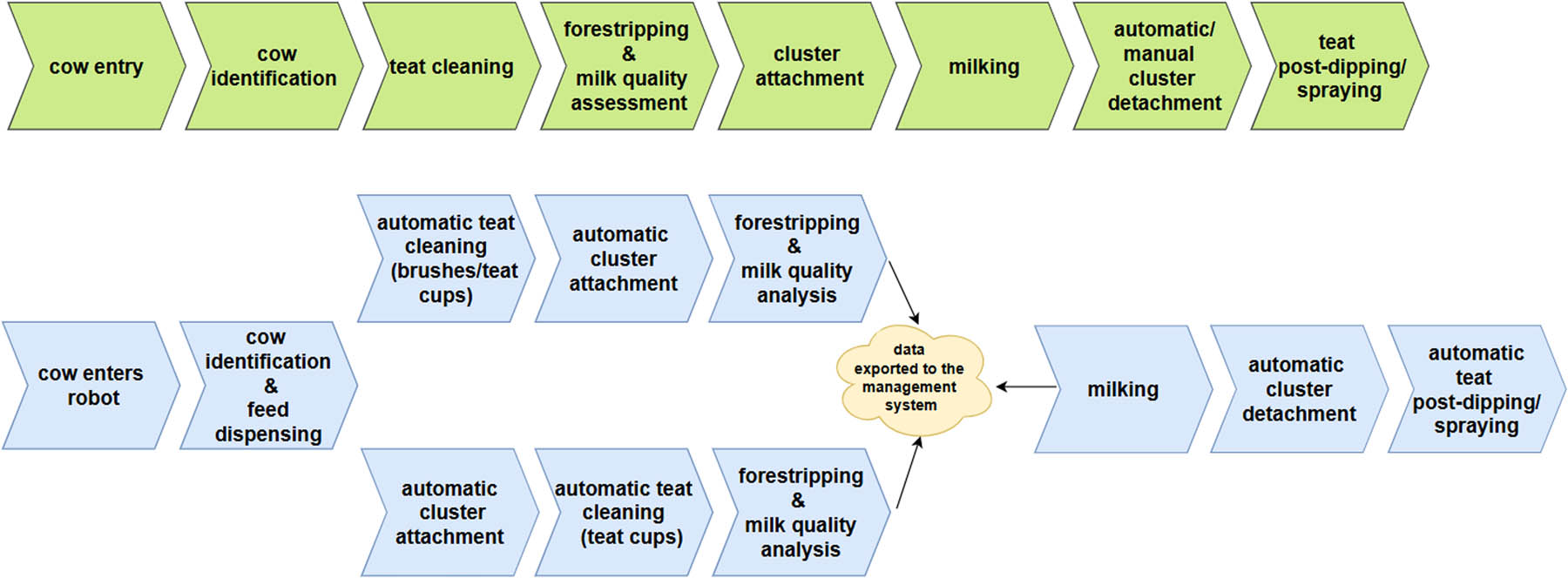
Figure 2
Workflow comparison between CMS (green) and AMS (blue).
Source: data adapted from Simões Filho et al., 2020 and Meijering et al. (2004).
The main factor that attracts a cow to the milking robot is the feed. Cows get a separate amount of concentrate during every milking session. It has been shown that cows do not lose their motivation to visit the milking robot when the amount of concentrate fed in it is lower and there are other places to feed in the barn besides the robot (Johansen et al., 2025a). Moreover, some studies indicate (Piwczyński et al., 2023) the favorable statistical effect of the presence of additional feeding stations in the barn on the frequency, speed, and efficiency of milking as well as on milk output.
Robotic milking creates vast potential for herd management. AMSs collect huge amount of data from each single milking episode. Sensors mounted in the milking robot allow basic data to be harvested, such as the number of milkings per day, daily yield, or the milk flow rate for each cow (Hooker et al., 2025), but the list of collected information can be much more extensive and may include, for example, the number of cluster attachment attempts, the time needed for teat cup attachment, the time spent in the milking box, milking time, etc. (Sitkowska et al., 2025; Piwczyński et al., 2023).
Additionally, some manufacturers equip their milking units with a dedicated sensor that enables detection of mastitis, measuring SCC, color, electrical conductivity (EC), and lactate dehydrogenase (LDH) level (Steeneveld et al., 2015). The milk progesterone level sensor is also noteworthy, as regular measurements allow for managing the herd’s reproduction (Bruinjé et al., 2025). Not all sensors are included in the robot’s basic unit. They are selected according to individual farmer’s preferences.
There are various types of software on the market that aim to support the management of dairy cow herds. Among them, there are data management systems for the information that the milking robot collects during each milking (Boerman et al., 2025) (Figure 3).

Figure 3
AMS sensor framework and mastitis detection pipeline.
Source: data from Boerman et al. (2025).
AMSs offer several important advantages, including reduced labor demands, milking flexibility, and the ability to collect detailed, real-time data supporting herd management and early disease detection (e.g., mastitis or reproductive status). Cows gain improved animal welfare in free traffic systems that allow cows to express more natural behavior patterns.
In addition to their many benefits, AMSs also have limitations. High investment and maintenance costs, the need for proper barn design, and herd size optimization can be challenging for the investor. Similarly, the multitude of system configurations (e.g., traffic type, sensor selection) and related decisions can impact overall farm efficiency and performance, farmer satisfaction, and willingness to learn new things, especially if poor choices were made at the outset. In addition, some limitations may be the need for the operator to be comfortable using a computer and, depending on the herd management system used, the ability to properly interpret the information presented therein.
5. Mastitis and its risk factors in barns equipped with AMS
Mastitis (mammary gland inflammation) can be caused by various etiological factors including allergies, traumas, or metabolic and physiological changes in the body, but most often it is caused by microorganisms (Alnakip et al., 2014). These involve a wide spectrum of bacterial strains, viruses, fungi, mycoplasmas, algae, and yeasts (Krukowski et al., 2020). Etiological microorganisms are divided into infectious, environmental, and opportunistic (living on the teat skin and not dangerous as long as the cow stays in good health) (Sarma & Hussain, 2021). Some of them, like Streptococcus uberis, may be classified as both environmental and infectious pathogen (Naranjo-Lucena et al., 2025; Leelahapongsathon et al., 2020).
The number of somatic cells (SCC) in one milliliter of milk is used to assess the health status of the mammary gland (Cobirka et al., 2020). The specificity of the SCC measurement in milk as a diagnostic indicator for new intramammary infections is considered to be high (Dohoo and Leslie, 1991). Somatic cells in milk mainly consist of epithelial cells, polymorphonuclear neutrophils, macrophages, and lymphocytes (Li et al., 2014). Their increase in milk beyond the normal physiological level provides information about an ongoing infection in the mammary gland, mechanical injury, etc. Vargas Jurado et al. (2026), based on their own outcomes, and the results from Carvalho-Sombra et al. (2021) indicated that SCC values increase both in the clinical form and in subclinical mastitis as a result of immune response. Nonetheless, some differences in the pattern of those increases are visible.
The European Union does not allow for human consumption of milk with a SCC exceeding 400,000 cells per 1 mL. However, this is not a limit that determines the health status of the udder gland (Kaskous, 2021). A mammary quarter is deemed to be healthy when the SCC level is below 100,000 cells/mL of milk. On the other hand, in field conditions, an SCC below 200,000 cells/mL of milk is widely used as the threshold level to differentiate healthy udders from subclinically affected ones. This approach has a practical meaning for reducing diagnostic error (Sumon et al., 2020).
The prevalence of subclinical mastitis in dairy herds varies around the world. Some studies have shown that it amounts to 36.7% of cows in North-East Poland (Sztachańska et al., 2016), 46.35% in India (Bangar et al., 2015), 50.4% in Rubavu and Nyabihu districts, Western Rwanda (Mpatswenumugabo et al., 2017), 37.7% in China (Chen et al., 2022), 46.4% in Brazil (Busanello et al., 2017), and 19.0 % in Finland (Hiitiö et al., 2017). Even if the studies were not conducted on the same number of animals in a given country, the results show the magnitude of the problem of subclinical mastitis.
An increase in the number of SCC results in a decrease in milk production efficiency per cow (Costa et al., 2019). Moreover, milk containing SCC s exceeding the accepted norms cannot be sold as it is deemed inedible, which creates extra economic losses for farmers. These reasons and the high prevalence of mastitis in dairy herds make the awareness of mastitis risk factors an important issue for breeders. Understanding those risks is crucial for their elimination. Mastitis risk factors in barns using milking robots can be related to both the environmental condition in barn and the individual cow characteristics.
The teat canal is the gateway to infection. Studies show that the teat canal is not closed immediately after the milking process is complete, creating a great opportunity for the mastitis-causing pathogens to enter the udder through the teat canal (Facciuolo et al., 2025). Strapák et al. (2017) showed in their research that the front teats need at least 2 h to return to their pre-milking diameter, and the rear teats need more than 2 h.
To reduce the likelihood of new intramammary infections occurring, cows leaving the milking robot should avoid lying down during the period of teat canal closure. In free-traffic barns, the ability to restrict cows from lying down immediately after milking is limited, as the animals have unrestricted access to all areas of the barn. After milking, if a cow rests on a lying area that is heavily contaminated with pathogens, then there is a high probability that they will enter the udder gland. Therefore, the cleanliness of the cow and the bedding material used in the barn are crucial. In studies, it has been proven that significant contamination of the udder gland, the tail area, or the abdomen affects the increase in somatic cells in milk (Pytlewski et al., 2022).
Bedding material in the lying area is an important factor for the cow’s cleanliness. Cows kept in barns featuring laying pens bedded with sand are cleaner than those kept in barns with mattresses and waterbeds (Salfer et al., 2018). In addition to sand, bagasse is a very good bedding material. However, this is not easily accessible and commonly used bedding material in European countries. Shahedani et al. (2024) tested five bedding materials (bagasse, sand, pumice, manure, and manure and soil), and the lowest level of somatic cells was observed in cows kept on sand, whereas the lowest number of bacteria was recorded on bagasse. Other research has shown that among organic non-manure materials, manure solids, reclaimed sand, and new sand, the last two had the lowest counts of the mastitis-causing bacteria, Staphylococcus, coliforms, and Klebsiella spp. (Patel et al., 2019). Nonetheless, a study of 2,889 cows from 78 herds showed that none of the four bedding materials tested (manure solids, new sand, recycled sand, and organic non-manure) had significantly lower rates of intramammary infection in late-lactation dairy cows (Rowe et al., 2019). On the other hand, research by Poli et al. (2025) indicates that animal bedding conditioners with certain types of bedding materials can help reduce the number of environmental mastitis pathogens. The abovementioned results clearly indicate that a poor quality of surface in the lying area creates a real risk of an intramammary infection for cows kept in those conditions.
The udder consists of four independent quarters, which differ in the amount of milk they produce. The front teats show lower milk yield. They also show a higher risk of hyperkeratosis, which can be caused by many factors. One of these is over-milking (Cerqueira et al., 2018). A common cause of over-milking is an improperly set teat cup detachment (take-off) level. If the threshold is set too low, the robot will continue milking even at a minimal milk flow, prolonging the contact time of the teat cups with the teats. One of the most negative consequences of this neglect may be an increased risk of mammary gland inflammation. Teat hyperkeratosis is a predisposing factor for subclinical or clinical mastitis (Pantoja et al., 2020). Clinical mastitis cases in primiparous cows were more often noted in the front quarters than in the rear quarters (Guarín et al., 2017). In contrast, increasing the teat cup detachment threshold reduces the extent of over-milking while having no significant effect on milk flow characteristics, thereby improving milking efficiency (Ferneborg et al., 2019).
The success and efficacy of a milking procedure in AMS depends on many factors such as the presence of hair on the udder, teat color, udder and teat structure and condition, and also cow behavior (Hovinen et al., 2005). Nogara et al. (2025) proved that the AMS type, and especially the way in which the cow’s udder is cleaned before milking, affects the prevalence of mastitis and the main type of pathogens infecting the udder gland. Robotic units that use teat cups for teat cleaning have a lower prevalence of subclinical mastitis in cows compared to those that use rotating brushes for teat cleaning. This discovery may have practical implications and be a decisive factor for farmers looking for solutions for their herd.
Moreover, various factors such as age (Kurjogi & Kaliwal, 2014), breed (Govignon-Gion et al., 2016), blood group (Larsen et al., 1985), stage of lactation (Sinha et al., 2021), factors related to several physiological and immunological changes in the udder during the dry period (Egyedy & Ametaj, 2022), milk yield (Koeck et al., 2014), and udder conformation (Nakov et al., 2014) are all related to the occurrence of mastitis in dairy cows.
Mastitis is a multifactorial disease, which in its subclinical form is possible to recognize only with the use of indirect methods such as assessment of SCC in milk. Measurement of SCC s, despite being a useful tool, does not fully capture the complexity of mastitis, particularly in distinguishing between clinical and subclinical forms and their causes.
The environment of the barns plays important role in the prevalence of mammary gland infections among cows. Knowledge about cows’ behavior and cow-environment interactions, and knowledge of the operating principles of devices are crucial for making proper management decisions, including those that directly impact udder health.
Unfortunately, despite numerous studies carried out to find out the best possible solutions for barns equipped with AMS, researchers still do not have one correct answer. The reasons for this situation are variability in study design, herd size, geographical conditions, the different approach of AMS manufacturers to some aspects like teat cleaning and management systems, etc. There is also a lack of standardized thresholds and unified methodologies for presenting information among AMS originating from different manufacturers. All these factors together limit the comparability of results and complicate the development of universally applicable guidelines for mastitis prevention and control.
6. Mastitis monitoring in AMS
The primary difference between AMS and CMS is that in AMS, the milking process is not supervised by a human. This presents new challenges and opportunities in the context of predicting which cows are at risk of developing an inflammation of the udder gland. The main limitation of AMS is the lack of or rare detection of clinical mastitis during the milking process compared to milking performed by humans. On the other hand, milking robots can detect udder inflammation at an early stage due to the measurement of milk parameters at each milking.
The basic equipment of a milking robot includes systems for detecting and identifying cows, a robot arm for cleaning the udder and attaching milking cups, systems for monitoring milking parameters (e.g., milk flow), modules for cleaning and disinfecting the udder, as well as a central unit and software for managing the process. It is also crucial that the station is equipped with a feeding manger and a milk filtration system.
To control milk composition and its physical features, robots are equipped with a proper set of different sensors, which differ between AMS brands. In addition to the robot, the hardware is supported by software based on algorithms that analyze parameters and inform farmers about important incidents like the risk of mastitis in real-time. Sensors can measure, among other things, EC, temperature, color, LDH activity, or determine the SCC in milk.
Milk in an infected quarter, compared to healthy ones, has higher EC. This is due to the increased concentration of anions and cations (Na+ and Cl−) (Norberg et al., 2004). The quarter-level measurement of milk EC, whether it is first, second, or third or later lactations, is characterized by higher detectability of the clinical form of mastitis than measurement at the whole udder level (Inzaghi et al., 2021). The specificity of this test is high, but the test is not sensitive enough for farmers to rely on its results alone when making a diagnosis. In a study conducted by Lien et al. (2016) on 48 cows, specificity of 83.7% and sensitivity of 46.2% were found. The temperature of the milk is essential for EC to be interpreted correctly, as it affects the result (Kunes et al., 2021). The abovementioned limitation of method results in the fact that the robots’ software informs the herd manager about suspected disease in individual animals, rather than categorically indicating it. Cows identified by the device should undergo further diagnostic procedures.
The color changes of milk are a very important indicator of mastitis. Healthy milk is usually white. Milk from cows with mastitis may have changed color, for example, becoming yellow or pink (which indicates the presence of blood in the milk) (Amran et al., 2025; Kamphuis et al., 2008). Milk color may provide useful diagnostic information; however, due to its limited sensitivity and specificity when used as a standalone parameter, it is not applied independently for mastitis detection but rather in combination with other milk quality indicators.
Mastitic cows have higher LDH activity than healthy ones (Atroshi et al., 1996). LDH and immunoglobulin G (IgG) cross the blood-milk barrier when cohesion is reduced. Increased transport of IgG from blood to milk occurs when there is an intramammary infection, mainly due to gram-negative bacteria (Khatun et al., 2022). In the literature, there are notable discrepancies regarding the diagnostic sensitivity and specificity of LDH for mastitis detection, with reported values varying depending on study design, population, and selected cut-off thresholds. Moreover, LDH is not typically used as a standalone marker for mastitis diagnosis in practice, but is mainly applied in combination with other indicators, such as SCC, to improve overall diagnostic accuracy.
The SCC remains one of the primary methods of mastitis diagnosis. Due to the labor-intensive nature of measurements, SCC is not available at high sampling frequencies at the individual cow level on most farms, especially on farms that milk cows in the conventional manner. In contrast, some helpful solutions have already been developed and introduced by one of the AMS manufacturers. Online cell counts can serve as a potential tool for detecting new cases of clinical mastitis as well as episodic subclinical mastitis (Dalen et al., 2019). This solution has been implemented on the market in the latest generation of AMS platform features as a novel solution, milk cell analysis (MCA). The sensor uses somatic cell fluorescent staining, and the analysis of fluorescence allows the milking robot to precisely count the number of the somatic cells in the milk.
Although counting SCC seems to be interesting and effective, some disadvantages of this approach still exist. First, a single measurement of the SCC in milk by AMS is not as accurate as a measurement performed in a professional laboratory. However, repeated measurements on the same cow within a day result in a positive correlation with laboratory measurements (Deng et al., 2020a). Finally, the capability of AMS milking robots to perform multiple measurements makes this solution valuable for herd managers.
Sensors are one side of a coin, while the other is computer software. A properly functioning computer system that precisely identifies events in the herd and provides effective information about them is a key part of the AMS in the context of using the data it collects for management and reducing workload. Many computational algorithms currently being researched and used are sufficiently efficient to be used in practice but there still remains some room for improvement.
The study conducted by Yesil & Goncu (2024) developed an multilayer perceptron (MLP) model using five milk parameters (SCC, EC, pH, density, and foremilk temperature) to classify mastitis into four levels, achieving high accuracy (∼95%). Notably, the model outperformed traditional logistic regression and effectively detected particularly challenging subclinical cases. Also worth noting is that the choice of SCC thresholds significantly affects diagnostic outcomes. Nonetheless, the model shows strong potential for application in automated milking systems (Yesil & Goncu, 2024). The implementation of such a model in automated milking systems has the potential to address the challenge of diagnosing subclinical udder inflammation. Milk flow profile data combined with milking machine sensor data and weekly milk composition measurements can be used to train machine learning models for detecting subclinical mastitis (based on elevated SCC s), achieving an area under the curve of 0.793 (Jin et al., 2024).
Currently, machine learning models and artificial intelligence are rapidly developing and are increasingly applied in automated milking systems. They enable the early detection of mastitis based on milk production and quality data. Pan et al. (2025) investigated the use of machine learning models logistic regression, support vector machine and neural networks (feedforward neural network) for detecting mastitis in dairy cows based on data such as SCC and EC. This study shows that the use of accurate and reliable time-specific SCC or EC data enable machine learning algorithms to effectively classify milk samples into healthy and clinical mastitis categories. Their results demonstrate that SCC is a significantly more reliable indicator than EC, as well. The authors highlight the significance of combining different parameters in calculating models. In their opinion, such an approach may offer practical advantages in real-world applications where accurate real-time data (e.g. SCC, EC, etc.) acquisition is challenging. The incorporation of many features can enhance model robustness and diagnostic stability, particularly in settings lacking high-precision sensors or where measurements are intermittently unreliable. The study also highlights the need for the development of high-precision sensors and further validation of these models under practical farm conditions. The application of machine learning for detecting intramammary infections in dairy cows based on milk cellular indicators (SCC; differential SCC; neutrophils + lymphocytes count/mL; polymorphonuclear leukocyte count) has been shown to be an effective method in identifying healthy animals by Zecconi et al. (2025). Similarly, these researchers point out the need for further improvement in detecting diseased cases.
One interesting proposal comes from Abdul Ghafoor & Sitkowska (2021). MasPA, a machine learning application to predict risk of mastitis in cattle from AMS sensor data is a machine learning-based solution that can predict the risk of mastitis in cattle from the inhale and exhale limits of their udder and their temperature with an accuracy of 98.1% and sensitivity and specificity of 99.4 and 98.8%, respectively. The huge advantage of this approach is that the necessary data can be harvested via highly affordable sensors. Moreover, these sensors can be integrated into an AMS.
In contrast to the previous authors, a study by Bausewein et al. (2022) on detecting the clinical form of mastitis conducted in Bavarian dairy herds using AMS from different manufacturers showed that specificity ranged from 79 to 97%, while sensitivity ranged from 31 to 78%. Additionally, each manufacturer of milking robots uses different reference values for potential udder health problems. Generally, the results from this study indicate that the detection level was sufficient. However, low specificity can result in unnecessary milk discards and an additional burden on farmers to monitor their animals. Moreover, new solutions are being developed that allow for the prediction of mastitis 1 day before clinical symptoms appear. These solutions have their limitations, which are being addressed (Dharejo et al., 2025).
The mastitis diagnostic methods discussed above rely on the ability to analyze the risk of the disease based on EC, somatic cells, and other milk components. Recent research indicates another important solution for combating udder inflammation, namely, analyzing the microbiological composition of the milk. Research results presented by Kalińska et al. (2025) indicate that AI algorithms based on neural networks can quickly recognize selected strains of microorganisms (Streptococcus uberis, Staphylococcus aureus, Escherichia coli, Candida albicans, Prototheca sp.) with 90% accuracy, 86% sensitivity, and 94% precision. Considering that microorganism identification was taught using images, this approach, being relatively easy to implement in milking robots, should be of interest to manufacturers. From the perspective of farmers, veterinarians, and consumers, implementing such a solution offers a range of potential benefits, from increased diagnostic accuracy, reduced antibiotic use and treatment costs, to improved milk quality.
AMS manufacturers rely on predefined and system-specific parameters for mastitis detection. As a result, each system applies a different set of thresholds and indicators, which may limit diagnostic consistency and complicate decision-making. The number of false alarms may be a certain inconvenience for users. AMSs frequently generate too many false-positive mastitis alerts. As a result, more animals may be classified as diseased than actually are, leading to unnecessary interventions and potential losses in welfare and production (Ozella et al., 2023). At the same time, this trade-off between increased workload due to false alarms and system sensitivity is partly offset by the benefit of earlier identification of udder inflammation. It should also be noted that studies on algorithm-based alerts have been conducted on farms that fully comply with all AMS manufacturer recommendations. Therefore, the data obtained from such studies may not fully correspond to those observed under commercial farm conditions.
The results presented by Ekman et al. (2025) raise some concerns about the full use of the capabilities of currently offered solutions. The authors showed that veterinarians rarely use data from AMS. This may be due to a lack of ability to use these data. Given the growing popularity of AMS worldwide, this may prove to be an important issue in the near future.
AMS offers clear advantages in mastitis monitoring through continuous, automated data collection and high-frequency measurement of milk parameters, enabling earlier detection of changes in udder health without direct human supervision. The use of multiple indicators (e.g., EC, milk yield, temperature, SCC) together with ongoing technological development, including predictive models, further enhances their potential in herd health management. Given Teki̇n et al., (2021) suggestion that the disease affects both physiological and behavioral responses, such as changes in feeding time, lying and standing time, self-grooming, rumination, head-turning frequency, digging, isolation, side-lying preference, and increased restlessness, the use of increasingly common sensors such as collar-mounted accelerometers and other IoT sensors to automatically monitor behavioral changes may be useful for further improving automated mastitis detection. Data from these sensors, combined with milking data from an AMS system, can improve the accuracy of mastitis detection.
However, several important limitations remain. AMSs are associated with a high burden of false-positive alerts, which increases farmer workload and may lead to unnecessary interventions. In addition, some sensors show limited sensitivity for detecting subclinical mastitis, reducing diagnostic reliability when used alone. Effective use of AMS data is also constrained by farm staff/veterinarian–technology interaction issues, including difficulties in interpreting alerts and integrating system outputs into routine management. Although new predictive approaches are emerging, their practical effectiveness under field conditions still requires further validation (Table 1).
Table 1
Criteria used by different AMS manufacturers to generate alerts for potential udder health problems (Bausewein et al., 2022)
| AMS manufacturer | Basis for mastitis alert generation |
|---|---|
| DeLaval | Mastitis detection index, a composite indicator combining quarter-level EC, detection of blood in milk, and milking interval. Threshold values are set at ≥1.4 for further examination and ≥2.0 for acute alerts. MCA sensor. |
| GEA Farm Technologies | Udder health monitoring relies on lists generated from deviations in EC: List 1 includes cows with inter-quarter EC differences of at least 30% (with a minimum EC value above 400), while List 2 captures intra-quarter deviations of ≥110%. Cows present on both lists are classified as acute cases. |
| Lely | A multi-factor approach is applied, incorporating milk yield, EC, milk temperature, and SCC. Alerts are generated when milk yield drops by ≥4 kg or 20% (or more than 7 kg/day), EC changes by at least 20% relative to the previous milking or 3 days average with an absolute value ≥100, temperature exceeds a deviation factor of 2.0, and SCC reaches ≥500 (measured by the MQC-C system). |
| Lemmer-Fullwood | The 4QCM system detects potential cases by monitoring quarter-level EC, with alerts triggered when values rise by ≥35% compared to the 10 days average or exceed 7.5 mmho during the ongoing milking. |
Source: data from Bausewein et al. (2022).
7. Mastitis treatment in AMS
The clinical form of mastitis is a painful condition for the animal. Mastitis severity (MS) is scored in 3 stages: MS1 (the only change is that the milk looks abnormal), MS2 (in addition to MS1 changes, visible symptoms of udder inflammation occur), and MS3 (symptoms including previous stages of the disease and systemic symptoms such as apathy or decreased appetite occur) (Schmenger & Krömker, 2020). It is worth consideration that switching from CMS to AMS may cause problems with increased levels of somatic cells in milk for the first several months of use. The number of cows with elevated SCC levels decreases over time (Rasmussen et al., 2001). This phenomenon may entail some issues in proper diagnosis of udder health status, especially in relation to inflammatory conditions without clearly marked clinical changes.
Antibiotic therapy is the primary method of treating mastitis (Gomes & Henriques, 2016). To reduce the problem of increasing antibiotic resistance of bacterial strains, veterinarians should treat udder infections according to evidence-based therapy concepts. It is also recommended to administer non-steroidal anti-inflammatory drugs to sick animals, regardless of the severity of mastitis (Krömker & Leimbach, 2017). It has also been shown that the use of ketoprofen non-steroidal anti-inflammatory drug can in some cases of non-severe bovine mastitis lead to the reduction in the number of antibiotics used for treatment (Krömker et al., 2025). We can substitute antibiotic therapy with alternative treatment strategies. Examples of such therapies include animal-derived antimicrobials (e.g., lactoferrin), bacteria-derived antimicrobials (e.g., bacteriocins), phytotherapy (e.g., Thymus vulgaris extract), bacteriophage therapy or nanotherapy (Tomanić et al., 2023). The use of stem cells in mastitis treatment has also yielded promising results (Pokorska et al., 2024).
According to the data from 254 farms using CMS and 42 farms with AMS, antimicrobial usage for mastitis treatment was similar. However, the route of administration to lactating animals differed. In farms using milking robots, antibiotics were more often administered by injection and less often intramammarily (Deng et al., 2020b). The basis for these observations may be the limited accessibility of the udder for the operator in robotic milking systems, as well as the manufacturers’ recommendations prohibiting therapeutic actions on cows in milking boxes. AMS can also measure the cow’s body weight (Pszczola et al., 2018). Having knowledge of the exact weight of the sick animal allows for precise determination of the drug dose, which could positively influence the reduction in antibiotic resistance.
Managing the health of a herd’s udders is important not only for the welfare of the animals. It has been estimated that in the time period from -5 to 30 days around the first mastitis treatment, the median milk loss in each treated cow was 101.5 kg (Adriaens et al., 2021). Loss of milk results in financial losses, which translates to a decrease in the farm’s profitability.
Clinical classification of MS is important in AMSs. It allows veterinarians to choose effective treatment strategies, including both antibiotic and alternative therapies. Data collected by milking robots (e.g., body weight, treatment recording) enable practical improvements in the precision of animal treatment and herd health management. This is crucial given the growing pressure to reduce antibiotic-based treatments and the search for alternative, innovative therapeutic methods, such as the use of bacteriophages, phytotherapy, and stem cells.
Despite numerous initiatives, antibiotic therapy remains the dominant treatment method for udder inflammation. However, there are some differences in treatment protocols between CMS and AMS farms, including variability in drug administration routes, which, due to the complexity of the issue, makes comparisons between individual studies difficult. From a veterinarian’s perspective, information collected in AMS systems can be helpful, although certain limitations remain.
8. Conclusion
The development and expansion of dairy farms, along with the increasing labor demands associated with CMSs, have accelerated the transition from CMS to AMS. Continuous udder health monitoring remains essential for the early detection of mastitis, particularly in large herds where individual animal assessment is challenging and often limited by insufficient staff training.
This review highlights the growing role of AMS as an effective tool for mastitis detection through the integration of sensor-based milk parameters collected at each milking event, enabling timely identification of cows at risk. However, the diagnostic performance of many sensor-based and AI-supported approaches requires further validation under diverse farm conditions.
Importantly, this review identifies several key research gaps, including the need for external validation of AI-based mastitis prediction models, improved integration of sensor data with pathogen-specific diagnostics, and the limited standardization of data interpretation across AMS platforms.
Future research should focus on the development of robust, generalizable prediction models, the integration of multi-source data streams, and the implementation of targeted training programs for veterinarians and farmers to enhance the effective use of AMS-generated data. Addressing these challenges will be critical to fully exploit the potential of AMS technologies in improving udder health management and mastitis control in dairy herds.
Acknowledgements
This research was supported by statutory research and development funds allocated to the Department of Internal Diseases and Diagnostics, No. 506.JOR.DC.00; Poznań University of Life Sciences.
Funding information
This research was financially supported by the Minister of Science under the program “Regional Initiative of Excellence” (RID/SP/0017/2024/01).
Author contributions
Conceptualization, writing – original draft, visualization, and writing – review and editing, S.K.; Writing – review and editing, K.S.; Writing – review and editing and supervision, R.K.
Conflict of interest statement
Authors state no conflict of interest.