
Mastitis is one of the most common and economically significant diseases affecting dairy cows, leading to substantial financial losses in the livestock industry. It is also the primary reason for antibiotic use in cattle, which necessitates milk withdrawal during the treatment period and contributes to the selection of antimicrobial-resistant strains. In light of the growing global concern over antimicrobial resistance (AMR) and the principles of the “One Health” approach, there is an increasing emphasis on reducing antibiotic usage and exploring alternative treatment strategies for mastitis (Romanek et al., 2024; Tomanić et al., 2025).
In recent years, interest has grown in plant-derived compounds with antimicrobial and immunomodulatory properties as potential therapeutic agents for intramammary infections (Debruyn et al., 2025; Fan et al., 2025; Kovačević et al., 2025). Although pectin, morin, and quercetin have individually demonstrated beneficial anti-inflammatory and immunomodulatory effects relevant to mastitis, their complementary activities within a combined formulation have not yet been evaluated in a clinical field setting. This knowledge gap provides the rationale for investigating whether a pectin–morin–quercetin mixture may offer a promising non-antibiotic approach, as the three compounds possess pharmacological properties that could act synergistically to limit excessive inflammation in the bovine mammary gland (Kocik et al., 2025 a). Their mechanism of action involves, among others, modulation of innate immune signaling through interactions with Toll-like receptors (TLRs) and inhibition of the activation of the transcription factor NF-κB, leading to reduced secretion of pro-inflammatory cytokines such as TNF-α, IL-1β, and IL-6 (Jiang et al., 2022). At the same time, these compounds help preserve the integrity of the mammary epithelial barrier by protecting intercellular junctions from inflammation-induced damage (Khan et al., 2020). In addition to modulating the host response, both pectin and morin exhibit direct antimicrobial activity. In the mammary environment, pectin forms a cross-linked hydrogel that prolongs contact with the tissue and physically hinders bacterial adhesion (Kocik et al., 2025 a); morin, in turn, inhibits enzymes involved in bacterial adhesion, such as sortase A, thereby limiting biofilm formation by mastitis-associated pathogens (Huang et al., 2014).
Pilot studies have shown that intramammary administration of these natural compounds is safe and well tolerated, with each component demonstrating efficacy in alleviating infectious inflammation of the mammary gland. For instance, quercetin significantly reduced somatic cell counts (SCC) in the milk of cows affected by mastitis (Burmańczuk et al., 2018), morin alleviated the inflammatory response induced by lipopolysaccharide (LPS) (Khan et al., 2020), intramammary (IMM) infusions of 10% pectin reduced the clinical symptoms of mastitis as effectively as antibiotic therapy, without causing any adverse effects (Kocik et al., 2025 a, b).
We hypothesize that this combination of multi-target compounds represents a promising therapeutic alternative, integrating infection control with modulation of the inflammatory response in cows with mastitis. This study aimed to evaluate the efficacy of intramammary administration of a pectin–morin–quercetin (PMQ) combination in dairy cows with naturally occurring clinical mastitis. Specific objectives included assessment of effects on udder health indicators (somatic cell count, clinical mastitis score) and comparison of therapeutic outcomes with standard antibiotic treatment.
Material and methods
All animal procedures were conducted in accordance with ethical standards and approved by the Local Ethics Committee for Animal Experimentation in Lublin (approval No. 12/2024).
Pectin, morin, and quercetin (all from Sigma-Aldrich, Merck Group, Darmstadt, Germany) were dissolved in phosphate-buffered saline (PBS; Sigma-Aldrich) to final concentrations of 10%, 3%, and 0.5% (w/v), respectively, using a laboratory ultrasonic bath at 37°C for approximately 30 min, until visually homogeneous. The concentrations of the active compounds in the multicomponent mixture were selected based on previously performed preliminary studies evaluating the effects of the individual components in mastitis treatment (Burmańczuk et al., 2018; Kocik et al., 2025 a, b). The resulting pectin–morin–quercetin (PMQ) solution was transferred into custom-prepared dermal tubing syringes. The solution was prepared fresh daily, immediately before use, to ensure stability and sterility.
General experimental schedule and workflow of the treatment trial is presented in Figure 1. The study enrolled multiparous Holstein-Friesian dairy cows (3–7 years of age) from a single commercial herd (Liplas village, Lesser Poland Voivodeship, Poland). Initial selection of cows for the experimental and control groups was based on monthly performance and health records provided by the Polish Federation of Cattle Breeders and Dairy Farmers (including SCC, age, days in milk, and milk yield). Inclusion criteria required multiparous cows ≤100 days in milk presenting with a first episode of moderate clinical mastitis affecting a single quarter. Herd records indicated that mastitis in the study herd were predominantly caused by two environmental pathogens, E. coli and S. uberis. The primary selection parameter was a SCC > 400,000 cells/mL in the affected quarter (Pyörälä, 2003). Exclusion criteria included acute severe systemic illness, chronic metabolic disorders (clinical or subclinical ketosis, hypocalcemia), nutritional deficiencies, concurrent infections, and advanced clinical signs such as udder-skin cyanosis or pathological discharge between milkings. Udders were palpated to detect focal induration or nodularity suggestive of chronic inflammatory changes, and cows exhibiting such findings were excluded. In total, 100 cows with clinical mastitis were initially screened. To confirm the etiology of mastitis in screened cows, aseptic milk samples were collected and transported to a commercial microbiology laboratory for RT-qPCR analysis using VetMAX™ MastiType Multi kits (Thermo Fisher Scientific, Waltham, MA, USA), which enable detection and differentiation of 15 major mastitis-causing pathogens. All screened cows were confirmed to have mastitis caused by E. coli or S. uberis monoinfection, with no fungal growth detected. From the cows that met the predefined enrollment criteria, 72 were randomly selected for the experiment.
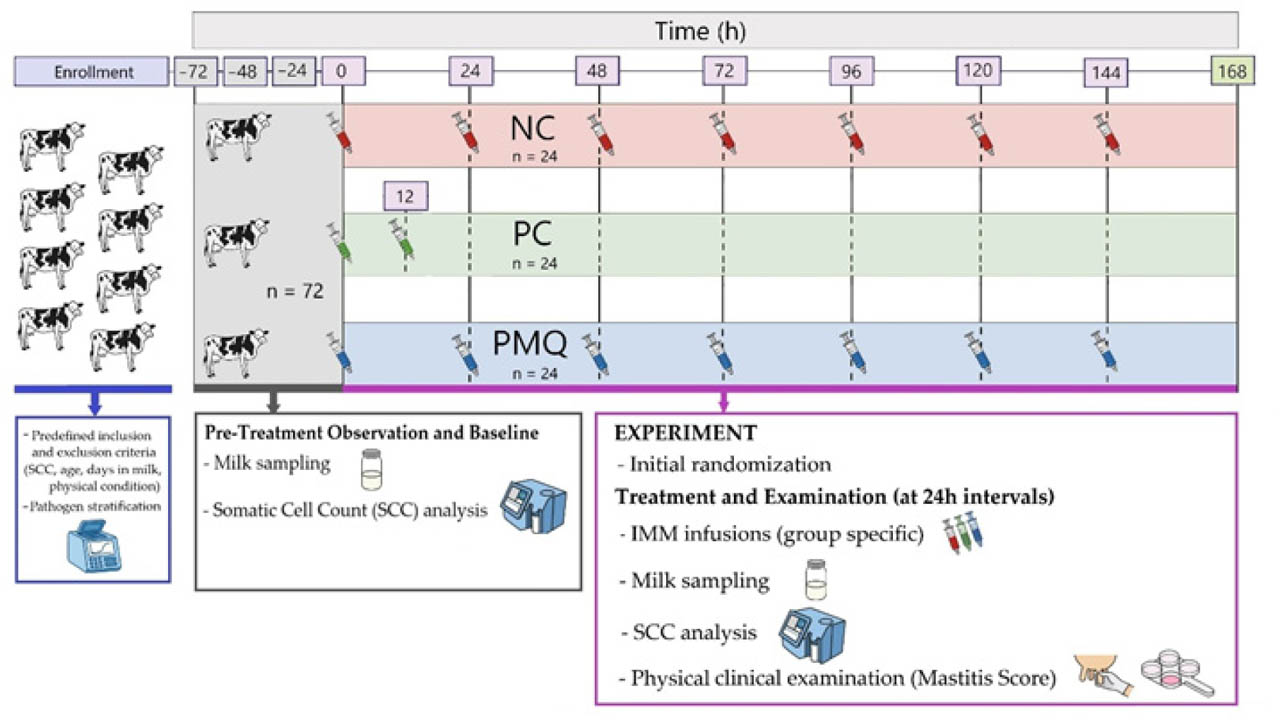
Figure 1.
Experimental schedule. Seventy-two multiparous Holstein-Friesian cows with naturally occurring clinical mastitis (n = 72) meeting predefined inclusion criteria after pathogen stratification were enrolled to the study. Following a 72-hour pre-treatment observation period with baseline measurements of milk SCC (−72 h, − 48 h, − 24 h), cows were randomized into three treatment groups (n=24 per group): NC (negative control, BPS administered at 24-hour intervals from 0 h through 144 h), PC (positive control, antibiotic administered at 0 h and 12 h), and PMQ (pectin + morin + quercetin administered at 24-hour intervals from 0 h through 144 h). Milk samples were collected and SCC analysis performed at 24-hour intervals from 0 h through 168 h, corresponding to 24 h after the final PMQ or PBS administration. Physical clinical examinations and mastitis severity scoring were conducted at each sampling time point. Syringe icons indicate treatment administration time points (group specific).
During the three-day pre-treatment observation period, the 72 selected cows were milk-sampled and analyzed for SCC using a 4 × 4Q Mastitis Detector (Dramiński S.A., Szabruk, Poland; a 4-quarter device for detecting milk resistance). The mean SCC across all cows and all three time points was used to establish the global baseline for the study. Following this period, and without additional stratification by age, body weight, milk yield, or other production parameters, cows were randomly assigned to one of three treatment groups (n = 24 per group). Post-randomization statistical analysis confirmed that neither the pre-treatment SCC values measured at the –24 h time point nor the distribution of mastitis pathogens differed significantly between the groups (P>0.05 for both assays), ensuring baseline equivalence and uniform pathogen distribution prior to treatment initiation, and indicating that cows in all treatment groups started from a comparable disease-associated baseline level.
The experimental PMQ group received seven IMM infusions of 5 mL of the prepared PMQ solution administered at 24-h intervals (0, 24, 48, 72, 96, 120, and 144 h). The positive control group (the PC group) received two IMM infusions at 0 and 12 h of a fixed-combination commercial formulation containing tetracycline hydrochloride (200 mg), neomycin sulfate (250 mg), bacitracin (2000 IU), and prednisolone (10 mg). The negative control group (the NC group) received IMM infusions of phosphate-buffered saline (PBS) at the same dose and time schedule as the PMQ group.
All IMM administrations were performed into the affected quarter immediately after the morning milking at 9:00 a.m. Before each administration, the udder skin and teat orifice were disinfected using a commercial disinfectant (Oxy-Foam D, EcoLab Inc., Saint Paul, MN, USA). Due to differences in treatment schedules between groups, the attending veterinarian responsible for treatment administration was aware of group allocation; however, the veterinarian was not otherwise involved in the research. All cows were continuously monitored for general health and for standardized local tolerance to the IMM administrations throughout the study period. No concomitant medications were permitted in the PMQ and NC groups. Importantly, no cow was withdrawn from the study due to clinical deterioration requiring rescue antibiotic therapy.
At each morning examination from 0 to 168 h (i.e., up to 24 h after the final IMM administration), mastitis severity in the treated quarter was assessed before daily treatment using a standardized 4-point scoring system: score 0, no clinical abnormalities; score 1, mild changes in milk without local inflammatory signs; score 2, moderate milk abnormalities with mild local inflammation; and score 3, severe mastitis with pronounced local inflammation and systemic signs (Balemi et al., 2021; Kan et al., 2022).
Milk from the affected quarters was collected at the same time points as mastitis scoring. Before sampling, teat orifices were disinfected with 70% ethanol. Samples were obtained into 50 mL tubes containing bronopol (8 mg) and natamycin (0.3 mg) as Broad Spectrum Microtabs II (Bentley Instruments) and kept chilled until analysis. Somatic cell counts were determined within 12 h of collection using a semi-automated analyzer (BactoCount IBCm, Bentley Instruments, Chaska, MN, USA) according to the manufacturer's instructions.
Statistics
All enrolled cows completed the study, and no missing data were recorded; therefore, all observations were included in the analyses. Statistical analyses were performed in R (version 4.5.0), with statistical significance defined as P<0.05 for all tests.
Fisher's exact test was used to assess the relative distribution of mastitis pathogens isolated from milk samples, as well as to verify the distribution of mastitis scores between groups at the 0 h time point.
Somatic cell counts were log2-transformed to obtain the somatic cell score (SCS) to improve data symmetry and approximate normality, as confirmed by the Shapiro–Wilk test, thereby meeting the assumptions of linear modeling. Temporal changes in SCS were analyzed using a linear mixed-effects model fitted with fixed effects for treatment group, time (categorical), and their interaction, and a random intercept for cow to account for repeated measurements (lmer function, lmerTest package). Model assumptions were assessed by visual inspection of residuals for approximate normality and homoscedasticity. Post hoc analyses were performed using estimated marginal means (emmeans) to evaluate within-group changes relative to a common baseline and to conduct pairwise between-group comparisons at each time point. To control for multiple testing, p-values were adjusted using the Benjamini–Hochberg false discovery rate (FDR) procedure.
Mastitis inflammation severity (mastitis score) was analyzed as an ordinal outcome. The effects of treatment and time were assessed using a cumulative link mixed-effects model (CLMM) fitted with the ordinal package, including fixed effects for treatment, time, and their interaction, and a random intercept for cow to account for repeated measurements. The distribution of mastitis scores within each treatment group at 0 h (treatment initiation) was used as the reference level, and contrasts at subsequent time points were performed relative to this baseline within each group. Resulting P-values were adjusted using the FDR method.
Results
Figure 2 A shows individual cow trajectories and group mean responses for SCS as differences from pre-treatment baseline. In the NC group, SCS remained stable throughout the observation period, with no significant deviations from baseline at any time point (P>0.05 for all comparisons). In contrast, both treatment groups (PC and PMQ) showed significant SCS reductions from 72 h onward (P<0.01 to P<0.001), with progressive decline through 168 h. Between-group comparisons (Figure 2 B) revealed no significant differences among groups during the early observation period (0–96 h). At 120 h, PC differed from NC (P<0.05). By 144 h and 168 h, both PC and PMQ groups demonstrated significantly lower SCS than NC (P<0.05), with no difference between PC and PMQ.
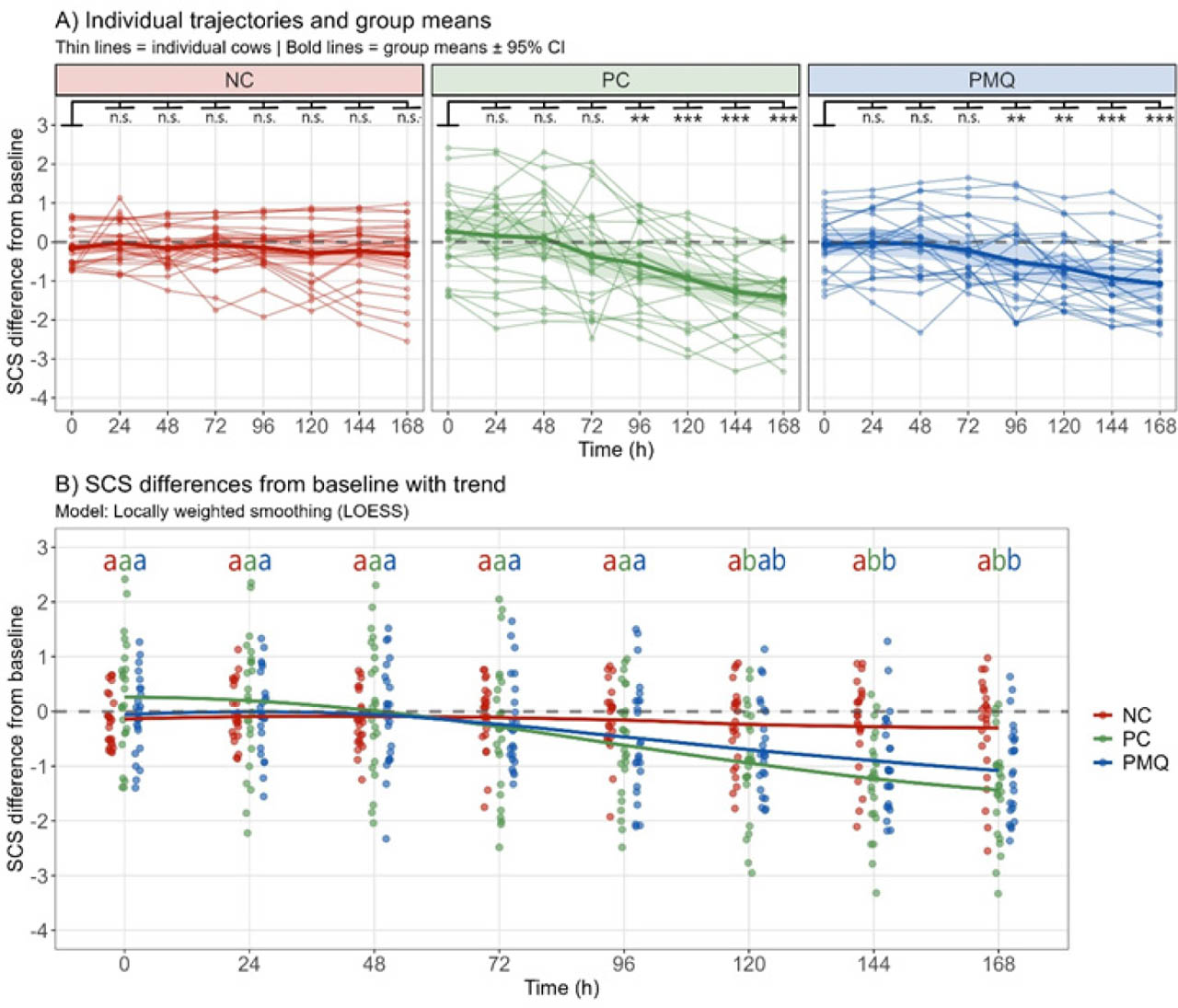
Figure 2.
Somatic cell score (SCS) dynamics during treatment period. (A) Individual cow trajectories (thin lines) and group means (bold lines) with 95% confidence intervals (shaded ribbons) showing SCS differences from global pre-treatment baseline. Significance levels for within-group comparisons to baseline are indicated above each panel (n.s. = not significant, ** P<0.01, *** P< .001; LMM for repeated measures with FDR adjustment for multiple comparison). (B) SCS differences from baseline with locally weighted smoothing (LOESS) trend lines. Points represent individual observations. Letters above time points indicate between-group comparisons; groups sharing the same letter do not differ significantly (P>0.05; LMM for repeated measures with FDR adjustment for multiple comparison). NC = negative control (PBS), PC = positive control (antibiotic), PMQ = pectin + morin + quercetin.
The distribution of mastitis severity scores at baseline (0 h) did not differ significantly between treatment groups, ensuring comparability prior to intervention (P>0.05, Fisher's exact test). The NC group showed no significant changes in mastitis severity throughout the 168-hour observation period, with inflammation persisting at baseline levels (Figure 3 A). In contrast, both treatment groups demonstrated significant improvements. The PC group exhibited significant reduction in severity scores starting at 72 h (P<0.01), with sustained improvement through 168 h (P<0.001). The PMQ group showed earlier response, with highly significant improvements emerging at 72 h (P<0.001) and maintained throughout the study period. Population-level predictions from the CLMM model illustrated these temporal patterns (Figure 3 B). The predicted probability of inflammation (score ≥ 1) remained stable and near-maximal in the NC group (~97–99%) throughout the observation period, consistent with persistent untreated infection. Both treatment groups showed progressive declines in inflammation probability over time. The PC group demonstrated a gradual decrease from 95.5% at baseline to 45.0% at 168 h, representing a 53% reduction in inflammation probability. The PMQ group exhibited a similar temporal pattern, declining from 96.1% to 64.1% (33% reduction). Notably, the PC group achieved lower final inflammation probability than PMQ, though both groups showed substantial improvement relative to untreated controls. The widening confidence intervals (CI 95%) over time in treated groups reflect increasing heterogeneity in treatment response, with some animals achieving complete resolution while others maintained moderate inflammation.
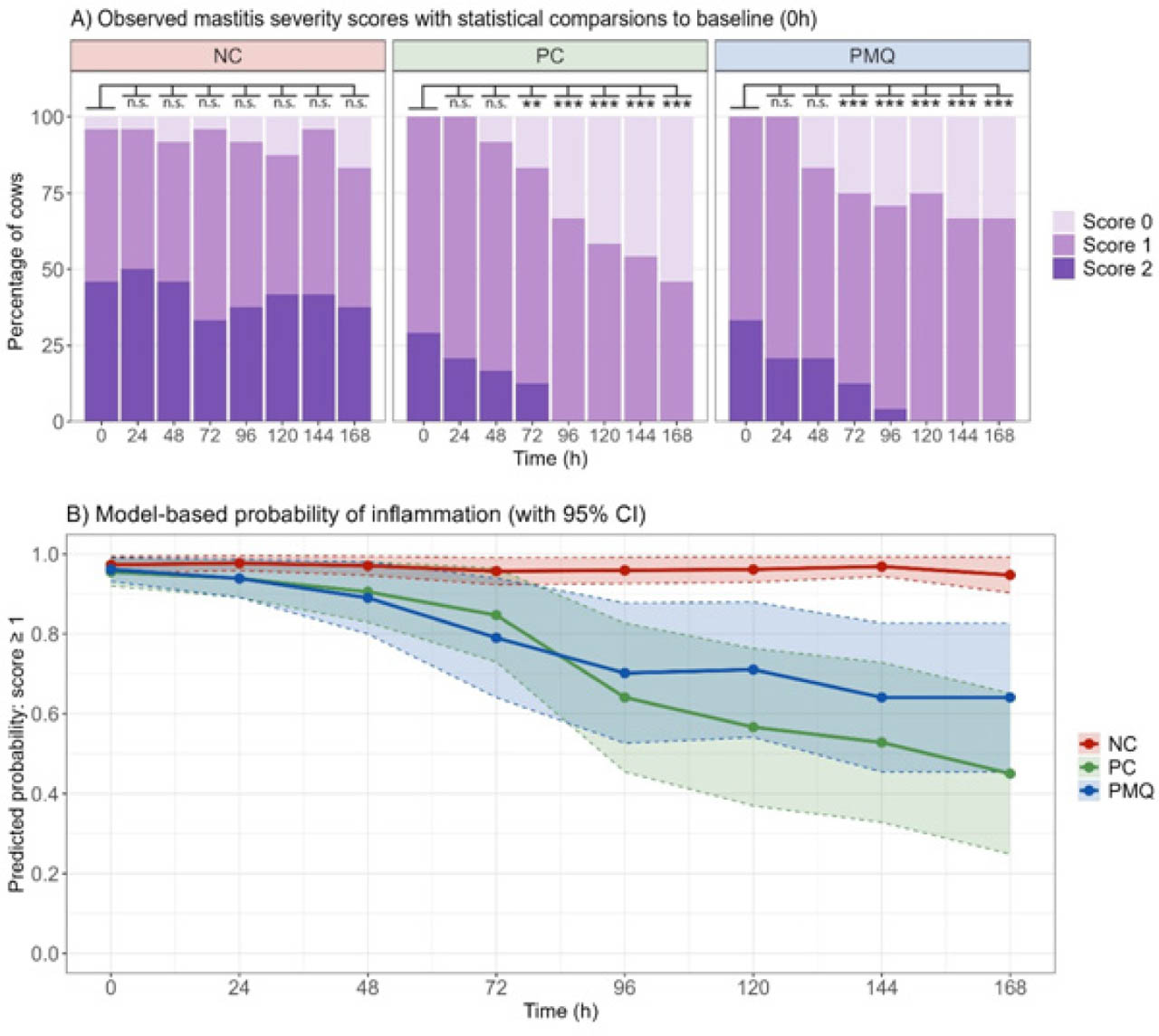
Figure 3.
Temporal dynamics of mastitis severity and treatment response. (A) Observed distribution of mastitis scores (0 = none, 1 = moderate, 2 = severe) displayed as percentage of cows in each treatment group over the 168-hour observation period. Asterisks indicate significant within-group differences from baseline (0 h) based on post-hoc comparisons (*P<0.05, **P<0.01, ***P<0.001; n.s. = not significant; CLMM for repeated measures with FDR adjustment for multiple comparison). (B) Model-predicted probability of inflammation (mastitis score ≥ 1) from CLMM model. Solid lines represent population-averaged predictions, shaded ribbons indicate model 95% confidence intervals. NC = negative control (PBS), PC = positive control (antibiotic), PMQ = pectin + morin + quercetin.
Discussion
The results indicate that the three-component PMQ (pectin–morin–quercetin) therapy was clinically effective and comparable to standard antibiotic treatment. Because bacteriological cure was assessed only descriptively and without sufficient power for statistical comparison, conclusions regarding pathogen clearance cannot be drawn. The discussion therefore focuses on clinical recovery and SCC dynamics, which were the primary validated outcomes of the study. Both the PC and PMQ groups showed a significant reduction in clinical mastitis scores within 72 h of treatment initiation, followed by a significant decrease in SCS within 96 h. A previous study by Kocik et al. (2025 a) reported a 100% cure rate for both pectin and the antibiotic treatment. In the present study, both the PMQ and control groups achieved comparable clinical improvement. No significant differences in clinical scores were observed at any stage of the follow-up. At the same time, the PMQ group showed a trend toward faster regression of inflammatory symptoms. In a previous study using 10% pectin alone, clinical signs resolved on average 1.6 days earlier than with antibiotic therapy (Kocik et al., 2025 a). Similarly, in the SCC analysis, a marked decrease in somatic cell count in the pectin group was observed after approximately 96 hours of treatment, whereas in the antibiotic group, this reduction occurred only after 120 hours (Kocik et al., 2025 a). In our PMQ therapy, a similar trend toward slightly faster normalization of parameters compared to antibiotic treatment was observed. No adverse effects related to local tolerance of the PMQ formulation were observed, consistent with findings from previous studies on pectin (Kocik et al., 2025 a) and morin (Kocik et al., 2025 b). No signs of irritation or tissue damage were observed in the udder following infusion. Milk yield after treatment was comparable between the two groups, and the absence of antibiotics eliminates concerns related to drug residues and withdrawal periods. This suggests that PMQ therapy may serve as a safe alternative, avoiding the risks of antimicrobial resistance and milk withdrawal associated with conventional antibiotic use. The analysis of SCS changes and clinical presentation in the current study highlights differences related to infection etiology. Although our study did not stratify results by pathogen, previous research indicates that mastitis caused by E. coli is typically associated with a rapid, short-term inflammatory response, whereas infections caused by S. uberis tend to provoke a more prolonged, subacute or chronic reaction, often reflected by persistently elevated SCC (Kocik et al., 2025 a, b). According to the literature, cows with E. coli mastitis often exhibit an acute spike in milk leukocyte count (SCC peak) within the first few days, which then rapidly declines as the inflammatory response subsides (Sumon et al., 2020; Williamson et al., 2022). In the case of S. uberis, the changes are typically less abrupt but more prolonged over time. Our findings reflect this pattern: clinical improvement appeared earlier (around 48–72 hours), whereas normalization of cytological parameters (SCC) took longer, which is characteristic of infections caused by coliform bacteria (Kirkeby et al., 2021). In the antibiotic group, clinical symptoms resolved more rapidly than in the PMQ group, a difference that was particularly noticeable during the initial days of treatment in cases of E. coli-induced mastitis. In the PMQ-treated cows, the reduction of udder swelling and redness progressed gradually but at a slower pace.
We did not directly assess cytokine profiles in milk; however, comparisons with published studies suggest that PMQ exhibits anti-inflammatory properties. Unlike steroid preparations or certain antibiotics combined with glucocorticoids, natural compounds such as pectin, morin, and quercetin inhibit the accumulation of inflammatory cells and the release of cytokines, while not inducing bacterial resistance or producing adverse effects in milk (Burmańczuk et al., 2018; Jiang et al., 2022, Kocik et al., 2025 a). Previous reports indicate that oral or local administration of pectins does not elevate TNF-α levels in either blood or milk. Study results show no significant differences in TNF-α concentrations between pectin treatment and standard control therapy (Kocik et al., 2025 a). Similarly, numerous in vitro studies and experimental models have demonstrated that quercetin reduces the synthesis of TNF-α, IL-1β, IL-6, and other pro-inflammatory cytokines (Xiong et al., 2019; Yu et al., 2022). Quercetin has the ability to inhibit NF-κB activation, in part by modulating pathways mediated by Toll-like receptors, which leads to a reduction in the synthesis of pro-inflammatory cytokines such as TNF-α, IL-1β, and IL-6. This makes it a promising natural compound with anti-inflammatory properties. For example, in vitro studies have demonstrated that quercetin suppresses LPS-induced inflammatory responses by inhibiting the TLR4/NF-κB signaling pathway (Burmańczuk et al., 2018; Jiang et al., 2022). Regarding pectin, its potential to regulate immune responses is less well defined, as there is a lack of studies clarifying its effects on TLR signaling, NF-κB activation, and cytokine profiles within mammary gland tissue. It should also be emphasized that the efficacy and safety of both approaches, particularly for pectin and morin, remain insufficiently documented. At present, they are better regarded as experimental or supportive therapies rather than fully validated alternatives to conventional anti-inflammatory and antimicrobial agents used in the treatment of mastitis.
Nevertheless, the results obtained are consistent with previous findings while also revealing some new insights. In a prototype in vivo study on spontaneous recovery, administration of a 10% pectin solution led to clinical improvement and a reduction in SCS comparable to that achieved with antibiotic treatment (Kocik et al., 2025 a). Importantly, the anti-inflammatory effect of pectin was observed as early as 48 hours after administration, and cytological changes occurred more rapidly than in the antibiotic-treated group. In light of these findings, the PMQ therapy used in the present study showed a slightly slower onset of action (with significant changes around 72 hours), which may be attributed to differences in formulation or dosing, as well as the heterogeneous nature of the three-component mixture. In the case of morin alone, previous experiments (Kocik et al., 2025 b) showed that a 3% morin solution significantly reduced symptoms of E. coli-induced mastitis, restoring clinical condition and lowering SCC, although more slowly than antibiotics. In contrast, in S. uberis infections, morin's effectiveness was limited: clinical improvement appeared only after 96–168 hours, and the reduction in SCC was noticeably weaker than with antibiotic treatment. Our findings similarly suggest that PMQ performs well against Gram-negative pathogens (with rapid clinical improvement in E. coli cases), but its efficacy against Gram-positive infections is moderate, echoing the results seen with morin alone. This aligns with the observation that PMQ helps alleviate inflammation even in S. uberis infections but does not clear the infection as effectively as strong antibiotics. As for quercetin, a previous study demonstrated that repeated intramammary administration significantly reduced SCS in cows with mastitis within eight days of therapy (Burmańczuk et al., 2018). Our observations confirm that quercetin (albeit in combination with other components) contributes to the reduction of inflammatory cells in milk. The combination of pectin, morin, and quercetin may have acted through complementary mechanisms: for example, quercetin and morin may have enhanced the immunomodulatory effect, while pectin likely accelerated the formation of a protective barrier. The applied mixture achieved at least the level of effectiveness seen with each component individually, similar to previously studied pectin and morin, reducing both clinical symptoms and SCC. The key new findings stem from the assessment of the cumulative effect and confirmation of the safety of this combination (no adverse effects observed), as well as the indication that PMQ therapy can reduce inflammation levels to nearly those achieved by systemic antibiotics, while potentially shortening the time to improvement compared to no treatment.
In recent years, numerous natural compounds have been evaluated as alternatives to antibiotics in bovine mastitis therapy. These include immunomodulatory polysaccharides such as β-glucans, chitosan, and alginates, as well as various plant extracts (do Nascimento et al., 2025). Although some of these agents can stimulate leukocyte recruitment or exert direct antimicrobial effects, their therapeutic outcomes remain inconsistent and often pathogen dependent. For instance, β-glucans show limited effectiveness in chronic Gram-positive infections, while chitosan and alginates possess antibacterial and wound-healing properties but may exhibit restricted penetration into deeper mammary tissue (Inchaisri et al., 2000; Kruk and Winnicka, 2022; Tomanić et al., 2023; Guamán et al., 2024; Godoy et al., 2025). These limitations underscore the need for better-defined, multi-target natural formulations. The PMQ approach, combining a polysaccharide (pectin) with two flavonoids (morin and quercetin), may help address some of these challenges. Pectin supports epithelial barrier integrity and reduces local inflammation, morin can limit biofilm formation, and quercetin provides complementary antioxidant and immunomodulatory effects. When administered together, these components may interact synergistically, offering more predictable and rapid mitigation of inflammatory symptoms than single-compound or crude plant-based preparations. In contrast to essential oils or homeopathic remedies, PMQ has a clearly defined composition and a mechanistic basis validated in experimental models, which strengthens its potential as a structured non-antibiotic therapeutic option.
The results discussed align with the global trend of reducing antibiotic use in veterinary medicine. The One Health concept, along with the growing resistance of pathogens, underscores the need to explore alternative therapeutic strategies (Kocik et al., 2025 b). As suggested by Jiang et al. (2025), reducing antibiotic therapy is particularly justified in cases of Gram-negative infections, where anti-inflammatory effects may allow the host's immune system to resolve the infection naturally. Our observations are consistent with this approach, supportive treatment with PMQ produced outcomes comparable to those of antibiotics. The absence of antibiotic residues in milk following PMQ therapy is an additional advantage from both a public health and dairy farming perspective.
However, PMQ therapy also has limitations. Its effectiveness may be reduced in severe or chronic infections caused by Gram-positive pathogens such as S. uberis, which are known for their ability to persist within mammary tissue. In study of Kocik et al. (2025 b), morin alone produced only a slower and less pronounced reduction in SCC compared to antibiotic treatment in S. uberis infections. It can therefore be assumed that in cases of severe mastitis or mixed infections, antibiotics remain necessary, while PMQ may serve primarily as a supportive therapy. Further research is needed to optimize PMQ dosing and formulation, to better understand the pharmacokinetics of its components, and to evaluate its application across different forms of mastitis. Large-scale in vivo clinical trials are also required to assess its effectiveness at various stages of the disease and to compare it with other treatment modalities.
The present study has several important limitations. Most notably, the lack of pharmacokinetic data for PMQ components following intramammary administration prevents assessment of their tissue penetration, duration of action, and optimal dosing regimen. The trial involved a fixed treatment cycle, which does not allow conclusions about the flexibility of the therapy. Another limitation is the heterogeneity of infections and potential strain variability, combined with a relatively modest sample size (72 cows), and the absence of stratification by lactation stage, metabolic status, milk yield, or cow genotype, all of which may have influenced treatment response (Bagnicka et al., 2023). The observation period was limited to 7 days, without post-treatment bacteriological evaluation. Thus, it remains unclear whether pathogens were fully eliminated or what effect PMQ had on the udder microbiome and recurrence risk. No molecular analyses were performed either, PMQ's impact on cytokine expression, TLR signaling, or oxidative stress markers in glandular epithelium was not assessed. Such data could help elucidate mechanisms of action and provide objective validation. Finally, PMQ therapy requires frequent applications (seven doses per day), which limits its practicality. There is also a lack of comparisons between different ratios of PMQ components. Further studies should evaluate the efficacy, potential synergy, and formulation possibilities for extended-release delivery systems.
In conclusion, the results suggest that the three-component PMQ therapy may represent a promising alternative to antibiotic treatment in the management of clinical mastitis in dairy cows. The natural compounds used combine anti-inflammatory, antimicrobial, and barrier-protective effects, while avoiding complications associated with antibiotic use. However, overly broad generalizations should be avoided. The potential of PMQ is best realized as part of an integrated treatment strategy, particularly in mild infections, with ongoing monitoring of therapeutic outcomes and continued investigation into the method's limitations.