
Growth performance is one of the most critical economic traits in poultry production. In traditional farming practices, antibiotics were commonly added to poultry feed to enhance growth performance. However, the widespread overuse of antibiotics has led to the emergence of antibiotic resistance, which is now a major global public health concern (Wang et al., 2021). Consequently, the use of antibiotics as growth promoters in poultry farming has been banned, while the demand to maximize poultry growth traits persists. This has driven scientific focus toward identifying and developing green and safe alternatives to antibiotics (Zhang et al., 2022). Yupingfeng powder, a traditional Chinese medicine formulation, is composed of Astragalus membranaceus (Fisch.) Bunge (Huangqi), Atractylodes macrocephala Koidz (Baizhu), and Saposhnikovia divaricata (Fangfeng) in specific proportions (Zhang et al., 2011). According to traditional Chinese medicine principles, Yupingfeng powder is effective in treating colds (Zhang et al., 2022), respiratory inflammation, and even cancer (Bai et al., 2023; Pei et al., 2023). It has also demonstrated antiviral activity and cellular immunity (Poon et al., 2006). Recent studies have highlighted the potential applications of Yupingfeng powder in animal nutrition. It has been reported to improve animal health, thereby enhancing growth performance (Sun et al., 2018) and the quality of animal-derived products (Yang et al., 2021). These findings suggest that Yupingfeng powder is a promising, eco-friendly feed additive with potential as a sustainable alternative to growth-promoting antibiotics.
Yupingfeng polysaccharide (YPF-P) is a highly branched, water-soluble heteropolysaccharide extracted from Yupingfeng powder and represents its principal bioactive component (Zheng et al., 2023). Polysaccharides derived from traditional Chinese medicine are widely recognized for their multifunctional properties, including immune enhancement (Nai et al., 2021), antioxidant activity (Li et al., 2022), and antiviral effects (Gong et al., 2022). Similarly, Yupingfeng polysaccharide has been reported to exert a broad spectrum of beneficial effects, such as anti-inflammatory activity (Makino et al., 2004), regulation of animal immunity (Fan et al., 2017), and promotion of growth and development in animals (Yin et al., 2019). Collectively, these findings highlight YPF-P as a promising green, plant-based additive with considerable potential applications in animal production.
Serum metabolomics is a powerful analytical approach for the identification and quantification of low-molecular-weight metabolites and has been widely applied in poultry research to characterize metabolic alterations under diverse physiological and dietary conditions (Fiehn, 2001). By elucidating metabolic pathways associated with growth, immune responses, and overall health, metabolomics offers critical insights into how external interventions influence systemic metabolism (Ibero-Baraibar et al., 2016). The intestinal microbiota constitutes a highly complex and dynamic ecosystem that is particularly responsive to dietary, pharmaceutical, and environmental stimuli, resulting in pronounced shifts in microbial composition and function. Maintaining microbial balance is essential for optimizing nutrient metabolism and immune function (Valdes et al., 2018). Beneficial gut microbiota secrete enzymes that facilitate polysaccharide degradation and synthesize essential metabolites, such as vitamins, which circulate systemically and support various physiological processes (Rowland et al., 2018). In addition, lipid metabolism and growth performance have been shown to be closely associated with specific gut microbial populations (Zhang et al., 2022). Dietary supplementation with YPF-P has been reported to exert modest effects on growth performance in white shrimp, while markedly altering the composition and metabolic activity of the gut microbiota (Su et al., 2020). In rabbits, YPF-P supplementation notably enhanced growth performance, increased the abundance of beneficial intestinal microflora, and suppressed the proliferation of pathogenic bacteria (Sun et al., 2016). Furthermore, YPF-P has been identified as a potential antibacterial agent capable of inhibiting the colonization of harmful gut bacteria while promoting the proliferation of beneficial microorganisms (Zheng et al., 2023; Guan et al., 2024). These findings suggest that the growth-regulating effects of YPF-P may be closely linked to its capacity to modulate intestinal microbiota and their associated metabolites.
However, studies examining the associations between YPF-P supplementation and serum metabolites or gut microbiota in early-stage broiler chickens remain limited. Moreover, the mechanistic links between YPF-P–induced metabolic reprogramming and growth performance in chicks are not yet fully understood. Therefore, this study aimed to investigate the effects of YPF-P on growth performance, serum growth-related hormones, and serum metabolites in chicks. In addition, correlation analyses were performed by integrating the current metabolomic data with previously published gut microbiota datasets. Collectively, these findings provide a scientific basis for optimizing the application of YPF-P as a green and safe feed additive in poultry production.
Material and methods
Material
Yupingfeng polysaccharide (YPF-P) was obtained as a powdered product from the National Medicine Group Dezhong (Foshan) Pharmaceutical Co., Ltd., Guangdong, China. The primary preparation process followed the protocol described in our previous experiment (Zheng et al., 2023). The polysaccharide content of YPF-P was quantified as 90.11% by the phenol-sulfuric acid method.
Animal treatments and experimental design
A total of 4,224 healthy Qingyuan partridge chickens, each 3 days old, were individually weighed and randomly assigned into four treatment groups: control (0 g/kg YPF-P), 1 g/kg YPF-P, 2 g/kg YPF-P, and 4 g/kg YPF-P, with eight replicates per group and 132 chicks per replicate. All chickens were raised at Guangdong Tiannong Food Group Co., Ltd., Qingyuan Poultry Farm (Qingyuan, China). The control group received a basal diet (0 g/kg YPF-P), while the experimental groups were fed basal diets supplemented with 1 g/kg, 2 g/kg, or 4 g/kg YPF-P. The selected supplementation levels (1, 2, and 4 g/kg YPF-P) were selected based on existing literature. Effective doses ranging from 1.0 to 1.5 g/kg have been shown to improve growth performance in broilers and intestinal health in other species (Liu et al., 2024; Xu et al., 2025). Furthermore, a higher dose of 3.2 g/kg has been demonstrated to be safe and effective in murine models (Liu et al., 2023). Therefore, this dosage range was chosen to comprehensively evaluate the dose-dependent effects and identify the optimal supplementation level of YPF-P in chicks. All chickens were housed in three-tier battery cages with ad libitum access to feed and water. Room temperature was initially set at 35°C, gradually decreasing to 25°C, while relative humidity was maintained at 60–70% (days 1–21) and 45–55% (days 22–37). The nutritional composition of the feed provided was detailed in our previous study (Zheng et al., 2023). After 12 hours of fasting on day 34, a total of eight chicks from each group were used for serum metabolomics, growth-related hormones, and microbiota analysis, ensuring that the same eight chicks were used for all analyses within each group. The experimental protocol was approved by the Institutional Animal Care and Use Committee (Approval Code: FOSU 2022-307).
Growth performance
The body weight (BW) of chicks at 3 days of age and the final body weight (FBW) at the age of 37 days at the end of the experiment were recorded, and the average daily weight gain (ADG) was calculated. Daily feed intake and mortality were recorded on a per-pen basis throughout the trial. After calculating the average daily feed intake (ADFI), the feed conversion ratio (FCR) at 37 days of age was determined by the ratio of ADFI to ADG. The FCR was calculated as follows: FCR = ADFI (g) / ADG (g).
Serum biochemical indicators
After a 12-hour fasting period, 8 chicks from each group (one per replicate) were randomly selected on day 34. Venous blood samples were collected from the wings of the chicks and the collected blood was used for ELISA kit detection. The contents of growth hormone (GH), growth hormone-releasing hormone (GHRH), thyroid stimulating hormone (TSH), insulin-like growth factor-1 (IGF-1), triiodothyronine (T3) and tetraiodothyronine (T4) in serum were detected by specific ELISA kit produced by Shanghai Yuanju Biotechnology Center (Shanghai, China). All methods follow the manufacturer’s instructions.
LC-QTOF/MS for serum metabolome analysis
Based on the results of growth performance and serum biochemical analysis, the 2 g/kg YPF-P group, which showed the most favorable outcomes among the YPFP groups, was selected for comparison with the 0 g/kg control group to evaluate the impact of YPF-P on chick metabolism via metabolomic profiling. Serum samples were collected from a total of 16 chicks (8 from the control group and 8 from the 2 g/kg YPF-P group) after fasting. These 8 chicks were the same individuals for all analyses. Including metabolomics, serum hormone measurements, and microbiota analysis.
The LC-MS analysis was performed using a Waters Acquity I-Class PLUS UPLC and Waters Xevo G2-XS QTof mass spectrometer. The analysis utilized a Waters Acquity UPLC HSS T3 column (1.8 µm, 2.1 × 100 mm). In positive ion mode, the mobile phases were 0.1% formic acid aqueous solution (A) and 0.1% formic acid acetonitrile (B).while in negative ion mode, the same solvents were used. A 1 µL injection was made, and mass spectrometry data were collected in MSe mode, with dual-channel acquisition at low (2 V) and high (10–40 V) collision energies. Data were acquired every 0.2 seconds and processed using Progenesis QI software with METLIN and Biomark’s custom libraries for peak extraction, alignment, and identification, with mass deviations within 10 ppm.
Multivariate analysis, including principal component analysis (PCA) and orthogonal partial least squares discriminant analysis (OPLS-DA), was performed to identify and visualize differential metabolites between the control and YPF-P treated groups. R²Y and Q²Y values were used to assess the model’s fit and prediction ability. R2Y reflects the model’s ability to explain the variance of the data, with higher values indicating a better fit. Q2Y was determined through cross-validation and reflects the model’s predictive ability for new samples. R2Y values closer to 1 suggest a good model fit, and Q2Y values greater than 0.5 indicate a model with acceptable prediction accuracy.
Screening for differential metabolites was performed using R Studio based on thresholds of VIP > 1.0, P<0.05, and a fold change > 1, followed by the generation of a volcano plot and a heatmap to visualize the alterations in metabolite levels. All metabolomic analyses presented in this study were performed exclusively on serum samples.
Statistical analysis
The growth performance and serum biochemical data are expressed as mean ± SEM and analyzed using SPSS version 20.0 (SPSS, Chicago, IL, USA). All the data conform to normal distribution. Oneway ANOVA was performed for statistical analysis, followed by Duncan’s post hoc test to assess between-group differences. Orthogonal contrasts (linear and quadratic) were used to assess the dose-dependent effects of YPF-P supplementation (0, 1, 2, and 4 g/kg) on growth performance and serum hormone levels, with linear contrasts examining overall trends and quadratic contrasts assessing potential curvilinear relationships. Graphical representations were generated using GraphPad Prism version 9.0 (GraphPad Software Inc., San Diego, CA, USA), with significance indicated as *P<0.05 and **P<0.01. Metabolomics data were processed using the online tool available at www.metaboanalyst.com. No new microbial sequencing or microbiota profiling was performed in the present study.
Correlation analysis of serum hormones and microbiota
To investigate the relationship between serum hormones and the microbiota, we performed a Spearman correlation analysis between the top 20 most abundant microbial community compositions and both growth-related hormones and differential metabolites from annotated amino acid metabolic pathways in serum. For serum hormone data, samples from the control group and the 2 g/kg YPF-P group were used. The microbial community data were obtained from the top 20 most abundant genera in the cecum and duodenum previously reported, with all samples collected from the same chickens (Zheng et al., 2023).
Results
Influence of YPF-P on the growth performance of chicks
To evaluate the impact of YPF-P supplementation on chick growth performance, we recorded and calculated changes in body weight, weight gain, and feed-to-weight ratio throughout the experimental period. As shown in Table 1, the FBW and ADG significantly increased in the 2 g/kg YPF-P group compared with those in the 0 g/kg group (P<0.05). The administration of 2 g/kg YPF-P improved FCR compared to both the 0 g/kg and 1 g/kg YPF-P groups as well as the 4 g/kg YPF-P group during the overall period (Quadratic, P = 0.003). The significant growth promotion observed with 2 g/kg YPF-P supplementation prompted us to investigate whether it was causally linked to concomitant changes in endocrine regulation.
Table 1.
Effects of YPF-P on growth performance in chicks
| Items | YPF-P levels (mg/kg feed) | SEM | P-value | ||||
|---|---|---|---|---|---|---|---|
| 0 g/kg | 1 g/kg | 2 g/kg | 4 g/kg | linear | quadratic | ||
| BW (g) | |||||||
| 3 d | 28.92 | 28.95 | 28.58 | 29.16 | 0.19 | 0.615 | 0.678 |
| FBW (g) | |||||||
| 3 to 37 d | 390.9 bc | 385.29 c | 408.77 a | 397.74 b | 2.27 | 0.015 | 0.116 |
| ADFI (g/d) | |||||||
| 3 to 37 d | 23.87 | 23.87 | 23.80 | 23.78 | 0.73 | 1.000 | 0.959 |
| ADG (g/d) | |||||||
| 3 to 37 d | 10.65 bc | 10.48 c | 11.18 a | 10.84 b | 2.29 | 0.017 | 0.100 |
| FCR (g/g) | |||||||
| 3 to 37 d | 2.24 ab | 2.28 a | 2.13 c | 2.20 b | 0.01 | < 0.001 | 0.003 |
[i] Note: a, b, c within a row with different letters mean significant differences at P<0.05 level. Means within a row followed by the same letter or with no letter do not differ significantly (P>0.05). SEM, total standard error of mean. Values were expressed as means ± SEM. ADFI, average daily feed intake; BW, body weight; FBW, final body weight; ADG, average daily weight gain; FCR, feed conversion ratio.
Influence of YPF-P on the serum growth-related hormones of chicks
The effect of YPF-P on serum growth-related hormones of chicks is presented in Figure 1. According to Figure 1 A and C–F, compared with the 0 g/kg group, dietary supplementation with 4 g/kg YPF-P significantly increased the contents of GH, TSH, T3, T4 and IGF-1 in the serum of chicks (P<0.05). Compared with the 0 g/kg group, the contents of TSH, T3, T4 and IGF-1 in the 2 g/kg YPF-P group were significantly increased (P<0.05) (Figure 1 C–F). In contrast, supplementation with 1 g/kg YPF-P resulted in significantly higher serum concentrations of TSH and T4 only (P<0.05) (Figure 1 C, E). Although the addition of YPF-P increased the serum GHRH content, the difference was not significant (P>0.05) (Figure 1 B). Having delineated the coordinated endocrine response to YPF-P, we next examined whether these hormonal changes were accompanied by alterations in systemic metabolic profiles.
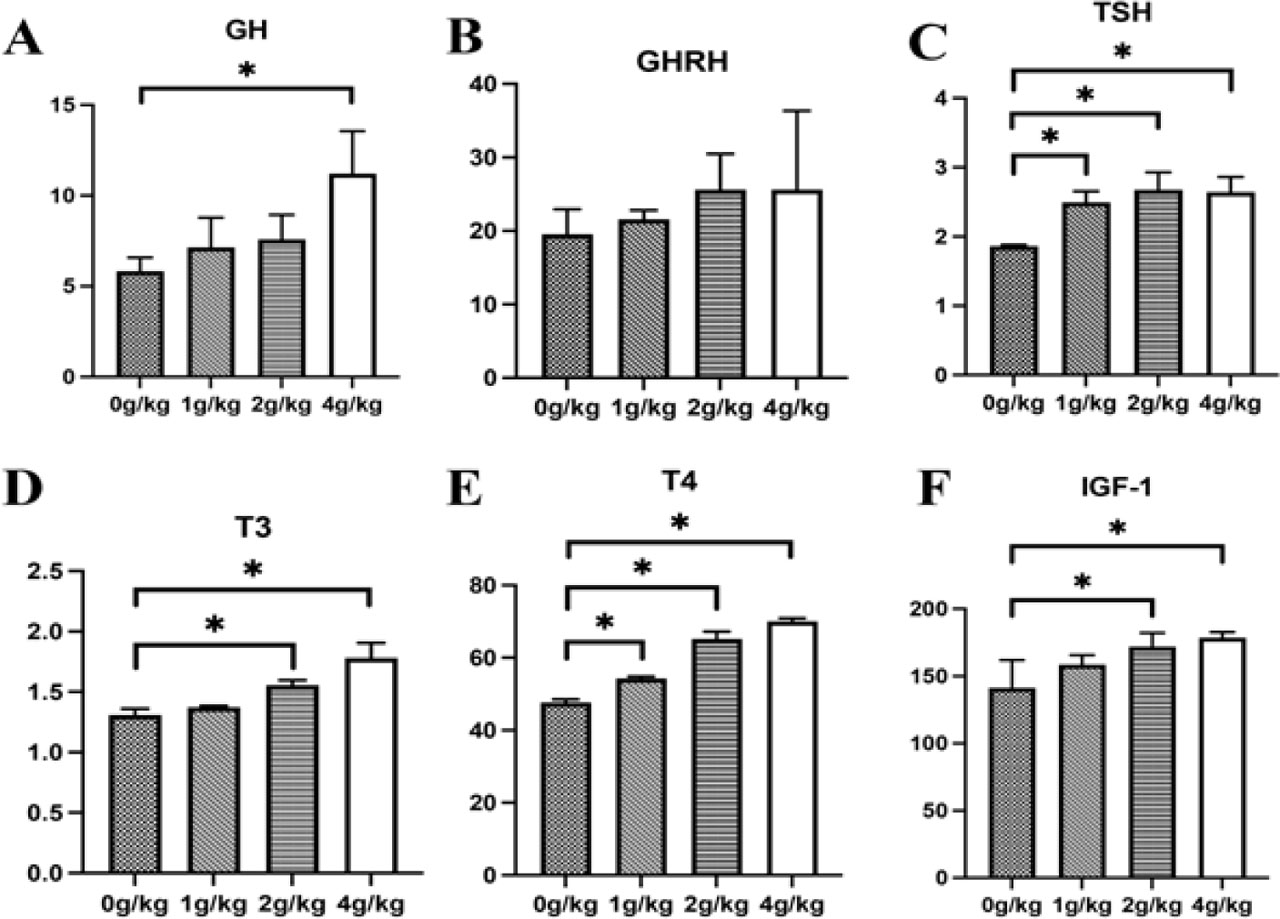
Figure 1.
Effects of YPF-P on levels of serum growth-related hormones in chicks. Data represent mean ±SEM (n=8). Bars in the figure with the * differ significantly (P<0.05).
Effects of YPF-P on the serum metabolome
In total, 16,575 peaks were detected, from which 3,642 metabolites were identified. As shown in Figure 2 A. PCA model revealed that all samples are basically within 95% confidence interval. There is a trend of separation between the two groups of samples. Figures 2 B and C show that the two groups of samples are separated from each other on the OPLS-DA scoring plots, which shows that the current model can explain the differences between groups well. The fold change (FC) values of two groups of differential metabolites were calculated. As shown in Figure 2 D, a total of 872 differential metabolites were identified, of which 687 were up-regulated and 185 were down-regulated.
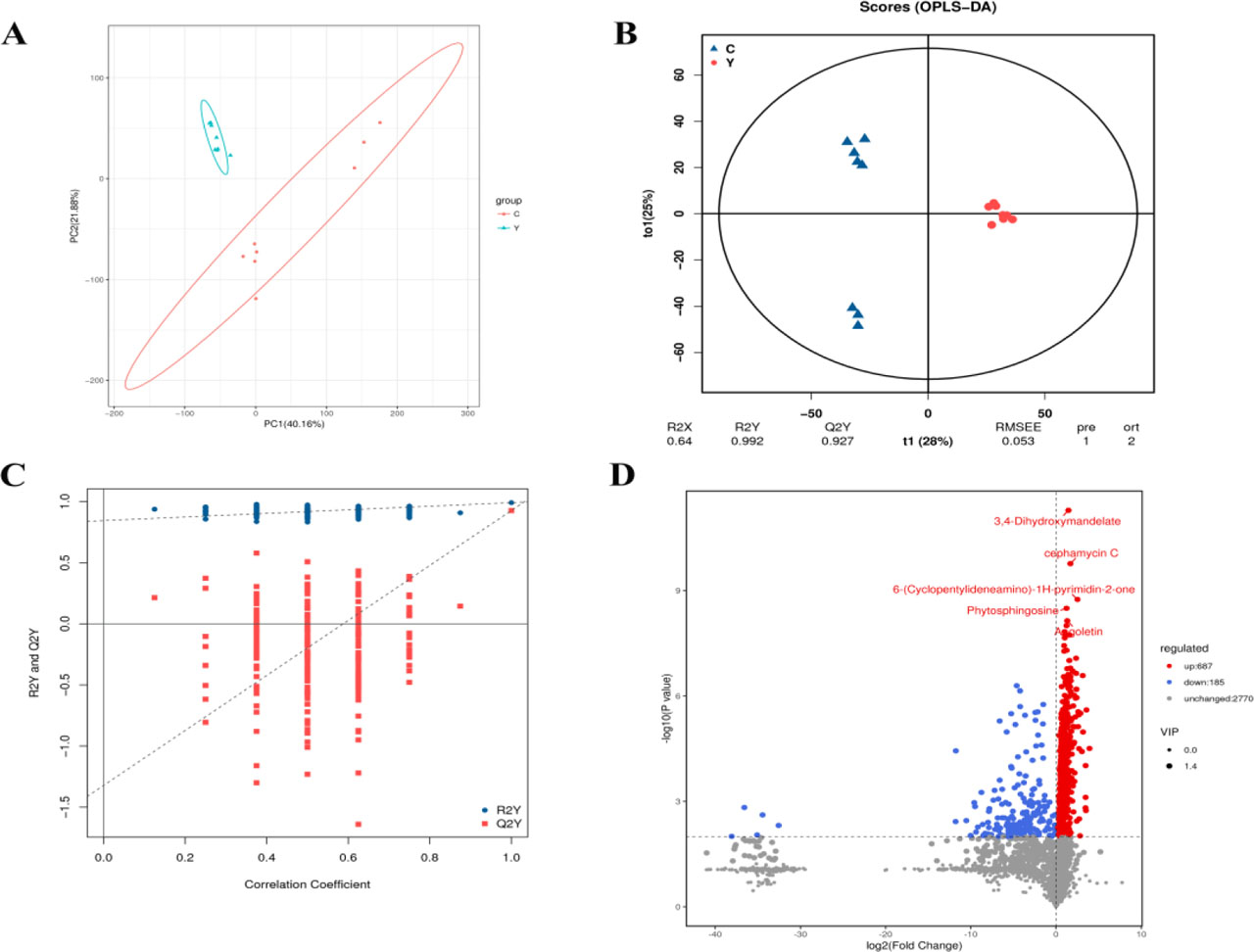
Figure 2.
Multivariate analysis of the untargeted LC-QTOF/MS metabolomics. (A): PCA scores plot. (B): OPLS-DA scores plot. (C): Permutation test plot. (D) The volcano plot shows the differential metabolites between 0 g/kg group and 2 g/kg YPF-P group (log2 Y/C), −log10 (0.05) = 1.30 − log10 (P-value) > 1.30 means significant difference. The red dot indicates log2FC > 0 and the metabolite is up-regulated. The blue dot indicates log2FC < 0 and the metabolite is downregulated. The grey dot means no significant difference (−log10 (P-value) < 1.3) (C is the serum control group (0 g/kg), and Y is the serum 2 g/kg YPF-P addition group, C and Y labels apply to plots A and B, respectively.) R2Y represents the model’s fit to the data, and Q2Y indicates its predictive ability.
As shown in Figure 3 A, the annotated differential metabolites were predominantly classified as carboxylic acids and derivatives, fatty acyls, and related compound classes. Quantitative enrichment analysis revealed that sphingolipid metabolism, vitamin B6 metabolism and amino acid metabolism, especially tryptophan metabolism, phenylalanine metabolism, lysine degradation and glycine, serine and threonine metabolism were the most significantly enriched pathways, and the enrichment ratio were > 6 (Table 2;Figure 3 B).
Table 2.
The quantitative enrichment analysis results of serum metabolites in C vs Y group chicks
| Pathway | Hits | P-value | FDR |
|---|---|---|---|
| Tryptophan metabolism | 4 | 2.52E-08 | 5.04E-07 |
| Sphingolipid metabolism | 3 | 3.71E-05 | 0.0004 |
| Phenylalanine metabolism | 4 | 0.0015 | 0.0076 |
| Steroid hormone biosynthesis | 6 | 0.0017 | 0.0076 |
| Steroid biosynthesis | 1 | 0.0028 | 0.0076 |
| Primary bile acid biosynthesis | 1 | 0.0028 | 0.0076 |
| Lysine degradation | 3 | 0.0030 | 0.0076 |
| Pyrimidine metabolism | 2 | 0.0031 | 0.0076 |
| Folate biosynthesis | 1 | 0.0035 | 0.0076 |
| Vitamin B6 metabolism | 3 | 0.0038 | 0.0076 |
| Glycine, serine and threonine metabolism | 4 | 0.0049 | 0.0089 |
| Sulfur metabolism | 1 | 0.0053 | 0.0089 |
| Arginine biosynthesis | 3 | 0.0066 | 0.0094 |
| Arginine and proline metabolism | 6 | 0.0066 | 0.0094 |
| Drug metabolism – other enzymes | 1 | 0.0090 | 0.0119 |
| Glycerophospholipid metabolism | 1 | 0.0116 | 0.0139 |
| Biotin metabolism | 1 | 0.0118 | 0.0139 |
| Porphyrin metabolism | 2 | 0.0131 | 0.0146 |
| Purine metabolism | 3 | 0.0229 | 0.0241 |
| Terpenoid backbone biosynthesis | 1 | 0.0320 | 0.0320 |
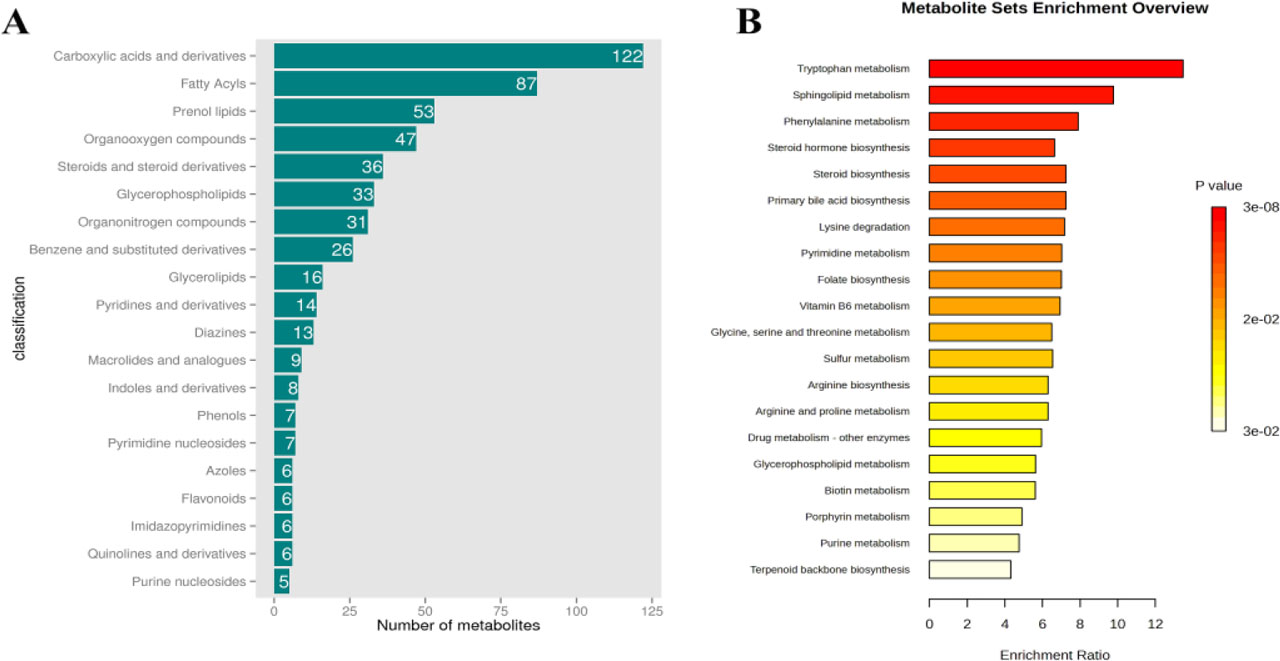
Figure 3.
(A): Differential metabolite classification map. (B): Pathway enrichment analysis of differential metabolites. The enrichment ratio in the x-axis indicates the ratio of the number of differential metabolites annotated to the pathway.
Distinct clustering of metabolites between the two groups was observed (Figure 4 A). Examination of the major differential metabolic pathways indicated that YPF-P supplementation predominantly up-regulated amino acid metabolism-related pathways. Therefore, we think that YPF-P can regulate the growth of chicks by up-regulating its multiple amino acid metabolic pathways. Therefore, we analyzed the Spearman correlation between the differential metabolites in amino acid metabolic pathway and growth-related hormones and growth data. As shown in Figure 4 B, serum IGF-1 levels were positively correlated with the different metabolites in tryptophan metabolism, lysine degradation and arginine biosynthesis pathways. GH, T4 and TSH were positively correlated with the different metabolites in vitamin B6 metabolism and phenylalanine metabolism. This indicates that the regulation of YPF-P on growth may be related to the up-regulation of these metabolic pathways.
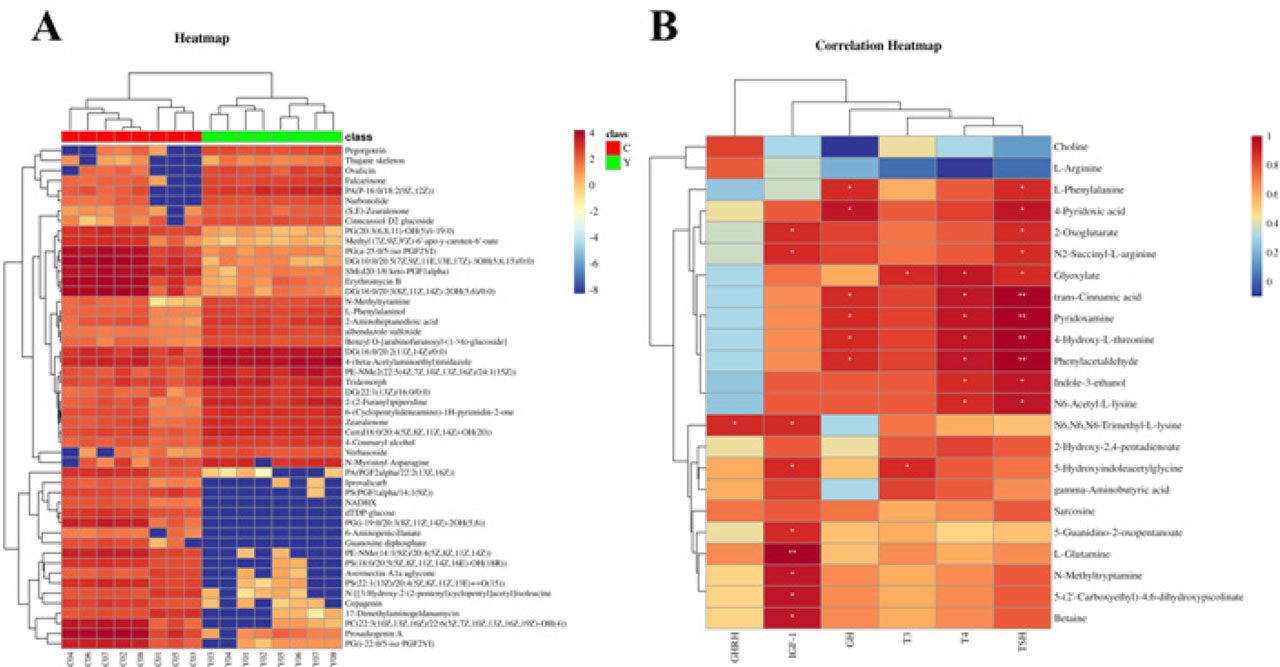
Figure 4.
(A): Heatmap of the hierarchical clustering of up- and down-regulated Top25 enriched metabolites in the serum contents of YPF-P vs control groups chicks. (B): The correlation heat-map between amino acid metabolism-related metabolites and growth-related hormones in Group C vs Group Y. Correlation was performed using data from the same 8 individual animals per group for both metabolomic and hormonal measurements. (Panel A: C refers to the serum control group (0 g/kg), and Y refers to the serum 2 g/kg YPF-P addition group).
Our previous study demonstrated that YPF-P modulates the composition of predominant intestinal bacteria (Zheng et al., 2023). We therefore hypothesize that the observed alterations in host metabolism may be associated with these changes in the gut microbial community.
Correlation between microorganisms and identified serum metabolites
To further investigate whether microbial regulation of growth is associated with endocrine responses, we analyzed the correlation between the top 20 bacteria at the genus level published by our research group and growth-related hormones (Zheng et al., 2023). According to Figure S1 A and Table S1, in cecum flora, Bacteroides were positively correlated with T4 and T3 (P<0.01), Megamonas was positively correlated with T3 and IGF-1 (P<0.05), Faecalibacterium was negatively correlated with GH (P<0.05). In the correlation analysis between duodenum and growth-related hormones (Figure S1 C), Bacteroides were positively correlated with TSH, T3, and T4 (P<0.05), Enterococcus was negatively correlated with IGF-1 and GHRH (P<0.05).
We also analyzed the correlations between different metabolites and microorganisms in amino acid metabolic pathways (Figure S1). According to Figure S1 B, in the cecal microbiota, Bacteroides were positively correlated with 5-hydroxyindoleacetylglycine in the pathway of tryptophan metabolism, and with glyoxylate involved in arginine and proline metabolism, glycine, serine, and threonine metabolism. Megamonas is positively correlated with 5-hydroxyindoleacetylglycine in tryptophan metabolism, with gamma-aminobutyric acid and 5-guanidino-2-oxoopentanoate in arginine and proline metabolism, and with L-glutamine in arginine biosynthesis. Figure S1 D shows that in the duodenal flora, Bacteroides are positively correlated with trans-cinnamic acid and phenylacetaldehyde in phenylalanine metabolism, and 2-hydroxy-2 in phenylalanine metabolism, 4-pentadienoate, gamma-aminobutyric acid in arginine and proline metabolism, and arginine and pro-line metabolism and glycine. Glyoxylate in serine and threonine metabolism is positively correlated with N6-acetyl-L-lysine in lysine degradation, indole-3-ethanol in tryptophan metabolism, and 4-hydroxyl-l-threonine and pyridoxamine in vitamin B6 metabolism. Roseburia and Megamonas are positively correlated with 2-hydroxyl 2-hydroxy-2,4-pentadienoate in phenylalanine metabolism and gamma-aminobutyric acid in arginine and proline metabolism, and glyoxylate in arginine and proline metabolism, glycine, serine and threonine metabolisms, N6-acetyl-L-lysine in lysine degradation and indole-3-ethanol in tryptophan metabolism. Collectively, these results indicate that the growth-regulatory effects of YPF-P are associated with specific changes in microorganisms and amino acid metabolic pathways.
Collectively, these correlations indicate that YPF-P modulates host growth through specific changes in the cecal and duodenal microbiota that are associated with the regulation of amino acid metabolism and key growth hormones.
Discussion
Maintaining high growth performance is crucial for efficient poultry production. So far, there has been sufficient evidence to show the positive role of Chinese herbal polysaccharide in animal production. For weaned piglets, the addition of Atractylodes macrocephala polysaccharide and Glycyrrhiza polysaccharide is beneficial for improving the daily gain of piglets and reduce the feed-meat ratio (Li et al., 2023; Zhang et al., 2023). The diet treated with yam polysaccharide can significantly increase the daily gain of geese and reduce the feed-meat ratio (Shi et al., 2022). Adding Lycium barbarum polysaccharide and Astragalus polysaccharide to the diet of chicks can significantly increase the weight of chicks and reduce the feed-meat ratio (Wu, 2018; Long et al., 2020). In addition, adding Astragalus polysaccharide into lamb feed can also significantly increase daily gain and reduce feed-meat ratio (Chen et al., 2021). The results of this series of studies show that supplementing Chinese herbal polysaccharide in diet is beneficial for improving the growth performance of animals. The results of this study showed that adding 2 g/kg YPF-P to the diet could significantly increase the FBW and ADG of chicks and significantly improved the FCR of chicks. These results suggest that YPF-P, as a traditional Chinese medicine-derived polysaccharide, promotes chick growth at certain doses, benefiting their overall development. Therefore, we further investigated the changes in growth-related hormones in serum.
The growth of poultry is influenced by many factors in the body, such as food intake and secretion from different organs and tissues in the body, and these factors are transported through the bloodstream to their target sites (Kowalik and Sechman, 2022). It was found that adding a certain dose of YPF-P to the diet could significantly increase the serum concentrations of GH, TSH, T3, T4 and IGF-1 in chicks. It is suggested that YPF-P may improve the growth performance and metabolism of chicks by regulating the hormone level in serum. Previous studies have found that adding polysaccharide can improve the serum hormone levels related to growth in different animals. For example, adding 0.05 kg/kg yam polysaccharide to chick’s diet can increase the concentration of T3, T4, IGF-1 and GH in chick’s serum (Deng et al., 2022). It has also been confirmed that the injection of Astragalus polysaccharides into heat-stressed dairy cows will significantly increase the concentration of T3 and T4 in dairy cows’ serum (Zeng et al., 2020). These findings suggest that different concentrations of Chinese herbal polysaccharide can improve the hormone level in serum of animals to varying degrees, which is consistent with the results of this study. However, the mechanisms through which YPF-P regulates serum hormone levels in chicks remain unclear and require further investigation.
Therefore, we further analyzed the influence of YPF-P on serum metabolites, hoping to find out the metabolic mechanism related to growth. Using LC-MS-based metabolomics, we examined the changes in serum metabolites in chicks. At present, there are few studies on the effect of YPFP on serum metabolism. We proved that YPF-P can regulate serum metabolism, especially amino acid metabolism. Non-targeted metabolomics revealed that 872 significantly changed serum metabolites were mainly related to the metabolism of amino acid metabolism and metabolisms of co-factors and vitamins. In addition, the changes of serum metabolic markers are related to tryptophan metabolism, vitamin B6 metabolism, sphingolipid metabolism, phenylalanine metabolism, lysine degradation, glycine, serine and threonine metabolism, arginine biosynthesis and arginine and proline metabolism. This study found significant changes in amino acid metabolic pathways, with YPF-P supplementation notably up-regulating many of these pathways.
As the basic unit of protein, amino acids are considered to be essential for maintaining basic life metabolism, involving protein biosynthesis, immune response and energy conversion (Li et al., 2007). Phenylalanine regulates the neurodevelopment of organisms, and tryptophan plays an important role in the function of neurotransmitters (Wu, 2013). Arginine and proline metabolism pathways are involved in cell growth and development (Liao et al., 2020). Glutamine is related to the growth of chickens (He et al., 2021), while L-glutamine is involved in the synthesis of arginine biosynthesis. Dietary supplementation with lysine (Zarghi et al., 2020) or tryptophan (Mund et al., 2020) can improve the growth performance and tissue development of broilers.
By analyzing the correlation between differential metabolites and growth-related hormones and growth, we can also find that these growth-related factors are significantly correlated with amino acid metabolism. Notably, increased availability of tryptophan, a precursor for serotonin (5-HT) synthesis, may directly stimulate the GH-IGF-1 axis. Previous studies support this hypothesis: administration of 5-HT or its receptor agonist can elevate serum GH levels in rats and cattle (Willoughby et al., 1987; Gaynor et al., 1995), and dietary tryptophan supplementation has been shown to enhance basal GH secretion in weaned piglets (Rao et al., 2021). Crucially, our correlation analysis further indicates a positive relationship between key tryptophan metabolites and serum IGF-1 levels. Thus, we propose that the YPF-P-induced up-regulation of tryptophan metabolism increased serotoninergic activity, which in turn stimulates GH secretion and subsequently elevates circulating IGF-1, ultimately contributing to the enhanced growth performance in chicks.
The intestinal microbial community plays a pivotal role in regulating the physiology and metabolism of chickens, thereby influencing growth performance, feed efficiency, nutrient absorption, and immune response (Wu et al., 2019; Kogut et al., 2020). Plant extracts can reach the colon via enterohepatic circulation, where they are metabolized by colonic microflora before absorption, leading to the production of metabolites detectable in serum (Muñoz-González et al., 2019). Studies have shown a positive correlation between broiler growth and the abundance of Bacteroides (Li et al., 2016), which is consistent with the findings of this study. Bacteroides metabolize polysaccharides and oligosaccharides, providing essential nutrients and vitamins to both the host and other intestinal microorganisms (Zafar and Saier, 2021). Furthermore, Bacteroides contribute to the development of the host immune system (Hooper, 2004) and maintain intestinal microbial balance (Sears, 2005). Vitamin B6, an essential coenzyme in nutritional metabolism, plays a role in reducing oxidative stress (Wassie et al., 2022). Reports suggest that Bacteroides are involved in the synthesis of vitamin B6 (Matxain et al., 2007; Rosenberg et al., 2017). In the YPF-P supplementation group, Bacteroides abundance in the duodenum was significantly correlated with vitamin B6 metabolism, leading to an up-regulation of the serum vitamin B6 metabolic pathway. These findings suggest that YPF-P enhances vitamin metabolism by increasing the abundance of Bacteroides.
Additionally, Megamonas ferments carbohydrates into short-chain fatty acids (Feng et al., 2019), while Roseburia, a potential beneficial bacterium, produces butyrate, which enhances energy expenditure and fat oxidation, thereby impacting energy homeostasis and lipid metabolism (Nie et al., 2021). Correlation analyses revealed that both Megamonas and Roseburia are significantly associated with amino acid metabolism. Furthermore, Bacteroides and Megamonas showed significant correlations with growth-related hormones production and growth performance. These findings highlight that YPF-P improves chick growth performance by optimizing intestinal microbiota distribution and modulating key growth-related metabolites.
Conclusion
In summary, dietary supplementation with YPF-P enhances broiler growth by improving growth performance indicators, including increased BWG, improved FCR and elevated serum levels of GH, GHRH, TSH, IGF-1, T3, and T4. Metabolomic analysis further revealed that YPF-P modulates serum metabolites. Clustering and correlation analyses revealed that the growth-regulating effects are associated with the up-regulation of metabolites involved in amino acid metabolism pathways. Additionally, specific alterations in the microbial-metabolic axis may play a pivotal role in the growth-regulatory mechanisms of YPF-P. Collectively, these findings provide mechanistic insights into how YPF-P regulates broiler growth and support its potential application as a sustainable, antibiotic-free growth promoter in poultry production.
Acknowledgement
This work was supported by the Guangdong Provincial Key Laboratory of Animal Molecular Design and Precise Breeding (2019B030301010).