
The global human population is increasing at a faster rate, expected to be around 9.70 billion in 2050 (UN, 2022), for which overall food production needs to be increased by 60% (UN, 2022) from the present level. Fisheries and aquaculture are the prominent keys to feeding quality protein to the world and providing a livelihood for millions. About 51% of fish production is contributed by aquaculture to total fisheries production, and 57% of aquatic animal production from aquaculture is available for human consumption (FAO, 2024). This trend indicates that the capture fisheries have attained their peak and started dwindling in contribution, showing that the future of fish production would mainly depend on aquaculture (Bhuvaneshwaran, 2025).
Whiteleg shrimp or Pacific white shrimp holds the topmost position among all the farmed aquatic animals globally (FAO, 2024), making a significant contribution to overall aquaculture production. Thus, whiteleg shrimp emerges as a vital candidate species to augment aquaculture production and achieve substantial export revenue (Gulati et al., 2025).
In global aquaculture, more than 90% of farmed shrimp rely on fish meal (FM)-based high-protein diets (Cummins et al., 2017). FM is highly preferred for shrimp feed due to its high-quality digestible protein, balanced amino acid profile, ω-3 fatty acid content, and unidentified growth factors. (Mehta et al., 2023). However, a dichotomy exists between the blooming aquaculture industry with increased demand for feed and a declining wild capture fishery with an irregular supply of FM for aquafeed (Macusi et al., 2023). Moreover, the twofold hiking of FM price in recent years aggravates the situation concerning cost-effective aquafeed production (Bansemer et al., 2023) as feed cost is 60–70% of the total operating expenses of aquaculture (Macusi et al., 2023). Accordingly, FM-based aquafeed production cannot be sustained (Wang et al., 2023; FAO, 2024; Su et al., 2025). Thus, there is a need to shift towards an alternative protein ingredient other than FM to attain sustainability in aquafeed production (Tacon and Metian, 2008; Bhuvaneshwaran et al., 2019; Bhuvaneshwaran, 2025). Numerous research studies have been conducted to find various plant and animal-based ingredients as FM alternatives in the diet of aquatic species with varying levels of success (Macusi et al., 2023; Moyo and Rapatsa-Malatji, 2023; Yadav et al., 2025). Despite the cost-effectiveness and widespread availability of plant-based ingredients, their utilization in aquafeed is hindered by the existence of anti-nutritional factors such as trypsin inhibitors, phytates, and tannins (Ahmed et al., 2025). Additionally, the imbalanced amino acid profile, characterized by deficiencies in essential amino acids (EAA) like methionine and lysine, alongside issues of low palatability, high fiber content, and the existence of non-starch polysaccharides (NSP), further compounds the challenges associated with their incorporation into aquafeed formulations (Dayal et al., 2020; Sánchez-Muros et al., 2020; Jannathulla et al., 2022; Hossain et al., 2024). However, animal protein sources are considered the best FM alternatives for aquafeed due to their higher protein, superior amino acid, and fatty acid profile, and palatability (Naz et al., 2023). In this connection, the bioconversion of organic wastes into animal-based ingredients has gained momentum these days, especially the insect meals such as black soldier fly larvae (BSFL), maggot larvae, yellow mealworms, crickets, etc., which are tried as replacers of FM in various fish and shrimp diets (Nairuti et al., 2021; Richardson et al., 2021; Camperio et al., 2025; Yadav et al., 2025). Insect meal is a promising animal protein for feeding aquatic animals as an alternative to FM (Gougbedji et al., 2021; Rajalakshmi et al., 2025). The insects have a biological capability to convert low-quality organic wastes into high-quality animal protein biomass at a lower cost of water and land with less emission of greenhouse gases, along with a lower carbon footprint (Van Huis et al., 2013; Van Huis, 2020; Ebeneezar et al., 2021). The European Union Commission’s regulation in 2017 (2017/893/EC) endorsed the inclusion of insect meal as a feed ingredient in feed formulations, permitting the utilization of seven insect species in the aquaculture sector (Bruni et al., 2018). Amongst the permitted insect species, black soldier fly (BSF) (Hermetia illucens (Linnaeus, 1758)) larvae had gained special attention and were utilized highly for aquafeed formulation (Wardhana et al., 2017). These species exhibit significant potential for converting organic wastes into protein-rich biomass, thereby facilitating sustainable recycling of waste materials (Sheppard et al., 1994; Barragan et al., 2017; Shumo et al., 2019; Sidiq et al., 2025; Camperio et al., 2025). The crude protein and lipid contents of BSFL meal are about 35–46% (Meneguz et al., 2018) and 19–37% (Kroeckel et al., 2012), respectively. They have a suitable amino acid and fatty acid profile prescribed for inclusion in animal feeds (Barroso et al., 2014; Makkar et al., 2014; Surendra et al., 2016; Yadav et al., 2025). However, the primary issue in BSFL production is the variation of nutrients in different lots depending on the environmental conditions and substrates. Like most other organisms, the growth, reproduction, maturation, and various life history traits of BSF are highly reliant on the nutritional content and the quality of the culture substrate and environmental conditions (Tomberlin et al., 2002).
Hence, the production of BSFL in the artificial system with controlled environmental conditions such as temperature and relative humidity, pH, moisture, and the quality of the substrate could be the right strategy (Sabir et al., 2020; Avila et al., 2022; Van et al., 2022) and more effectiveness of this black soldier fly larvae meal (BSFLM) as FM alternative in aquafeed is expected. Although several studies have investigated the replacement of FM with BSFLM in aquafeeds, comparative evaluation of larvae meals produced under different systems is limited. With this backdrop, the present study aimed to evaluate the effect of dietary ECBSFL vis-a-vis OSBSFL on growth, nutrient utilization, antioxidant activity, physico-metabolic status, and immune responses of brackish water-reared whiteleg shrimp.
Material and methods
Experimental animals and acclimatization
Whiteleg shrimp juveniles were procured from a Shrimp Farm, Pedapudi, Kakinada, India, and transported in an aerator fitted with 4 barrels of 200 L capacity filled with brackish water of 7 ppt salinity. Then, shrimps were randomly distributed to the hapas (1 m × 1 m × 1 m) installed in the brackish water pond of 7 ppt salinity and acclimatized under ambient conditions. During the acclimation period, the shrimps were fed thrice a day with commercial feed (36% crude protein and 5% lipid) on a satiation basis, until they reached an average weight of 2.0±0.25 g, which was used as the initial weight for the experiment.
Preparation of defatted black soldier fly larvae meal
The black soldier fly larvae (BSFL) reared in environment controlled system using a proprietary substrate made of pre-consumer vegetal sources were procured from Green Grahi Solutions Pvt Ltd, Uttarakhand, and subjected to defatting in the Socsplus apparatus (SCS 08 AS, PELICAN Equipment’s, India) using diethyl ether (boiling point 60±5°C) as solvent, and then the defatted BSFL meal was prepared and designated as ECBSFL. BSFL reared in an open system was procured from a local entrepreneur in Coimbatore, Tamil Nadu, and processed for the preparation of defatted BSFL meal and designated as OSBSFL.
Formulation and preparation of the experimental diets
Nine iso-nitrogenous (36% crude protein), isolipidic (6%), isocaloric (370 Kcal digestible energy/100 g feed) practical diets were formulated by replacing fish meal with graded levels of defatted ECBSFL or OSBSFL, viz. control (0% BSFL), ECBSFL (25, 50, 75, and 100%), and OSBSFL (25, 50, 75, and 100%). The formulation and proximate composition of the experimental diets are depicted in Table 1. According to the feed formulation, all the dried ingredients were finely ground, sieved, and weighed precisely. All the feed ingredients were uniformly homogenized and subjected to steam cooking for 20 min. Then vitamin-mineral mixture, oil, BHT, CMC, choline chloride, cholesterol, and soy lecithin were added to the cooled dough and mixed uniformly. The cooled dough was then pressed through a mechanical pelletizer through a perforated die of 1 mm diameter. The feed pellets were kept in a dryer at 60°C to attain a moisture level of less than 10% and airtight zipper bags were used for packing and stored in a dry and cool place.
Table 1.
Formulation and proximate composition of experimental diets fed to Penaeus vannamei juveniles for 60 days
| Ingredients composition (g/kg) | Diet/Treatments1 | ||||||||
|---|---|---|---|---|---|---|---|---|---|
| control | ECBSFL25% | ECBSFL50% | ECBSFL75% | ECBSFL100% | OSBSFL25% | OSBSFL50% | OSBSFL75% | OSBSFL100% | |
| Fish meal | 250.00 | 187.50 | 125.00 | 62.50 | 0.00 | 187.50 | 125.00 | 62.50 | 0.00 |
| DBSFL2 | 0.00 | 62.50 | 125.00 | 187.50 | 250.00 | 62.50 | 125.00 | 187.50 | 250.00 |
| SBM3 | 145.00 | 145.00 | 145.00 | 145.00 | 145.00 | 145.00 | 145.00 | 145.00 | 145.00 |
| GNOC4 | 140.00 | 155.00 | 170.00 | 186.00 | 202.80 | 165.00 | 185.00 | 208.00 | 233.00 |
| Wheat flour | 100.00 | 100.00 | 100.00 | 100.00 | 100.00 | 100.00 | 100.00 | 100.00 | 100.00 |
| Maize flour | 70.00 | 70.00 | 70.00 | 70.00 | 70.00 | 70.00 | 70.00 | 70.00 | 70.00 |
| DORB5 | 238.30 | 218.80 | 200.10 | 181.05 | 161.25 | 208.80 | 185.10 | 161.30 | 133.30 |
| Fish oil | 7.00 | 10.00 | 12.50 | 14.50 | 16.50 | 10.00 | 12.50 | 13.00 | 15.00 |
| Soybean oil | 3.50 | 5.00 | 6.20 | 7.25 | 8.25 | 5.00 | 6.20 | 6.50 | 7.50 |
| BHT6 | 0.20 | 0.20 | 0.20 | 0.20 | 0.20 | 0.20 | 0.20 | 0.20 | 0.20 |
| Vit-Min mix7 | 15.50 | 15.50 | 15.50 | 15.50 | 15.50 | 15.50 | 15.50 | 15.50 | 15.50 |
| Cholesterol | 2.50 | 2.50 | 2.50 | 2.50 | 2.50 | 2.50 | 2.50 | 2.50 | 2.50 |
| CMC8 | 20.00 | 20.00 | 20.00 | 20.00 | 20.00 | 20.00 | 20.00 | 20.00 | 20.00 |
| Choline | 3.00 | 3.00 | 3.00 | 3.00 | 3.00 | 3.00 | 3.00 | 3.00 | 3.00 |
| chloride | |||||||||
| Soy lecithin | 5.00 | 5.00 | 5.00 | 5.00 | 5.00 | 5.00 | 5.00 | 5.00 | 5.00 |
| Total | 1000.00 | 1000.00 | 1000.00 | 1000.00 | 1000.00 | 1000.00 | 1000.00 | 1000.00 | 1000.00 |
| Proximate composition (on % dry matter basis) | |||||||||
| Dry matter | 90.84 | 90.21 | 89.15 | 89.8 | 89.96 | 90.18 | 90.75 | 90.74 | 90.68 |
| Crude protein | 36.16 | 36.25 | 35.99 | 36.39 | 35.86 | 36.15 | 36.16 | 35.96 | 36.23 |
| Ether extract | 6.12 | 6.08 | 6.03 | 5.97 | 6.13 | 6.03 | 6.14 | 6.01 | 6.10 |
| Crude fiber | 4.89 | 4.97 | 5.05 | 5.16 | 5.21 | 4.98 | 5.01 | 5.17 | 5.22 |
| Total ash | 9.79 | 9.35 | 9.33 | 9.68 | 9.34 | 9.39 | 9.39 | 9.09 | 9.13 |
| NFE9 | 43.04 | 43.35 | 43.6 | 42.8 | 43.46 | 43.45 | 43.3 | 43.77 | 43.32 |
| GE10 (MJ/kg) | 19.39 | 19.46 | 19.44 | 19.39 | 19.45 | 19.44 | 19.46 | 19.47 | 19.50 |
| DE11 (MJ/Kg). | 15.55 | 15.60 | 15.78 | 15.49 | 15.57 | 15.58 | 15.60 | 15.59 | 15.60 |
| P:E12 (mg protein/KJ DE) | 23.25 | 23.23 | 23.08 | 23.48 | 23.01 | 23.20 | 23.18 | 23.04 | 23.23 |
1 Control (25% fish meal and 0% defatted black soldier fly larvae meal prepared from larvae raised in either controlled environment system, ECBSFL or in open system, OSBSFL), ECBSFL25% (6.25% ECBSFL in replacement of 25% fish meal or FM), ECBSFL50% (12.5% ECBSFL in replacement of 50% FM), ECBSFL75% (18.75% ECBSFL in replacement of 75% FM), ECBSFL100% (25% ECBSFL in replacement of 100% FM), OSBSFL25% (6.25% OSBSFL in replacement of 25% FM), OSBSFL50% (12.5% OSBSFL in replacement of 50% FM), OSBSFL75% (18.75% OSBSFL in replacement of 75% FM), OSBSFL100% (25% OSBSFL in replacement of 100% FM).
7 Composition of vitamin-mineral mix (PRE-MIX PLUS) (quantity/kg): vitamin A, 5,500,000 IU; vitamin D3, 1,100,000 IU; vitamin B2, 2,000 mg; vitamin E, 750 mg; vitamin K, 1,000 mg; vitamin B6, 1,000 mg; vitamin B12, 6 mg; calcium pantothenate, 2,500 mg; nicotinamide, 10 g; Choline chloride, 150 g; Mn, 27,000 mg; I, 1,000 mg; Fe, 7,500 mg; Zn, 5,000 mg; Cu, 2,000 mg; Co, 450 L-lysine, 10 g; dL-methionine, 10 g; selenium 125 mg; vitamin C, 2,500 mg;
Experimental setup and feeding trial
A 60-day feeding trial was performed in hapas installed in the brackish water pond of 200 m2 at Kakinada Centre, ICAR-CIFE, India. Initially, the pond water was completely drained out, and unwanted fish were removed. After drying the pond, lime was applied according to the soil pH and mixed with the soil using the tractor. After 7 days of lime application, 200 kg of raw cow dung as organic manure was uniformly broadcasted in the pond, and the pond was refilled with brackish water of 7 ppt salinity up to 1.5 m depth. A total of 27 hapas (1 m × 1 m × 1 m) were installed in the manured pond with the help of bamboo poles and nylon thread. The pond was covered with net strings to prevent bird entry from the top, and the dykes were subjected to net fencing to avoid crab entry. The pond water was continuously aerated by using a paddle wheel aerator of 3 HP.
After fifteen days of manuring following overnight feed restriction, one thousand and eighty (1080) acclimated juveniles of whiteleg shrimp with an average body weight of 2.0 ± 0.25 g, were grouped randomly into nine experimental treatments, viz. control, ECBSFL25%, ECBSFL50%, ECBSFL75%, ECBSFL100%, OSBSFL25%, OSBSFL50%, OSBSFL75%, and OSBSFL100% in triplicate with a stocking density of 40 shrimps per hapa following a completely randomized design. Throughout the feeding trial, the water salinity was maintained at 7 ppt, and the juveniles of different experimental treatments were fed 4 times daily (6:30 a.m., 10:30 a.m., 2:00 p.m., 5:30 p.m.) to satiation level. At fortnightly intervals, shrimp weights were assessed to facilitate adjustments for the satiation level of feeding. Throughout the experimental period, the water level of the pond was maintained, and a 10% water exchange was done at every four-day interval. To calculate the survival rate, shrimp mortality within each hapa was meticulously recorded during the course of the feeding trial. The present study was conducted strictly in accordance with the ethical norms governing Animal Care at ICAR-CIFE in Mumbai, India.
Every day, the water temperature, salinity, pH, and dissolved oxygen of the pond were monitored and evaluated by using a multiparameter waterproof meter (HI98194, HANNA Instruments, Romania), respectively. The total hardness, total alkalinity, and free carbon dioxide of the experimental pond were determined every three days by using the titrimetric method (APHA, 2005). However, ammonia-nitrogen, nitrite-nitrogen, and nitrate-nitrogen in pond water were measured at three-day intervals by the spectrophotometric method (APHA, 2005). In the present study, the physicochemical parameters of water were observed to fall within optimal ranges. Such as temperature between 26 to 31°C, pH 7.7–8.1, dissolved oxygen 4.5–5.6 mg/L, salinity 7–9 ppt, total hardness 1506–1701 mg/L, total water alkalinity 131–175 mg/L, free carbon dioxide nil, the concentration of total ammonium-nitrogen, nitrite-nitrogen, and nitrate-nitrogen of the experimental hapas in the pond were obtained within the 0.03–0.06, 0.002–0.007, and 0.02–0.08 mg/L, respectively.
Analysis of amino acids and fatty acids of BSFL meal and experimental diets
The amino acid composition of ECBSFL and OSBSFL was assessed by utilizing a Biochrom 30+ amino acid analyzer (Biochrom Ltd, Cambridge, UK), following sample hydrolysis in vacuum hydrolysis tubes (Thermo Scientific) with 6 N HCl within a dry block heater maintained at 110°C for 24 h, as outlined by Zumwalt et al. (1987).
The fatty acid composition of ECBSFL and OSBSFL was assessed by homogenizing the samples with a 30 ml mixture of chloroform and methanol (2:1), following the method described by Folch et al. (1957). Dried lipid was used for FAME preparation and subsequently preserved in glass vials at −20°C for further analysis in GC-MS (AOAC, 1995). Then the fatty acid methyl esters (FAMEs) were separated using GC-MS (QP2010, Shimadzu, USA) coupled with a DB Wax capillary column (Cromlab S.A.). The fatty acid composition of ECBSFL and OSBSFL and the experimental diets are depicted in Table 3 and Table 5.
Sampling
The initial weight and final weight were estimated by calculating the total biomass of the experimental shrimps stocked at the experimental hapa at the commencement of the experiment and after 60 days. Anaesthetization of the collected shrimps from all the experimental hapas was done by using clove oil (50 µl/L). For hematological and serum biochemical analysis, four intermolt shrimp were randomly collected and pooled from each experimental hapa (12 shrimp per treatment) and immersed in aerated water for 5 minutes. Hemolymph was then collected from the base of the fifth pereopod using a syringe, which was not pre-rinsed with anticoagulant. The hemolymph was immediately transferred to a dry Eppendorf tube free from shrimp saline solution to act as an anticoagulant. The tubes were maintained at ambient temperature for one hour to allow clotting. Afterward, the hemolymph was centrifuged at 4000 rpm for 5 min, and the serum was carefully collected and transferred to a separate Eppendorf tube. The serum was then stored at −20°C for subsequent analysis of serum parameters. To determine the concentration of hemocyanin (OxyHC), 10 µL of hemolymph was immediately diluted with 990 µL of distilled water. The absorbance of the resulting solution was measured at a wavelength of 335 nm. From each replicate, five shrimps were randomly selected (15 shrimp per treatment), pooled and weighed using an electronic weighing balance, pooled, and placed in a petri dish for whole-body proximate analysis. Additionally, four shrimps per replicate (12 shrimp per treatment) were pooled and dissected out in an iced condition to obtain hepatopancreas and muscle tissue samples. Following tissue collection, the samples were placed in ice-cold buffered phosphate solution (0.025 M), and for performing different enzyme assays, tissue homogenates were prepared accordingly.
Chemical composition analysis of the diets and the whole body of shrimp
The chemical composition of different experimental diets and the whole body of shrimp encompassing moisture, crude protein (CP), ether extract (EE), total ash (TA), crude fiber (CF), and nitrogen-free extract (NFE) of the experimental diets and the whole body of shrimp was determined using standard methods (AOAC, 1995). Except for moisture, other proximate components were determined on a dry matter basis. The NFE extract of the diet sample was calculated by the subtraction method as follows:
The gross energy (GE), digestible energy (DE) according to Halver (1976), and protein-to-energy ratio (P: E) of experimental diets were calculated by using the following formula.
Finally, the proximate components other than the moisture of the whole body of shrimp were expressed on a wet weight basis.
Growth, feed conversion, and nutrient utilization
The various growth performance metrics, including percent weight gain (%), specific growth rate (SGR), thermal growth coefficient (TGC), feed conversion ratio (FCR), the protein efficiency ratio (PER), and lipid efficiency ratio (LER), were calculated by using the standard formula as follows:
Survival rate
Following the completion of the experiment, the total count of the shrimp in each experimental hapa was recorded, and the survival percentage was determined by the following formula:
Enzyme analysis
Sample preparation
A 5% (W/V) tissue homogenate was meticulously prepared using ice-cold buffered phosphate solution (0.025 M KH2PO4, 0.025 M Na2PO4.12H2O, pH 7.5) within a Teflon-coated mechanical homogenizer (Model 40147 REMI Equipment, Mumbai, India). Stringent maintenance of ice-cold conditions was upheld throughout the process, ensuring the preservation of enzyme activity from initial tissue collection to homogenate preparation. Subsequently, the prepared tissue homogenates were centrifuged at 5000 rpm for 10 min at 4°C, employing a refrigerated centrifuge (Heraeus Megafuge 8R Centrifuge, Thermo Fisher Scientific, Germany). Then the supernatant was carefully collected into 2 ml Eppendorf tubes and conserved in a deep freezer at −20°C till enzyme analysis was executed.
Estimation of tissue protein
Quantification of tissue protein levels is crucial for various biological and biochemical studies, as protein content serves as a fundamental indicator of nutritional status, growth, and overall health in shrimps. Lowry’s method described by Lowry et al. (1951) was employed for the quantification of protein in various tissue homogenates. Enzyme activity was subsequently determined based on the resultant tissue protein values, and optical density readings were taken at 660 nm against a blank. The protein concentrations of various tissue samples were determined by utilizing a bovine serum albumin standard curve.
Digestive enzymes
The protease enzyme activity in the hepatopancreas tissue homogenate was assessed using Drapeau’s (1976) casein digestion method and indicated as micromoles of tyrosine released per minute per milligram of protein. Similarly, the amylase activity in the hepatopancreas tissue homogenate was determined utilizing the DNS (3,5-dinitrosalicylic acid) method outlined by Rick and Stegbauer (1974) and the activity was expressed as micromoles of maltose released per minute per milligram of protein. Furthermore, the hepatopancreatic lipase activity was evaluated employing the titrimetric method described by Cherry and Crandell (1932), which quantifies the release of fatty acids through the enzymatic hydrolysis of triglycerides in an olive oil emulsion. Lipase activity was expressed in units per hour per milligram of protein.
Estimation of AST and ALT
Protein metabolic enzymes such as aspartate aminotransferase (AST) and alanine aminotransferase (ALT) play crucial roles in various biochemical processes and are important indicators of metabolic activity and health. The activity of aspartate aminotransferase (AST) and alanine aminotransferase (ALT) in both hepatopancreas and muscle tissue homogenates was determined using the method outlined by Wooten (1964). AST activity was expressed as nanomoles of oxaloacetate released per minute per milligram of protein, while ALT activity was expressed as nanomoles of sodium pyruvate released per minute per milligram of protein.
Estimation of oxidative stress enzyme activity
The superoxide dismutase (SOD) activity in hepatopancreas tissue homogenates was evaluated following the Mishra and Fridovich (1972) method, which relies on the enzyme’s ability to oxidize the epinephrine-adrenochrome transition, with changes in OD at 480 nm recorded for 3 min. Therefore, SOD activity was quantified as 50% inhibition of epinephrine auto-oxidation/milligram of protein/minute.
For the determination of catalase (CAT) activity in hepatopancreas tissue homogenates, the technique proposed by Takahara et al. (1960) was followed. The method relies on the ability of catalase to break down hydrogen peroxide (H2O2), with the extent of decomposition measured spectrophotometrically at 240 nm. CAT activity was subsequently calculated as nanomoles of H2O2 decomposed/minute/milligram of protein.
Serum biochemical profile
Serum total protein, glucose, total cholesterol, and triglycerides were determined utilizing kits acquired from Erba® Diagnostic Mannheim and Transasia Biochemistry Test Kits, India. Serum hemocyanin (OxyHC) concentration was determined according to the method outlined by Chen and Cheng (1995).
Quantification of hepatopancreatic malondialdehyde (MDA) and phenoloxidase (PO) activity
In centrifuge tubes, one ml of hepatopancreatic tissue homogenate was added to two ml of TCA-TBA-HCl reagent to estimate hepatopancreatic malondialdehyde (MDA). All tubes were briefly vortexed and subsequently immersed in a boiling water bath for 15 minutes. After cooling to room temperature, centrifugation was performed at 1000 rpm for 10 min. The supernatant was then pipetted into a cuvette, and the optical density (OD) was measured at 535 nm against the blank. MDA value was calculated as follows:
Perazzolo and Barracco (1997) proposed a method for measuring phenoloxidase (PO) activity. Initially, serum samples were pre-incubated with either 0.45 M NaCl or serine proteinase trypsin (1 mg/ml). Subsequently, these pre-treated samples were exposed to 50 μL of L-DOPA (3 mg/ml) for 5 min, followed by the addition of 850 μL of distilled water to mitigate the reaction rate. The ensuing step involved incubating the L-DOPA with 0.45 M NaCl to detect spontaneous oxidation. After 5 min the absorbance measurements were taken and the activity was expressed as change in absorbance units/milligram of protein/minute.
Statistical analysis
The statistical analysis of the data was performed by using SPSS version 25, in which one-way analysis of variance (ANOVA) was initially employed, preceded by an assessment of variance homogeneity. Subsequently, to discern significant differences among the means, Duncan’s multiple range tests were executed. These comparisons were carried out at a 5% significance level, and the data are expressed as mean ± SE.
Results
Amino acid and fatty acid composition of BSFLM
The amino acid values of ECBSFL were higher than those of OSBSFL (Table 2). EAA, like leucine, isoleucine, methionine, valine, threonine, phenylalanine, and non-essential amino acids (NEAA) like alanine, arginine, aspartic acid, glutamic acid, and serine, showed higher values in defatted ECBSFL than defatted OSBSFL. The amino acid composition of experimental diets was depicted in Table 4.
Table 2.
Amino acid composition (on dry matter basis) of full-fatted and defatted black soldier fly larvae meals (ECBSFL and OSBSFL)
| Amino acids (%) | BSFL meal | |||
|---|---|---|---|---|
| full-fatted ECBSFL meal | defatted ECBSFL meal | full-fatted OSBSFL meal | defatted OSBSFL meal | |
| Arginine | 3.45 | 2.85 | 3.22 | 0.88 |
| Histidine | 0.87 | 0.92 | 0.72 | 1.44 |
| Leucine | 2.13 | 2.22 | 1.97 | 2.09 |
| Isoleucine | 1.43 | 1.59 | 1.33 | 1.45 |
| Lysine | 2.09 | 2.00 | 1.90 | 2.03 |
| Methionine | 1.70 | 0.73 | 0.52 | 0.56 |
| Phenylalanine | 1.23 | 1.27 | 1.10 | 1.18 |
| Threonine | 1.11 | 3.61 | 1.02 | 1.59 |
| Valine | 1.92 | 2.15 | 1.84 | 1.97 |
| Alanine | 1.50 | 1.85 | 1.41 | 1.49 |
| Aspartic acid | 1.77 | 2.02 | 1.66 | 1.90 |
| Cystine | 0.33 | 0.49 | 0.09 | 0.37 |
| Glutamic acid | 4.19 | 4.63 | 3.89 | 4.27 |
| Glycine | 1.61 | 1.76 | 1.58 | 1.65 |
| Proline | 2.68 | 3.65 | 2.08 | 4.53 |
| Serine | 1.22 | 1.42 | 1.13 | 1.30 |
Table 3.
Fatty acid composition (on dry matter basis) of full-fatted and defatted black soldier fly larvae meals (ECBSFL and OSBSFL)
| Fatty acids (%) | BSFL meal | |||
|---|---|---|---|---|
| full-fatted ECBSFL meal | defatted ECBSFL meal | full-fatted OSBSFL meal | defatted OSBSFL meal | |
| C10:0 | 1.83 | BLQ | 1.13 | 0.83 |
| C12:0 | 63.08 | 47.95 | 49.22 | 54.33 |
| C14:0 | 9.92 | 8.41 | 8.53 | 10.71 |
| C16:0 | 11.37 | 20.10 | 15.19 | 22.41 |
| C16:1(n-7) | 5.55 | 7.58 | 1.83 | 0.96 |
| C18:0 | 0.79 | BLQ | 0.69 | 1.3 |
| C18:1(n-9) | 4.44 | 10.13 | 15.41 | 5.85 |
| C18:2(n-6) | 1.64 | 5.83 | 7.84 | BLQ |
| C18:3(n-3) | 0.19 | BLQ | BLQ | 3.61 |
| C20:4(n-6) | BLQ | BLQ | BLQ | BLQ |
| C20:5(n-3) | BLQ | BLQ | BLQ | BLQ |
| C22:6(n-3) | BLQ | BLQ | BLQ | BLQ |
| ΣSFA | 87.43 | 76.46 | 74.83 | 89.58 |
| ΣMUFA | 10.74 | 17.71 | 17.33 | 6.81 |
| ΣPUFA | 1.83 | 5.83 | 7.84 | 3.61 |
| Σn-3 PUFA | BLQ | BLQ | BLQ | BLQ |
| Σn-6 PUFA | BLQ | BLQ | BLQ | BLQ |
[i] Abbreviation: BSFL, black soldier fly larvae; ECBSFL, controlled environment system-raised defatted black soldier fly larvae; OSBSFL, open system-raised defatted black soldier fly larvae; BLQ, below the limit of quantification; SFA, saturated fatty acids; MUFA, monounsaturated fatty acids; PUFA, polyunsaturated fatty acids.
Table 4.
Amino acid composition (on dry matter basis) of experimental diets fed to Penaeus vannamei juveniles for 60 days
| Amino acid (%) | Diet/Treatments1 | ||||||||
|---|---|---|---|---|---|---|---|---|---|
| control | ECBSFL25% | ECBSFL50% | ECBSFL75% | ECBSFL100% | OSBSFL25% | OSBSFL50% | OSBSFL75% | OSBSFL100% | |
| Arginine | 2.95 | 2.84 | 2.98 | 2.91 | 2.74 | 2.86 | 2.67 | 2.52 | 2.37 |
| Histidine | 1.02 | 0.97 | 0.91 | 0.86 | 1.05 | 1.00 | 0.86 | 0.75 | 0.65 |
| Isoleucine | 1.39 | 1.32 | 1.26 | 1.19 | 1.43 | 1.32 | 1.02 | 0.86 | 0.71 |
| Leucine | 2.39 | 2.25 | 2.12 | 1.99 | 2.46 | 2.26 | 1.86 | 1.60 | 1.35 |
| Lysine | 2.03 | 1.90 | 1.76 | 1.63 | 1.54 | 1.91 | 1.56 | 1.31 | 1.06 |
| Methionine | 0.74 | 0.67 | 0.61 | 0.54 | 0.71 | 0.66 | 0.55 | 0.43 | 0.32 |
| Phenylalanine | 2.03 | 1.98 | 1.93 | 1.88 | 1.76 | 1.99 | 1.80 | 1.68 | 1.57 |
| Threonine | 1.20 | 1.27 | 1.34 | 1.41 | 1.20 | 1.15 | 0.99 | 0.84 | 0.69 |
| Valine | 2.29 | 2.25 | 2.20 | 2.15 | 2.35 | 2.24 | 1.91 | 1.73 | 1.56 |
| Tyrosine | 0.97 | 0.87 | 0.76 | 0.66 | 1.01 | 0.88 | 0.85 | 0.75 | 0.65 |
| Cystine | 0.36 | 0.35 | 0.35 | 0.34 | 0.36 | 0.32 | 0.34 | 0.31 | 0.27 |
| Alanine | 1.33 | 1.32 | 1.32 | 1.31 | 1.38 | 1.31 | 1.29 | 1.26 | 1.24 |
| aspartic acid | 2.70 | 2.62 | 2.54 | 2.46 | 2.89 | 2.64 | 2.57 | 2.52 | 2.46 |
| Glycine | 2.04 | 1.91 | 1.79 | 1.66 | 2.13 | 1.92 | 1.80 | 1.68 | 1.56 |
| Glutamic | 6.58 | 6.19 | 5.81 | 5.43 | 6.92 | 6.23 | 5.85 | 5.50 | 5.15 |
| Proline | 1.80 | 1.86 | 1.93 | 1.99 | 1.88 | 1.93 | 2.06 | 2.19 | 2.32 |
| Serine | 1.47 | 1.43 | 1.40 | 1.36 | 1.54 | 1.44 | 1.40 | 1.37 | 1.34 |
1 Control (25% fish meal and 0% defatted black soldier fly larvae meal prepared from larvae raised in either controlled environment system, ECBSFL or in open system, OSBSFL), ECBSFL25% (6.25% ECBSFL in replacement of 25% fish meal or FM), ECBSFL50% (12.5% ECBSFL in replacement of 50% FM), ECBSFL75% (18.75% ECBSFL in replacement of 75% FM), ECBSFL100% (25% ECBSFL in replacement of 100% FM), OSBSFL25% (6.25% OSBSFL in replacement of 25% FM), OSBSFL50% (12.5% OSBSFL in replacement of 50% FM), OSBSFL75% (18.75% OSBSFL in replacement of 75% FM), OSBSFL100% (25% OSBSFL in replacement of 100% FM).
Table 5.
Fatty acid composition (on dry matter basis) of experimental diets fed to Penaeus vannamei juveniles for 60 days
| Fatty acids (%) | Diets/Treatments1 | ||||||||
|---|---|---|---|---|---|---|---|---|---|
| control | ECBSFL25% | ECBSFL50% | ECBSFL75% | ECBSFL100% | OSBSFL25% | OSBSFL50% | OSBSFL75% | OSBSFL100% | |
| C12:0 | 1.07 | 1.48 | 1.36 | 1.21 | 1.41 | 1.15 | 1.99 | 2.58 | 2.37 |
| C14:0 | 2.12 | 3.14 | 4.16 | 4.09 | 4.24 | 4.39 | 4.77 | 3.9 | 4.28 |
| C16:0 | 15.73 | 20.83 | 18.18 | 18.05 | 17.21 | 19.61 | 19.95 | 18.93 | 18.84 |
| C16:1(n-7) | 4.84 | 4.43 | 4.21 | 4.16 | 4.12 | 4.5 | 4.09 | 3.51 | 4.23 |
| C18:0 | 3.02 | 4.99 | 4.78 | 4.06 | 3.68 | 4.78 | 4.5 | 3.94 | 4.02 |
| C18:1(n-9) | 25.62 | 23.71 | 24.75 | 27.52 | 29.11 | 24.59 | 25.45 | 26.01 | 27.16 |
| C18:2(n-6) | 24.97 | 21.66 | 23.65 | 25.85 | 27.06 | 22.31 | 23.01 | 23.78 | 23.21 |
| C18:3(n-3) | 2.12 | 1.95 | 1.93 | 2.00 | 1.8 | 1.73 | 1.78 | 1.52 | 1.37 |
| C20:4(n-6) | BLQ | BLQ | BLQ | BLQ | BLQ | BLQ | BLQ | BLQ | BLQ |
| C20:5(n-3) | 5.24 | 5.44 | 5.35 | 5.01 | 4.61 | 5.98 | 5.16 | 4.24 | 4.65 |
| C22:6(n-3) | 4.52 | 4.59 | 2.58 | 2.66 | 1.59 | 4.8 | 3.63 | 2.38 | 2.47 |
| ΣSFA | 27.93 | 36.41 | 32.64 | 31.45 | 30.47 | 34.45 | 35.45 | 33.19 | 31.87 |
| ΣMUFA | 30.42 | 28.14 | 28.96 | 32.33 | 33.92 | 29.89 | 30.25 | 34.33 | 32.57 |
| ΣPUFA | 36.85 | 34.48 | 33.51 | 36.22 | 35.7 | 35.66 | 34.3 | 32.48 | 31.7 |
| ΣUSFA | 67.31 | 63.44 | 62.47 | 68.12 | 69.62 | 65.55 | 64.55 | 66.81 | 63.09 |
| Σn-3 PUFA | 11.88 | 11.82 | 9.86 | 9.67 | 8.00 | 12.51 | 10.42 | 8.06 | 8.49 |
| Σn-6 PUFA | 24.97 | 21.82 | 23.72 | 25.95 | 27.06 | 22.31 | 23.16 | 23.85 | 23.21 |
1 Control (25% fish meal and 0% defatted black soldier fly larvae meal prepared from larvae raised in either controlled environment system, ECBSFL or in open system, OSBSFL), ECBSFL25% (6.25% ECBSFL in replacement of 25% fish meal or FM), ECBSFL50% (12.5% ECBSFL in replacement of 50% FM), ECBSFL75% (18.75% ECBSFL in replacement of 75% FM), ECBSFL100% (25% ECBSFL in replacement of 100% FM), OSBSFL25% (6.25% OSBSFL in replacement of 25% FM), OSBSFL50% (12.5% OSBSFL in replacement of 50% FM), OSBSFL75% (18.75% OSBSFL in replacement of 75% FM), OSBSFL100% (25% OSBSFL in replacement of 100% FM).
Similarly, defatted ECBSFL showed higher polyunsaturated fatty acids (PUFA) and monounsaturated fatty acids (MUFA) than the defatted OSBSFL, whereas the defatted ECBSFL showed lower saturated fatty acids (SFA) than OSBSFL (Table 3). The fatty acid composition of experimental diets was depicted in Table 5.
Proximate composition of the whole body of shrimp
The moisture, crude protein, ether extract, and total ash contents did not show any significant variation across the treatment groups (Table 6).
Table 6.
Whole-body proximate composition (on % wet weight basis) of Penaeus vannamei juveniles fed with different experimental diets for 60 days
| Treatments1 | Moisture | Protein | Ether extract | Total ash |
|---|---|---|---|---|
| Control | 75.99±0.06 | 15.93±0.07 | 1.83±0.01 | 3.19±0.02 |
| ECBSFL25% | 75.97±0.08 | 15.74±0.06 | 1.81±0.02 | 3.23±0.03 |
| ECBSFL50% | 75.63±0.34 | 15.9±0.26 | 1.83±0.03 | 3.36±0.07 |
| ECBSFL75% | 75.06±0.44 | 16.7±0.34 | 1.88±0.03 | 3.36±0.10 |
| ECBSFL100% | 75.13±0.29 | 15.74±0.21 | 1.89±0.02 | 3.28±0.07 |
| OSBSFL25% | 75.11±0.53 | 15.93±0.31 | 1.90±0.04 | 3.38±0.12 |
| OSBSFL50% | 74.83±0.55 | 15.86±0.31 | 1.90±0.04 | 3.32±0.11 |
| OSBSFL75% | 75.44±0.41 | 15.29±0.33 | 1.86±0.03 | 3.28±0.11 |
| OSBSFL100% | 75.28±0.37 | 15.39±0.17 | 1.90±0.03 | 3.33±0.02 |
| P-value | 0.370 | 0.049 | 0.246 | 0.735 |
1 Control (25% fish meal and 0% defatted black soldier fly larvae meal prepared from larvae raised in either controlled environment system, ECBSFL or in open system, OSBSFL), ECBSFL25% (6.25% ECBSFL in replacement of 25% fish meal or FM), ECBSFL50% (12.5% ECBSFL in replacement of 50% FM), ECBSFL75% (18.75% ECBSFL in replacement of 75% FM), ECBSFL100% (25% ECBSFL in replacement of 100% FM), OSBSFL25% (6.25% OSBSFL in replacement of 25% FM), OSBSFL50% (12.5% OSBSFL in replacement of 50% FM), OSBSFL75% (18.75% OSBSFL in replacement of 75% FM), OSBSFL100% (25% OSBSFL in replacement of 100% FM).
Growth performance and survival
The growth performance indices showed a significant variation (P<0.05) in whiteleg shrimp juveniles across different experimental treatments (Table 7). The experimental group fed with ECBSFL75% followed by ECBSFL50% exhibited significantly higher (P<0.05) final body weight (g), WG (g), WG%, SGR, and TGC. However, the control group showed similar final body weight and WG (g) with ECBSFL25%, OSBSFL25%, and OSBSFL50%. FCR showed significantly higher values in the OSBSFL100% and OSBSFL75% treatment groups. Except for the ECBSFL100% group, all other environmental controlled system reared BSFL showed a significantly lower (P<0.05) FCR similar to the control treatment. Treatment fed with ECBSFL75% showed the highest PER and LER, whereas OSBSFL 75% and OSBSFL100% groups showed the lowest PER and LER, respectively. Survival (%) did not vary significantly among the dietary groups.
Table 7.
Growth, feed and nutrient utilization and survival of Penaeus vannamei juveniles fed with different experimental diets for the period of 60 days
| Treatments1 | Initial body weight (g) | Final body weight (g) | Weight gain (%) | SGR2 | TGC3 | FCR2 | PER4 | LER5 | Survival (%) |
|---|---|---|---|---|---|---|---|---|---|
| Control | 2.12±0.00 | 17.17±0.09 b | 707.87±4.02 b | 3.48±0.006 b | 1.89±0.00 b | 1.49±0.01 c | 1.12±0.01 b | 6.7±0.04 b | 86.66±3.33 |
| ECBSFL25% | 2.12±0.00 | 17.23±0.08 b | 711.15±4.31 b | 3.49±0.008 b | 1.89±0.00 b | 1.48±0.00 c | 1.12±0.01 b | 6.74±0.04 b | 85.00±2.88 |
| ECBSFL50% | 2.12±0.00 | 17.53±0.12 b | 725.19±5.68 b | 3.51±0.012 b | 1.91±0.00 b | 1.45±0.01 c | 1.15±0.01 b | 6.88±0.05 b | 88.33±2.20 |
| ECBSFL75% | 2.12±0.00 | 18.43±0.11 a | 773.22±8.21 a | 3.61±0.017 a | 1.95±0.01 a | 1.36±0.01 c | 1.22±0.01 a | 7.28±0.05 a | 87.50±2.50 |
| ECBSFL100% | 2.12±0.00 | 15.63±0.17 c | 626.68±11.43 c | 3.30±0.027 c | 1.81±0.01 c | 1.68±0.02 b | 0.99±0.02 c | 6.03±0.08 c | 78.33±6.29 |
| OSBSFL25% | 2.12±0.00 | 17.26±0.03 b | 711.62±1.74 b | 3.49±0.003 b | 1.9±0.00 b | 1.48±0.00 c | 1.12±0.00 b | 6.77±0.02 b | 89.17±2.20 |
| OSBSFL50% | 2.12±0.00 | 17.17±0.15 b | 708.65±6.93 b | 3.48±0.015 b | 1.89±0.01 b | 1.49±0.01 c | 1.12±0.01 b | 6.72±0.07 b | 75.01±4.50 |
| OSBSFL75% | 2.11±0.00 | 15.27±0.14 cd | 612.67±8.11 cd | 3.27±0.020 cd | 1.79±0.01 d | 1.72±0.23 ab | 0.97±0.01 cd | 5.86±0.07 d | 81.26±3.00 |
| OSBSFL100% | 2.12±0.00 | 14.90±0.17 d | 601.18±8.14 d | 3.25±0.020 d | 1.77±0.01 d | 1.75±0.26 a | 0.95±0.01 d | 5.7±0.08 d | 71.66±4.40 |
| P-value | 0.415 | 0.006 | <0.001 | <0.001 | <0.001 | <0.001 | <0.001 | <0.001 | 0.052 |
Means with different letters in the same column differ significantly (P<0.05, one-way ANOVA followed by Duncan’s test).
1 Control (25% fish meal and 0% defatted black soldier fly larvae meal prepared from larvae raised in either controlled environment system, ECBSFL or in open system, OSBSFL), ECBSFL25% (6.25% ECBSFL in replacement of 25% fish meal or FM), ECBSFL50% (12.5% ECBSFL in replacement of 50% FM), ECBSFL75% (18.75% ECBSFL in replacement of 75% FM), ECBSFL100% (25% ECBSFL in replacement of 100% FM), OSBSFL25% (6.25% OSBSFL in replacement of 25% FM), OSBSFL50% (12.5% OSBSFL in replacement of 50% FM), OSBSFL75% (18.75% OSBSFL in replacement of 75% FM), OSBSFL100% (25% OSBSFL in replacement of 100% FM).
Digestive enzyme activity
The hepatopancreatic protease activity was similar to control in all open system reared BSFL fed groups, except the OSBSFL100% group. However, ECBSFL50% and ECBSFL75% showed significantly higher protease activity compared to all other treatments. Whereas OSBSFL-fed treatments showed similar protease activity to the control, except for the OSBSFL100% group. All the open system reared BSFL fed groups showed a lower amylase activity. Among the open system BSFL fed groups, the OSBSFL25% and OSBSFL50% treatment groups displayed a higher amylase (P<0.05) activity than the other two groups. The control group had the highest lipase activity, whereas all other treatment groups exhibited similar lipase activity, with the exception of the OSBSFL75% and OSBSFL100% groups, which showed lower lipase activity (Table 8).
Table 8.
Activities of hepatopancreatic digestive enzymes in Penaeus vannamei juveniles fed with different experimental diets for the period of 60 days
| Treatments1 | Protease2 | Amylase3 | Lipase4 |
|---|---|---|---|
| Control | 2.46±0.08 c | 6.17±0.18 a | 0.46±0.02 a |
| ECBSFL25% | 2.48±0.13 c | 5.99±0.14 a | 0.31±0.04 b |
| ECBSFL50% | 3.11±0.19 a | 5.44±0.23 ab | 0.28±0.03 b |
| ECBSFL75% | 3.61±0.15 a | 6.01±0.19 a | 0.30±0.004 b |
| ECBSFL100% | 2.79±0.08 bc | 4.12±0.44 c | 0.31±0.002 b |
| OSBSFL25% | 2.56±0.27 c | 5.24±0.22 b | 0.32±0.02 b |
| OSBSFL50% | 2.63±0.10 c | 4.61±0.16 bc | 0.31±0.01 b |
| OSBSFL75% | 2.82±0.12 bc | 4.02±0.13 c | 0.20±0.02 c |
| OSBSFL100% | 2.91±0.37 b | 3.82±0.15 c | 0.25±0.01 bc |
| P-value | 0.004 | 0.012 | <0.001 |
Means with different letters in the same column differ significantly (P<0.05, one-way ANOVA followed by Duncan’s test).
1 Control (25% fish meal and 0% defatted black soldier fly larvae meal prepared from larvae raised in either controlled environment system, ECBSFL or in open system, OSBSFL), ECBSFL25% (6.25% ECBSFL in replacement of 25% fish meal or FM), ECBSFL50% (12.5% ECBSFL in replacement of 50% FM), ECBSFL75% (18.75% ECBSFL in replacement of 75% FM), ECBSFL100% (25% ECBSFL in replacement of 100% FM), OSBSFL25% (6.25% OSBSFL in replacement of 25% FM), OSBSFL50% (12.5% OSBSFL in replacement of 50% FM), OSBSFL75% (18.75% OSBSFL in replacement of 75% FM), OSBSFL100% (25% OSBSFL in replacement of 100% FM).
Protein metabolic enzyme activity
The hepatopancreatic AST levels exhibited significant variation (P<0.05) among the experimental groups, whereas there were no significant changes observed in muscle AST activity (Table 9). The hepatopancreatic AST activity was highest in the ECBSFL75% fed treatment, and lowest in the OSBSFL100% fed treatment. Both the hepatopancreas and muscle ALT activities showed significant variation (P<0.05) among the different experimental groups. The ALT activity in the hepatopancreas displayed a significant elevation (P<0.05) in the ECBSFL75% group, followed by the ECBSFL50% group, with the lowest activity observed in the OSBSFL100% group. Values were also varying significantly (P<0.05), with the highest muscle ALT activity exhibited by ECBSFL75% treatment and the lowest activities in OSBSFL100%, OSBSFL75%, and ECBSFL100% treatments.
Table 9.
Acitivites of protein metabolic enzymes in hepatopancreas and muscle of Penaeus vannamei juveniles fed with different experimental diets for the period of 60 days
| Treatments1 | AST2 | ALT3 | ||
|---|---|---|---|---|
| hepatopancreas | muscle | hepatopancreas | muscle | |
| Control | 2.85±0.04 bc | 0.89±0.63 | 1.00±0.20 bcd | 1.33±0.26 ab |
| ECBSFL25% | 2.21±0.37 cd | 0.72±0.08 | 0.82±0.16 bcd | 0.93±0.15 bc |
| ECBSFL50% | 3.77±0.37 b | 1.30±0.18 | 1.27±0.11 b | 1.10±0.16 abc |
| ECBSFL75% | 5.11±0.24 a | 1.44±0.10 | 2.99±0.28 a | 1.65±0.34 a |
| ECBSFL100% | 1.35±0.51 de | 0.25±0.07 | 0.62±0.10 bcd | 0.55±0.09 c |
| OSBSFL25% | 2.87±0.43 bc | 1.04±0.20 | 1.21±0.40 bc | 0.83±0.13 bc |
| OSBSFL50% | 2.05±0.37 cd | 0.78±0.31 | 0.58±0.21 cd | 0.82±0.11 bc |
| OSBSFL75% | 1.32±0.27 de | 0.42±0.09 | 0.74±0.05 bcd | 0.65±0.13 c |
| OSBSFL100% | 0.94±0.09 e | 0.62±0.17 | 0.51±0.02 d | 0.51±0.02 c |
| P-value | <0.001 | 0.085 | <0.001 | 0.004 |
Means with different letters in the same column differ significantly (P<0.05, one-way ANOVA followed by Duncan’s test).
1 Control (25% fish meal and 0% defatted black soldier fly larvae meal prepared from larvae raised in either controlled environment system, ECBSFL or in open system, OSBSFL), ECBSFL25% (6.25% ECBSFL in replacement of 25% fish meal or FM), ECBSFL50% (12.5% ECBSFL in replacement of 50% FM), ECBSFL75% (18.75% ECBSFL in replacement of 75% FM), ECBSFL100% (25% ECBSFL in replacement of 100% FM), OSBSFL25% (6.25% OSBSFL in replacement of 25% FM), OSBSFL50% (12.5% OSBSFL in replacement of 50% FM), OSBSFL75% (18.75% OSBSFL in replacement of 75% FM), OSBSFL100% (25% OSBSFL in replacement of 100% FM).
Oxidative stress enzyme activity
The SOD activity in hepatopancreas varied significantly (P<0.05) across different experimental groups. All groups fed ECBSFL exhibited comparable SOD activity to the control group. In contrast, the OSBSFL50% and OSBSFL75% groups demonstrated reduced SOD activity (P<0.05) relative to the control group. Whereas, only ECBSFL100% and OSBSFL100% fed treatment groups exhibited significantly higher (P<0.05) catalase activity (Table 10).
Table 10.
Activities of oxidative stress enzymes in hepatopancreas of Penaeus vannamei juveniles fed with different experimental diets for 60 days
| Treatments1 | SOD2 | CAT3 |
|---|---|---|
| Control | 2.84±0.48 a | 3.34±0.52 bcd |
| ECBSFL25% | 2.79±0.23 ab | 2.35±0.29 d |
| ECBSFL50% | 2.81±0.18 a | 2.06±0.13 d |
| ECBSFL75% | 2.71±0.19 a | 3.28±0.44 bcd |
| ECBSFL100% | 2.59±0.16 ab | 5.37±0.29 a |
| OSBSFL25% | 2.22±0.24 b | 2.62±0.49 cd |
| OSBSFL50% | 1.78±0.15 c | 5.10±0.18 abc |
| OSBSFL75% | 1.82±0.12 bc | 3.48±0.44 bcd |
| OSBSFL100% | 2.91±0.29 a | 6.97±0.51 a |
| P-value | 0.004 | 0.004 |
Means with different letters in the same column differ significantly (P<0.05, one-way ANOVA followed by Duncan’s test).
1 Control (25% fish meal and 0% defatted black soldier fly larvae meal prepared from larvae raised in either controlled environment system, ECBSFL or in an open system, OSBSFL), ECBSFL25% (6.25% ECBSFL in replacement of 25% fish meal or FM), ECBSFL50% (12.5% ECBSFL in replacement of 50% FM), ECBSFL75% (18.75% ECBSFL in replacement of 75% FM), ECBSFL100% (25% ECBSFL in replacement of 100% FM), OSBSFL25% (6.25% OSBSFL in replacement of 25% FM), OSBSFL50% (12.5% OSBSFL in replacement of 50% FM), OSBSFL75% (18.75% OSBSFL in replacement of 75% FM), OSBSFL100% (25% OSBSFL in replacement of 100% FM).
Serum biochemical profile
The current investigation found no significant differences in hemocyanin levels among the treatments. The highest serum total protein values were observed in the ECBSFL75% group, and the lowest values in the OSBSFL75% and OSBSFL100% groups. However, there is no significant variation in serum total protein concentration observed among the control and ECBSFL 25%, ECBSFL 50%, and ECBSFL 100% groups. The highest serum glucose levels and lowest total triglyceride and cholesterol levels were recorded in the ECBSFL100% and OSBSFL100% groups. Conversely, the ECBSFL75% group exhibited the lowest serum glucose level, which did not vary significantly from that of the control treatment (Table 11).
Table 11.
Hemocyanin and serum biochemical profiles of Penaeus vannamei juveniles fed with different experimental diets for 60 days
| Treatments1 | Serum biochemical parameters | ||||
|---|---|---|---|---|---|
| hemocyanin (mmol/l) | total protein (g/dl) | glucose (mg/dl) | total cholesterol (mg/dl) | triglycerides (mg/dl) | |
| Control | 1.76±0.01 | 5.62±0.40 ab | 66.26±6.70 cd | 107.41±9.75 a | 144.93±3.13 a |
| ECBSFL25% | 1.75±0.02 | 5.5±0.10 ab | 68.23±1.14 bcd | 101.71±1.49 bc | 142.69±0.54 ab |
| ECBSFL50% | 1.78±0.01 | 5.62±0.17 ab | 66.8±2.34 cd | 100.9±0.86 bc | 137.76±3.13 cd |
| ECBSFL75% | 1.76±0.02 | 5.65±0.70 a | 60.14±1.66 d | 101.39±1.55 bc | 133.73±0.54 d |
| ECBSFL100% | 1.78±0.02 | 5.44±0.35 ab | 70.68±0.96 abcd | 75.19±2.56 d | 124.93±1.22 e |
| OSBSFL25% | 1.75±0.01 | 4.88±0.13 abc | 70.74±3.4 abcd | 105.78±1.88 ab | 144.63±1.33 a |
| OSBSFL50% | 1.76±0.01 | 4.31±0.11 bc | 76.11±1.77 abc | 98.13±5.22 ab | 138.96±1.37 bc |
| OSBSFL75% | 1.77±0.02 | 4.06±0.76 c | 78.02±3.25 ab | 93.58±2.26 bc | 134.03±0.93 d |
| OSBSFL100% | 1.75±0.03 | 4.04±0.13 c | 81.07±3.36 a | 87.23±2.26 d | 128.51±0.65 e |
| P value | 0.672 | 0.023 | 0.006 | < 0.001 | <0.001 |
Means with different letters in the same column differ significantly (P<0.05, one-way ANOVA followed by Duncan’s test).
1 Control (25% fish meal and 0% defatted black soldier fly larvae meal prepared from larvae raised in either controlled environment system, ECBSFL or in open system, OSBSFL); ECBSFL25% (6.25% ECBSFL in replacement of 25% fish meal or FM); ECBSFL50% (12.5% ECBSFL in replacement of 50% FM); ECBSFL75% (18.75% ECBSFL in replacement of 75% FM); ECBSFL100% (25% ECBSFL in replacement of 100% FM); OSBSFL25% (6.25% OSBSFL in replacement of 25% FM); OSBSFL50% (12.5% OSBSFL in replacement of 50% FM); OSBSFL75% (18.75% OSBSFL in replacement of 75% FM); OSBSFL100% (25% OSBSFL in replacement of 100% FM).
Hepatopancreatic malondialdehyde (MDA) and phenoloxidase (PO) activity
All treatments fed with ECBSFL and OSBSFL showed significantly lower MDA levels than the control group (Figure 1). However, the OSBSFL 25% and OSBSFL50% groups showed significantly lower MDA content than other experimental groups. Among the ECBSFL fed group, ECBSFL75% and ECBSFL50% showed significantly higher PO activity, while OSBSFL25% and OSBSFL50% showed higher PO activity among the OSBSFL fed groups (Figure 2). However, ECBSFL100%, OSBSFL75%, and OSBSFL100% exhibited notably lower PO activity compared to the control treatment, with statistical significance observed at P<0.05.
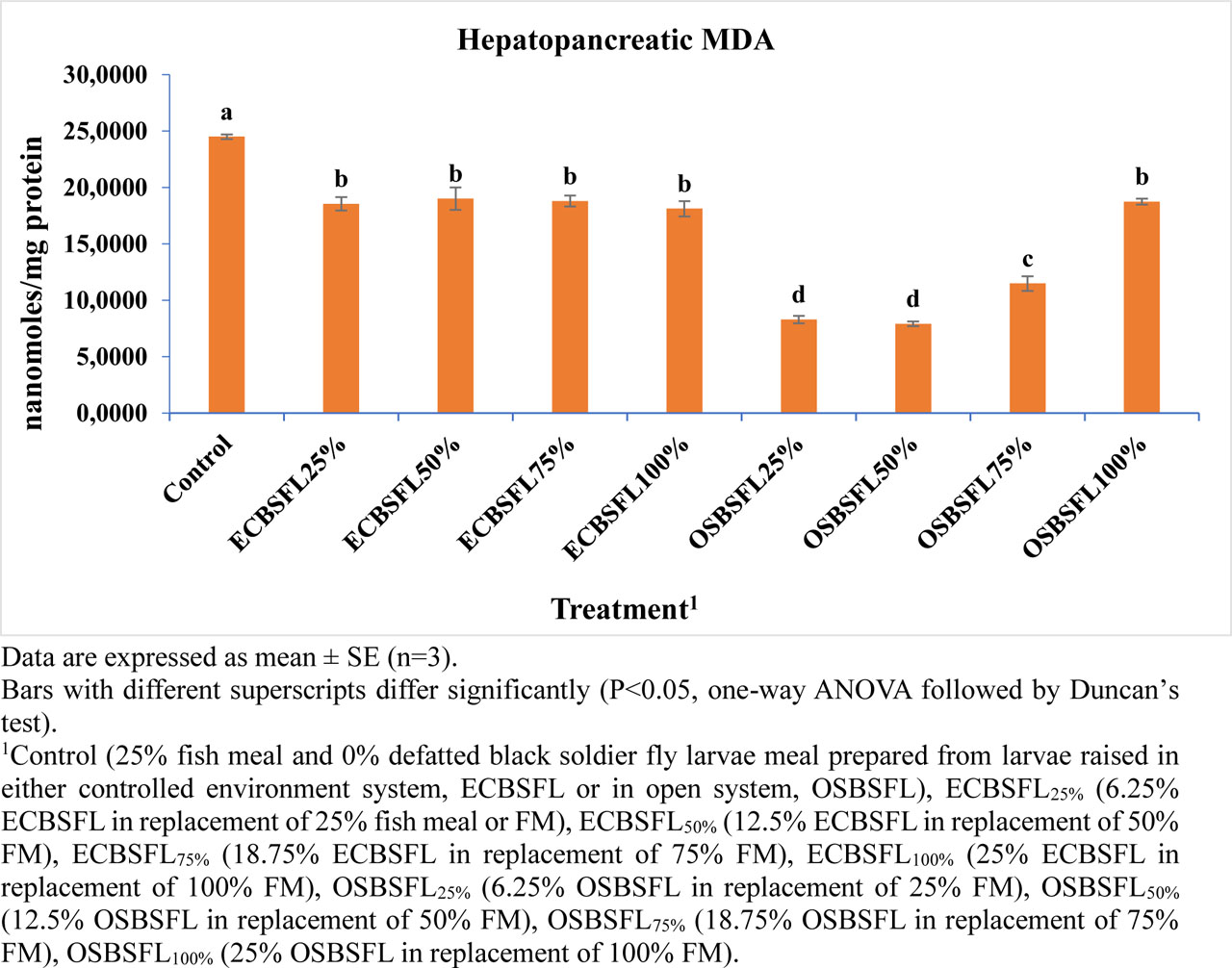
Figure 1.
Hepatopancreatic malondialdehyde (MDA) levels of Penaeus vannamei juveniles fed with different experimental diets for 60 days
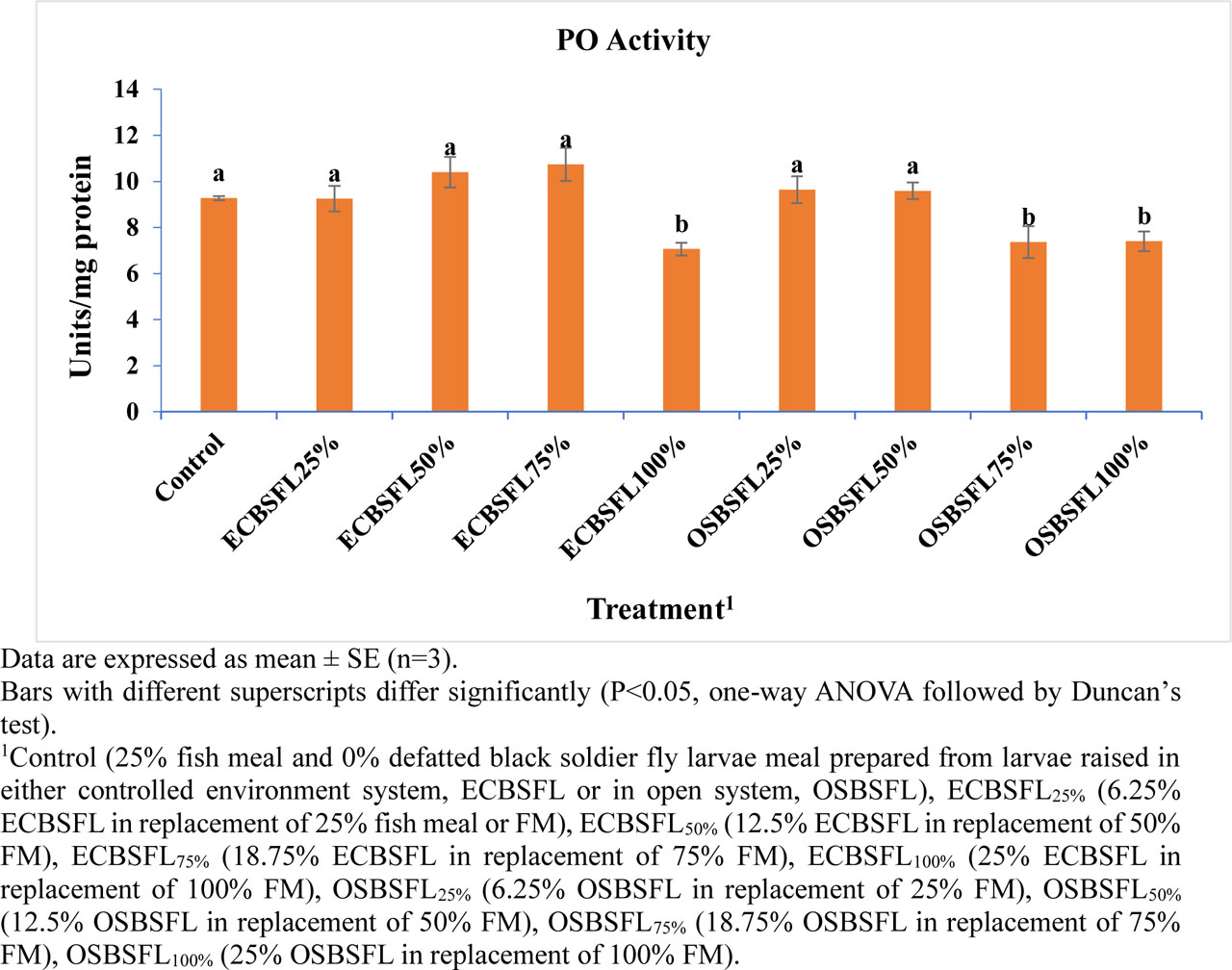
Figure 2.
Hepatopancreatic phenoloxidase (PO) activity of Penaeus vannamei juveniles fed with different experimental diets for 60 days
Discussion
There is a need to shift towards an alternative protein ingredient of fish meal for sustainability in aquafeed production (Tacon and Metian, 2008; Yadav et al., 2025). Insect meal acts as a promising animal protein for feeding aquatic animals as a fish meal replacer (Oteri et al., 2021; Khan et al., 2025). Among various insect meals, BSFLM has gained special attention in the recent past and was successfully utilized in aquafeed. This species paves the way for sustainable waste recycling by converting organic wastes into high-quality protein biomass (Raghuvaran et al., 2024; Dîrvariu et al., 2025). The nutritional profile of BSFLM mainly depends upon the substrate and the environmental conditions in which it is reared. Like most other organisms, the growth, reproduction, maturation, and various life history traits of BSFL are highly determined by the nutritional quality and the quantity of the culture substrate and environmental conditions. Hence, BSFL raised under controlled temperature, relative humidity, and pH with a nutrient-dense substrate having desirable moisture content has an improved nutrient profile. Thus, the current study aimed to assess the effect of meals from environment controlled system-raised BSFL and open system-raised BSFL on the growth, feed utilization, nutrient utilization, physio-metabolic status, and immune response of whiteleg shrimp juveniles reared in brackish water.
Whole body proximate composition indicates the nutritional preview of shrimp. In the current study, moisture, crude protein, ether extract, and total ash contents showed no significant difference across different experimental groups. Similar findings were also observed by Zhou et al. (2018) in Jian carp; Wang et al. (2019) in Japanese seabass (L. japonicus); Guerreiro et al. (2021) in meagre (Argyrosomus regius); Fahrur et al. (2021) and Chang et al. (2025) in whiteleg shrimp.
Growth occurs when the dietary nutrients satisfy the nutritional requirements and accumulate in the body of finfish and shellfish. Crustaceans, including shrimp, use protein as an energy source more efficiently than lipids and carbohydrates (Talukdar et al., 2021). Besides, dietary protein plays an important role in the growth of shrimp (Jana et al., 2021). In the majority of shrimp feeds, fish meal constitutes a predominant protein source. However, irregular supply, quality deterioration, and price hiking warrant to use of suitable fish meal alternatives in shrimp feed. In this regard, defatted black soldier fly larvae meal (DBSFLM) could be more appropriate owing to their high protein and low lipid contents. This approach aligns with efforts to address the escalating apprehension regarding the excessive utilization of fish meal (Wang and Shelomi, 2017). Previous studies indicated that BSFL could partially or fully replace fish meal in various fish and shrimp feeds without impairing the growth performance (Tran et al., 2015; Cummins et al., 2017; Xiao et al., 2018; Chang et al., 2025).
In the current study, the ECBSFL75% fed shrimp group exhibited significantly the highest (P<0.05) final body weight (g), WG (g), WG%, SGR, PER, and FCR of which was similar to the control group. In agreement with the present finding, Chang et al. (2025) reported that whiteleg shrimp fed with a diet containing 20.61% DBSLM to replace 75% of fish meal did not significantly affect the growth performance. Nunes et al. (2023) reported that whiteleg shrimp fed a diet with 75% fish meal replacement by BSFLM showed the highest growth performance. Similarly, Wang et al. (2021) reported that BSFLM could replace 60% fish meal in the whiteleg shrimp diet without compromising the growth performance. Kamarudin et al. (2021) also reported that 75% fish meal could be replaced by BSFLM in the diet of lemon fin barb with higher body weight gain (g) and SGR of fish, and decreased above this level of inclusion, which is on par with our results. In this study, the FCR values of ECBSFL100%, OSBSFL75%, and OSBSFL100% groups were significantly higher than the control group; however, other BSFLM fed groups showed similar FCR values to the control group to indicate effective feed utilization with enhanced growth of fish (Fahrur et al., 2021). In corroboration with the present finding, Nunes et al. (2023) reported higher FCR in whiteleg shrimp of the BSFLM fed group with 100% replacement of fish meal. Mapanao et al. (2023) reported superior growth performance (MWG, ADG, and SGR) of A. testudineus fed with a defatted BSFLM-containing diet in replacement of 75% fish meal, probably due to enhanced nutrient availability and utilization. However, lower final body weight (g), WG (g), WG (%), SGR, and higher FCR of 100% ECBSFL and OSBSFL fed whiteleg shrimp juveniles in this study could support the findings of Wang et al. (2019) and He et al. (2022 a). The highest PER of the ECBSFL75% group in this study could indicate the efficient dietary protein utilization to enhance the growth of shrimp, whereas OSBSFL100% showed the lowest PER. Thus, PER values were comparable between the treatments, indicating that the proteins from the diet were efficiently utilized by the animal for growth (De Silva and Anderson, 1995).
In the present study, the survival % did not significantly (P<0.05) vary among dietary groups. Similarly, Wang et al. (2021) found that whiteleg shrimp fed with defatted BSFLM containing diets in replacement of 0, 15, 30, 45, 60, and 80% fish meal showed similar survival %. This implies that the incorporation of BSFL did not exert discernible effects on the survival % of whiteleg shrimp, aligning with the outcomes observed in our study.
The hepatopancreas serves as the principal organ in the shrimp digestive system, playing a pivotal role in essential digestive processes, encompassing the synthesis and excretion of digestive enzymes, facilitation of nutrient digestion, and provision of a locus for nutrient absorption. (NRC, 2011). The enzymatic activities involved in digestion exhibit a positive correlation with the digestibility of nutrients, leading to enhanced availability and subsequent growth of animals, including shrimp (Talukdar et al., 2021). In addition, the secretion of these enzymes is positively associated with the availability of suitable substrate in the digestive system of shrimp. The current study demonstrated a significant variation (P<0.05) in the activities of protease, amylase, and lipase enzymes among shrimps fed under different treatments. In the present study, the highest (P<0.05) protease activity of ECBSFL75% and ECBSFL50% groups could be attributed to improved growth, probably through improved protein digestibility and absorption of amino acids, and absorbed amino acid-mediated body protein synthesis and accretion. In accordance with the present finding, He et al. (2022 a) reported that the shrimp fed a BSFLM-containing diet in replacement of 50% fish meal had higher protease activity than the control group. This finding might be owing to the reason that a low level of chitin in insect meal probably could improve protease activity of shrimp (Tseng et al., 2021; Rothig et al., 2023). In the present study, the shrimp of ECBSFL100% and all OSBSFL fed groups showed significantly lower amylase activity than the control group, but other ECBSFL fed groups showed similar amylase activity to the control group. However, in contrast with this finding, Kamalii et al. (2022) reported the highest amylase activity in Carrasius auratus of the 100% replacement group. On the other hand, all the BSFLM-fed groups showed significantly lower lipase activity than the control group in the present study. However, in contrast with the present finding, Kamalii et al. (2022) demonstrated the highest lipase activity in C. auratus fed a BSFLM-containing diet in replacement of 100% fish meal. Moreover, different levels of dietary defatted BSFLM did not cause any substantial changes in lipase activity in Japanese seabass, L. japonicus (Wang et al., 2019), and in whiteleg shrimp (Wang et al., 2021).
In shrimp, protein metabolic enzymes like aspartate aminotransferase (AST) and alanine aminotransferase (ALT) play integral roles in transamination processes to synthesize new non-essential amino acids from pre-existing ones. Newly synthesized amino acids in the presence of sufficient non-protein energy sources, such as lipid and carbohydrate, take part in the synthesis and accumulation of body proteins, causing growth of fish; however, at shortage of lipid and carbohydrate, these amino acids produce energy at the cost of growth (De Silva and Anderson, 1995). In the current study, the highest hepatopancreatic AST and ALT activities, along with the elevated growth performance of the ECBSFL75% group, indicated that AST and ALT enzymes induced newly synthesized amino acids probably could take part in the synthesis and accretion of body protein. However, muscle AST activity did not vary significantly among dietary groups, and muscle ALT activity of the ECBSFL75% group was similar to control group. Similarly, Mastoraki et al. (2020) found a two-fold enhancement of ALT activity in prawn, Palaemon adspersus, due to feeding of BSFL as a fish meal alternative.
Free radicals, including reactive oxygen species (ROS), induce oxidative stress, cause cellular damage, and various health problems in shrimp (Li et al., 2008; Schieber and Chandel, 2014). Several factors, such as poor water quality, pathogens, composition of diet, and poor handling, can accelerate the oxidative stress in shrimp (Winston and Giulio, 1991). However, shrimp’s antioxidant defenses can neutralize this stress. Superoxide dismutase (SOD) is an important antioxidant enzyme that, through dismutation, converts the superoxide anion into molecular oxygen and hydrogen peroxide. Subsequently, catalase (CAT) converts toxic hydrogen peroxide to water and molecular oxygen. Thus, hepatopancreatic SOD and CAT activities are good indicators of stress in shrimp. In the current study, all ECBSFL-fed groups and the OSBSFL100% group showed similar SOD activity to the control group. However, except for the ECBSFL100% and OSBSFL100% groups, all other BSFLM-fed groups exhibited comparable CAT activity with the control group. These findings indicated that dietary BSFLM did not produce stress in shrimp. These observations were consistent with the findings of earlier studies in whiteleg shrimp replacing FM with DBSFLM (Ko et al., 2025) and by fish fed with BSFLM-containing feed in replacement of FM (Hu et al., 2019; Mastoraki et al., 2020; He et al., 2022 b).
Hemocyanin (Hc) is a vital copper-based protein of hemolymph in shrimp that transports oxygen to tissues via the circulatory system. The copper ions within hemocyanin undergo reversible oxidation-reduction reactions, allowing them to bind and release oxygen depending on the oxygen concentration in the surrounding environment. The current investigation found no significant differences in hemocyanin levels among the treatments. This observation corroborated the findings of Yildirim-Aksoy et al. (2022).
Serum total protein serves as a key indicator of the health status of fish and crustaceans. In the current study, except the OSBSFL75% and OSBSFL100% groups, all other BSFLM-fed groups and the control had similar serum total protein levels. Similar findings were also reported by Kamalii et al. (2022) in Carassius auratus and Sharifinia et al. (2023) in whiteleg shrimp fed respectively with BSFLM and mealworm (Tenebrio molitor) meal containing diets in replacement of fish meal.
Blood glucose level is a good health indicator in fish (Hemre et al., 2002). Accordingly, hyperglycemia is commonly regarded as a stress indicator in fish as well as in shrimps (Polakof et al., 2012; Chen et al., 2022). In the present study, BSFLM-fed groups, except OSBSFL75% and OSBSFL100% groups, showed similar serum glucose levels to the control. These findings indicated that the complete replacement of fish meal by ECBSFL and partial replacement of fish meal by OSBSFL could be possible in the shrimp diet without hyperglycemic stress.
Although the serum total cholesterol level of ECBSFL100%, OSBSFL75% and OSBSFL100% groups was significantly lower, the control and other defatted BSFLM fed groups had similar serum total cholesterol levels. This finding demonstrated that higher inclusion of defatted BSFLM in the shrimp diet could reduce the serum total cholesterol level and might be due to high dietary chitin-mediated interference on cholesterol absorption. In the same line of work, Wang et al. (2019, 2021) and Chen et al. (2021) found that defatted BSFLM had cholesterol-lowering properties in fish. Similar trends of results were also obtained by Li et al. (2017) in Jian carp (C.carpio var. Jian) and Magalhães et al. (2017) in European seabass (Dicentrarchus labrax).
In the present study, though ECBSFL25% and OSBSFL25% groups showed similar serum triglyceride levels with the control group, significantly lower level of this parameter was recorded in all other BSFLM fed groups, with the lowest value in ECBSFL100% and OSBSFL100% groups. In agreement with present findings, Chen et al. (2021) reported a lowered serum triglyceride level in the increased BSFL-fed group of whiteleg shrimp. As malondialdehyde (MDA) is a byproduct of fatty acid peroxidation, its hepatopancreatic level is a direct indicator of lipid peroxidation extent. Thus, the higher MDA content indicates more cytotoxicity to damage cells and tissues, leading to cell death (To et al., 2021). In the current study, all the defatted BSFLM-fed groups showed significantly lower hepatopancreatic MDA levels than those of the control group. Present observations corroborate the findings of Wang et al. (2019) in Japanese seabass (Lateolabrax japonicus), Wang et al. (2021), and Chen et al. (2023) in whiteleg shrimp.
Phenol oxidase, an essential constituent of the crustacean prophenoloxidase (proPO) system, is the bifunctional (tyrosinase/monophenolase and catecholase/diphenolase) copper-containing principal enzyme in melanin synthesis (Boonchuen et al., 2021). These enzymatic functions catalyze the conversion of various monophenols and o-diphenols into o-quinone intermediates, which serve as precursor molecules for subsequent melanin production (Perazzolo et al., 2002). Thus prophenoloxidase (proPO) system, being a key component of their innate immunity, plays a central role in the immune response of shrimp. In the present study, though ECBSFL100%, OSBSFL75% and OSBSFL100% groups had significantly lower PO activity than the control group, similar activity of this enzyme was recorded in all other BSFLM fed groups and control. This finding indicated that higher dietary inclusion of defatted BSFLM could suppress immunity in shrimp (Radhakrishnan et al., 2023). In contrast, dietary inclusion of mealworm (Tenebrio molitor) meal in replacement of 15, 30, and 60% fish meal could significantly elevate phenol oxidase (PO) activity in whiteleg shrimp (Sharifinia et al., 2023).
Conclusion
The results of the current study demonstrated that environment controlled system produced defatted black soldier fly larvae meal (ECBSFL) can effectively replace 75% fish meal in the diet of whiteleg shrimp. ECBSFL-based diets showed better effects in relation to growth performance, physio-metabolic status, and immune response compared to its open system produced counterpart (OSBSFL). Accordingly, ECBSFL could be incorporated in the shrimp diet at 18.75% in replacement of 75% fish meal without compromising the growth performance and health status of shrimp. Thus, ECBSFL could be a potential FM alternative in diet for sustainable shrimp aquaculture.
Acknowledgement
The authors wish to express their most sincere gratitude to the Director, ICAR-Central Institute of Fisheries Education, Mumbai, for laboratory facilities and to Green Grahi Solutions Pvt. Ltd for providing resources to conduct the research.