
There has been a consistent worldwide rise in the demand for chicken products in the past few years. This increased need has motivated several efforts to identify new techniques to enhance poultry productivity ( Ghanima et al., 2023). Threonine (Thr) (Figure 1), commonly referred to as α-amino-β-hydroxybutyric acid, is a critical amino acid that animals need to get through their diet (Halas et al., 2025). According to Tang et al. (2021), it is the third limiting amino acid in broiler diets made of corn and soybean meal and a second limiting amino acid for finisher animals fed a diet made of corn and soybean meal. Threonine is an important bioactive substance that mediates energy metabolism, protein synthesis, and nutrient absorption ( Corsetti et al., 2024). The physiological functions, metabolic mechanisms, and needs of Thr have been the subject of numerous previous investigations ( Tang et al., 2021). Kareem et al. (2025) have identified Thr as the third amino acid that limits the growth of chickens. Threonine has important functions in cellular formation, boosting the lining of the intestines, increasing the activity of digestive enzymes, supporting the immune system, maintaining the integrity of barriers, and enhancing the capacity to fight against oxidants. Approximately 30% of the proteins present in mucin, an essential constituent, are believed to consist of threonine-rich peptides ( Khalid et al., 2025). Insufficient levels of Thr in meat-type chicken result in impaired productive performance, reduced feed intake, and decreased carcass traits ( Zhang and Kim, 2014).
Moreover, elevated concentrations of crude protein (CP) in broiler diets result in an overabundance of amino acids and heightened excretion of nitrogen. To boost nitrogen retention efficiency, it is important to supplement low-CP diets with specific crystalline amino acids that fit the maintenance and tissue growth requirements. The incorporation of L-threonine as a supplementary ingredient presents a prospect for poultry nutritionists, particularly those involved in turkey farming, to further decrease the amounts of dietary CP. Reducing the amount of CP in the feed offers various benefits: 1) increased efficiency in utilizing nitrogen; 2) decreased release of nitrogen; 3) improved ability of chickens to withstand high temperatures; and 4) lowered amounts of ammonia in the litter. However, when the amount of dietary CP is decreased, it is essential to make sure that the amino acid composition of the diet meets the birds’ needs for maintaining their bodies and promoting tissue growth to obtain the best possible performance. In addition, L-threonine (L-Thr) plays a crucial function in promoting healthy growth as it is an essential constituent of body protein and acts as a precursor for L-lysine and serine. In addition, it enhances the effectiveness of the immune response and promotes the synthesis of gastrointestinal mucin ( Shirisha et al., 2018).
Threonine is often the third most limited amino acid in corn–soybean rations for broiler chickens in plant-based poultry feed formulations. This limitation becomes more noticeable when the levels of CP fall. The incorporation of crystalline L-lysine and DL-methionine in complete meals (Salahi et al., 2025) has made this restriction more noteworthy. Since the initial inquiries into Thr in poultry nutrition, namely throughout the 1980s and 90s, multiple studies have investigated Thr requirements, its effectiveness in low-CP feed, and the biochemical pathways accountable for Thr degradation ( Tang et al., 2021). Threonine continues to be the third most restrictive amino acid in low-CP diets for chickens. The ongoing advancements in fermentation techniques for threonine-producing microorganisms are anticipated to result in greater accessibility of commercial L-Thr. Accordingly, this review aims to assess the potential impacts of dietary Thr supplements and offer insights into their prospective industrial applications within the poultry industry.
An overview of the metabolism of threonine
Essential processes such as protein synthesis and degradation, amino acid nitrogen utilization for uric acid formation, conversion of amino acid carbons into glucose, fat, or energy, and the generation of non-protein derivatives are key components of amino acid metabolism. Threonine plays a vital role in protein synthesis and contributes to general metabolism through its catabolic products. The breakdown (catabolism) of L-Thr primarily yields glucogenic metabolites, including pyruvate, propionate, and glycine (Figure 2). In chicks, Thr catabolism is mediated by enzymes such as threonine dehydratase, dehydrogenase, and aldolase, whereas in mammals, threonine dehydrogenase predominantly facilitates Thr oxidation during feeding ( Tang et al., 2021). The resulting pyruvate can be used for energy production or gluconeogenesis, while glycine serves multiple metabolic functions, including participation in serine and creatine synthesis, uric acid formation, bile salt production, and glutathione synthesis. Notably, chicks have a particular dietary need for glycine or serine to support these rapid metabolic processes ( Naigaonkar et al., 2025).
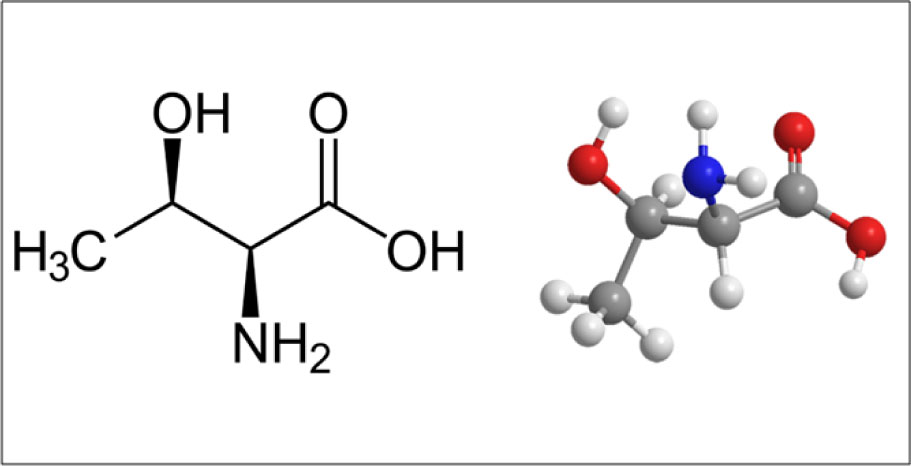
Figure 1.
Threonine structure.
Long description: Chemical structure of threonine shown as a structural formula and a three-dimensional ball-and-stick molecular model.
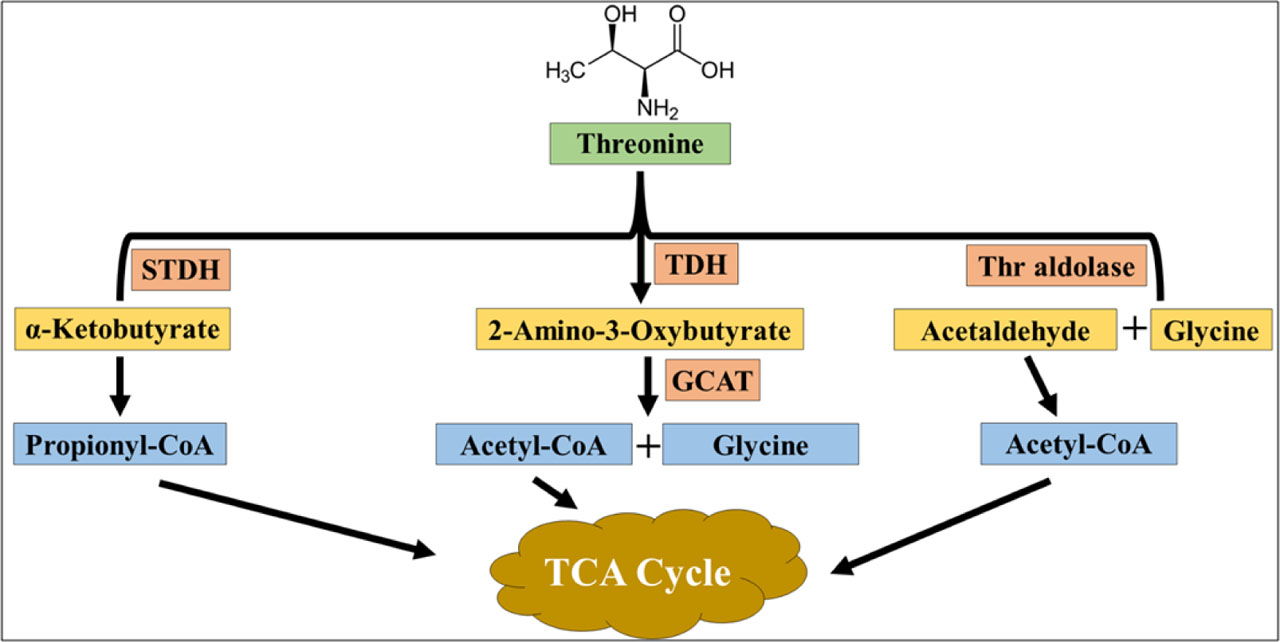
Figure 2.
The threonine metabolic pathway. Three enzymes break down Thr into several intermediate and final products. GCAT: 2-amino-3-oxobutyrate CoA ligase; STDH: threonine dehydratase; TCA: tricarboxylic acid cycle; TDH: threonine dehydrogenase.
Long description: The diagram places threonine at the top and shows three metabolic routes. STDH produces α-ketobutyrate and then propionyl-CoA. TDH produces 2-amino-3-oxybutyrate, which GCAT converts to acetyl-CoA and glycine. Thr aldolase produces acetaldehyde and glycine, with acetaldehyde converted to acetyl-CoA. Products feed into the TCA cycle.
Earlier investigations have confirmed the ability of Thr to preserve glycine by providing chicks with a diet lacking glycine but enriched with an excessive amount of Thr (approximately 13 g/kg of feed, equivalent to 1.3%). The research demonstrated that elevated quantities of Thr in the food can improve the growth of chicks even when glycine and serine are not present ( Siegert and Rodehutscord, 2019). Upon reintroduction of glycine into the high-threonine diet, the growth of chicks was diminished; however, the efficiency of gain concerning feed intake was enhanced. These findings indicate that providing additional Thr can partially fulfill the glycine needs of chicks ( Qaisrani et al., 2018). However, it should be noted that the conversion of glycine to Thr does not take place in chicks ( Macelline et al., 2021). Nevertheless, Strifler et al. (2024) indicate that Thr does not conserve glycine in chicks. The exact mechanisms of how Thr affects glycine sparing in chicks remain a topic of debate and further investigation.
Potential impacts of threonine supplementation in broiler diets
An important component of poultry nutrition, Thr supports numerous biological processes essential for growth and productivity. It is a key amino acid in protein synthesis, contributing to the development of muscles, feathers, and overall body composition ( Tang et al., 2021). As a major constituent of mucin, Thr maintains the integrity of the intestinal mucus layer, which enhances nutrient absorption and protects against infections. Moreover, it plays a crucial role in the synthesis of immunoglobulins, thereby strengthening the immune system and improving disease resistance in birds ( Yang and Liao, 2019). Additionally, Thr supplementation has been shown to enhance feed efficiency, accelerate growth, and reduce nitrogen excretion by optimizing protein utilization, which contributes to both farm profitability and environmental sustainability ( Ghanima et al., 2023) (Figure 3).
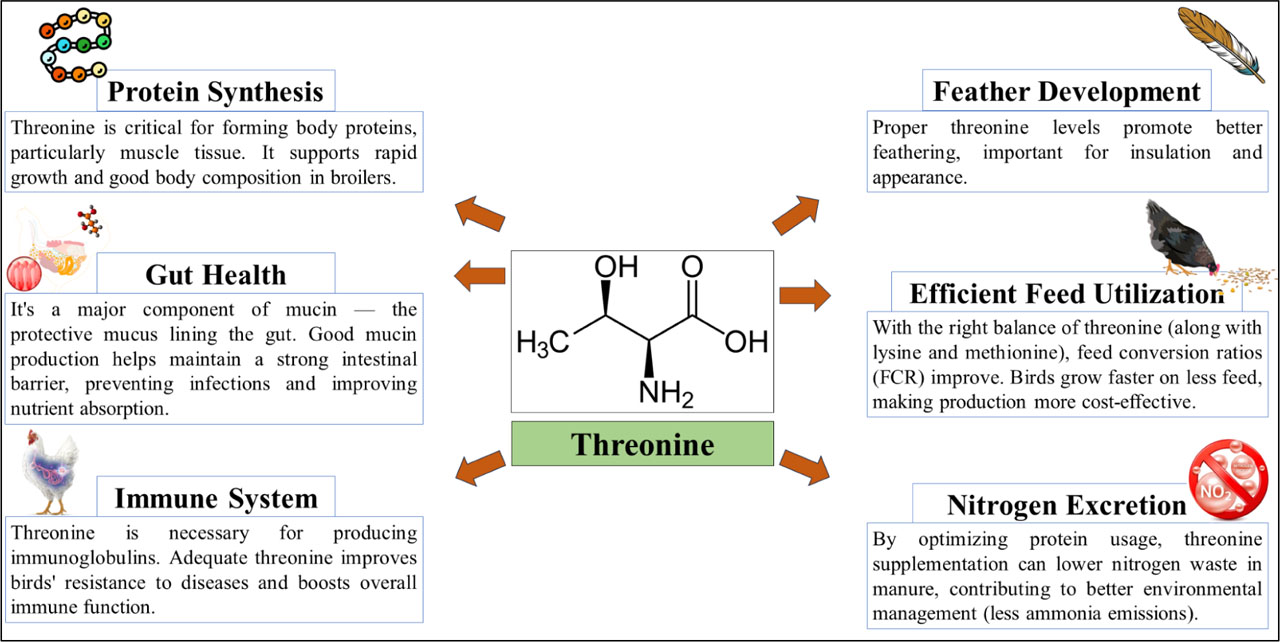
Figure 3.
Key biological activities of threonine in poultry diets
Long description: The diagram places threonine centrally and connects it to six biological functions: protein synthesis, gut health, immune system support, feather development, efficient feed utilization, and reduced nitrogen excretion.
A. Growth performance
Evaluating the growth rate of broilers is essential for determining the effectiveness of the feed provided. Table 1 summarizes the impacts of dietary Thr supplementation on the growth performance of poultry. This is influenced by both environmental factors and the levels of Thr in the diet ( Kidd et al., 2003). Research has shown that there are different ideal levels of Thr for female (0.60–0.67%) and male (0.63–0.68%) broiler chickens throughout the finishing stage, which lasts from 42 to 45 days ( Kidd et al., 2003). Furthermore, Corzo et al. (2003) suggested that an optimal total dietary Thr concentration of 0.69% is required for optimal growth rate, and a level of 0.71% is needed for optimal feed conversion ratio (FCR) throughout the finisher stage. However, Kidd et al. (2004) proposed that the optimal dietary Thr needs for achieving body weight gain (BWG) and meat yield from breast through the grower and finisher stages are 0.74% and 0.71%, respectively.
Table 1.
Effects of threonine on growth performance in poultry
| Author and year | Threonine dose (%/g kg) | Observed effects on growth performance | Diet type / Broiler strain / Duration |
|---|---|---|---|
| Kidd et al., 2003 | Females 0.60–0.67%; Males 0.63–0.68% (6–6.8 g/kg) | Optimal growth during finishing stage (42–45 d) | Corn–peanut–soybean diet / Cobb 500 / 45 days |
| Corzo et al., 2003 | 0.69% (6.9 g/kg) | Improved growth and FCR during finisher period (30–42 d) | Corn–soybean diet / Ross 308 / 42 days |
| Kidd et al., 2004 | 0.74% grower; 0.71% finisher (7.1–7.4 g/kg) | Improved BWG and breast meat yield (21–42 d) | Corn–soybean diet / Cobb 500 / 42 days |
| Jiang et al., 2017 | 0–2.8 g/kg (0–0.28%) | Increased breast muscle and growth in Pekin ducks | Corn–wheat–peanut-based diet / Pekin ducks / 1–21 days |
| Ghanima et al., 2023 | 110–130% of requirement (≈0.82–0.96%; 8.2–9.6 g/kg) | Higher BWG and improved FCR under feed restriction | Corn–soybean diet / Ross 308 / 42 days |
Various studies have examined the potential impacts of different quantities of Thr on the growth rate of broilers. For instance, Najafi et al. (2017) and Kheiri and Alibeyghi (2017) showed that higher quantities of Thr (0.97% and 0.90%, respectively) resulted in enhanced feed intake, greater BWG, and improved FCR as compared to the control group. Similarly, in former studies, Min et al. (2017), Chen et al. (2017), and Valizadeh et al. (2016) observed enhanced growth performance when Thr levels were increased, indicating a favorable association. However, Eftekhari et al. (2015) and Shirzadegan et al. (2015) reported that diets containing 0.81% and 0.84% total dietary Thr, respectively, resulted in improved FCR and overall performance compared with the 0.74% level recommended by the National Research Council (NRC, 1994). Ospina-Rojas et al. (2013) and Corzo et al. (2007) determined that the most effective levels for improving broiler performance are 0.77% and 0.86%, respectively.
Recently, the report presented by Ghanima et al. (2023) aimed to evaluate the influences of various doses of dietary Thr supplementation on growth parameters in broiler chickens under feed restriction conditions. This study encompassed a total of 1,600 birds, consisting of 800 Ross 308 and 800 Indian River breeds, all of whom were 21 days old. The birds were categorized into two primary cohorts: the control group and the feed-restricted group (limited to 8 hours of feeding per day) during the fourth week of their lifespan. The primary category was additionally broken into four subcategories. The initial group was given a baseline diet devoid of any supplementary Thr (100%), whereas the subsequent groups, namely the 2nd, 3rd, and 4th groups, were provided with the basal diet enriched with additional Thr concentrations of 110%, 120%, and 130%, respectively. The findings demonstrated that incorporating increased quantities of Thr in the diet had a considerable positive impact on body weight, BWG, and FCR. The elevated levels of growth hormone (GH), insulin-like growth factor-1 (IGF-1), triiodothyronine (T3), and thyroxine (T4) in the birds were primarily responsible for the observed improvements. Furthermore, it is important to note that the control and feed-restricted groups, which were supplemented with higher levels of Thr, had the lowest feed cost per kilogram of BWG and had better economic returns.
Additionally, Jiang et al. (2017) examined the impact of Thr supplementation on lipid metabolism in Pekin ducks as well as the effectiveness of Thr supplementation in lowering dietary CP content. Pekin ducks aged 1–21 days were used to assess the effects of dietary CP concentrations (160, 190, and 220 g/kg) and supplementary Thr concentrations (0, 0.07, 0.14, 0.21, and 0.28% of the diet) on growth performance. In all CP diets, dietary Thr supplementation increased growth performance and the plasma concentrations of certain amino acids. Also, Thr needs, based on quadratic broken-line model estimation, were 6.6 and 7.0 g/kg for optimal average daily growth (ADG) of Pekin ducks from 1 to 21 days of age at 190 and 220 g/kg CP, respectively. The dietary Thr needs and estimated ADG (55.18 vs. 55.86 g/d/bird) of Pekin ducks did not differ between 190 and 220 g/kg CP.
Through several interconnected processes, dietary supplementation of the essential amino acid Thr can improve poultry growth. According to Lisnahan and Nahak (2020), Thr is a crucial component of the intestinal mucus layer, or mucin. Sufficient Thr increases gut integrity, villus height, and absorption surface area, all of which improve nutrient uptake and growth potential. Second, Thr promotes immune and antioxidant functions: elevated Thr levels raise serum concentrations of globulin and total protein, increase the activity of antioxidant enzymes like superoxide dismutase, decrease oxidative stress markers, and lower the metabolic cost of disease or stress, freeing up more energy for growth ( Min et al., 2017). Third, Thr affects the balance of amino acids and protein metabolism. By taking up a previously limited role in the diet, Thr supplementation enhances the overall utilization of amino acids and promotes increased lean tissue accretion instead of catabolism of body reserves ( Saleh et al., 2021). Furthermore, under specific circumstances, research has demonstrated that increased dietary Thr increases the hormones that drive growth in poultry, such as growth hormone, IGF-1, and thyroid hormones, promoting growth rate and feed conversion efficiency ( Ghanima et al., 2023). These elements work together to explain why increasing the Thr supply above baseline guidelines can result in quantifiable increases in body weight and feed conversion ratio.
B. Carcass characteristics
The Thr necessity for carcass yield in broilers is subject to variation, which is impacted by parameters like age, strain, sex, dietary CP level, and the kind and quantity of feed ingredients used ( Maharjan et al., 2021). The enhanced physical properties of the carcass can be related to an advanced level of necessary amino acids, specifically Thr, in the diet ( Estalkhzir et al., 2013). In an experiment conducted by Al-Hayani (2017), the effects of three diverse levels of Thr (0.3%, 0.6%, and 0.9%) in broiler diets were examined. The findings indicated that the feed containing 0.90% Thr caused a 3.7% increase in carcass weight, a 2.3% rise in breast weight, and a 1.1% decrease in thigh weight. Similarly, Abdelaziz et al. (2018) found that broilers that were given meals with 0.87% Thr had a 28% increase in breast weight, a 1.6% rise in drumstick weight, and a 9.6% decrease in thigh weight compared to those given diets with 0.77% Thr.
Furthermore, an experiment was carried out by Shirzadegan et al. (2015) to assess the impact of different dietary Thr levels (0.74%, 0.79%, 0.81%, and 0.84%) on the carcass characteristics of broilers. The findings indicated that while a Thr level of 0.79% was linked to a decrease in thigh weight in comparison to the control group, it also increased the weights of the pancreas, liver, and breast meat when compared to a level of 0.74%. In a similar trial, Abbasi et al. (2014) found that using 0.77% and 0.84% of Thr during the finisher phase resulted in broilers having higher carcass weight, drum-stick weight, and breast meat compared to the recommended level of 0.71% Thr. Moreover, Rezaeipour and Gazani (2014) compared two groups of broilers fed diets containing 0.74% and 0.77% total dietary Thr, respectively. The broilers receiving the diet with 0.77% Thr exhibited increased weights of the pancreas, liver, and breast meat compared with those fed the 0.74% Thr diet. Likewise, Estalkhzir et al. (2013) reported that a dietary Thr level of 0.77% produced superior results compared with the control diet containing 0.67% Thr, leading to significantly higher carcass, breast meat, thigh, and liver weights. However, compared to the control diet, Kidd et al. (2004) discovered that adding 0.87% of dietary Thr significantly increased the carcass weight and breast meat of broilers.
Additionally, Jiang et al. (2017) used Pekin ducks aged 1–21 days to assess the effects of dietary CP concentrations (160, 190, and 220 g/kg) and supplementary Thr concentrations (0, 0.07, 0.14, 0.21, and 0.28% of the diet) on carcass traits. In all CP diets, dietary Thr supplementation increased the percentage of breast muscle. Also, Thr needs based on quadratic broken-line model estimation were 6.7 and 7.3 g/kg for breast muscle percentage of Pekin ducks from 1 to 21 days of age at 190 and 220 g/kg CP, respectively. The dietary Thr needs and breast muscle percentage (2.79% vs. 2.75%) of Pekin ducks did not differ between 190 and 220 g/kg CP. With Thr supplementation to balance dietary amino acids, the dietary CP level in Pekin ducks aged 1–21 days could be lowered to 190 g/kg, and in this case, Thr supplementation prevented excessive hepatic lipid deposition.
Furthermore, Ahmed et al. (2020) demonstrated that supplementing Thr above the recommendations of the NRC (1994) improved broiler performance, particularly when diets included less digestible protein sources such as canola meal. Increasing dietary Thr to 110–120% of the NRC level enhanced body weight gain and FCR, effectively compensating for the negative effects of low protein digestibility.
Similarly, Kidd et al. (2002) compared crystalline L-Thr supplementation with Thr derived from intact protein sources and found that increasing dietary L-Thr up to 544 g/ton did not significantly affect growth or carcass characteristics. This indicates that once the dietary Thr requirement is met, further supplementation provides no additional benefit to broiler performance.
Table 2 summarizes the impacts of dietary Thr supplementation on the carcass yield of poultry. These studies collectively indicate that, for optimal productivity and improved carcass features, a greater level of Thr than presently recommended in broiler diets is essential. Threonine, in conjunction with serine, plays a crucial role in muscle mass development and positively influences gut morphology, thereby enhancing nutrient absorption and ultimately improving the carcass characteristics of broilers.
Table 2.
Effects of threonine on carcass yield
| Author and year | Threonine dose (%/g kg) | Observed effects on carcass traits | Diet type / Broiler strain / Duration |
|---|---|---|---|
| Rezaeipour and Gazani, 2014 | 0.74 vs 0.77% (7.4 vs 7.7 g/kg) | Higher breast meat, liver, and pancreas weight at 0.77% | Corn–soybean diet / Ross 308 / 42 days |
| Shirzadegan et al., 2015 | 0.74–0.84% (7.4–8.4 g/kg) | Increased meat, liver, and pancreas weights | Corn–soybean diet / Ross 308 / 42 days |
| Al-Hayani, 2017 | 0.3%, 0.6%, 0.9% (3–9 g/kg) | Improved carcass, breast, and thigh yield, maximum at 0.9% | Wheat–soybean diet / Arbor Acres / 35 days |
| Jiang et al., 2017 | Up to 0.28% (2.8 g/kg) | Increased breast muscle percentage in Pekin ducks | Corn–wheat–peanut-based diet / Pekin ducks / 21 days |
C. Gut health development
Due to its function in intestinal mucosal development and the proper operation of digestive enzymes, Thr supplements have been shown to improve the growth performance of broiler chickens ( Min et al., 2017). Maintaining a healthy digestive system is crucial for the development of broilers since it improves the process of feed digestion and nutrient absorption, which eventually results in profitable chicken farming. Crucial markers for evaluating gut health are crypt depth (CD) and villus height (VH). A healthy gut is indicated by a shorter crypt and a longer villus ( Qaisrani et al., 2015).
Recent research has shown that these intestinal parameters are considerably improved by dietary Thr supplementation above recommended levels. According to Bassareh et al. (2023), broiler chickens fed diets containing 105% of the recommended Thr level showed significantly higher VH, villus surface area (VSA), and villus to crypt ratio (V/C ratio) than those fed standard levels. The same study also found that birds receiving higher Thr had a higher goblet cell count, which suggests improved secretory function and mucosal protection.
Research repeatedly emphasizes the importance of Thr in maintaining the health of the digestive system in broiler chickens. In a study, Chen et al. (2017) investigated that elevating the dietary levels of Thr to 1.08% resulted in an 18.3% rise in VH, a 33% increase in the V/C ratio, and a 12.5% decline in CD in the jejunum, when compared to the recommended level for the strain (Arbor Acres Plus; 0.77%). Similarly, Zhang et al. (2016) showed that higher levels of Thr (0.90%) led to an increase in VH and a decrease in jejunal CD compared to the lower levels of Thr (0.49%). Likewise, Najafi et al. (2017) found that including 0.89% Thr in the diet caused a 15% rise in VH, a 1.8% increase in V/C ratio, and a 2% decrease in CD in the duodenum compared to the control diet. Moreover, Eftekhari et al. (2015) demonstrated that broiler chickens fed a diet comprising 0.88% total dietary Thr experienced improved gut health, as evidenced by increased VH, V/C ratio, and reduced CD, compared to the recommended level of 0.74%. Similarly, the former investigations of Shirzadegan et al. (2015) and Abbasi et al. (2014) revealed that high concentrations of Thr (0.84% and 0.77%, respectively) were associated with improved gut health, as indicated by higher values of VH and CD. The investigation of Zaefarian et al. (2008) demonstrated that a diet containing 1.1% total Thr resulted in improved gut shape, characterized by higher VH and shorter crypts in the ileum. However, Chee et al. (2010) described that broilers given a diet comprising 0.8% Thr showed a notable increase in VH, CD, and V/C ratio in the ileum when compared to broilers on a control diet.
In ovo nutrient administration has emerged as a promising approach to enhance early development and post-hatch performance in poultry. Thr, an essential amino acid with critical roles in mucin synthesis and intestinal integrity, has attracted growing attention among the nutrients tested for in ovo application. Several studies have explored the optimal dosage for in ovo Thr delivery. Zarrin-Kavyani et al. (2020) confirmed improvements in jejunal morphology, specifically increased VH, CD, and V/C ratio, following comparable supplementation levels. These structural changes are indicative of improved absorptive capacity and digestive efficiency, both of which are crucial during the early post-hatch period when chicks transition from yolk to feed.
The observed enhancement of intestinal microarchitecture may be attributed to Thr’s involvement in mucin production by goblet cells. Mucins form the protective mucus layer that safeguards the epithelial surface from mechanical injury, toxins, and pathogens, thereby supporting mucosal barrier integrity. Furthermore, Thr contributes to the synthesis of glutathione and secretory immunoglobulin A (sIgA), molecules essential for antioxidant defense and mucosal immunity (Corthésy, 2010). This dual role highlights Thr’s potential to mitigate oxidative stress and immune challenges during early life stages, when the developing chick is particularly vulnerable to environmental pathogens.
Beyond local gut effects, in ovo Thr supplementation may exert systemic benefits by influencing immune organ development and promoting the establishment of a beneficial gut microbiota. Early provision of Thr through the amniotic route ensures its immediate availability during the rapid differentiation of intestinal tissues, a developmental window that may “program” long-term gut functionality and disease resistance ( Das et al., 2021; Tang et al., 2021). Collectively, evidence from both post-hatch and in ovo studies suggests that administering 3–7 mg of Thr per egg is sufficient to stimulate intestinal maturation, strengthen mucosal defenses, and enhance overall chick viability, underscoring its potential as a practical intervention in modern hatchery management.
These improvements are attributed to Thr’s role in mucin synthesis, which is rich in Thr residues, as well as its involvement in the proliferation and differentiation of intestinal epithelial cells. Debnath et al. (2019) reported that threonine supplementation enhanced gut morphology in broilers during the pre-starter and starter phases, evidenced by increased villus height, higher villus-to-crypt ratios, and elevated goblet cell numbers, collectively reflecting improved mucosal barrier function. Likewise, Khalid et al. (2025) demonstrated that high dietary threonine mitigated intestinal damage in cyclic heat-stressed broilers, promoted tight junction protein expression, and increased goblet cell density, underscoring threonine’s protective role under stress conditions. These results highlight the role that Thr plays in immune system function, gut integrity, and growth performance. To improve intestinal morphology, increase nutrient absorption, and promote general health and productivity, it is strategically important to optimize Thr levels in poultry diets. The enhancement in intestinal architecture, which is associated with the addition of Thr, may be connected to its function in the production of mucin. Mucin, which consists of the amino acids Thr, serine, and proline, functions as a defensive barrier for the intestinal epithelium, safeguarding it against acids, digestive enzymes, and foreign pathogens ( Kim and Ho, 2010).
To summarize, these investigations consistently demonstrate the favorable association between the addition of Thr and enhanced health of the gut in broiler chickens. This underscores the significance of Thr in promoting optimal growth performance. Table 3 summarizes the impacts of dietary Thr supplementation on hematology, immunity, gut health, and antioxidant status of poultry.
Table 3.
Effects of threonine on hematology, immunity, gut health, and antioxidant status
| Author and year | Threonine dose (%/g kg) | Potential impacts | Diet type / Broiler strain / Duration |
|---|---|---|---|
| Corzo et al., 2007 | 0.71–0.74% (7.1–7.4 g/kg) | Improved immune organ growth, antibody response, and FCR | Corn–soybean diet / Ross 308 / 42 days |
| Chen et al., 2017 | 0.88% (8.8 g/kg) | Heavier spleen and bursa; greater villus height and shallower crypts | Corn–soybean diet / Cobb 500 / 21 days |
| Jiang et al., 2019 | 0.67–0.90% (6.7–9.0 g/kg) | Modulated mucin (MUC2) and tight-junction gene expression | Corn–soybean diet / Ross 308 / 35 days |
| Zarrin-Kavyani et al., 2020 | 0.8–1.0% (8–10 g/kg) | Enhanced humoral and cellular immune responses (↑ T-cells) | Corn–soybean diet / Cobb 500 / 42 days |
| Ghanima et al., 2023 | 100–130% of requirement (≈0.74–0.96%; 7.4–9.6 g/kg) | Improved hematological and biochemical profiles under restriction | Corn–soybean diet / Ross 308 / 42 days |
D. Blood biochemical parameters
The recent investigation by Ghanima et al. (2023) evaluated the influence of varying doses of dietary Thr supplement on biochemical markers in broiler chickens under feed restriction conditions. This study employed a sample size of 1,600 avian specimens, comprising two separate breeds, namely Ross 308 and Indian River, at an age of 21 days. Beginning in the fourth week of life, the birds were divided into two main groups: control and feed-restricted (8 hours/day). The major groups were subdivided into four subgroups based on different degrees of Thr supplementation, ranging from 100% to 130%. The findings demonstrated that incorporating elevated quantities of Thr in the basic diet had a notable impact on the hematological and biochemical characteristics of the avian subjects. More precisely, birds that were given limited amounts of food and received additional Thr at levels of 120% and 130% showed a significant increase in the concentrations of alanine aminotransferase, aspartate aminotransferase, and urea, in comparison to the other groups. These findings provide insight into the possible impacts of Thr supplementation on important biochemical factors in broiler birds. Moreover, Jiang et al. (2017) reported that dietary Thr supplementation (0, 0.28% of the diet) influenced lipid metabolism in Pekin ducks fed diets containing 160–220 g/kg CP.
Furthermore, Debnath et al. (2019) investigated the influence of graded levels of dietary L-Thr on serum biochemical parameters in Vencobb-400 broilers. Birds were allocated to diets containing threonine at 100% of NRC (1994) recommendations, and 100%, 110%, 120%, and 130% of the Vencobb-400 strain specifications. Increasing dietary Thr levels resulted in a linear rise (P = 0.001) in serum glucose, along with both linear and quadratic increases in serum total protein and globulin concentrations. Conversely, the albumin-to-globulin ratio showed a linear decreasing trend. Notably, serum total cholesterol and VLDL cholesterol levels decreased significantly with increasing Thr, while HDL cholesterol levels increased linearly (P = 0.04) and LDL cholesterol levels decreased linearly (P = 0.01). These results indicate that dietary threonine supplementation favorably modulates lipid metabolism and protein synthesis in broilers.
Through several physiologic and metabolic processes, dietary supplementation of Thr can enhance blood biochemical parameters in poultry. When Thr is given above the required levels, one important effect is the increase in serum total protein and globulin concentrations, which is probably due to increased synthesis of immunoglobulins and plasma proteins. In contrast to birds that were fed only the basal Thr level, broilers fed 125% of the NRC-recommended Thr showed noticeably higher serum total protein and globulin values ( Ji et al., 2019; Abou-Elkhair et al., 2020). Second, Thr affects the activity of enzymes involved in the metabolism of nitrogen and amino acids. Excess dietary Thr has been shown to increase the activities of aminotransferases like ALT and AST, indicating increased hepatic metabolic activity and amino acid turnover ( Ji et al., 2019). Accordingly, it has been demonstrated that adding Thr to low-CP diets lowers serum levels of urea, creatinine, and total cholesterol, indicating better lipid metabolism and nitrogen utilization ( Azzam et al., 2019). Thirdly, Thr seems to promote improved antioxidant status and liver health in situations of stress or inadequate nutrition. Higher Thr (175–200% of requirement) improved serum albumin, decreased corticosterone and cholesterol, and increased superoxide dismutase (SOD) activity in broilers subjected to cyclic heat stress. These findings suggest improved oxidative defense and decreased hepatic stress ( Khalid et al., 2025). When combined, these biochemical changes, including increased serum protein and globulin, altered enzyme activity, improved lipid and nitrogen metabolism, and improved oxidative status, show that supplementing with Thr can improve the metabolic resilience and health of poultry.
E. Immunity and antioxidant-related parameters
Ensuring appropriate immunity is essential for achieving optimal growth performance in broilers. Improved immune function is linked to enhanced performance of immune organs, comprising the thymus, bursa, and spleen, resulting in heightened generation of antibodies ( Corzo et al., 2007; Zhang et al., 2016). Threonine plays a vital role in immune and metabolic functions by serving as a precursor for serine and glycine and supporting the synthesis of immune and acute-phase proteins during immune activation. Under conditions of infection or stress, increased production of pro-inflammatory cytokines, particularly tumor necrosis factor-alpha (TNF-α) and interleukin-6 (IL-6), elevates the bird’s Thr requirements ( Tang et al., 2021; Hadžimusić and Hadžijunuzović-Alagić, 2025). Adequate dietary Thr can help mitigate the negative effects of inflammation, such as reduced feed intake and growth depression, by supporting immune protein synthesis and maintaining metabolic balance. Therefore, optimizing Thr nutrition is crucial for sustaining immune resilience and productivity in poultry under disease or stress conditions.
Although the National Research Council (NRC) offers guidelines for maintaining healthy birds in optimal conditions, birds in commercial production settings are frequently subjected to a range of stresses ( Taghinejad-Roudbaneh et al., 2013). In unsanitary environments, the need for dietary Thr increases to maintain the health of the gut lining and enhance the immune scheme ( Corzo et al., 2003). Dietary Thr is crucial for preserving gut immune function, according to numerous studies (Figure 4). Research has repeatedly shown that the necessary amount of dietary Thr increases when animals are exposed to stressful or unhygienic conditions. Under normal conditions, the recommended range of 0.71%–0.74% is sufficient to maintain optimal growth performance and FCR ( Corzo et al., 2007; Taghinejad-Roudbaneh et al., 2013). The environmental problems encountered during the finisher phase, namely related to aged litter and inadequate management conditions, undermine avian immunity. Increasing the dietary concentration of Thr has been associated with enhanced development of immune organs, elevated antibody production, and reduced immune stress in birds challenged with pathogens such as Escherichia coli or Newcastle disease virus ( Azzam et al., 2012; Trevisi et al., 2015). Also, the experiment performed by Chen et al. (2017) found that birds that were given a feed containing 0.88% Thr had notably higher weights in their spleen and bursa, suggesting enhanced functionality of their immune organs. In addition, Valizadeh et al. (2016) reported that broilers fed a diet containing 0.675% threonine exhibited a 7% higher antibody titer against infectious bursal disease. Similarly, Eftekhari et al. (2015) demonstrated that broilers supplemented with 0.89% threonine showed increased bursa weight and elevated antibody titers against Newcastle disease.
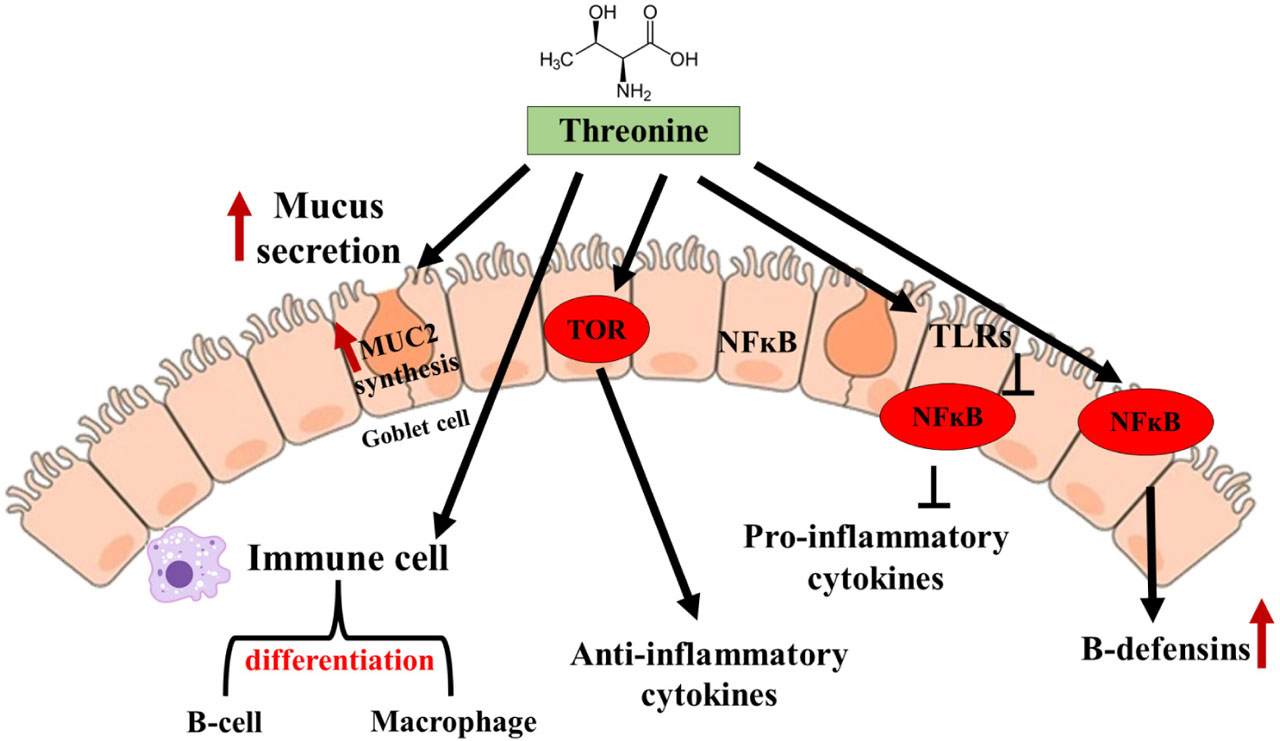
Figure 4.
The gut immune system is modulated by dietary factors. Dietary threonine influences the development of goblet cells, which in turn promotes the synthesis of MUC2. Thr controls the development of immune cells. In the meantime, Thr can control cytokine release through the TOR and NF-ĸB pathways. MUC2: mucin-2; TLRs: toll-like receptors; TOR: the target of rapamycin; NF-ĸB: nuclear factor ĸ-light-chain-enhancer of activated B cells.
Long description: The diagram shows threonine acting on intestinal epithelial and immune cells. It promotes mucus secretion and MUC2 synthesis through goblet cells, influences immune-cell differentiation, and affects TOR and NF-κB pathways. NF-κB and TLR-related signaling regulates pro-inflammatory cytokines, while threonine is associated with increased anti-inflammatory cytokines and β-defensin production.
Broilers fed a diet including 0.69% dietary Thr showed a slightly increased spleen weight and a 24% drop in bursa weight compared to broilers fed a diet including 0.74% Thr, according to research by Azzam and El-Gogary (2015). According to Valizadeh et al. (2014), higher dietary levels of Thr (0.675%) led to a 2.5% rise in bursa weight and a 20% increase in spleen weight when compared with the control diet. A study by Zhang and Kim (2014) highlights the effect of Thr on the immune system. In contrast to a control diet that contained 0.70% Thr, they discovered that a meal containing 0.80% Thr increased the weight of the spleen by 66%.
Also, consuming higher amounts of dietary Thr (0.77%) led to a notable rise in bursa weight and enhanced ND antibody titers when compared to the control diets ( Estalkhzir et al., 2013). Threonine is essential for the synthesis of mucin glycoproteins that form the protective mucus layer lining the gastrointestinal tract. This barrier plays a crucial role in maintaining gut health and immunological competence, serving as the body’s first line of defense against pathogenic infections ( Zarrin-Kavyani et al., 2020). Supplementing broilers with dietary Thr has been demonstrated to improve humoral and cell-mediated immune responses. For example, Thr supplementation dramatically increased the toe web thickness index, a measure of cell-mediated immunity, in broiler chickens, suggesting increased T-cell responsiveness ( Zarrin-Kavyani et al., 2020). Threonine has also been linked to the control of pro-inflammatory cytokines like interleukin-6 (IL-6) and tumor necrosis factor-alpha (TNF-α), which are important immune response mediators during infection and stress. Threonine helps lessen the detrimental effects of immune activation on growth performance by preserving intestinal integrity and lowering inflammation ( Lee et al., 2023). Additionally, Thr aids in the production of acute-phase proteins and immunoglobulins, both of which are critical for systemic immune defense and pathogen neutralization ( Seidavi et al., 2023). Optimizing Thr levels in the diet is an intelligent move to boost immune resilience and overall productivity in contemporary poultry production systems, where birds are frequently exposed to environmental and pathogenic stressors. As a result, Thr functions as a functional nutrient that boosts poultry’s immune system and increases disease resistance in addition to promoting growth and feed efficiency.
Threonine is vital for strengthening poultry’s antioxidant defenses, especially when they are subjected to stressors like high heat, infection, or high-density rearing. An imbalance between the generation of reactive oxygen species (ROS) and the bird’s capacity to counteract them using its own antioxidant defenses causes oxidative stress in poultry. By promoting mucin synthesis and preserving intestinal barrier integrity, Thr enhances antioxidant capacity and lowers oxidative damage and systemic inflammation ( Zarrin-Kavyani et al., 2020). Furthermore, by facilitating the availability of glycine and serine, which are precursors in the glutathione pathway, Thr indirectly aids in the biosynthesis of glutathione, a significant intracellular antioxidant ( Lee et al., 2023). Recent research has shown that dietary Thr supplementation increases the activity of important antioxidant enzymes in broiler chickens, including glutathione peroxidase (GPx), catalase (CAT), and SOD. Increasing dietary Thr levels, for instance, dramatically enhanced antioxidant enzyme activities and decreased malondialdehyde (MDA) concentrations, a sign of lipid peroxidation, in broilers subjected to oxidative stress, according to Lee et al. (2023).
Meat quality, immunological response, and growth performance are all linked to these increases in antioxidant status. Furthermore, threonine’s immunomodulatory qualities are intimately related to its anti-oxidant effects. Threonine helps maintain cytokine balance and immune cell function, both of which are necessary for efficient immune responses, by lowering oxidative stress. Threonine is a valuable nutritional strategy in poultry production because of its dual role, particularly in systems without antibiotics where natural resilience is essential. Thus, increasing the amount of Thr in poultry diets improves the birds’ natural antioxidant defenses, growth, and feed efficiency, all of which lead to increased productivity, welfare, and health ( Chen et al., 2017).
In conclusion, research continuously shows that feeding broilers dietary Thr levels beyond the NRC guidelines can improve their immunity. By encouraging the growth of immune organs, especially the spleen and bursa, Thr boosts immunoglobulin synthesis and improves the antibody response to several illnesses, such as E. coli, salmonellosis, and ND disease.
F. Relative gene expression
A study by Jiang et al. (2019) investigated how the expression of genes in breeder hens and chick embryos was affected by adding Thr to the diet at levels of 0.12, 0.24, 0.36, 0.48, or 0.60%. Breeder hens’ expression of zonula occludens 1 (ZO-1) in the duodenum and mucin 2 (MUC2) in the uterus was found to be significantly impacted by the supplementation. This highlights how the amino acid Thr regulates the expression of genes linked to the synthesis of tight junction proteins and mucin in the reproductive and gastrointestinal tract of hens. According to a study, nutritional supplementation with Thr resulted in a significant increase in the expression of threonine dehydrogenase in the thigh, aminopeptidase in the duodenum and ileum, and poultry target of rapamycin (pTOR) in the liver and breast muscle in chick embryos at 18 days of embryonic age. However, there were no appreciable effects on the ileum and duodenum’s MUC2 expression. The results imply that Thr specifically affects the expression of genes related to protein deposition and amino acid transport in developing embryos.
Kermanshahi et al. (2015) examined the impact of in ovo Thr injection on MUC2 gene expression and digestive enzyme activity in broiler embryos. Fertile eggs were injected either with saline (0.05 or 0.1 mL) or with a Thr solution (5 mg/mL) administered into or under the air sac (TUAS). On the day of hatch, chicks injected with 0.05 mL under the TUAS were reared on diets containing threonine levels according to NRC (1994) recommendations, while the 0.1 mL-injected groups were excluded due to poor hatchability. Results indicated that in ovo Thr injection significantly upregulated MUC2 mRNA expression, suggesting enhanced mucin synthesis and intestinal barrier function, whereas protease and amylase activities remained unaffected. Overall, in ovo Thr supplementation appears to modulate intestinal mucin gene expression without altering digestive enzyme activity during early post-hatch development.
Andrade et al. (2022) investigated the influence of in ovo Thr supplementation on the ileal expression of nutrient transporter genes in broiler chicks challenged with Salmonella enteritidis. Fertile eggs were injected with either sterile saline or 3.5% Thr solution into the amniotic fluid on day 17.5 of incubation. After hatching, half of the chicks from each treatment group were orally inoculated with S. enteritidis at two days of age. Gene expression analysis for sodium-dependent glucose transporter 1 (SGLT1), glucose transporter 2 (GLUT2), di- and tri-peptide transporter 1 (PepT1), and alanine–serine–cysteine–threonine transporter (ASCT1) was performed at hatch, 2, and 9 days of age (7 days post-inoculation). In ovo administration of Thr significantly upregulated the expression of SGLT1 and GLUT2 at 9 days of age, indicating an enhanced capacity for glucose transport. However, exposure to Salmonella infection downregulated GLUT2 expression, suggesting an inhibitory effect on nutrient absorption under pathogenic conditions. A significant interaction between Thr and Salmonella was observed for PepT1 and ASCT1, with Thr increasing PepT1 expression only in non-challenged chicks, while ASCT1 expression increased regardless of infection status. These findings indicate that intra-amniotic Thr supplementation enhances the transcription of genes involved in monosaccharide and amino acid transport, potentially improving intestinal absorptive function, although bacterial challenge can attenuate these effects. Table 4 summarizes the effects of Thr on gene expression in broilers.
Table 4.
Effects of threonine on gene expression in broilers
| Author and year | Threonine dose (%/ g kg−1; mg/egg) | Target genes / Pathways | Main findings | Diet type / Broiler strain / Duration |
|---|---|---|---|---|
| Bhanja et al., 2014 | In ovo amino acid mix incl. Thr (4–6 mg egg) | Growth and immune genes | Enhanced expression of GH and Ig-related genes post-hatch | In ovo / Vencobb-400 / 0–21 days |
| Kermanshahi et al., 2015 | In ovo 5 mg mL−1 Thr (0.05 mL injected under air sac; ≈0.25 mg egg) | MUC2 (mucin gene) | ↑ MUC2 mRNA expression, suggesting enhanced intestinal mucus barrier; no change in digestive enzymes | In ovo injection / Ross 308 / 0–10 days post-hatch |
| Chen et al., 2018 | 0.88% (8.8 g kg) | ZO-1, OCLN, CLDN1, TNF-α, IL-1β | The reversed LPS-induced down-regulation of tight-junction genes ↓ and inflammatory cytokines | Corn–soybean diet / Cobb 500 / 1–21 days |
| Jiang et al., 2019 | 0.67–0.90% (6.7–9.0 g kg) | MUC2, ZO-1, OCLN (tight junction) | ↑ MUC2 and ZO-1 expression → improved intestinal integrity | Corn–soybean diet / Ross 308 / 35 days |
| Ji et al., 2019 | 0.60–1.0% (6–10 g kg) | Tight junction and oxidative genes | Both deficiency and excess Thr altered the expression of barrier-related genes | Corn–soybean diet / Arbor Acres / 42 days |
| Zarrin-Kavyani et al., 2020 | 0.8–1.0% (8–10 g kg) | Cytokine and T-cell genes | ↑ IL-2, IFN-γ expression; improved immune signaling | Corn–soybean diet / Cobb 500 / 42 days |
| Andrade et al., 2022 | In ovo 3.5% Thr solution (~35 mg egg) | SGLT1, GLUT2, PepT1, ASCT1 | ↑ SGLT1 & GLUT2 in ileum (enhanced nutrient absorption); interaction with Salmonella enteritidis challenge | In ovo (amniotic) / Cobb 500 / 0–9 days of age |
G. Economic efficiency
To our knowledge, few reports have studied the economic efficiency of Thr supplements in poultry diets. Hence, Ghanima et al. (2023) evaluated the economic efficiency of Thr supplementation in broilers subjected to feed restriction. Broilers were fed diets containing 100%, 110%, 120%, or 130% of the NRC (1994) recommended Thr level. The study showed that birds receiving 120% and 130% of the recommended dietary Thr achieved the highest economic performance, with significantly lower feed costs per kilogram of body weight gain (9.56 and 9.27 Egyptian pounds [LE]/kg, respectively) compared to the control group (10.24 LE/kg). The authors also recorded the highest net return per bird (15.72 and 16.43 LE) and the greatest economic efficiency (163.5% and 172.3%). The improvements were particularly evident under feed restriction, where Thr supplementation compensated for limited nutrient intake and enhanced feed utilization efficiency. Overall, supplementing Thr beyond standard recommendations improved both growth and profitability, confirming its economic value in restricted-feeding systems.
Reis et al. (2020) evaluated the economic optimization of digestible Thr and sulfur amino acids (SAA) levels in broiler diets across different growth phases. Two dose–response trials were conducted using 560 male Cobb 500 broilers, allocated to seven dietary treatments with graded levels of SAA or Thr. Performance data from the starter (1–14 days), grower (15–28 days), and finisher (29–42 days) phases were analyzed to estimate the amino acid intake that maximized profit based on gross income, total feed cost, and gross margin. Increasing dietary Thr or SAA improved body weight gain and feed intake in all phases. The optimal Thr intake for maximum profit was estimated at 236, 696, and 1,042 mg/bird/day for the starter, grower, and finisher periods, respectively, while optimal SAA intake was 223, 504, and 975 mg/bird/day. The study demonstrated that variations in amino acid market prices had minimal impact on the economically optimal intake, highlighting that economic modeling is a practical approach for determining cost-effective Thr inclusion in broiler feeds.
Conclusion and recommendations
This review integrates findings from multiple studies on the effects of dietary threonine (Thr) on broiler growth performance, gut morphology, immune function, intestinal barrier integrity, oxidative status, plasma metabolites, and carcass characteristics. Evidence consistently indicates that supplementing Thr above the NRC-recommended levels (0.74–0.81%) enhances growth rate and positively influences intestinal structure, immune status, and carcass yield. The reviewed literature also provides insight into optimal total dietary Thr levels for different growth phases. Under normal rearing conditions, the ideal Thr range appears to be 0.80–0.90% during the starter phase (0–21 days), 0.72–0.86% during the grower phase (22–42 days), and 0.67–0.84% over the entire 0–42-day period. However, the review emphasizes that Thr requirements become more complex under conditions of disease, stress, or poor hygiene. The variability observed across studies reflects a lack of precise definitions for optimal Thr levels needed to maximize broiler performance. Furthermore, data on the effects of dietary Thr on protein digestibility in the ileum and throughout the gastrointestinal tract remain limited. These gaps underscore the need for future research to clarify Thr’s role in nutrient utilization and its broader impact on broiler physiology.
Acknowledgments
The authors extend their appreciation to the Deanship of Research and Graduate Studies at King Khalid University for funding this work through the Large Research Project under grant number RGP2/113/47.