Have a personal or library account? Click to login
Effects of hygiene methods on the microbiome and resistome of poultry litter Cover

Effects of hygiene methods on the microbiome and resistome of poultry litter

Open Access
|Feb 2026

Figures & Tables

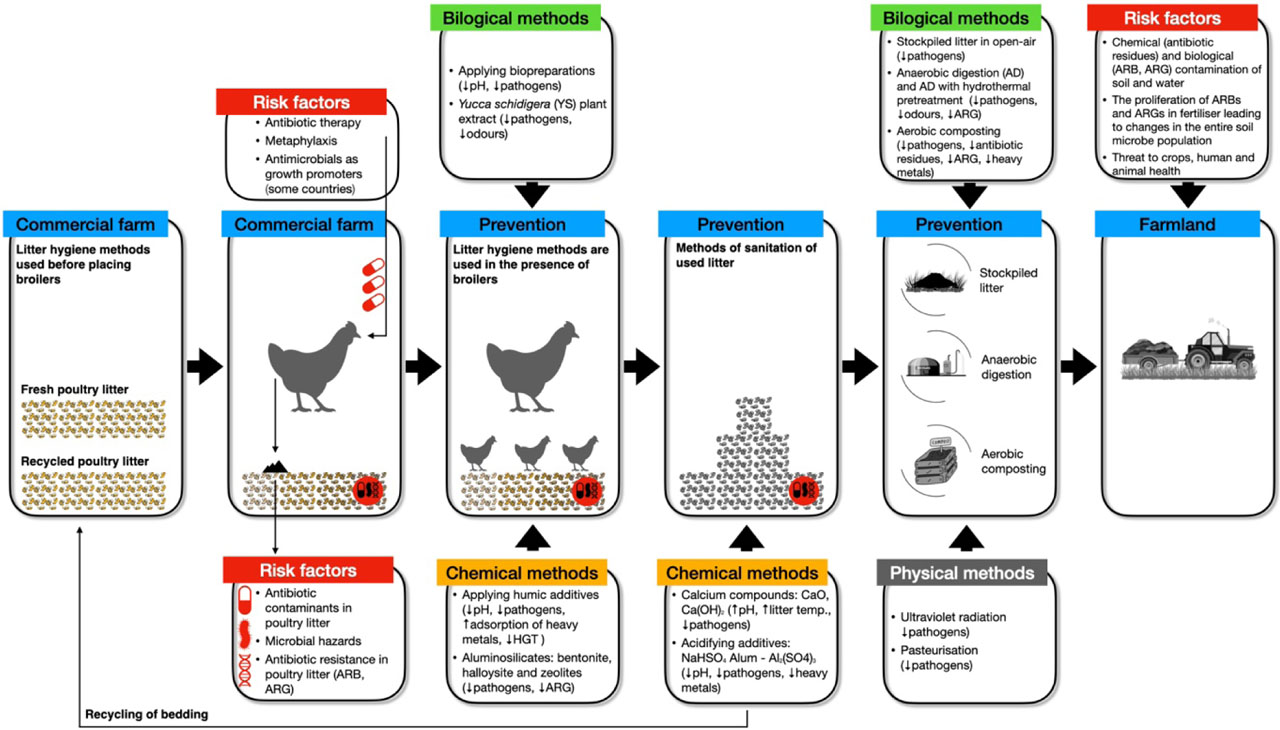
Figure 1.

Schematic representation of preventive methods for bacterial transmission and antibiotic resistance genes in poultry litter

Properties of chemical, biological and physical methods utilised in the processing and sanitation of chicken manure_

Type of MethodExamplePropertiesInvestment/Operating Cost*References
ChemicalCaO (quicklime), Ca(OH)2 (hydrated lime)
  • Alkalisation of litter environment, pH > 12, protein denaturation, enzyme inactivation.

  • May raise litter temperature and increase ammonia emissions.

  • High effectiveness in antibiotic residue inactivation, pathogen and ARG elimination.

Medium / medium(Maguire et al. 2006), (Więckol-Ryk et al. 2023)
NaHSO4 (sodium bisulphate)
  • pH reduction, microorganism deactivation.

  • Lower effectiveness in antibiotic residue and ARG inactivation compared to alkaline method.

Low / low(Rothrock et al. 2008)
Al2(SO4)3·14H2O (alum)
  • pH reduction, phosphate binding, ammonia emission reduction.

  • Moderate effectiveness in antibiotic residue and ARG inactivation.

Low / low(Choi et al. 2008), (Gandhapudi et al. 2006)
Nanotechnology (e.g. nano-Ag)
  • Biocidal action, bacterial cell wall damage.

  • High toxicity.

  • High effectiveness in antibiotic residue, pathogen and ARG elimination.

High / medium(Czyż et al. 2023), (Mohammed et al. 2022)
BiologicalStorage (manure storage)
  • Temporary microbial inactivation.

  • Low impact on antibiotic residues and ARG.

  • Moderate impact on bacterial communities (pathogens).

Low / low(Ferguson et al. 2004)
Aerobic composting
  • Aerobic decomposition of poultry litter or chicken manure.

  • Economical and environmentally friendly approach.

  • Requires temperature and moisture control.

  • High effectiveness in antibiotic residue inactivation.

  • Very high effectiveness in pathogen elimination.

  • High ARG elimination (tet, ermB, qnr, bla) only in thermophilic phase (>80 °C).

Medium / medium(Qiu et al., 2021), (Esperon et al., 2020)
Aerobic composting with mineral additives (e.g. bentonite)
  • Adsorption of active substances, stabilisation of organic matter, odour reduction.

  • High effectiveness in inactivating antibiotic residues.

  • Very high effectiveness in eliminating pathogens.

  • High effectiveness in eliminating ARG to tetracyclines, sulphonamides and macrolides (tet, ermB, sul).

Medium / medium(Qiu et al., 2022)
Aerobic composting with carbon additives (biochar, bamboo charcoal)
  • Adsorption of pollutants, stabilisation of organic matter, increased nitrogen retention.

  • Very high effectiveness in inactivating antibiotic residues.

  • Very high effectiveness in eliminating pathogens and ARG to tetracyclines, sulphonamides and phenicols (tet, sul floR, cfr).

Medium–high / medium(Cui et al., 2016), (Li et al., 2017)
Aerobic composting with biochar and Bacillus subtilis inoculation
  • Sorption of pollutants, stabilisation of organic matter, increased nitrogen retention.

  • Highly effective in inactivating antibiotic residues.

  • Very highly effective in eliminating pathogens and ARG to tetracyclines and macrolides (tet, ermB).

Medium–high / medium(Wu et al., 2024)
Aerobic composting with semi- permeable membrane technology (SMHC)
  • Very high effectiveness in inactivating antibiotic residues.

  • Very high effectiveness in eliminating pathogens.

  • Very high effectiveness in eliminating ARG on beta-lactams and colistin (blaNDM-1 and mcr-1).

High / medium–high(Xing et al., 2021), (Cui et al., 2020)
Anaerobic digestion (methane fermentation)
  • Anaerobic decomposition of biowaste, biogas production, post- fermentation acidification, odour reduction.

  • Highly effective in inactivating antibiotic residues after thermophilic fermentation only.

  • Moderate effectiveness in eliminating pathogens (47–72%) under thermophilic conditions.

  • Moderate effectiveness in eliminating ARG (possibility of increasing the number of tet, sul, ermA genes).

High / high(Tian et al., 2016), (Jang et al., 2018), (Sun et al., 2022)
Anaerobic digestion with thermal pretreatment (TPT)
  • Pre-treatment carried out before Anaerobic digestion (AD) at 70–180°C.

  • Intensification of the AD process.

  • Very high effectiveness in inactivating antibiotic residues (tetracycline, macrolides, lincosamides).

  • Very high effectiveness in eliminating pathogens.

Very high / high(Pourrostami Niavol et al., 2024)
Anaerobic digestion with hydrothermal pretreatment (HTP)
  • Pre-treatment carried out before AD at 120–200°C under high- pressure conditions.

  • Very high effectiveness in inactivating antibiotic residues (e.g. tylosin).

  • Very high effectiveness in eliminating pathogens.

  • Very high effectiveness in eliminating ARG to beta-lactams and macrolides.

  • sulphonamides, quinolones and tetracyclines (blaTEM, ermB, sul, qnr, tet).

Very high / high(Paranhos et al., 2023)
Anaerobic digestion with alkaline and ultrasonic microwave-acid pretreatment (MW-H)
  • Raising pH, protein denaturation.

  • High effectiveness in eliminating pathogens and ARB before AD.

  • Moderate effectiveness in eliminating ARG (possible increase in ARG in post-fermentation).

Medium / medium(Wang et al., 2019), (Tong et al., 2016)
Anaerobic digestion with ultrasonic pretreatment and biochar
  • Sonication breaks down structures; biochar adsorbs antibiotics and stabilises microflora.

  • Highly effective in eliminating ARG (possible increase in ARG in post-fermentation).

High / medium(Zhang et al., 2019a)
PhysicalUV radiation
  • Enzymatic inactivation, damage to pathogens, DNA/RNA and ARG.

  • Effective only on a thin layer of chicken manure.

  • Highly effective in eliminating pathogens.

  • Moderately effective in eliminating ARG.

Medium / medium(El-Maghawry et al., 2024)
Pasteurisation (thermal heating)
  • Protein denaturation, damage to microbial DNA/RNA.

  • Highly effective in eliminating pathogens (70°C) and bacterial spores (>90°C).

  • Moderately effective in eliminating ARG.

Medium–high / medium(Martens and Böhm, 2009)

Properties of chemical and biological additives utilised in the sanitation of poultry litter

Method typeExamplePropertiesReferences
ChemicalHumic substances (humic acids, peat)
  • Acidify the litter and absorb moisture

  • Adsorb antibiotic residues

  • Strong interaction with fluoroquinolones, less intense with sulphonamides

  • Affect bacterial communities (e.g. reduce E. coli counts)

  • Inhibit the spread of ARGs

  • More effective when combined with other methods (e.g. composting)

  • (Xie et al., 2021)

  • (Kulikova et al., 2022)

  • (Dančová et al., 2025)

Bentonite
  • Adsorbs antibiotic residues

  • Affects bacterial communities (e.g. reduces Campylobacter counts)

  • May reduce potential ARG proliferation, especially regarding sulphonamides

  • (Prasai et al., 2016)

  • (Qiu et al., 2022)

  • (Peng et al., 2018)

Zeolites
  • Retain organic compounds, increase sludge porosity

  • High efficiency in antibiotic adsorption and degradation

  • Affect bacterial communities (e.g. reduce Enterobacteriaceae without disrupting beneficial bacteria)

  • Improve ARG removal during composting

  • More effective when combined with other methods (e.g. composting)

(Prasai et al., 2017)
Superphosphate
  • Acidifies the litter, absorbs moisture, reduces ammonia emissions

  • Shows antibacterial effects

  • Inhibits the spread of ARGs

(Peng et al., 2018)
Activated carbon, biochar
  • Stabilisation of organic matter

  • Regulates the growth of microorganisms in litter

  • Highly effective in the adsorption and degradation of antibiotics

  • (Feng et al., 2022)

  • (Karamova et al., 2022).

BiologicalProbiotics (Bacillus spp., Lactobacillus spp.)
  • Compete with pathogens in the gut for space and nutrients, inhibiting their growth

  • Effective in litter sanitation

  • Moderate effect on bacterial communities (pathogens)

  • (Tian et al., 2021)

  • (Juricova et al., 2022)

Yucca schidigera extract
  • Reduces odours

  • Antagonistic properties against pathogens: E. coli, Salmonella, Enterococcus faecalis

(Matusiak et al., 2016)
DOI: https://doi.org/10.2478/aoas-2025-0116 | Journal eISSN: 2300-8733 | Journal ISSN: 1642-3402
Language: English
Submitted on: Apr 9, 2025
|
Accepted on: Oct 9, 2025
|
Published on: Feb 13, 2026
In partnership with: Paradigm Publishing Services
Publication frequency: Volume open

© 2026 Przemysław Racewicz, Sebastian Nowaczewski, Marcin Hejdysz, Piotr Ślósarz, Sebastian Kaczmarek, Piotr Pawlak, Zofia E. Madeja, Magdalena Szyndler-Nędza, published by National Research Institute of Animal Production
This work is licensed under the Creative Commons Attribution 3.0 License.

AHEAD OF PRINT