
Intensive livestock farming exerts pressure on natural resources (Johnson and Villumsen, 2017). Larger scales of production contribute to higher profitability but simultaneously escalate environmental risks and can lead to environmental degradation (Augustyńska-Prejsnar et al., 2018). In developed countries, large-scale factory farms pose significant challenges, annually generating hundreds of millions of tons of faeces that require proper disposal (Jia et al., 2018). Much of the excreta from slaughtered broilers is managed as fertiliser and ends up in agricultural fields through surface spillage or soil application. However, introducing manure into the soil is associated with ecological, hygienic, and sanitary hazards (Skowron et al., 2015; Gaballah et al., 2021; Otieno and Mageto, 2023). The potential presence of pathogens in litter that can infect humans and animals necessitates practical measures to reduce the risks associated with their spread in soil, water and plants via organic manures (Zalewska et al., 2021). The spread of antibiotics and antibiotic-resistant bacteria (ARBs) through poultry manure has become increasingly important (Męcik et al., 2023). The introduction of antibiotics and their active metabolites into soil can promote the selection of antibiotic-resistant bacterial strains. Consequently, microorganisms with developed drug resistance mechanisms in this environment may facilitate their transfer to other microorganisms through horizontal gene transfer (HGT) (Racewicz et al., 2020).
Given the risks associated with the agricultural use of manure, all hygiene treatments applied to poultry litter before its agricultural use should aim, in addition to improving physicochemical properties, to primarily reduce its microbiological activity (Zhao et al., 2021). Therefore, proper management of chicken manure must be based on the knowledge of the survival of microorganisms within it and an understanding of the factors affecting their viability (Skowron et al., 2015).
The literature reviewed in this study indicates that adhering to appropriate handling standards for poultry manure enhances microbiological safety. However, detailed discussions regarding the molecular mechanisms involved in the transmission of antibiotic resistance to soil bacteria remain limited. Given the current understanding, comprehending the dynamics of the spread of ARBs and antibiotic resistance genes (ARGs) in poultry litter and surrounding farm environments is crucial for establishing effective husbandry practices to reduce this phenomenon. Therefore, this review aims to present different methods of poultry litter hygiene to compare their effectiveness in eliminating ARBs and ARGs in the poultry production environment.
Characteristics of poultry production
Poultry farming systems
Poultry farming is one of the world’s most crucial meat production sectors. In the year 2022, the global poultry population (laying hens and broilers) reached 26.6 billion (Statista, 2024). The largest chicken producer in 2021 was China, with 11.1 billion chickens, followed by the United States of America, with 9.3 billion chickens, and third and fourth place went to Brazil and Indonesia, with 6.1 and 4.6 billion broilers, respectively (Statista, 2024). According to the forecast for October 2023, the world production of chickens for slaughter has increased by 0.4 per cent to approximately 102 million tons (USDA, 2023). At the same time, meat consumption will increase by 0.6% to reach a ceiling of almost 100 million tons (USDA, 2023). At the same time, poultry meat consumption is forecasted to increase by 5%, reaching 12.5 million tonnes (EC, 2023).
Various farming systems have been used for poultry production. According to the adopted classification, these are intensive, semi-intensive, and extensive farming (Safitri and van Asselt, 2024). In intensive housing systems, there is barn-slatted and deep litter for maintaining broilers. Semi-intensive farming is aimed at a slightly slower weight gain in animals. The third type is the extensive keeping system, which is mainly used in small backyard farms and organic production. These systems include free-range production with lower stocking densities and minimal environmental impacts (Dal Bosco et al., 2021).
To increase productivity, profitability and profits, poultry are increasingly maintained on large-scale farms, where a highly industrialised and concentrated production profile dominates (Mottet and Tempio, 2017). However, the intensification of poultry production is associated with an increased amount of waste products, such as manure, and the emission of ammonia (NH3), carbon dioxide (CO2), hydrogen sulphide (H2S), methane (CH4), organic acids, and other odorous compounds into the environment (Myszograj, 2012). Ammonia and carbon dioxide in livestock buildings are primarily formed by microbiological processes in which uric acid and undigested proteins are broken down (Stuper-Szablewska et al., 2018). Other chemical contaminants present in poultry production include heavy metals, pesticides, detergents, disinfectants, antibiotic residues and coccidiostats (Kyakuwaire et al., 2019). Poultry farms also emit physical (dust) and biological (bacteria, fungi, and endotoxins) pollutants (Skóra et al., 2016). The number of microorganisms in the livestock housing varied. The largest number of saprophytic and potentially pathogenic bacteria are found in animal faeces, followed by bedding and floor surfaces (Augustyńska-Prejsnar et al., 2018).
Poultry waste management
One of the main byproducts of poultry farming is droppings or manure. Poultry manure is composed of a mixture of faeces, urine, wasted feed, bedding materials and feathers. It contains a wide range of nutrients (i.e. nitrogen and phosphorus) and is rich in micro- and macroelements that are essential for plants (Guo et al., 2018; Shi et al., 2018).
The need to protect the natural environment forces us to take measures to reduce the negative impacts of poultry farms, including the management of manure and waste generated during the production cycle (Myszograj, 2012). The negative impact of poultry manure on soil can be prevented by implementing effective best management practices (BMPs) at the early stages of poultry production (Dróżdż et al., 2020). For example, in some countries, bedding used in one production cycle can be reused, provided that it has been physically and/or biologically disinfected. In Europe, the bedding in each facility is replaced after each production cycle (Myszograj, 2012).
A common method of utilising poultry manure is agricultural (fertiliser) use (Manogaran et al., 2022). Poultry manure is one of the best available organic fertilisers for improving soil fertility (Adeyemo et al., 2019). Poultry manure can be applied directly to agricultural crops or after processing, e.g. by composting as fertiliser or compost (Dróżdż et al., 2020).
Risks of poultry manure management
Antibiotic contaminants in poultry litter
Waste management problems in intensive poultry production primarily relate to manure disposal. Manure generated on farms seriously threatens human and animal health, as well as the environment. Environmental problems related to the use of poultry relate to the risks associated with ammonia and greenhouse gas emissions as well as chemical (antibiotic residues) and biological (ARBs) contamination of water and soil (Dróżdż et al., 2020).
Antibiotics in poultry are usually administered to the whole flock and are used to treat disease (therapy) and prevent disease (metaphylaxis) (Roth et al., 2019). Antibiotics used to promote growth were banned in the EU in 2006, in the USA in 2017, and in China in 2020. Although the use of antibiotics in poultry farming is subject to legal regulations, the scale of its use is not fully known. Consumption reports are obtained from pharmaceutical companies and, in most cases, are based on the value of their sales (Abdallah et al., 2024). Obtaining information only on the total amount of antibiotics sold in tons or kilograms is not a reliable indicator of their actual consumption. Therefore, the PCU (population correction unit) monitors this parameter – defined as the ratio of antibiotics used per kilogram of animal weight in a given country. However, it should be emphasised that over the last decade, use of antibiotics in the poultry industry has decreased from 14,347.37 tons in 2010 (148 mg/PCU) to 4,736.91 tons in 2020 (35.4 mg/PCU) (Ardakani et al., 2024).
Despite the implementation of various restrictions and antimicrobial management programs, antibiotics such as tetracyclines, sulphonamides, tylosin and fluoroquinolones are still used in excessive quantities worldwide because of their broad-spectrum activity, relatively low toxicity, and affordability (Lyu et al., 2020; Wallinga et al., 2022; Mulchandani et al., 2023). These, together with faeces or urine, end up on farmland as organic fertilisers (Berendsen et al., 2015). These fertilisers are not subject to laboratory control due to the presence of antibacterial substances, making them a potential threat to the natural environment (Osinski, 2022).
Antibiotics are unchanged in manure or poultry manure from livestock farms at concentrations ranging from a few μg/kg to several hundred mg/kg (Osinski, 2022). This is because antibiotics can be excreted in large amounts in urine and faeces after administration, and it has been reported that between 17 and 90% of them are excreted unmetabolised or as active metabolites (Berendsen et al., 2015; Spielmeyer et al., 2018). This evidence agrees with the findings from other researchers who reported detecting high concentrations of antimicrobials in faeces from several production animals. In particular, these researchers found significant evidence of tetracyclines, sulphonamides, and amphenicols in droppings from broiler chickens and manure from cattle and swine with drug concentrations that ranged from 1.4 µg to 300 mg of drug per kg, or L of faeces (Martínez-Carballo et al., 2007). A study conducted on chicken broiler farms in Egypt found elevated levels of chlortetracycline and oxytetracycline residues in broiler chicken litter and faeces. The concentrations of these residues were 6.05 and 2.47 μg/g for chlortetracycline and 5.9 and 1.33 μg/g for oxytetracycline, respectively (Mahmoud and Abdel-Mohsein, 2019). The results of tests on chicken manure samples from large-scale farms in Brazil and Chile confirmed the presence of high concentrations of oxytetracycline and fluoroquinolones, with the highest concentrations of enrofloxacin (Parente et al., 2019; Yévenes et al., 2021). Similar results were obtained in Chinese studies, with the maximum concentration of this chemotherapeutic agent in chicken manure exceeding 1420 mg/kg (Zhao et al., 2010). For comparison, the concentrations of enrofloxacin in chicken manure, oscillating between 2.8 and 8.3 mg/kg, have been recorded in Austrian studies (Martínez-Carballo et al., 2007). In the same experiment, the concentration of sulfadiazine in chicken manure was 51 mg/kg, and sulphonamide potentiated with trimethoprim did not exceed 17 mg/kg (Martínez-Carballo et al., 2007). Sulphonamides, in combination with trimethoprim, are therefore unstable in litter, which has also been confirmed by other researchers (Zhao et al., 2010; Wegst-Uhrich et al., 2014).
Previous studies have shown that antibacterial substances in animal faeces can reach the upper layers of the soil, where they are collected or washed into surface waters, and can also penetrate into the groundwater (Merchant et al., 2012; Yang et al., 2019). The influx of antibiotics and their residues into the soil through natural fertilisers is estimated to be several hundred grams per hectare, often at concentrations exceeding several hundred μg/kg of soil (Cycon et al., 2019; Gaballah et al., 2021). The largest component is tetracyclines, which are commonly used in poultry farming (Massé et al., 2014). Other groups of antibiotics with considerable concentrations in manure are fluoroquinolones and sulphonamides. The concentrations of oxytetracycline and chlortetracycline in some agricultural lands may reach extremely high levels, whereas the concentrations of ciprofloxacin, norfloxacin, and tetracycline are typically considerably lower (Cycon et al., 2019).
Antibiotic residues occurring in the soil, even at small concentrations, affect the microbiome and resistome of soil. Using organic fertilisers from large-scale farms also poses a risk related to the penetration of antibacterial substances into plants, thereby affecting human and animal health (Tian et al., 2021; Tripathi et al., 2023; Symochko et al., 2023).
Microbial hazards
Sustainable broiler chicken production requires the use of bedding materials that are highly absorbent, comfortable for chickens and safe for the environment (Shao et al., 2015). Poultry litter, as a byproduct, contains a vast number of microorganisms, including intestinal bacteria (e.g. lactobacilli and E. coli) (Rychlik et al., 2023). Environmental conditions, bird rearing type, bird age, and bird breed and health strongly influence the quantity and quality of litter microbiota (Horyanto et al., 2024). Moreover, the microbiological quality of litter significantly affects the production results, health, quality of carcasses and welfare parameters of chickens (Garcês et al., 2013; Ramadan et al., 2013).
Approximately 1010 CFU is found in 1 g of poultry litter, with gram-positive bacteria such as Staphylococcus saprophyticus, Weissella jogaejeotgali, Corynebacterium casei, Lactobacillus gasseri and Lactobacillus salivarius Brevibacterium, Brachybacterium, Salinococcus and Dietzia accounting for almost 90% of the chicken manure microbiota (Kubasova et al., 2022). An average flock of 22,000 broilers generates more than 18,000 kg of poultry manure per shed (Cook et al., 2014). The litter also serves as a reservoir of bacteria that, upon introduction into the soil, can potentially propagate epizootics and zoonoses on farms (Gontar et al., 2022). This situation most likely occurs when crops are cultivated on fertilised land for direct consumption or on pastures immediately before grazing (Muhammad et al., 2019; Ali Mirza et al., 2020).
Humidity, temperature, and pH are the three most important factors affecting the survival of pathogens in faeces (Soliman et al., 2018). Pathogenic bacteria that pose risks to both humans and animals include Actinobacillus, Bordetella, Campylobacter, Clostridium, Corynebacterium, Escherichia coli, Globicatella, Listeria, Mycobacterium, Salmonella, Staphylococcus and Streptococcus (Zhao et al., 2010). Salmonella spp. are most frequently isolated from faecal samples and chicken litter (Chen and Jiang, 2014). The population of Salmonella spp. in chicken litter ranges from 4 to 1.1 × 10⁵ CFU/g of litter (Chinivasagam et al., 2010). E. coli is found in chicken litter at rates as high as 100%, and the O157:H7 strain is not detected in broiler chicken litter samples (Shepherd Jr et al., 2010). The population of E. coli in used bedding was 4.2 × 10⁵ CFU/g (Chinivasagam et al., 2010). Campylobacter prevalence in litter or faecal samples of slaughtered chickens can range from 0% to 100%, with an average population level of approximately 105 CFU/g in faecal samples (Stern and Robach, 2003). Listeria monocytogenes is generally absent from chicken litter and poultry composts, suggesting that this pathogen does not appear to be a significant concern in chicken litter-based organic fertilisers (Shepherd Jr et al., 2010; Zhao et al., 2010). Introducing ARBs into the soil environment through manure may temporarily boost their abundance and potentially transmit this trait to soil bacteria such as Proteus and Pseudomonas (Sun et al., 2015).
Antibiotic resistance in poultry litter
Intensive treatment of livestock, including poultry, is the leading cause of ARBs in animals and the environment (Li et al., 2024). Consequently, frequent or inappropriate use of antibiotics in animals increases the prevalence of multidrug-resistant (MDR) bacterial strains (Zhao et al., 2010). The emergence of antibiotic-resistant strains is genetically determined and typically spreads through HGT. This transfer is often mediated by mobile genetic elements (MGE) such as plasmids, transposons and associated integrons. The spread of antibiotic resistance can occur among taxonomically similar groups of bacteria and strains of different serovars, species, genera and families (Racewicz et al., 2020). This phenomenon is often associated with commensal and enteropathogenic bacteria, such as Salmonella spp., E. coli, Campylobacter spp. and Enterococcus spp. (Urban-Chmiel et al., 2022; Juricova et al., 2021).
Studies have suggested an association between antibiotic use and the spread of ARGs in the environment (Marshall and Levy, 2011). ARGs are transmitted between poultry and the environment through faeces, sewage and air (Chen et al., 2025). In recent years, the transfer of ARGs from manure to the environment after the application of natural or organic fertilisers has frequently been observed (Wang et al., 2016). ARGs have been found in soil after the application of pig manure (Jechalke et al., 2013) and poultry manure (Cook et al., 2014). However, ARG contamination in poultry farming environments differs greatly from that in other livestock environments. These differences are due to the use of different breeding practices, physiological traits, manure management methods, and environmental transmission pathways (Korver, 2023).
Furthermore, ARG concentrations in fertilised soil can be up to 28,000 times higher compared to unfertilised soil (He et al., 2020). ARGs and MGEs, especially transposons and associated integrons, were found to be closely associated with manure and their increased abundance in soil is a direct result of the application of this fertiliser to arable fields (Qian et al., 2018; Wang et al., 2020).
ARGs can confer resistance to various classes of antibiotics, including: tetracyclines (tet), sulphonamides (sul), β-lactams (bla), macrolides (erm), aminoglycosides (aac), quinolones (qnr), colistin (mcr), vancomycin (van) and MDR (Huang et al., 2019). The most commonly detected classes of ARGs in animal waste, including poultry waste, include tet, sul, erm, qnr and bla, which correspond to the primary classes of antibiotics used in animal husbandry (Qian et al., 2018; Hurst et al., 2019; Bai et al., 2024). Tet and sul resistance genes are frequently found in manure, manure-fertilised soil samples, agricultural and non-agricultural soils, wastewater, and surface water in feedlots, indicating their extensive potential for dissemination (Martínez-Carballo et al., 2007).
Information regarding the presence of ARGs in chicken litter is limited, mainly stemming from industrialised countries, such as the USA, China, and Australia, but is largely absent in developing countries experiencing rapid growth in the poultry industry and chicken manure usage (Kyakuwaire et al., 2019). The findings from studies confirming the high frequency of strains showing resistance to multiple antibiotics in animal faeces are of specific concern (Xu et al., 2022 a; Wang et al., 2023). For example, in the USA, all (100%) tested samples of chicken broiler manure were found to be contaminated with E. coli containing genes causing resistance to more than seven antibiotics, specifically amoxicillin, ceftiofur, tetracycline, sulphonamides, nalidixic acid and sarafloxacin (Kyakuwaire et al., 2019). In turn, ampicillin and tetracycline resistance genes have been detected in E. coli-contaminated composted poultry litter (Kyakuwaire et al., 2019).
In a Chinese study describing the spread of ARGs in pig, poultry and cattle farms, the frequency of selected genes in a production ecosystem was assessed. The ermB, tetM and sul2 genes were detected at the highest concentrations and frequencies, with average levels exceeding 109 copies/g and detection frequencies higher than 90% (Wang et al., 2016). In soil, tet and sul were the most dominant genes, exhibiting absolute concentrations 2–4 orders of magnitude higher than other ARGs tested, with sul2 having the highest concentration (1.73 × 10⁹ copies/g), followed by tetC, tetM and sul1 with concentrations higher than 108 copies/g (Wang et al., 2016). In contrast, an experiment by Han et al. (2018) confirmed that the amount of ARGs in fertilised soils decreased over time but after 120 days remained higher than in unfertilised soils.
Heavy metals in animal husbandry have also been shown to increase the risk of spreading ARGs in the environment (Guo et al., 2018). Copper (Cu) is an essential animal metal listed as a priority contaminant. Typically, at concentrations two to three orders of magnitude higher than those of antibiotic residues, metals can increase bacterial resistance to erythromycin and stimulate plasmid-mediated HGT conjugation processes (Ji et al., 2012; Zhang et al., 2016). The co-transfer of ARGs and metal resistance genes (MRGs) by MGEs has been observed in environments such as the soil and human gut (Rosewarne et al., 2010).
Processing poultry litter before application in the field has the potential to reduce the abundance of antibiotic resistance genes and, thus, the risk of contamination of crops or water resources (Subirats et al., 2021).
Prevention of the spread of ARBs, ARGs through poultry litter
Most organic fertiliser management plans focus on volume reduction or nutrient management, with less emphasis on the risks associated with bacteria carried by poultry manure. Awareness of the risks associated with introducing resident pathogenic microorganisms into the soil environment with chicken manure and the potential for further spread through the dietary route necessitates prior treatment of this manure to reduce the presence of these bacteria (Chen and Jiang, 2014).
The survival rate of the test microorganisms in chicken manure depends on several factors that are often strongly interrelated. The most important factors are temperature, dry matter, dry organic matter content, pH, presence of antagonistic natural microflora, initial abundance of test microorganisms, nutrient abundance of the fertiliser, and redox potential (Soliman et al., 2018).
Many methods are currently being used to sanitise poultry litter. These methods can be categorised into physical, biological, and chemical methods. This review categorises strategies that can be utilised during chicken rearing and post-production. A schematic representation of methods to prevent the transmission of bacteria and antibiotic resistance genes in poultry faeces is presented in Figure 1.
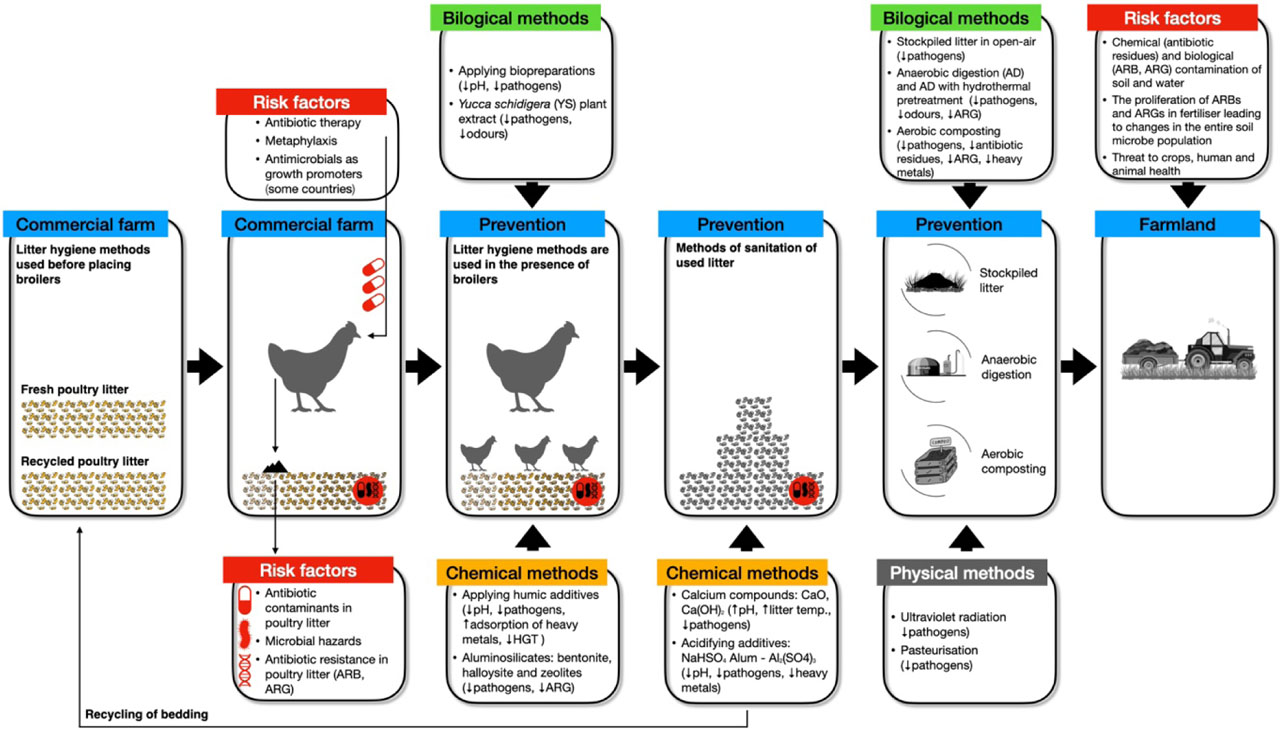
Figure 1.
Schematic representation of preventive methods for bacterial transmission and antibiotic resistance genes in poultry litter.
Sanitation methods for poultry litter used in the presence of birds
For the sake of bird safety and to minimise the burden on the external environment of poultry production, increasing attention is being paid to natural methods of litter hygiene. Among these, the most notable are those applicable at an early stage of poultry production, such as in the presence of livestock. Examples of such treatments include the addition of chemical and biological additives to poultry litter. Table 1 presents the properties of chemical and biological additives utilised in the sanitation of poultry litter.
Table 1.
Properties of chemical and biological additives utilised in the sanitation of poultry litter
| Method type | Example | Properties | References |
|---|---|---|---|
| Chemical | Humic substances (humic acids, peat) |
| Xie et al. (2021), Kulikova et al. (2022), Dančová et al. (2025) |
| Bentonite |
| Prasai et al. (2016), Qiu et al. (2022), Peng et al. (2018) | |
| Zeolites |
| Prasai et al. (2017) | |
| Superphosphate |
| Peng et al. (2018) | |
| Activated carbon, biochar |
| Feng et al. (2022), Karamova et al. (2022) | |
| Biological | Probiotics (Bacillus spp., Lactobacillus spp.) |
| Tian et al. (2021), Juricova et al. (2022) |
| Yucca schidigera extract |
| Matusiak et al. (2016) |
Chemical additives
Chemical additives used in the rearing of chickens for feed and bedding purposes often include mineral preparations. These additives possess highly favourable properties from a hygiene perspective, increasing the sorption capacity of bedding materials (resulting in a drying effect). Moreover, mineral additives are benign to animals and the environment and enhance the fertiliser value of poultry manure. These additives include humic raw materials such as peat and lignite as well as biocarbon, superphosphate, and aluminosilicates such as bentonite, diatomite, halloysite, vermiculite and zeolites (Prasai et al., 2017; Feng et al., 2022; Karamova et al., 2022).
For instance, when dealing with humic substances (HS), an optimal approach involves blending a small quantity of peat with straw or sawdust. This treatment positively influences the physical properties of mulch by increasing its water adsorption capacity (Song et al., 2023). HS, due to their high content of stable free radicals, can interact with various biotic and abiotic substances in the environment (Fu et al., 2021) and influence the fate and transport of organic pollutants and heavy metals (Lipczynska-Kochany, 2018). Fu et al. (2021) identified the primary mechanisms through which HS impacts ARGs evolution, including electrostatic interactions, hydrophobic interactions, hydrogen bonds, non-specific van der Waals interactions and alterations in microbial communities. The effectiveness of peat addition in reducing antibiotic resistance was also demonstrated in an experiment by Xie et al. (2021), where a beneficial impact of 15% wood peat was found to reduce bioavailable Cu content and attenuate HGT.
An example of HS is peat moss, which is renowned for its high adsorption capacity and natural acidity, making it an excellent addition to poultry bedding (Živkov Baloš et al., 2020). A study conducted by Everett et al. (2013) demonstrated a decrease in E. coli bacteria following the addition of peat moss during the second week of chicken rearing. The bacterial count in the litter post-application of this additive at 13% or 20% stood at 3.92 and 4.04 log CFU/g, respectively, from the aforementioned group. However, peat was not included in the control mulch, where the E. coli count was 5.43 log CFU/g of mulch (Everett et al., 2013; Dancova et al., 2025).
One of the environmentally friendly mineral materials contributing to the optimisation of the microclimate in livestock facilities is bentonite, a representative of aluminosilicates. Other aluminosilicates such as halloysite and zeolites exhibit similar properties. In a study by Prasai et al. (2016), the authors investigated the impact of bentonite on poultry litter microflora; a reduction in certain bacterial species, including potential pathogens of the order Campylobacterales, was observed. The elimination of certain bacteria has also been confirmed for zeolite, which is used as a feed additive for chickens (Prasai et al., 2017). Its supplementation inhibits the transmission of pathogens from the Enterobacteriaceae family without interfering with beneficial bacteria (Prasai et al., 2017). Kaolin, vermiculite, perlite and saponite also enhanced the mulch properties. However, their widespread adoption is limited, mainly because of their relatively high cost (Mituniewicz et al., 2007).
Biological additives
Biological methods involve administering probiotics to chickens or ‘inoculating’ the litter with biopreparations containing non-pathogenic microorganisms, mainly strains of Bifidobacterium, Bacillus, Lactobacillus and Lactococcus (Jha et al., 2020). The positive effects of probiotics on production results, broiler carcass composition, and microbial contamination of farms have been documented in numerous studies (Patel et al., 2015; Rehman et al., 2020; Halder et al., 2024). Adding probiotics to broiler feed increases the absorption of amino acids and decreases the content of nitrogenous compounds in manure, reducing ammonia emissions (Zhang and Kim, 2014). According to some authors, administration of lactic acid bacteria in poultry diets may be effective in reducing Salmonella colonisation in the gut, improving the overall health of birds and reducing the need for antibiotics (Abdel-Raheem et al., 2024; He et al., 2024). De Cesare et al. (2019) observed a reduction in the total number of aerobic bacteria, Enterobacteriaceae (Salmonella spp., E. coli) and coagulase-positive staphylococci after bio-preparation containing Bacillus spores. However, some studies question the direct anti-infective effect of probiotics in the intestines of chickens (Juricova et al., 2022). Probiotic supportive preparations are highly effective in litter disinfection processes (Tian et al., 2021). A study by Pedroso et al. (2013) confirmed the disinfecting properties of synbiotics (probiotics and prebiotics) against pathogenic microflora in litter. However, their ability to limit the spread of ARB and ARG in the environment was relatively low.
Among the biological methods, biopreparations that contain additional substances in their composition, for example, Yucca schidigera (YS) plant extract, are becoming increasingly popular. Due to its high saponin content, YS has antagonistic properties against pathogenic microorganisms present in poultry manure and has a positive effect on the sanitary condition of breeding farms. Saponins also contribute to the reduction of odour production by reducing the action of urease, an enzyme responsible for the release of NH3 from glycolic acid and urea (Windisch et al., 2008; Matusiak et al., 2016). Matusiak et al. (2016) showed that the combined treatment of chicken manure with 5% YS extract and a microbiological formulation containing lactic acid bacteria (L. mesenteroides, L. plantarum) reduced the population of most pathogenic microorganisms, including E. coli, Listeria monocytogenes, Salmonella Typhimurium and Enterococcus faecalis but did not affect the number of Lactobacillus. The application of 15% YS extract reduced all potentially pathogenic microorganisms. Reductions in overall gut bacteria and E. coli counts were also reported in previous studies (Ayoub et al., 2019) in which broilers were administered YS extract in drinking water. In contrast, different results were obtained in the Onbaşilar et al. (2014) study, in which the addition of YS to broiler chicken litter did not affect the total colony count of Enterobacteriaceae, yeast, mould, pH, moisture, or ammonia-N.
Methods of sanitation of used litter
Poultry manure processing involves the use of various technologies that alter its composition and quantity to increase its reuse, most commonly in processed fertiliser products. Various poultry bedding processing technologies are available, ranging from simple and robust farm-scale solutions to more high-tech solutions in complex processing chains. These technologies are based on chemical, biological or physical methods or combinations (Zhang et al., 2023). Table 2 presents the properties of chemical, biological and physical methods utilised in the processing and sanitation of chicken manure.
Table 2.
Properties of chemical, biological and physical methods utilised in the processing and sanitation of chicken manure.
| Method type | Example | Properties | Investment/Operating cost* | References |
|---|---|---|---|---|
| 1 | 2 | 3 | 4 | 5 |
| Chemical | CaO (quicklime), Ca(OH)2 (hydrated lime) |
| Medium / medium | Maguire et al. (2006), Więckol-Ryk et al. (2023) |
| NaHSO4 (sodium bisulphate) |
| Low / low | Rothrock et al. (2008) | |
| Al2(SO4)3·14H2O (alum) |
| Low / low | Choi et al. (2008), Gandhapudi et al. (2006) | |
| Nanotechnology (e.g. nano-Ag) |
| High / medium | Czyż et al. (2023), Mohammed et al. (2022) | |
| Biological | Storage (manure storage) |
| Low / low | Ferguson et al. (2004) |
| Aerobic composting |
| Medium / medium | Qiu et al. (2021), Esperon et al. (2020) | |
| Aerobic composting with mineral additives (e.g. bentonite) |
| Medium / medium | Qiu et al. (2022) | |
| Aerobic composting with carbon additives (biochar, bamboo charcoal) |
| Medium–high / medium | Cui et al. (2016), Li et al. (2017) | |
| Aerobic composting with biochar and Bacillus subtilis inoculation |
| Medium–high / medium | Wu et al. (2024) | |
| Aerobic composting with semi-permeable membrane technology (SMHC) |
| High / medium–high | Xing et al. (2021), Cui et al. (2020) | |
| Anaerobic digestion (methane fermentation) |
| High / high | Tian et al. (2016), Jang et al. (2018), Sun et al. (2022) | |
| Anaerobic digestion with thermal pretreatment (TPT) |
| Very high / high | Pourrostami Niavol et al. (2024) | |
| Anaerobic digestion with hydrothermal pretreatment (HTP) |
| Very high / high | Paranhos et al. (2023) | |
| Anaerobic digestion with alkaline and ultrasonic microwave-acid pretreatment (MW-H) |
| Medium / medium | Wang et al. (2019), Tong et al. (2016) | |
| Anaerobic digestion with ultrasonic pretreatment and biochar |
| High / medium | Zhang et al. (2019 a) | |
| Physical | UV radiation |
| Medium / medium | El-Maghawry et al. (2024) |
| Pasteurisation (thermal heating) |
| Medium–high / medium | Martens and Böhm (2009) |
[i] The investment and operating costs were estimated based on the report by Flotats et al. (2011).
Chemical methods
For many years, research has been conducted to optimize the physicochemical and microbiological characteristics of the litter used on poultry farms. The most noteworthy are chemical methods involving the application of various mineral or organic preparations to the litter. Chemical additives applied to bedding offer numerous advantages, such as lowering or raising its pH, preventing the conversion of nitrogen to ammonia, reducing moisture levels, absorbing odours, improving its chemical composition, and inhibiting enzyme production and microbial growth (Soliman et al., 2018).
Calcium compounds are mineral additives that have been known and valued for years and are widely used as potent disinfectants and sanitisers, both before and after birds enter a livestock building. Studies have shown that calcium oxide (CaO) or hydrated lime (Ca(OH)2) can serve as biocompatible disinfectants for poultry litter (Więckol-Ryk et al., 2020). Their use alkalises litter and increases its temperature, surpassing the tolerance ranges of most intestinal pathogens (Chen and Jiang, 2014). The disinfecting efficacy of quicklime has also been attributed to the dehydration of poultry litter (Chen and Jiang, 2014). Litter treated with disinfection processes involving calcium compounds can be reused in subsequent production cycles, a practice observed in certain countries (Mituniewicz et al., 2016).
Recent studies have shown that adding CaO to poultry litter significantly reduces the population of bacteria and fungi (Więckol-Ryk et al., 2023). Maguire et al. (2006) found that applying 10% quicklime to broiler litter reduced the total bacteria count from 793,000 to 6,500 CFU/g. This treatment also reduced the number of pathogenic microorganisms such as Salmonella spp. and E. coli. In 2003, Bennett et al. (2003) proved that applying lime to litter at concentrations of 5%, 10% and 20% increased the pH from 8.36 to 12.57 and significantly reduced the incidence of Salmonella Enteritidis within 24 h. In contrast, applying hydrated lime at concentrations of up to 5% reduced the total aerobic bacteria count but did not decrease Campylobacter or Salmonella spp. (Bennett et al., 2005). Nevertheless, Ruiz et al. (2008) observed that applying 15% quicklime reduced the CFU count/g on days 1 and 10 post-treatment and 7 days after chicken placement on the farm compared to other treatments. More detailed findings were reported in a Polish study, where the 10.5% addition of CaO to chicken manure increased its pH and temperature (pH = 9.5; 40°C), resulting in a reduction in Enterobacteriaceae from 107 CFU/g to 102 CFU/g at 180 h (Więckol-Ryk et al., 2023).
Recycling of bedding by chemical treatment (litter acidification) between successive cycles of broiler production is a common practice used, for example, in Brazil and the USA (Saraiva et al., 2020). Although the physicochemical effects of litter acidifying additives have been well studied, little attention has been paid to their effects on the microbial community in poultry litter (Rothrock et al., 2008). One frequently used acidifier in the poultry industry is a product based on sodium bisulphate (NaHSO4), a dry, granular acid that, when in contact with moisture, produces hydrogen ions (H+) and dissolves (Tabler and Wells, 2017). Hydrogen ions react with ammonia in the litter to form ammonium, which is non-volatile. In addition to controlling NH3 emissions, acids have been shown to reduce pests and pathogens in reused litter (Soliman et al., 2018; Cockerill et al., 2020) The use of NaHSO4 has been shown to be effective in reducing Salmonella, Campylobacter (Line and Bailey, 2006; Williams et al., 2012) and other bacteria (e.g. E. coli) in broiler stroma (Payne et al., 2019). More recently Joerger et al. (2020) showed that the application of sodium bisulphate to reused mulch covered with fresh pine chips resulted in an increase in Escherichia and Faecali-bacterium and a decrease in Acidobacteria. Researchers have suggested that higher ammonia levels resulted in stunted growth of Escherichia spp., whereas lower pH and lower levels of free ammonia allow their survival (Joerger et al., 2020).
Alum (aluminium sulphate Al2(SO4)3 × 14H2O) is another commercially available acidifier commonly used for the chemical treatment of poultry bedding in the USA (Rothrock et al., 2008). Previous studies have shown that alum treatment reduced NH3 emissions from mulches, lowered water-soluble phosphorus, and that soils treated with alum mulch had fewer pathogens, heavy metals, and higher nitrogen content (Gandhapudi et al., 2006). Rothrock et al. (2008) showed that the addition of alum to poultry litter potentially changed the microbial population from bacterial to fungal dominance. In an experiment conducted by Choi et al. (2008), the effects of alum, aluminium chloride and ferrous sulphate on the total number of aerobic bacteria and bacteria capable of growing on McConkey agar (gram-negative bacteria) were investigated, and a lower total number of bacteria and gram-negative bacteria in litter altered with acidifiers was confirmed. The results of Line and Bailey (2006) and Sahoo et al. (2016) suggest that litter acidification delays the onset of Campylobacter colonisation in broiler chickens, whereas Salmonella colonisation is not impaired.
Research is currently underway to develop modern preparations using nanotechnology, with Ag being the most commonly used element. Silver is employed in litter hygiene as a preparation combined with mineral compounds such as humic and aluminosilicate (Mituniewicz et al., 2008; Gavanji, 2013). A study conducted in Poland by Czyż et al. (2023) demonstrated the moderate effectiveness of silver mineral preparations in reducing litter microflora. Although the application of nanopreparations led to a reduction in enterococci and moulds, the results regarding Salmonella spp. and E. coli were inconclusive. Conversely, a study by Mohammed (2022) showed the overall effectiveness of a composite formulation of nanosilver combined with calcium hypochlorite (Ca(OCl)2-Ag NPs) against various pathogens in the litter (E. coli, Salmonella spp., K. pneumoniae, and L. monocytogenes). Despite the strong biocidal effect observed, the use of nanotechnology preparations raises concerns because of mounting evidence indicating that AgNPs are highly toxic not only to microorganisms in the environment but also to higher organisms (Rezvani et al., 2019).
Organic chemical additives such as formaldehyde have proven to be very effective in disinfecting poultry litter; however, due to their toxic effects, they are mainly used to disinfect enclosures before the birds are transported to farms. This restriction applies to farms in which poultry are reared on bedding enriched with complementary feed. Treating mulch with organic chemical additives can increase the risk of food poisoning and potential mineral imbalances in the body (Mituniewicz et al., 2008).
Biological methods
Among the methods of biological processing of poultry manure, the most noteworthy are those based on stockpiling in open-air, anaerobic digestion (AD), and composting. Storing poultry litter is the simplest and most cost-effective method for treating this manure. Consequently, it is widely used and preferred over other agricultural methods. Before being applied to the land, poultry manure is stored in the field (for approximately 4–6 months) until it is used as a soil additive (Ferguson and Ziegler, 2004). During this process, humidity is reduced by up to 20–30%, and gases resulting from the action of bacteria are released into the atmosphere. During the storage and pre-drying periods, bio-decontamination processes also occur to reduce the number of pathogenic microorganisms (Mroczek et al., 2019). The survival rate of microorganisms during this process varies significantly and can be measured in weeks or months depending on factors such as bacterial type, initial concentration, soil composition, nutrient availability and storage duration (Bulut, 2019). Therefore, using this method to process poultry manure is ineffective for eliminating ARBs, ARGs and MGEs. This is evidenced by a study conducted by Graham et al. (2009), where there was no decrease in the number of antibiotic-resistant enterococci and staphylococci or ARGs related to macrolides (erm (A), erm (B), erm (C), msr (A/B), msr (C) and vat (E)) over 120 days of the experiment. A likely reason for the ineffectiveness of this method in preventing the spread of ARBs and ARGs is the failure to achieve adequate temperatures during storage, which should exceed a minimum of 60°C (Gupta et al., 2021). As reported by Bulut (2019), only long-term storage of fertiliser at high temperatures before its application to the soil can reduce the level of antimicrobial resistance.
Unlike landfill, anaerobic digestion is a more efficient technique for the disposal of organic waste (Niu et al., 2013). Through AD, the weight of waste, the number of pathogenic microorganisms and the number of odorous substances are reduced. The products of fermentation are high-energy methane and digestate, which can be used as fertilisers after water removal (Shi et al., 2018). The temperature at which the process is carried out significantly impacts the course and efficiency of AD. In most cases, fermentation is carried out at temperatures ranging from 30 to 35°C in the presence of mesophilic bacteria and at temperatures ranging from 50 to 55°C with the participation of thermophiles. As noted in studies, mesophilic fermentation is not fully effective in inactivating pathogens. Better results in reducing the presence of antibiotics and pathogens are achieved with thermophilic fermentation systems (Tian et al., 2016; Miller et al., 2016) or TPAD (two-phase anaerobic digestion) (Jang et al., 2018). Other studies have shown that AD at the current level of technology does not guarantee the complete removal of antibiotic residues, ARBs and ARGs from manure. According to Yang et al. (2022), the effectiveness of AD in removing antibiotic residues through sorption and bio-degradation is estimated at 47% to 72%. It has also been shown that AD reduces ARGs to 4.23 log, but it is not a panacea, as it can increase the abundance of some ARGs (e.g. sul and fca) by up to 52-fold (He et al., 2020). This calls into question the direct application of digestate to soil as a fertiliser (Sui et al., 2018). Another concern of researchers is the fact that ARGs can be detected in digestate or soils even in the absence or non-quantifiable amount of antibiotics (Wallace et al., 2018; Xie et al., 2018). Moreover, the low rate of degradation of antibiotics in the AD process could maintain microbes under the minimum inhibitory concentration (MIC), supporting the selection for ARGs by microbes (Yang et al., 2016). A similar phenomenon was observed in the Riaz et al. (2020) study, in which fermentation of chicken manure increased the absolute number of genes conferring resistance to macrolides and tetracyclines (erm (A) and tet (A)). This situation may result from differences in fermentation temperature and the properties of the fertiliser itself (Sun et al., 2016), with the ability of bacteria to maintain and transfer antibiotic resistance genes identified as a key factor determining the fate of ARGs (Li et al., 2022; Yang et al., 2021). This demonstrates the complexity of the problem and the need for further research.
Aerobic composting is a common and effective method for removing hazardous substances from faeces (such as antibiotics, ARGs and ARBs) before they are applied to land (Qiu et al., 2021). During composting of chicken manure, compost bacteria mainly consist of Firmicutes, Bacteroidetes, Proteobacteria and Actinobacteria, which make up at least 75% of the total bacterial community (Cui et al., 2016; Song et al., 2020). During the composting process, the structure of the microbiome changes from Firmicutes to Bacteroidetes and Proteobacteria (Xu et al., 2022 b). Proper temperature, humidity and carbon-to-nitrogen ratio are crucial factors influencing its efficiency (Mao et al., 2020). Composting can significantly reduce ARGs (with a decrease of 0.7–2.0 log) and the concentration of antibiotic residues in poultry manure, especially during the thermophilic phase (He et al., 2020; Zhang et al., 2019 b).
To date, few studies have been conducted on the effectiveness of composting chicken manure to eliminate ARBs, ARGs and integrons. A study by Esperon et al. (2020) proved that composting poultry manure for 10 weeks promotes the reduction of residues from pathogenic bacteria, antibiotics, and resistance genes. The presence of pathogenic bacteria such as Campylobacter coli or commensal bacteria such as E. coli decreased during the composting process. Additionally, the study reported a 90% decrease in ciprofloxacin and doxycycline concentrations after composting. In addition to the decline in antibiotic residues, a reduction in 12 of the 16 selected ARGs (tet(A), tet(B), tet(K), tet(M), tet(Q), tet(S), tet(W), ermB, qnrS and blaTEM) has been observed (Esperon et al., 2020). Other studies have confirmed the effectiveness of this method (Xu et al., 2022 b). Li et al. (2017) and Slana et al. (2017) noted a low prevalence of genes generating resistance to aminoglycosides, macrolides, fluoroquinolones and tetracyclines in chicken manure post-composting. However, intriguing results were obtained by Riaz et al. (2020), in which different composting processes reduced or completely eliminated penicillin and aminoglycoside resistance genes (blaCTX-M; aac6’-Ib; aadA) and the intl1 gene responsible for multidrug resistance, while simultaneously increasing the absolute abundance of ARGs for quinolones, sulphonamides and tetracyclines (qnrD; sul1; and tet(A)). Li et al. (2017) reported similar findings regarding sulphonamide resistance genes. The differences in the effectiveness of eliminating ARGs and MGEs during the composting process depend on the duration of each composting phase and the temperature (Awasthi et al., 2019). The temperature obtained in the conventional thermophilic phase (70°C) is not effective in removing ARGs and MGEs (Li et al., 2020). Only temperatures above 80°C are effective in the removal of ARGs and MGEs (plasmids) and heavy metal bacteria involved in conjugation processes (Liao et al., 2018). A recently developed method of hyperthermophilic composting covered with a semi-permeable membrane has shown greater efficiency in removing ARGs (tetM, ermQ, ermB, ermO, aph3-III, aac6′ and sat4) and MGE (92% and 93%) from chicken manure compared to the conventional method (76% and 92%) (Sun et al., 2024).
Contamination of compost with antibiotics and heavy metals can increase the risk of soil contamination by ARGs through the co-selection mechanism. Conversely, the use of porous and adsorbent materials reduces the likelihood of their transfer to the soil. This was attributed to the increased relative surface area required for the multiplication and function of compost bacteria (Wang et al., 2016; Yin et al., 2016). This phenomenon was substantiated in an experiment by Qiu et al. (2022), where supplementation of mineral (diatomite or bentonite) and organic (biocarbon) substances to manure facilitated the decomposition of antibiotic residues. It reduced the relative number of ARGs by 53.72% and 59.54% and the relative abundance of intI1 by as much as 41.41% and 59.81% after treatment with metal and oxytetracycline, respectively. In another study, it was found that the application of mineral and organic additives to manure before composting effectively reduced the population of pathogens (Corynebacterium and Pseudomonas), genes conferring resistance to tetW, ermB, ermC, sul1 and sul2, and class 1 integrons (Qiu et al., 2021). The reduction in the effect of composting additives on ARGs and ARBs is attributed, among other factors, to their ability to adsorb heavy metals (enhancing conjugation processes in HGT) and reduce the available carbon content (Peng et al., 2018).
Physical methods
Physical methods used for manure hygiene primarily rely on the decontamination effects of ultraviolet radiation or biothermal decontamination (pasteurisation). UV-C disinfection provides an eco-friendly alternative to chemical composites for controlling microbiological contamination of chicken manure (El-Maghawry et al., 2024). Pasteurisation, a classical thermal method, leverages the bactericidal effect of high temperatures on the cellular structures of microorganisms (Daí Pra et al., 2009). A 60-min pasteurisation at temperatures near 70°C reliably inactivated vegetative bacteria, viruses, and infectious parasites. Conversely, pasteurisation at higher temperatures (90°C) results in inactivation of some bacterial spores (Martens and Böhm, 2009). The heat treatment parameters applied to the litter, as studied by Stringfellow et al. (2010), also led to an increase in litter pH, significantly reducing the microbial colonisation of S. Typhimurium. Similar results were obtained by Soliman et al. (2018), who found a complete reduction in E. coli and S. Typhimurium within 1 h at temperatures of 55°C and 65°C. However, because of the high investment costs, these methods, while effective, have not found broader practical applications.
Chicken manure processing strategies
Advances in science and technology have led to the development of methods for converting poultry litter into valuable resources that fit into the bioeconomy concept and support sustainable environmental development. Modernising and optimising chicken manure processing technologies improves nutrient recycling, reduces the negative impact on the environment and improves resource use in agriculture (Jędrczak, 2019). The chemical, biological and physical methods described in this review are diverse methods for sanitising poultry litter and chicken manure. An analysis of the available literature has shown that their integration can significantly reduce the presence of antibiotics, ARBs and ARGs in fertiliser products.
Fermentation and composting play a key role in closing the poultry waste cycle and provide a more environmentally acceptable organic waste treatment method than landfilling and incineration (Jędrczak, 2019). For example, the inclusion of various additives in composting can increase the degradation efficiency of antibiotic residues and inhibit the spread of ARGs by reducing the bioavailability of heavy metals (Awasthi et al., 2019) and by reducing the amount of available carbon (Guo et al., 2017; Peng et al., 2018). Research conducted by Cui et al. (2016) under laboratory conditions demonstrated that adding fungal biochar during composting significantly enhances the elimination of resistance genes associated with tetracycline, sulphonamides, and chloramphenicol (specifically, tet, sul, floR, fexA, fexB, cmlA, and cfr), as well as the integrase 1 gene (intI1). The average ARG elimination rate was 0.86 log. A similar result in ARGs elimination (tet and sul, floR, drfA1, drfA7 and ermB) was obtained during co-composting with bamboo charcoal (Li et al., 2017). There is growing evidence that the addition of bulking agents (sawdust, mushroom substrates and green waste) during composting can also accelerate the degradation of antibiotics and reduce the spread of ARGs in manure (Peng et al., 2018).
Effective removal of antibiotics during composting depends on the appropriate selection of microorganisms and ensuring conditions conducive to their activity (Seokjong et al., 2021). The Wu et al. (2024) study explored the combined effects of Bacillus subtilis inoculation with biochar on the evolution of bacterial communities, ARGs, and MGEs during the composting of chicken manure. The results showed that B. subtilis inoculation combined with biochar reduced ARG (tetX, tetG, tetM, tetO, tetW, ermB) and MGE (Tn916/154) by 97% and 96% respectively. The experiment also proved that Firmicutes and Actinobacteriota played a significant role in the spread of ARGs.
New composting technologies, such as semi-permeable membrane-covered high-temperature aerobic composting (SMHC) (Xiong et al., 2022), electric field-assisted aerobic composting (EAC) (Fu et al., 2022) and vermicomposting (Huang et al., 2017) are gradually being developed. Cui et al. (2020) conducted an experiment in which they treated dehydrated sludge and rice husks using a conventional composting system and SMHC. The results showed a decrease of 42.1% and 38.1% in the abundance of ARGs and mobile genetic elements after SMHC treatment, respectively. The main reason for this is the inhibitory effect of semi-permeable membranes, which prevent contamination caused by the deposition of particles containing abundant and diverse ARGs and MGEs in the composting plant atmosphere on the surface of the compost material. Furthermore, SMHC reduces the abundance of major pathogens and thus the risk of ARG spread (Xing et al., 2021).
Anaerobic fermentation is a technology that should be included in any sustainable development strategy. An integrated approach to reducing the diffusion of antibiotic residues, ARBs and ARGs along the chicken manure biogas production chain is currently a key objective in improving this technology and optimising the measures taken before and after the process (Jameel et al., 2024). Manure handling before AD should focus on improving storage conditions and pre-treating biogas substrates (Ólafsdóttir et al., 2023). As described in the previous chapter, the impact of manure storage on antibiotic removal efficiency is relatively low. Still, if used as a pre-treatment before AD or aerobic composting, it can more effectively support antibiotic removal (Lamshöft et al., 2010). It is assumed that appropriate technological treatment of the feedstock can significantly increase AD efficiency with little additional energy and cost inputs associated with the pre-treatment of lignocellulosic biomass (Yadav and Vivekanand, 2020). There are four basic groups of biomass pretreatment: mechanical (micronisation, microwave treatment), thermal-pressure (heat treatment, hydrothermal treatment), chemical (alkalisation or acidification) and biological (microbial and enzymatic treatment) (Witaszek et al., 2025). Thermal pre-treatment (TPT) is a process that involves heating the substrate before anaerobic fermentation to improve the decomposition of organic matter and increase the efficiency of biogas production. In the context of poultry manure fermentation, which contains high concentrations of organic compounds, antibiotic residues and pathogens, TPT plays a significant role. Exposing substrates to controlled temperatures ranging from 70 to 180°C accelerates the removal of tetracyclines, macrolides and lincosamides during AD (Pourrostami Niavol et al., 2024). Hydrothermal pretreatment (HTP), based on biomass processing under elevated temperature and pressure in the presence of water (without the need for drying), has also proven to be a very effective method for the pretreatment of poultry manure. Studies (Paranhos et al., 2023) showed that the use of HPT before AD, in an energy-balanced manner (at 80°C), effectively reduces the level of tylosin, tylosin-resistant bacteria and selected ARGs (blaTEM, ermB, intI1, sul1 and qnrA, tetA) present in poultry litter. In the context of pathogens, antibiotic resistance genes and antibiotic residues, the use of alkaline treatment (NaOH and CaO) can play a key role in improving the sanitary safety of manure before further processing. An example of an innovative (hybrid) method of mixing biomass that effectively reduces antibiotics is the combination of alkaline and ultrasonic methods (Tong et al., 2016).
Modern technologies significantly support the methane fermentation process. Conventional anaerobic reactor models, such as the anaerobic sequencing batch reactor (ASBR) or upflow anaerobic sludge blanket reactor (UASB), can remove residual antibiotic concentrations (Zhang et al., 2021). However, their ability to remove antibiotic-resistant bacteria and ARGs is limited (Cheng and Hong, 2017). In this context, progress in anaerobic reactor technology has been presented, including developing innovative membrane biogas reactors (AnMBR – anaerobic membrane bioreactors). However, due to the high solid content in manure, using high-performance reactors requires supporting techniques, such as co-fermentation (Zhang et al., 2021).
Integrating methods is currently the most effective strategy for processing poultry manure in terms of processing efficiency and eliminating antibiotics, ARBs and ARGs. Particularly effective combinations are: biochar + AD + composting (Congilosi and Aga, 2021), HTP + AD + pyrolysis (Wang et al., 2021; Paranhos et al., 2023). In a study by Zhang et al. (2019 a), for example, the effect of combining microwave pretreatment and activated carbon (AC) on ARG concentrations and methane yield during AD treatment of chicken litter was investigated. After 47 days of AD operation, ARG was removed at 87–95% with AC and microwave pretreatment, compared to 34–58% in the control digester (raw chicken manure, without AC).
Modernising and optimising chicken manure processing and treatment technologies to remove ARB and ARG pharmaceuticals is a key step in protecting the agricultural environment and public health. However, their modernisation poses significant challenges, such as high investment and maintenance costs, technological difficulties, and regulatory and legal issues. A comprehensive approach is therefore needed, including financial support, technical knowledge development and an appropriate legal framework to address these challenges.
Summary
Agricultural use of poultry litter is a legitimate way to manage it in many respects. However, waste management for fertilisers on farms is not always in line with sustainable development principles, despite every economic activity necessitating concern for the natural environment. Therefore, the problems associated with the rational management of poultry manure highlight the need to look for holistic, pro-ecological solutions that align with the principles of the bioeconomy. The introduction of poultry manure into the soil poses potential risks to human and animal health. The literature in this review describes poultry litter as an important niche for resistance gene transfer and a source of ARBs, although this aspect remains underrecognised. Therefore, further interdisciplinary research within the ‘one health’ framework is essential to meticulously determine the detailed interdependencies between the chicken poultry litter microbiome and the expression of associated ARGs. These studies may establish the dynamics of resistance build-up in poultry production settings, aiding the development of strategies to counter antibiotic resistance in zoonotic microorganisms in the food chain.
Notes
[2] Contributed by Author contributions
P.R: conceptualisation, literature search, writing – original draft, editing. S.N.: writing and review. M.H.: supervision. P.S.: supervision. S.K.: supervision, P.P.: review. Z.E.M.: writing – review and editing. M.S.-N.: review and editing, supervision, validation.