
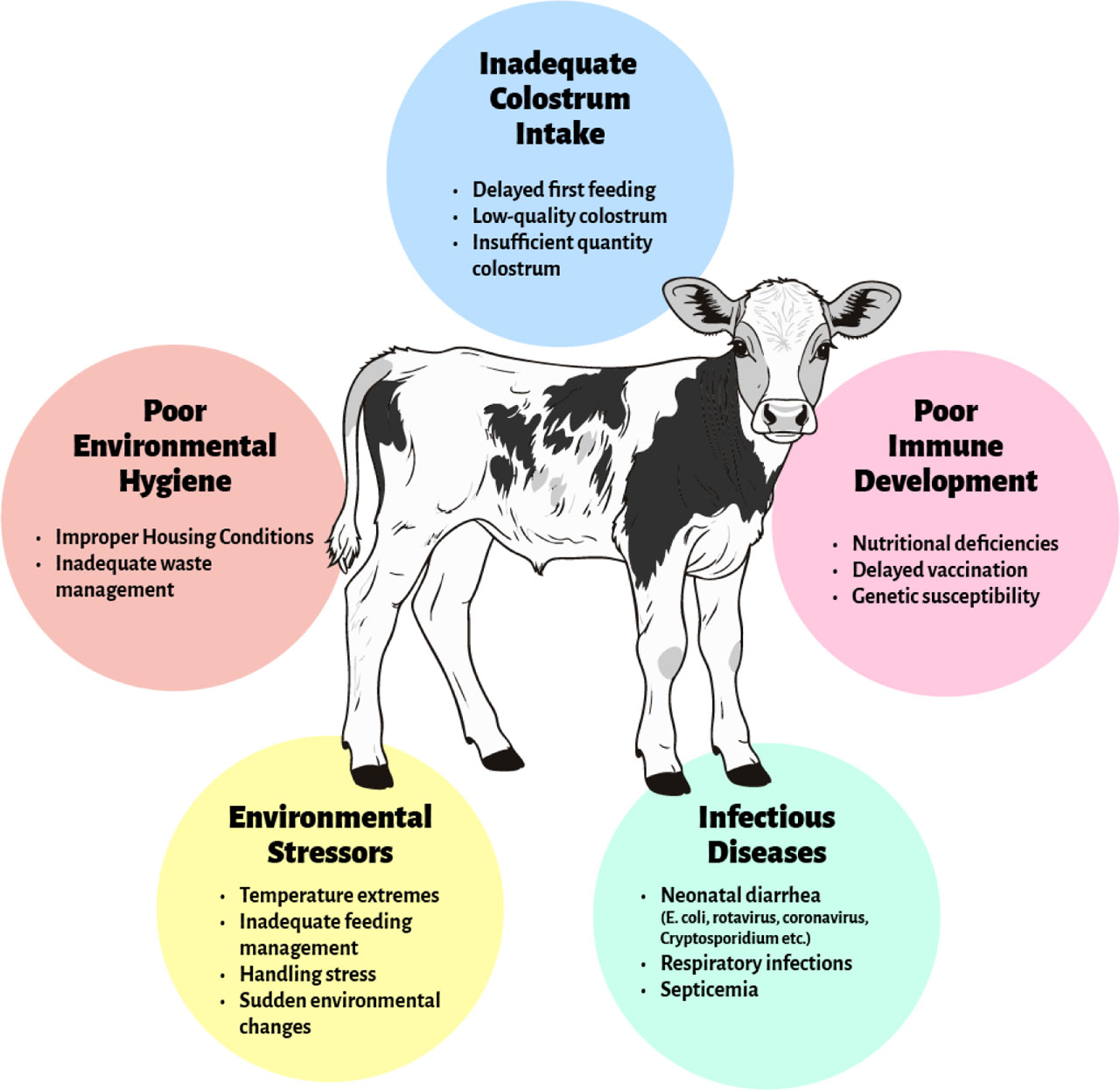
Figure 1.
Major risk factors for calves in early life.
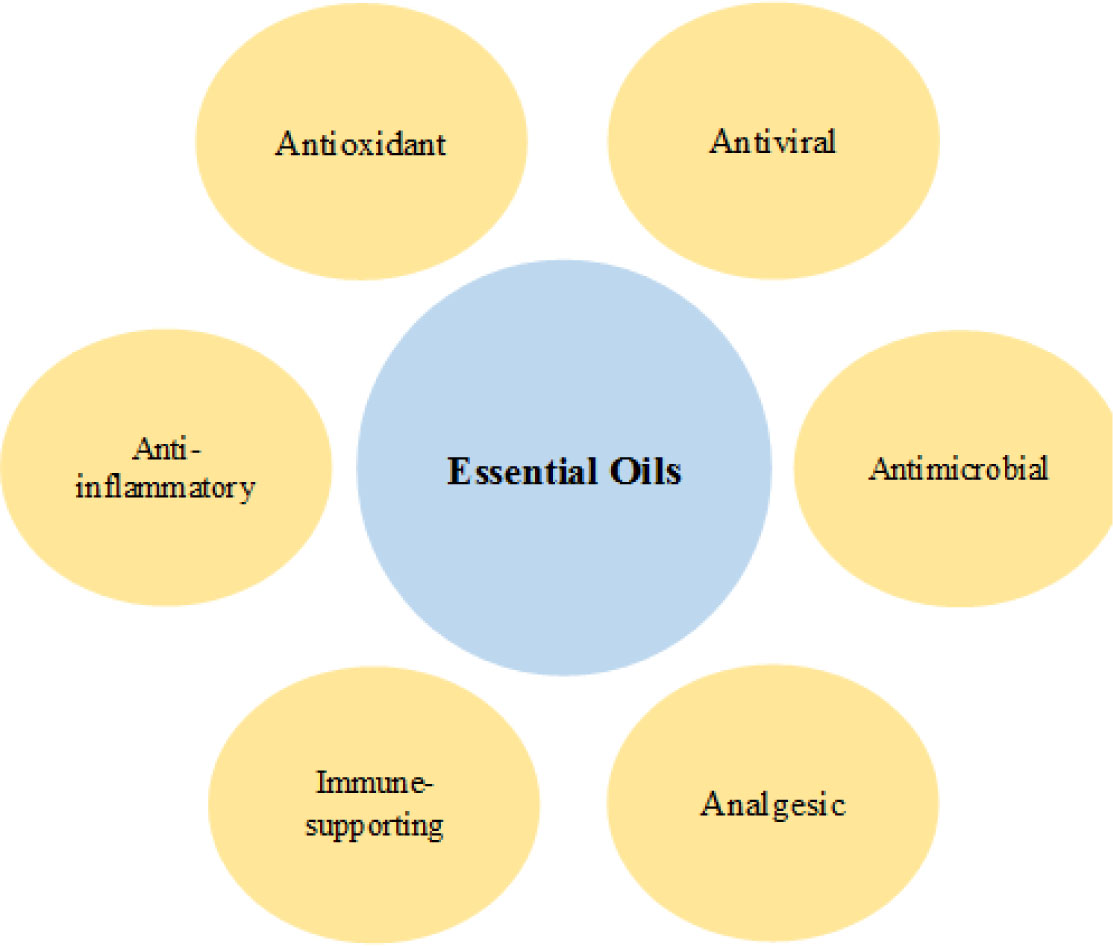
Figure 2.
Main therapeutic properties of essential oils.
Table 1.
Common essential oils and their main active compounds
| Essential oils | Source plants | Main compounds | Reference |
|---|---|---|---|
| Lavender oil | Lavandula angustifolia | Linalool, linalyl acetate, lavandulol, geraniol | Białoń et al. (2019) |
| Peppermint oil | Mentha × piperita | Menthol, menthone, limonene, 1,8-cineole, menthofuran | Beigi et al. (2018) |
| Tea tree oil | Melaleuca alternifolia | Terpinen-4-ol, γ-terpinene, α-terpinene, 1,8-cineole | Benchaar et al. (2007) |
| Eucalyptus oil | Eucalyptus globulus | 1,8-cineole, α-pinene, p-cymene, β-myrcene | Almas et al. (2021) |
| Lemon oil | Citrus limon | Limonene, β-pinene, γ-terpinene | Kačániová et al. (2024) |
| Thyme oil | Thymus vulgaris | Thymol, γ-terpinene, p-cymene, 1,8-cineole, γ-cadinene | Nguyen et al. (2024) |
| Rosemary oil | Rosmarinus officinalis | 1,8-cineole, α-pinene, camphor, verbenone | Verma et al. (2020) |
| Chamomile oil | Matricaria chamomilla | Bisabolol, chamazulene, coumarins, umbelliferone | Sharafzadeh and Alizadeh (2011) |
| Clove oil | Syzygium aromaticum | Eugenol, eugenyl acetate, β-caryophyllene, α-humulene | Haro-González et al. (2021) |
| Oregano oil | Origanum vulgare | Carvacrol, thymol, p-cymene, γ-terpinene | Zamuner et al. (2023) |
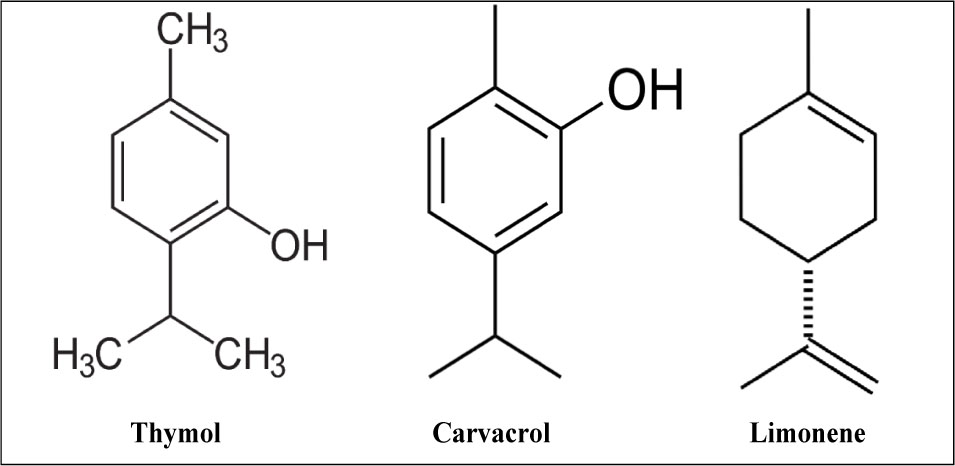
Figure 3.
Molecular structures of some of the most common compounds in essential oils.
Table 2.
Summary of studies on the effects of essential oils on calf immune system function
| Breed | N | Essential oil | Feeding period | Route | Dose | Outcomes | Reference |
|---|---|---|---|---|---|---|---|
| Holstein | 30 | Rosemary | 4–56 | MR | 500–2000 mg/d | IgG (+), Total protein (0) | Biyik et al. (2023) |
| Holstein | 36 | Blend of EO (coneflower, yarrow, peppermint, citrus) | 3–60 | Milk | 4–12 ml/d | IgG (0), Total protein (+), globulin (0) | Jahani-Azizabadi et al. (2022) |
| Holstein | 14 | Blend (anise, cinnamon, garlic, rosemary, and thyme) | 4–60 | MR | 1 g/d | Bas (0), Eos (−), Lym (0), Mon (0), Leu (0) | Campolina et al. (2021) |
| Holstein | 20 | Blend (peppermint, eucalyptus, menthol) | 1–28 | MR | 4 mL/d | Total protein (0), Eos (−) | Coelho et al. (2023) |
| Holstein | 24 | Attapulgite + oregano | 7–67 | Starter | 1000 g/1 t | IgG (0), IgM (0), IgA (0) | Li et al. (2024) |
| Holstein | 20 | Prebiotic + blend (carvacrol, caryophyllene, p-cymete, cineole, terpinene, thymol) | 3–70 | Starter | 44.1 ppm/d | IgG (+), IgM (+), IgA (+), Total protein (+) | Liu et al. (2020) |
| Holstein | 16 | Sage oil | 14–70 | Milk | 100–200 μL/d | IgG (+), IgE (0), IgM (0), IL-1β (−), IL-6 (−), TNF-α (−) | Kara and Pirci (2024) |
| Brown Swiss | 48 | Ajwain or thyme | 7–67 | Milk | 1–2 ml/d | Total protein (0) | Ebrahimi et al. (2018 b) |
| Holstein | 16 | Sage oil | 3–56 | Milk | 100–200 μL/d | IgG (0), IgM (0), IgA (+), TNF-α (−), IFN-ɣ (−) | Kara et al. (2025) |
| Holstein | 8 | Blend (cinnamon, oregano, and eucalyptus) | 10–60 | MR | 5 g/kg MR | IgA (+), Total protein (0), Globulin (0), Leu (−), Lym (−) | Nora et al. (2024) |
| Holstein | 75 | Blend (NA) | 14–70 | MR | 94,281 mg /d | Total protein (+), Globulin (+) | Soltan (2009) |
[i] EO: essential oil, MR: milk replacer, NA: not available, Ig: immunoglobulin, ml: milliliter, g: gram, mg: milligram, μL: microliter, t: ton, ppm: parts per million, lym: lymphocytes, leu: leukocytes, mon: monocytes, eos: eosinophils, bas: basophils, +: increased, −: decreased, 0: did not change.
Table 3.
Summary of studies on the effects of essential oils in diarrhea status of calves
| Breed | N | Essential oil | Feeding period | Route | Dose | Outcomes | Reference |
|---|---|---|---|---|---|---|---|
| Holstein | 20 | Blend (peppermint, eucalyptus, menthol) | 1–28 | MR | 4 mL/d | Fecal score (0) | Coelho et al. (2023) |
| Jersey | 15 | Green tea or oregano oil | 1–60 | N/A | 60 mg | Fecal score (0) | Heisler et al. (2020) |
| Holstein | 36 | Blend of EO (coneflower, yarrow, peppermint, citrus) | 3–60 | Milk | 4–12 ml/d/milk | Fecal score (−) | Jahani-Azizabadi et al. (2022) |
| Holstein × Gyr | 14 | Blend (anise, cinnamon, garlic, rosemary, and thyme) | 4–60 | MR | 1 g/d | Fecal score (0) | Campolina et al. (2021) |
| Holstein | 10 | Oregano | 3–53 | Top-dressed in starter | 60 mg/kg BW/d | Streptococcus (−), Escherichia (−) | Ritt et al. (2023) |
| Holstein | 30 | Blend (thyme, lavender, sage, caper) | 7–42 | Milk | 100–300 mg/d | Fecal E. coli (−), Lactobacillus (−) | Asghari et al. (2021) |
| Holstein | 20 | Prebiotic + blend (carvacrol, caryophyllene, p-cymete, cineole, terpinene, thymol) | 3–70 | Starter | 44.1 ppm/d | Fecal score (−) | Liu et al. (2020) |
| Holstein | 16 | Sage oil | 14–70 | Milk | 100–200 μL/d/MR | Fecal score (0) | Kara and Pirci (2024) |
| Holstein | 21 | Oregano | 4-W | MR | 893 mg/d | Fecal score (0) | Selvi and Tapki (2019) |
| Holstein | 48 | Attapulgite + oregano | 10 g/1000 g | Diarrhea rate (−) | Li et al. (2024) | ||
| Holstein | 18 | Oregano | 4-W | Milk | 100–150 mg/l | Fecal score (−) | Tapki et al. (2020) |
| Holstein | 24 | Mint or thyme | Birth – 2 weeks post-weaning | Starter | 0.2%/BW/d | Fecal score (0) | Ebrahimi et al. (2018 a) |
| Holstein | 46 | Oregano | 0–10 | Syringe-fed | 12.5 mg/kg BW/d | Fecal score (−), days with diarrhea (−) | Katsoulos et al. (2017) |
| Holstein | 23 | Oregano | 0–10 | Syringe-fed | 12.5 mg/kg BW/d | Fecal score (−) | Katsoulos et al. (2022) |
Table 4.
Summary of the studies on the effects of essential oils in average daily weight gain, feed intake and feed efficiency of calves
| Breed | N | Essential oil | Feeding period | Route | Dose | Outcomes | Reference |
|---|---|---|---|---|---|---|---|
| Holstein | 30 | Rosemary | 4–56 | MR | 500–2000 mg/d/MR | ADG (+), FE (+), FI (+) | Biyik et al. (2023) |
| Holstein | 36 | Blend (coneflower, yarrow, peppermint, citrus) | 3–60 | Milk | 4–12 ml/d/milk | ADG (0), FI (0) | Jahani-Azizabadi et al. (2022) |
| Holstein | 40 | Blend (peppermint, eucalyptus, menthol) | 1–28 | MR | 4 mL/d | ADG (0), FE (0), FI (+) | Coelho et al. (2023) |
| Holstein | 20 | Prebiotic + blend (carvacrol, caryophyllene, p-cymete, cineole, terpinene, thymol) | 3–70 | Starter | 44.1 ppm/d | ADG (+), FE (+), DMI (+) | Liu et al. (2020) |
| Holstein | 16 | Sage oil | 14–70 | Milk | 100–200 μL/d | ADG (+), DMI (+) | Kara and Pirci (2024) |
| Holstein× Gyr | 14 | Blend (anise, cinnamon, garlic, rosemary, thyme) | 4–60 | MR | 1 g/d | ADG (0), FE (0) | Campolina et al. (2021) |
| Holstein | 24 | Attapulgite + oregano | 7–67 | Starter | 1000 g/1 t | ADG (+), FCR (−) | Li et al. (2024) |
| Holstein | 8 | Blend (cinnamon, oregano, eucalyptus) | 10–60 | MR | 5 g/kg | ADG (+), FE (+) | Nora et al. (2024) |
| Holstein | 75 | Blend (NA) | 14–70 | MR | 94–281 mg /d | ADG (0) | Soltan (2009) |
| Holstein | 10 | Oregano | 3–53 | Top-dressed in starter | 60 mg/kg BW/day | ADG (0), FE (0), FI (0) | Ritt et al. (2023) |
| Jersey | 15 | Green tea or oregano oil | 1–60 | N/A | 60 mg/kg BW/day | ADG (0) | Heisler et al. (2020) |
| Brown Swiss | 48 | Ajwain or thyme | 7–67 | Milk | 1–2 ml/d | ADG (0), FCR (0), DMI (0) | Ebrahimi et al. (2018 b) |
| Holstein | 30 | Blend (thyme, lavender, sage, caper) | 7–42 | Milk | 100–300 mg/d | ADG (+), FCR (−) | Asghari et al. (2021) |
| Holstein | 21 | Oregano | 4–W | MR | 839 mg/d/MR | ADG (0), FE (0) | Selvi and Tapki (2019) |
| Holstein | 18 | Oregano | 4–W | Milk | 100–150 mg/l milk | ADG (+), FCR (0) | Tapki et al. (2020) |
| Holstein | 24 | Mint or thyme | 0–74 | Starter | 0.2%/BW/d | ADG (+), FE (+), DMI (+) | Ebrahimi et al. (2018 a) |
| Holstein | 20 | Blend (carvacrol, cinnamaldehyde, cineole, pepper) | B–56 | MR | 200–400 mg/kg BW/MR | ADG (0) | Santos et al. (2015) |
Table 5.
Summary of studies on the effects of essential oils on ruminal parameters of calves
| Breed | N | Essential oil | Feeding period | Route | Dose | Outcomes | Reference |
|---|---|---|---|---|---|---|---|
| Holstein | 20 | Blend (carvacrol, cinnamaldehyde, cineole, pepper) | B–56 | MR | 200–400 mg/kg BW/MR | AA (0), BA (0), PA (0) | Santos et al. (2015) |
| Holstein × Gyr | 14 | Blend (anise, cinnamon, garlic, rosemary, thyme) | 4–60 | MR | 1 g/d | AA (0), BA (0), PA (0), NH3-N (0) | Campolina et al. (2021) |
| Holstein | 20 | Prebiotic + blend (carvacrol, caryophyllene, p-cymete, cineole, terpinene, thymol) | 3–70 | Starter | 44.1 ppm/d | AA (+), BA (+), PA (+), IVA (0), TVFA (0), pH (0) | Liu et al. (2020) |
| Holstein × Gyr | 8 | Blend (anise, cinnamon, garlic, rosemary, thyme) | 4–60 | MR | 1 g/d | AA (0), BA (0), PA (0), NH3-N (0) | Campolina et al. (2023) |
| Holstein | 10 | Oregano | 3–53 | Top-dressed in starter | 60 mg/kg BW/d | AA (0), BA (0), PA (0), TVFA (0) | Ritt et al. (2023) |
| Holstein | 24 | Attapulgite + oregano | 7–67 | Starter | 1000 g/1 t | AA (0), BA (0), PA (0), VA (0), IVA (0), TVFA (0), pH (0) | Li et al. (2024) |
| Holstein | 30 | Rosemary | 4–56 | MR | 500–2000 mg/d/MR | AA (+), BA (0), PA (+), VA (+), IVA (+), TVFA (+), pH (0), NH3-N (−) | Biyik et al. (2023) |
| Holstein | 10 | Blend (carvacrol, caryophyllene, p-cymene, cineole, terpinene, thymol) | 3–42 | MR | 3.75 g/d/MR | AA (0), BA (0), PA (+), VA (+), IVA (+), TVFA (+) | Poudel et al. (2019) |
| Holstein | 36 | Blend (coneflower, yarrow, peppermint, citrus) | 3–60 | Milk | 4–12 ml/d/milk | AA (+), BA (0), PA (+), TVFA (0), NH3-N (−) | Jahani-Azizabadi et al. (2022) |
[i] EO: essential oil, MR: milk replacer, AA: acetic acid, BA: butyric acid, BW: body weight, PA: propionic acid, IVA: isovaleric acid, VA: valeric acid: TVFA: total volatile fatty acids, kg: kilogram, ml: milliliter, g: gram, t: ton, ppm: parts per million, mg: milligram, +: increased, −: decreased, 0: did not change.