
Shrimp farming has expanded rapidly worldwide, notably in tropical and subtropical areas where high-density rearing systems are employed (Das et al., 2022; Silva et al., 2025). However, this accelerated growth has also contributed to the pollution and degradation of aquatic ecosystems and the surrounding environments (Islam et al., 2023; Ali and Rahman, 2024). To ensure sustainable development and avoid negative environmental impacts, it is crucial to implement economically viable green technologies (Austin et al., 2022; Das et al., 2022; Emerenciano et al., 2025). Among the technologies adopted in recent years that have managed to both increase production and mitigate the damage caused by aquaculture is biofloc technology (BFT) (El-Sayed, 2021; Yu et al., 2023; Li et al., 2024 a). BFT works by utilizing ammonia generated within the system, which is then used by heterotrophic bacteria for their rapid growth (Xu et al., 2016; Minaz and Kubilay, 2021; Khanjani et al., 2025 a). For this process to develop optimally, it is essential to control the accumulation of ammonia by manipulating the carbon/nitrogen (C/N) ratio, which promotes the bacterial growth (Avnimelech, 1999; Khanjani et al., 2025 b). As a result, ammonium/ammonia is maintained at low and non-toxic concentrations in the water (Ebeling et al., 2006; Avnimelech, 2012). To achieve an adequate C/N ratio, the proportion of carbohydrates in the feed can be adjusted, or alternatively, an additional source of organic carbon can be added (Avnimelech, 1999; Khanjani et al., 2024 a). Carbon sources used to maintain the appropriate C/N ratio should be selected based on key commercial factors, including local availability, low cost, and standardized formulation or presentation (liquid, powder, or flour) (Ulloa et al., 2020; Popoola and Miracle, 2022; Hussien et al., 2025). It is essential that these sources are water-soluble and possess high bioavailability, as the rapid availability of carbon promotes efficient bacterial activity (Chakrapani et al., 2022; Oliveira et al., 2024). Therefore, sources rich in carbohydrates are preferred, with simple sugars (monosaccharides and disaccharides) being the most desirable due to their rapid release compared to more complex compounds (polysaccharides) (Serra et al., 2015; Wei et al., 2016; García-Ríos et al., 2019; Li et al., 2023; Mahadik et al., 2024). Furthermore, palatability and digestibility are important considerations, emphasizing the need for high carbon content (on average, above 30%) and a minimum concentration of nitrogen are essential (Ulloa et al., 2020). The application of different external carbon sources influences water quality in culture systems, as well as animal performance and the quality and composition of floc (Crab et al., 2010; Monroy-Dosta et al., 2013; Wei et al., 2016; Li et al., 2018; Ebrahimi et al., 2020; Luo et al., 2022; Abiri et al., 2022; Sharawy et al., 2022; Ajamhasani et al., 2023; Tasleem et al., 2024). Commonly used carbon sources often originate from industrial processes or are waste by-products (Emerenciano et al., 2013; Deng et al., 2018). Molasses, starch, and wheat flour are among the most frequently used carbon sources in various studies related to BFT (Dauda et al., 2017; Bakhshi et al., 2018; Khanjani et al., 2021, 2025 a; Rind et al., 2023; Hosain et al., 2024). At a commercial level, molasses and flours derived from edible plants are the most widely used due to their low cost and accessibility (Panigrahi et al., 2019; Ulloa et al., 2020; Oliveira et al., 2024). Identifying new, economical, and locally available carbon sources is essential for the development of BFT (Abbaszadeh et al., 2019; Elayaraja et al., 2020; Komara et al., 2022).
Aquaculture diversification, both in Chile and globally, is urgently needed, requiring not only an increase in the number of cultured species but also the implementation and adaptation of new production technologies (Wurmann and Routledge, 2017). Cryphiops caementarius, an endemic crustacean belonging to the Palaemonidae family, inhabits the rocky bottoms of fast-flowing rivers running through the valleys of the western slopes of the Andes to the sea, from the Lambayeque region in Peru (6º 30′ S, 79º 54′ W) southward through Peru and northern Chile, reaching as far as the Aconcagua River (32º 44′ S, 71º 30′ W) (Bahamonde and Vila, 1971; Jara et al., 2006; Meruane et al., 2006). This species is emerging as a viable option for aquaculture diversification, with significant biological, economic, and commercial importance in southern Peru and northern Chile (Campos et al., 2017; Moreno-Reyes et al., 2021).
Given the critical role of carbon sources in BFT, it is vital to understand their behavior during cultivation and evaluate their impact on floc dynamics and overall system performance. This study focuses on evaluating and comparing the effects of two carbon sources: molasses, a widely used industrial by-product, and chancaca, a locally available sugar derived from beets on the biofloc system. The research was conducted using the northern river shrimp C. caementarius. By characterizing the effects of each carbon source on water quality, floc properties, and shrimp growth, this study aims to provide valuable insights into optimizing BFT protocols and promoting sustainable aquaculture practices, particularly in resource limited regions.
Material and methods
Study location and animal origin
The experiment was conducted over a 142-day culture period at the Crustacean Laboratory of the Católica Universidad del Norte in Coquimbo, Chile (29° 57′S–71° 21′W). The juveniles used in this research originated from domesticated shrimp breeders naturally spawned in the laboratory. All animal procedures in this study were conducted in accordance with the guidelines for the care and use of the Crustacean Laboratory. The animal studies were reviewed and approved by the Scientific Ethics Committee of the Universidad Católica del Norte (UCN), Coquimbo, Chile.
Experimental design
The biofloc systems were produced according to the protocol described by Mendez et al. (2021), utilizing two carbon sources: liquid molasses (∼30% C) and chancaca (dextrose derived from sugar beets, ∼36% C). Carbon sources were supplied daily at a controlled dose in each experimental unit, consistently maintaining a C/N ratio of 15:1. This dosing was based on the recommendation by Avnimelech (2012), which states that 20 g of a carbon source are required to convert 1 g of TAN. The carbon sources were weighed, transferred to 1-L plastic containers, and thoroughly mixed with water from the culture tank. The resulting mixture was evenly distributed over the surface of the tank to promote biofloc development. Each carbon source was applied to three randomly distributed replicates. The systems consisted of rectangular tanks (107 × 63 × 45 cm) with a water volume of 150 L. A hydraulic aeration pipe was connected to a 2.5 HP blower (Sweetwater), and two rubber/polyethylene (Colorite Plastics) air diffusing hoses were placed in each of the rearing tanks. Culture water temperature was regulated using submersible 300-watt heaters (Whale VK-1000) set to maintain the temperature at 23±1°C. Ten shrimp were placed in each tank, with an average body weight of 24.28±0.44 g and a cephalothorax length of 14.42±0.56 mm. The organisms were acclimated to the temperature conditions one week prior to the start of the experiment. They were fed daily with a formulated trout feed at a 5% biomass. The nutritional composition of the diet consisted of 48.5% crude protein, 18.5% lipids, 1.9% fiber, 12% ash, and 10% moisture. In the control tank, 20% of the water was replaced daily with fresh water, whereas in the biofloc tanks, water loss only occurred through evaporation or the removal of solids.
Determination of water quality parameters
During the experimental period, dissolved oxygen (DO) and temperature were measured using a YSI 650 multiparameter instrument (YSI, Yellow Springs, OH, USA), while pH was measured with a pH meter (EZDO PP-203, Gondo Electric Co., Ltd., Taipei, Taiwan). Measurements were taken twice daily in all systems, at 9:00 am and 4:00 pm. Total ammonia as nitrogen (TAN), nitrate as nitrogen, nitrite as nitrogen, phosphorus, total suspended solids (TSS), floc volume (FV), total alkalinity and hardness were monitored weekly. The protocol used for TAN was method 8155 (salicylate method), nitrate method 8039 (cadmium reduction method), nitrite method 8507 (diazotization method) and phosphate method 8048 (ascorbic acid method) (Hach Company, 2003). Measurements were done using a DR 3900 spectrophotometer (HACH, Loveland, CO, USA). TSS was measured using the 2540D method described by the American Public Health Association (APHA, 2017). FV was measured on Imhoff cones (1000–0010 Vitlab, Grossostheim, Germany) following the methodology proposed by Avnimelech (2009). Total hardness was determined by the titration method with EDTA (Hach Company, 2015) and total alkalinity was determined by the bromophenol blue titration method, with the HI3811 alkalinity kit (Hanna Instruments, Smithfield, RI, USA).
Proximal composition of the biofloc
At the end of the experiment (142 days), biofloc samples were collected from each tank using a 40 μm mesh net. The proximate composition analysis, including moisture, protein, lipid, and ash content, was conducted following the methodology as stated by the Association of Official Analytical Chemists (AOAC, 2000). Moisture was measured by drying the samples at 55°C until reaching a constant weight. Ash content was determined by calcining the samples at 550°C. Crude protein was analyzed using the Kjeldahl method, while lipids were measured using the Folch method and crude fiber was determined using the Weende method. Nitrogen free extract (NFE) was measured as follows: NFE (%) in dry matter = 100 − (total ash % + crude protein % + crude lipid % + crude fiber %) in accordance with Anand et al. (2014). The gross energy content of the flocs was calculated using kJ·g−1 DW values of 23.0, 38.1 and 17.2 for protein, lipids and carbohydrates, respectively (Tacon, 1990).
Total bacterial count in the cultures
Total bacterial and Vibrio counts in all experimental water samples were assessed at the end of the culture period. Water samples were collected in sterile polypropylene bottles directly from the respective experimental tanks and stored at 4°C until analysis. Thiosulfate-citrate-bile salts-sucrose (TCBS) agar and Plate Count Agar (PCA) (Difco) were used for Vibrio and total bacterial counts, respectively, following the method outlined by Panigrahi et al. (2017). Freshly collected water samples were serially diluted, spread onto the appropriate media plates, and incubated at 18°C for 24–48 hours. The colonies were then counted and reported as colony-forming units (CFU mL−1).
Determination of zooplanktonic and phytoplanktonic communities
1000 mL of water samples were collected from the nine tanks and filtered through a 40 µm mesh. Each concentrated sample was preserved in 50 mL plastic bottles with a 5% formalin solution. The preserved samples were labeled and stored according to the protocol described by Azim et al. (2003). For quantification, a Sedgwick-Rafter chamber was used along with a light microscope (Carl Zeiss, Primo Star, Oberkochen, Germany), with objectives ranging from 10× to 40×. The identification of species and groups of plankton was conducted through photographs taken with a Canon E05 Rebel T5 camera (Canon U.S.A., Inc. Melville, New York, USA) using the taxonomic keys from Parra and Bicudo (1996), and Parra (1998). With the data obtained, the concentration of microalgae per milliliter was determined for each of the culture tanks. To identify organisms such as ciliates, rotifers, cladocerans, and nematodes, five samples of 5 mL were taken from the nine culture tanks, which were fixed with 5% formalin. Each sample was observed and counted directly. The taxonomic identification of the observed groups was conducted at the genus level, using specialized literature (Streble and Krauter, 1987; Smirnov, 1996; Aladro-Lubel, 2009).
Bioflocs size distribution
To determine biofloc size, a 1-L sample was collected in triplicate from each tank on day 142 of the culture period. Each sample was sieved through a series of screens with varying mesh openings, ranging from 500 μm to 1.2 μm, following the methodology described by Cripps (1995) and Cripps and Bergheim (2000). Subsequently, pipettes were used to transfer the solids retained on each sieve onto GF/C filter paper of 1.2 μm, which was then filtered using a vacuum pump (model 1.25 HP R-300 BOECO, Boeckel + Co (GmbH + Co), Hamburg, Germany). The filters were dried in an oven (Binder ED115 BINDER GmbH, Tuttlingen, Germany) at 105°C for 24 hours to obtain the dry weight of the particles, in accordance with method 2540-D for total suspended solids (APHA, 2017). For weighing, an analytical scale (BAS 31 Plus BOECO, Boeckel + Co (GmbH + Co), Hamburg, Germany) with a precision of 0.0001 g was used. The results were expressed as the percentage of floc retained on each of the sieves used.
Zootechnical performance
Biometric measurements were conducted monthly throughout the study to monitor shrimp growth under each treatment throughout the study, using a digital scale with precision to two decimal places (Mettler PJ3600 Delta Range, Mettler Toledo GmbH, Greifensee, Switzerland). Excess moisture was removed from each shrimp using paper prior to weighing. The average weight was calculated, and the amount of feed supplied was adjusted accordingly. Upon completion of the experiment, the following performance parameters were evaluated:
where TW1 and TW2 are total weight at days T1 (start of the experiment) and T2 (after 142 days);Statistical analysis
All data reported were expressed as means with standard deviations. Data analysis was conducted using one-way ANOVA after confirming normality (Shapiro-Wilk test) and homogeneity of variance (Fligner-Killeen test). The shrimp survival data were transformed into arcsine form for analysis. Significant differences were considered at P<0.05 (Sokal and Rohlf, 1969). When significant differences were detected, Tukey’s test was employed to identify differences among treatments. Analyses were performed using the free software package RStudio, Inc. (Version 1.1.442) (R Core Team, 2018).
Results
Water quality parameters
The physical and chemical parameters of water quality monitored throughout the experiment are presented in Table 1. The mean values of temperature (<25°C), dissolved oxygen (>8 mg L−1), and pH (>7.7) were comparable across all treatments, with no statistically significant differences present (P>0.05). However, TAN, NO2, NO3, PO4−3, hardness, alkalinity, FV and TSS had significant differences (P<0.05). The BFT (molasses) treatment had the lowest concentrations of TAN (0.27±0.15 mg L−1) and NO2-N (0.33±0.22 mg L−1). However, it had the highest concentrations of NO3-N (112.84±20.56 mg L−1), PO4−3 (4.34±2.86 mg L−1), hardness (1,068.67±244.68 mg CaCO3 L−1), alkalinity (255.06±38.6 mg CaCO3 L−1), floc volume (26.75±12.5 mL L−1) and total suspended solids (287.15±37.85 mg L−1).
Table 1.
Water quality parameters
| Water quality parameters | Molasses | Chancaca | Control |
|---|---|---|---|
| Temperature (°C) am | 22.5±0.89 | 22.7±0.91 | 22.7±0.91 |
| Temperature (°C) pm | 23.7±1.11 | 24.0±0.90 | 24.1±1.09 |
| Dissolved oxygen (mg L−1) am | 8.08±0.25 | 8.08±0.30 | 8.08±0.26 |
| Dissolved oxygen (mg L−1) pm | 7.83±0.22 | 7.80±0.35 | 7.87±0.21 |
| pH | 8.69±0.20 | 8.80±0.12 | 8.54±0.21 |
| TAN (NH3-N mg L−1) | 0.27±0.15 b | 0.62±0.19 a | 0.28±0.65 b |
| Nitrite-N (NO2 mg L−1) | 0.33±0.22 c | 0.70±0.15 b | 0.94±0.71 a |
| Nitrate-N (NO3 mg L−1) | 62.84±10.56 a | 26.39±11.59 b | 50.73±33.89 a |
| Phosphorus (PO4−3 mg L−1) | 4.34±2.86 a | 1.48±1.22 b | 3.98±3.26 a |
| Total hardness (mg CaCO3 L−1) | 1068.67±244.68 a | 936.67±130.33 a | 740.33±159.67 b |
| Total alkalinity (mg CaCO3 L−1) | 255.06±38.63 a | 205.33±39.91 b | 156.33±43.01 c |
| FV (mL L−1) | 26.75±12.51 a | 15.27±8.12 b | 1.87±2.16 c |
| TSS (mg L−1) | 287.15±37.85 a | 214.20±39.97 b | 102.14±15.07 c |
Proximate analysis of different bioflocs
The proximate analysis of the different types of bioflocs is shown in Table 2. No significant differences were found between the two carbon sources in terms of the levels of crude protein, lipids, and moisture (P>0.05). However, differences were observed in the amounts of fiber and nitrogen-free extract (NFE) (P<0.05). Overall, both bioflocs appear to be rich in protein, NFE, and lipids.
Table 2.
Chemical composition of bioflocs generated with two carbon sources
| Carbon source | Protein (%) | Lipids (%) | Fiber (%) | Ash (%) | Humidity (%) | NFE (%) | Gross energy (kJ·g−1) |
|---|---|---|---|---|---|---|---|
| Chancaca | 31.20±1.71 | 4.53±1.86 | 11.17±2.19 a | 38.97±6.81 | 92.53±1.64 | 14.13±9.43 b | 1133.41±125.01 |
| Molasses | 29.57±2.32 | 4.87±2.04 | 8.70±4.56 b | 38.23±3.12 | 91.43±2.24 | 18.63±9.96 a | 1185.95±93.02 |
Total microorganisms present
Total microorganism counts are presented in Tables 3 and 4. Bioflocs cultured with different carbon sources exhibited similar composition; including unicellular algae, bacterial communities, protozoa, rotifers, and other microorganisms. However, the abundance of these organisms varied among the three culture systems. Total bacterial counts (3.51 and 2.37 × 10⁵ CFU mL−1) were significantly (P<0.05) higher in molasses and chancaca groups compared to the control group (1.66×10⁵ CFU mL−1). Notably, Vibrio spp. were not detected in any of the three culture systems. In the systems with molasses, a lower quantity of microalgae and, generally, a greater quantity of zooplankton were found compared to the systems using chancaca.
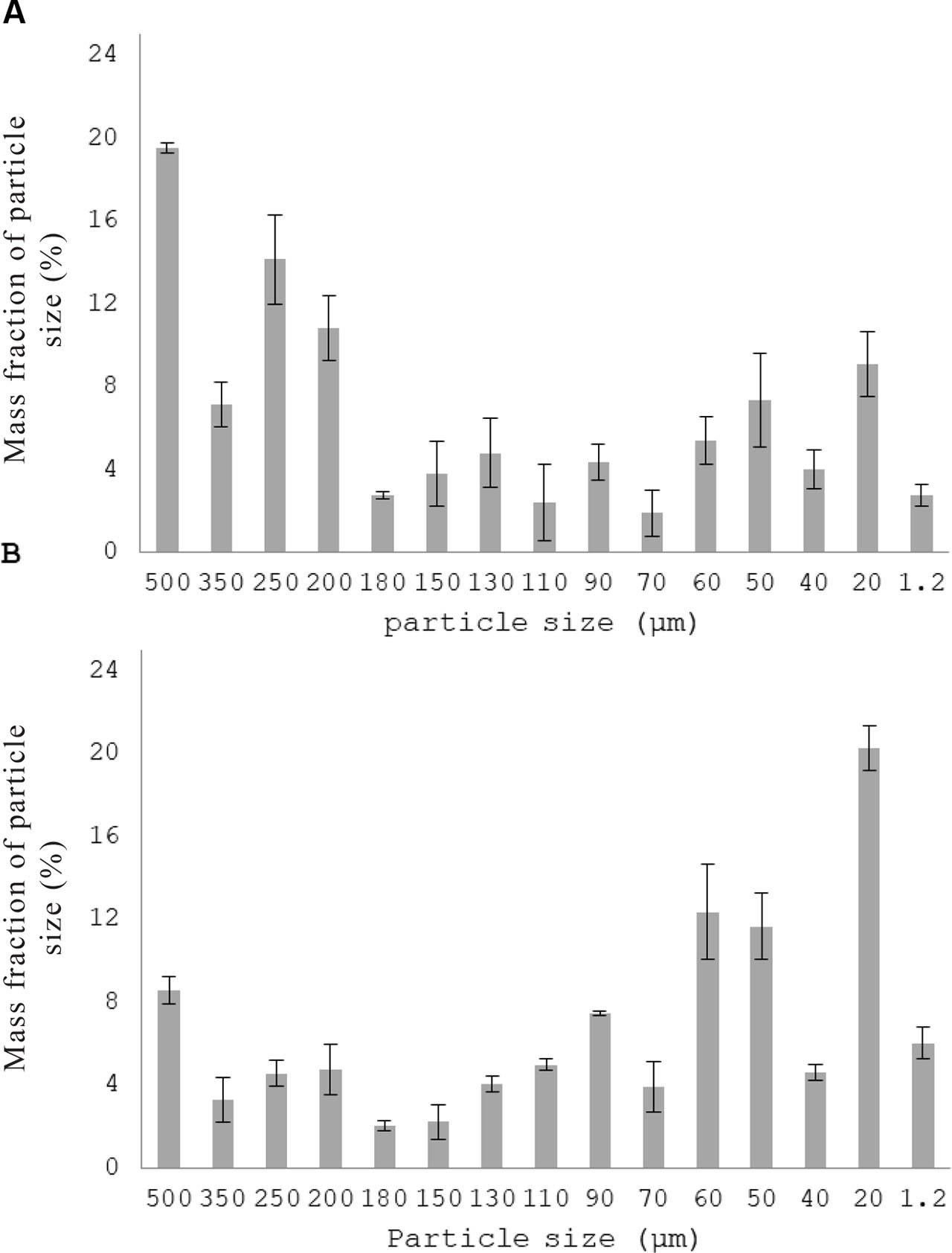
Figure 1.
Particle size distribution: a fractional mass percentage of biofloc sampled. A. Chancaca carbon source; B. Molasses carbon source. Bars represent standard deviation
Table 3.
Total microorganism abundances in biofloc systems using different carbon sources after 142 days of rearing Cryphiops caementarius
| Microorganism composition | Molasses | Chancaca | Control |
|---|---|---|---|
| Total bacteria (CFU×105 mL−1) | 3.51±1.38 a | 2.37±0.65 b | 1.66±0.39 c |
| Vibrio spp. (CFU×105 L−1) | 0.00±0.00 | 0.00±0.00 | 0.00±0.00 |
| Chlorophyceae (cell mL−1) | 430.33±88.79 b | 581.33±71.06 a | 64.01±18.52 c |
| Bacillariophyceae (cell mL−1) | 119.11±15.37 b | 156.66±15.61 a | 5.19±3.36 c |
| Cyanophyceae (cell mL−1) | 92.33±28.38 b | 125.66±24.99 a | 0.00±0.00 b |
| Rotifer (ind. L−1) | 58.67±23.45 a | 41.00±19.05 b | 4.00±3,61 c |
| Cladocera (ind. L−1) | 42.12±12.74 a | 30.33±17.31 b | 0.00±0.00 b |
| Annelids (ind. L−1) | 3.30±1.43 a | 3.33±1.52 a | 0.00±0.00 b |
| Nematode (ind. L−1) | 2.00±1.21 b | 10.33±1.41 a | 0.00±0.00 c |
| Copepod (ind. L−1) | 1.45±1.42 a | 2.00±1.73 a | 0.00±0.00 b |
| Ciliates (ind. L−1) | 134.67±61.59 a | 46.00±26.52 b | 15.00±7.93 c |
Table 4.
Taxonomic composition of plankton communities in biofloc systems with different carbon sources following culturing after 142 days of rearing of Cryphiops caementarius
| Microorganism composition | Molasses | Chancaca | Control |
|---|---|---|---|
| Bacillariophycea | |||
| Synedra sp. | + | + | + |
| Navicula sp. | + | + | + |
| Nitzchia sp. | + | + | + |
| Chlorophyceae | |||
| Palmella sp. | + | + | + |
| Chlorella sp. | + | + | + |
| Scenesdesmus sp. | + | + | + |
| Cyanophyceae | |||
| morphotype 1 | + | + | + |
| Rotifer | |||
| Philodina sp. | + | + | + |
| Lecane sp. | + | + | + |
| Cephalodella sp. | + | + | + |
| Cladocera | |||
| Chydorus sp. | + | + | − |
| Nematode | |||
| Monhytera sp. | + | + | − |
| Annelid | |||
| Aelosoma sp. | − | + | − |
| Copepod | − | + | |
| Cyclops sp. | + | + | − |
| Amoeba | |||
| Amoeba sp. | + | − | − |
| Ciliates | |||
| Paramecio sp. | + | + | + |
| Coleps sp. | + | + | + |
| Vorticella sp. | + | + | + |
| Halteria sp. | + | + | + |
Biofloc size composition
The size distribution of the bioflocs generated by each carbon source is shown in Figure 1. Significant differences exist in the size distribution percentages among the applied treatments (P<0.05). In the chancaca treatment, sizes predominantly ranged between 500 and 200 μm with values of 51.56%, while the predominant size range in the molasses treatment was from 60 to 1.2 μm at 54.82%. The predominant size for the chancaca treatment was 500 μm, whereas in the molasses treatment, it was 20 μm.
Zootechnical performance analysis
The growth parameters observed across the different treatment groups are presented in Table 3. Significant differences (P<0.05) were found at the end of the experiment in specific growth rate (SGR) and final weight (FW) between treatments. However, no significant differences (P>0.05) were found in the survival percentage values among the treatments. The feed conversion ratio (FCR) could not be determined due to the low survival rate observed in the cultivation systems.
Table 5.
Zootechnical variables of Cryphiops caementarius reared using biofloc technology (BFT) with different carbon sources during the 142 days of the experiment
| Parameters | Treatments | ||
|---|---|---|---|
| molasses | chancaca | control | |
| Initial mean weight (g) | 24.58±3.15 | 24.58±3.15 | 24.58±3.15 |
| Final mean weight (g) | 25.26±6.80 b | 29.80±4.36 a | 29.68±5.26 a |
| Specific growth rate (% day−1) | 0.74±0.12 b | 0.89±0.15 a | 0.89±0.21 a |
| Survival (%) | 33.33±6.12 | 23.33±5.77 | 23.33±5.77 |
Discussion
Water quality parameters
All water quality parameters met the conditions suitable for shrimp growth and biofloc cultivation (Reyes-Avalos, 2016; Escobar et al., 2017; Mendez et al., 2021; Mogollon-Calderon and Reyes-Avalos, 2021; Luo et al., 2023). The oxygen levels were above the recommended values for aquatic organisms and for biofloc systems (Crab et al., 2012; Khanjani et al., 2024 a). It was observed that TAN levels were lower with molasses treatments, as described by other authors, who suggest that this carbohydrate helps control ammonia levels due to its rapid dissolution rate, which promotes the growth of heterotrophic bacteria (Serra et al., 2015; Panigrahi et al., 2019). The levels of TAN, nitrite, nitrate and phosphate remained within the safe ranges for the cultivation of penaeids (Lin and Chen, 2003; Kuhn et al., 2010; Furtado et al., 2015; Samocha et al., 2017). Therefore, carbon sources can generate differences in the pathways of nitrate removal in bioflocs, thereby affecting the efficiency of phosphate removal (Li et al., 2024 b, c). This may explain the variation in phosphorus and nitrogenous compounds. Furthermore, it has been described that in BFT systems, these compounds tend to accumulate (Cao et al., 2020; Das et al., 2022).
Total alkalinity and total hardness are key variables that influence the productivity of aquatic ecosystems and aquaculture (Boyd et al., 2016). In our study, alkalinity levels remained above the recommended minimum of 100 mg CaCO3 L−1, which is considered adequate both for shrimp farming and for supporting the nitrification processes essential to BFT systems (Furtado et al., 2014; Velásquez et al., 2023). Hardness is the concentration of divalent ions, mainly calcium and magnesium, which are key components of the exoskeleton in shrimp (Gonzalez-Vera et al., 2017). It has been described that when hardness is very low, the process of exoskeleton hardening is prolonged (Tavabe et al., 2015). In a study conducted on male C. caementarius shrimp, it was observed that hardness values of 100 and 400 mg CaCO3 L−1 had no effect on survival (Graciano León et al., 2022). Although our values exceeded those typically recommended for the species, the hardness levels are influenced by the hydrographic conditions of northern Chile. In another study conducted with BFT in the nursery and grow-out phases of L. vannamei, with groundwater hardness levels ranging from 923.8 to 4204.2 mg CaCO3 L−1, survival and growth performance were not affected. A key finding was that the Mg/Ca ratio played a more critical role (Al-Subiai et al., 2025). The differences in alkalinity and hardness between molasses and chancaca treatments, may be primarily attributed to the composition of the carbon sources, as sugarcane molasses contains substantial amounts of sodium (Na), potassium (K), magnesium (Mg), and sulfate (SO4). Reported concentrations of these elements range approximately from 0.09% to 9% for Na, 4% to 50.83% for K, 1% to 14% for Mg, and 2.24% to 9.91% for SO4 (Jamir et al., 2021). In beet molasses, calcium is lower, while potassium and sodium are higher, reaching up to 3.6% and 1.4%, respectively (Bakar et al., 2024). The values of total suspended solids (TSS) and biofloc volume (FV) in BFT systems remained within the optimal ranges for shrimp farming (less than 800 mg L−1 and 30 mL L−1, respectively) (Schveitzer et al., 2013; Xu et al., 2016). The differences in the amount of TSS and FV between carbon sources may be attributed to the fact that the amount of feed and the feeding strategy modulate the level of TSS in the BFT system (da Silva et al., 2020). Another possible explanation is that the NO3 present in the systems with molasses stimulates biofloc growth, given that the higher the concentration of NO3 in the water, the greater the biofloc growth (Tarigan et al., 2025). Controlling FV and TSS in BFT systems is crucial, as they can lead to increased oxygen demand by the microbiota and a significant rise in operational costs (Sun et al., 2024). Currently, no studies have yet been conducted to determine the appropriate concentrations of TSS and FV for the cultivation of C. caementarius, as these values may vary between shrimp species (Copetti et al., 2021).
Proximal composition of the biofloc
With respect to bioflocs composition, it has been described that differences in the proximate composition can occur due to the C/N ratio and the source of carbohydrate used (Crab et al., 2009; Zhao et al. 2016; Soliman and Abdel-Tawwab, 2022; Oliveira et al., 2024). It is noteworthy to add that the flocs have exhibited a high moisture content, ranging from 90% to 99% (Gallardo-Collí et al., 2024). In general, the nutritional composition of the biofloc is characterized by high levels of crude protein, ranging from 14% to 50%, accompanied by lower levels of carbohydrates and lipids, varying from 0.5% to 15% (Martínez-Córdova et al., 2015; Li et al., 2024 a). In our study, the values of protein, lipids, and moisture content fell within these previously reported ranges. Only fiber and nitrogen-free extract (NFE) content showed notable variation. These differences could be attributed to the composition of the microorganisms present in the biofloc (Table 3), such as bacteria, chlorophytes, and diatoms (Said et al., 2024; Wang et al., 2025).These characteristics suggest that bioflocs may serve as a high-quality feed in situ, available 24 hours a day (Avnimelech, 2007; Khanjani and Sharifinia, 2024). Additionally, bioflocs could be harvested and incorporated as a feed component in aquaculture diets for various animals (Bauer et al., 2012; Promthale et al., 2019; Sharawy et al., 2022). The use of bioflocs as an animal feed has been reported for shrimp, including C. caementarius (Torres-Lagos et al., 2024; Wang et al., 2025). Bioflocs contribute essential nutrients, including amino acids, vitamins, polysaccharides, phytosterols, and minerals (Khanjani et al., 2023 a, b). However, their nutritional benefit depends on several factors, including the ontogenic stage of the target species, the nutritional quality of the biofloc, and particle size, among others (Decamp et al., 2002; Cardona et al., 2015; Suita et al., 2016).
Microbial community
The microbial community is a key component playing a crucial role in the biofloc system and in the fluctuations of nitrogen metabolites in the water (Ray et al., 2012; Khanjani et al., 2022; Pereira et al., 2024). As observed in our study and as described in previous research, bioflocs are partly formed by a wide range of microorganisms, including heterotrophic and chemoautotrophic bacteria, cyanobacteria, archaea, viruses, microalgae, yeasts and fungi. In addition, bioflocs can host or be inhabited by free-swimming invertebrates such as rotifers, copepods, protozoa, cladocerans, amoebae, ostracods, nematodes and annelids (Ray et al., 2010; Emerenciano et al., 2017; Becerril-Cortes et al., 2018; Raza et al., 2024 a). The microbial composition in the biofloc systems is influenced by the species present in the culture environment, such as in the tank, water, and air, as well as by the microorganisms associated with the cultivated species, which are found in the intestines, skin, gills, and mouth (Khanjani et al., 2022; Ghosh et al., 2024). Additionally, it has been noted that the type of carbon source can stimulate certain bacteria, protozoa, and algae, thereby influencing both the microbial composition and the structure of the biofloc community (Crab et al., 2009; Wei et al., 2016; Guo et al., 2024). Furthermore, size and amount of biofloc could generate differences in the composition of microbial communities by providing diverse micro-scale niches that promote their abundance, diversity, and structure (Wei et al., 2020 a; Hosain et al., 2025). The absence of Vibrio spp. in BFT systems may be due to the competition between the microorganisms within the system and the pathogenic bacteria, effectively inhibiting their proliferation (Luis-Villaseñor et al., 2015; Kumar et al., 2021). Biofloc systems have been reported to contain a higher number of beneficial heterotrophic bacteria, such as Bacillus, Sphingomonas, Acinetobacter, Micrococcus, Nitrosomonas, Rhodopseudomonas, Nitrospira, Pseudomonas, Nitrobacter, and Cellulomonas (Raza et al., 2024 b). In C. caementarius cultured under BFT conditions, it has been described that the dominant groups of potentially beneficial bacteria at the phylum level are Planctomycetota (50–57%) and Proteobacteria (27–34%) (Torres-Lagos et al., 2024). Additionally, the total bacterial count is lower in traditional systems without an added carbon source compared to BFT groups, which is consistent with the findings of our study (Soliman and Abdel-Tawwab, 2022). Among the microalgae, Chlorophyta was the most prevalent and abundant group, while among the zooplankton groups, rotifers and ciliates were the most dominant, which aligns with findings from other BFT studies (Monroy-Dosta et al., 2013; Becerril-Cortes et al., 2018; Khanjani et al., 2022; Maciel de Lima et al., 2022; Ma et al., 2025). In general, differences were observed between the groups with the two carbon sources, supporting what has been described by other authors, who indicate that the microbial density and diversity in BFT depend on the carbon source employed (Wei et al., 2020 b; Hosain et al., 2021; Helal et al., 2024; Mahadik et al., 2024).
Biofloc size composition
Our results correlate with previous descriptions of biofloc particles, which typically exhibit a broad size range, from 50 μm to 1000 μm, and are generally irregular in shape (Chu and Lee, 2004; De Schryver et al., 2008). Biofloc is a heterogeneous system and its composition may alter in terms of size and structure given different parameters such as size and species of cultured organisms, feeding methods, aeration intensity, hydraulic condition of the culture tank, management protocols, environmental, temporal and spatial factors (McMillan et al., 2003; De Schryver et al., 2008; Ray et al., 2009; Emerenciano et al., 2011; Ali, 2013). The differences observed in particle size ranges between the two carbon sources studied may be attributed to the irregular nature of biofloc particles, which tend to aggregate with other particles (Becke et al., 2020). Furthermore, biofloccules may be bound together by bacterial secretions and electrochemical forces (Tierney and Ray, 2018). It is important to highlight that aeration in all two rearing systems was consistent and continuous, minimizing turbulence to avoid disrupting the particles, as high turbulence has been shown to break bioflocs into smaller particles, potentially resulting in an accumulation of smaller particles in the culture system (Rusten et al., 2006; Fernandes et al., 2017). In our study, the variety in biofloc sizes could explain the differences in nitrogen oxidation processes, as size can increase the surface area for bacterial growth (Mansour and Esteban, 2017). It has been observed that increasing the surface area of the bioflocs promotes greater bacterial growth, which in turn improves water quality and provides greater feed availability (Caldini et al., 2015; Ferreira et al., 2016; Pedersen et al., 2017; Becke et al., 2019). Among all groups, the molasses treatment exhibited the highest proportion of small-sized bioflocs (from 1.2 to 60 μm). Our results corroborate those of Ekasari et al. (2016), in which molasses led to the predominance of smaller biofloc sizes (<48 μm), accounting for 44.8% of the total biofloc volume. It has been described that controlling smaller bioflocs is essential, as they often harbor higher concentrations of opportunistic pathogens, such as Vibrio spp., which can compromise the health of cultured organisms (Zhu et al., 2025). Although in our research, Vibrio spp. was not detected. Additionally, small bioflocs can negatively impact production indices and may even lead to shrimp mortality (Huang et al., 2022 a). The effect of smaller biofloc particles on production indices in C. caementarius is yet to be determined. In general, it is important to emphasize that determining the size distribution of bioflocs can aid in optimizing system designs for the effective removal of excess biofloc (Mendez et al., 2025).
Zootechnical performance
In the BFT treatments, it was expected that the production indices would be higher than those found in conventional systems, such as survival and specific growth rate, as there would be more food available 24 hours a day (Xu et al., 2012; Baloi et al., 2013; Rajkumar et al., 2016; Anand et al., 2017; Chan-Vivas et al., 2019; Tinh et al., 2021; Khanjani and Alizadeh, 2024; Suneetha et al., 2024). However, this expectation was not confirmed and may be attributed to the territorial behavior of this species, causing higher competition for food in high-density systems, regardless of the amount of food supplied (Meruane et al., 2006; Mendez et al., 2024). This study concurs with findings from other species, such as juveniles of M. rosenbergii, which showed no significant differences in survival and growth rates (Ballester et al., 2017), including other crustacean species F. paulensis (Emerenciano et al., 2007), P. semisulcatus (Kaya et al., 2020) and Cherax cainii, which are territorial species (Nguyen et al., 2024). The survival rate of C. caementarius observed in this study was comparable to that of a previous study (Méndez et al., 2024), which indicates that C. caementarius is a species with cannibalistic and territorial behavior. Moreover, the species exhibits various social mechanisms, such as aggressive interactions and established social hierarchies. A possible solution to improve production indices is the use of substrates, which can offer protection for the organisms individually, thus preventing cannibalism. Furthermore, it is recommended to reduce stocking density and ensure proper feeding (Romano and Zeng, 2007; Kelly et al., 2023). Regarding the feed conversion ratio (FCR), referred to as “apparent” efficiency, it has been reported that BFT systems show lower FCR values compared to traditional clear water systems (Hussain et al., 2021). Due to the low survival rate observed in the cultivation systems, the FCR could not be determined. However, the FCR holds more practical than biological significance, as it was not possible to monitor the actual feed intake in the biofloc tanks, nor to directly assess the impact of cannibalism and biofloc consumption (Tacon et al., 2002).
Water is an increasingly critical resource globally, especially in arid regions such as northern Chile. It has been shown that BFT can achieve up to 90% water savings compared to traditional systems (Ridha et al., 2020; Huang et al., 2022 b; Garcés and Lara, 2023). Furthermore, BFT systems are well suited to water-restricted regions, as they significantly reduce water demand, potentially making them an ideal technology for aquaculture in water-scarce areas (Khanjani et al., 2024 b). In the present study on freshwater shrimp C. caementarius farming, water usage was reduced by 89% compared to traditional systems. These results demonstrate that the BFT system represents a sustainable alternative to traditional aquaculture, conserving water while maintaining water quality at levels suitable for shrimp cultivation.
In conclusion, incorporating carbon sources such as molasses and chancaca into BFT systems for C. caementarius cultivation represents a promising alternative, as they enhance water quality by maintaining optimal conditions for cultivation while simultaneously promoting microbial diversity. Furthermore, the BFT system proved to be efficient in water management and conservation, underscoring its potential as an environmentally sustainable technology, particularly well-suited for the arid regions of Chile. Nevertheless, further research is needed to optimize the application of molasses and chancaca within BFT systems.
Acknowledgments
This work and publication were developed with the support of the project FONDEF ID15I10353. We express our sincere gratitude to the research staff of the Crustaceans Laboratory of the Universidad Católica del Norte.
Notes
[10] CRediT authorship contribution statement
Carlos A. Mendez: conceptualization, data curation, formal analysis, investigation, methodology, writing – original draft, writing, review & editing. Jorge Moreno: conceptualization, methodology, formal analysis, investigation, writing, review & editing. Carla Galleguillos: data curation, formal analysis, review & editing. Maria Cristina Morales: project administration, funding acquisition, review & editing. All authors have read and agreed to the published version of the manuscript.