
The growing demand for foods of animal origin (Colgrave et al., 2021) and current challenges that face livestock such as rangeland degradation, water scarcity, competition for land with crops and urban development, food–feed competition, and global warming have left livestock farmers and scientist to find alternatives (Moran and Blair, 2021).
For livestock production profitability, it is essential to reduce feeding costs. However, the shortage and cost of concentrates are significant challenges faced by animal nutritionists (Sultana, 2020; Valdivié-Navarro et al., 2020). Industrial by-products or marginalized legumes and cereals have been used as feeding alternatives for livestock (Correddu et al., 2020; Kholif et al., 2021; Boukrouh et al., 2024). Utilizing unconventional feed alternatives such as tree leaves (e.g., M. oleifera) can help address this issue (Saadaoui et al., 2021; Abdoun et al., 2024). In low-income countries, tree leaves serve as vital feed sources for smallholder farmers.
M. oleifera is a tree found in tropical and subtropical regions that can thrive under various soil conditions (Sultana, 2020) and is available year-round. The leaves and soft twigs contain approximately 90% organic matter (OM), 29% crude protein (CP), about 10% fatty acids, mainly α-linolenic acid, and 10% fiber. M. oleifera leaves are also rich in vitamin C (up to 279 mg/100 g), Ca (up to 2.65%), P (up to 0.304%), and K (up to 2.03 g/100 g) (Sultana, 2020; Hridoy et al., 2025). The protein derived from M. oleifera leaves contains 47% rumen bypass protein (Su and Chen, 2020) with a balanced amino acid profile (Ebeid et al., 2020 a). Furthermore, M. oleifera leaves are rich in antioxidant flavonoids (53.3 g quercetin equivalent/kg), myricetin (0.108% dry matter (DM)), quercetin (0.222% DM), and total phenolics (7.22% DM) as well as antioxidant nutrients (Afzal et al., 2021).
Studies (Zaher et al., 2020; Morsy et al., 2022) evaluating various levels of M. oleifera leaves as replacements for concentrate or protein feeds in ruminant diets have demonstrated the feasibility of partially or completely substituting these feeds with M. oleifera leaves. Additionally, a series of experiments have employed M. oleifera leaves as an alternative to concentrates and soybean meal in the diets of lactating cows and does (Kekana et al., 2022; Morsy et al., 2022) as well as in growing calves, kids, and lambs (Babiker et al., 2017; Abdel-Raheem and Hassan, 2021; Bhokre et al., 2021), resulting in improved feed utilization and performance. Kekana et al. (2022) supplemented the diets of dairy cows with M. oleifera at a rate of 16.6 g/100 kg of body weight, reporting unchanged feed intake but improved milk fat, protein, lactose, total solids, and blood glucose levels, along with decreased lipid peroxidation measured by non-esterified fatty acids and malondialdehyde.
Microalgae can be utilized as a feed due to their chemical composition and profiles of amino acids and fatty acids (Anele et al., 2016; Gadzama et al., 2025). One of the primary species that has garnered interest is C. vulgaris. It is a unicellular microalga consisting of approximately 60% CP (Gadzama et al., 2025) and contains glutamic acid, leucine, lysine, and methionine as its main amino acids (Sultana, 2020). Additionally, it is rich in antioxidants, pigments, unsaturated fatty acids, and carotenoids (Spínola et al., 2024). C. vulgaris has been evaluated as a feed additive or ingredient in both in vitro (Anele et al., 2016) and in vivo (Tsiplakou et al., 2017; Lamminen et al., 2019) experiments. Results indicate that it can be included at low levels (~1% DM basis). In lactating goats, dietary inclusion of C. vulgaris improved feed intake, rumen fermentation, and productive traits (Kholif et al., 2021). However, Lamminen et al. (2019) reported only mild effects on nutrient utilization and productive performance in dairy cows fed with C. vulgaris.
The potential associative effects of M. oleifera leaves silage and C. vulgaris have been previously evaluated both in vitro (Kholif et al., 2023) and in vivo (Kholif et al., 2022). Results showed associative effects due to the complementary actions of amino acids found in M. oleifera leaves silage and C. vulgaris, which were reflected in improved milk production, rumen fermentation, and blood metabolites. An in vitro experiment (Kholif et al., 2023) compared different levels of C. vulgaris and M. oleifera leaves silage to identify their optimal inclusion levels, finding that 1% C. vulgaris and up to 40% M. oleifera in the diet were sufficient to enhance rumen fermentation.
Currently, there is limited information on the additive effects of C. vulgaris microalgae and M. oleifera on nutrient utilization, ruminal fermentation, blood metabolites, and growth performance in Damascus kids. We hypothesize that the combination of these two ingredients could enhance growth performance in kids. Therefore, this study aims to compare two replacement levels (0, 20, and 40%) of concentrates with M. oleifera leaves silage and C. vulgaris at 1% DM of the total diet on growth performance, nutrient intake and digestibility, rumen fermentation kinetics, and blood metabolites in Damascus kids.
Material and methods
Study location
This study was carried out at the experimental farm at Gemmeiza Station of the Animal Production Research Institute, Egypt, located at coordinates 30°47′42.5″N latitude and 31°07′22.5″E longitude. Animal handling was conducted in accordance with the Institutional Animal Care and Use Committee of the Animal Production Research Institute, Egypt, and the technical committee of the Science, Technology & Innovation Funding Authority (project STDF 37138).
Animals and diets
Details regarding the processing and preparation of M. oleifera and Chlorella vulgaris are provided in a companion paper (Kholif et al., 2022). M. oleifera seeds were planted and harvested at 65 days post-seeding, cutting at a height of 5–7 cm. The biomass consisted of leaves and small twigs, with larger twigs removed. The cut material was left in the field for 1 day, then chopped and used to prepare silage (Figure 1). The farm is located at coordinates 31°04′06.1″ N, 30°31′53.7″ E. Molasses was mixed at 5% of fresh weight, and materials were packed into a polythene silo bag (40 cm × 70 cm) and compressed manually to create anaerobic conditions for 45 days. Silage pH was measured using a digital pH meter (Thermo Scientific, Orion Star™ A121, Beverly, MA, USA). Ammonia-N (NH3-N) and volatile fatty acids (VFAs) were analyzed as quality indicators of silage according to AOAC (2005). Ammonia-N was measured using the steam distillation method with a Kjeldahl apparatus, in which 3 mL of the sample was combined with 3 mL of 0.2 M hydrochloric acid, following the procedure outlined by AOAC (2005) (method ID: 973.49). A 0.8 mL aliquot of the silage extract was combined with 0.2 mL of metaphosphoric acid solution (250 g/L) for VFA quantification by using gas chromatograph, as will be described later. Aflatoxin B1 concentration was determined in silage with the use of a Fluorometer, Series-4 (Vicam, Milford, MA, USA) based on the method described by AOAC (2005) (method ID: 994.08). Briefly, 50 g of ground silage was extracted with 100 mL of 80% methanol in distilled water and blended for 3 minutes. The extract was filtered through Whatman No. 1 filter paper, and 10 mL of the filtrate was diluted with 40 mL of distilled water, then passed through an aflatoxin B1 immunoaffinity column (Vicam, Milford, MA, USA). The column was washed with 10 mL of distilled water, and aflatoxins were eluted with 1.0 mL of methanol. The eluate was mixed with 1.0 mL of developer solution, and the fluorescence was measured using the fluorometer. Aflatoxin B1 levels were quantified by comparing sample fluorescence with a standard calibration curve. Total phenolic content in Moringa oleifera silage was determined using the Folin–Ciocalteu colorimetric method as described by Meier et al. (1988), where gallic acid was used as the standard, and absorbance was measured at 765 nm using a spectrophotometer. Tannin concentration was measured following the butanol–HCl assay described by Makkar (2003), in which the silage extract was reacted with butanol-HCl reagent and ferric reagent, heated in a water bath at 95°C for 60 minutes, and the absorbance was read at 550 nm.
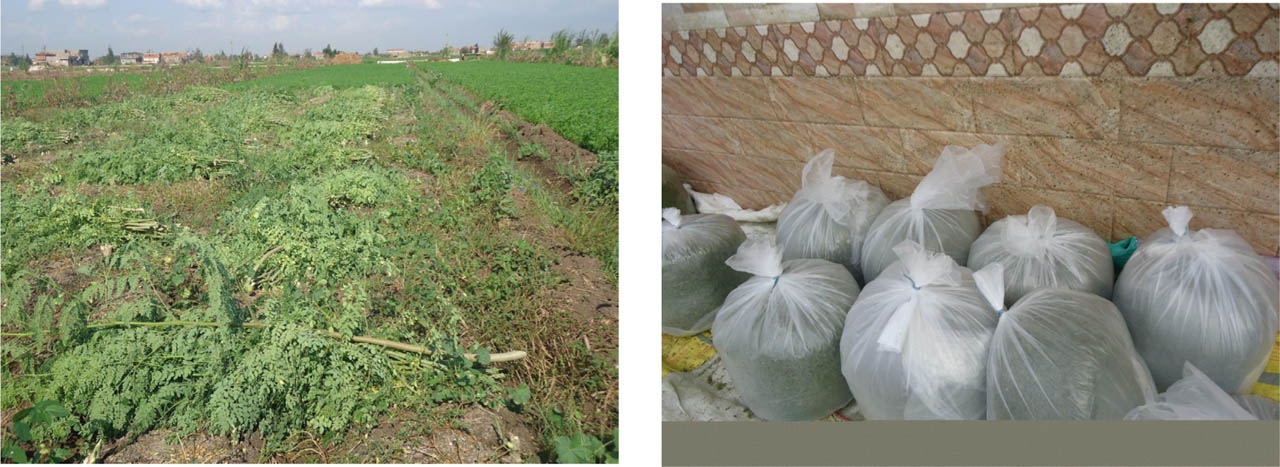
Figure 1.
The planting and preparation process of Moringa oleifera leaves for silage production
In the laboratory, C. vulgaris was cultivated in 5 L glass flasks containing 3 L of algal growth medium (BG-11 medium) (Rippka et al., 1979). The medium was composed of 1.5 g NaNO3; 0.004 g K2HPO4; 0.075 g MgSO4.7H2O; 0.036 g CaCl2.2H2O; 0.006 g citric acid; 0.02 mg Na2CO3; 0.001 g Na2EDTA; 0.63 g ferric ammonium citrate and 1.0 ml trace elements in 1000 mL distilled water. The trace elements contained 2.86 g H3BO3; 1.81 g MnCl2.4H2O; 0.222 g ZnSO4.7H2O; 0.39 g Na2MoO4. 2H2O; 0.079 g CuSO4.5H2O and 0.0494 g Co(NO3)2.6H2O. Pure strain of C. vulgaris H1957 was obtained from the Marine Toxins Laboratory, National Research Centre, Egypt. The culture medium used for cultivation of C. vulgaris was BG-11 medium (Rippka et al., 1979). After autoclaving and cooling, pH of the medium was adjusted to 7.1. C. vulgaris was cultivated under continuous illumination coming from white, fluorescent lamps at room temperature and aeration was performed using an air compressor linked with polyethylene tubes (3 mm). After 25 days of cultivation, C. vulgaris in its late exponential phase was transferred at a ratio of 1:10 into 1000 L polyethylene tanks containing 600 L of culture media, linked to an aeration system. C. vulgaris biomass was harvested using the continuous separating centrifuge apparatus (Westfalia Separator centrifuge at 15,000 L/h), and the drained water was recycled back to the ponds. The harvested biomass (0.75 kg microalgae per day) was re-washed three times with tap water to eliminate any residual salts from the culture media. The biomass was then partially dried using an air-drying oven (Thermo Scientific Heratherm OGS100, Thermo Electron LED GmbH, Langenselbold, Germany) at 45 °C for 2–4 h. Figure 2 shows the produced C. vulgaris microalgae.
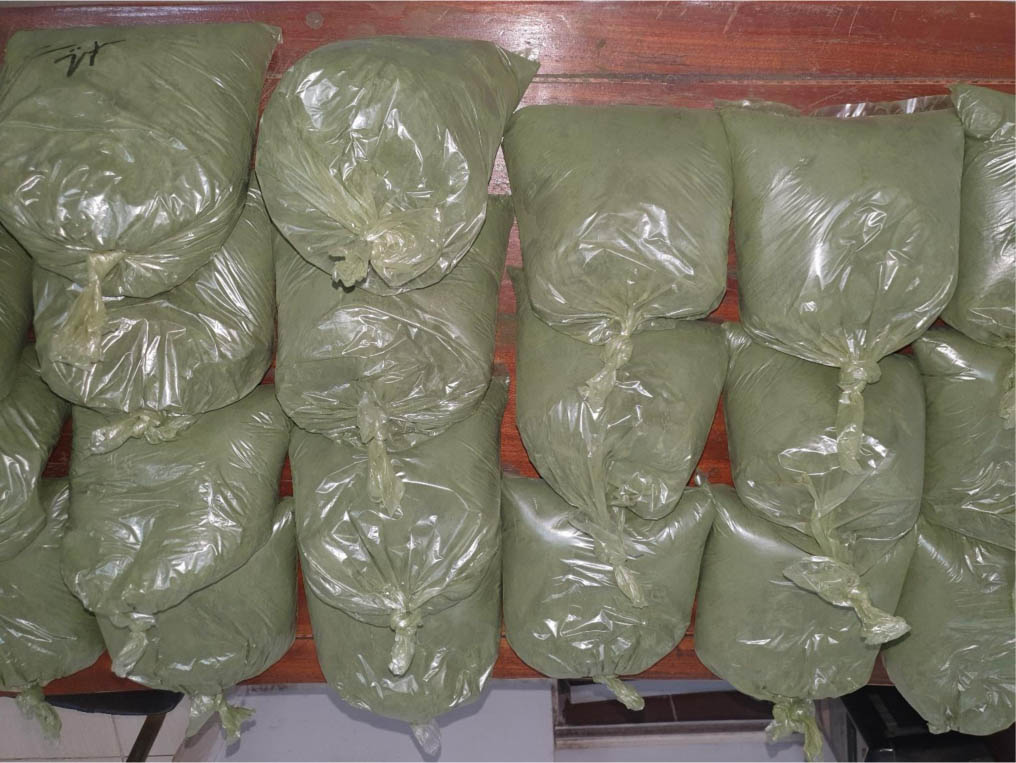
Figure 2.
Cultivated Chlorella vulgaris microalgae
Thirty Damascus kids (24.3±0.8 kg body weight and 9±0.4 months of age) were randomly assigned to three treatments (n=10 kids/treatment) for a duration of 120 days. The kids were individually housed in semi-opened concrete floor pens (1.5 m2/kid) under shade, without bedding, and had free access to water. Diets were formulated to meet the CP and net energy requirements for a kid weighing 25 kg with a target daily gain of 180 g, according to NRC (2007). The kids were individually fed twice daily at 08:00 and 16:00 h in two equal portions. They were weighed weekly to record the daily weight changes, and at monthly intervals to calculate the nutrient requirements.
The control diet comprised a 70% concentrate feed mixture and 30% rice straw as a forage. A mixture of M. oleifera leaves silage and C. vulgaris microalgae (at 10 g/kg DM) replaced the concentrate mixture at 20% (MA20 treatment) or 40% (MA40 treatment) on a DM basis. These replacement levels and levels of microalgae were determined from a previous in vitro experiment (Kholif et al., 2023). The ingredients and chemical composition of the diets are shown in Table 1. C. vulgaris microalgae were included at 1% DM of the total ration.
Table 1.
Ingredients (g/kg DM) and chemical composition (g/kg DM) of total mixed rations fed to the growing Damascus goats
| Ingredient | Diet1 | ||||||
|---|---|---|---|---|---|---|---|
| rice straw | CFM2 | M. oleifera leaves silage3 | C. vulgaris microalgae | control | MA20 | MA40 | |
| Ingredient | |||||||
| Rice straw | 300 | 300 | 300 | ||||
| CFM2 | 700 | 552 | 414 | ||||
| M. oleifera leaves silage3 | 0 | 138 | 276 | ||||
| C. vulgaris microalgae | 0 | 10 | 10 | ||||
| Chemical composition | |||||||
| Dry matter | 943 | 838 | 391 | 932 | 870 | 809 | 747 |
| Organic matter | 849 | 891 | 862 | 942 | 878 | 875 | 871 |
| Crude protein | 43 | 162 | 282 | 579 | 126 | 147 | 164 |
| Ether extract | 19 | 42 | 45 | 139 | 35 | 36 | 37 |
| Non-fibrous carbohydrates | 159 | 421 | 190 | 106 | 342 | 307 | 275 |
| Neutral detergent fiber | 628 | 266 | 345 | 118 | 375 | 384 | 395 |
| Acid detergent fiber | 397 | 99 | 299 | 43 | 188 | 215 | 243 |
1 Diets: Concentrate mixture in the control diet was replaced with Chlorella vulgaris microalgae (at 1%) + Moringa oleifera leaves silage mixture at 0% (Control diet), 20% (MA20 diet) or 40% (MA40 diet), DM basis. Chlorella vulgaris microalgae were incorporated at a concentration of 1% in the M20 and M40 treatments, while Moringa oleifera leaves silage was included at two different levels to replace equivalent amounts of concentrates.
Intake and nutrient digestibility
Four digestibility trials were conducted during the last 10 days of each month. Acid-insoluble ash (AIA) was used as an internal indigestibility marker, and the coefficients of apparent digestion were calculated using the equations of Dhanoa et al. (2008) as:
The differences between offered feed and orts from the previous day's feeding were considered as feed intake. Individual fecal samples were collected twice daily during each collection period at 07:00 and 15:00 h, dried at 60°C in a forced-air oven for 48 h, and pooled per kid.
Samples of dried feeds, orts, and feces were analyzed according to methods described by AOAC (2005) to determine ash (method ID 942.05), CP (method ID: 954.01), ether extract (method ID: 920.39) and acid detergent fiber (ADF) (method ID: 973.18). Neutral detergent fiber (NDF) and lignin contents were analyzed according to Van Soest et al. (1991). The contents of non-fibrous carbohydrates (NFC = 1000 − NDF − CP − EE − ash), cellulose (NDF – ADL), hemicellulose (NDF – ADF), and OM (1000 – ash) were estimated. The nutritive value of diet expressed as total digestible nutrients (TDN), digestible energy (DE), and metabolizable energy (ME) were calculated according to the NRC (2001) equations [TDN (%) = digestible CP + digestible EE × 2.25 + digestible CF + digestible NFE; DE (Mcal/kg) = 0.04409 × TDN (%); ME (Mcal/kg) = 1.01 × DE (Mcal/kg) – 0.45]. The net energy requirements for lactation equivalent to 1 kg of standard air-dry barley (unité fourragère du lait, UFL) was calculated according to the INRA (2018) equation as: UFL = 1.76 × net energy for lactation (NEL), where NEL (Mcal/kg DM) = 0.0245 × TDN (%) – 0.12.
Rumen fluid samples
All kids were sampled for rumen liquor (100 mL/kid) on days 30, 60, 90, and 120 of the study, in the morning, 3 h post-feeding. Approximately 100 mL of rumen contents were collected using a stomach tube and hand pump. To avoid saliva contamination, the first 50 mL of the rumen fluid samples were discarded, and the remaining rumen contents were strained through four layers of cheesecloth. The pH of the rumen fluid was measured immediately using a pH meter (HI98127 pHep®4 pH/Temperature Tester, Hanna® Instruments, Villafranca Padova PD, Italy). Approximately 5 mL of the subsample was preserved in 5 mL of 0.2 M HCl for NH3-N analysis (ID: 973.49) (AOAC, 2005), and 0.8 mL of rumen fluid was mixed with 0.2 mL of a solution containing 250 g of metaphosphoric acid/L for total VFAs analysis. Another 4 mL of the fermented media was mixed with 1 mL of 10% formaldehyde solution for fixing, and then kept at 4°C until measurement of bacterial and protozoal count. The total bacterial counts were determined using a bacterium counting chamber (Hausser Scientific®, 3900, Horsham, PA) and a phase contrast microscope at a magnification of 100×. Exactly 0.5 mL of the fixed sample was taken and diluted with 4.5 mL of distilled water. The number of bacteria per milliliter was calculated as the average of bacterial counts in each grid, multiplied by the dilution factor (1.25) and the chamber factor (2×10⁷). For the protozoal count, 1 mL of the fixed sample was diluted with 1 mL of distilled water. Thereafter, 0.5 mL of the mixed sample was taken with a Pasteur pipette (BRAND, 7712, Wertheim, Germany) into a Neubauer chamber (BRAND, 7178-10, Wertheim, Germany). Protozoa were counted under a contrast microscope at 400× magnification, which maintained their morphological integrity. The protozoa count was performed in eight quadrants (4 of each grid). The protozoa number per milliliter of culture medium was calculated as the average count of protozoa in each grid, multiplied by the dilution factor (3) and the chamber factor (1×10⁴). Samples of rumen liquor were preserved at −20°C. The individual molar proportions of VFAs were determined using a gas chromatograph (Thermo Fisher Scientific, Inc., TRACE 1300, Rodano, Milan, Italy) fitted with an AS3800 autosampler and equipped with a capillary column HP-FFAP (19091F-112; 0.320 mm o.d., 0.50 μm i.d., and 25 m length; J & W Agilent Technologies Inc., Palo Alto, CA, USA). A mixture of known concentrations of individual short-chain fatty acids (acetate, propionate and butyrate) was used as an external standard (Sigma Chemie GmbH, Steinheim, Germany) to calibrate the integrator.
Blood samples
All kids were sampled for blood on days of 30, 60, 90, and 120 of the study. Approximately 10 mL of blood was collected 4 h post-feeding from the jugular vein into clean and dry tubes without anticoagulants. The collected samples were centrifuged at 4,000 × g at 4°C for 20 min. Serum was separated into 2-mL clean dried Eppendorf tubes, and frozen at −20°C prior to analysis for total proteins, albumin, globulin, urea-N, glucose, aminotransferase (ALT), aspartate transaminase (AST), triglycerides, high-density lipoprotein (HDL), low-density lipoprotein (LDL), nonesterified fatty acids (NEFA), and β-hydroxybutyric acid (BHBA), using specific kits (Stanbio Laboratory, Boerne, Texas, USA), following manufacturer instructions. Globulin concentration was calculated as as the difference between total protein and albumin (total protein – albumin).
Statistical analysis
Data were analyzed using a completely randomized design with repeated measurements over time, where each kid served as an experimental unit. The analysis was conducted using PROC MIXED procedure in SAS (SAS Inst., Inc., Cary, NC, Version 9.4). The statistical model included the fixed effect of treatment and the random effect of period, as described by the following model:
where Yijk is each individual observation for a given variable, μ is the overall mean, Ti is the treatment effect, Pj is the period effect, (T × P)ij is the interaction between treatment and period, and eijk is the residual error. When the treatment F-test was significant at P<0.05, means were separated using the least squares means (LSMEANS) statement with the PDIFF option. Polynomial contrasts were applied to examine responses to increasing levels of M. oleifera leaves silage. Statistical significance was declared at P<0.05. Interactions between diet and period were not significant (P>0.05) for most measurements; therefore, only the main effects of diets and periods are reported. Significance was declared at a level of P<0.05. To ensure sufficient statistical power to detect significant differences between treatments, a power analysis was conducted using a tool developed by Dr. M.L. Galyean (www.depts.ttu.edu/afs/home/mgalyean). The tool indicated that a minimum of six animals per treatment was required to detect at least a 10% difference between treatments at P<0.05. In the present study, ten animals were used per treatment, which was sufficient to detect significant differences in the primary response variables.Results
Performance traits
Initial body weights were similar across treatments (Table 2). Compared to the control, MA20 and MA40 had greater growth performance (P=0.018) (Figure 3); however, MA40, followed by MA20, exhibited greater total weight gain (P=0.012), average daily gain (P=0.012), and feed efficiency (P=0.013).
Table 2.
Growth performance and feed efficiency of Damascus kids fed diets containing Moringa oleifera and Chlorella vulgaris microalgae
| Diets1 | SEM | P-value | |||||||
|---|---|---|---|---|---|---|---|---|---|
| control | MA20 | MA40 | diet | period | control vs. others | linear | quadratic | ||
| Initial body weight (kg) | 24.6 | 24.2 | 24.2 | 0.80 | 0.308 | <0.001 | 0.125 | 0.184 | 0.442 |
| Final body weight (kg) | 43.6 b | 45.6 a | 46.6 a | 0.71 | 0.018 | <0.001 | 0.036 | 0.011 | 0.401 |
| Weight gain (kg) | 19.0 c | 21.4 b | 22.4 a | 0.192 | 0.027 | 0.020 | 0.012 | 0.012 | 0.672 |
| Average daily gain (ADG; g/d) | 158 c | 178 b | 187 a | 7.7 | 0.027 | 0.020 | 0.012 | 0.012 | 0.672 |
| Feed efficiency (ADG/intake) | 0.16 c | 0.18 b | 0.19 a | 0.016 | 0.032 | 0.001 | 0.016 | 0.013 | 0.811 |
a, b, c – means in the same row with different letters differ at P<0.05. P-value is the observed significance level of the F-test for treatment; SEM, standard error of the mean.
1 Diets: Concentrate mixture in the control diet was replaced with Chlorella vulgaris microalgae (at 1%) + Moringa oleifera leaves silage at 0% (Control diet), 20% (MA20 diet) or 40% (MA40 diet), DM basis. Chlorella vulgaris microalgae were incorporated at a concentration of 1% in the M20 and M40 treatments, while Moringa oleifera leaves silage was included at two different levels to replace equivalent amounts of concentrates.
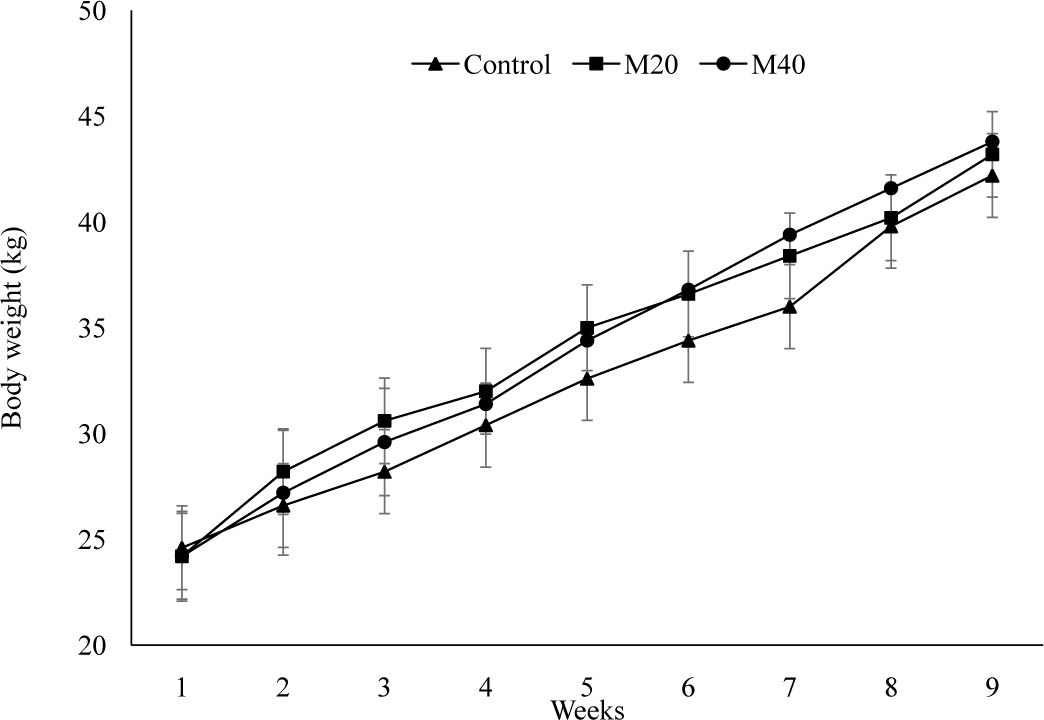
Figure 3.
Weekly changes in body weight among growing Damascus kids fed diets containing Moringa oleifera and Chlorella vulgaris microalgae. Diets: Concentrate mixture in the control diet was replaced with Chlorella vulgaris microalgae (at 1%) and Moringa oleifera leaves silage at 0% (Control diet), 20% (MA20 diet) or 40% (MA40 diet), DM basis. Chlorella vulgaris microalgae were incorporated at a concentration of 1% in the M20 and M40 treatments, while Moringa oleifera leaves silage was included at two different levels to replace equivalent amounts of concentrates
Nutrient intake and digestibility
Total feed and rice straw intake did not differ between treatments (Table 3). However, MA20 and MA40 consumed less (P<0.001) concentrates and more M. oleifera leaves silage. Both MA20 and MA40 linearly increased (P<0.01) digestibility of DM, OM, CP, ether extract (EE), NFC, NDF, and ADF (Table 4). Moreover, MA20 and MA40 linearly increased (P<0.01) TDN, DE, ME, and UFL compared to the control.
Table 3.
Intake (g/d) of diets containing a mixture of both Moringa oleifera leaves silage and Chlorella vulgaris microalgae fed to growing Damascus kids
| Diets1 | SEM | P-value | |||||||
|---|---|---|---|---|---|---|---|---|---|
| control | MA20 | MA40 | diet | period | control vs. others | linear | quadratic | ||
| Concentrate | 673 a | 567 b | 395 c | 3.6 | <0.001 | <0.001 | <0.001 | <0.001 | <0.001 |
| M. oleifera leaves silage mixture | 0.0 c | 139 b | 256 a | 2.5 | <0.001 | <0.001 | <0.001 | <0.001 | 0.001 |
| Rice straw | 287 | 301 | 308 | 13.9 | 0.151 | 0.441 | 0.178 | 0.145 | 0.118 |
| Total DM intake | 960 | 1007 | 959 | 3.8 | 0.651 | 0.537 | 0.601 | 0.977 | <0.001 |
a, b, c – means in the same row with different letters differ at P<0.05. P-value is the observed significance level of the F-test for treatment; SEM, standard error of the mean.
1 Diets: Concentrate mixture in the control diet was replaced with Chlorella vulgaris microalgae (at 1%) and Moringa oleifera leaves silage at 0% (Control diet), 20% (MA20 diet) or 40% (MA40 diet), DM basis. Chlorella vulgaris microalgae were incorporated at a concentration of 1% in the M20 and M40 treatments, while Moringa oleifera leaves silage was included at two different levels to replace equivalent amounts of concentrates.
Table 4.
Nutrients digestibility of diets containing Moringa oleifera and Chlorella vulgaris microalgae fed to growing Damascus kids
| Diets1 | SEM | P-value | |||||||
|---|---|---|---|---|---|---|---|---|---|
| control | MA20 | MA40 | diet | period | control vs. others | linear | quadratic | ||
| Dry matter | 588 b | 639 a | 642 a | 6.9 | <0.001 | 0.013 | <0.001 | <0.001 | 0.073 |
| Organic matter | 594 b | 647 a | 648 a | 8.0 | <0.001 | 0.667 | <0.001 | <0.001 | 0.051 |
| Crude protein | 583 b | 641 a | 642 a | 7.7 | <0.001 | 0.183 | <0.001 | <0.001 | 0.074 |
| Ether extract | 598 b | 647 a | 649 a | 8.2 | <0.001 | 0.208 | <0.001 | <0.001 | 0.055 |
| Non-fibrous carbohydrates | 608 b | 654 a | 645 a | 9.5 | 0.003 | 0.679 | 0.001 | 0.008 | 0.071 |
| Neutral detergent fiber | 554 b | 591 a | 610 a | 9.6 | 0.001 | 0.378 | 0.001 | 0.001 | 0.447 |
| Acid detergent fiber | 540 b | 576 a | 581 a | 6.9 | 0.001 | 0.361 | <0.001 | 0.001 | 0.068 |
| TDN (g/kg DM)2 | 53.7 b | 57.5 a | 57.7 a | 0.50 | <0.001 | 0.981 | <0.001 | <0.001 | 0.064 |
| DE (Mcal/kg DM)2 | 2.37 b | 2.54 a | 2.55 a | 0.022 | <0.001 | 0.981 | <0.001 | <0.001 | 0.085 |
| ME (Mcal/kg DM)2 | 2.39 b | 2.56 a | 2.57 a | 0.022 | <0.001 | 0.980 | <0.001 | <0.001 | 0.055 |
| UFL (Mcal/kg DM)3 | 2.10 b | 2.27 a | 2.28 a | 0.021 | <0.001 | 0.981 | <0.001 | <0.001 | 0.055 |
a, b – means in the same row with different letters differ at P<0.05. P-value is the observed significance level of the F-test for treatment; SEM, standard error of the mean.
1 Diets: Concentrate mixture in the control diet was replaced with Chlorella vulgaris microalgae (at 1%) and Moringa oleifera leaves silage at 0% (Control diet), 20% (MA20 diet) or 40% (MA40 diet), DM basis. Chlorella vulgaris microalgae were incorporated at a concentration of 1% in the M20 and M40 treatments, while Moringa oleifera leaves silage was included at two different levels to replace equivalent amounts of concentrates.
2 TDN = total digestible nutrients, DE = Digestible energy, ME = Metabolizable energy. All values have been calculated according to the NRC (2001) equation.
3 The UFL (unité fourragère lait), which represents the net energy requirements for lactation equivalent to 1 kg of standard air-dry barley, has been determined based on the equation provided by INRA (2018).
Ruminal fermentation
Both MA20 and MA40 linearly increased ruminal pH (P<0.001), total VFAs (P=0.019), acetate (P=0.015), propionate (P=0.024), and butyrate (P=0.03) without affecting acetate to propionate ratio (Table 5). Furthermore, MA20 and MA40 linearly increased the total bacteria count (P=0.028) and reduced the count of ruminal protozoa (P=0.018).
Table 5.
Ruminal fermentation parameters of growing Damascus kids fed diets containing Moringa oleifera and Chlorella vulgaris microalgae
| Diets1 | SEM | P-value | |||||||
|---|---|---|---|---|---|---|---|---|---|
| control | MA20 | MA40 | diet | period | control vs. others | linear | quadratic | ||
| pH | 6.14 b | 6.69 a | 6.76 a | 0.042 | <0.001 | 0.076 | <0.001 | <0.001 | <0.001 |
| Ammonia N (mg/dL) | 35.4 a | 32.9 b | 31.4 b | 0.80 | 0.004 | 0.531 | 0.002 | 0.001 | 0.620 |
| Total volatile fatty acids (mmol/L) | 126 b | 136 a | 139 a | 3.2 | 0.019 | 0.030 | 0.006 | 0.008 | 0.343 |
| Acetate (mmol/L) | 73.2 b | 79.3 a | 80.2 a | 1.76 | 0.015 | 0.024 | 0.004 | 0.008 | 0.234 |
| Propionate (mmol/L) | 31.2 b | 33.6 a | 34.4 a | 0.84 | 0.024 | 0.126 | 0.008 | 0.009 | 0.456 |
| Butyrate (mmol/L) | 21.8 b | 23.4 a | 24.2 a | 0.50 | 0.023 | 0.011 | 0.018 | 0.035 | 0.750 |
| Acetate: propionate ratio | 2.35 | 2.37 | 2.33 | 0.040 | 0.810 | 0.709 | 0.966 | 0.719 | 0.592 |
| Bacteria (× 108) | 10.0 b | 11.8 a | 12.4 a | 0.35 | 0.028 | 0.044 | 0.013 | 0.028 | 0.755 |
| Protozoa (× 105) | 4.68 a | 4.17 b | 4.06 b | 0.251 | 0.018 | 0.048 | 0.023 | 0.026 | 0.525 |
a, b – means in the same row with different letters differ at P<0.05. P-value is the observed significance level of the F-test for treatment; SEM, standard error of the mean.
1 Diets: Concentrate mixture in the control diet was replaced with Chlorella vulgaris microalgae (at 1%) and Moringa oleifera leaves silage at 0% (Control diet), 20% (MA20 diet) or 40% (MA40 diet), DM basis. Chlorella vulgaris microalgae were incorporated at a concentration of 1% in the M20 and M40 treatments, while Moringa oleifera leaves silage was included at two different levels to replace equivalent amounts of concentrates.
Blood chemistry
Total protein, globulin, glucose, ALT, AST, triglycerides, HDL, and LDL were similar between treatments (Table 6). Both MA20 and MA40 linearly enhanced blood albumin levels (P<0.001), albumin: globulin ratio (P=0.036), and antioxidant capacity (P=0.008) concentrations.
Table 6.
Blood serum parameters of growing Damascus kids fed diets containing Moringa oleifera and Chlorella vulgaris microalgae
| Diet1 | SEM | P-value | |||||||
|---|---|---|---|---|---|---|---|---|---|
| control | MA20 | MA40 | diet | period | control vs. others | linear | quadratic | ||
| Total proteins (g/dL) | 7.74 | 8.01 | 8.04 | 0.091 | 0.055 | 0.181 | 0.015 | 0.026 | 0.298 |
| Albumin (g/dL) | 4.16 b | 4.55 a | 4.56 a | 0.052 | <0.001 | 0.904 | <0.001 | <0.001 | 0.004 |
| Globulin (g/dL) | 3.58 | 3.45 | 3.48 | 0.099 | 0.637 | 0.262 | 0.355 | 0.479 | 0.530 |
| Albumin: globulin ratio | 1.18 b | 1.34 a | 1.31 a | 0.044 | 0.036 | 0.425 | 0.011 | 0.044 | 0.095 |
| Urea-N (mg/dL) | 36.4 a | 33.3 b | 33.7 b | 0.58 | 0.011 | 0.276 | 0.028 | 0.015 | 0.103 |
| Glucose (mg/dL) | 64.9 | 68.2 | 68.8 | 1.69 | 0.220 | 0.274 | 0.087 | 0.106 | 0.524 |
| ALT (U/L) | 17.7 | 17.7 | 17.7 | 0.33 | 0.999 | 0.134 | 0.972 | 0.990 | 0.962 |
| AST (U/L) | 33.8 | 32.3 | 32.2 | 0.73 | 0.252 | 0.127 | 0.099 | 0.142 | 0.440 |
| Triglycerides (mg/dL) | 173 | 176 | 178 | 2.4 | 0.254 | 0.529 | 0.141 | 0.101 | 0.925 |
| High-density lipoprotein (mmol/L) | 86.4 | 86.2 | 87.6 | 1.71 | 0.837 | 0.536 | 0.824 | 0.640 | 0.714 |
| Low-density lipoprotein (mL/dL) | 68.3 | 70.0 | 69.5 | 0.92 | 0.445 | 0.009 | 0.226 | 0.386 | 0.353 |
| Antioxidant capacity | 111 b | 121 a | 124 a | 3.047 | 0.008 | 0.002 | 0.003 | 0.003 | 0.413 |
| Nonesterified fatty acids (mmol/L) | 0.88 a | 0.77 b | 0.78 b | 0.012 | 0.028 | 0.798 | 0.031 | 0.017 | 0.819 |
| β-hydroxybutyric acid (mg/dL) | 1.83 a | 1.51 b | 1.52 b | 0.031 | 0.040 | 0.595 | 0.038 | 0.041 | 0.851 |
a, b – means in the same row with different letters differ at P<0.05. P-value is the observed significance level of the F-test for treatment; SEM, standard error of the mean.
1 Diets: Concentrate mixture in the control diet was replaced with Chlorella vulgaris microalgae (at 1%) and Moringa oleifera leaves silage at 0% (Control diet), 20% (MA20 diet) or 40% (MA40 diet), DM basis. Chlorella vulgaris microalgae were incorporated at a concentration of 1% in the M20 and M40 treatments, while Moringa oleifera leaves silage was included at two different levels to replace equivalent amounts of concentrates.
Discussion
Growth performance and feed efficiency
The initial body weights were not significantly different between treatments, indicating a random distribution of animals among treatments with no differences between the two diets. Diets that contained M. oleifera leaves silage improved the growth performance of kids, as reflected in the final body weight, total weight gain, and average daily gain. The enhanced performance may be related to a combination of various factors, such as dietary CP and improved nutrient digestibility, which positively influenced ruminal total VFAs and propionate, and serum albumin concentrations (Babiker et al., 2017). M. oleifera leaves contain approximately 50% of their CP as ruminal undegraded protein (Ebeid et al., 2020 a), which increases CP bypass and absorption in the small intestine. Wankhede et al. (2022) reported that feeding M. oleifera increased the concentrations of triiodothyronine, thyroxine hormone, and growth hormones, which are essential for energy utilization and growth. Babiker et al. (2017) and Wankhede et al. (2022) reported improvements in total body weight gain and average daily gain in lambs and kids fed M. oleifera leaves.
The unchanged daily feed intake accompanied by increased daily weight gain in kids consuming diets containing M. oleifera leaves silage, resulted in improved feed efficiency. Wankhede et al. (2022) also observed increased feed efficiency in growing goat kids when fed M. oleifera.
Feed intake and nutrient apparent digestibility
Consistent with the rationale of our study, the differences in concentrate and M. oleifera leaves silage intake among treatments arise from varying inclusion levels. However, replacing concentrates with M. oleifera leaves silage did not affect total feed intake. This finding was also reported by Kholif et al. (2022) when Damascus goats were fed on diets including M. oleifera and C. vulgaris as alternatives to concentrates. Conversely, other studies (Kekana et al., 2022; Wankhede et al., 2022) described high palatability of diets containing M. oleifera, which influenced intake patterns and the secretion of digestive fluids.
The improved nutrient digestibility of diets containing M. oleifera leaves silage may have beneficial effects on ruminal fermentation and microbial activity (Abdel-Raheem and Hassan, 2021). The observed increase in total bacterial counts and the reduction in protozoal counts may partially explain the enhanced nutrient digestibility (Morsy et al., 2022). M. oleifera leaves contain secondary metabolites that may improve nutrient digestibility through concurrent changes in the rumen microbiome, particularly among microbes responsible for fiber fermentation and digestibility (Ebeid et al., 2020 b). Furthermore, the enhanced CP intake could also contribute to the apparent improvement in digestibility, as fecal nitrogen tends to decline with increased CP intake. Differences in NDF digestibility between ingredients such as the concentrate and M. oleifera may explain the improved NDF digestibility observed in M. oleifera diets. The enhanced digestibility of CP along with a decrease in rumen NH3-N concentration in diets containing M. oleifera, could be attributed to tannins and phenolic compounds found in M. oleifera, which enhance protein digestion in the lower gut (Ammar et al., 2024).
The presence of C. vulgaris in the experimental diets should not be overlooked as a contributing factor to the improved nutrient digestibility. The synchronization of energy (from VFAs) and nitrogen release may optimize microbial growth, leading to enhanced nutrient digestion (Zhang et al., 2020). C. vulgaris contains β-glucans, which scavenge free radicals from the rumen, thereby improving rumen fermentation (Kholif and Olafadehan, 2021 a). Additionally, C. vulgaris can increase populations of rumen bacteria such as Butyrivibrio fibrisolvens, Ruminococcus albus, and Clostridium sticklandii in goats, resulting in enhanced nutrient digestibility (Kotrbáček et al., 2015; Tsiplakou et al., 2017). Furthermore, microbial growth and improved nutrient digestibility may be stimulated by carotenoids, phycobiliproteins, polysaccharides, and phycotoxins, contained in C. vulgaris (Tibbetts et al., 2016; Kholif and Olafadehan, 2021 a).
Ruminal fermentation
Replacing concentrates with M. oleifera leaves silage increased rumen pH, which aligns with previous studies (Kekana et al., 2022; Kholif et al., 2022). An increase in ruminal pH towards the optimal level (6.2 to 7) is essential for rumen microbial activity (Ryle and Ørskov, 1990), and this proliferation of bacteria consequently increases microbial protein absorption in the small intestine, which may partially explain the improved growth of animals. The increased ruminal pH was unexpected given the rise in total ruminal VFAs concentrations observed in diets containing M. oleifera. In this study, rumen pH values were not significant from a biological perspective.
Feeding M. oleifera to kids lowered ruminal NH3-N production. This result was anticipated due to the presence of secondary metabolites in M. oleifera that bind the protein to protect it from ruminal degradation. Tannins, in M. oleifera, form stable complexes with proteins, reducing their susceptibility to microbial degradation in the rumen and allowing more protein to bypass to the small intestine for absorption (Kholif and Olafadehan, 2021 b). Additionally, saponins, in M. oleifera, exhibit antimicrobial properties that selectively inhibit rumen protozoa, which are responsible for significant protein degradation (Ramos-Morales et al., 2017). This dual mechanism enhances nitrogen utilization efficiency, improving animal performance while reducing nitrogen excretion and environmental pollution. The reduced ruminal NH3-N was not consistent with the increased total tract CP digestibility, indicating that a significant portion of the CP in M. oleifera-containing diets was digested and absorbed post-ruminally. The presence of low-degradable protein, nucleic acids, and amines in C. vulgaris may explain the NH3-N results (Gadzama et al., 2025). Additionally, the decreased protozoal count in diets containing M. oleifera may contribute to this effect, as protozoa are responsible for degrading protein in feeds (Abdel-Raheem and Hassan, 2021).
Diets containing M. oleifera leaves silage improved total VFAs, propionate, acetate, and butyrate – precursors of a diverse range of compounds in the body, including energy (Kekana et al., 2022). Such results could be attributed to improved nutrient digestibility. Higher concentrations of total VFAs and reduced NH3-N are desirable for improving the synchronization between energy and nitrogen availability in the rumen, leading to greater microbial protein production and enhanced animal performance (Jones and Jones, 2012). Diets containing M. oleifera leaves silage increased propionate levels, which could be related to increased OM and NFC digestibility. Increased rumen propionate can facilitate improved amino acid absorption in the small intestine (Samanta et al., 2013). Moreover, the enhanced acetate and butyrate concentrations in M. oleifera leaves silage diets result from increased fiber digestion. Higher concentrations of acetate and butyrate are beneficial for growing animals, promoting meat and fat production. The replacement of concentrates with M. oleifera leaves silage increased total bacterial counts and decreased ruminal protozoal counts, which may explain the observed improvements in total tract nutrient digestibility, ruminal total and individual VFAs concentrations, and reduced ruminal NH3-N levels.
Blood metabolites
In this study, blood metabolites were within the values reported for healthy animals (Etim et al., 2013). Replacing concentrates with M. oleifera leaves silage increased blood albumin and the albumin:globulin ratio, indicating an improved nutritional and health status of the animals. The increased albumin levels may indicate higher nitrogen retention (Wankhede et al., 2022). The substitution of concentrate with M. oleifera leaves silage also increased antioxidant capacity, likely due to the presence of isothiocyanates found in both M. oleifera (Cohen-Zinder et al., 2017) and C. vulgaris (Kovač et al., 2013). Consistent with our results, other studies (Cohen-Zinder et al., 2017) have reported that feeding M. oleifera leaves silage can increase antioxidant concentrations due to the isothiocyanates and the accretion of amino acids and peptides from M. oleifera leaves.
The treatments led to decreased urea-N levels, reflecting reduced protein degradation in the rumen. These results may indicate a stable energy-protein ratio from dietary treatments and reduced degradation of protein in the rumen, as well as improved synthesis of essential amino acids (Wankhede et al., 2022). The decreased urea-N levels also suggest minimal protein catabolism and normal kidney function, which are important for growing animals.
The concentrations of ALT and AST were similar across treatments, indicating unaltered liver function. Additionally, triglycerides, HDL, and LDL were comparable among the treatments.
The treatments also lowered concentrations of non-esterified fatty acids (NEFA) and β-hydroxybutyric acid (BHBA), suggesting improvements in fat mobilization and net energy balance (Van Hoeck et al., 2015). Kekana et al. (2022) noted a decrease in NEFA content with M. oleifera supplementation. Both NEFA and BHBA serve as indicators of energy status and oxidative status, as they alter the expression of genes related to oxidative stress (Van Hoeck et al., 2015). Lower levels of BHBA and NEFA reflect decreased lipid peroxidation and a reduced risk of oxidative stress (Kekana et al., 2022).
Conclusions
Replacing dietary concentrates with a blend of M. oleifera and C. vulgaris enhanced nutrient digestion, ruminal fermentation patterns, and growth performance in Damascus male kids. No differences were observed between low and high inclusion levels; therefore, both levels are recommended depending on the availability of both ingredients. Future research efforts should consider analyzing the effects of feeding mixtures of M. oleifera and C. vulgaris on meat and dairy products from small ruminants. Investigating the rumen microbiome could provide additional insights into how M. oleifera and C. vulgaris trigger changes in nutrient digestion, ruminal fermentation patterns, and growth performance in kids.
Notes
[16] Financial disclosure Funding
This paper is based upon work supported by the Science, Technology & Innovation Funding Authority (STDF) under grant: 37138.
[17] Institutional review board statement
Management of the kids was following the 3rd edition (2010) of the Guide for the Care and Use of Agricultural Animals in Research and Teaching of the Federation of Animal Science Societies, Champaign, IL, USA, and approved by the Institutional Animal Care and Use Committee of the Animal Production Research Institute, Egypt.
[18] Contributed by Author contributions
Conceptualization, A.E.K., H.A.H., E.V.-B.-P., Q.Z. and A.A.A.; methodology, A.A.A., A.E.K., H.A.H. and T.A.M.; validation, A.E.K., Q.Z. and T.A.M.; formal analysis, A.E.K. and T.A.M.; investigation, A.E.K., H.A.H., T.A.M. and A.A.A.; resources, A.E.K., T.A.M. and A.A.A.; data curation, A.E.K. and E.V.-B.-P.; visualization, A.E.K. and T.A.M.; supervision, A.E.K.; project administration, A.E.K.; writing – original draft preparation, A.E.K.; writing – review and editing, A.E.K., Q.Z. and E.V.-B.-P. All authors have read and agreed to the published version of the manuscript.