
Although ruminants evolved to efficiently use forages as a source of nutrients, concentrates are commonly included in their diets in production scenarios, particularly high-starch cereal grains. This also applies to newborn animals. Newborn calves, lambs and kids are often fed high-starch concentrates ad libitum from the very first days of life, while forages are not provided or provided only in limited amounts in many countries (Carballo et al., 2019; Khan et al., 2020). Such a feeding strategy is used to speed up ruminal epithelium development, increase solid feed intake and daily weight gains, and also facilitate weaning transition (Heinrichs, 2005; Khan et al., 2016; Carballo et al., 2019). However, high intake of high-starch concentrate in the first weeks of life substantially alters the development of the rumen (Stabo et al., 1966; Álvarez-Rodríguez et al., 2012; Connor et al., 2013; Terler et al., 2023) and eating and rumination behavior of reared animals (Terré et al., 2013; Nieper et al., 2017; Poczynek et al., 2020).
There are indications that a modulation of the rumen development early in life as a result of a high intake of starchy concentrates may have a long-term impact on its function and other aspects of animal physiology (as reviewed by Yáñez-Ruiz et al., 2015). For example, Yáñez-Ruiz et al. (2010) reported differences in the ruminal bacterial community 4 months after transitioning to the same forage-based diet in sheep that in their first weeks of life were fed only grass hay or grass hay plus concentrate, and Khan et al. (2020) showed that the composition of solid feed offered pre-weaning to calves (forage or high-starch concentrate) may affect the immune response of animals during the weaning transition. Moreover, in sheep, even short-term exposure to concentrate in first weeks of life was shown to elicit extended in time effect on the rumen epithelium development (Ortega-Reyes et al., 1992). The feed composition, exposure to particular feed in early life or its presentation method also has a long-term impact on feed preference and eating behavior of ruminants (Ortega-Reyes et al., 1992; Miller-Cushon and DeVries, 2015). Furthermore, a lack of access to forage was shown to delay the occurrence of the first rumination event and reduce rumination time in the first weeks of life, resulting in a greater time spent performing abnormal behavior (Terré et al., 2013; Poczynek et al., 2020).
The composition of the diet provided early in life may have a particularly significant impact on the performance of animals that are transitioned at weaning to a forage-only diet, which is common in rearing programs of farm ruminants to reduce rearing costs (Belanche et al., 2019; Carballo et al., 2019; Khan et al., 2020). Cattle that were fed in the first week of life a forage-based starter feed performed better when transitioned to a pasture-based diet compared to cattle that were fed a concentrate-based starter (Khan et al., 2020; McCoard et al., 2023), and lambs that had no access to concentrate in first weeks of life spent more time grazing and rumination once put on pasture (Nieper et al., 2017). Furthermore, around weaning, blood β-hydroxybutyric acid (BHBA) and cholesterol concentrations were higher in animals fed a high forage diet compared to high concentrate diet in their first weeks of life, indicating substantial impact on the metabolic activity of the ruminal epithelium (Khan et al., 2020; Terler et al., 2022), potentially affecting feed use efficiency at later stages of rearing. Moreover, low or very low rumen pH is observed in young ruminants that are fed diets abundant in starchy feeds (Laarman et al., 2012; Soltani et al., 2017; Gelsinger et al., 2020). It has been shown that the onset of rumen acidosis may have moderate or even long-term impact on ruminal epithelium function (Krehbiel et al., 1992; Schwaiger et al,. 2013). Thus, the diet offered early in life may also affect the response of the rumen to a concentrate-based diet later in life.
The hypothesis of this study was that a high intake of high-starch concentrate-based diet early in life has a long-term impact on growth performance, forage intake, digesta retention, nutrient digestibility, behavior, rumination, selected blood parameters in sheep, and response of the rumen to a high-starch diet later in life. Thus, the aim was to determine long-term impact of diet offered early in life on the mentioned parameters.
Material and methods
Before the initiation of the study, the experimental protocol was approved by the Local Institutional Animal Care and Use Committee (Kraków, Poland, protocol No. 28/2021).
Animals, study stages and overall assumptions
Twelve male and 12 female newborn lambs [initial body weight (BW) 6.3±0.97 kg; mean ± SD] of Polish Mountain Sheep and its crossbreds with Olkuska Sheep and/or Black-Headed Sheep were used for the study. Lambs were allocated to the study between day 7 to 14 of age. Before that, lambs were kept with their mothers in group pens of several ewes. While with mothers, lambs were not offered concentrates or forages; however, droppings of haylage from the ewes' feeder or bedding (straw) could be consumed.
Two batches (blocks) of lambs were used for the study (12 lambs/batch), with two weeks interval between the batches. Within each batch, lambs were divided into two group pens of six lambs per pen. Each pen included both males and females, with 2 to 4 rams per pen. Each group pen was than randomly allocated to one of two treatments differing in solid feed offered in the first 10 weeks of the study. Treatments were balanced for sex of lambs and included 8–9 purebred and 3–4 crossbred lambs.
The study was divided into four stages. In stage 1, lambs were fed milk replacer (MR) and solid feed consisting of hay with a small inclusion of concentrate (control group; C) or a mixture of concentrates consisting mostly of high-starch cereal grain with small inclusion of chopped hay (high-starch group; HS). Once stage 1 was completed, lambs were shifted to a forage-only diet. The first day of the forage-only diet was considered the first day of stage 2, which lasted 18 weeks for males and 26 weeks for females, corresponding to age of approximately 7 months for males and 9 months for females, respectively. Thus, concentrate feeding was discontinued for 4.5 and 6.5 months for rams and ewes, respectively. These ages at the end of stage 2 were considered the ages when the rumen reached full maturity in each sex. Once stage 2 was completed, sheep were placed in individual pens for ad libitum forage intake control, digestibility and digesta retention measurement (stage 3). Subsequently, animals were challenged with a high-starch diet (stage 4). Thus, stage 1 was used to differentiate treatments in terms of solid feed offered, stage 2 was a period of a forage-only diet without any high-starch concentrate, stage 3 was used to assess whether the composition of the feed offered early in life has a long-term effect on forage intake, digesta retention and digestibility later in life, and stage 4 whether diet early in life affects response of the rumen to high-starch intake later in life (Figure 1).
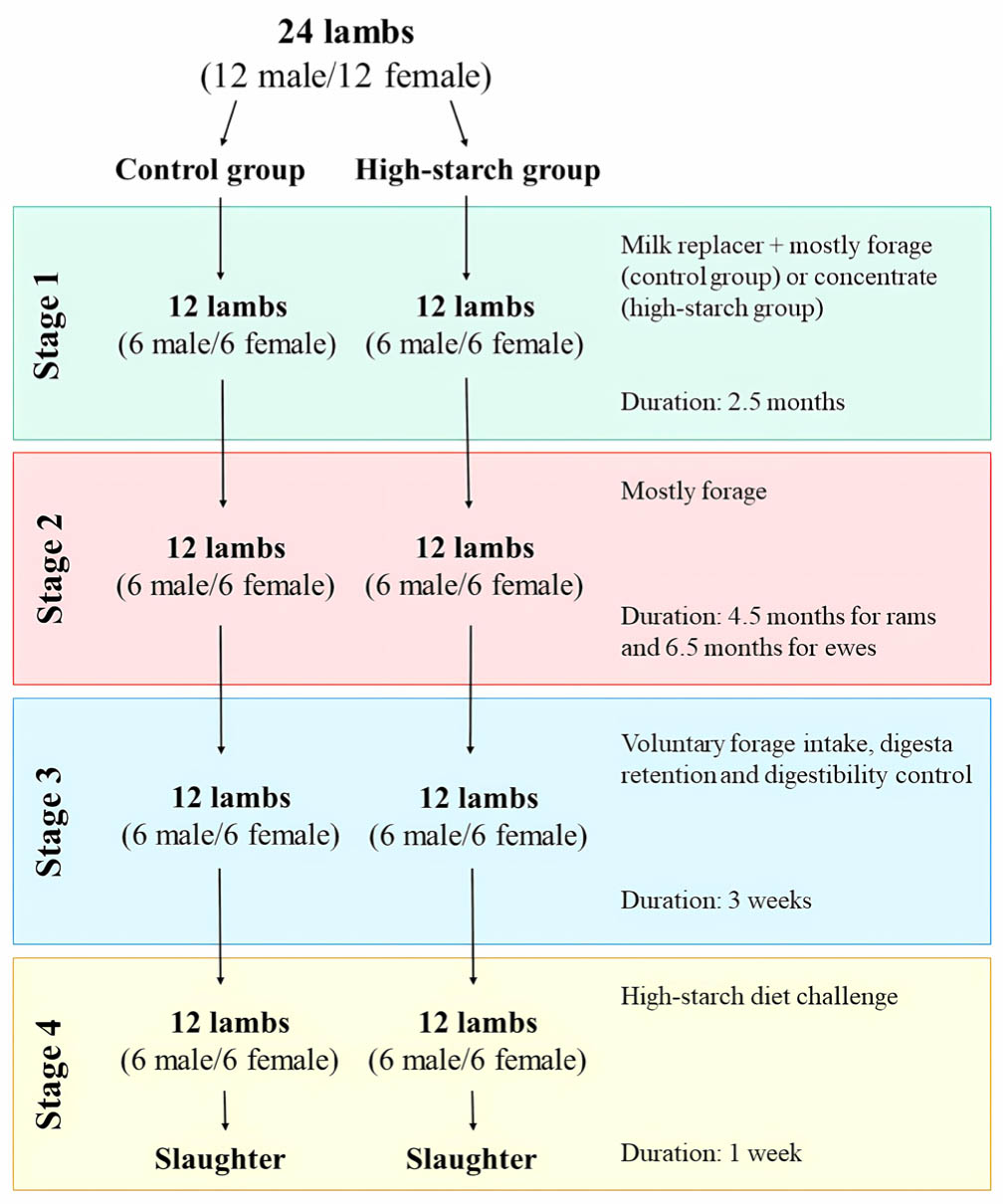
Figure 1.
Experimental setup
Housing of animals
In stage 1, lambs were kept in four group pens of 3.5 × 3.3 m each. Pens were bedded with sawdust to avoid intake of the bedding (e.g. straw) and were equipped with a wooden trough, a hay rack and a bucket for water. All pens were in one room and arranged in a way that C and HS could see and hear each other but had no physical contact.
In stage 2, animals of the same treatment were combined and moved to two large group pens (3.5 m × 6.6 m, one for C and one for HS). Pens were located in the same room; groups had no physical contact but could see and hear each other. Pens were equipped with a wooden trough for supplemental feed, a hay rack and automatic water bowls, and were bedded with straw. Once animals reached five months of age, each group pen was divided into two equal pens to separate males and females to preclude ewes getting pregnant, but physical contact through fences was possible within each group.
In stage 3 and 4, animals were placed into individual boxes of 1.6 m × 0.9 m each. Each box was equipped with a feeder and bucket for water. Boxes were located in one room and were arranged in a way that animals could see and hear each other but had no physical contact. Boxes were bedded with sawdust; in the fecal sampling period, bedding was removed and slatted floor was installed for easier feces collection. In each stage, day length lasted at least 8 h and was provided by both natural and artificial light.
Feeds, feeding regiment, feed intake and BW measurements
In stage 1, lambs of both groups were fed for the first 6 weeks a MR (Sprayfo Primo Lamb, Trouw Nutrition, Poland; 22% of crude protein (CP) and 22% of crude fat) that was offered for ad libitum consumption. The MR was fed 4 times/day in weeks 1 to 3 (07:00, 12:00, 17:00 and 23:00), 3 times/day in week 4 (07:00, 14:00 and 23:00), twice per day in week 5 (07:00 and 23:00) and once per day in week 6 of the study (07:00). The MR was prepared by diluting 200 g of MR powder in 1 L of water (according to manufacturer instructions) and was fed from buckets with nipples. After all the lambs completed MR consumption, the buckets with MR were removed from pens. The amount of MR offered per feeding ensured 5 to 10% refusals. Thus, the procedure of MR feeding ensured ad libitum MR intake per each feeding, and consequently ad libitum or close to ad libitum MR intake over at least first 3 to 4 weeks of the study (i.e. when MR was fed 4 or 3 times/day). The time when the frequency of MR feeding was reduced to twice per day was considered the beginning of the weaning transition.
In addition to MR, from the first day of the study, C was fed moderate quality second cut long meadow hay [~ 10% of CP and 60% of neutral detergent fiber (NDF) in dry matter (DM)] and 50 g/lamb/day of wheat bran. In week 4 (i.e. when MR feeding frequency was reduced), wheat bran was replaced with a concentrate mixture. The amount of concentrate mixture fed was increased to 100 g/lamb/day in week 5 (i.e. when MR feeding frequency was further reduced) and to 150 g/lamb/day in week 9. The concentrate mixture was the same concentrate mixture that was fed to HS (details below) and was included in the diet for C group to avoid potential negative energy balance of the lambs during the weaning transition. Specifically, the doses of concentrate mixture aimed to ensure that protein and energy intake during post-weaning period of stage 1 covered requirement for maintenance and average daily gain of 50–75 g/day (assuming DM intake in that period of the study ~ 0.5 kg/animal/day; INRA, 2019) and were set to a minimum to limit starch intake while ensuring that results of the study will be not compromised by undernutrition of C animals and constrained growth during the post-weaning period. Wheat bran was fed in first weeks of the study in order to adapt lambs to concentrate intake and to prevent that on the first days of offering concentrate this would be consumed by only some lambs in the pen. Moreover, wheat bran was fed to C animals in first weeks of the study instead of concentrate mixture consisting of soybean meal and barley grain, in order to limit as much as possible having situation in which when one animal in the pen starts consuming ‘concentrate’, it will consume most or all feed available in the feeder. By-products of wheat processing are less palatable than soybean meal and barley grain (Spörndly and Åsberg, 2006; Rapisarda et al., 2012; Miller-Cushon et al., 2014), which should have limited aforementioned situation. Furthermore, this approach, in interaction with lower starch concentration in wheat bran compared to concentrate mixture, limited starch intake by C animals in first weeks of the study as much as possible. Similarly, the gradual increase of the amount of concentrate offered aimed to avoid its potential high intake by only some animals. This procedure resulted in a situation in which all lambs in the pen approached the feeder right after concentrate was fed. Beginning on week 7, lambs were also fed 15 g of mineral-vitamin supplement/lamb/day (Polfamix OK, Trouw Nutrition, Grodzisk Mazowiecki, Poland; as fed: 24% Ca, 12% P, 6% Na, 6.5% Mg, 300 mg Mn, 2 500 mg Zn, 50 mg I, 15 mg Co, 3 mg Se, 300 000 IU vitamin A, 30 000 IU vitamin D3, 1 500 IU vitamin E) in order to cover requirement for minerals and vitamins no longer provided by MR. Long hay was fed from a hay rack and concentrate from a wooden trough once a day (10:00). One salt lick/pen was available for animals throughout stage 1. Water was available ad libitum.
In stage 1, HS was fed an ad libitum concentrate mixture consisting of 77.5% of finely ground barley, 17.5% of soybean meal and 5% of chopped hay (~ 5 cm length; as fed; ~ 20% of CP, 24% of NDF and 35% of starch in DM). Beginning on week 7, lambs were also fed 15 g of mineral-vitamin supplement/lamb/day (Polfamix OK, Trouw Nutrition, Grodzisk Mazowiecki, Poland). Beginning on week 9, forages were included in the diet ensuring their ad libitum intake, whereas concentrate mixture was reduced gradually in week 10 to 150 g day/animal, which aimed to limit negative consequences of an abrupt diet change from ad libitum concentrate intake to forage-only diet. Thus, the last 2 weeks of stage 1 ware also used to transition HS to forage-only diet. Concentrate was fed from a wooden trough once a day (10:00). One salt lick/pen was also available throughout stage 1. Water was available ad libitum. The exact sequence of feeding regimes for stage 1 is indicated in Figure 2.
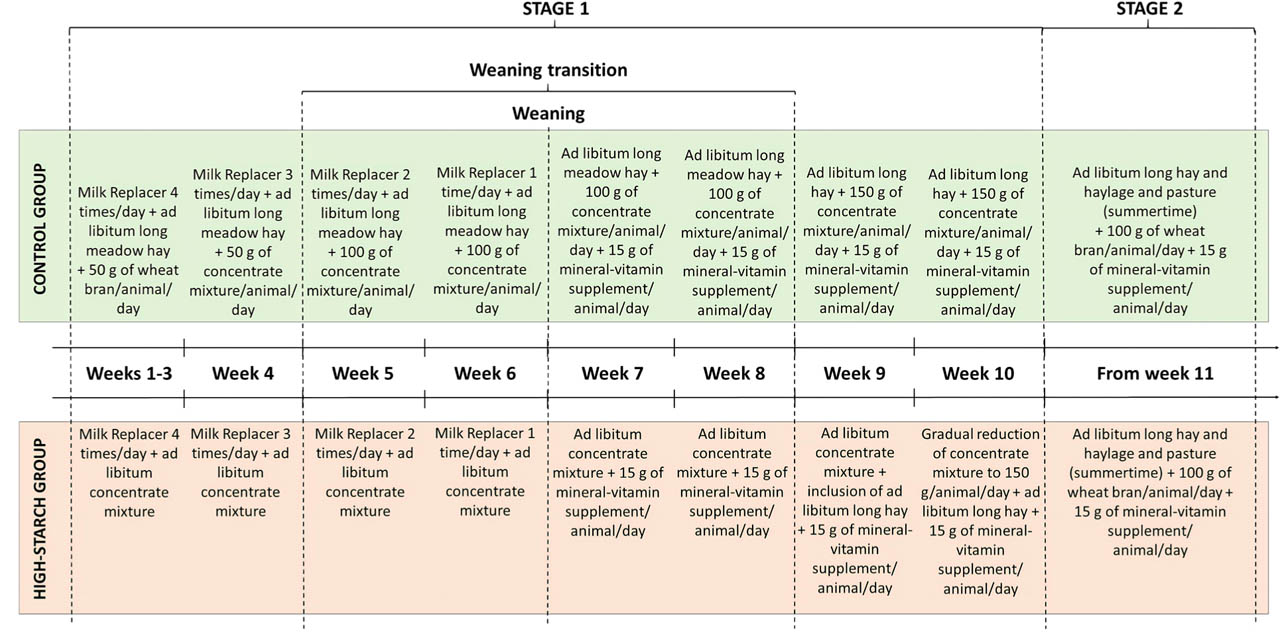
Figure 2.
Details of feeding regimen in the first 11 weeks of the study
In stage 2, lambs were fed moderate quality (~ 10–12% of CP in DM) long hay and haylage offered from hay racks for ad libitum consumption and additionally had access to pasture from 8:00 till 14:00 during summertime (June till September; the same pasture was used with fences preventing physical contact between C and HS animals). Additionally, lambs were fed 15 g of mineral-vitamin supplement/animal/day (Polfamix OK, Trouw Nutrition, Grodzisk Mazowiecki, Poland). The mineral-vitamin supplement was mixed with 100 g of wheat bran and fed from a wooden trough once a day (10:00). Sheep had unlimited access to salt licks. Water was available ad libitum.
In stage 3, sheep were fed individually with coarsely chopped (~ 10 cm length) moderate quality (~ 10% of CP in DM) first cut hay and a mixture of 15 g of mineral-vitamin supplement (Polfamix OK, Trouw Nutrition, Grodzisk Mazowiecki, Poland), 5 g of salt and 50 g of wheat bran/sheep/day. Ad libitum hay feeding was continued for 21 days, which included 14 days of adaptation period and 7 days of voluntary DM intake, digesta retention and DM digestibility measurements. Water was available ad libitum.
In stage 4, each animal was challenged with a high-starch diet. The challenge lasted 7 days and was induced by a rapid shift to a diet containing 50% of barley in offered DM. For that purpose, DM intake was limited to 90% of ad libitum intake during stage 3, and barley was included at 20% of DM on day 1, 30% on day 2, 40% on day 3 and 50% on days 4–7 of the challenge. The inclusion of barley in the diet was based on a study by Schurmann et al. (2014) showing apparent ruminal pH drop and changes in ruminal epithelium functions when animals are rapidly shifted to diet containing 50% of barley. In addition, the duration of high-starch diet was also based on a study by Steele et al. (2011 a) showing that the greatest changes in ruminal pH, ruminal epithelium structure, barrier function and markers of ruminal short-chain fatty acids (SCFA) metabolism occur 7 days after switch to a high-starch diet. Limited intake and also gradual inclusion of high-starch diet over 4 days were used to avoid frothy bloat and to ensure complete feed intake and thus desired proportion of concentrates in consumed DM. Animals were fed once a day at 8:00. During the starch challenge, hay and barley were mixed prior to feeding. Water was available ad libitum.
In stage 1, MR intake was monitored for each pen beginning on week 2 and concentrate (wheat bran or concentrate mixture) intake was monitored daily beginning on week 3, i.e. when its intake by lambs was regular. However, due to scattering of hay by C lambs, hay intake could not be precisely measured and was discontinued. In stage 2, feed intake was not monitored, whereas in stage 3 and 4 intake was monitored daily and individually for each animal. In stage 1, hay and concentrate mixture was sampled three times over the study period. In stage 3 and 4, samples of hay, wheat bran and mineral-vitamin supplement were collected weekly and then composited to yield one sample for a period covering individual observations conducted for rams and ewes. Also, refusals were collected for each animal daily and stored frozen (–20°C), and subsequently composed to yield one sample for each animal. Animals were weighed weekly.
Behavioral observations
The animals were continuously video recorded during the entire stage 1, and one week during month 5 of the study (stage 2). The video recording was done using a digital video recorder (model BCS-0404LE-AN; Dahua Technology) equipped with high resolution color day/night video cameras (EVA-TV-1200iRW; KAM-TECH; wide-angle lens, 2.8–12 mm). One camera was positioned above each group pen in stage 1 and two cameras above group of each treatment in stage 2. Recorded videos were saved on a hard disk. Subsequently, 24 h (from feeding in the morning till feeding the next day) were selected, watched and analyzed for weeks 3, 4, 5, 6 and 7 of the study in stage 1 and week 18 of the study in stage 2. Weeks 3 to 7 covers period of MR feeding and weaning, whereas week 18 was week prior to animals were allowed to access pasture during summertime and also separated based on sex, and thus their behavior could be recorded once kept indoors. For each lamb included in the study, the duration and frequency of the following behaviors was analyzed: idle lying (including sleep), rumination while lying and standing, play, fight, feeding attempts, intake of forage or concentrate, drinking of water, licking of the salt lick as well as atypical behaviors such as licking walls or elements of pens. Used marking (painting) of animals in the later stages did not allow for their clear differentiation during the night period (marking was not visible when cameras switched to the infrared mode). Consequently, observations at week 18 covers 16 h of the day (from 6:00 till 22:00). Because of this reduction of the number of hours that was analyzed, behavior of animals was analyzed over two consecutive days and mean from two days was used for statistical analysis. The fact that data at week 18 was limited to 16 h/day did not allow for analyzing results for pre-weaning and post-weaning period together (i.e. as a repeated measure conducted over a longer time on each animal), as it was done for weeks 3 to 7.
Blood sampling
Blood samples were collected in week 4 of the study (i.e. MR feeding period), two weeks after weaning (i.e. when respective treatments were still continued; C sheep were fed mostly forage whereas HS sheep were fed mostly concentrates), and during month 4 and 6 of the study. Blood samples were collected 2–3 h after feeding with MR (for pre-weaning period) or solid feed (for post-weaning period) from the jugular vein. Tubes containing lithium heparin (plasma separation; SARSTEDT, Nümbrecht, Germany) and plastic tubes without any reagent (serum separation; FL MEDICAL, Torreglia, Italy) were used for blood collection. The heparinized tubes were placed on ice, whereas the plastic tubes were left at room temperature for 2 h to clot. Subsequently, the tubes were centrifuged at 1 800 × g for 10 min using a laboratory centrifuge (MPW MED. INSTRUMENTS, Warsaw, Poland), and the obtained plasma and serum were stored at −20°C for further analysis.
Digesta retention and digestibility
Digesta retention measurements followed procedures described by Przybyło et al. (2019), with minor modifications. Briefly, the lambs were fed three markers on the first day of fecal samples collection: water-soluble cobalt ethylenediaminetetraacetic acid (Co-EDTA, at the dose of 0.03 g/kg of BW) was used as a solute marker representing the fluid digesta phase, chromium (Cr) mordanted hay (<2 mm; 0.2 g/kg of BW) as a marker of small particles, and cerium (Ce) mordanted hay (10 mm; 0.2 g/kg of BW) as a marker of large particles. Markers were prepared as described by Udén et al. (1980). Co-EDTA was dissolved in 8 ml of warm water directly before being fed to the lambs. The markers were mixed with 15 g of wheat bran and fed to the animals at 7:30 and refusals (if noticeable) were collected 30 min after delivery. Relative to the intake of markers, fecal samples were collected two days and one day before marker feeding and also right before marker feeding (the day of marker application) and served to establish baseline concentrations of markers in the feces. Representative fecal samples were collected for 7 consecutive days: 6 samples on day 1 and 2 (8:00, 12:00, 16:00, 20:00, 00:00, 4:00), 4 samples on day 3 and 4 (8:00, 14:00, 20:00, 2:00), 3 samples on day 5 (8:00, 16:00, 00:00), 2 samples on day 6 (8:00, 20:00) and 1 sample on day 7 (8:00). Each sample was weighed. Furthermore, all remaining feces were collected and weighed at these time points in order to determine apparent total tract nutrient digestibility. Samples of feces were kept frozen (–20°C) for further analyses.
Digesta sampling
On the last day of stage 4, the sheep were killed by captive bolt stunning and exsanguination 3 h after feeding. After the killing, the GIT was removed, the reticulorumen was separated and the digesta was collected, mixed thoroughly, squeezed through 2 layers of cheesecloth, and the pH of the resulting fluid was measured (pH meter N517; Meratronic, Warsaw, Poland). Furthermore, 4 mL of fluid was preserved with 0.8 mL of metaphosphoric acid (25% wt/vol) and stored at −20°C for SCFA analysis, and 4 mL was preserved with 0.2 mL of HgCl2 and stored frozen for NH3-N analysis.
Sample analysis, calculations and other measurements
The collected feed samples were analyzed for DM, ash, CP, NDF, acid detergent fiber (ADF) and starch, and refusals for DM as described previously by Świerk et al. (2023). Metabolizable energy (ME) in meadow hay and concentrate mixture used in stage 1 and meadow hay, barley grain and wheat bran used in stage 3 were estimated using PrevAlim (ver. 5) based on INRA (2007). Concentration of passage markers in feces was analyzed as described by Przybyło et al. (2019). Plasma glucose, urea and cholesterol and serum BHBA and non-esterified fatty acids (NEFA) were analyzed in a commercial laboratory (WDL, Gietrzwałd, Poland) on an automatic chemical analyzer (Hitachi 902, Hitachi, Japan; ERBA 640XL, Erba Lachema s.r.o., Czech Republic) using dedicated sets of reagents (Biosystems S.A., Barcelona, Spain, and Diagnostic Systems GmbH, Holzheim, Germany). Dry matter intake was calculated based on known amount of feed offered and refused, and concentration of DM in offered feeds and refusals. Digesta retention was calculated as described in Przybyło et al. (2019) and apparent total tract DM digestibility as the proportion of the difference between DM ingested and excreted in feces of the DM intake. In addition, GIT fill was estimated based on DM intake, DM digestibility and large particle mean retention time (MRT; MRTparticle CeGIT) and expressed as GIT DM content, as described in Munn et al. (2015). Reticuloruminal SCFA concentrations were determined by gas chromatography (3400 CX; Varian Star, Palo Alto, CA, USA) equipped with a flame ionization detector using a DB-FFAP column (30 m × 0.5 mm, J&W Scientific, Folsom, CA. USA) as also previously described in Świerk et al. (2023). In details, rumen fluid was collected and mixed with 25% metaphosphoric acid (Merck KGaA, Darmstadt, Germany) in a 5:1 ml ratio. The samples were then centrifuged at 3000 × g for 10 min using a laboratory centrifuge (MPW MED. INSTRUMENTS, Warsaw, Poland). The clean supernatant was carefully collected and further filtered through syringe filters before being transferred into chromatographic vials for analysis. The analysis was performed with nitrogen as the carrier gas. The column temperature ranged from 90 to 205ºC, while the injector and detector temperatures were set at 200ºC and 250ºC, respectively. The flow rate was maintained at 1 mL/min, and the injection volume was 1 μL. The NH3-N concentration (mg/dL) in RR digesta was determined as described by Conway (1962). For analyses weeks 1 to 4 were considered pre-weaning period, weeks 5 to 8 were considered weaning transition (a period when MR feeding was reduced to two feedings per day and period covering two weeks after weaning), and period from week 10 till end of six month of the study was considered as post-weaning period.
Statistical analysis
All variables were analyzed using the GLIMMIX procedure of SAS (ver. 9.4), assuming a Gaussian distribution of the data. In each analysis, animal was considered an experimental unit, with exception to feed intake in stage 1 that was analyzed using a pen as an experimental unit. For measurements collected in a single time point, the statistical model included fixed effect of the experimental group and random effect of block (batch) and group pen (to which animal was allocated in stage 1) nested within a block. The statistical model used was as follows:
where: μ = overall population mean; TI = main effect of experimental group; Bj = random effect of block; Pk = random effect of pen; and eijkl = residual error.For measurements repeated in time on the experimental unit, effects of time (day or week of the study) and interaction between experimental group and time, and a random effect for _residual_ and sheep specified as subject of analysis were included in the model to account for repeated measure on each animal. The statistical model used was as follows:
where μ = overall population mean; Ti = main effect of experimental group; Bj = random effect of block; Pk = random effect of pen; eijkl = residual error; Dk = fixed effect of time (day or week of the study); and (DTi)Ik = fixed effect of experimental group × time (day or week of the study) interaction.The most optimal covariance structure (simple, compound symmetry, heterogeneous compound symmetry and unstructured) for measurements repeated in time was chosen based on Akaike's criterion. Prior to analysis, assumption of normal distribution of the data was verified using the UNIVARIATE procedure of SAS. If the assumption of the normality was not met, potential outliers were removed or the response distribution in the model was changed to lognormal in case it improved the fit of the model. In case of a significant interaction between main effects, the exact reason for interaction was explored using the SLICE option of the LSMEANS statement. Since the study was conducted on both males and females, the effect of sex was also tested in the statistical model for data collected during stage 1 and 2, i.e. when measurements were collected simultaneously on both males and females. However, this effect was not significant for any parameters (P>0.05) and thus was removed from statistical models. On the other hand, because purebred and crossbred sheep were not evenly distributed within sex of sheep, the effect of breed was not considered in the statistical model. Furthermore, because in stage 3 and 4 measurements were conducted separately on rams and ewes, and there was a gap of more than one month between those measurements, results for stage 3 and 4 were analyzed separately for each sex. Data are presented as least square means and corresponding standard errors. Significance was declared when P≤0.05, and a tendency was declared when 0.05<P≤0.10.
Results
One ram from HS died in the third week of the study due to pneumonia and one ewe from HS was excluded from the study during stage 3 due to a leg injury. Thus, the data sets for stage 1 and 2 do not include one animal from HS and the data set for stage 3 does not include two animals from HS.
The composition of feeds used in stage 1 and 3 is presented in Table 1. Initial BW, BW at initiation of weaning transition, at weaning, at the end of weaning transition, and at the end of 6 months of the study did not differ between groups (P≥0.11; Table 2). However, over the whole 6 months, BW was subject to a group × time interaction (P<0.01), which was a result of a numerically (P=0.11) greater BW of HS on the last day of the weaning transition (Figure 3 A). Correspondingly, the average daily gain (ADG) did not differ between groups before weaning, after weaning and in the whole 6 months of the study (P≥0.48), but tended to be greater for HS (P=0.08) during the weaning transition, which resulted in a significant group × time interaction for ADG in the whole investigated period (P<0.01).
Table 1.
Chemical composition of experimental feeds
| Item | Stage 1 | Stage 3 and 4 | |||
|---|---|---|---|---|---|
| meadow hay | concentrate mixture1 | meadow hay | barley | wheat bran | |
| DM2 (%) | 90.5±1.4 | 91.2±1.3 | 90.6±0.7 | 89.2±0.1 | 89.1±0.1 |
| Ash (%) | 7.9±0.4 | 4.9±0.4 | 6.9±1.2 | 3.4±0.2 | 5.0±0.5 |
| CP3 (% DM) | 10.4±0.3 | 22.1±5.7 | 9.4±0.3 | 11.4±0.2 | 18.0±1.2 |
| NDF4 (% DM) | 61.4±1.9 | 24.0±4.2 | 64.3±2.5 | 22.9±0.3 | 38.2±1.6 |
| ADF5 (% DM) | 36.5±2.2 | 10.7±1.8 | 43.6±1.8 | 11.3±0.8 | 12.7±1.3 |
| Starch (% DM) | nd6 | 33.7±5.4 | nd | 40.1±2.4 | 24.3±0.9 |
| ME7 (MJ/kg DM) | 8.1±0.2 | 12.7±0.2 | 7.7±0.1 | 12.1±0.1 | 10.5±1.4 |
Table 2.
Body weight and body weight gain of sheep over six months of the study
| Item | Group1 | SE | P-value | |||
|---|---|---|---|---|---|---|
| C | HS | group | time | group × time | ||
| Body weight (kg) | ||||||
| initial | 6.15 | 6.37 | 0.340 | 0.65 | – | – |
| start of weaning transition | 11.8 | 12.6 | 0.72 | 0.45 | ||
| weaning | 15.5 | 16.0 | 0.91 | 0.69 | – | – |
| end of weaning transition | 16.2 | 18.2 | 0.85 | 0.11 | – | – |
| end of six months | 26.4 | 27.9 | 1.15 | 0.39 | – | – |
| mean over six months | 17.8 | 19.5 | 0.84 | 0.16 | <0.01 | <0.01 |
| Average daily gain (g/day)2 | ||||||
| before weaning transition | 202 | 221 | 25.8 | 0.61 | <0.01 | 0.33 |
| during weaning transition | 156 | 199 | 17.0 | 0.08 | <0.01 | <0.01 |
| after weaning transition | 97.4 | 92.3 | 13.0 | 0.78 | <0.01 | 0.13 |
| mean over six months | 126 | 133 | 7.78 | 0.48 | <0.01 | <0.01 |
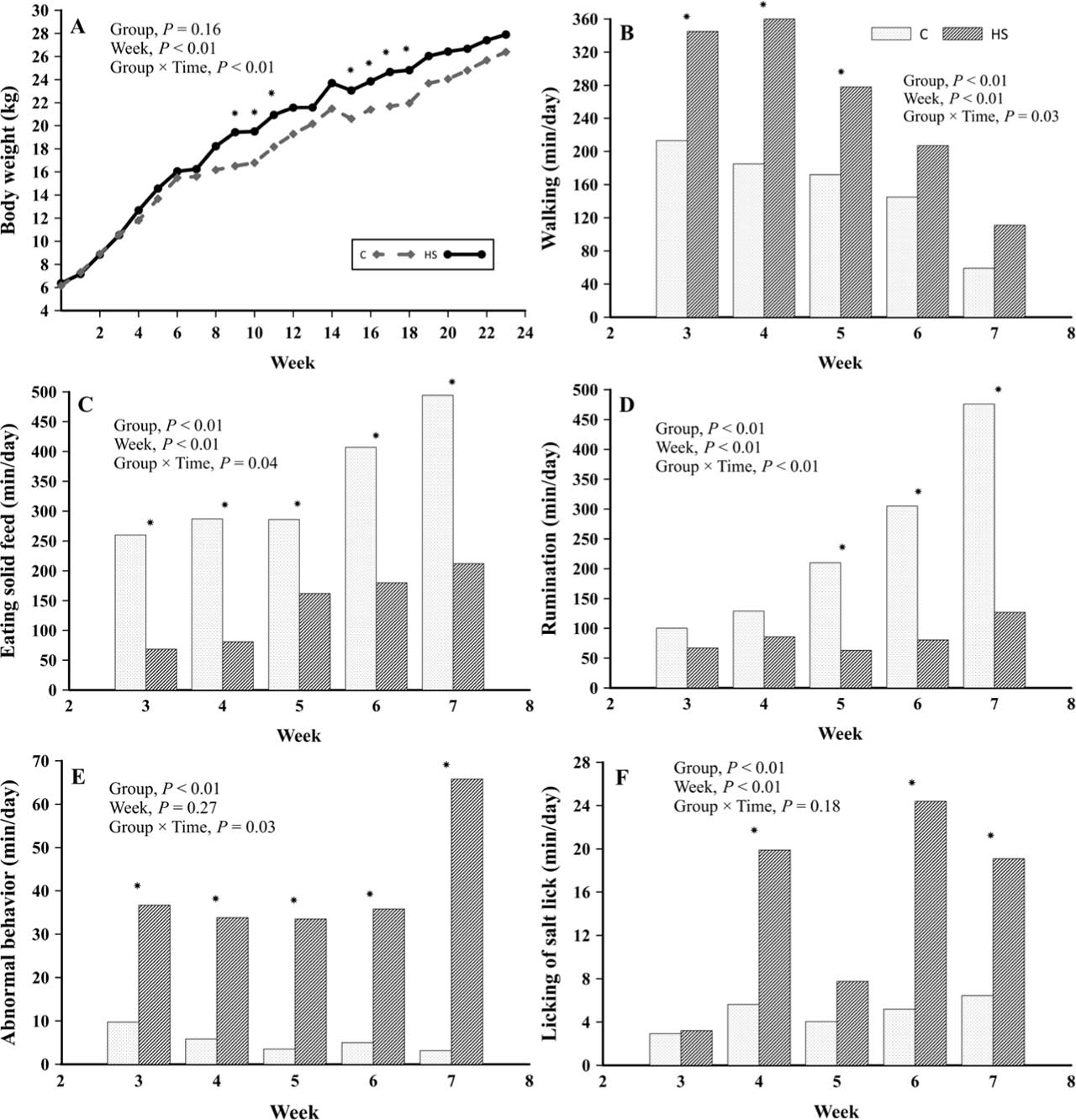
Figure 3.
Body weight over 6 months of study (A) and time spent walking (B), eating solid feed (C), ruminating (D), abnormal behavior (E) and licking of salt lick (F). C = sheep fed milk replacer and mostly hay in first weeks of life; HS = sheep fed milk replacer and mostly mixture of high-starch concentrate in first weeks of life. *Means within the time period differ significantly (P≤0.05)
As per design, absolute (L/day) MR intake was more or less similar between week 2 and 5, and then decreased (effect of time, P<0.01; Table 3). However, when expressed relative to BW (% of BW), MR intake decreased beginning on week 5 (effect of time, P<0.01). In the whole study period, absolute MR intake was higher for C (on average 1.21 vs. 1.17 L/day; data not shown; P=0.01) but did not differ between treatments relative to BW (on average 11.2 vs. 10.8% of BW; data not shown; P=0.56).
Table 3.
Milk replacer and concentrate intake in stage 1
| Item | Group1 | SE | P-value | |||
|---|---|---|---|---|---|---|
| C | HS | group | time | group × time | ||
| Milk replacer intake (L/day) | ||||||
| week 2 (4× MR2 feeding) | 1.13 | 1.16 | 0.009 | 0.01 | <0.01 | 0.79 |
| week 3 (4× MR feeding) | 1.31 | 1.26 | ||||
| week 4 (3× MR feeding) | 1.37 | 1.36 | ||||
| week 5 (2× MR feeding) | 1.33 | 1.26 | ||||
| week 6 (1× MR feeding) | 0.91 | 0.81 | ||||
| Milk replacer intake (% BW) | ||||||
| week 2 (4× MR feeding) | 13.9 | 14.6 | 0.552 | 0.56 | <0.01 | 0.76 |
| week 3 (4× MR feeding) | 13.4 | 13.0 | ||||
| week 4 (3× MR feeding) | 12.2 | 11.8 | ||||
| week 5 (2× MR feeding) | 10.4 | 9.24 | ||||
| week 6 (1× MR feeding) | 6.25 | 5.26 | ||||
| Concentrate intake3 (kg/day) | ||||||
| week 3 (4× MR feeding) | 0.05 | 0.13* | 0.022 | <0.01 | <0.01 | <0.01 |
| week 4 (3× MR feeding) | 0.05 | 0.15* | ||||
| week 5 (2× MR feeding) | 0.09 | 0.17* | ||||
| week 6 (1× MR feeding) | 0.10 | 0.25* | ||||
| week 7 (weaning) | 0.10 | 0.33* | ||||
| week 8 | 0.10 | 0.43* | ||||
| week 9 | 0.14 | 0.49* | ||||
| week 10 | 0.15 | 0.26 | ||||
| Concentrate intake3 (% BW) | ||||||
| week 3 (4× MR feeding) | 0.51 | 1.27* | 0.155 | <0.01 | <0.01 | <0.01 |
| week 4 (3× MR feeding) | 0.44 | 1.30* | ||||
| week 5 (2× MR feeding) | 0.76 | 1.20 | ||||
| week 6 (1× MR feeding) | 0.68 | 1.64* | ||||
| week 7 (weaning) | 0.64 | 2.04* | ||||
| week 8 | 0.65 | 2.47* | ||||
| week 9 | 0.89 | 2.61* | ||||
| week 10 | 0.90 | 1.30 | ||||
By the beginning of week 3, the concentrate fed to C (50 g/day/lamb) was fully consumed. Each animal approached the feeder and spent at least 20 min eating those feeds. Therefore, substantial variation of its intake between C animals can be excluded. In weeks 3 to 9, concentrate intake was higher for HS compared to C (P<0.01; Table 3).
Plasma glucose was the highest during the MR feeding period and decreased gradually thereafter (effect of time, P<0.01; Table 4). Overall, its concentration was higher for HS (P=0.03); however, this was mostly a result of higher plasma glucose concentration for HS pre-weaning and during weaning transition. On the other hand, plasma glucose was lower for HS at month 6 of the study (group × time interaction, P<0.01). Plasma cholesterol was also the highest during the MR feeding period and decreased thereafter (effect of time, P<0.01). In the whole investigated period, it was higher for C (P<0.01), with differences between treatments apparent especially during weaning transition and month 6 (group × time interaction, P<0.01). Plasma urea was lowest during the MR feeding period and increased thereafter (effect of time, P<0.01); however, there were no differences between treatments. Serum BHBA was lowest during the MR feeding period, then increased during weaning and decreased thereafter (effect of time, P<0.01). Overall, there were no differences between treatments for BHBA concentration. Serum NEFA were lower in month 1 and 2, but higher in month 4 and 6 (effect of time, P<0.01). Over the whole investigated period, there were no differences between treatments; however, NEFA were higher for C during the MR feeding period, weaning transition and month 6, but lower during month 4 (group × time interaction, P<0.01).
Table 4.
Plasma glucose, cholesterol and urea and serum β-hydroxybutyric acid and free fatty acids concentrations in sheep in selected time points over 6 months of the study
| Item | Group1 | SE | P-value | |||
|---|---|---|---|---|---|---|
| C | HS | group | time | group × time | ||
| 1 | 2 | 3 | 4 | 5 | 6 | 7 |
| Glucose (mg/dL) | ||||||
| month2 1 (MR3 feeding period) | 113.8 | 129.9* | 2.21 | 0.03 | <0.01 | <0.01 |
| month 2 (weaning)4 | 89.5 | 105.9* | ||||
| month 4 | 85.2 | 79.8 | ||||
| month 6 | 69.0 | 65.3* | ||||
| Cholesterol (mg/dL) | ||||||
| month 1 (MR feeding period) | 67.2 | 62.3 | 1.66 | <0.01 | <0.01 | <0.01 |
| month 2 (weaning) | 57.3 | 32.7* | ||||
| month 4 | 55.2 | 56.0 | ||||
| month 6 | 49.7 | 43.1* | ||||
| Urea (mg/dL) | ||||||
| month 1 (MR feeding period) | 26.9 | 27.8 | 2.30 | 0.90 | <0.01 | 0.15 |
| month 2 (weaning) | 27.4 | 31.4 | ||||
| month 4 | 33.6 | 33.6 | ||||
| month 6 | 39.7 | 35.6 | ||||
| BHBA5 (mmol/L) | ||||||
| month 1 (MR feeding period) | 0.22 | 0.15 | 0.016 | 0.60 | <0.01 | 0.23 |
| month 2 (weaning) | 0.39 | 0.37 | ||||
| month 4 | 0.24 | 0.27 | ||||
| month 6 | 0.24 | 0.25 | ||||
| NEFA6 (mmol/L) | ||||||
| month 1 (MR feeding period) | 0.21 | 0.10* | 0.03 | 0.97 | <0.01 | <0.01 |
| month 2 (weaning) | 0.21 | 0.08* | ||||
| month 4 | 0.28 | 0.67* | ||||
| month 6 | 0.58 | 0.43* | ||||
1 C = sheep fed milk replacer and hay in first weeks of life; HS = sheep fed milk replacer and mostly high-starch concentrate in first weeks of life.
HS in stage 1 spent more time walking (P<0.01; Figure 3 B) and standing (P<0.01; Table 5), particularly between weeks 3 and 7 (group × time interaction, P≤0.03). Walking time was also longer for HS in stage 2 (week 18 of the study; P<0.01) but the opposite difference was found for standing time, which was shorter for HS (P=0.01; Table 7). HS spent less time consuming MR at weeks 4 and 6 (group × time interaction, P=0.04; Table 6). As per experimental design, HS spent more time consuming concentrate during stage 1 (P<0.01), with differences being the most apparent beginning on week 5 (group × time interaction, P<0.01; Table 6). However, time spent eating solid feed [concentrate (HS) or concentrate plus hay (C)] was longer for C during stage 1 (P<0.01), with the most apparent differences observed in weeks 6 and 7 (group × time interaction, P=0.04; Figure 3 C). This difference in time spent consuming solid feed in stage 1 was not maintained in stage 2 (P≥0.20). C spent more time ruminating in stage 1 (P<0.01; Figure 3 D), which was particularly due to longer time spent ruminating while lying (i.e. rumination while lying accounted for over 98% of total rumination time in last weeks of stage 1; Table 5). The difference between groups was most apparent from week 5 onwards (group × time interaction, P<0.01). However, opposite results were found for stage 2, i.e. HS spent more time ruminating while lying and ruminating in general (P≤0.04; Table 7). HS spent more time performing abnormal behaviors (P<0.01; Figure 3 E) and licking the salt lick in stage 1 (P<0.0; Figure 3 F). Salt licking was also longer for HS in stage 2 (P<0.01; Table 7). For other investigated parameters, no differences between treatments were found. Although some significant interactions between effect of group and time were detected, differences between specific time points were not significant.
Table 5.
Duration of standing, standing with rumination, lying, lying with rumination and sleeping by sheep in stage 1
| Item | Group1 | SE | P-value | |||
|---|---|---|---|---|---|---|
| C | HS | group | time | group × time | ||
| Standing (min/day) | ||||||
| week2 3 (4× MR3 feeding) | 23.8 | 111* | 27.00 | <0.01 | <0.01 | <0.01 |
| week 4 (3× MR feeding) | 68.5 | 67.2 | ||||
| week 5 (2× MR feeding) | 43.4 | 71.9* | ||||
| week 6 (1× MR feeding) | 60.8 | 137* | ||||
| week 7 (weaning) | 28.1 | 175* | ||||
| Standing with rumination (min/day) | ||||||
| week 3 (4× MR feeding) | 0.33 | 0.00 | 2.571 | 0.10 | <0.01 | <0.01 |
| week 4 (3× MR feeding) | 8.83 | 1.27 | ||||
| week 5 (2× MR feeding) | 0.67 | 3.45 | ||||
| week 6 (1× MR feeding) | 16.1 | 1.36* | ||||
| week 7 (weaning) | 11.8 | 1.82* | ||||
| Lying (min/day) | ||||||
| week 3 (4× MR feeding) | 566 | 639 | 92.6 | 0.78 | <0.01 | 0.01 |
| week 4 (3× MR feeding) | 583 | 533 | ||||
| week 5 (2× MR feeding) | 731 | 635 | ||||
| week 6 (1× MR feeding) | 448 | 557 | ||||
| week 7 (weaning) | 703 | 756 | ||||
| Lying with rumination (min/day) | ||||||
| week 3 (4× MR feeding) | 99.8 | 67.0 | 20.70 | <0.01 | <0.01 | <0.01 |
| week 4 (3× MR feeding) | 120 | 82.6 | ||||
| week 5 (2× MR feeding) | 209 | 57.6* | ||||
| week 6 (1× MR feeding) | 289 | 77.4* | ||||
| week 7 (weaning) | 464 | 123* | ||||
| Sleeping (min/day) | ||||||
| week 3 (4× MR feeding) | 328 | 216 | 79.79 | 0.52 | <0.01 | <0.01 |
| week 4 (3× MR feeding) | 253 | 265 | ||||
| week 5 (2× MR feeding) | 170 | 217 | ||||
| week 6 (1× MR feeding) | 341 | 277 | ||||
| week 7 (weaning) | 137 | 57.3 | ||||
Table 6.
Duration of milk replacer intake, hay intake, concentrate intake and drinking of water by sheep in stage 1
| Item | Group1 | SE | P-value | |||
|---|---|---|---|---|---|---|
| C | HS | group | time | group × time | ||
| Milk replacer intake (min/day) | ||||||
| week2 3 (4× MR3 feeding) | 10.3 | 11.9 | 0.36 | 0.18 | <0.01 | 0.04 |
| week 4 (3× MR feeding) | 9.50 | 7.05* | ||||
| week 5 (2× MR feeding) | 7.25 | 6.81 | ||||
| week 6 (1× MR feeding) | 4.67 | 2.55* | ||||
| Hay intake (min/day) | ||||||
| week 3 (4× MR feeding) | 211 | – | 8.66 | – | <0.01 | – |
| week 4 (3× MR feeding) | 249 | – | ||||
| week 5 (2× MR feeding) | 266 | – | ||||
| week 6 (1× MR feeding) | 371 | – | ||||
| week 7 (weaning) | 476 | – | ||||
| Concentrate intake4 (min/day) | ||||||
| week 3 (4× MR feeding) | 48.7 | 68.3 | 11.07 | <0.01 | <0.01 | <0.01 |
| week 4 (3× MR feeding) | 37.8 | 79.9 | ||||
| week 5 (2× MR feeding) | 19.8 | 162* | ||||
| week 6 (1× MR feeding) | 35.6 | 179* | ||||
| week 7 (weaning) | 18.2 | 211* | ||||
| Drinking of water (min/day) | ||||||
| week 3 (4× MR feeding) | 3.22 | 4.85 | 0.48 | 0.55 | 0.32 | 0.35 |
| week 4 (3× MR feeding) | 3.45 | 4.32 | ||||
| week 5 (2× MR feeding) | 3.09 | 2.27 | ||||
| week 6 (1× MR feeding) | 4.30 | 3.09 | ||||
| week 7 (weaning) | 5.94 | 3.61 | ||||
1 C = sheep fed milk replacer and mostly hay in first weeks of life; HS = sheep fed milk replacer and mostly high-starch concentrate in first weeks of life.
Table 7.
Duration of standing, standing with rumination, lying, lying with rumination, sleeping, hay intake, concentrate intake and drinking of water by sheep in stage 21
| Item | Group2 | SE | P-value | |
|---|---|---|---|---|
| C | HS | |||
| Standing (min/day) | 30.8 | 10.8 | 5.69 | 0.01 |
| Standing with rumination (min/day) | 8.62 | 8.79 | 2.656 | 0.96 |
| Lying (min/day) | 353 | 357 | 17.7 | 0.86 |
| Lying with rumination (min/day) | 111 | 198 | 28.1 | 0.04 |
| Rumination (total time; min/day) | 123 | 209 | 29.4 | 0.03 |
| Walking (min/day) | 43.2 | 75.5 | 7.15 | <0.01 |
| Abnormal behavior (min/day) | 2.07 | 1.00 | 0.502 | 0.19 |
| Hay intake (min/day) | 401 | 375 | 13.8 | 0.20 |
| Concentrate intake (min/day) | 31.9 | 27.7 | 2.35 | 0.23 |
| Drinking of water (min/day) | 4.24 | 4.94 | 0.512 | 0.35 |
| Licking of salt lick (min/day) | 0.91 | 5.36 | 0.755 | <0.01 |
Voluntary DM intake of hay in stage 3, both absolute (kg/day) and relative (% of BW) and BW did not differ between treatments (P≥0.25), irrespective of sex (Table 8 and 9). Furthermore, apparent total tract DM digestibility did not differ between treatments, for both rams and ewes (P≥0.74). For rams, mean retention times, selectivity factors and GIT fill also did not differ between treatments (P≥0.34). For ewes, fluid and small particle mean retention time in the reticulorumen tended to (P≤0.10), and large particle mean retention time in the reticulorumen was (P=0.04) significantly longer for C. Furthermore, long particle retention in the whole GIT and GIT fill expressed as % of BW tended (P≤0.09) to be higher for C. However, absolute GIT fill (kg of DM) did not differ between treatments (P=0.62).
Table 8.
Body weight, dry matter intake, dry matter digestibility and digesta retention in stage 3 – rams
| Item | Group1 | SE | P-value | |
|---|---|---|---|---|
| C | HS | |||
| Body weight (kg) | 27.5 | 29.9 | 1.32 | 0.25 |
| DM intake (kg/day) | 0.99 | 1.07 | 0.057 | 0.35 |
| DM intake (% BW) | 3.60 | 3.57 | 0.098 | 0.81 |
| DM digestibility (%) | 50.6 | 50.0 | 1.171 | 0.74 |
| Digesta retention | ||||
| MRT2solute-CoGIT3 (h) | 27.8 | 27.8 | 0.94 | 0.99 |
| MRTparticle-CrGIT (h) | 41.3 | 41.0 | 2.13 | 0.92 |
| MRTparticle-CeGIT (h) | 44.9 | 43.3 | 1.47 | 0.47 |
| SF4 GITCr/Co6 | 1.49 | 1.47 | 0.037 | 0.81 |
| SF5 GITCe/Cr6 | 1.09 | 1.06 | 0.021 | 0.34 |
| MRTsolute-CoRR7 (h) | 18.9 | 18.3 | 1.81 | 0.82 |
| MRTparticle-CrRR (h) | 32.4 | 31.6 | 3.00 | 0.85 |
| MRTparticle-CeRR (h) | 36.0 | 33.9 | 2.34 | 0.54 |
| SF RRCr/Co6 | 1.71 | 1.71 | 0.054 | 0.99 |
| SF RRCe/Cr6 | 1.12 | 1.08 | 0.028 | 0.42 |
| GIT fill (kg DM) | 1.33 | 1.40 | 0.085 | 0.58 |
| GIT fill (% BW) | 4.83 | 4.63 | 0.190 | 0.50 |
Table 9.
Body weight, dry matter intake, dry matter digestibility and digesta retention in stage 3 – ewes
| Item | Group1 | SE | P-value | |
|---|---|---|---|---|
| C | HS | |||
| Body weight (kg) | 30.4 | 30.2 | 3.79 | 0.97 |
| DM intake (kg/day) | 1.16 | 1.17 | 0.121 | 0.95 |
| DM intake (% BW) | 3.84 | 3.92 | 0.26 | 0.81 |
| DM digestibility (%) | 50.1 | 49.6 | 2.04 | 0.88 |
| Digesta retention | ||||
| MRT2 solute-CoGIT3 (h) | 28.9 | 26.7 | 1.78 | 0.36 |
| MRTparticle-CrGIT (h) | 40.5 | 38.3 | 1.24 | 0.24 |
| MRTparticle-CeGIT (h) | 46.6 | 40.6 | 3.36 | 0.09 |
| SF4 GITCr/Co6 | 1.41 | 1.44 | 0.063 | 0.78 |
| SF5 GITCe/Cr6 | 1.14 | 1.07 | 0.063 | 0.30 |
| MRTsolute-CoRR7 (h) | 20.6 | 17.4 | 1.56 | 0.10 |
| MRTparticle-CrRR (h) | 32.4 | 29.3 | 1.01 | 0.07 |
| MRTparticle-CeRR (h) | 38.3 | 31.5 | 3.19 | 0.04 |
| SF RRCr/Co6 | 1.58 | 1.66 | 0.096 | 0.58 |
| SF RRCe/Cr6 | 1.18 | 1.09 | 0.077 | 0.34 |
| GIT fill (kg DM) | 1.62 | 1.47 | 0.208 | 0.62 |
| GIT fill (% BW) | 5.33 | 4.81 | 0.172 | 0.07 |
After 3 days of high-starch challenge, feed was fully consumed by all animals and thus DM intake during stage 4 is not presented. Prior to killing on the last day of the challenge, DM intake did not differ between treatments, both for rams (0.75 and 0.79 kg DM/day for C and HS, respectively, P=0.71; Table 10) and for ewes (0.72 vs. 0.74 for C and HS, respectively, P=0.88; Table 11). On average, from feeding till killing, 90.4% of offered DM was consumed by rams and 75.5% by ewes. Since DM intake prior to killing could affect results of rumen fermentation, it was included in the statistical model, as a covariate. However, its effect turned out to be insignificant for near all analyzed parameters (except for the molar proportion of isobutyric acid in total SCFA for rams and of valeric acid in total SCFA for ewes) and thus was removed from the model. Reticuloruminal pH and molar proportion of valerate, isovalerate and isobutyrate in total SCFA were lower for HS in rams (P≤0.04). No differences in reticuloruminal fermentation between treatments were observed in ewes.
Table 10.
Rumen fermentation parameters on the last day of stage 4 – rams
| Item | Group1 | SE | P-value | |
|---|---|---|---|---|
| C | HS | |||
| Reticuloruminal pH | 5.98 | 5.80 | 0.033 | <0.01 |
| Reticuloruminal SCFA2 (mmol/L) | 139 | 143 | 5.4 | 0.65 |
| acetate (%) | 61.4 | 61.4 | 1.00 | 0.97 |
| propionate (%) | 24.9 | 25.2 | 1.44 | 0.90 |
| butyrate (%) | 11.4 | 11.5 | 0.77 | 0.93 |
| valerate (%) | 1.29 | 1.14 | 0.061 | 0.04 |
| isobutyrate (%) | 0.47 | 0.38 | 0.029 | 0.02 |
| isovalerate (%) | 0.53 | 0.38 | 0.031 | 0.01 |
| Reticuloruminal NH3-N (mg %) | 22.4 | 21.1 | 1.50 | 0.39 |
Table 11.
Rumen fermentation parameters on the last day of stage 4 – ewes
| Item | Group1 | SE | P-value | |
|---|---|---|---|---|
| C | HS | |||
| Reticuloruminal pH | 5.60 | 5.73 | 0.225 | 0.52 |
| Reticuloruminal SCFA2 (mmol/L) | 123 | 125 | 4.5 | 0.83 |
| acetate (%) | 61.8 | 61.3 | 1.73 | 0.78 |
| propionate (%) | 25.0 | 24.4 | 1.33 | 0.74 |
| butyrate (%) | 11.4 | 12.2 | 1.11 | 0.60 |
| valerate (%) | 1.26 | 1.17 | 0.931 | 0.75 |
| isobutyrate (%) | 0.41 | 0.35 | 0.058 | 0.27 |
| isovalerate (%) | 0.35 | 0.37 | 0.105 | 0.78 |
| Reticuloruminal NH3-N (mg %) | 15.1 | 19.7 | 4.23 | 0.29 |
Discussion
In the current study, sheep were fed either a forage-based or a concentrate-based diet for a period that encompassed the pre-weaning stage of rearing and the weaning transition. Hay or high-starch concentrate feeding was continued for 4 weeks after weaning, ensuring that those diets were still consumed in a period of intensive structural and functional rumen development (Meale et al., 2017; Gelsinger et al., 2019; van Niekerk et al., 2021), i.e. when their impact on the gastrointestinal tract would still be apparent. Furthermore, for the first 3 weeks of the study, C animals were fed hay with only a small inclusion of wheat bran, to limit starch intake as much as possible in a period when forestomach development is initiated, and long hay was used to encourage roughage intake and to initiate its impact on the GIT development beginning on the first days of the study, based on results of the study by Webb et al. (2014) indicating that young ruminants prefer long hay over chopped hay. On the other hand, the diet fed to HS animals contained only small inclusion of chopped hay (5% of the diet), which was included in the diet to ensure that animals were not deprived of forage. This was justified due to ethical reasons and allowed to cover at least basic requirements of animals for physically effective components of the diet (Khan et al., 2016; Soltani et al., 2017; Poczynek et al., 2020). Furthermore, the period of interruption of concentrate feeding (for 4.5 and 6.5 months for rams and ewes, respectively) was considered sufficient to determine whether feeding a concentrate-based diet early in life has a long-term effect on rumen structure and function later in life, based on results of studies in which differences induced early in life due to different nutritional intervention were still present several months later (Yáñez-Ruiz et al., 2010; Belanche et al., 2018, 2019). Thus, experimental diets differed substantially between treatments, which allows testing whether the main source of nutrients (forage or high-starch concentrate) offered in the first weeks of life has a long-term impact on sheep GIT function, and consequently feed intake, nutrient digestibility, and also the response of the rumen to high-starch diet later in life.
Prior to an in-depth results discussion, several weaknesses of the experimental model have to be mentioned. First, in stage 1, hay fed to C could limit protein and energy intake by lambs, due to its moderate quality. This could be especially an issue during the weaning transition as nutritional deficiencies during this period may have a long-term impact on, for example, the growth performance of animals (Steele et al., 2017). However, we did not observe BW loss of C during weaning transition, which was prevented by a small inclusion of the concentrate mixture in the diet, and estimated nutrient intake covered nutritional needs of animals (INRA, 2019). Moreover, not only C animals but also HS animals likely met with nutritional challenges once transitioned to forage-only diet, as indicated by growth stagnation in weeks 9 and 10 of the study (Figure 1 A) and high NEFA concentrations after weaning (Table 4). This occurred although the concentrate mixture was removed from their diet not abruptly and in parallel to the offer of forage. In general, limiting a potentially confounding effect of differences in nutrient intake during the weaning transition when two substantially different diets are fed pre-weaning is difficult, and must be taken into account when interpreting results of such studies. Second, wheat bran was fed to C in first weeks of the study but not to HS. While only a limited amount of wheat bran was fed and there was justification for such a feeding strategy (see Material and methods and also Results sections), the impact on investigated parameters is difficult to predict. However, prior to concentrate mixture inclusion into the diet of C, wheat bran intake was only 50 g/day/animal, nearly three times less than in HS, and considering less starch in wheat bran than in the concentrate mixture, starch intake by C was substantially less than in HS (e.g. in week 4 of the study, that is when concentrate mixture was fed to both treatments, starch intake was 50.5 vs. 16.9 g/day/animal for HS and C, respectively). Third, only 2 group pens were used per treatment, and to increase the power of analysis, animal was used as experimental unit for BW and ADG analysis, which should not be considered an ideal solution. However, growth performance was not the most important aim of the current study. Fourth, reticuloruminal pH was measured only 3 h after feeding, which may not represent reticuloruminal pH over the whole day. Fifth, lambs were kept in group pens, which could result in substantial differences of concentrate and starch intake between animals. This could be especially a concern for the C group, which was offered only limited amount of concentrate. However, as already mentioned, the mixture of high-starch concentrates was included in the diet of C once all animals were approaching the feeder after feed allocation and consumed concentrate, limiting such a possibility. Last, in the last stages of the study males and females were kept and investigated separately, and thus effect of sex could not be accounted for in the statistical analysis.
As expected, HS animals periodically grew better than C animals, particularly during weaning (tendency to higher daily gains of HS lambs; P=0.08). This is in line with results of studies conducted on sheep (Yáñez-Ruiz et al., 2008) and cattle (Khan et al., 2020; McCoard et al., 2023) and is a logical consequence of lower energy and protein density in the forage-based diet. It is particularly important to note that the hay offered pre-weaning contained much less protein (10.4 vs. 22.1% of DM) and energy (8.1 vs. 12.7 MJ ME/kg of DM) and substantially more NDF (61.4 vs. 24% of DM) compared to the mixture of concentrates. It is well established that the bulkiness of forage limits DM intake by newborn ruminants (Stabo et al., 1966; Khan et al., 2020; Terler et al., 2022; McCoard et al., 2023), particularly when its quality is low, i.e. the concentration of protein is low while that of fiber is high (Terler et al., 2022, 2023). Nevertheless, C animals were able to catch up growth loss in the later stages of the study, which was in line with results of others when forage or concentrate-based solid feed was offered pre-weaning to cattle (Khan et al., 2020; McCoard et al., 2023). Also, Yáñez-Ruiz et al. (2008) showed that sheep fed a hay-based diet grew less rapidly pre-weaning but had higher ADG after weaning despite a similar feed intake. However, considering that only 2 pens/treatment were used in the current study, growth data in stage 1 should be interpreted with caution. Moreover, our results showed that at least ewes in the C group could have longer digesta retention time in the reticulorumen, and thus greater GIT fill, which could affect BW of animals.
It can be speculated that when forage-based diets are fed pre-weaning, this may better prepare animals for such diets later in life, as shown in cattle (Khan et al., 2020; McCoard et al., 2023) and also in the current study, based on similar final BW of C and HS. The lack of differences of BW in a long-term perspective is especially important considering the traditional approach of transitioning sheep to forage-based diets after weaning, in order to reduce feeding costs (Belanche et al., 2019; Carballo et al., 2019). On the other hand, the lack of differences of voluntary DM intake in stage 3 may suggest that structural and particularly functional differences in terms of GIT development expected early in life due to different composition of the diet disappeared after several months. Specifically, feeding concentrates early in life substantially increases the reticulorumen capacity (Stabo et al., 1966) and affects the development of ruminal epithelium (Connor et al., 2013; Terler et al., 2023) and ruminal microbial community (Yáñez-Ruiz et al., 2008). In fact, full or empty reticulorumen mass did not differ between treatments on the last day of the study (P≥0.33; data not presented). However, longer retention time in the reticulorumen, particularly of large particles, was observed for C animals in stage 3. Our study cannot answer whether such an impact of early life diet can be expected mostly in ewes or is changing with age (due to the fact that voluntary DM intake and digesta retention were investigated at higher age in ewes than in rams). That said, sex-related differences in digestive physiology and metabolism are well known and may contribute to variations in nutrient utilization efficiency between males and females (Gindri et al., 2020). For example, studies on goats (Silva et al., 2018) and cattle (He et al., 2018) demonstrate that sex significantly influences metabolic responses, with males and females exhibiting distinct patterns in nutrient utilization, rumen fermentation, and energy metabolism. These findings collectively emphasize that physiological and metabolic variations between sexes must be accounted for to fully understand the impact of diet on animal performance and health. However, Belanche et al. (2018, 2019) found that differences in e.g. rumen tissue weight, nutrient digestibility or ruminal microbial community between lambs kept with their mothers pre-weaning or reared artificially were still present 4 months after weaning. Also, short-term exposure to concentrate in first weeks of life had lasting effect on the rumen epithelium development (Ortega-Reyes et al., 1992). However, both in the current study as well as in that of Belanche et al. (2018, 2019) and in some of several studies conducted by Ortega-Reyes et al. (1992) those differences in GIT structure and function developed as a response to the nutrition early in life had no substantial impact on production parameters later in life, which may argue in favor of a diet based on forage for sheep. However, this may be in contrast to cattle, for which a more recent study showed that early life modulation of rumen microbial composition may have long-term impact on production parameters, despite the transient nature of the impact on the microbiome (Huuki et al., 2022).
A lack of forage in the diet has been repeatedly shown to increase the time newborn ruminants spent performing abnormal behaviors, such as suckling or biting pen elements or tongue rolling (Terré et al., 2013; Horvath and Miller-Cushon, 2017; Poczynek et al., 2020), similarly to what was found in the current study. This observation was accompanied with longer time HS animals spent walking. Newborn cattle spend several minutes grazing even in the first week of life, which linearly increases with age and reaches 70% of time at 100 days of life (Nicol and Sharafeldin, 1975). Moreover, first episodes of rumination can be observed already in the first 2–3 weeks of life (Žitnan et al., 1998; Terré et al., 2013). A lack of forage does not allow newborn ruminants to perform behaviors that would be naturally performed, leading to the allocation of time to other, alternative activities. In stage 2, HS animals were still more active (as indicated by greater walking time) and spent more time licking salt lick. However, the time spent performing abnormal behaviors was no longer different, in line with results of studies of Downey and Tucker (2023) in which providing hay to newborn calves had no long-term advantages in terms of limiting abnormal behavior of animals. This indicates that the transition to forage-based diet efficiently eliminates some but not all such behaviors. More time spent licking salt lick in stage 1 by HS might be a result of greater requirement for sodium when intake of rapidly fermentable carbohydrates increases (and thus SCFA production in the rumen increases), due to crucial role of sodium in SCFA transport across ruminal epithelium (Schurmann et al., 2014); however, evidence supporting this hypothesis is weak (Bertens et al., 2023). Thus, more time on licking could be rather considered as abnormal behavior. Due to the increased use of the salt lick early in life the animals possibly developed a preference for a salty taste that persisted later in life, in line with results of other studies in which moderate or long-term preference for feed offered early in life was observed (Arnold and Maller, 1977; Squibb et al., 1990; Ortega-Reyes et al., 1992), even though this preference may weaken with age (Arnold and Maller, 1977). Summarizing, inclusion of forage at early stages of growth may efficiently eliminate some but not all abnormal behaviors developing in animals having no access to forage, which may be sustained in later life affecting welfare of animals.
Of the investigated behaviors, the longer time spent ruminating by HS in stage 2 seems especially worth highlighting, as it may indicate that they could need more time to efficiently reduce forage particle size. There is evidence that skills associated with feed intake (and thus also rumination) may be affected by early life nutrition (Arnold and Maller, 1977). Nevertheless, conclusions on the long-term persistence of this observation as well as other behavioral observations in the current study must be made with caution, as animals were only ~ 20 weeks old when investigated. Furthermore, in stage 3 large particle mean retention was longer for C ewes, which contradicts a potentially more efficient particle size reduction by C animals. Other limitations of methodology, such as observations limited to 16 h/day in stage 2 and lack of the knowledge on potential differences of feed intake, have to be kept in mind.
While behavioral observations were limited to the first 18 weeks, selected blood parameters were monitored nearly through the whole study period, allowing verification that nutrition in early life had a long-term impact on blood glucose, cholesterol and NEFA.
Blood glucose in ruminants decreases with age until reaching values typical for adult animals (McCarthy and Kesler, 1956; Quigley et al., 1991; Khan et al., 2007). The higher blood concentration in the first weeks of life is associated with the consumption of lactose present in milk (Jafari et al., 2021). As solid feed consumption increases, glucose decreases and SCFA derived from ruminal fermentation become the main source of energy (Baldwin et al., 2004). Correspondingly, plasma glucose was highest during the MR feeding period and decreased with age. However, after weaning, it remained increased in HS, which is in contradiction with the results of other authors (Fennessy et al., 1972; Lane and Albrecht, 1991; Khan et al., 2007). This observation may be attributed to the intake of large amounts of concentrates and a rapid increase of this intake during weaning. In other studies where a high-starch diet constituted the exclusive solid feed following weaning, plasma glucose levels were also observed to remain elevated (Hart and Doyle, 1985; Burakowska et al., 2021 a). Glucose levels decreased in the subsequent months when both groups were fed only hay, but it was only in month 6th that they reached levels within the reference values for adult sheep (50 – 80 mg/dL; Kaneko et al., 2008). This decrease was more apparent in HS, suggesting a long-term impact of the high-starch diet on the regulation and utilization of glucose. Other studies on both animals and humans showed that glucose metabolism in later life is dependent on maternal nutrition during pregnancy and early life nutrition; both under- and overnutrition during these critical periods can influence the expression of genes involved in glucose metabolism, affecting it in adulthood (Zheng et al., 2014; Zhou et al., 2020).
Similar to the results obtained by Terler et al. (2022) in calves, lambs fed mostly forage early in life had higher plasma cholesterol. Cholesterol biosynthesis occurs in the liver and intestines (Steele et al., 2011 b) and also in the ruminal epithelium, potentially from both butyrate (Zhao et al., 2017) and acetate (Terler et al., 2022). It has been shown that feeding concentrates to ruminants decreases cholesterogenesis in the ruminal epithelium (Steele et al., 2011 b). Due to the high SCFA production in the rumen when a high-concentrate diet is fed and the associated increased substrate availability for cholesterol biosynthesis, cholesterogenesis by ruminal epithelial cells is inhibited (Steele et al., 2011 b). Thus, the diet fed to HS animals might have contributed to a reduced cholesterogenesis in the ruminal epithelium, resulting in lower plasma cholesterol at weaning. Additionally, those changes in SCFA metabolism by ruminal epithelium were long lasting, as indicated by lower plasma cholesterol in the HS at 6 months. This long-term impact may be associated with metabolic programming induced by nutrition in early life (Fall and Kumaran, 2019), mostly through epigenetic modifications (Zheng et al., 2014) and well-known DNA methylation (Zhou et al., 2020). Epigenetic mechanisms can also influence cholesterol metabolism (Zhang et al., 2023). To support that, the genes encoding 3-hydroxy-3-methyl-glutaryl-coenzyme A reductase, sterol regulatory element-binding protein 2, and ATP-binding cassette transporter A1, crucial for the process of cholesterogenesis (Steele et al., 2011 b; Espenshade, 2013; Zhao et al., 2017) can undergo DNA methylation, which can result in changes in the expression of these genes, as well as other genes that also regulate and impact cholesterol metabolism later in life (Meaney, 2014; Reeskamp et al., 2020).
The concentration of NEFA in the blood of newborn ruminants can be considered high and decreases with age (Quigley et al., 1991; Knowles et al., 2000; Lee et al., 2009), and any increases are associated with nutritional deficiencies and the body's response to nutritional stress due to energy deficiency (Lane and Albrecht, 1991; Khan et al., 2007; Terler et al., 2022). The higher NEFA concentrations in C after weaning may be due to the removal of energy dense MR from the diet, and thus at least periodical negative energy balance in animals under this treatment. However, as the study progressed, NEFA concentrations in the two dietary groups changed differently. Group C showed a steady increase over time with a significant increase at the 6th month, while HS experienced a large increase at the 4th month and decrease thereafter. These results are in contrast with other studies that clearly stated that NEFA levels decrease with age and remain low (Quigley et al., 1991; Knowles et al., 2000; Takagi et al., 2008; Lee et al., 2009), as long as nutritional needs are covered, and thus fat mobilization does not occur. The higher NEFA concentrations in HS at the 4th month are likely due to replacing concentrates with hay. Such results may suggest the occurrence of nutritional deficiency or nutritional stress, leading to NEFA increase and utilization as energy (Lane and Albrecht, 1991). Nevertheless, the persistent differences between the groups at the 6th month suggest a significant long-term impact of the early life diet, through different metabolic adaptations.
While results from low number of animals were analyzed for stage 3 and 4 of the study (n=5–6/treatment), due to the fact that results for males and females had to be analyzed separately, when using standard deviations observed in the current study for e.g. total SCFA concentration in reticuloruminal digesta, DM digestibility or GIT mean retention time samples size of 6 animals/treatment was sufficient to detect differences of 10–15% between treatments (assuming alpha = 0.05 and power of 0.8). Thus, differences for many parameters important for scientific hypothesis verification that were investigated could be successfully detected or analysis was only marginally underpowered due to 5 animals in HS treatment.
While intake of high-starch concentrate in first weeks of life substantially accelerates ruminal epithelium and thus ruminal papillae growth (Stabo et al., 1966; Terler et al., 2023), simultaneously low or even very low ruminal pH is observed when newborn ruminants are fed a concentrate-based diets (Laarman et al., 2012; Gelsinger et al., 2020). It was shown that with increasing intake of starch, ruminal epithelium damage in weaned calves and lambs increased (Steele et al., 2012; Burakowska et al., 2021 b). Furthermore, a long-term impact of early life nutrition on the rumen microbial community was documented (Yáñez-Ruiz et al., 2008, 2010). Those alterations in rumen development due to high-starch diet intake may have long-term impact also when it comes to response of the rumen to high-starch diet later in life, as supported by results of the current study. Multiple factors could contribute to the lower reticuloruminal pH of rams fed a concentrate-based diet in first weeks of life, which were not investigated in details in the current study, such as faster feed consumption after its allocation or selection for concentrate, less intensive rumination or less efficient SCFA absorption from the rumen. Furthermore, only one measurement of reticuloruminal pH limits strong conclusions. However, results of this study indicate that diet composition early in life may affect susceptibility of ruminants to GIT-related diseases later in life, such as sub-acute ruminal acidosis, pointing that this aspect of ruminant nutrition is worthy of further investigation.
Conclusions
The diet consumed by sheep during early life exerted a long-term influence on selected behaviors, specific blood parameters, and the retention time of large particles in the digestive tract; however, it did not affect growth performance or feed intake in later stages of life. It also influenced the rumen's response to a high intake of starchy concentrate in later life, as evidenced by lower ruminal pH in animals that consumed high-starch concentrate during early life. Consequently, diet fed early in life may have multiple, long-term impacts on rumen function in sheep. However, not all observed differences between treatments were consistent across ewes and rams. Additionally, the reasons and potential mechanisms underlying the long-term impact of early diet on ruminal fermentation necessitate further investigation.
Acknowledgments
The authors would like to express their gratitude to R. Kowal, I. Lipska and H. Barleben for their technical support.