1. Introduction
Our main topic is the characterization of theta graphs that are obtainable as reconfiguration graphs with respect to the minimum independent dominating sets of some graph.
In graph theory, reconfiguration problems are often concerned with solutions to a specific problem that are vertex subsets of a graph. When this is the case, the reconfiguration problem can be viewed as a token manipulation problem, where a solution subset is represented by placing a token at each vertex of the subset. Each solution is represented as a vertex of a new graph, referred to as a reconfiguration graph, where adjacency between vertices corresponds to a predefined token manipulation rule called the reconfiguration step. The reconfiguration step we consider here consists of sliding a single token along an edge between adjacent vertices belonging to different solutions.
More formally, given a graph G, the slide graph of G is the graph H such that each vertex of H represents a solution of some problem on G, and two vertices u and v of H are adjacent if and only if the solution in G corresponding to u can be transformed into the solution corresponding to v by sliding a single token along the edge uv ∈ E(G). See [7] for a survey on reconfiguration of colourings and dominating sets in graphs.
We use the standard notation of α(G) for the independence number of a graph G. The independent domination number i(G) of G is the minimum cardinality of a maximal independent set of G, or, equivalently, the minimum cardinality of an independent domination set of G. An independent dominating set of G of cardinality i(G) is also called an i-set of G, or an i(G)-set. An α-set of G, or an α(G)-set, is defined similarly. When i(G) = α(G), we say that G is well-covered.
Given a graph G, we consider the slide graph ℐ (G) of G, formally defined in Section 2 below, with respect to its i-sets. Our main result, Theorem 5.3, concerns the class Θ of “theta graphs” for which we characterize, in Sections 5 and 6, those graphs H ∈ Θ for which there exists a graph G such that H ≅ ℐ (G). We state known results required here in Section 3. We introduce the technique we use for theta graphs in Section 4, where we apply it to the simpler problem of characterizing line graphs and claw-free graphs that are realizable as i-graphs. In Section 7.1 we exhibit a graph that is neither a theta graph nor an i-graph, and in Section 7.2 we show that certain planar graphs are i-graphs and α-graphs. We conclude with some open problems in Section 8.
In general, we follow the notation of [3]. For other domination principles and terminology, see [4, 5].
2. i-graphs and theta graphs
The i-graph of a graph G, denoted ℐ (G) = (V (ℐ (G)), E(ℐ (G))), is the graph with vertices representing the minimum independent dominating sets of G (that is, the i-sets of G), and where u, v ∈ V (ℐ (G)), corresponding to the i(G)-sets Su and Sv, respectively, are adjacent in ℐ (G) if and only if there exists xy ∈ E(G) such that Su = (Sv − x) ∪ {y}. Imagine that there is a token on each vertex of an i-set S of G. Then S is adjacent, in ℐ (G), to an i(G)-set S′ if and only if a single token can slide along an edge of G to transform S into S′. Similarly, the α-graph 𝒜 (G) of a graph G is the slide reconfiguration graph with vertices representing the α(G)-sets, and where adjacency is defined as for the i-graph. In Section 5 we present several constructions for i-graphs that are also constructions for α-graphs.
We say H is an i-graph, or is i-graph realizable, if there exists some graph G such that ℐ (G) ≅ H. Moreover, we refer to G as the seed graph of the i-graph H. Going forward, we mildly abuse notation to denote both the i-set X of G and its corresponding vertex in H as X, so that X ⊆ V (G) and X ∈ V (H).
In acknowledgment of the slide-action in i-graphs, given i-sets X = {x1, x2, . . . , xk} and Y = {y1, x2, . . . xk} of G with x1y1 ∈ E(G), we denote the adjacency of X and Y in ℐ (G) as , where we imagine transforming the i-set X into Y by sliding the token at x1 along an edge to y1. When discussing several graphs, we use the notation to specify that the relationship is on G. More generally, we use x ∼ y to denote the adjacency of vertices x and y (and x ≁ y to denote non-adjacency); this is used in the context of both the seed graph and the target graph.
The study of i-graphs was initiated by Teshima in [9]. In [2], Brewster, Mynhardt and Teshima investigated i-graph realizability and proved some results concerning the adjacency of vertices in an i-graph and the structure of their associated i-sets in the seed graph. They presented the three smallest graphs that are not i-graphs: the diamond graph 𝔇 = K4 − e, K2,3 and the graph κ, which is K2,3 with an edge subdivided. They showed that several graph classes, like trees and cycles, are i-graphs. They demonstrated that known i-graphs can be used to construct new i-graphs and applied these results to build other classes of i-graphs, such as block graphs, hypercubes, forests, cacti, and unicyclic graphs.
The diamond 𝔇, K2,3, and κ are examples of theta graphs: graphs that are the union of three internally disjoint nontrivial paths with the same two distinct end vertices. The graph Θ 〈j, k, ℓ〉, where j ≤ k ≤ ℓ, is the theta graph with paths of lengths j, k, and ℓ. In this notation, the three non-i-graph realizable examples are 𝔇 ≅ Θ 〈1, 2, 2〉, K2,3 ≅ Θ 〈2, 2, 2〉, and κ ≅ 〈2, 2, 3〉.
3. Previous results
To begin, we state several useful observations and lemmas from [2, 9] about the structure of i-sets within given i-graphs. Given a set S ⊆ V (G) and a vertex v ∈ S, the private neighbourhood of v with respect to S is the set pn(v, S) = N[v] − N[S − {v}], and the external private neighbourhood of v with respect to S is the set epn(v, S) = pn(v, S) − {v}.
Observation 3.1 ([2, 9]).
Let G be a graph and H = ℐ (G). A vertex X ∈ V (H) has degH(X) ≥ 1 if and only if for some v ∈ X ⊆ V (G), there exists u ∈ epn(v, X) such that u dominates pn(v, X).
For some path X1, X2, . . . , Xk in H, at most one vertex of the i-set is changed at each step, and so X1 and Xk differ on at most k − 1 vertices. This yields the following immediate observation.
Observation 3.2 ([2, 9]).
Let G be a graph and H = ℐ (G). Then for any i-sets X and Y of G, the distance dH(X, Y) ≥ |X − Y|.
Lemma 3.3 ([2, 9]).
Let G be a graph with H = ℐ (G). Suppose XY and YZ are edges in H with and , with X ≠ Z. Then XZ is an edge of H if and only if y1 = y2.
Combining the results from Lemma 3.3 with Observation 3.2 yields the following observation for vertices of i-graphs at distance 2.
Observation 3.4 ([2, 9]).
Let G be a graph and H = ℐ (G). Then for any i-sets X and Y of G, if dH(X, Y) = 2, then |X − Y| = 2.
Lemma 3.5 ([2, 9]).
Let G be a graph and H = ℐ (G). Suppose H contains an induced K1,m with vertex set {X, Y1, Y2, . . . , Ym} and degH(X) = m. Let i ≠ j. Then in G,
(i) X − Yi ≠ X − Yj,
(ii) |Yi ∩ Yj| = i(G) − 2, and
(iii) m ≤ i(G).
Lemma 3.3 and Observation 3.2 are also used to prove the next result.
Proposition 3.6 ([2, 9]).
Let G be a graph and H = ℐ (G). Suppose H has an induced C4 with vertices X, A, B, Y, where XY, AB ∉ E(H). Then, without loss of generality, the set composition of X, A, B, Y in G, and the edge labelling of the induced C4 in H, are as in Figure 1.
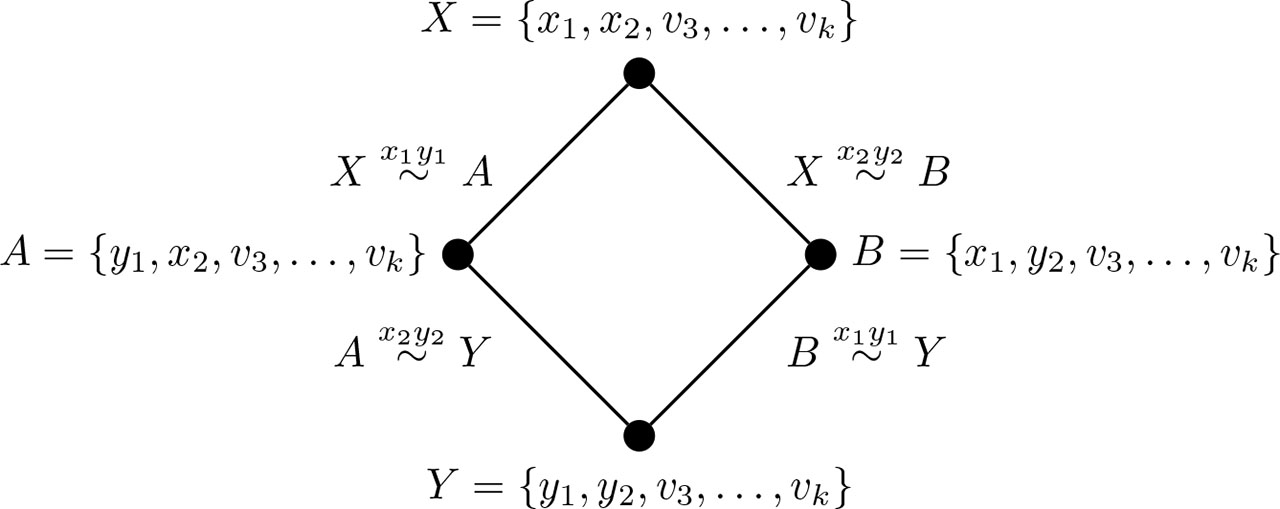
Figure 1.
Reconfiguration structure of an induced C4 subgraph from Proposition 3.6
We state the above-mentioned results regarding 𝔇, K2,3, and κ here for referencing.
On the other hand, the house graph ℋ = Θ 〈1, 2, 3〉 in Figure 2(b) is a theta graph that is an i-graph, as illustrated by the seed graph G in Figure 2(a). The i-sets of G and their adjacencies are overlaid on ℋ in Figure 2(b).
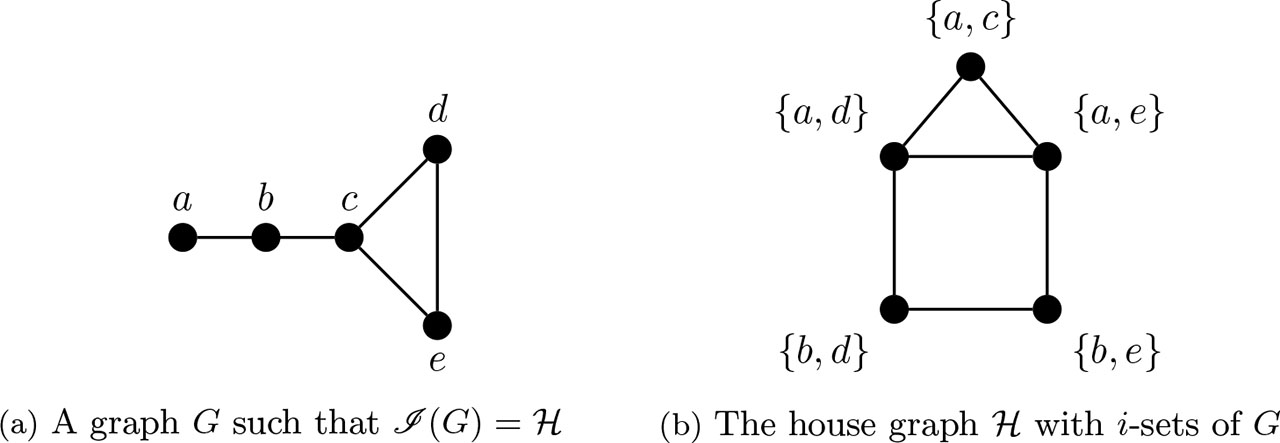
Figure 2.
The graph G for Proposition 3.8 with ℐ (G) = ℋ
The next result shows that maximal cliques in i-graphs can be replaced by arbitrarily larger maximal cliques to form larger i-graphs.
Lemma 3.9 (Max Clique Replacement Lemma [2, 9]).
Let H be an i-graph with a maximal m-vertex clique, 𝒦m. The graph Hw formed by adding a new vertex w* adjacent to all of 𝒦m is also an i-graph.
The Deletion Lemma below shows that the class of i-graphs is closed under vertex deletion, that is, every induced subgraph of an i-graph is also an i-graph.
Lemma 3.10 (Deletion Lemma [2, 9]).
If H is a nontrivial i-graph, then any induced subgraph of H is also an i-graph.
Corollary 3.11 ([2, 9]).
If H is not an i-graph, then any graph containing an induced copy of H is also not an i-graph.
When visualizing the connections between the i-sets of a graph G, it is sometimes advantageous to consider its complement G̅ instead. From a human perspective, it is curiously easier see to which vertices a vertex v is adjacent, rather than to which vertices v is nonadjacent. This is especially true when i(G) = 2 or 3, when we may interpret the adjacency of i-sets of G as the adjacencies of edges and triangles (i.e. K3), respectively, in G̅. In the following sections we examine how the use of graph complements can be exploited to construct the i-graph seeds for certain classes of line graphs, theta graphs, and maximal planar graphs.
4. Line graphs and claw-free graphs
Consider a graph G with i(G) = 2 and where X = {u, v} is an i-set of G. In G̅, u and v are adjacent, so X is represented as the edge uv. Moreover, no other vertex w is adjacent to both vertices of X in G̅; otherwise, {u, v, w} is independent in G, contrary to X being an i-set.
Now consider the line graph L(G̅) of G̅. If X = {u, v} is an i-set of G, then e = uv is an edge of G̅ and hence e is a vertex of L(G̅). Thus, the i-sets of G correspond to a subset of the vertices of L(G̅). In the case where G̅ is triangle-free (that is, G has no independent sets of cardinality 3), these i-sets of G are exactly the vertices of L(G̅). Now suppose Y is an i-set of G adjacent to X; say, , so that Y = {v, w}. Then, in G̅, f = vw is an edge, and so in L(G̅), f ∈ V (L(G̅)). Since e and f are both incident with v in G̅, ef ∈ E(L(G̅)). That is, for i-sets X and Y of a well-covered graph G with i(G) = α(G) = 2, X ∼ Y if and only if X and Y correspond to adjacent vertices in L(G̅). Thus ℐ (G) ≅ L(G̅).
In the example illustrated in Figure 3 below, ℋ is the house graph, where X = {a, c} and Y = {c, e} are i-sets with . In , the two vertices in each of these i-sets are likewise adjacent.
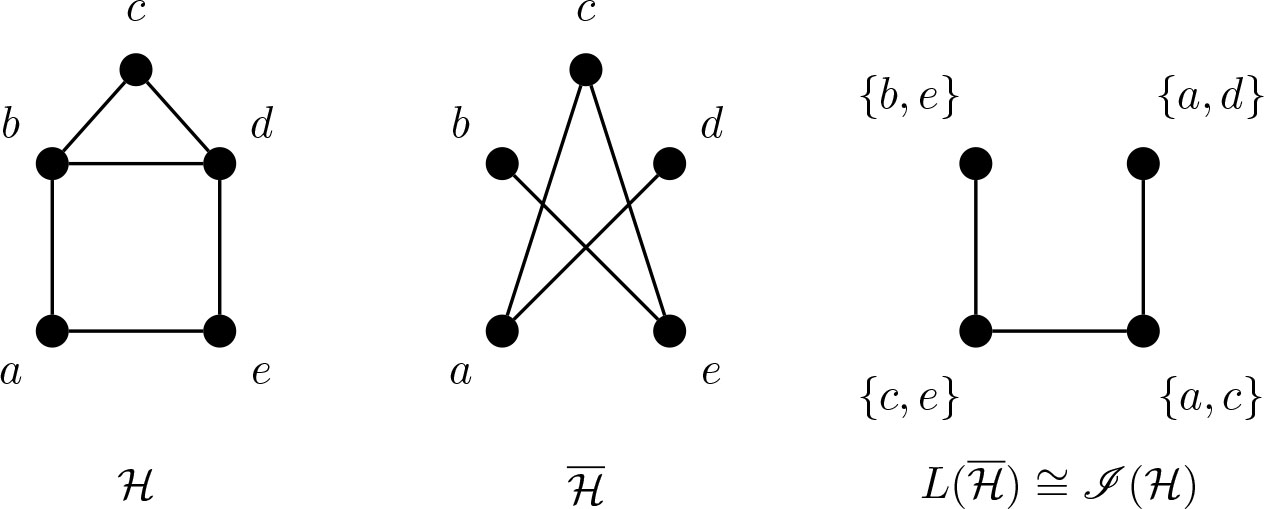
Figure 3.
The complement and line graphs complement of the well-covered house graph ℋ
The connection between graphs with i(G) = 2 and line graphs helps us not only understand the structure of ℐ (G), but also lends itself towards some interesting realizability results. We follow this thread for the remainder of this section, and build towards determining the i-graph realizability of line graphs and claw-free graphs. The straightforward proof of the following lemma can be found in [9] and is omitted here.
Lemma 4.1.
The line graph of a connected graph G of order at least 4 contains 𝔇 as an induced subgraph if and only if G contains a triangle. (See Figure 4.)
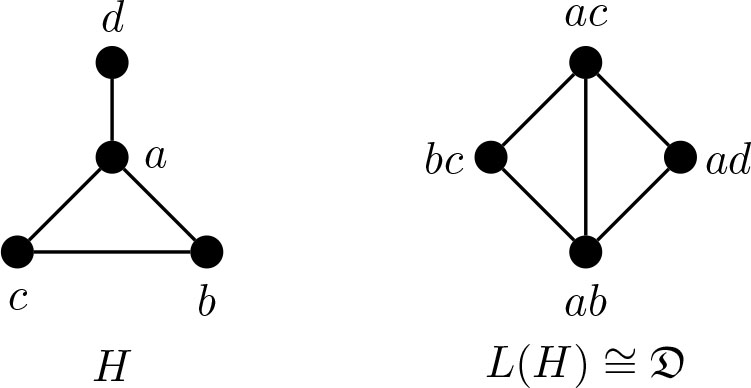
Figure 4.
The “paw” H with L(H) ≅ 𝔇
Proof
Suppose H is an i-graph. By Proposition 3.7 and Corollary 3.11, H is 𝔇-free.
Conversely, suppose that H is 𝔇-free. If H is complete, then H is the i-graph of itself. So, assume that H is not complete. Say H is the line graph of some graph F, where we may assume F has no isolated vertices (as isolated vertices do not affect line graphs). Since H is 𝔇-free and connected, F has no triangles by Lemma 4.1. Since F has edges (which it does since H exists), α(F̅) ≤ 2. Moreover, as F is connected, F̅ has no universal vertices, and so i(F̅) ≥ 2. Thus, i(F̅) = α(F̅) and F̅ is well-covered. It follows that every edge of F corresponds to an i-set of F̅. Since H is the line graph of F, it is the i-graph of F̅.
Finally, if we examine Beineke’s forbidden subgraph characterization of line graphs (see [1] or [3, Theorem 6.26]), we note that eight of the nine minimal non-line graphs contain an induced 𝔇 and are therefore not i-graphs. The ninth minimal non-line graph is the claw, K1,3. Thus, 𝔇-free claw-free graphs are 𝔇-free line graphs, hence i-graphs.
Corollary 4.3.
Let H be a connected claw-free graph. Then H is an i-graph if and only if H is 𝔇-free.
While Theorem 4.2 and Corollary 4.3 reveal the i-graph realizability of many famous graph families (including another construction for cycles, which are connected, claw-free, and 𝔇-free), the realizability problem for graphs containing claws remains unresolved. Moreover, among clawed graphs are the theta graphs which we first alluded to in Section 2 as containing three of the small known non-i-graphs. In the next section we apply similar techniques with graph complements to construct all theta graphs that are i-graphs.
5. Theta graphs from graph complements
Consider a graph G with i(G) = 3. Each i-set of G is represented as a triangle (a K3) in G̅. If X and Y are two i-sets of G with , then G̅[X] and G̅[Y] are triangles in G̅, and have |X ∩ Y| = 2. Although it is technically the induced subgraphs G̅[X] and G̅[Y ] that are the triangles of G̅, for notational simplicity we refer to X and Y as triangles. In G̅, the triangle X can be transformed into the triangle Y by removing the vertex u and adding in the vertex v (where ). Thus, we say that two triangles are adjacent if they share exactly one edge. Moreover, since two i-sets of a graph G with i(G) = 3 are adjacent if and only if their associated triangles in G̅ are adjacent, we use the same notation for i-set adjacency in G as triangle adjacency in G̅; that is, the notation X ∼ Y represents both i-sets X and Y of G being adjacent, and triangles X and Y of G̅ being adjacent.
In the following sections we use triangle adjacency to construct complement seed graphs for the i-graphs that are theta graphs; that is, a graph G̅ such that ℐ (G) is isomorphic to some desired theta graph. Before proceeding with these constructions, we note some observations which will help us with this process.
Observation 5.1.
A graph G has i(G) = 2 if and only if G̅ is nonempty and has an edge that does not lie on a triangle.
If G̅ has an edge uv that does not lie on a triangle, then {u, v} is independent and dominating in G, and so i(G) ≤ 2. When building our seed graphs G with i(G) = 3, it is therefore necessary to ensure that every edge of the complement G̅ belongs to a triangle.
Observation 5.2.
Let G be a graph with i(G) = 3. If S with |S| ≥ 4 is a (possibly non-maximal) clique in G̅, then no 3-subset of S is an i-set of G.
Suppose that S = {u, v, w, x} is such a clique of G̅. Then, for example, x is undominated by {u, v, w} in G, and so {u, v, w} is not an i-set of G. Conversely, suppose that {u, v, w} is a triangle in a graph G̅ with i(G) = 3. By attaching a new vertex x to all of {u, v, w} in G̅, we remove {u, v, w} as an i-set of G, while keeping all other i-sets of G. This observation proves to be very useful in the constructions in the following section: we now have a technique to eliminate any unwanted triangles in G̅ (and hence i-sets of G) that may arise. Note that this technique is an application of the Deletion Lemma (Lemma 3.10) in G̅ instead of in G.
The use of triangle adjacency in a graph G̅ to determine i-set adjacency in G provides a key technique to resolve the question of which theta graphs are i-graphs. In our main result, Theorem 5.3, we show that all theta graphs except the seven listed exceptions are i-graphs. Using this method of complement triangles, the proofs of the lemmas for the affirmative cases make up most of the remainder of Section 5. The proofs of the lemmas for the seven negative cases are given in Section 6.
Theorem 5.3.
A theta graph is an i-graph if and only if it is not one of the seven exceptions listed below:
Table 1 summarizes the cases used to establish Theorem 5.3 and their associated results.
Table 1.
i-graph realizability of theta graphs
| Θ 〈j, k, ℓ〉 | Realizability | Result |
|---|---|---|
| Θ 〈1, 2, 2〉 | non-i-graph | 𝔇. Proposition 3.7 |
| Θ 〈1, 2, ℓ〉, ℓ ≥ 3 | i-graph | Lemma 5.4 |
| Θ 〈1, k, ℓ〉, 3 ≤ k ≤ ℓ | i-graph | Lemma 5.6 |
| Θ 〈2, 2, 2〉 | non-i-graph | K2,3. Proposition 3.7 |
| Θ 〈2, 2, 3〉 | non-i-graph | κ. Proposition 3.7 |
| Θ 〈2, 2, 4〉 | non-i-graph | Proposition 6.1 |
| Θ 〈2, 2, ℓ〉, ℓ ≥ 5 | i-graph | Lemma 5.10 |
| Θ 〈2, 3, 3〉 | non-i-graph | Proposition 6.2 |
| Θ 〈2, 3, 4〉 | non-i-graph | Proposition 6.3 |
| Θ 〈2, 3, ℓ〉, ℓ ≥ 5 | i-graph | Lemma 5.12 |
| Θ 〈2, 4, 4〉 | i-graph | Lemma 5.14 |
| Θ 〈2, k, 5〉, 4 ≤ k ≤ 5 | i-graph | Lemma 5.16 |
| Θ 〈2, k, ℓ〉, k ≥ 4, ℓ ≥ 6, ℓ ≥ k | i-graph | Lemma 5.18 |
| Θ 〈3, 3, 3〉 | non-i-graph | Proposition 6.4 |
| Θ 〈3, 3, 4〉 | i-graph | Lemma 5.19 |
| Θ 〈3, 3, 5〉 | i-graph | Lemma 5.21 |
| Θ 〈3, 3, ℓ〉, ℓ ≥ 6 | i-graph | Lemma 5.23 |
| Θ 〈3, 4, 4〉 | i-graph | Lemma 5.25 |
| Θ 〈3, 4, ℓ〉, ℓ ≥ 5 | i-graph | Lemma 5.27 |
| Θ 〈3, 5, 5〉 | i-graph | Lemma 5.29 |
| Θ 〈4, 4, 4〉 | i-graph | Lemma 5.31 |
| Θ 〈j, k, 5〉, 4 ≤ j ≤ k ≤ 5. | i-graph | Lemma 5.33 |
| Θ 〈j, k, ℓ〉, 3 ≤ j ≤ k ≤ ℓ, and ℓ ≥ 6. | i-graph | Lemma 5.35 |
5.1. Θ 〈1, k, ℓ〉
We have already seen that the house graph ℋ = Θ 〈1, 2, 3〉 is an i-graph (Proposition 3.8). We can further exploit previous results to see that all graphs Θ 〈1, 2, ℓ〉 for ℓ ≥ 3 are i-graphs by taking a cycle Cn with n ≥ 4, and replacing one of its maximal cliques (i.e. an edge) with a K3. By the Max Clique Replacement Lemma (Lemma 3.9), the resultant Θ 〈1, 2, n − 1〉 is also an i-graph. For reference, we explicitly state this result as a lemma.
5.1.1. Construction of G̅ for Θ 〈1, k, ℓ〉, 3 ≤ k ≤ ℓ.
In Figure 5 below, we provide a first example of the technique we employ repeatedly throughout this section to construct our theta graphs. To the left is a graph G̅, where each of its nine triangles corresponds to an i-set of its complement G. The resultant i-graph of G, ℐ (G) = Θ 〈1, 4, 5〉, is presented on the right. For consistency, we use X and Y to denote the triangles corresponding to the degree 3 vertices in the theta graphs in this example, as well as all constructions to follow.
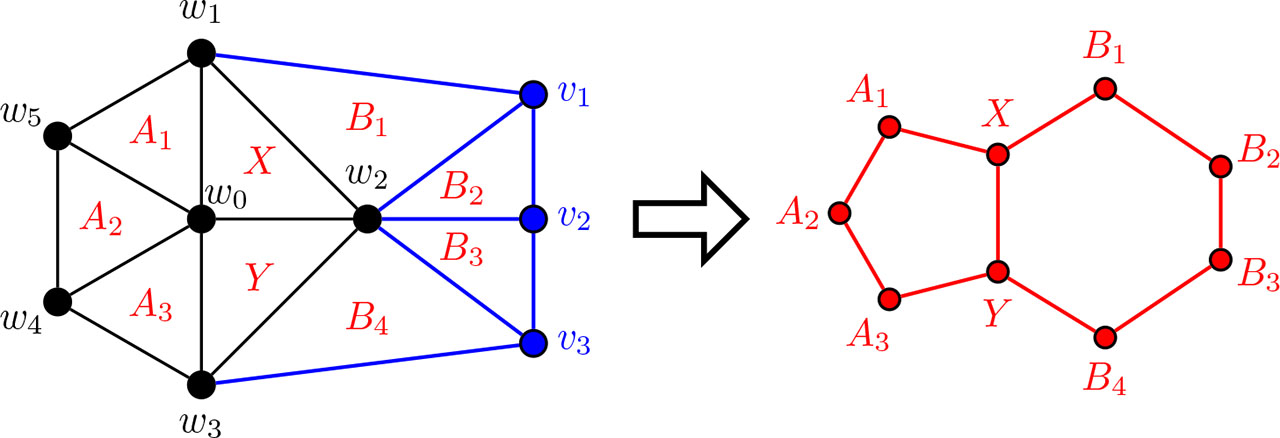
Figure 5.
A graph G̅ (left) such that ℐ (G) = Θ 〈1, 4, 5〉 (right)
We proceed now to the general construction of a graph G̅ with ℐ (G) = Θ 〈1, k, ℓ〉 for 3 ≤ k ≤ ℓ. As it is our first construction using this triangle technique, we provide the construction and proof for Lemma 5.6 with an abundance of detail.
Construction 5.5 (See Figure 6).
Let H̅ ≅ Wk+2 = Ck+1 ∨ K1, where Ck+1 = (w1, . . . , wk+1, w1) and w0 is the central hub, i.e., the vertex with degree k + 1. Add a path Pℓ−2 : (v1, . . . , vℓ−2), joining each vi, i = 1, ..., ℓ − 2, to w2. Join v1 to w1 and vℓ−2 to w3. (If ℓ = 3, then v1 = vℓ−2, hence v1 is adjacent to w1, w2 and w3.) This is the (planar) graph G̅.
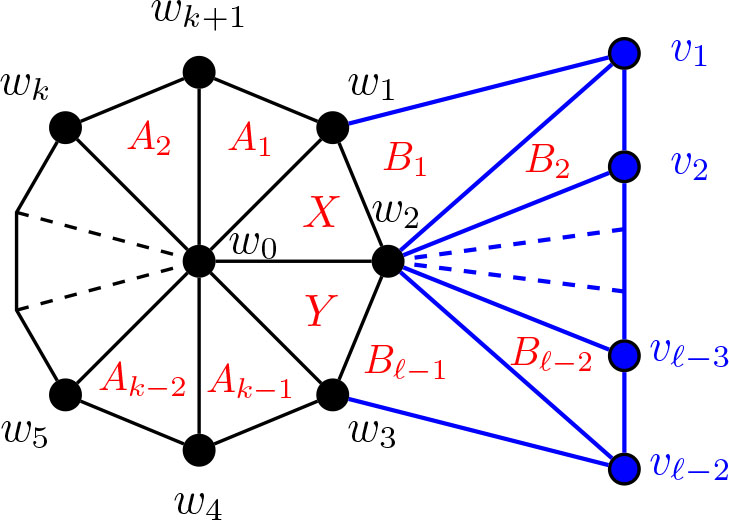
Figure 6.
The graph G̅ from Construction 5.5 such that ℐ (G) = Θ 〈1, k, ℓ〉 for 3 ≤ k ≤ ℓ
Lemma 5.6.
If G̅ is the graph constructed by Construction 5.5, then ℐ (G) = 𝒜 (G) = Θ 〈1, k, ℓ〉, 3 ≤ k ≤ ℓ.
Proof
To begin, notice that since in G̅, the vertices 𝒲 = {w0, w1, . . . , wk, wk+1} form a wheel on at least five vertices, H̅ ≆ K4. Likewise, the graph induced by {w0, w1, w2, w3, v1, v2, . . . , vℓ−2} in G̅ is also a wheel on ℓ + 2 vertices, where w2 is the central hub, and so it too contains no K4. Therefore, G̅ is K4-free and the triangles of G̅ are precisely the maximal cliques of G̅, and so ω(G̅) = i(G) = α(G) = 3. Since the i-sets of G are identical to its α-sets, ℐ (G) = 𝒜 (G), and so for ease of notation, we will refer only to ℐ (G) throughout the remainder of this proof.
We label the triangles as in Figure 6 by dividing them into two collections. The first are the triangles composed only of the vertices from 𝒲 and each containing w0: let X = {w0, w1, w2}, Y = {w0, w2, w3}, A1 = {w0, wk+1, w1}, A2 = {w0, wk, wk+1}, . . . , Ak−2 = {w0, w4, w5}, Ak−1 = {w0, w3, w4}. The remainder are the triangles with vertex sets not fully contained in H̅: B1 = {w2, w1, v1}, B2 = {w2, v1, v2}, B3 = {w2, v2, v3}, . . . , Bℓ−2 = {w2, vℓ−3, vℓ−2}, and Bℓ−1 = {w2, vℓ−2, w3}. We refer to these collections as 𝒮 = {X, Y }, 𝒜 = {A1, A2, . . . , Ak−1}, and ℬ = {B1, B2, . . . , Bℓ−1}. It is clear from Figure 6 that these are the only triangles of G̅. Therefore V (ℐ (G)) = {X, Y, A1, A2, . . . , Ak−1, B1, B2, . . . , Bℓ−1}.
We now show that the required adjacencies hold. From the construction of G̅, the following are immediate for ℐ (G):
(i) ,
(ii) ,
(iii) .
Since G̅ is a planar graph and all of its triangles are facial (that is, the edges of the K3 form a face in the plane embedding in Figure 6), each triangle is adjacent to at most three others. From (i)–(iiit287) above, triangles X and Y are both adjacent to the maximum three (and hence degℐ (G)(X) = degℐ (G)(Y) = 3).
Recall that to be adjacent, two triangles share exactly two vertices. Notice that the triangles of 𝒜 are composed entirely of vertices from 𝒲 − {w2}, and that for 2 ≤ i ≤ ℓ − 2, Bi ∩ 𝒲 = {w2}; furthermore, B1 ∩ 𝒲 = {w1, w2} and Bℓ−2 ∩ 𝒲 = {w2, w3}. Therefore no triangle of ℬ is adjacent to any triangle of 𝒜. It is similarly easy to see that there are no additional unwanted adjacencies between two triangles of 𝒜 or two triangles of ℬ.
We conclude that the graph G̅ generated by Construction 5.5 yields ℐ (G) = 𝒜 (G) = Θ 〈1, k, ℓ〉.
Before we proceed with the remainder of the theta graph constructions, let us return to Figure 6 to notice the prominence of the wheel subgraph in the complement seed graph G̅. In the constructions throughout this paper, this wheel subgraph will appear repeatedly; indeed, all of the complement seed graphs for the i-graphs of theta graphs have a similar basic form: begin with a wheel, add a path of some length, and then add some collection of edges between them. As stated without proof in Lemma 5.7, Figure 7 below demonstrates that a wheel in a triangle-based complement seed graph G̅ corresponds to a cycle in the i-graph of G. Using this result, in our later constructions with a wheel subgraph, we already have two of the three paths of a theta graph formed. Hence, we need only confirm that whatever unique additions are present in a given construction form the third path in the i-graph.
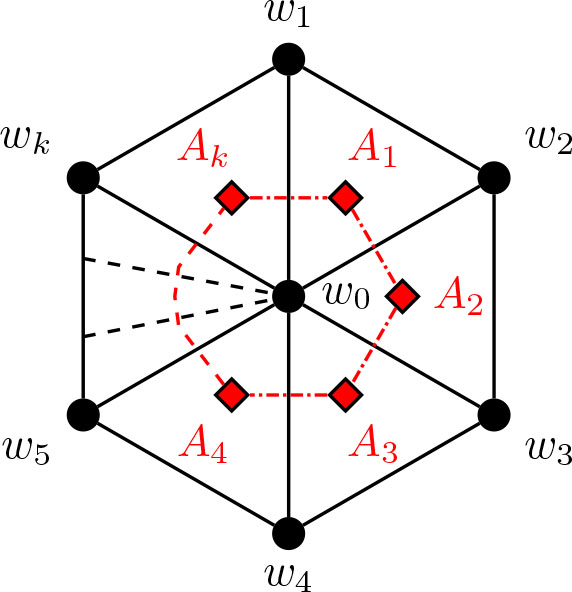
Figure 7.
The wheel Hk = Wk+1, with the i-graph of its complement, , embedded in red
We note the following analogous – although less frequently applied – result for fans of the form K1 + Pk, as illustrated in Figure 8.
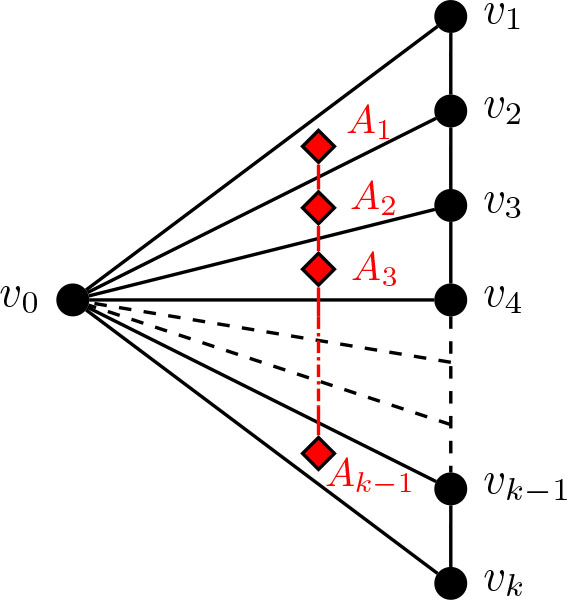
Figure 8.
The fan Hk = K1 ∨ Pk, with the i-graph of its complement, , embedded in red
5.2. Θ 〈2, k, ℓ〉 for 2 ≤ k ≤ ℓ
5.2.1. Construction of G̅ for Θ 〈2, 2, ℓ〉, ℓ ≥ 5
As stated in Proposition 3.7, K2,3 ≅ Θ 〈2, 2, 2〉 and κ ≅ Θ 〈2, 2, 3〉 are not i-graphs. Extending these results, we find that the length of the third path in Θ 〈2, 2, ℓ〉 has a transition point between ℓ = 4 and ℓ = 5; while ℓ = 4 is still too short to form an i-graph (see Lemma 6.1), for ℓ ≥ 5, Θ 〈2, 2, ℓ〉 is i-graph realizable.
Construction 5.9.
See Figures 9 and 10. Begin with the graph H̅ ≅ W5 = C4 ∨ K1, labelling the degree 3 vertices as w1, w2, w3, w4 and the central degree 4 vertex as w0.
(a) If ℓ ≥ 6 (as in Figure 9), attach to H̅ a path Pℓ−3 : (v1, v2, . . . , vℓ−3) by joining w1 to v1, v2, . . . , vℓ−4. Join vℓ−5 to vℓ−3. Next, join w2 to v1, and w3 to vℓ−3. Then, join w4 to vℓ−4 and vℓ−3. Add a new vertex z, joined to w1, w4, and vℓ−4.
(b) If ℓ = 5 (as in Figure 10), attach to H̅ a path of P2 : (v1, v2), by joining w1 to v1, and w2 to v1 and v2. Then join w3 to v2, and w4 to both v1 and v2. Add two new vertices, z1 and z2, joining z1 to v1, w1, and w4, and z2 to v2, w2 and w3.
We label the resultant (planar) graph G̅.
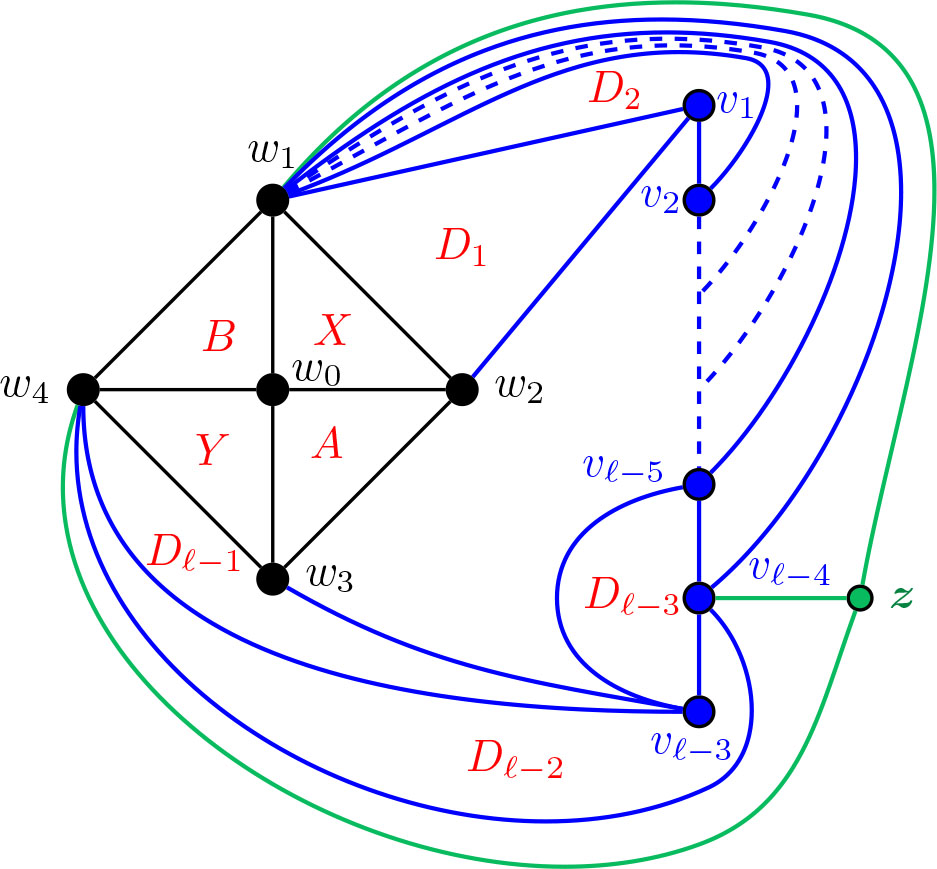
Figure 9.
The graph G̅ from Construction 5.9 such that ℐ (G) = Θ 〈2, 2, ℓ〉 for ℓ ≥ 6
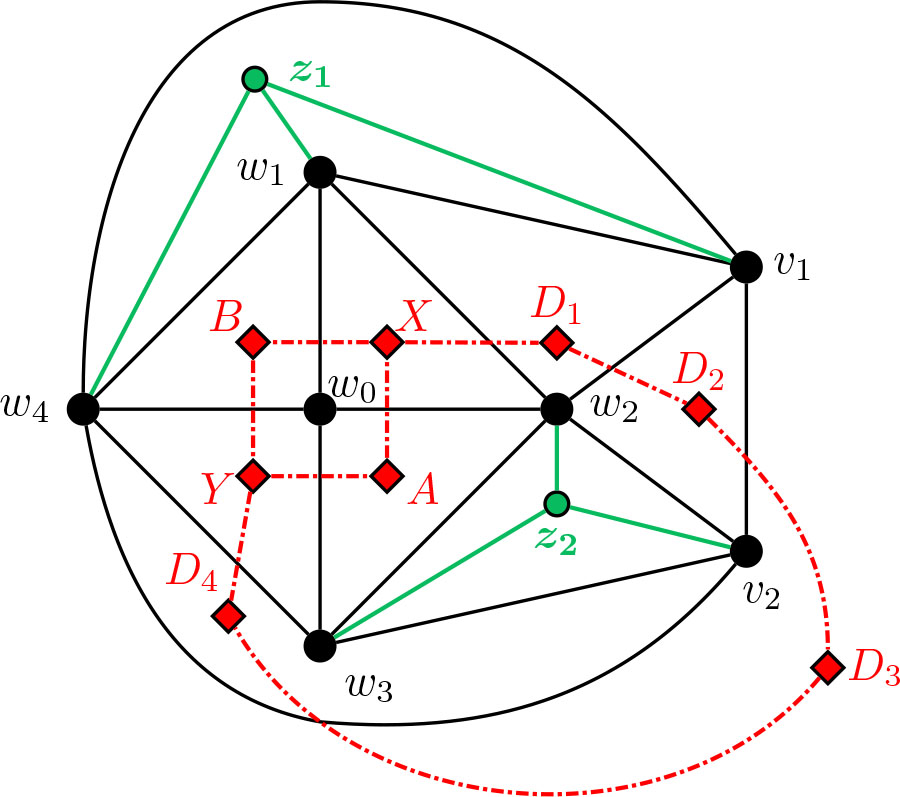
Figure 10.
The graph G̅ from Construction 5.9 such that ℐ (G) = Θ 〈2, 2, 5〉, with Θ 〈2, 2, 5〉 overlaid in red
As with our other constructions, the triangles of G̅ are its smallest maximal cliques, and so i(G) = 3. However, we now employ a technique of adding vertices to create K4’s in G̅ and eliminate any “unwanted” triangles that might arise in our construction. In (b), the addition of z1 and z2 eliminate triangles {w1, w4, v1} and {w2, w3, v2}, respectively. Similarly, in (a), z prevents {w1, w4, vℓ−3} from being a maximal clique of G̅ and hence an i-set of G. The unfortunate trade-off in this triangle-elimination technique is that the remaining triangles are no longer α-sets; the constructions work only for i-graphs, not α-graphs.
Proof
We only prove the lemma for case where ℓ ≥ 6; the single case where ℓ = 5 is adequately illustrated in Figure 10 and details can be found in [9].
As in the previous constructions, since each edge of G̅ belongs to a triangle and some triangles are not contained in K4’s, these triangles of G̅ form the smallest maximal cliques of G̅. We label these triangles as in Figure 9; in particular,
It is straightforward to verify that these ℓ+3 sets are precisely the maximal cliques of G̅ of order 3 and, hence, the i-sets of G. Therefore they form the vertex set of ℐ (G). Moving to the edges of ℐ (G), the following adjacencies are clear from Figure 9:
(i) ,
(ii) ,
(iii) .
As for its vertex set, it is straightforward to verify that the edge set of ℐ (G) consists of precisely the edges listed in (i)–(iii). We conclude that ℐ (G) = Θ 〈2, 2, ℓ〉.
5.2.2. Construction of G̅ for Θ 〈2, 3, ℓ〉 for ℓ ≥ 5
For many of the results going forward, we apply small modifications to previous constructions. In the first of these, we begin with the graphs from Construction 5.9, which were used to find i-graphs for Θ 〈2, 2, 5〉 and Θ 〈2, 2, ℓ〉 for ℓ ≥ 6, and expand the central wheel used in there to build i-graphs for Θ 〈2, 3, 5〉 and Θ 〈2, 3, ℓ〉 for ℓ ≥ 6.
Construction 5.11.
Refer to Figures 11 and 12.
(a) If ℓ ≥ 6, begin with a copy of the graph G̅ from Construction 5.9. Subdivide the edge w1w4, adding the new vertex w5. Join w5 to w0, so that w0, w1, . . . , w5 forms a wheel. Delete the vertex z.
(b) If ℓ = 5, begin with a copy of the graph G̅ from Construction 5.9. Subdivide the edge w1w4, adding the new vertex w5. Join w5 to w0, so that w0, w1, . . . , w5 forms a wheel. Delete the vertex z1.
We rename the resultant (planar) graph for ℓ ≥ 5.
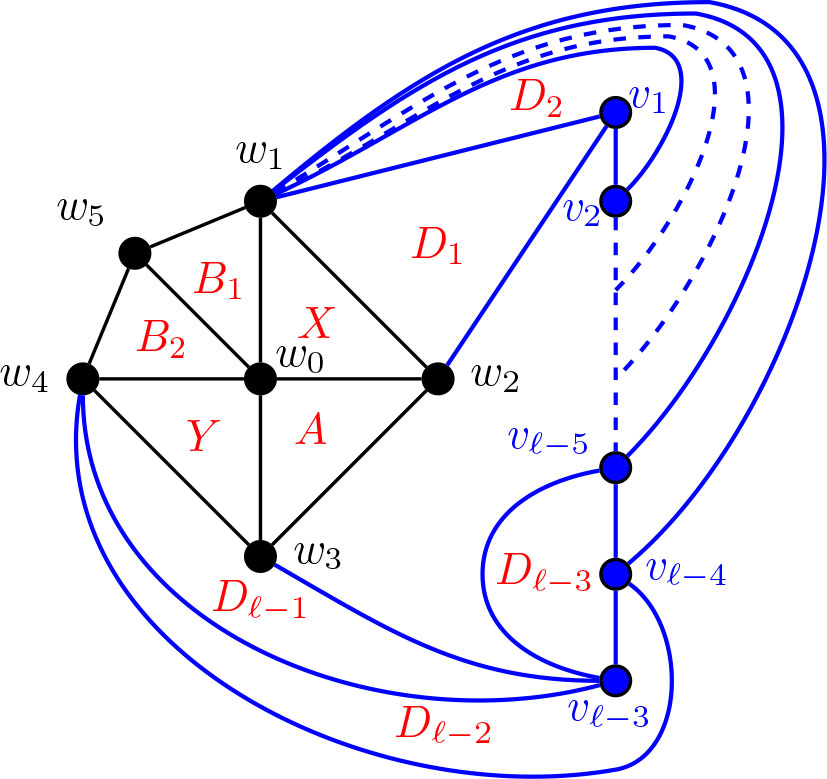
Figure 11.
The graph from Construction 5.11 (a) such that ℐ (G2,3, ℓ) = 𝒜 (G2,3, ℓ) = Θ 〈2, 3, ℓ〉 for ℓ ≥ 6
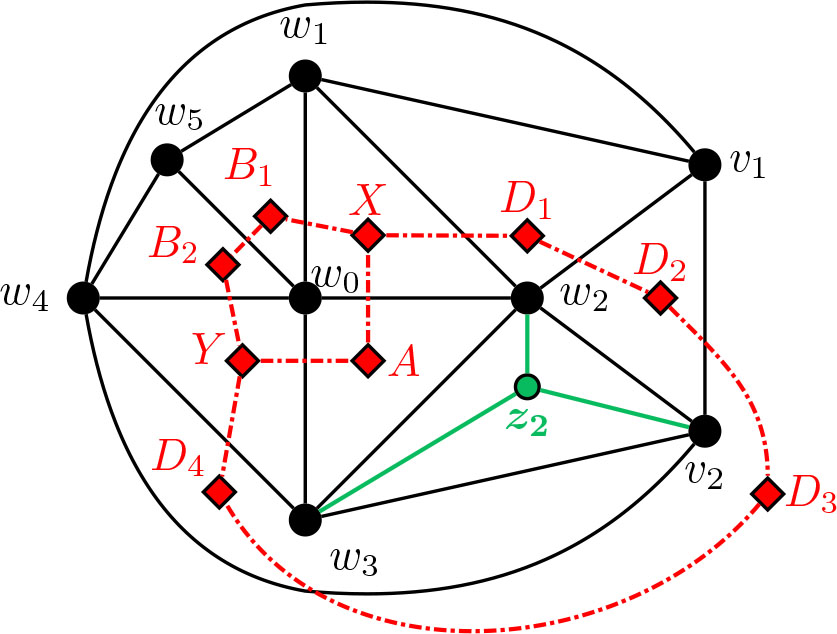
Figure 12.
The graph from Construction 5.11 (b) such that ℐ (G2,3,5) = Θ 〈2, 3, 5〉, with ℐ (G2,3,5) over-laid in red
In Construction 5.11 (a), notice that the vertex z is deleted from G̅. In the original Construction 5.9 for a graph G̅ with ℐ (G) = Θ 〈2, 2, ℓ〉 for ℓ ≥ 6, z served to eliminate the unwanted triangle formed by {w1, w4, vℓ−4}. Now with the expanded wheel including w5, {w1, w4, vℓ−4} is not a triangle in , and z is not needed. Indeed, as now has α(G2,3, ℓ) = 3, its triangles are also α-sets in G, and so we can immediately extend the construction from i-graphs to α-graphs.
The extension, however, does not apply to Construction 5.11 (b) for the graph . Here, we no longer require z1 (which served to eliminate the unwanted triangle formed by {w1, w4, v1}), but z2 remains and forms the clique {w2, w3, z2, v2}; thus, α(G2,3,5) = 4.
The proof for the following Lemma 5.12 is otherwise very similar to the proof of Lemma 5.10, and so is omitted.
5.2.3. Construction of G̅ for Θ 〈2, 4, 4〉
In the following construction for a graph G̅ with ℐ (G) = Θ 〈2, 4, 4〉, we again apply the technique of adding vertices to eliminate unwanted triangles.
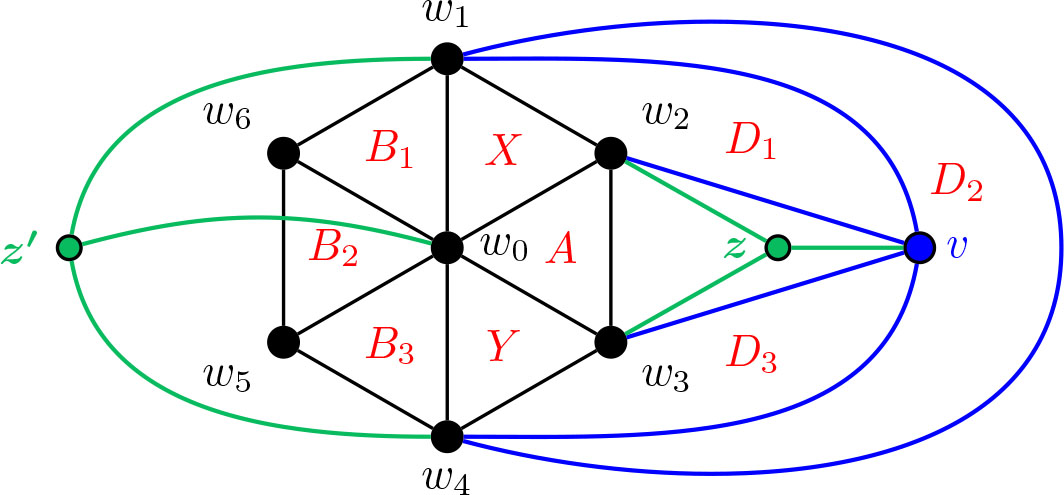
Figure 13.
A graph G̅ such that ℐ (G) = Θ 〈2, 4, 4〉
Construction 5.13.
Refer to Figure 13. Begin with a copy of the graph H̅ ≅ W7 = C6 ∨ K1, labelling the degree 3 vertices as w1, w2, . . . , w6 and the central degree 6 vertex as w0. Join w1 to w4. Add a new vertex v to H̅, joining v to w1, . . . , w4. Then, add the new vertex z, joined to v, w2 and w3, and the new vertex z′, joined to w0, w1, and w4. We label the resultant (non-planar) graph G̅.
Proof
As shown in Figure 13, the triangles of G̅ forming maximal cliques of G̅, and therefore the i-sets of G, are labelled them as follows:
Similarly to the construction for Θ 〈2, 2, 5〉 in the proof of Lemma 5.10, the vertices z and z′ are added to ensure that {v, w2, w3} and {w0, w1, w4}, respectively, are not maximal cliques in G̅, and hence are not i-sets of G.
It can be seen that there are no other triangles in G̅ beyond the nine listed above; we omit the details, which can be found in [9, Lemma 5.19].
From Figure 13, the following triangle adjacencies are immediate:
(i) ,
(ii) ,
(iii) .
It is again straightforward to verify that there are no additional edges in ℐ (G) than those listed above. We conclude that ℐ (G) = Θ 〈2, 4, 4〉 as required.
Notice that Construction 5.13 is our first theta graph construction that is not planar as it has a K3,3 minor. Indeed, with the exception of the constructions that are based upon Construction 5.13, all of our i-graph constructions use planar complement seed graphs.
Problem 1.
(i) Find a planar graph-complement construction for Θ 〈2, 4, 4〉.
(ii) Do all i-graphs with largest induced stars of K1,3, always have a planar graph-complement construction?
A large target graph requires a large seed graph in order to generate a sufficient number of unique i-sets. Can a target graph become too dense to allow for a planar graph-complement construction?
Moving forward, we will no longer explicitly check that there are no additional unaccounted for triangles in our constructions. Should the construction indeed result in triangles of G̅ that produce extraneous vertices in ℐ (G), we can easily remove them using the Deletion Lemma (Lemma 3.10).
5.2.4. Constructions of G̅ for Θ 〈2, 4, 5〉 and Θ 〈2, 5, 5〉
Construction 5.15.
Refer to Figure 14.
(a) Begin with a copy of the graph from Construction 5.11 (b) for Θ 〈2, 3, 5〉. Subdivide the edge w1w5, adding the new vertex w6. Join w6 to w0, so that w0, w1, . . . , w6 forms a wheel. Call this graph .
(b) Begin with a copy of the graph from Construction 5.15 (a). Subdivide the edge w1w6, adding the new vertex w7. Join w7 to w0, so that w0, w1, . . . , w7 forms a wheel. Call this graph .
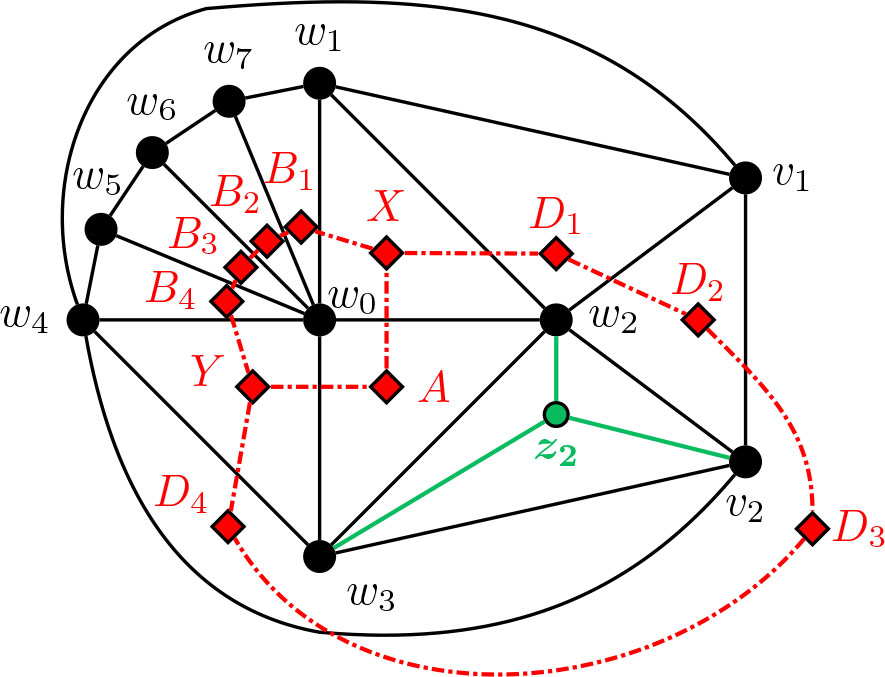
Figure 14.
The graph from Construction 5.15 such that ℐ (G) = Θ 〈2, 5, 5〉, with ℐ (G) overlaid in red.
Lemma 5.16.
If is the graph constructed by Construction 5.15, then ℐ (G2,k,5) = Θ 〈2, k, 5〉, for 4 ≤ k ≤ 5.
Lemma 5.16 follows readily from Figure 14 and we omit the proof.
5.2.5. Construction of G̅ for Θ 〈2, k, ℓ〉 for ℓ ≥ k ≥ 4 and ℓ ≥ 6
Construction 5.17.
See Figure 15. Begin with a copy of the graph from Construction 5.11 (a) for ℓ ≥ 5. Subdivide the edge w1w5 k − 3 times (for k ≤ ℓ), adding the new vertices w6, w7, . . . , wk+2. Join w6, w7, . . . , wk+2 to w0, so that w0, w1, . . . , wk+2 forms a wheel. Call this graph .
Lemma 5.18.
If is the graph constructed by Construction 5.17, then ℐ (G2,k,ℓ) = 𝒜 (G2,k,ℓ) = Θ 〈2, k, ℓ〉, for ℓ ≥ k ≥ 4 and ℓ ≥ 6.
Lemma 5.18 follows from Figure 15.
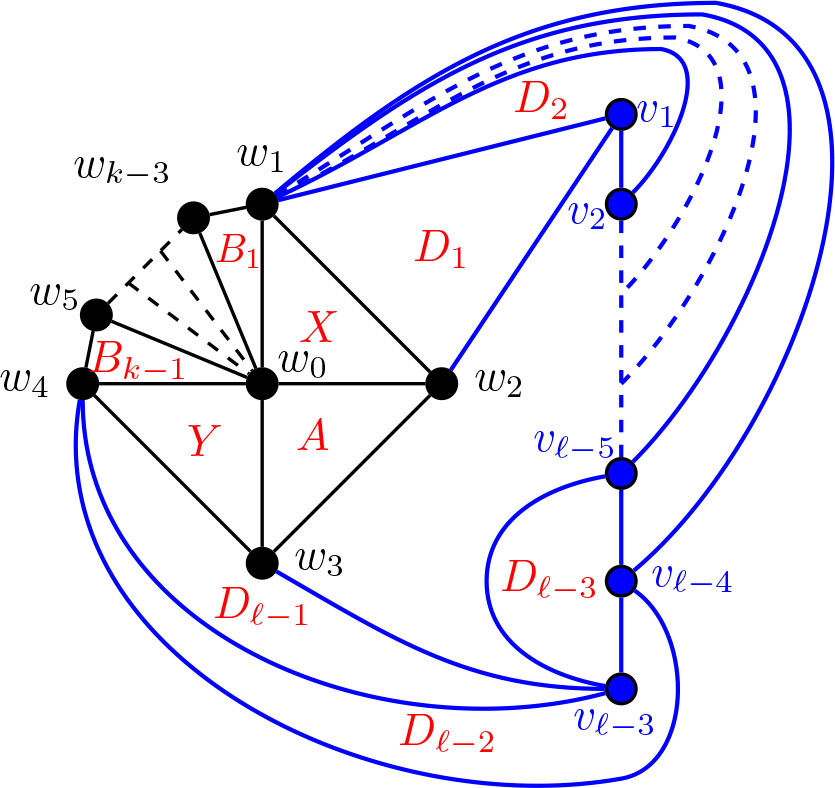
Figure 15.
The graph from Construction 5.17 such that for ℓ ≥ k ≥ 4 and ℓ ≥ 6
5.3. Θ 〈3, k, ℓ〉
In the rest of Section 5 we only give the constructions and their associated figures, and state the lemmas without proof. Details can be found in [9, Chapter 5].
5.3.1. The graph G̅ for Θ 〈3, 3, 4〉
The triangles X, A1, A2, Y, B2, B1, D1, D2, D3 in Figure 16, and the obvious paths formed by them, illustrate the following lemma.
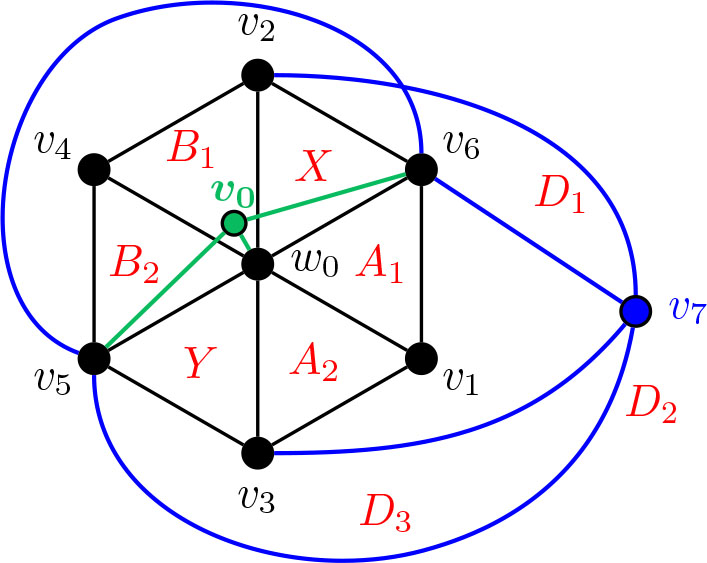
Figure 16.
A graph G̅ such that ℐ (G) = Θ 〈3, 3, 4〉
5.3.2. Construction of G̅ for Θ 〈3, 3, 5〉
Construction 5.20.
Refer to Figure 17. Begin with a copy of the graph H̅ ≅ W7 = C6 ∨ K1, labelling the degree 3 vertices as w1, w2, . . . , w6 and the central degree 6 vertex as w0. Add new vertices v1 and v2 to H̅, joined to each other. Then, join v1 to each of {w1, w2, w5}, and v2 to each of {w2, w4, w5}. Call this graph .
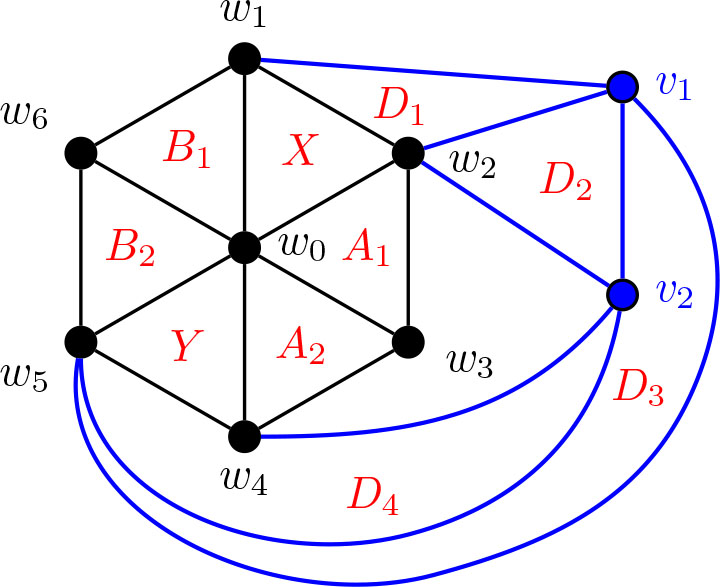
Figure 17.
A graph from Construction 5.20 such that ℐ (G3,3,5) = Θ 〈3, 3, 5〉.
Lemma 5.21.
If is the graph constructed by Construction 5.20, then ℐ (G3,3,5) = 𝒜 (G3,3,5) = Θ 〈3, 3, 5〉.
5.3.3. Construction of G̅ for Θ 〈3, 3, ℓ〉 for ℓ ≥ 6
Construction 5.22.
Refer to Figure 19. Begin with a copy of the graph H̅ ≅ W7 = C6 ∨ K1, labelling the degree 3 vertices as w1, w2, . . . , w6 and the central degree 4 vertex as w0. For ℓ ≥ 6, add to H̅ a new path of ℓ − 3 vertices labelled as v1, v2, . . . , vℓ−3. Then, join w1 to each of {v1, v2, . . . , vℓ−4}, w4 to vℓ−3, and w5 to vℓ−4 and vℓ−3. Finally, join vℓ−5 to vℓ−3, so that {vℓ−5, vℓ−4, vℓ−3} form a K3. Call this graph for ℓ ≥ 6.
Although the general construction still applies for the case when ℓ = 6, we include a separate figure for the construction of Θ 〈3, 3, 6〉 for reference below, because of the additional complication that now v1 = vℓ−5, and so the single vertex now has dual roles in the construction.
Lemma 5.23.
If is the graph constructed by Construction 5.22, then ℐ (G3,3, ℓ) = 𝒜 (G3,3, ℓ) = Θ 〈3, 3, ℓ〉 for ℓ ≥ 6.
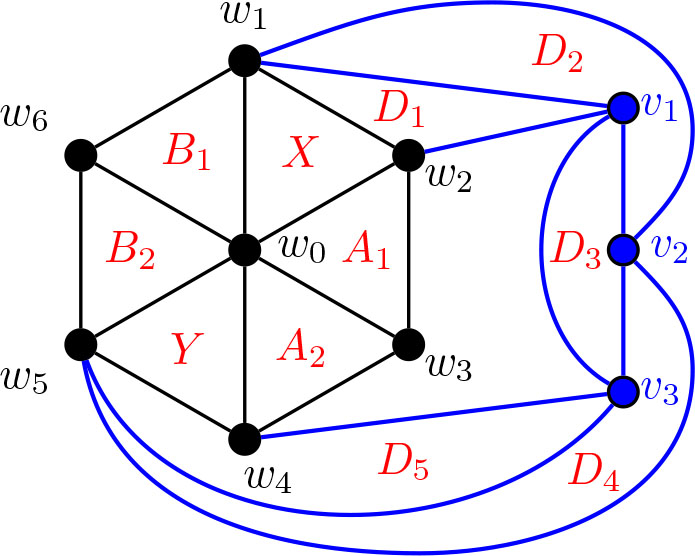
Figure 18.
The graph from Construction 5.22 such that ℐ (G3,3,6) = 𝒜 (G3,3,6) = Θ 〈3, 3, 6〉
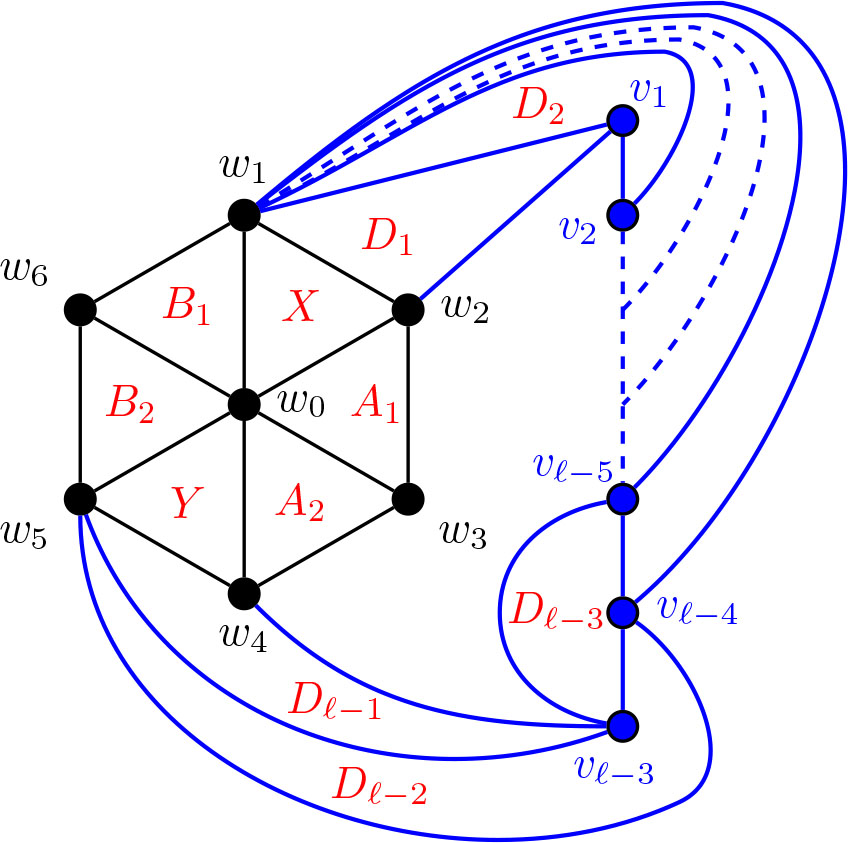
Figure 19.
The graph from Construction 5.22 such that ℐ (G) = 𝒜 (G) = Θ 〈3, 3, ℓ〉 for ℓ ≥ 6
5.3.4. Construction of G̅ for Θ 〈3, 4, 4〉
Construction 5.24.
See Figure 20. Begin with a copy of the graph G̅ from Construction 5.13 for Θ 〈2, 4, 4〉, which we rename here as . Subdivide the edge w2w3, adding a new vertex u1, and joining u1 to w0. Delete the vertex z. Call this graph .
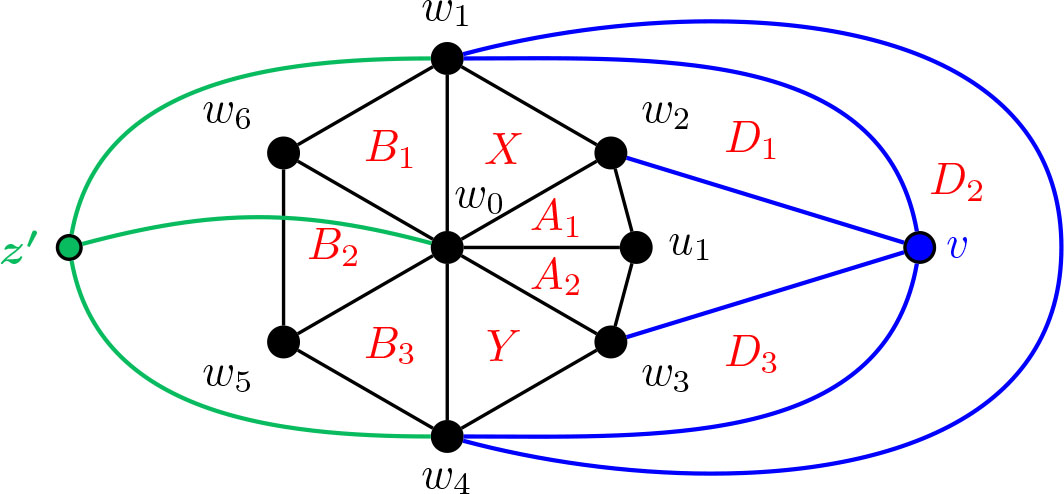
Figure 20.
The graph from Construction 5.24 such that ℐ (G3,4,4) = Θ 〈3, 4, 4〉
5.3.5. Construction of G̅ for Θ 〈3, 4, ℓ〉, ℓ ≥ 5
Construction 5.26.
Begin with a copy of the graph from Construction 5.24 for Θ 〈3, 4, 4〉. Subdivide the edge w1w6 ℓ − 4 times (for ℓ ≥ 5), adding the new vertices w7, w8, . . . , wℓ+2. Join w7, w8, . . . , wℓ+2 to w0, so that w0, w1, . . . , wℓ+2 forms a wheel. Call this graph .
Lemma 5.27.
If is the graph constructed by Construction 5.26, then ℐ (G3,4, ℓ) = Θ 〈3, 4, ℓ〉 for ℓ ≥ 5.
5.3.6. Construction of G̅ for Θ 〈3, 5, 5〉
Construction 5.28.
Refer to Figure 21. Begin with a copy of the graph from Construction 5.20. Subdivide the edge w1w6 twice, adding the new vertices w7 and w8. Join w7 and w8 to w0, so that w0, w1, . . . , w8 forms a wheel. Call this graph .
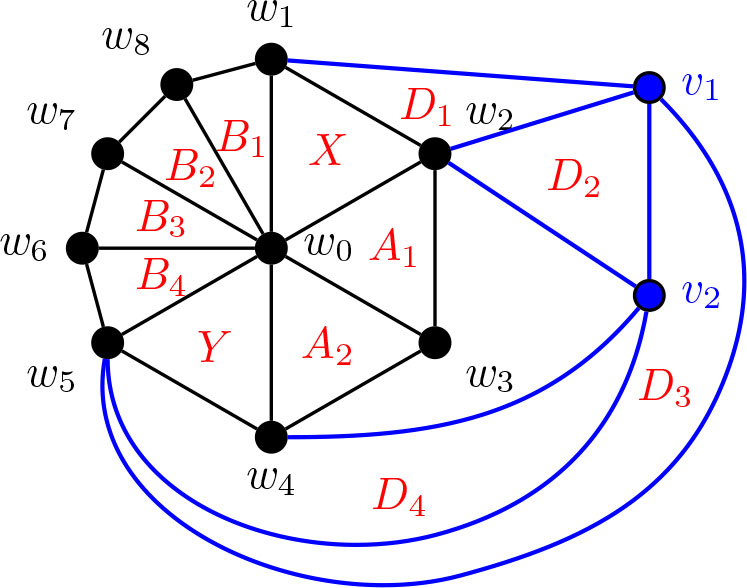
Figure 21.
A graph from Construction 5.28 such that ℐ (G3,5,5) = Θ 〈3, 5, 5〉.
Lemma 5.29.
If is the graph constructed by Construction 5.28, then ℐ (G3,5,5) = 𝒜 (G3,5,5) = Θ 〈3, 5, 5〉.
Notice that subdividing only once in Construction 5.28 (adding only w7 and not w8) gives an alternative (planar) construction for Θ 〈3, 4, 5〉.
5.4. Θ 〈j, k, ℓ〉 for 4 ≤ j ≤ k ≤ ℓ and 3 ≤ j ≤ k ≤ ℓ, ℓ ≥ 6
5.4.1. Construction of G̅ for Θ 〈j, k, ℓ〉 for 4 ≤ j ≤ k ≤ ℓ ≥ 5
Construction 5.30.
Refer to Figure 22. Begin with a copy of the graph from Construction 5.24. Subdivide the edge u1w3, adding the new vertex u2. Join u2 to w0, so that
forms a wheel. Call this graph .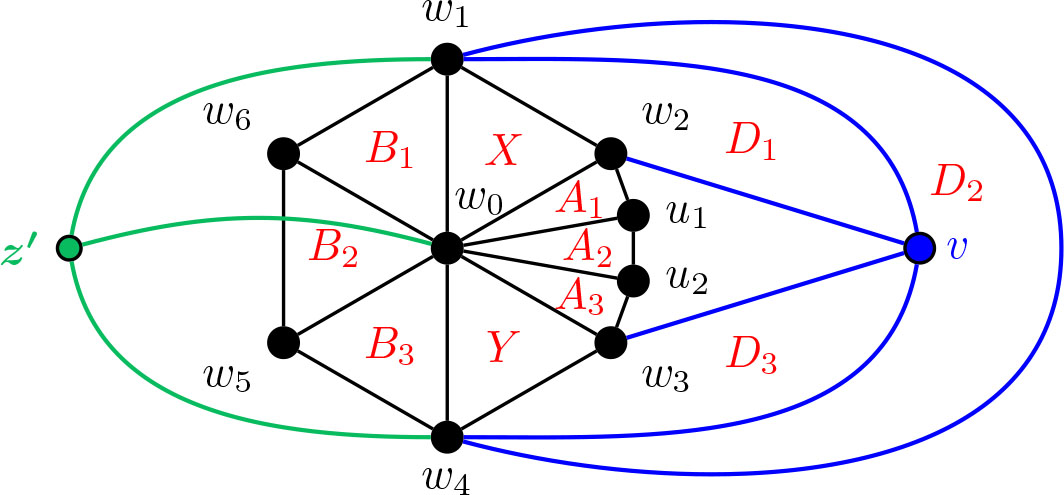
Figure 22.
The graph from Construction 5.30 such that ℐ (G4,4,4) = Θ 〈4, 4, 4〉
Construction 5.32.
Begin with a copy of the graph from Construction 5.20. For k = 4 subdivide the edge w1w6 once, adding the vertex w7; for k = 5, subdivide a second time, adding the vertex w8. For j = 4, subdivide the edge w2w3, adding the vertex u1; for j = 5 (j ≤ k), subdivide a second time, adding the vertex u2. Connect all new vertices to w0 to form a wheel. Call this graph for 4 ≤ j ≤ k ≤ 5.
An example of the construction of is given in Figure 23 below.
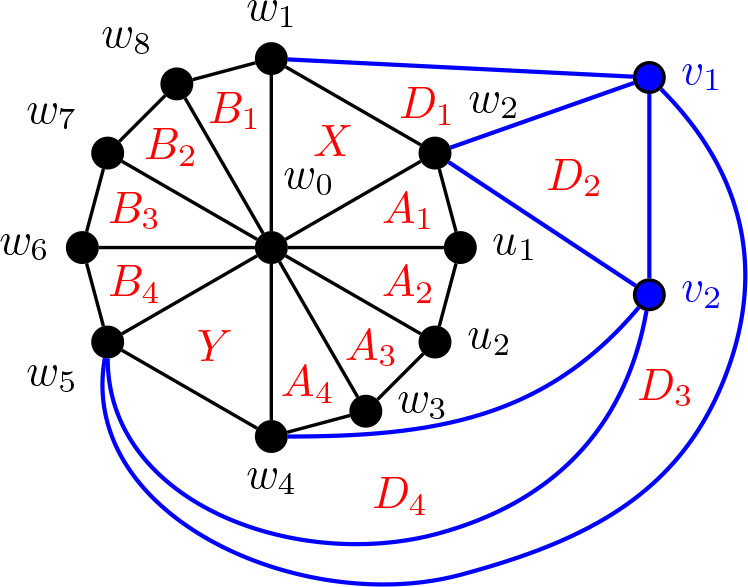
Figure 23.
A graph from Construction 5.28 such that ℐ (G5,5,5) = Θ 〈5, 5, 5〉
Lemma 5.33.
If is the graph constructed by Construction 5.32, then ℐ (Gj,k,5) = 𝒜 (Gj,k,5) = Θ 〈j, k, 5〉 for 4 ≤ j ≤ k ≤ 5.
5.4.2. Construction of G̅ for Θ 〈j, k, ℓ〉 for 3 ≤ j ≤ k ≤ ℓ, ℓ ≥ 6
Construction 5.34.
Begin with a copy of the graph from Construction 5.22 for Θ 〈3, 5, ℓ〉 for ℓ ≥ 6. For 3 ≤ k ≤ ℓ, subdivide the edge w1w6 k − 3 times, adding the new vertices w7, w8, . . . , wk+3. Join each of w7, w8, . . . , wk+3 to w0, so that w0, w1, . . . , wk+3 forms a wheel. Then, for 3 ≤ j ≤ k, subdivide the edge w2w3 j − 3 times, adding the new vertices u1, u2, . . . , uj−3. Again, join each of u1, u2, . . . , uj−3 to w0 to form a wheel. Call this graph for 3 ≤ j ≤ k ≤ ℓ and ℓ ≥ 6.
Lemma 5.35.
If for 3 ≤ j ≤ k ≤ ℓ and ℓ ≥ 6 is the graph constructed by Construction 5.34, then ℐ (Gj, k, ℓ) = 𝒜 (Gj, k, ℓ) = Θ 〈j, k, ℓ〉.
The lemmas above imply the sufficiency of Theorem 5.3: if a theta graph is not one of seven exceptions listed, then it is an i-graph. In the next section, we complete the proof by examining the exception cases.
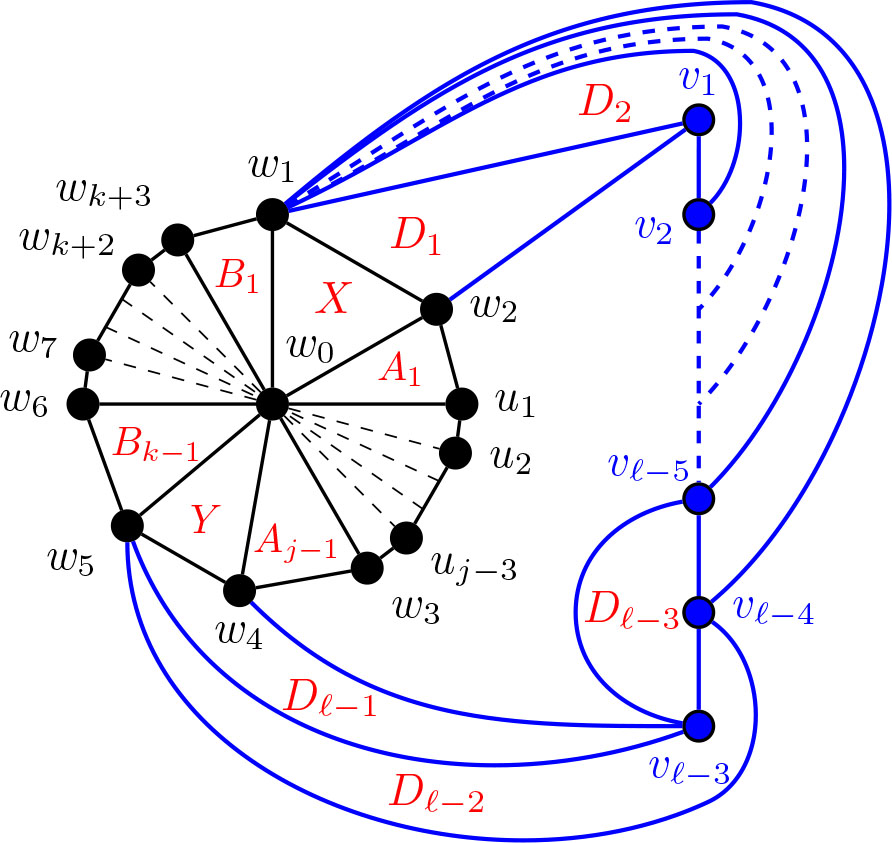
Figure 24.
The graph from Construction 5.34 such that ℐ (Gj, k, ℓ) = Θ 〈j, k, ℓ〉 for 3 ≤ j ≤ k ≤ ℓ and ℓ ≥ 6
6. Theta graphs that are not i-graphs
In this section we show that Θ 〈2, 2, 4〉, Θ 〈2, 3, 3〉, Θ 〈2, 3, 4〉, and Θ 〈3, 3, 3〉 are not i-graphs; together with Proposition 3.7, this completes the proof of Theorem 5.3.
6.1. Θ 〈2, 2, 4〉 is not an i-graph
Proof
Suppose to the contrary that Θ 〈2, 2, 4〉 is realizable as an i-graph, and that H = Θ 〈2, 2, 4〉 ≅ ℐ (G) for some graph G. Label the vertices of H as in Figure 25.
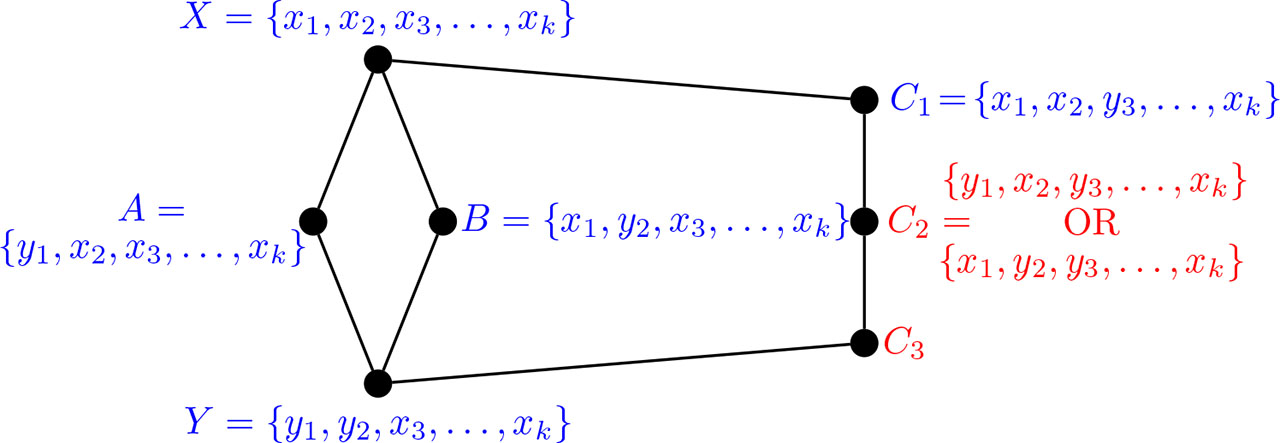
Figure 25.
H = Θ 〈2, 2, 4〉 non-construction
From Proposition 3.6, the composition of the following i-sets of G are immediate:
where k ≥ 3 and y1, y2, y3 are three distinct vertices in G − X. These sets are illustrated in blue in Figure 25. This leaves only the composition of C2 and C3 (in red) to be determined. As we construct C2, notice first that y3 ∈ C2; otherwise, if say some other z ∈ C2 so that , then , and XC2 ∈ E(H). Thus, a token on one of {x1, x2, x4, . . . , xk} moves in the transition from C1 to C2. We consider three cases.Case 1: The token on x1 moves. If for some z ∉ {y1, y2}, then |C2 ∩ Y| = 3, contradicting the distance requirement between i-sets from Observation 3.2. Moreover, from the composition of B, x1 ≁ y2, and so , so that C2 = {y1, x2, y3, . . . , xk}. However, since x3 ∼ y3, we have that , so that AC2 ∈ E(G), a contradiction.
Case 2: The token on x2 moves. An argument similar to Case 1 constructs C2 = {x1, y2, y3, . . . , xk}, with , resulting in the contradiction BC2 ∈ E(G).
Case 3: The token on xi for some i ∈ {4, 5, . . . , k} moves. From the compositions of X and Y, xi is not adjacent to any of {x3, y1, y2}, so the token at xi moves to some other vertex, say z, so that and {x1, x2, y3, z} ⊆ C2. This again contradicts the distance requirement of Observation 3.2 as |C2 ∩ Y| = 4.
In all cases, we fail to construct a graph G with ℐ (G) ≅ Θ 〈2, 2, 4〉 and so conclude that no such graph exists.
6.2. Θ 〈2, 3, 3〉 is not an i-Graph
Proof
To begin, we proceed similarly to the proof of Proposition 6.1: suppose to the contrary that Θ 〈2, 3, 3〉 is realizable as an i-graph, and that H = Θ 〈2, 3, 3〉 ≅ ℐ (G) for some graph G. Label the vertices of H as in Figure 26. As before, the corresponding i-sets in blue are established from previous results, and those in red are yet to be determined. Moreover, from the composition of these four blue i-sets, we observe that for each i ∈ {1, 2, 3}, xi ∼ yj if and only if i = j.
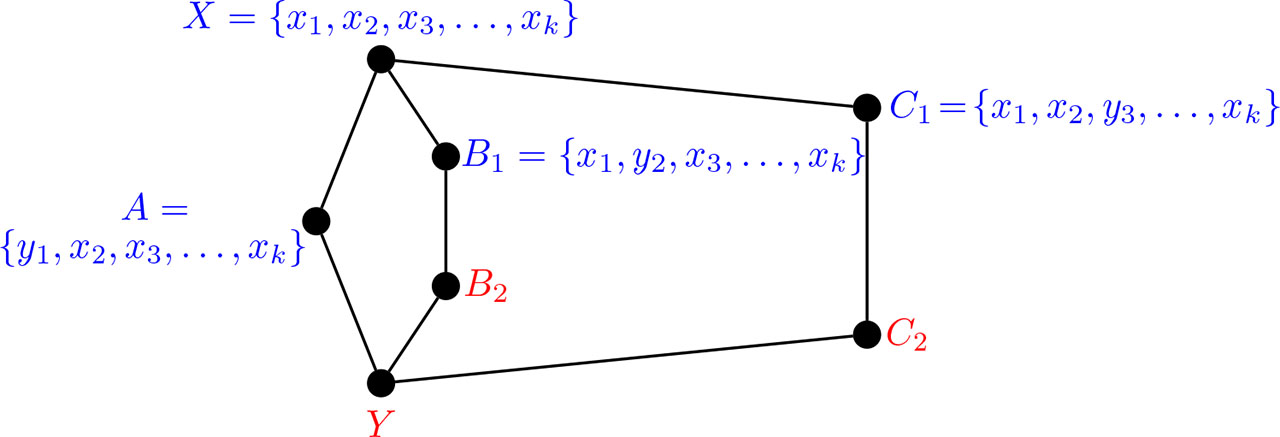
Figure 26.
H = Θ 〈2, 3, 3〉 non-construction
Unlike the construction for Θ 〈2, 2, 4〉, we no longer start with knowledge of the exact composition of Y. We proceed with a series of observations on the contents of the various i-sets:
(i) y1 ∈ Y, y2 ∈ B2, and y3 ∈ C2 by three applications of Proposition 3.6.
(ii) y1 ∉ B2 and y1 ∉ C2. If y1 ∈ B2, then (because A shows that y1 is not adjacent to x3, . . . , xk) so that B2 = {y1, y2, x3, . . . , xk}, and therefore , which is impossible. Similarly, if y1 ∈ C2, then , which is also impossible.
(iii) y3 ∉ B2. Otherwise, B2 = {x1, y2, y3, x4, . . . , xk} and so .
(iv) y2 ∉ Y and y3 ∉ Y. If y2 ∈ Y, then Y = {y1, y2, x3, . . . , xk} and so . Likewise, if y3 ∈ Y then .
From (i) and (ii), y1 ∈ Y but y1 ∉ B2, and similarly from (iv) y2 ∈ B2 but y2 ∉ Y ; therefore, . Now, since x1 ∼ y1, and y1 ∈ Y, we have that x1 ∉ Y. Thus, if x1 were in B2, its token would move in the transition from B2 to Y. However, we have already established that it is the token at y2 that moves, and so x1 ∉ B2. We conclude that for some z ∉ {y1, y3}, so that B2 = {z, y2, x3, . . . , xk}. Notice that since B2 is independent, and x2 ∼ y2, it follows that z ≠ x2.
Using similar arguments, we determine that , and that for some w ∉ {y1, y2, x1}. Moreover, C2 = {w, x2, y3, x4, . . . , xk}. Again, note that since x3 ∼ y3, w ≠ x3.
From , we have that Y = {y1, z, x3, x4 . . . , xk}. However, from , we also have that Y = {y1, x2, w, x4, . . . , xk}. As we have already established that z ≠ x2 and w ≠ x3, we arrive at two contradicting compositions of Y. Thus, no such graph G exists, and we conclude that Θ 〈2, 3, 3〉 is not an i-graph.
6.3. Θ 〈2, 3, 4〉 is not an i-Graph
Proof
The construction for our contradiction begins similarly to that of Θ 〈2, 3, 3〉 in Proposition 6.2. As before, we illustrate the graph in Figure 27, labelling the known sets in blue, and those yet to be determined in red. Given the similarity of Θ 〈2, 3, 3〉 and Θ 〈2, 3, 4〉, many of the observations from Proposition 6.2 carry through to our current proof. In particular, all of (i)–(iv) hold here, including that y1 ∉ C2 from (ii). Moreover, the compositions of Y and B2 also hold, where z is some vertex with z ∉ {y1, x2, y2}.
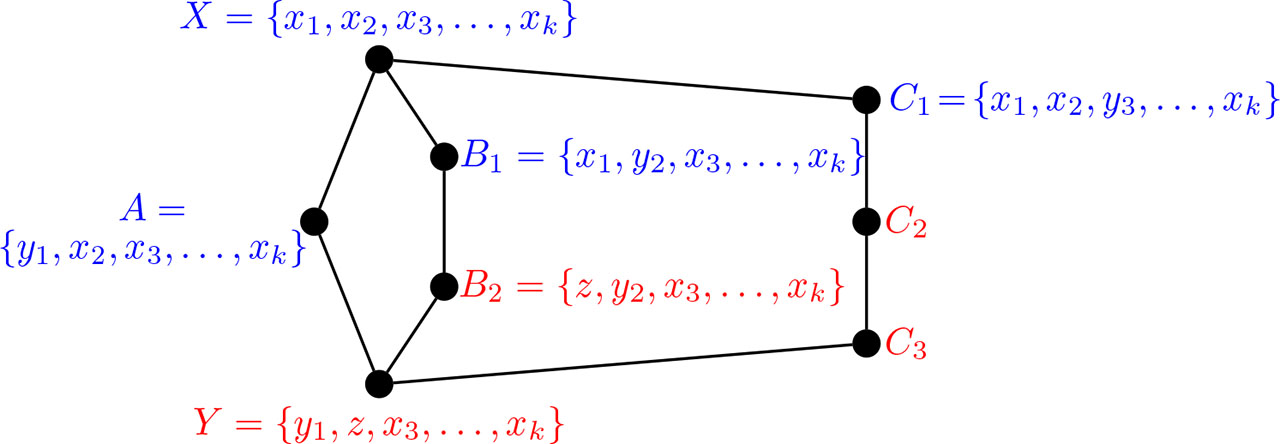
Figure 27.
H = Θ 〈2, 3, 4〉 non-construction
We now attempt to build C2. From Proposition 3.6, since X ≁ C2, y3 ∈ C2 (and x3 ∉ C2). From the distance requirement of Observation 3.2, |X − C2| ≤ 2, and so at least one of x1 or x2 is in C2. Recall from the construction for Proposition 6.2 that and , and so z is adjacent to both x1 and x2. Hence, z ∉ C2.
Gathering these results shows that none of {x3, z, y1} are in C2, and thus, d(C2, Y) ≥ 3, contradicting the distance requirement of Observation 3.2. We conclude that no graph G exists such that ℐ (G) = Θ 〈2, 3, 4〉.
6.4. Θ 〈3, 3, 3〉 is not an i-Graph
Proof
Let H be the theta graph Θ 〈3, 3, 3〉, with vertices labelled as in Figure 28. Suppose to the contrary that there exists some graph G such that H is the i-graph of G; that is, ℐ (G) = Θ 〈3, 3, 3〉.
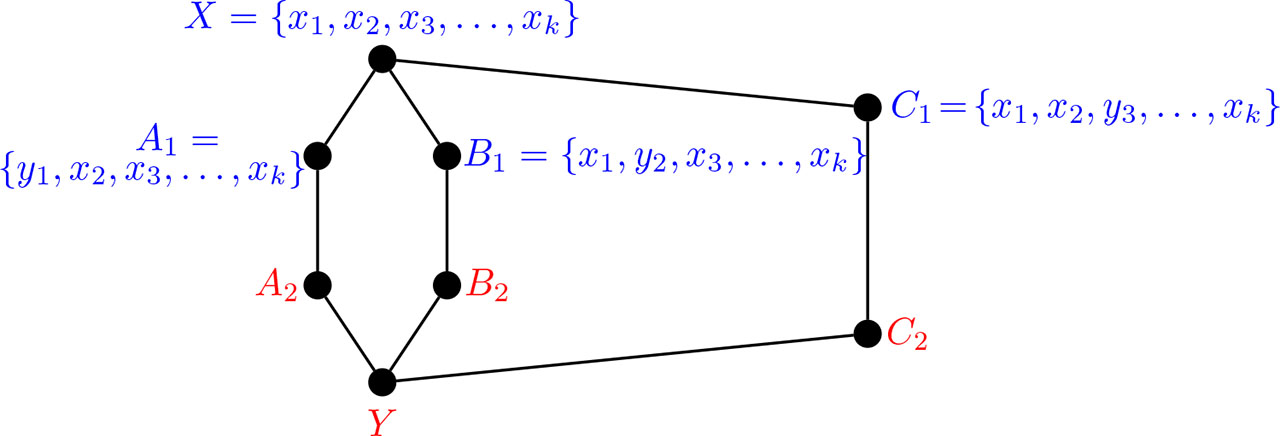
Figure 28.
H = Θ 〈3, 3, 3〉 non-construction
Since dH(A1, Y) = 2, by Observation 3.4, |A1 − Y| = 2. Similarly, |B1 − Y| = 2 and |C1−Y| = 2. Suppose that, say, x4 ∉ Y. Hence, by Observation 3.2 |{x1, x2, x3} ∩ Y| ≥ 1. Without loss of generality, say x1 ∈ Y. Then since y1 ∉ Y and x4 ∉ Y, both x2 and x3 ∈ Y to satisfy |A1 − Y| = 2. However, then Y = {x1, x2, x3, z, x5, . . . , xk} for some vertex z ∼ x4, and so , which is not so. We therefore conclude that x4 ∈ Y, and likewise xi ∈ Y for i ≥ 4. Thus, {x1, x2, x3} ∩ Y = ∅.
Returning to A1, since d(A1, Y) = 2 and x2, x3 ∉ Y, we have that y1 ∈ Y. Similarly, y2, y3 ∈ Y. Thus, Y = {y1, y2, y3, x3, . . . , xk}. Moreover, A2 is obtained from A1 by replacing one of x2 or x3, by y2 or y3, respectively. Say, so that A2 = {y1, y2, x3, . . . , xk}. Now, however, we have that , but clearly B1 ≁ A2. It follows that Θ 〈3, 3, 3〉 is not an i-graph.
This completes the proof of Theorem 5.3.
7. Other results
In this section we first display a graph that is neither a theta graph nor an i-graph, and then use the method of graph complements to show that every cubic 3-connected bipartite planar graph is an i-graph.
7.1. A non-theta non-i-graph
So far, every non-i-graph we have observed is either one of the seven theta graphs from Theorem 5.3, or contains one of those seven as an induced subgraph (as per Corollary 3.11). This leads naturally to the question of whether theta graphs provide a forbidden subgraph characterization for i-graphs. Unfortunately, this is not the case.
Consider the graph 𝒯 in Figure 29: it is not a theta graph, and although it contains several theta graphs as induced subgraphs, none of those induced subgraphs are among the seven non-i-graph theta graphs. In Proposition 7.1 we confirm that 𝒯 is not an i-graph.
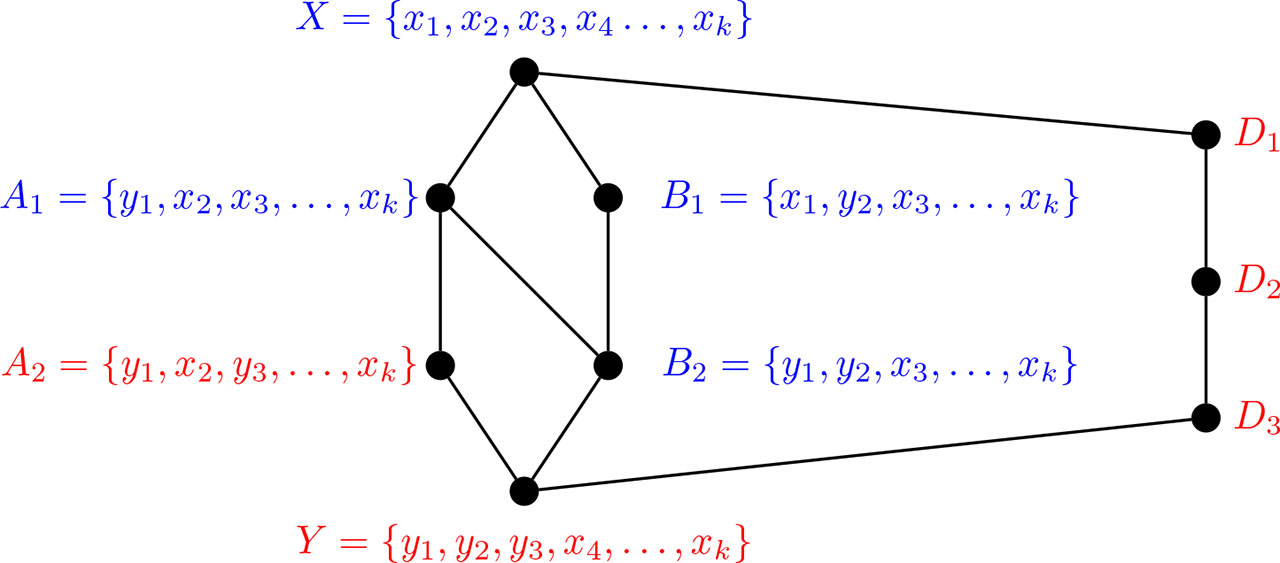
Figure 29.
A non-theta non-i-graph 𝒯.
Proof
We proceed similarly to the proofs for the theta non-i-graphs in Section 6. Let 𝒯 be the graph in Figure 29, with vertices as labelled, and suppose to the contrary that there is some graph G such that ℐ (G) ≅ 𝒯.
To begin, we determine the vertices of the two induced C4’s of 𝒯. Immediately from Proposition 3.6, the vertices of X, A1, B1, and B2 are as labelled in Figure 29. Using a second application of Proposition 3.6, A2 differs from A1 in exactly one position, different from B2. Without loss of generality, say, . Then again by the proposition, Y = {y1, y2, y3, x4 . . . , xk} as in Figure 29.
We now construct the vertices of D1 through a series of claims:
(i) x3 is not in D1.
From Lemma 3.3, D1 differs from X in one vertex, different from both A1 and B1; moreover, x1 and x2 are in D1. Notice that {x4, x5, . . . , xk} ⊆ D1: suppose to the contrary that, say, x4 ∉ D1, so that . Then z ≠ y1, since y1 ∼G x1 and D1 is independent. Likewise z ≠ y2 and z ≠ y3. Thus D1 = {x1, x2, x3, z, x5, . . . , xk} has |Y ∩ D1| = 4, but d(D1, Y) = 3, contradicting Observation 3.4.
(ii) y1, y2, and y3 are not in D1.
As above, y1 and y2 are not in D1, as D1 is an independent set containing x1 and x2. Suppose to the contrary that , so that D1 = {x1, x2, y3, . . . , xk}. Then, since x1 ∼G y1, we have that , a contradiction.
(iii) D1 = {x1, x2, z, x4, . . . , xk}, where z ∉ {y1, y2, y3}.
Immediate from (i) and (ii).
A contradiction for the existence of G arises as we construct D2. Since d𝒯(D1, Y) = 3 and |D1 ∩ Y| = 3, at each step along the path through D2, D3, and Y, exactly one token departs from a vertex of D1 and moves to one of Y − D1 = {y1, y2, y3}. However, D2 ≠ {y1, x2, z, x4, . . . , xk}, since otherwise, . Likewise, D2 ≠ {x1, y2, z, x4, . . . , xk}. Finally D2 ≠ {x1, x2, y3, x4, . . . , xk} as again we have . Thus, we cannot build a set D2 such that |D2 ∩ Y| ≤ 2 as required. We so conclude that no such graph G exists, and that 𝒯 is not an i-graph.
Like the seven non-i-graph realizable theta graphs of Theorem 5.3, 𝒯 is a minimal obstruction to a graph being an i-graph; every induced subgraph of 𝒯 is a theta graph.
7.2. Maximal planar graphs
We conclude this section with a result to demonstrate that certain planar graphs are i-graphs and α-graphs. Our proof uses the following three known results.
Theorem 7.4 ([6, 10]).
A maximal planar graph G of order at least 3 has χ(G) = 3 if and only if G is Eulerian.
In our proof of the following theorem, we consider a graph G that is cubic, 3-connected, bipartite, and planar. We then examine its dual G̃, and how those specific properties of G translate to G̃. Then, we construct the complement of G̃, which we refer to as H. We claim that H is a seed graph of G; that is, ℐ (H) contains an induced copy of G.
Proof
Let G be a cubic 3-connected bipartite planar graph and consider the dual G̃ of G. Since G is bridgeless, G̃ has no loops. Moreover, since G is 3-connected, Theorem 7.2 implies that no two edges separate G; hence, G̃ has no multiple edges. Therefore, G̃ is a (simple) graph. Further, since G is cubic, each face of G̃ is a triangle, and so G̃ is a maximal planar graph.
We note the following two key observations. First, since each face of G̃ is a triangle,
(1) each edge of G̃ belongs to a triangle.
For the second, note that since G is bipartite, G̃ is Eulerian (by Theorem 7.3). Then, by Theorem 7.4, χ(G̃) = 3, so G̃ does not contain a copy of K4. Thus,
(2) every triangle of G̃ is a maximal clique.
Now, by the duality of G̃ and G, there is a one-to-one correspondence between the facial triangles of G̃ and the vertices of G. Let H be the complement of G̃. By (1) and (2), i(H) = α(H) = 3, and every maximal independent set of G corresponds to a triangle of G̃. But again, by duality, the facial triangles of G̃ and their adjacencies correspond to the vertices of G and their adjacencies. Therefore, ℐ (H) contains G as an induced subgraph. Any additional unwanted vertices of ℐ (H) can be removed by applying the Deletion Lemma (Lemma 3.10).
8. Open problems
We conclude with a few open problems. Although the problems are stated here for i-graphs, many are relevant to other reconfiguration graphs pertaining to domination-type parameters and are also mentioned in [8, 9].
A graph G is well-covered if all its maximal independent sets have the same cardinality, that is, if α(G) = i(G).
Problem 3.
(a) Determine those i-graphs that are also α-graph realizable.
(b) Determine those i-graphs H for which there exists a well-covered seed graph G such that ℐ (G) ≅ H.
Problem 4.
We have already seen that classes of graphs such as trees, cycles, and, more generally, block graphs, are i-graphs.
As we build new graphs from these families of i-graphs, using tree structures, which of those are also i-graphs? For example, are cycle-trees i-graphs? Path-trees? For which families of graphs H are H-trees i-graphs?
Problem 5.
Determine the structure of i-graphs of various families of trees. For example, consider
(a) caterpillars in which every vertex has degree 1 or 3,
(b) spiders (K1,r with each edge subdivided).
Problem 7.
Suppose G1, G2, . . . are graphs such that ℐ (G1) ≅ G2, ℐ (G2) ≅ G3, ℐ (G3) ≅ G4, . . . . Under which conditions does there exist an integer k such that ℐ (Gk) ≅ G1?
As a special case of Problem 7, note that for any n ≥ 1, ℐ (Kn) ≅ Kn, and that for k ≡ 2 (mod 3), ℐ (Ck) ≅ Ck.
Acknowledgements
We acknowledge the support of the Natural Sciences and Engineering Research Council of Canada (NSERC), RGPIN-2014-04760 and RGPIN-03930-2020.
Cette recherche a été financée par le Conseil de recherches en sciences naturelles et en génie du Canada (CRSNG), RGPIN-2014-04760 and RGPIN-03930-2020.