
1. INTRODUCTION
The supply of freight bogies, especially on the domestic market, has decreased significantly in recent years. Those that are acquired often undergo thorough renovations after long periods of previous operation. The bogies currently used in rail freight transport, including intermodal transport, for example in the prototype wagon presented in [1], constitute a range of different mutations of imported Y25 bogies, which are manufactured abroad, mainly by companies from Slovakia, Russia, Romania, and recently also from China. Due to the long service life, an increase in the failure rate of these bogies is observed more and more often. For this reason, many trains are out of service for a long time. Design errors, faulty workmanship or inaccurate assembly of such bogies may lead to, for example, cracking of the bogie frames, seizure of bearings, damage to the suspension, most often springs, or similar failures. Unfortunately, there may also be cases of derailment of wagons. Currently, this type of bogies after modifications are allowed to drive at a speed of up to 120 km/h. Therefore, it is possible to find in the literature descriptions of modifications of Y25 bogies, which could result in a reduction of the failure rate, and in particular improve driving stability when using such bogies at increased speed [2, 3].
Research on the effect of suspension in railway bogies at highspeed crossings has been conducted by scientists in Poland and abroad [4, 5]. The suspension of railway bogies consists of springs and vibration dampers [6, 7]. The existing spring characteristics are linear or broken line characteristics for progressive springs, which are described by the relationship between the spring deformation and its load. [8, 9]. When using coil springs, which have practically zero damping properties, additional vibration dampers should be used, most often frictional ones [8, 10]. They are installed in the internal set of Y25 bogie springs. The damper friction plate is pressed against the axle box body and the pressure is transferred from the upper support of the load-bearing springs connected to the bogie frame. This makes it possible to generate pressure force on the damper plate, proportional to the vertical load value [6]. Papers can be found in the literature on the influence of suspension stage parameters on wagon motion [11], analyses of the suspension stage of Y25 freight bogies [12], modeling and simulation of the motion of various types of wagons on railway tracks [1, 13, 14], strength tests of freight bogies [15, 16] and modern design solutions, including the frames and suspensions of railway bogies [17]. The issue of suspension selection and its impact on wagon motion is described in the publication [9]. It presents tests of the influence of wagon suspension stage parameters on wheel-rail contact forces. The bogies have two suspension stages: the first stage is a system of 4 springs and 4 dampers, while the second stage is a system of 2 springs and 2 transverse and vertical dampers. The tests were carried out by decreasing and increasing by 30% the stiffness of the first and second suspension stage in order to determine the effect on the magnitude of the forces acting on the wheel. A decrease in the forces acting on the wheel by approx. 20% was found when the first and second suspension stage was changed [9]. Another example of studies on suspension issues is the book [15], in which the authors undertake to select suspension properties, focusing on improving the driving comfort of a fire truck and reducing the travel time. The influence of torque control on the driven wheel and damping in the suspension system when driving over uneven roads was assessed. After conducting model tests, the authors showed that simultaneous control of torque and damping allows to achieve benefits. Increasing the damping eliminates the negative effects of increasing drive torque when overcoming a single bump [11]. The literature describes in detail the aspects of the impact of suspension on the motion of a wagon on a straight or curved track [5, 9, 18], however, only one publication [1] was found which discussed the motion of a wagon on a curved track with two curves following one another, i.e. the most dangerous variant of the passage of a wagon with a load indicated in the industry standard [19].
In the summary of the literature research, it should be stated that no answer has been found to the question whether it is possible to adapt standard Y25 bogies, commonly used in freight transport, to be used in the prototype wagon for intermodal transport of semitrailers and safe driving with a permissible load of 50 tons at speeds of 100-120 km/h.
Therefore, the main objective of this paper is to determine the effect of the change in the damping value in Y25 bogies on the vibrations and motion of a wagon with a rotating platform, and to determine the forces acting in the wheel-rail contact during motion at speeds of 100 km/h and 120 km/h on a standard track with straight and curved sections containing two curvatures occurring one after the other.
2. FORMULATING THE RESEARCH PROBLEM AND THE SUBJECT OF RESEARCH
The subject of the paper is to test the influence of the railway bogie suspension on selected parameters of the motion of the prototype wagon for intermodal transport [20, 21], especially truck semi-trailers.
Due to the significant increase in demand for railway bogies for freight and intermodal transport, and especially due to the lack of new structures of this type, both on the domestic and foreign markets, attempts are made to develop a modern bogie design, especially suitable for intermodal transport with increased speed.
Such a structure must meet a number of requirements and obtain certification for use on railway lines. The desired features of such a railway bogie include:
- simplicity of construction and reliability, low weight, uncomplicated and infrequent servicing with long service intervals,
- modular construction, interchangeability of components and preparation for interoperability, i.e. the use of standard components available on the market, e.g. axle boxes, monoblock running gears, axles with wheels, etc.,
- versatility of applications for various types of wagons, especially for intermodal wagons, including those of special construction, such as a wagon with a rotating loading platform,
- possibility of safe operation at increased speeds, including on railway sections above 120 km/h, which would make it possible to use highly effective braking systems, and above all, improve the profitability of using such a structure.
A key issue in the construction of railway bogies, especially for freight and intermodal wagons, is to ensure appropriate dynamic characteristics of the suspension of such structures, guaranteeing safety and long service life. This is achieved by optimal selection of suspension stage stiffness and damping of the components of the bogie itself, including mainly the appropriate suspension characteristics. The above requirements are of particular importance in the transport of heavy loads, even close to the permissible weight, especially in intermodal transport, for example semi-trailers with load, which affects the high center of gravity of the wagon. Developing optimal characteristics of the bogie suspension, including achieving appropriate damping of structure vibrations, will allow to maintain movement stability by minimizing the effect of transverse vibrations or excessive structure vibrations and effectively reduce the wear of the bogie running gear components, especially when driving at high speeds on track sections with rapidly occurring curves with variable profile and direction.
2.1. Wagon construction – structure characteristics
The construction and implementation works of the wagon with the rotating loading platform for the transport of truck semi-trailers have been underway for several years [1]. Continued research and development work is aimed at optimizing the strength and weight of the prototype structure and preparing it for industrial implementation. Due to the fact that the wagon has an original, patent-protected design, it is necessary to limit the use of design changes that do not undermine the numerous patent claims when modifying the design and testing the impact of such modifications. [20, 21].
The intermodal wagon with the rotating loading platform allows for independent loading and unloading of semi-trailers without the use of additional lifting equipment and specialized platforms. The wagon design has many innovative solutions. By using special side locks and a properly shaped rotating loading platform, the effect of relieving the lowered wagon frame was achieved. Based on the conducted numerical analyses of the wagon strength and functional tests, it was found that the use of standard Y25 bogies is problematic for design, operational, production and other reasons. This translates into restrictions on the permissible speed of freight transport by railway wagons with this type of bogies [1]. The tested special wagon in the prototype version presented in Fig. 1 consists of the following parts: chassis in the form of a frame with overbogie parts and a central part profiled downwards, housing the body, i.e. the rotating loading platform. Two typical Y25 bogies with suspension stage, traction and buffer devices, other external devices and equipment, electrical equipment and hydraulic systems were mounted under the overbogie parts of the frame [1].
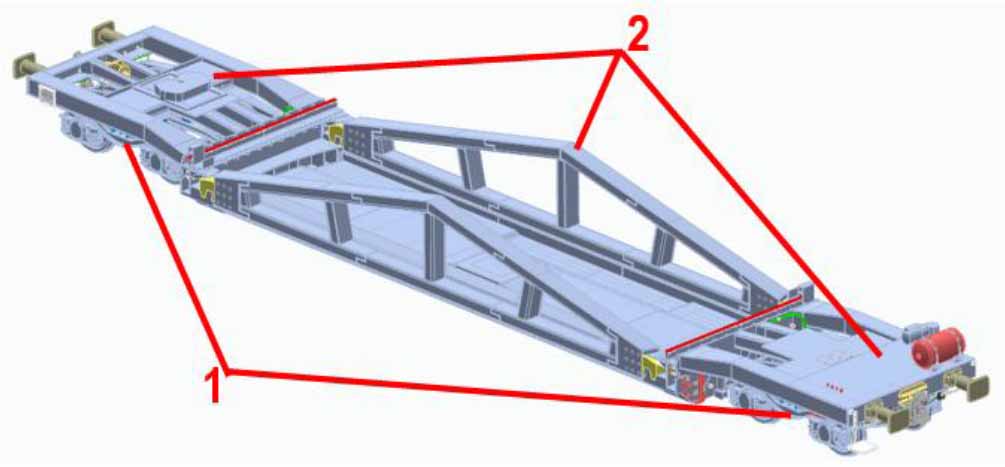
Fig. 1.
Prototype structure of the intermodal wagon with the rotating loading platform: 1 – standard Y25 bogies, 2 – wagon frame with the body – rotating platform in the lowered part
The wagon is characterized by innovative design solutions, which distinguishes it from existing solutions in freight railway rolling stock. The wagon is equipped with rollers (Fig. 2), which are located on the bottom of the frame of the rotating loading platform. These are commercially available sets, properly selected for the structure, mounted five pieces at opposite ends of the rotating loading platform. They support the rotation of the platform and are also used for the smooth entry of the platform during rotation onto the platform ramp during the loading or unloading of the semi-trailer.
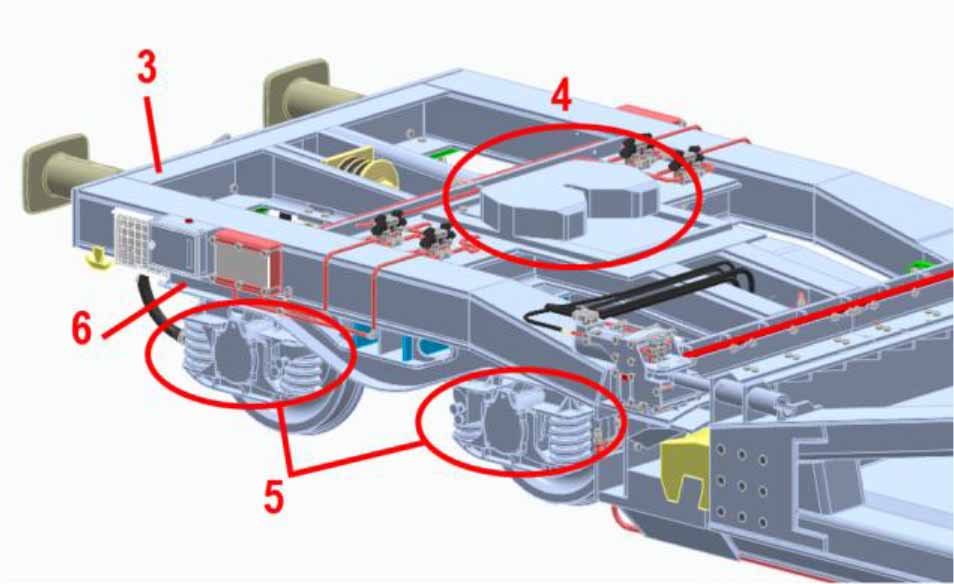
Fig. 2.
Oblique view of the overbogie part of the intermodal wagon: 3 – wagon frame, 4 – typical fifth wheel for securing semi-trailers, 5 – axle suspension stage of the bogie, 6 – bogie frame
The fifth wheel of wagon is used to attach the semi-trailer to the front overbogie part of the wagon chassis frame. Such a mechanism should also partially relieve the loading platform of the wagon. It is the main component that immobilizes the semi-trailer in the longitudinal direction of the wagon for the duration of transport.
The support mechanism (marked 6 in Figure 3) is used to introduce additional four support points of the wagon frame, the so-called feet driven by hydraulic cylinders, as an additional stiffening of the tested structure, while the locks of the side connector (marked 7 in Fig. 3) are unlocked – during the loading/unloading operation of the semi-trailer from the wagon. This mechanism is mounted under the wagon frame.
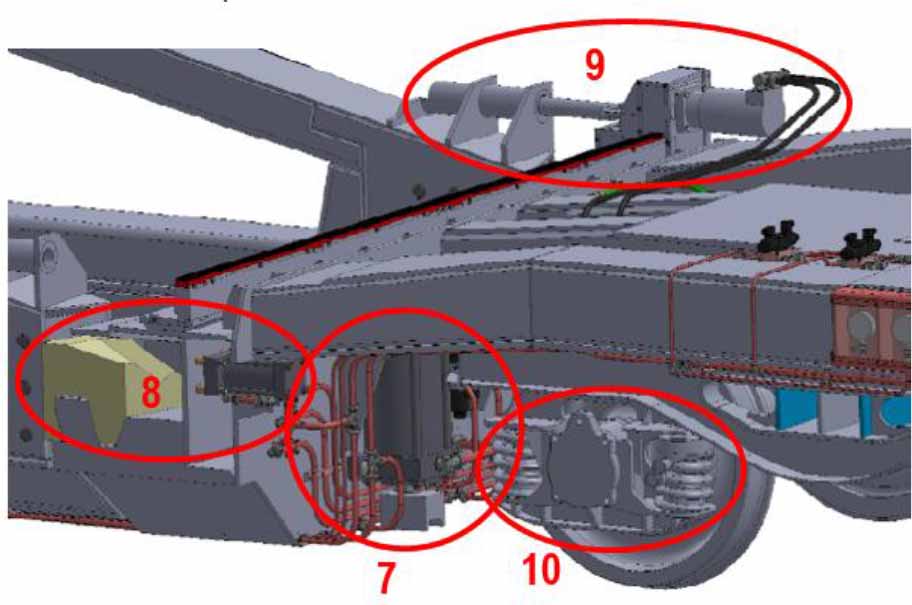
Fig. 3.
Side view of the overbogie part of the intermodal wagon with equipment: 7 – support mechanism, 8 – side connector, 9 – gear rotating mechanism of the loading platform with drive elements, 10 – classic Y25 bogie suspension stage
Side connectors, mounted in the corners of the loading platform-body (marked 7 in Figure 3), provide a connection between the rotating loading platform and the fixed part of the wagon frame. The single connector assembly consists of a hydraulic cylinder, a lock (wedge) and connecting hooks: one mounted in the sides of the rotating platform, the other in the form of a cut-out of the fixed overbogie part of the frame. A set of four side connectors and their fastenings to the platform are the most stressed components of the intermodal wagon.
The rotating mechanism (marked 3 in Figure 3) is used to rotate the loading platform during loading and unloading of truck semitrailers. The rotation mechanism consisting of a strip cooperating with a rack was located on both inner sides of the wagon overbogie part, thus enabling double-sided rotation of the platform in relation to the pivot centrally connected to the lowered part of the wagon frame.
There are three basic stages of loading a semi-trailer onto the wagon with the rotating platform using an ordinary tractor unit. Figures 4–6 illustrate the stages of loading the semi-trailer onto the wagon and its preparation for transport.
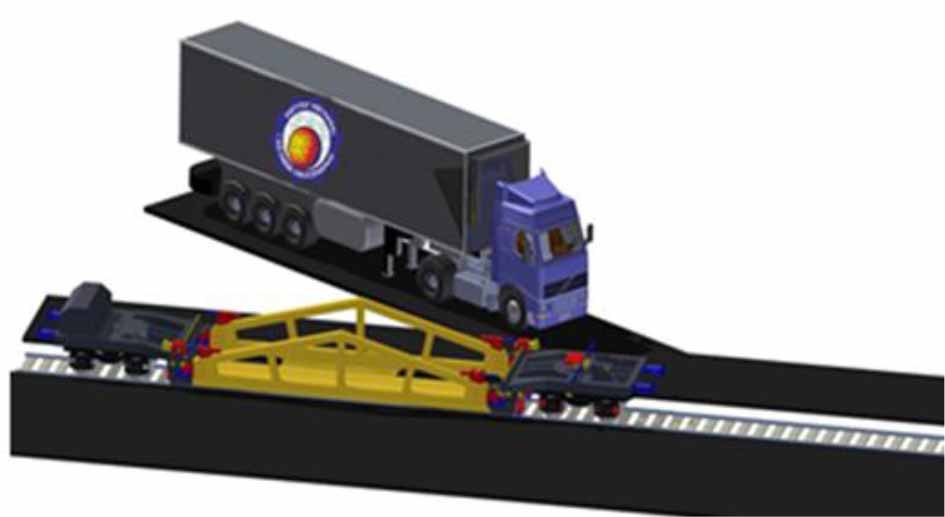
Fig. 4.
Stage I of loading – entry of the wagon onto the railway platform adapted for loading semi-trailers, positioning the tractor in the loading area and preparing the wagon for the rotation of the loading platform
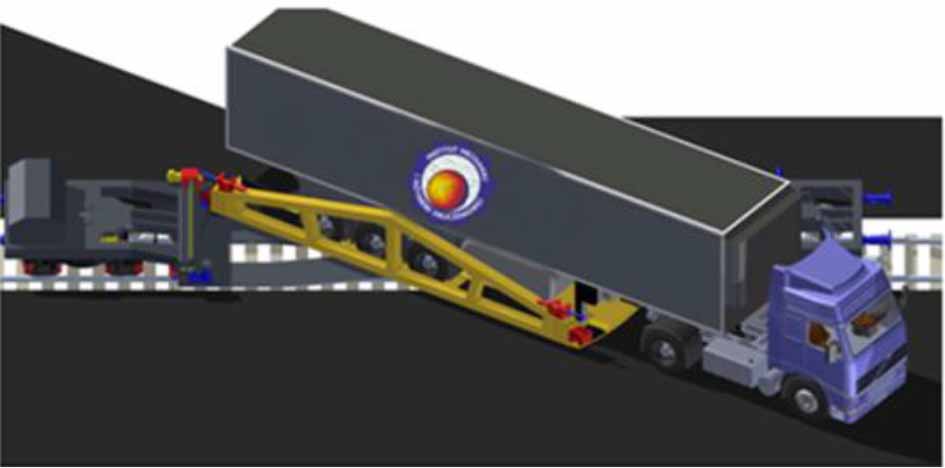
Fig. 5.
Stage II of loading – rotation of the platform, entry of the tractor with the semi-trailer, detachment and exit of the tractor itself and then re-rotation of the wagon’s loading platform to the transport position
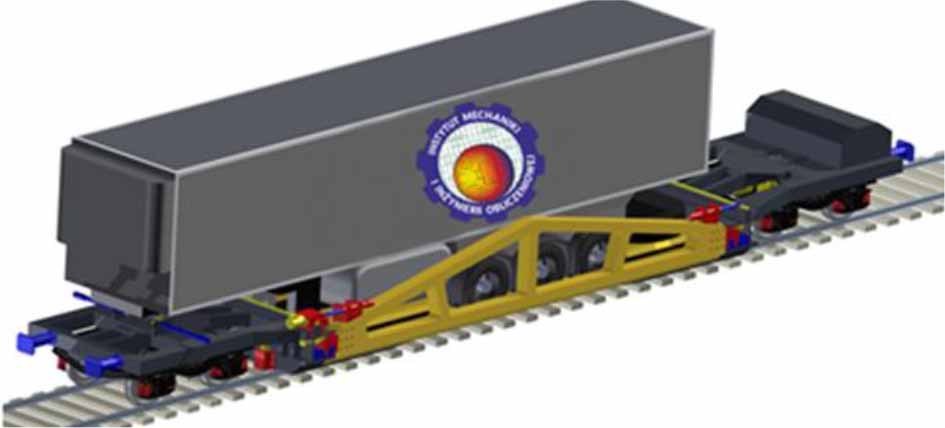
Fig. 6.
Stage III of loading – preparation of the wagon with the load for rail transport
Stage I (Fig. 4) is the entry of the tractor with the semi-trailer to the railway platform ramp. At the same time, the wagon is prepared for the rotation of the loading platform and loading by lowering the support feet onto the rails and unlocking the side locks.
Stage II (Fig. 5) – the truck drives onto the wagon, the supports in the semi-trailer are lowered, the semi-trailer is detached from the tractor and connected with the wagon frame by a fifth wheel coupling, the tractor drives off the wagon and then off the railway platform ramp.
Stage III (Fig. 6) – the platform with the semi-trailer is rotated, the side connectors are locked, after which the semi-trailer is immobilized in the overbogie fifth wheel of the wagon, the supports-stabilizers lowered before loading and resting on the railheads are lifted. After these actions, the wagon is prepared for travel.
2.2. Y25 railway bogie
The structure of the special wagon with the rotating platform is based on two Y25 bogies commonly used in Europe (Fig. 7).
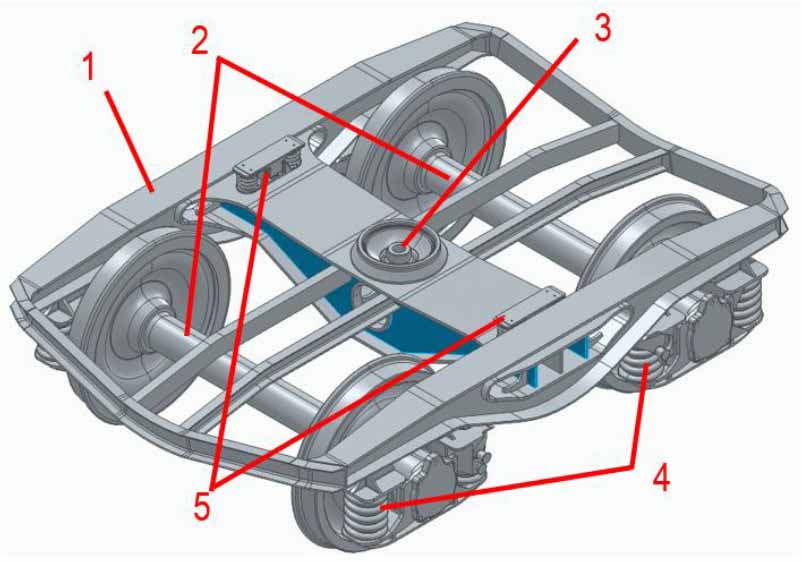
Fig. 7.
Y25 railway bogie [own development], 1 – frame, 2 – bogie axle, 3 – pivot pin, 4 – suspension (springs, friction dampers), 5 – side slides (mechanical vibration damper)
The Y25 bogie was designed on the basis of the documentation of the standard UIC bogie. It has been adapted to tracks with a width of 1435 mm and maximum axle load of 22500 kg. The bogie weight is approx. 4775 kg and the rolling diameter of wheels is 920 mm. The allowed speed of the bogie is 100 km/h with the maximum axle load and 120 km/h with an axle load not exceeding 20000 kg/axle.
The bogie frame is made as a welded structure, consisting of two external stringers, a torsion beam with a spherical pivot socket, end carriages and central stringers (used to suspend the brake gear). Individual parts of the frame are made of low-alloy steel sheets, while the end carriages and central stringers are made of a C-section. The axial suspension stage of the bogie consists of 8 identical sets of springs of different heights, inserted into each other, two at each wheel. This solution ensures increased stiffness of the suspension stage. The inner set of springs at each axial bearing is equipped with friction dampers for vertical vibrations [6]. In addition, the bogie of the Y25Ls(s)dl freight wagon has side slides that increase the rotational resistance of the wagon frame relative to the bogies and introduce additional frictional damping of motion/vibrations in the pivot pins.
In order to improve the operation of Y25 bogies, modifications of the bogie structure are used by optimizing the weight and strength of bogie frames [22] and modifications of the wagon bogie suspension due to the deterioration of the running properties of bogies when moving at higher speeds [2]. Such a solution is the use of a passive system of cylindrical rods transversely anchoring the opposite rolling bearing housings. The modeling of the wagon body suspension and FEM analysis of the pivot socket with friction lining were used in the paper [23]. Tests are also carried out on reducing noise in running gears by using wheels with noise dampers or using inserts made of another material [24]. However, the most common problem with Y25 bogies is the difficulty of selecting the right suspension characteristics for moving at high speeds. As a result of the test [4], it is possible to optimize the values of wheel contact forces by performing analytical calculations and computer simulations within the range of the given wagon travel speeds on tracks described according to the standards [5, 9, 18].
2.3. Research problem and justification for taking up the topic
The wagon with the rotating loading platform for intermodal transport of semi-trailers was designed in accordance with national and EU railway standards [25, 26] and industry requirements applicable in the Republic of Poland. In addition, in the design process, the principle was adopted that the construction concept of the wagon in the prototype version, in addition to the original elements and components developed as innovative and original versions, corresponding to the patent documentation, but at the same time subject to certification before implementation, should also include as many solutions as possible adopted earlier, implemented on the railway market and often tested in many years of operation. Such components in the wagon include standard two-axle Y25 bogies with traditional spring suspension. Bogies of this type, with various modifications, have been used for many years in wagons on European railways. Design calculations of the intermodal wagon with ordinary Y25 bogies were performed to a maximum speed of 100 km/h. Currently, bogies of this type, incorporating various design modifications [2, 17, 24] that improve lateral and longitudinal stability, especially on curved tracks [19], and with modernized braking systems, are permitted for freight traffic at a speed of up to 120 km/h. Therefore, it was considered necessary to check whether, for example, modifications to the suspension of the Y25 bogies would ensure safe running of the prototype wagon with or without load in the form of the semi-trailer. For this purpose, simulation tests will be performed using the multibody methodology and MBS software. Due to the fact that the prototype wagon had not yet been built and it was impossible to use the results of experimental tests of the complex engineering object, the parameters for the construction of numerical models were assumed on the basis of literature analyses of existing structures related to rolling stock [27, 28, 29], the authors’ own experience and the experience of teams carrying out previous design tests of such a structure, using analytical calculations and strength test methods [1, 4], including the use of dynamic simulations of wagon motion on the track [13, 14, 18].
It was initially established that one of the key problems of testing freight wagon bogies is the appropriate selection of suspension characteristics of such a structure. Standard two-axle Y25 railway bogies, which have been used for years in Europe, were used for dynamic tests of the considered design. Literature publications describe modifications of standard Y25 bogies in order to adapt and allow them to move at a speed of 120 km/h. It was decided to check whether the modifications of the Y25 bogie suspension for the prototype intermodal wagon would have a positive effect on the motion of the wagon at increased speed, especially on curved tracks. The multibody methodology and MBS software were used to check whether the modified suspension of the Y25 bogies with different damping values would ensure safe running of the prototype wagon with or without load in the form of the semi-trailer on the straight track and the curved track with two curves (Fig. 18).
This paper will also be the basis for continuing research on the prototype wagon for intermodal transport and on the influence of the railway bogie suspension on selected motion parameters. Continued wagon development will include expanding the prototype wagon into a three-bogie intermodal wagon. The methodology used in this paper to determine vibrations and pressure forces of wagon bogie wheels on the rail head as well as additional aspects related to the strength of the structure will be applied.
3. MBS METHOD AND SIMPLIFICATION OF THE NUMERICAL MODEL
3.1. MULTIBODY method
Multibody analyses (MBS) are used to study the dynamic behavior of mechanical systems consisting of many rigid bodies connected by kinematic constraints and elastic-damping elements. Such mechanical systems can represent: robots, industrial systems and many other complex mechanisms [29]. Kinematic and dynamic parameters are identified in the tested systems. The effects of external loads on the mechanism are checked and the forces and moments in the internal constraints are determined, as well as how they are transferred between the system components. Thanks to such simulations, it is possible to: determine the operation of systems; assess the performance and stability, determine the forces occurring in a given place in the system, which can then be used for detailed strength tests of components of a given structure [30]. MBS uses equations of motion based on classical mechanics and geometry to describe the kinematic and dynamic relationships between bodies [29]. For the analysis of multi-member systems, it is necessary to define the appropriate initial-boundary conditions. It is assumed that the origins of local reference frames correspond to the centers of masses of the members to which they belong, and the global reference frame is inertial [30]. The basic equations of motion for multi-body systems are defined in the form corresponding to ideal constraints in which no friction forces occur.
When solving the problem of the dynamics of a multi-member system with n number of members [2, 24, 31], it should be assumed that the global reference frame is inertial, and the origins of local reference frames are the centers of masses of individual members. The basic equations of motion of multi-member systems can be formulated using equations (1).
where:L – Lagrange function defined as the difference between the kinetic Ek and potential energy Ep of the system (L = Ek – Ep), – absolute coordinate vector describing the position and orientation of n number of system members, Φ – vector of the left-hand sides of the constraint equations in the form , constituting a system of non-linear algebraic equations with N number of variables gathered in the coordinate vector q, in which N = 6n, ΦK is the vector of kinematic pair constraints and ΦD is the vector of directing constraints,
λ – vector of Lagrange multipliers
Q – vector of generalized forces acting on a multi-member system.
After substituting the kinetic energy relationship expressed in matrix form into equation (1), the system of second-order differential equations is reduced to a first-order system [31]. It should be added that in the equations of motion of a multi-body system, in accordance with the notation used in the MBS program [31], the force F and moment vectors are treated as additional variables presented by means of functions •f" and "n" in the form of additional equations (2) and (3).
Together with the equations describing the motion of multi-body systems, the constraint equations are solved, which introduce constraints according to the relationships (4).
The complete system of equations describing the motion of a multi-body system is therefore composed of the equations presented by the relationships from (1) to (4), respectively. In mathematical terms, these equations constitute a non-linear mixed system of first-order differential equations, in which time is an independent variable, and algebraic equations [31]. Numerical integration of these systems of equations comes down to determining solutions at discrete moments of time with a given accuracy.
3.2. Numerical model of the wagon with a semi-trailer
Numerical tests were carried out in professional MBS software [29]. When performing dynamic analyses with numerical methods, it is necessary to adopt certain simplifications and optimize the models in relation to the adopted assumptions. Analyzing models with all the structural details will allow to obtain accurate and reliable results, but this will come at the expense of the time it takes to build such models and increase the simulation and processing time of the results. The bogie model after such simplifications, shown in Fig. 8, does not have a braking system, wagon buffers, bogie elements necessary to install braking systems and increase the rigidity of the frame. The parts were omitted due to their low weight and the way they work, which does not affect the operation of the wagon model during simulations. Springs and friction dampers were replaced with elastic-damping elements [29], using additional translational constraints enabling vertical movement. In addition, as part of the simplification of the model, no side slides were used, which would force the definition of additional contact joints of bodies, and this would extend the simulation time and could cause problems with the convergence of the analysis. The bogie and the frame were connected by means of a typical internal constraint in the form of a spherical articulated connection [29], without the possibility of rotation relative to the X axis with respect to the global coordinate system – Fig. 9. This solution blocks the possibility of rotation of the wagon frame in relation to the bogies, as in the case of side slides. Wheel sets were defined as a set of bodies connected into one monolithic component. The bogie frame was similarly reproduced in the model. The chassis of the semi-trailer and its wheel sets were also modeled as uniform bodies. The movement of the load was limited to the possible rotation in the ZY plane in relation to the feet supporting the semi-trailer at the bottom of the loading platform – Fig. 9. To perform the analyses, it was required to enter output data such as: load, speed and friction. The UIC60 outline wheels were modeled in accordance with the standard [32] and the UIC60 rail heads were modeled as in Fig. 8.
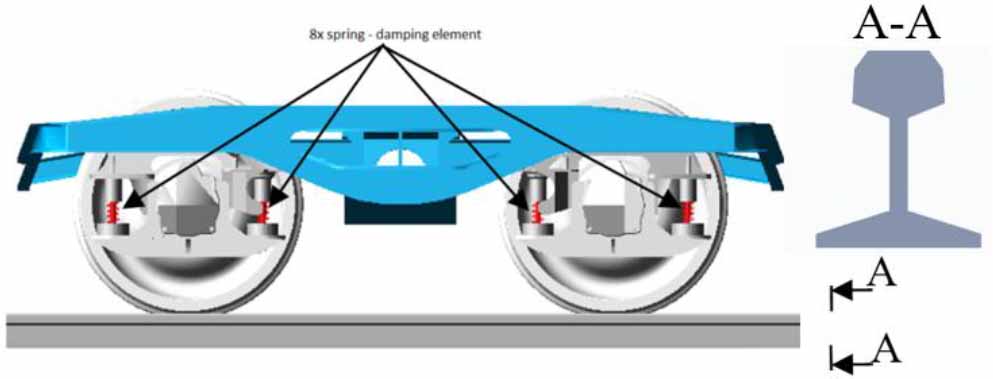
Fig. 8.
Model of the Y25 bogie and the outline of the rail profile in cross-section
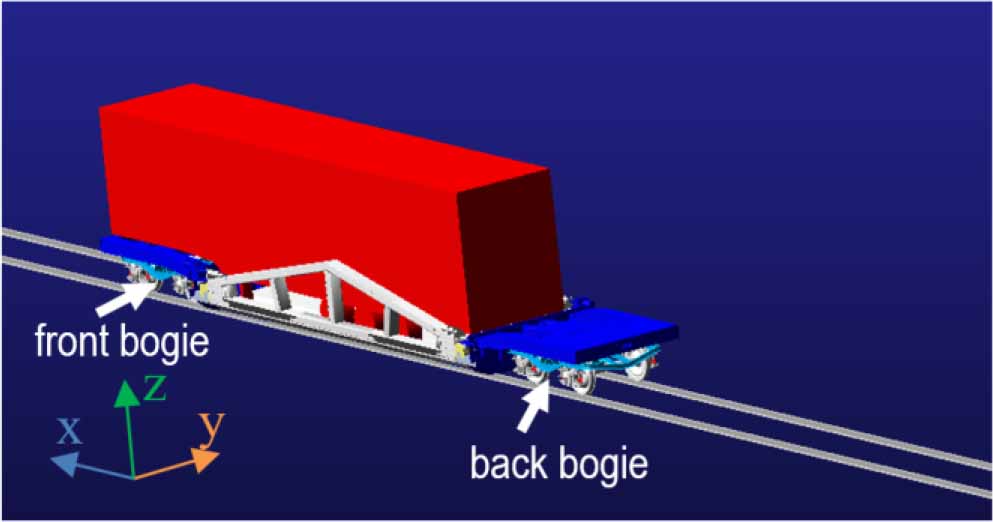
Fig. 9.
View of the model on the curved track
Three stages of simulations were carried out in the MBS software: Stage I – testing of forced free vibrations of the wagon, stage II – checking the impact of damping of the wagon moving on the straight track, stage III – checking the impact of damping of the wagon moving on the curved track. Stage I is described in detail in Section 4 of the paper. In stage II, a simulation was carried out for the wagon moving at a speed of 100 km/h. The influence of the change in the damping of the bogie spring on the forces acting in the wheel-rail contact was analyzed. The simulation lasts 10 seconds, during which the wagon accelerates from 0.5 to 5 seconds to a speed of 100 km/h on the straight track. The analyses were carried out for 4 variants of the damping value, i.e. I – Cmin = 170 [N·s/mm], II – 3000 [N·s/mm], III – 6000 [N·s/mm], IV – 7500 [N·s/mm]. In stage III, in order to determine the safety limit, the simulation was carried out on rails with two consecutive curves, mapped according to standards (Fig. 18) [19]. The track consists of 4 sections. The passage is made by accelerating to the desired speed on a section of the straight track with a length of 135 m, then a turn to the left with a radius of 250 m is applied, then another turn to the right on the track with a radius of 250 m, and in the fourth section, the passage at constant speed on the straight track with a length of 135m is modeled. The simulations were carried out in 18 seconds, during which the wagon accelerates from 0.5 to 8 seconds to a speed of 100 km/h and 120 km/h, respectively, on the curved track. Analyses were carried out for the initial damping variant and 3 larger damping values for both variants of driving speed: 100 km/h and 120 km/h. The weight of a single bogie in all test variants is 4000 kg, the semi-trailers with a load – 40000 kg and the dead weight of the wagon – the frame with the platform – 32000 kg. The models defined the appropriate contact conditions between the moving components of the wagon as well as the wheel-rail contacts. The values of the wheel-rail contact parameters (stiffness, damping) in the basic model variant were selected on the basis of own experience and the values of the parameters of the MBS models used in the analysis [18], including damping and friction coefficients. Analyses at this stage of numerical tests of wagon motion were carried out for the following variants of damping changes in the suspension components of bogie models: I initial value – Cmin = 170 [N·s/mm], II value – 7000 [N·s/mm], III value – 11000 [N·s/mm], V – maximum damping value Cmax = 17000 [N·s/mm]. Figure 8 shows the model of the Y25 bogie with the elastic and damping elements indicated, and Figure 9 shows the complete numerical model used in the multibody simulations.
4. TESTING OF FREE DAMPENED VIBRATIONS OF THE WAGON – STAGE I
Simulations in stage I of the tests began with checking the free vibrations of the wagon. The vibrating movement of the wagon was initiated by means of a load impulse shown in Fig. 10. To induce the vibration motion of the stationary wagon, a force impulse of F = 500 kN was used, acting vertically and applied to the central pin of the loading platform of the stationary wagon. The value of the exciting force increases linearly from zero in the time interval from 0.15 s to 0.2 s, reaching the maximum value, and decreases linearly in the time interval from 0.2 s to 0.22 s to the value equal to zero. The entire simulation of the wagon vibrations takes 2 seconds. In the initial phase of the simulation, the wagon and the bogies were lowered from a low height above the rail heads in order to correctly position all elements of the structure and initiate the operation of the defined contact areas. The analysis of free vibrations of the structure after excitation was carried out for two variants of damping of the suspension of freight bogies: the lowest output value of [170 N*s/mm] and the highest damping value of 17000 [N*s/mm]. As part of this testing phase, simulations were also carried out for two different wagon configurations: with the semi-trailer and load and without the semi-trailer with load. In the latter variant, the natural vibrations of the wagon were tested without the impact of external loads. In the tests of wagon vibrations influenced by the load in the semi-trailer, the impact of the suspension and semi-trailer wheel tires was not taken into account in the numerical models.
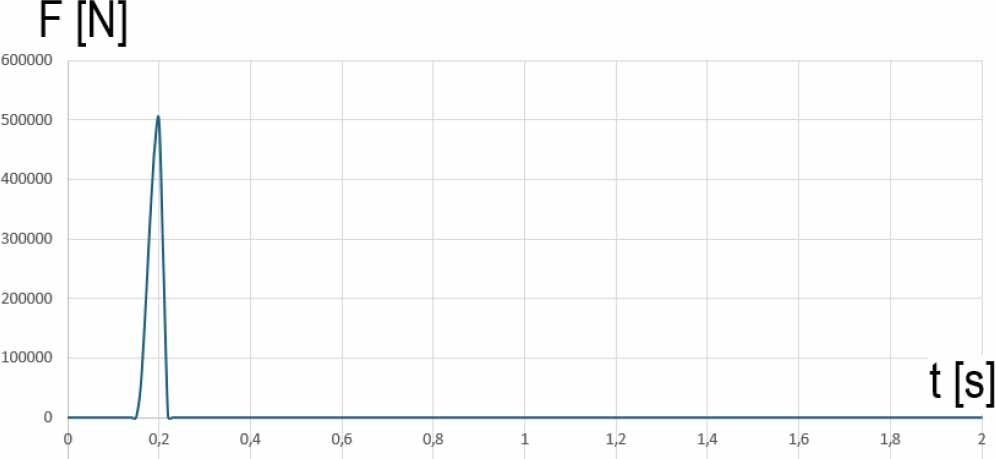
Fig. 10.
A force impulse in the wagon frame pin causing vibrations. Force vs. time graph
During the simulation of the structure vibrations, vertical displacements were recorded in two components of the wagon model – in the pivot pin of the front bogie and the rear bogie, respectively.
Figures 11 and 12 show the changes in displacements in the structure of the wagon with the semi-trailer caused by the force impulse. Changes in the values of vertical displacements as a function of simulation time were determined for two different damping values. Cases of vibration analysis without the semi-trailer are shown in Fig. 13 and 14.
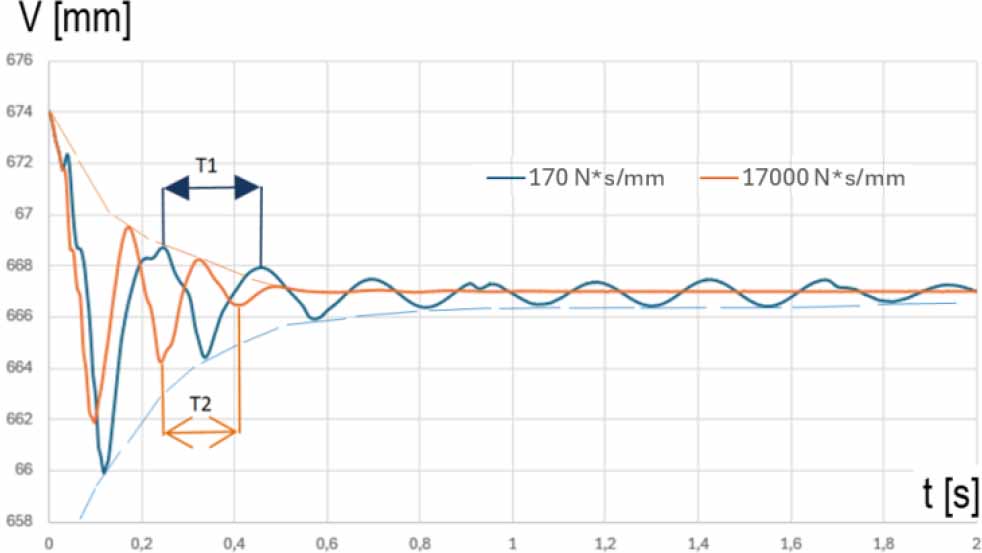
Fig. 11.
The influence of damping changes on the vibrations of the front bogie caused by the force impulse on the wagon with the semi-trailer. Graphs of vertical displacement as a function of time for two different damping values with marked vibration periods for suspension with different damping variants Cmin = 170 [N·s/mm] and Cmax = 17000 [N·s/mm]
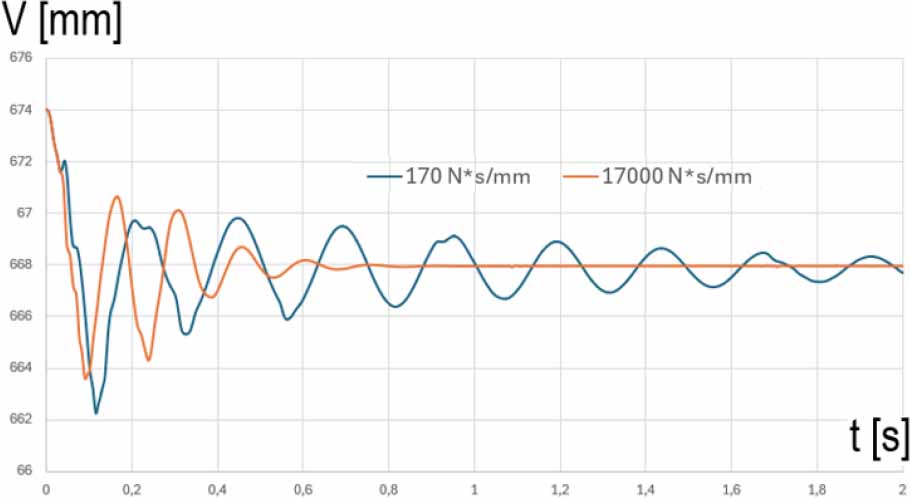
Fig. 12.
The influence of damping changes on the vibrations of the rear bogie caused by the force impulse on the wagon with the semi-trailer. Graphs of vertical displacement as a function of time for two extreme damping values Cmin and Cmax
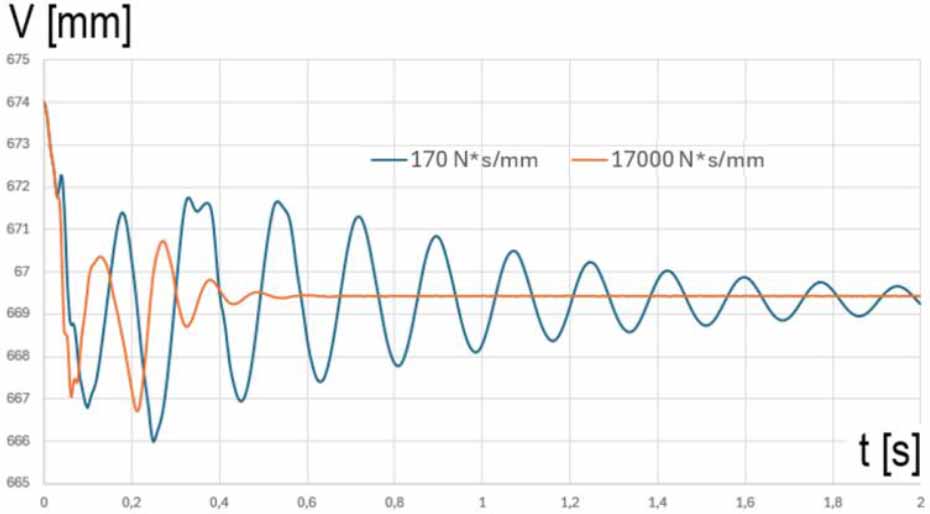
Fig. 13.
The influence of damping changes on the vibrations of the front bogie caused by the force impulse on the wagon without the load/semi-trailer. Graphs of vertical displacement as a function of time for two extreme damping values Cmin and Cmax
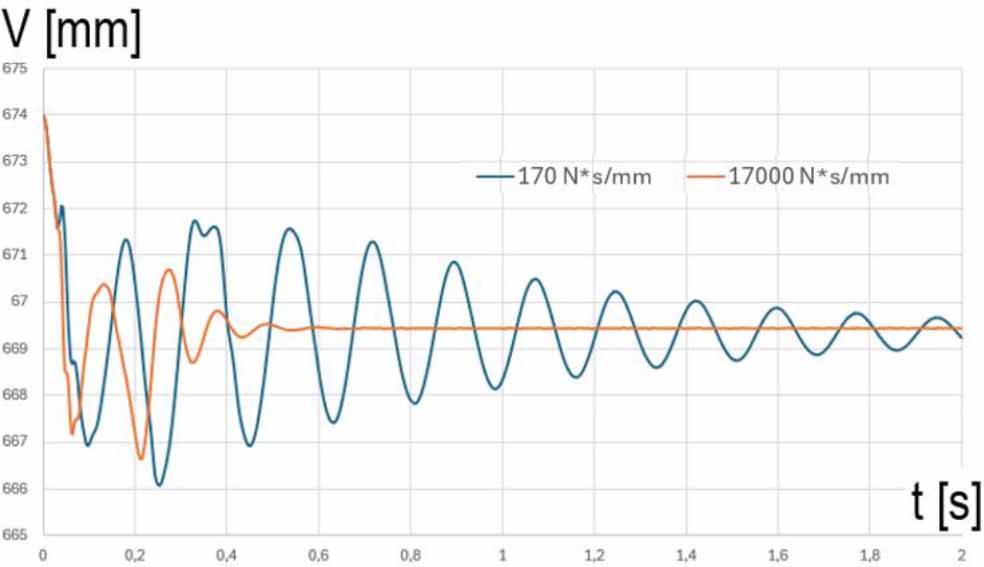
Fig. 14.
The influence of damping changes on the vibrations of the rear bogie caused by the force impulse on the wagon without the load/semi-trailer. Graphs of vertical displacement as a function of time for two extreme damping values Cmin and Cmax
The following designations are used in Fig. 10–15: F – force, t – time, V – vertical displacement, T1 – vibration period for damping variant I, T2 – vibration period for damping variant II.
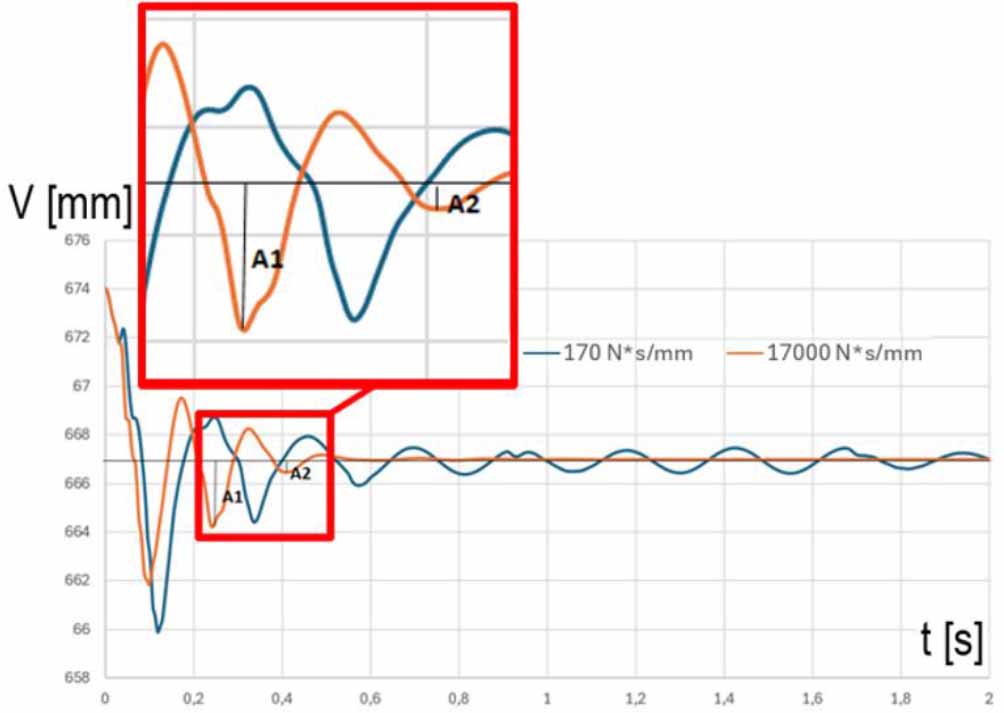
Fig. 15.
The influence of damping changes on the vibrations of the front bogie caused by the force impulse on the wagon with the semi-trailer. Graphs of vertical displacement as a function of time for two different damping values with marked amplitudes for calculating the logarithmic vibration damping decrement for suspensions with different damping variants Cmin = 170 [N·s/mm] and Cmax = 17000 [N·s/mm]
Figure 11 shows the changes in vertical displacements as a function of time for the frame of the front bogie of the wagon with the semi-trailer, and Fig. 12 shows the changes in vertical displacements as a function of time for the frame of the rear bogie of the wagon with the semi-trailer.
Table 1 presents selected parameters describing the natural vibrations of the wagon after the vibrations are excited by a force impulse. The periods of vibrations, frequency of vibrations, amplitudes and logarithmic damping decrement were determined. To determine the values, the diagrams of displacement vs. time presented in Fig. 11 and 13 were used. To calculate the logarithmic damping decrement, a zero line marked in black on the enlarged part of Fig. 15 was introduced. This line corresponds to the established displacement value of approx. 667 mm, after the effect of the impulse excitation has ceased and the free movement of the wagon has been supercritically damped. With regard to this line, amplitudes A1 and A2 are marked in detail in the enlarged part of Fig. 15. On the basis of the amplitude values determined in this way, the logarithmic damping decrement was calculated. The logarithmic damping decrement [33] describes the tendency of the system to damp vibrations and is determined as the natural logarithm of the quotient of the amplitude of the first vibration (A1), in Fig. 15, to amplitude A2 of the vibration following the first one, defined by the following formula (5):
where: δ – logarithmic damping decrement, A1 – amplitude of any vibration, A2 – amplitude of the vibration following the previous one at the time interval indicated as the vibration period T2 – Fig. 11 and Fig. 15.Table 1
Summary of parameters describing the wagon’s natural vibrations
| WAGON WITHOUT SEMI-TRAILER | WAGON WITH SEMI-TRAILER AND LOAD | |||
|---|---|---|---|---|
| DAMPING | Cmin | Cmax | Cmin | Cmax |
| Vibration period – T | 0.2 s | 0.116 s | 0.232 s | 0.172 s |
| Vibration frequency – ϑ | 5 Hz | 8.6 Hz | 4.3 Hz | 5.8 Hz |
| Amplitude after releasing vibrations – Amax | 3.5 mm | 2.8 mm | 1.5 mm | 2.7 mm |
| Logarithmic damping decrement – δ | 0.07 | 1.5 | 0.51 | 1.69 |
The values determined in Table 1 show that the higher damping value used in the wagon bogie suspension caused a decrease in the vibration period T for the wagon with the semi-trailer and load as well as without the semi-trailer. This also resulted in an increase in the vibration frequency for the variant with greater damping. The maximum natural vibration frequency of 8.6 Hz was determined for the wagon without the semi-trailer and load in the case of using the bogie suspension model with maximum damping Cmax. The natural vibration frequencies determined for the wagon with and without the semi-trailer under the influence of maximum bogie damping in the models differ by a maximum of approx. 48%.
The maximum values of the logarithmic damping decrement δ were calculated for the wagon with the semi-trailer and without the load in the vibration variants corresponding to the use of Cmax damping and are 1.69 and 1.5, respectively. These values are higher than the values δ calculated for the lowest damping Cmin used in the simulations by more than twenty times for the wagon without the semi-trailer and load and more than three times in the case of the wagon with an external load of the semi-trailer and load (400 kN), respectively. This means much more effective vibration damping when considering an empty wagon – without the semitrailer – and this is reflected in Fig. 13 and 14.
The highest values of vibration amplitudes occur in the initial phase of the simulation – up to 0.2 s of the simulation duration, corresponding to increasing the value of the excitation force impulse to 400 kN.
The displacement values recorded on the pivot pins of both bogies differ due to the uneven distribution of the semi-trailer with the load in relation to the wagon. This is influenced by the mounting and positioning of the semi-trailer on the fifth wheel above the front bogie and the position of the semi-trailer wheels in the front part of the wagon platform (Fig. 9). The above-mentioned points of load transfer from the load with the semi-trailer are therefore very asymmetrically distributed in relation to the center of gravity of the rotating platform and the complete, empty wagon [1, 34]. The semitrailer with the load is placed mostly at the front of the wagon, which adds weight to the front bogie of the prototype wagon. Therefore, in the case of the vibration test of the wagon without the semi-trailer, the displacement values are almost identical due to the application of an excitation impulse in the central pin of the rotating platform (the center of the empty wagon).
Figures 13 and 14 show a smaller influence of the force impulse in the second phase of the simulation of free vibrations of the wagon – after 0.22 s and the cessation of the influence of the excitation impulse. In the above-mentioned figures, the amplitudes of vertical displacements increased maximally only during the action of the excitation impulse and then the vibrations were completely damped – practically after recording only one full period of vibrations.
5. DYNAMIC TESTS OF WAGON MOTION ON STRAIGHT AND CURVED TRACKS – STAGE II AND III
In stage II and III of numerical tests of the impact of damping on the running stability of the prototype wagon, a criterion was adopted to determine the stability of wagon motion. It was assumed that the positive values of the contact forces determined in the two wheelrail contact pairs, located on the diagonal of the prototype wagon, on the first axle of the front bogie and the last axis of the rear bogie of the wagon, correspond to the pressure of the wheels on the rail. The instability of wagon motion occurs after the wheel is detached from the rail. In these analysis cases, the values of the contact forces reach values less than zero.
The analyses of wagon motion in the conditions of changing the travel speed on the standard sections of straight and curved tracks were carried out in numerical simulations using the MBS models of the prototype wagon and tracks discussed in Section 3. Numerical simulations of wagon motion were carried out for two wagon speeds: 100 km/h and 120 km/h. In all cases of simulation of wagon motion on the straight and curved sections, different damping values were assumed in the suspension components of the models of both bogies.
In all simulations of stage II and III, the results were recorded in the form of changes in the values of the contact pair forces of both bogies as a function of the simulation duration. The corresponding diagrams are presented in Fig. 16–17 and 19–22. Symbols adopted in Fig. 16–22: RPP – reaction of the right wheel of the front bogie, RPPmax – maximum reaction of the front right wheel, RPPmin – minimum reaction of the front right wheel, RTL – reaction of the left wheel of the rear bogie, RTLmax – maximum reaction of the rear left wheel, RTLmin – minimum reaction of the rear left wheel, T1 – time of entry of the wagon into the first curve, T2 – time of entry of the wagon from the first curve to the second curve, T3 – time of leaving of the wagon from the second curve, O – point of change in the direction of the track curvature, t – time.
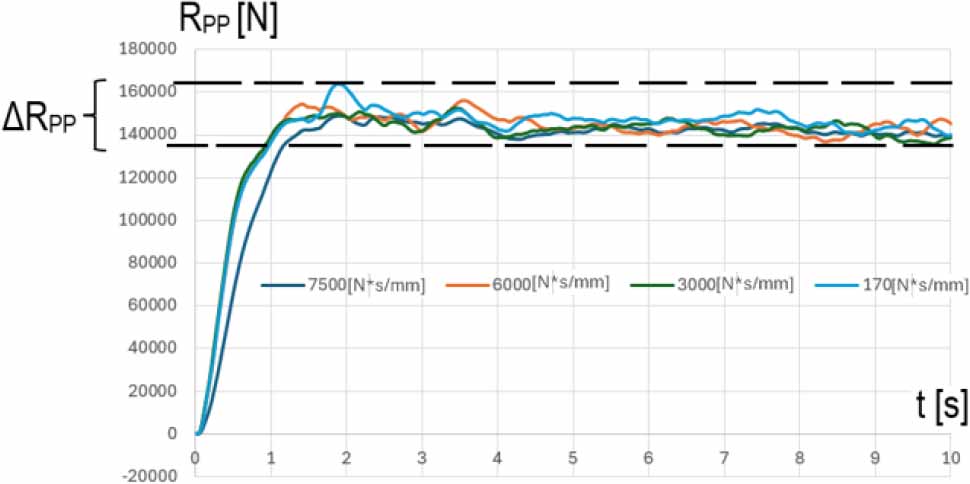
Fig. 16.
Graphs of changes in the contact force between the front right wheel and the rail as a function of time – V = 100 km/h, RPP – force on the front right wheel
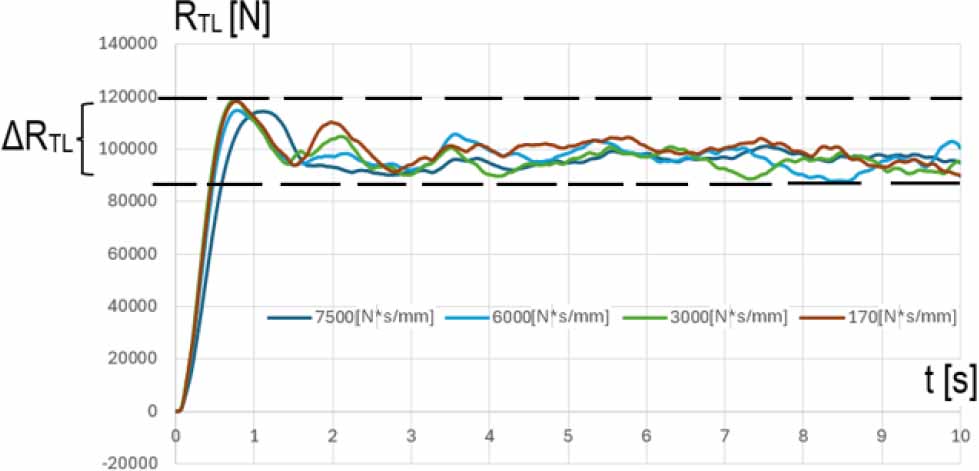
Fig. 17.
Graphs of changes in the contact force between the rear left wheel and the rail as a function of time – V = 100 km/h, RTL – force on the rear left wheel
In stage II of the simulation, the motion of the prototype wagon on a straight section of the track was modeled, taking into account different damping values in the suspension stage of both bogies, in the following damping variants:
- I output value: Cmin = 170 [N*s/mm],
- II value: 3000 [N*s/mm],
- III value: 6000 [N*s/mm],
- IV value: 7500 [N*s/mm].
The diagrams in Fig. 16 and 17 show the effect of the change in damping on the wheel-rail contact forces for movement at a speed of 100 km/h on the straight track. The values of the wheelrail contact forces in the case of the front right wheel change during increasing speed in the range of ΔRPP = ~ 20 kN (up to approx. 2 s of the simulation duration) and during a set speed of 100 km/h, they change less ΔRPP = ~ 10 kN and are not greater than the value of 150 kN. Due to the asymmetry of the external load applied from the semi-trailer with load, the wheels of the front bogie are more loaded. The averaged RPP force values are about 50 kN higher than the averaged RTL forces. The maximum relative differences of the highest and lowest contact forces recorded in the front right and rear left wheels, respectively, are described by the relationship (6).
In stage III of the simulation, the motion of the prototype wagon on the curved track at a speed of 100 km/h and 120 km/h was modeled, taking into account different damping values in the suspension stage of both bogies, in the following damping variants:
- I output value: Cmin = 170 [N*s/mm],
- II value: CII =7000 [N*s/mm],
- III value: CIII 11000 [N*s/mm],
- IV value: = Cmax=17000 [N*s/mm].
Figure 18 shows the configuration and basic dimensions of the curved track. The track model reflects the most demanding case according to the standards [1, 25], i.e. two curvatures named CL and CR in the drawing with a radius of R=250 m each, following one after the other, with a connection at the inflection point O – Fig. 18.

Fig. 18.
Configuration and dimensions of the curved track; CL – curvature to the left, CR – curvature to the right, O – point of inflection of the curvature/change of direction of track curvature
The diagrams in Fig. 19 and 20 show the influence of the change in damping on the course of contact forces in kinematic wheel-rail pairs in the motion variant at a speed of 100 km/h on the curved track presented in Fig. 18. These diagrams show two time intervals: T1-T2 and T2-T3, which present, respectively, changes in the value of contact forces as a function of the travel time of a given bogie wheel on the CL section of the cured track and changes in the value of contact forces as a function of the travel time of a given bogie wheel on the CP section of the curved track.
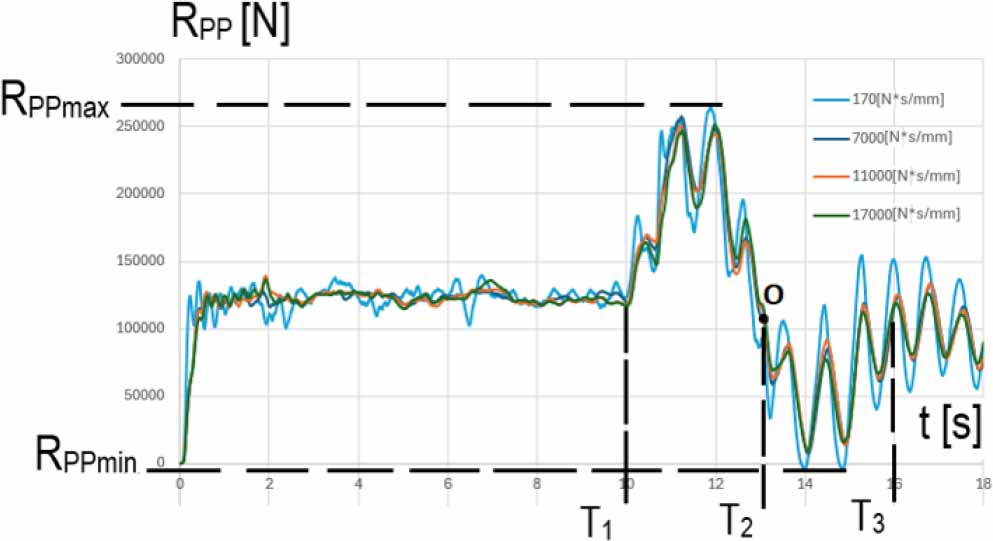
Fig. 19.
The influence of the change in damping on the course of the contact force between the front right wheel and the rail in the movement variant at a speed of 100 km/h on the curved track
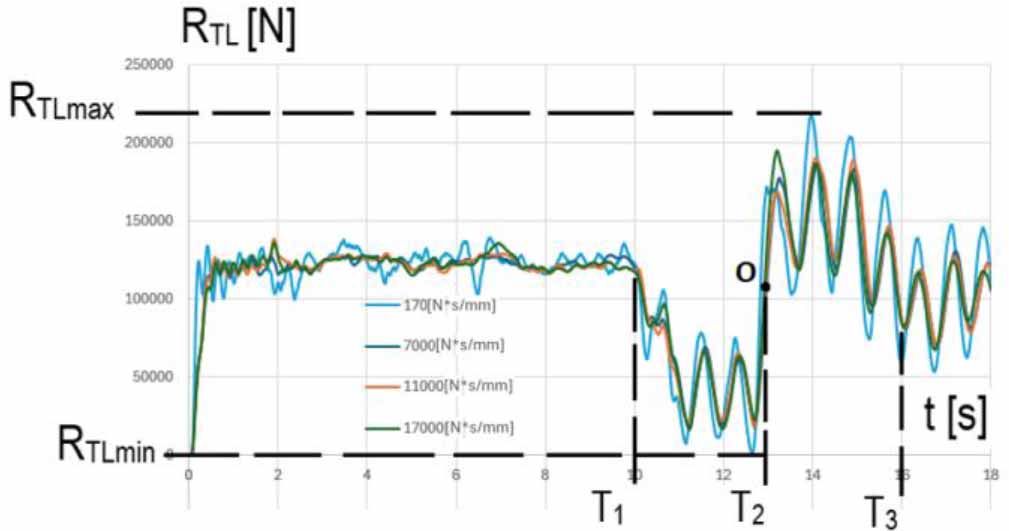
Fig. 20.
The influence of the change in damping on the course of the contact force between the rear left wheel and the rail in the movement variant at a speed of 100 km/h on the curved track
The diagrams in Fig. 21 and 22 show the influence of the change in damping on the course of contact forces in kinematic wheel-rail pairs in the movement variant at a speed of 120 km/h on the curved track. In these graphs, similarly to Fig. 19 and 20, two time intervals are marked: T1-T2 and T2-T3, which represent, respectively, the changes in the value of the contact forces as a function of the travel time of a given bogie wheel along the CL section and after passing the track inflection point, the CP section of the curved track.
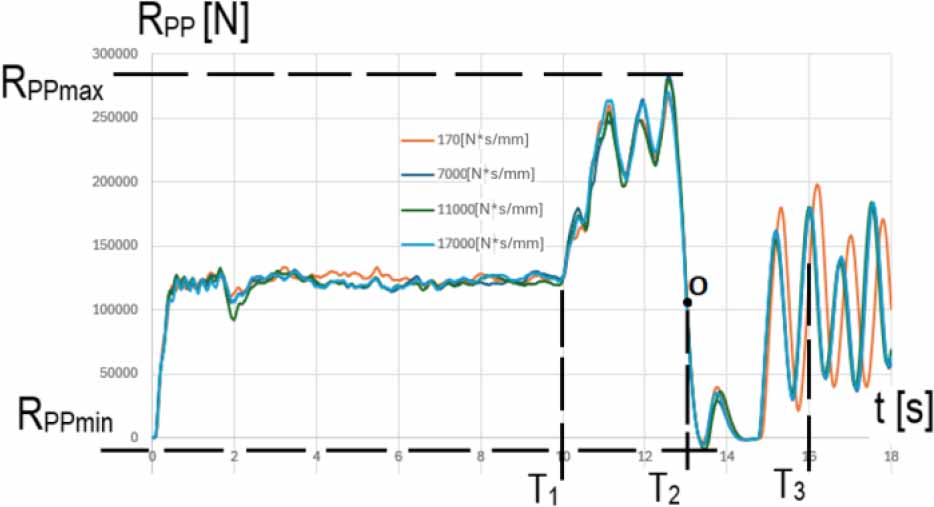
Fig. 21.
The influence of the change in damping on the course of the contact force between the front right wheel and the rail in the movement variant at a speed of 120 km/h on the curved track
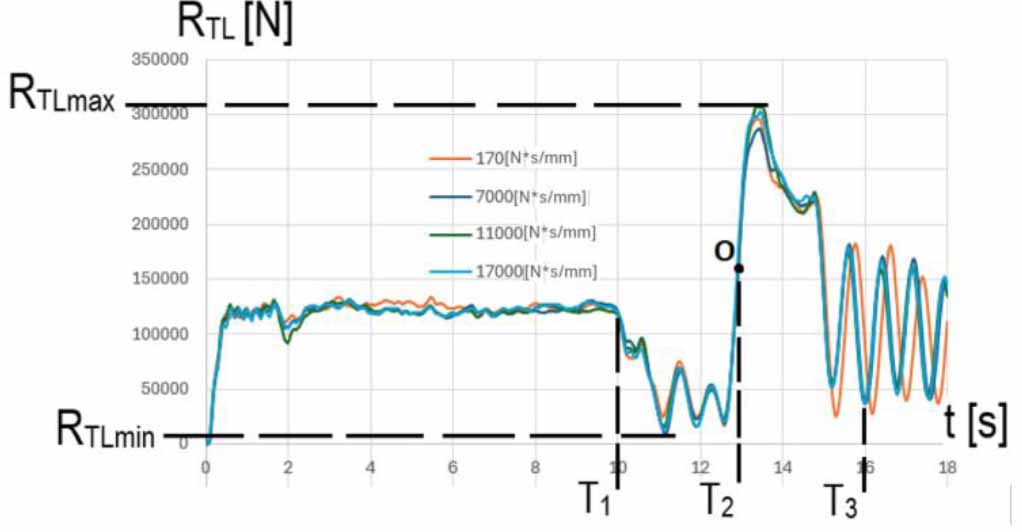
Fig. 22.
The influence of the change in damping on the course of the contact force between the rear left wheel and the rail in the movement variant at a speed of 120 km/h on the curved track
Table 2 presents the summary of the maximum and minimum reactions in the wheel-rail contact determined in the simulations of wagon motion on the straight track at a speed of 100 km/h and on the curved track – Fig. 18 at a speed of 100 km/h and 120 km/h.
Tab. 2.
Summary of the maximum and minimum reactions in the wheelrail contact for various conditions of the wagon motion simulation
| Straight track | Curved track | ||
|---|---|---|---|
| Speed V [km/h] | 100 | 100 | 120 |
| Reaction of the front right wheel – RPPmax[kN] | 163.8 | 264 | 283 |
| Reaction of the front right wheel – RPPmin [kN] | 138.2 | -4 | -6 |
| Reaction of the rear left wheel – RTLmax[kN] | 119 | 217.9 | 308 |
| Reaction of the rear left wheel - RTLmin [kN] | 87.4 | ~0 | 10 |
On the basis of the results of the wagon motion simulations, it was found that the front right wheel while driving in the CL curve (T1-T2 interval) is pressed against the track with the maximum force RPPmax (V = 120 km/h) = 283 kN – Fig. 21, while the rear left wheel of the wagon is relieved in this phase of motion with the possibility of a short-term separation of the wheel from the track: for V = 100 km/h and damping Cmin, RTLmun=~ 0 kN – Table 2 and Fig. 20.
The inverse relationship can be observed during motion in the CR curve during the T2-T3 analysis interval. In this phase of wagon motion, the left rear wheel is loaded – Fig. 20 and 22, while the right front wheel is relieved with the possibility of short-term loss of contact with the rail head: for V = 120 km/h, Cmin, RPPmin = -6 kN – Fig. 21 and Table 2.
The relationships described above are analogous for all considered variants of wagon motion on the curved track at speeds of 100 km/h and 120 km/h and with different damping values. In the analyzed results, only the maximum and minimum values of the contact forces in the kinematic pairs of the wheel-rail differ. The largest relative differences in the contact forces ΔRmax were recorded during motion on the curved track at speeds of 100 km/h and 120 km/h. The maximum relative differences between the forces RPPmax and RTLmax listed in Table 2 are respectively:
6. DISCUSSION OF RESULTS
It should be emphasised that the present analysis is based exclusively on numerical simulations. Although the MBS model captures the essential dynamic features of the wagon–bogie system, its predictive capabilities must be verified experimentally. Therefore, the results presented in this study should be interpreted as preliminary findings, forming a basis for further laboratory investigations and prototype-level validation.
The paper presents an analysis of the influence of selected suspension parameters of Y25 bogies on free vibrations of the prototype railway wagon and changes in the contact forces of wheel-bogie kinematic pairs during the simulation of wagon motion on the straight and curved track for different values of suspension damping in Y25 bogies and at different travel speeds of 100 km/h and 120 km/h. The analyses carried out made it possible to identify the maximum and minimum values of the forces acting in the wheel-rail contact.
In the tests of wagon vibrations influenced by the load in the semi-trailer, the impact of the suspension and semi-trailer wheel tires was not taken into account in the numerical models.
The adopted model includes several simplifications that may influence the accuracy of the predicted forces. The model assumes rigid bodies, neglects elastic deformations of the frame and bogie components, and does not incorporate track irregularities or the dynamic characteristics of the trailer suspension and tyres. These simplifications justify the need for complementary laboratory and field studies to confirm the applicability and safety of the proposed suspension modifications.
The displacement values recorded on the pivot pins of both bogies in the vibration analyses of the wagon loaded with the semitrailer differ significantly due to the uneven distribution of the semitrailer with the load in relation to the wagon.
The A1 and A2 amplitudes in individual cases of vibration tests of the prototype wagon were determined in the period immediately following the cessation of the excitation impulse, i.e. after 0.22 s of the simulation duration. They were used, among other things, to determine the damping decrements.
The analysis of the values of vibration decrements determined on the basis of data recorded in the models of the wagon with and without external load, in the form of the semi-trailer with a permissible weight of 400 kN, showed that much more effective vibration damping occurs when considering an empty wagon – without the semi-trailer placed on the wagon’s loading platform.
In the case of tests of the wagon model without the impact of the loaded semi-trailer, the amplitudes of vertical displacements increased maximally only during the action of the excitation impulse and then the vibrations were completely damped, practically after recording only one full period of vibrations. This may indicate that there are vibrations close to supercritical vibrations in these variants.
In the case of simulation of motion on the straight track, the wheel loads of both bogies of the prototype wagon are lower than when the wagon moves on the curved track. In the entire range of simulations performed, there is no danger of the wheels of the wagon detaching from the track. Only the phenomenon of asymmetric distribution of dynamic loads of both bogies with the additional loading of the wheels of the front bogie is observed.
Due to the asymmetry of the external load applied from the loaded semi-trailer, the wheels of the front bogie are more loaded in steady movement along the straight track. The averaged RPP force values are about 50 kN higher than the averaged RTL forces.
In the analysis variants, in which the wagon moves at a speed of 120 km/h on the curved track, in approx. 13th second of the simulation, there are conditions for a short-term detachment of the front right wheel from the rail head.
The damping values in stage III of the analysis – in passages on the curved track – were increased compared to stage II. Therefore, the increase in the wheel-rail contact forces was recorded compared to the simulation of wagon motion on the straight track. The wheel-rail contact force graphs for the left and right wheels of the front and rear bogies show that increasing damping generally causes a decrease in the amplitude of the contact force changes.
The graphs of the pressure forces of the wagon wheels on the rails, especially in the downforce phases, confirm that the values of the contact forces in the kinematic pairs decrease with the increase of damping.
7. SUMMARY AND CONCLUSIONS
The presented methodology of numerical tests with the use of rigid models and the MBS approach makes it possible to check the safety conditions of the prototype wagon with the full load with a set increased speed of 120 km/h on the standard track on the basis of the adopted criterion of the stability of wagon motion.
On the basis of the simulation results included in the paper, it was confirmed that it is possible to improve the stability of the prototype wagon motion with an increased speed of ≤100 km/h - 120 km/h thanks to the appropriate selection of damping in the suspension of the standard Y25 bogie.
Tests of the influence of changes in damping in the suspension stage of bogies on changes in wheel-rail contact forces with unchanged reduced stiffness of the suspension of Y25 bogies confirmed that, in general, the change of damping makes it possible to ensure operating conditions for motion on the curved standard track from the point of view of meeting the adopted criterion of motion stability at increased speed. This is an original aspect of the tests carried out and the fulfillment of the scientific purpose of this paper.
However, with the selection of suspension parameters of the Y25 bogies implemented in the paper, the possibility of short-term increase and exceeding of the permissible values of the load forces on the bogie axles, i.e. the maximum load force per axle ≤ 250 kN, was observed. At the same time, due to the dependencies of the impact of damping on motion stability obtained in the analyses (short-term tendencies to completely relieve some wheels, and even the emergence of conditions for their temporary lifting above the rail head), and in particular exceeding the permissible load of the front bogie axle in the conditions of crossing the curved track with immediately following opposite curvatures of the track at an increased speed of 120 km/h, with the predetermined, unchanging reduced stiffness of the bogie suspension, additional tests and detailed checks will be required, as this may be associated with accelerated wear of the wheel sets in conditions of excessive overload of the bogie wheels when moving in curves. The obtained results, although promising, cannot be directly applied to operational conditions. Any practical modification of bogie suspension parameters must be preceded by experimental validation, including laboratory testing of damping elements and on-track measurements of wheel–rail forces. Numerical simulations alone are insufficient to guarantee safe implementation. Therefore, it will be necessary to continue this type of detailed tests, according to the methodology developed in this paper, after the experimental verification of the reduced stiffness of the Y25 bogie suspension, in the version used in the discussed numerical simulations.
The reduced suspension stiffness defined in all bogie models considered in the paper was determined on the basis of the available manufacturer’s data on the standard suspension stage of Y25 bogies and numerical tests conducted by the authors. Therefore, it is also necessary to examine and experimentally verify the adopted value of reduced stiffness of the suspension stage in further stages of work on shaping the desired characteristics of the bogies used for the prototype wagon. Future work will focus on experimental verification of the model, including full-scale tests of the prototype wagon. These measurements will be used to refine the model parameters and assess the long-term performance and safety of the proposed suspension configuration.
The prototype wagon tested numerically in this paper has not yet been manufactured, so it is impossible to perform experimental functional and strength tests on a real object. Such tests would certainly facilitate the answers to many questions related to the completion of design work and the production implementation of the wagon.