
1. INTRODUCTION
Numerous application disciplines, such as information theory, research, and engineering, depend heavily on NHOPDEs. This is especially important for applied sciences and entropy. Moreover, they have been used for a long time to explain a variety of natural phenomena, such as temperature fluctuations, growth of populations, earthquakes, and atomic structure. In literatures, there are numerous applications of the integral transform in mathematics. Integro-differential equations, integral equations, and linear DEs can all be solved with ET. This method is not appropriate for solving nonlinear DEs due to the nonlinear variables. Nonlinear DEs can be solved using ET support for the homotopy perturbation approach, differential transform method, and any other methods.
These days, nonlinear equations are very important. Applications of nonlinear phenomena are significant in engineering, physics, and applied math. Finding new exact or approximate solutions to nonlinear PDEs requires creative thinking, which is challenging even in fields like applied math and physics, where precise solutions are crucial. Many writers have focused on applying various methods to the investigation of solutions to nonlinear PDEs in the last few years. Numerous methods have been proposed, such as the homotopy perturbation, differential transform, Elzaki transform, Laplace, and double Laplace transforms, variational iteration, Adomian decomposition method and Laplace variational iteration [1–17].
Over the past few years, numerous researchers have devoted considerable effort to exploring various methods for solving nonlinear PDEs. Techniques such as the homotopy perturbation method (HPM), differential transform method (DTM), Elzaki transform, Laplace and double Laplace transforms, and the variational iteration method (VIM) have been widely employed to address these challenges. For instance, Abdulazeez et al. in [18] utilized the homotopy analysis method (HAM) and VIM to solve nonlinear pseudo-hyperbolic equations, demonstrating that HAM provides results that are more accurate and closely aligned with exact solutions compared to VIM. Similarly, the residual power series method (RPSM), as proposed by Abdulazeez et al. [19], has shown the ability to solve nonlinear pseudo-hyperbolic PDEs with non-local conditions, while providing fast convergence and accurate results. The explicit finite difference method (EFDM) was applied by Abdulazeez et al. [20] to solve fractional-order pseudo-hyperbolic telegraph PDEs using Caputo derivatives, while the Crank–Nicholson difference scheme has been successfully utilized for mobile–immobile advection–dispersion models [21]. Furthermore, Abdulla et al. [22] extended this approach by comparing the solutions of third-order fractional PDEs using Caputo and Atangana-Baleanu Caputo (ABC) fractional derivatives.
To overcome and relax the inherent difficulties of nonlinear problems, hybrid methods that combine two or more techniques have been increasingly explored. For example, Ahsan et al. in [23] present a hybrid scheme of finite-difference and Haar wavelet distribution for the ill-posed nonlinear inverse Cauchy problem.
Advanced computational techniques have also found applications in specialized areas such as signal processing and electromagnetic wave modeling. For instance, Prewitt operators combined with fractional-order telegraph PDEs have been proposed by Tenekeci et al. [24] for edge detection, demonstrating the potential of fractional operators in enhancing image processing techniques. Similarly, Modanli et al. [25] introduced a computational method based on integral transforms for solving time-fractional equations arising in electromagnetic waves, highlighting the importance of fractional calculus in addressing wave propagation problems.
The new technique, which is based on a novel integral transform (ET), will be introduced and used in an accessible manner in this study [6]. We also explore the potential applications of this new transform side by side with the recently developed approach to solving NHOPDEs in this work. This method works well with standard impulse functions and functions along with discontinuities.
This document is organized as follows: Section 2 presents a new integral transform called the Elzaki transform (ET). Section 3 presents a convergence study and analytical methodology for solving NHOPDEs. Section 4 presents a several numerical example. Discussion and conclusion brought under Section 5 to a close
2. ELZAKI TRANSFORM
Integral equations, systems of PDEs, ODEs, and PDEs may all be solved with the ET, as demonstrated by Tarig M. Elzaki in [2–5, 29 – 33]. Effective application of ET is possible when Sumudu and Laplace transforms are unable to solve DEs with variable coefficients [11]. In engineering and applied mathematics, ET is a potent instrument.
The primary ideas behind this modification in presentation are as follows, ET of B(ε) is :
Definition 1 Let T′(ξ) be the ET of the derivative of B(ε), then:
(a) ,
(b) ,
The following helpful ETs have been established in this study:
Let E[B(ε)] = T(ξ) and E[a(ε)] = A(ξ), then:
,
,
.
Let E[B(ε, ζ)] = T(ε, ξ) then the ET of partial derivatives of B(ε, ζ) are,
3. ANALYSIS OF PROPOSED SCHEME
We use the following initial conditions and NHOPDEs Cauchy problem to demonstrate the basic idea in this method:
Where, B(ε, ζ) is the unknown function, NB(ε, ζ) nonlinear operator, g(ε, ζ) is the in-homogeneous or source term and a = a(ε, ζ) may be a constant or function of ε or / and ζ.
When k > 1, Eq. (2) turns into a nonlinear hyperbolic equation of greater order [26], while for k = 1, an equation (2) was reduced to a wave shape [27, 28].
Equation (2) can be written as follows:
orUsing ET to obtain:
Applying Elzaki inverse to get:
Where G(ε, ζ) denotes the term that arises from all or some of the function g(ε, ζ) and the stipulated initial conditions.
This method's efficacy hinges on how we choose the initial iteration B0(ε, ζ) that yields the most precise result in the fewest stages. To get a solution iteratively, we use the following relations:
It looks that the following is the series form for the solution to Eq. (2):
According to System. (4), we are able to determine the following B0(ε, ζ), B1(ε, ζ), B2(ε, ζ), ⋯, Eq. (5) can then be used to find the solution.
3.1. Convergence analysis
The convergence of the ET approach to the exact solution for NHOPDEs is covered in this section.
Theorem 1. If is a Banach space, in Eq. (5) is convergence, if ∃ (0 ≤ β 1), s.t. ∀ τ ∈ ℕ ⟹ ∥Bτ∥ ≤ β∥Bτ–1∥, to η ∈ B.
Proof. Partially sum sequence is described as follows: ,
It is now necessary to demonstrate that: is a Cauchy series in Banach space,
For all (τ, λ) ∈ ℕ2 as τ ≥ λ
Since (βτ–λ–1 + βτ–λ–2 + ⋯ + β) is a geometric series and 0 ≤ β < 1 then, then is the Cauchy sequence in Banach space then defined in Eq. (5) converges.
4. NUMERICAL APPLICATIONS
This section applies the suggested method to the solution of three numerical examples of nonlinear higher-order hyperbolic equations and two nonlinear wave-like equations with variable coefficients.
4.1. Nonlinear Higher Order Hyperbolic Equations
Numerous physical phenomena, such as vibrating strings and membranes, the motion of an inviscid compressible flow, and the motion of a compressible fluid like air, are all explained by nonlinear hyperbolic PDEs. Numerous disciplines have utilized these formulas, such as electromagnetic theory, astrophysics, hypoelastic solids, and heat wave propagation.
Example 1
Let, k = 2, a = 1, and g(ε, ζ) = 0,
then Eq. (2) becomes,
This is a Cauchy problem with a fourth-order hyperbolic equation [13]. Using ET in Eq. (6) to obtain,
Inverse ET states that:
The following diagram illustrates the iteration formula using a first approximation.
Eq. (7), gives:
and B2(ε, ζ) = 0, B3(ε, ζ) = 0, ⋯.Hence, the solution is B(ε, ζ) = eε+ζ. The ETM gives this exact solution after only one iteration. Fig. 1 illustrates the graphical representation of the numerical solution via ETM, which is identical to the exact solution and therefore confirms higher the effectiveness and the accuracy of this method. In this example, the relative error is zero because we found the exact solution using only one step.
Let, k = 2, a = 1, and g(ε, ζ) = 0, then Eq. (2) becomes,
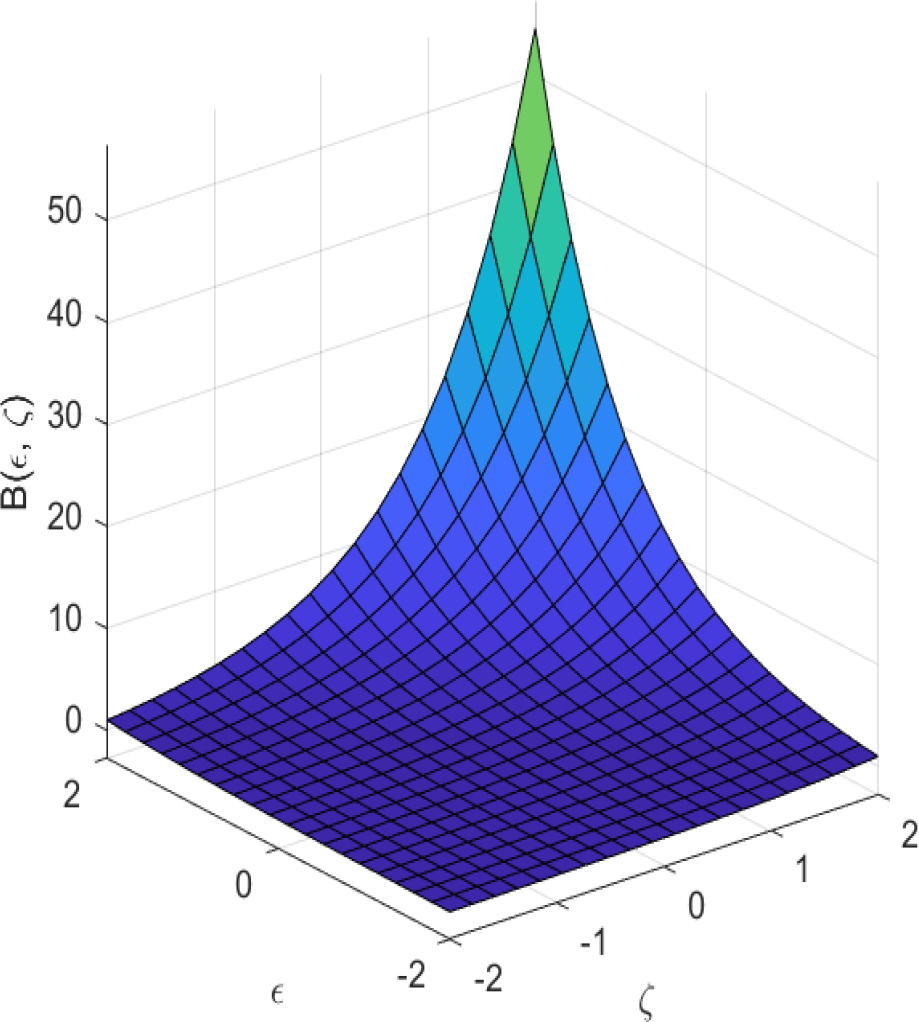
Fig. 1.
Graphical representation of the ETM solution to example 1 after only one iteration
Example 2.
It is the Cauchy problem of the fourth order hyperbolic equation [13]. Using ET from Eq. (8) the following results are obtained:
Following Example 1, the following recurring connection can be obtained by following the same procedure:
Later on, we are able to discover:
Thus: B(ε, ζ) = ζ4 – ε4. As the example 1, Fig. 2 shows the graphical representation of the exact solution obtained by ETM to this example, where the relative error is zero because we found the exact solution using only one step.
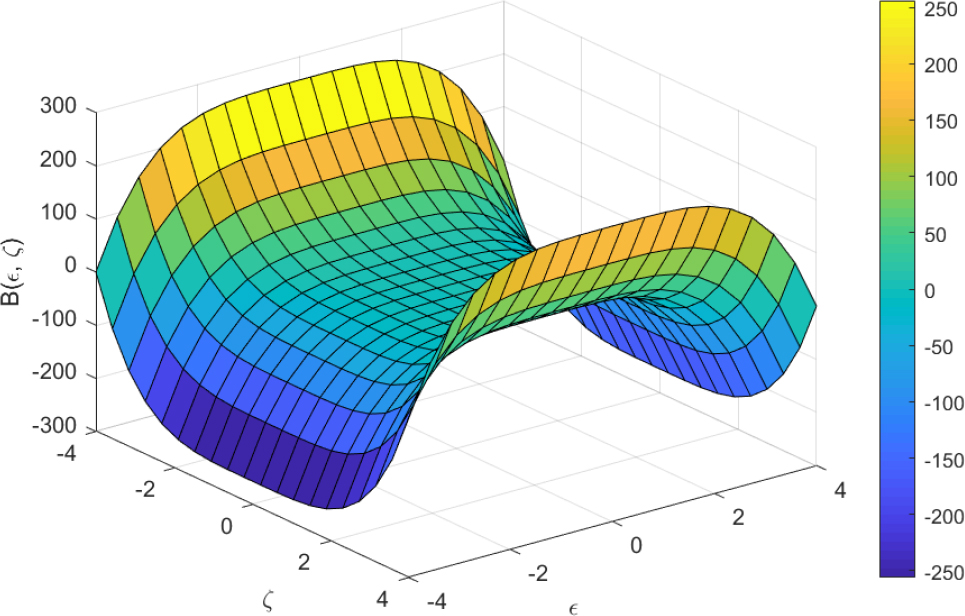
Fig. 2.
Graphical representation of the exact solution to example 2 via ETM after only one step
Example 3
Let, k = 3,a = 1, and g(ε, ζ) = 0, then Eq. (2) becomes,
This is the Cauchy problem for the hyperbolic equation of sixth order [13]. The expression for Eq. (10) is as follows:
Using ET to get:
Using the same method as in Example 1, one may find the recurrence relation in the following.
Next, we have B1(ε, ζ) = 0, B2(ε, ζ) = 0, B3(ε, ζ) = 0,⋯. Then B(ε, ζ) = cos ε sin ζ, this is the exact solution of this example and, is also obtained using ETM depicted graphically in Fig. 3. In this example, the relative error is zero because we found the exact solution using only one step.
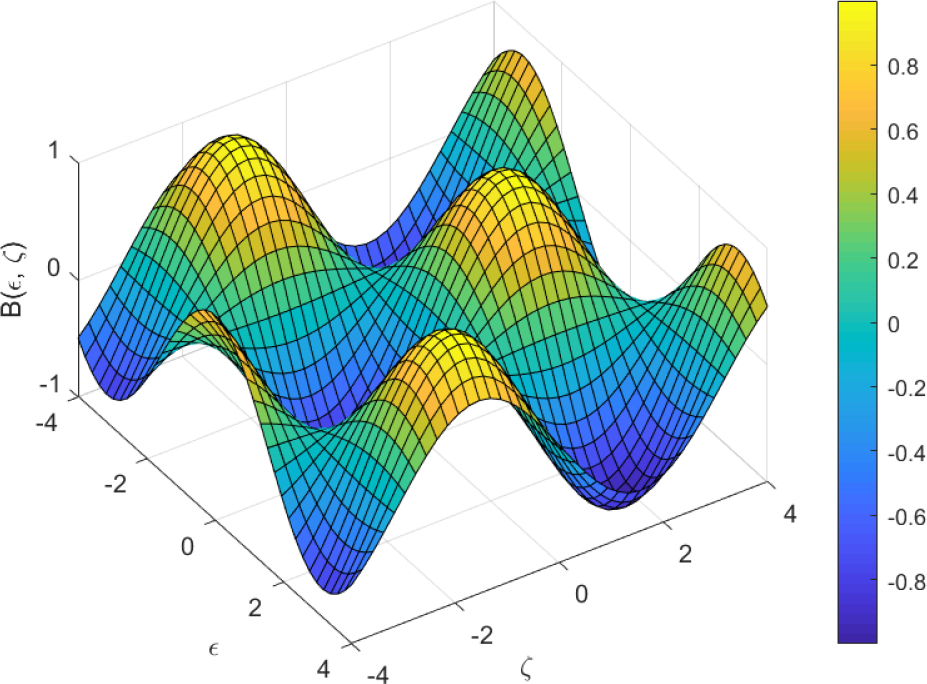
Fig. 3.
Graphical representation of the exact solution to example 3 via ETM after only one iteration
4.2. Nonlinear Wave-Like Equations with Variable Coefficients
For explaining the growth of stochastic systems, one of the most widely used wave models is the wave-like equation. The stochastic behavior of exchange rates, fluctuations in laser light intensity, and the random movements of microscopic particles immersed in fluids are a few examples of such systems.
The situation in which a = a(ε, ζ) may be a constant or function of εor / and ζ, will now be examined.
Example 4
Let, k = 1, a = ε2, and g(ε, ζ) = e2ζ then Eq. (2) becomes,
It is the Cauchy problem related to nonlinear wave-like equation with variable coefficients [14, 26]. Using ET to get:
Using the same method as in Example 1, one may find the recurrence relation in the following.
Next, we have:
Then B(ε, ζ) = εeζ. This is the exact solution to Eq. (11), however the HAA provided in [26] does not yield the exact solution. Fig. 4 shows the graphical representation of this solution, where the relative maximum error does not exceed 2 × 10⁻¹⁵ (see Tab.1). This result, achieved after just two iterations, highlights the efficiency of this method and its rapid convergence.
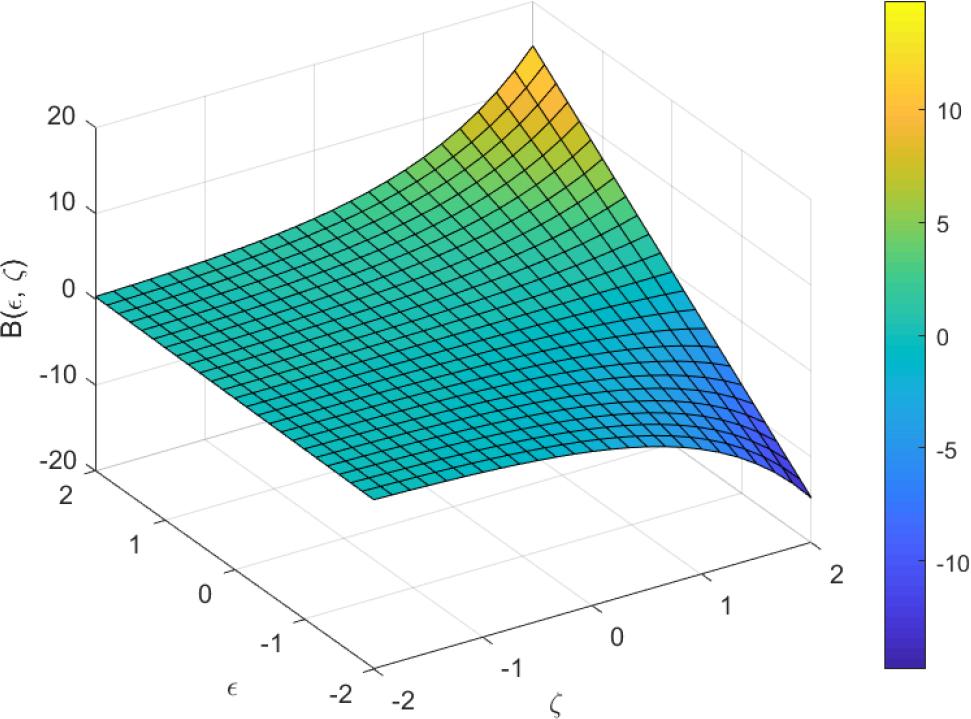
Fig. 4.
Graphical representation of the exact solution to example 4 via ETM after only two iterations
Tab. 1.
Relative errors concerning example 4
| Point | Elzaki relative error |
|---|---|
| (0,0) | 0 |
| (–2, –2) | 0 |
| (2, 2) | 2.4040 × 10⁻¹⁶ |
| (0.5, 1.8333) | 0 |
| (0.5, –1.8333) | 1.7360 × 10⁻¹⁵ |
| (1.5, 1.5) | 2.6424 × 10⁻¹⁶ |
| (–1.5, –1.5) | 3.3171 × 10⁻¹⁶ |
| (1.1667, 0.6667) | 1.8535 × 10⁻¹⁶ |
Example 5
Let, k = 1, a = ζ, and g(ε, ζ) = 0 then Eq. (2) becomes,
This is the Cauchy problem for nonlinear wave-like equation with variable coefficients [26].
The method used in Example 1 can be adopted to find the recurrent relationship in the following.
Then:
therefore B(ε, ζ) = (ε + 03B5;2)ζ. Again, this is the exact solution to Eq.(13), while HAA in [26] will not yield the exact solution. Fig. 5 shows the graphical representation of this solution, where the relative error is zero because we found the exact solution using only one step.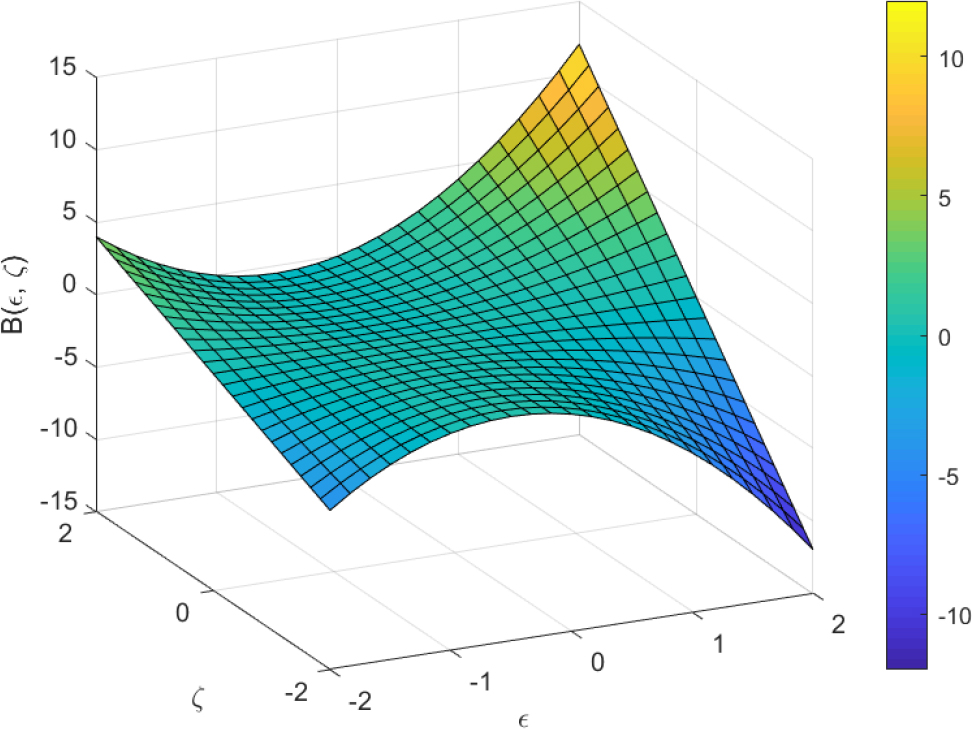
Fig. 5.
Graphical representation of the exact solution to example 5 via ETM after only one iteration
5. DISCUSSION AND CONCLUSION
This article has discussed the derivation, convergence, and ap-plication of the ET technique to higher-order nonlinear PDEs. Five numerical issues were analyzed: three nonlinear higher-order hy-perbolic equations and two nonlinear wave-like equations with var-iable coefficient types. The ET method produces infinite power se-ries solutions under suitable initial conditions, which nearly invaria-bly spontaneously converge to the exact solution of the DEs. The obtained outcomes demonstrate the efficacy of the ET technique as mathematical tools for solving higher order nonlinear PDEs.
These problems can be easily solved using the ET approach, as the findings of the nonlinear wave-like equations show, but they cannot be solved exactly with HAA [26]. The ET approach has advantages over MDM, HPM, and HAA due to its efficiency, ease of use, little computational footprint, and proven lightning-fast convergence to an exact solution. Because of its efficiency and ease of use, we also want to extend its application to higher order fractional PDEs in subsequent work. Lastly, we believe that those who work in the modern technology and other areas will find this essay useful. Finally, we think this article will be helpful to people who operate in current technology and other fields. However, Elzaki transform and/or other transforms remain incapable of solving certain differential equations, especially when dealing with unsuitable initial conditions or strongly nonlinear problems.