
1. Introduction
One of the greatest achievements of modern medicine has been the elimination or effective control of numerous infectious diseases, including smallpox, plague, cholera, and typhus. These successes were made possible by the development of vaccines and the implementation of widespread immunization programs, which contributed to both individual and population-level protection (Holmgren 2021). For centuries, epidemics of these diseases devastated populations across Europe and other parts of the world and, together with war and famine, became enduring symbols of human suffering and social catastrophe.
This remarkable progress was made possible by the pioneering work of microbiologists and immunologists. Among the scientists most widely recognized for their contributions are Louis Pasteur, whose research led to vaccines against diseases such as rabies and anthrax; Edward Jenner, who pioneered vaccination against smallpox; and Robert Koch, whose identification of the causative agent of tuberculosis fundamentally changed the understanding of infectious diseases. However, the contributions of other eminent scientists, including Rudolf Stefan Jan Weigl, who developed an effective vaccine against epidemic typhus, and Waldemar Mordecai Wolff Haffkine, who pioneered vaccines against cholera and plague, have received comparatively less recognition and remain unfamiliar to much of the wider public.
Revisiting the contributions of these scientists is particularly important in the history of microbiology and vaccinology. Their achievements show how advances in laboratory research, microbiological methods, and immunoprophylaxis can be translated into practical measures to prevent and control devastating epidemic diseases. The scientific careers of Weigl and Haffkine also illustrate the complex circumstances which important discoveries were made, including war, epidemics, political upheaval, social prejudice, and limited scientific resources.
This article revisits the scientific legacies of Rudolf Weigl and Waldemar Haffkine, with particular emphasis on their contributions to the development of vaccines against epidemic typhus, cholera, and plague. By examining their scientific achievements and the historical circumstances surrounding their work, the article highlights the lasting importance of two pioneers whose contributions played a significant role in the development of modern vaccinology and public health.
2. Rudolf Stefan Jan Weigl: the architect of the first effective typhus vaccine
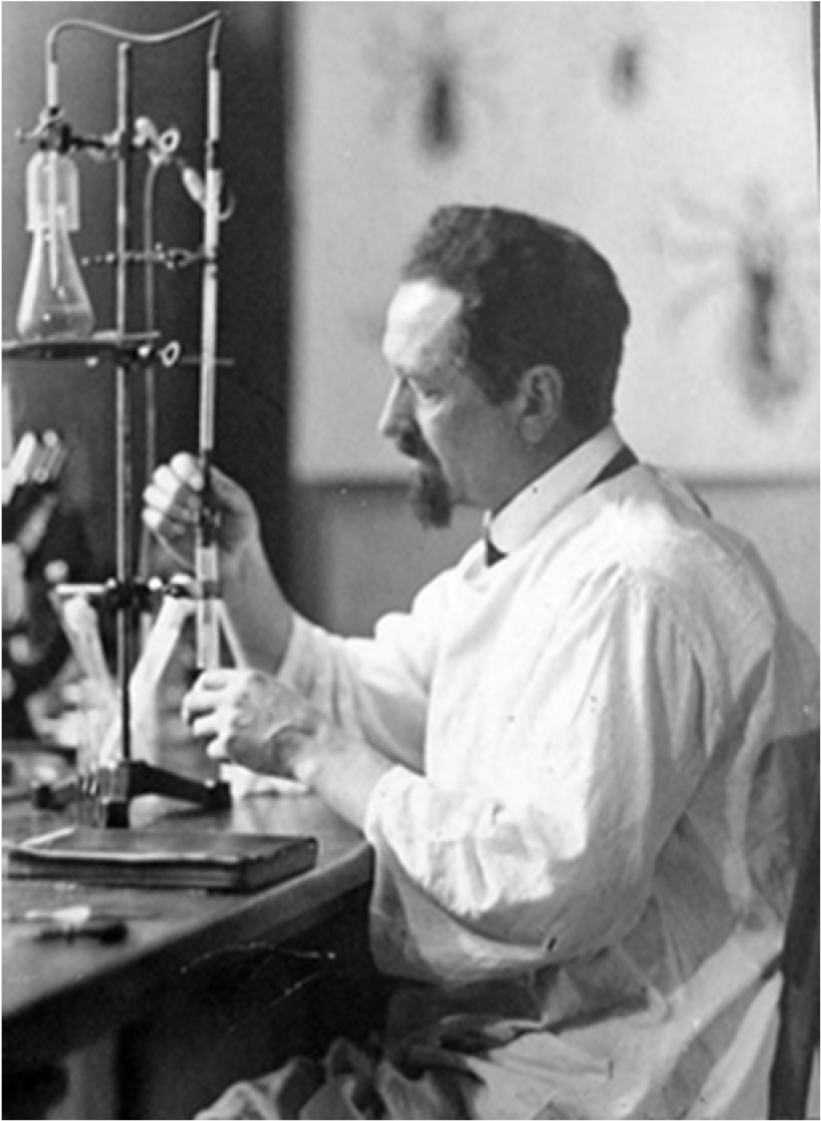
Rudolf Stefan Jan Weigl
Date of birth: September 2, 1883
Place of birth: Přerov, Austro-Hungarian Empire Date of death: August 11, 1957
Place of death: Zakopane, Poland
Nationality: Polish
Field: microbiology, immunology, epidemiology
Key scientific achievement: Development of the first successful typhus vaccine
Rudolf Weigl was a Polish biologist and microbiologist whose scientific work and humanitarian efforts made him one of the most important figures in twentieth-century infectious disease research. Born in Přerov, then part of the Austro-Hungarian Empire, Weigl studied at Jagiellonian University in Kraków, where he received his doctorate in zoology in 1907. He subsequently developed expertise in protozoology and comparative anatomy. During the First World War, while serving as a bacteriologist in the Austro-Hungarian army, he began his lifelong research on epidemic typhus, a deadly disease spread by lice that ravaged soldiers and civilians alike.
After Poland regained independence in 1918, Weigl became a professor and director of biology at Lwów University (Wincewicz et al. 2007). In the early 1920s, he developed an innovative method for cultivating Rickettsia prowazekii, the bacterium responsible for epidemic typhus, within infected lice (Kuzminov and Smolnytska 2022; Raoult and Woodward 2005). Using this model, Weigl developed an effective vaccine against epidemic typhus, which he refined and produced at the University of Lwów (the institute bearing his name was established later) (Wincewicz et al. 2007; Kuzminov and Smolnytska 2022). The production process involved infecting lice with Rickettsia prowazekii, harvesting infected louse tissues, and subsequently inactivating the pathogen with phenol. It was a dangerous but groundbreaking technique that dramatically reduced mortality rates during typhus outbreaks across Eastern Europe and later among troops in the Second World War (Nunes-Biesiadecka 2026).
When Nazi Germany occupied Lwów in 1939, Weigl used his institute as both a scientific center and a shelter (Polak et al. 2022). To maintain vaccine production, Weigl employed thousands of people as so-called “lice feeders” (Allen 2014). Their role was to allow laboratory lice to feed on human blood, which was necessary to maintain colonies of infected lice used in vaccine production. The vaccine produced at Weigl’s Institute was clandestinely distributed to Jewish ghettos and resistance groups, protecting against epidemic typhus under the conditions of Nazi occupation (Nunes-Biesiadecka et al. 2026; Polak et al. 2022). By employing residents in vaccine production, Weigl provided employment certificates that helped protect Polish intellectuals, including famous Lviv mathematicians, and Jewish citizens from arrest or deportation. During the German occupation, Weigl also supervised vaccine production in laboratories located in Kraków and Częstochowa (Aramowicz et al. 1996).
After the war, Weigl resumed academic life in Kraków and Poznań, training a new generation of microbiologists and rebuilding Polish biological research. He became a member of the Polish Academy of Sciences and was nominated for the Nobel Prize in Physiology or Medicine, though he was never awarded it (Wincewicz et al. 2007; Nobel Prize 1936). His scientific output included studies on the physiology of lice, vaccine stability, and epidemiological control measures that influenced later immunological research worldwide.
2.1. The scientific and humanitarian legacy of Rudolf Weigl
Weigl’s humanitarian legacy was eventually recognized long after his death. In 2003, Yad Vashem honored him as a Righteous Among the Nations for his efforts to save Jewish lives during the Holocaust. The Polish state had already decorated him with the Commander’s Cross of the Order of Polonia Restituta in 1938. Today, historians view him not only as the founder of modern rickettsiology but also as a scientist who demonstrated that moral integrity can stand beside intellectual brilliance. His pioneering vaccine, developed before World War II and later applied during wartime conditions, remains one of the most important contributions to twentieth-century medicine – a triumph of scientific ingenuity and compassion. The vaccine did not provide complete protection against infection; however, it substantially reduced the severity of epidemic typhus and was associated with lower mortality.
The publications presented in Table 1 illustrate the development of Weigl’s scientific work, from experimental studies on typhus lice and Rickettsia biology to the development and application of active immunization against epidemic typhus.
Table 1.
Selected key publications of Rudolf Weigl on epidemic typhus, Rickettsia prowazekii, and immunization
| Year | Publication | Journal / Source | Main subject / contribution |
|---|---|---|---|
| 1920 | Weigl, R. Untersuchungen und Experimente an Fleckfieberläusen. Die Technik der Rikettsia-Forschung. | Beiträge zur Klinik der Infektionsk-rankheiten | Experimental studies on typhus lice and the development of techniques for Rickettsia research |
| 1924 | Weigl, R. Der gegenwärtige Stand der Rickettsia-Forschung. | Klinische Wochenschrift | Review of the contemporary state of Rickettsia research |
| 1930a | Weigl, R. Über das Wesen und die Form des Fleckfiebererregers. | Bulletin de l’Académie Polonaise des Sciences et des Lettres, Classe Médicale | Research on the nature and morphology of the epidemic typhus pathogen |
| 1930b | Weigl, R. Die Methoden der aktiven Fleckfieber-Immunisierung. | Bulletin de l’Académie Polonaise des Sciences et des Lettres, Classe Médicale | Methods of active immunization against epidemic typhus |
| 1947 | Weigl, R. Immunization against typhus fever in Poland during World War II. | Texas Reports on Biology and Medicine | Experience with typhus immunization in Poland during World War II |
3. Waldemar Mordecai Wolff Haffkine: the forgotten pioneer who conquered cholera and plague
Waldemar Mordecai Haffkine, a microbiologist of Jewish origin born in Odessa, was a pioneer of modern vaccinology (Pelner 1967). A student of Élie Metchnikoff and a colleague of Louis Pasteur, he developed the world’s first effective vaccines against cholera and bubonic plague innovations that ultimately saved millions of lives across colonial India and beyond. Haffkine was hailed as “Jewish Jenner”(Hawgood 2007).
Born into a modest Jewish family in Odessa, then part of the Russian Empire (now Ukraine), Haffkine earned his doctorate in zoology from Odesa University in 1888 (Shafrir 1994). He later studied under Metchnikoff, who would go on to win the Nobel Prize in Physiology or Medicine for his work in immunology. Barred from pursuing an academic career in Tsarist Russia due to antisemitic restrictions, Haffkine relocated to Paris, France (Pelner 1967). At the Pasteur Institute, Haffkine became increasingly interested in epidemic diseases affecting densely populated and impoverished communities. Inspired by Louis Pasteur’s work on rabies, he developed an experimental cholera vaccine in 1892 (Montero et al. 2023). As part of the vaccine’s early experimental evaluation, Haffkine inoculated himself before extending the investigation to a small group of volunteers. Encouraged by the promising results, the British government invited him to India to test the vaccine on a larger scale (Gunter and Pandey 2020).
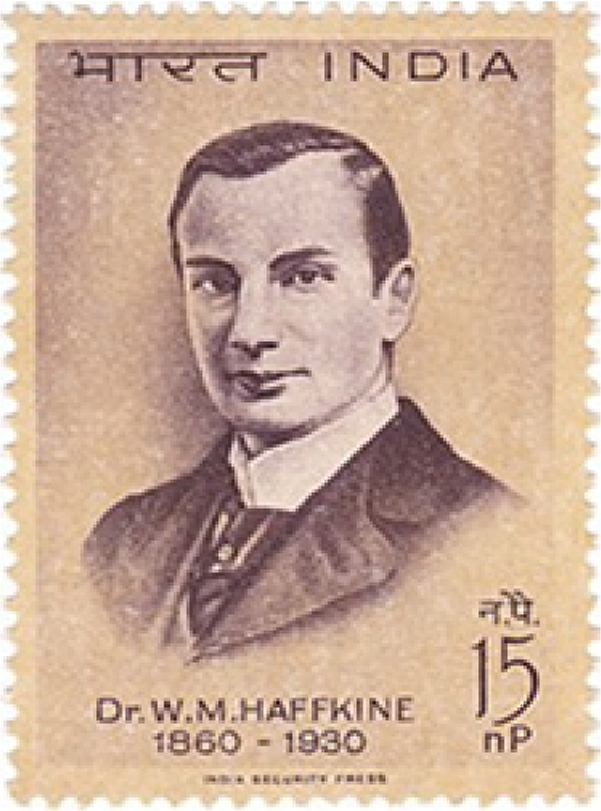
Waldemar Mordecai Wolff Haffkine
Date of birth: March 15, 1860
Place of birth: Odessa, Russian Empire (now Ukraine) Date of death: October 26, 1930
Place of death: Lausanne, Switzerland
Nationality: Russian (later naturalized British subject) Field: microbiology, immunology, epidemiology
Key scientific achievements: cholera vaccine – 1892; plague vaccine – 1897; mass vaccination methods
“He is almost invisible outside microbiology. A lot of scientists don’t even know his name. He’s been eliminated from history.”
The Guardian 9.06.2024
Arriving in Calcutta in 1893, Haffkine organized one of the first mass immunization campaigns in medical history (Chakrabarti 2010; Gunter and Pandey 2020). The vaccine was subsequently used in organized vaccination campaigns and was associated with reduced cholera incidence among vaccinated populations (Haffkine 1892). Later, while stationed in Bombay (now Mumbai), he confronted a new threat: the bubonic plague, which erupted in 1896. The emergence of plague in Bombay in 1896 occurred amid growing scientific understanding following the identification of Yersinia pestis by Alexandre Yersin in 1894, which marked a turning point in plague research and vaccine development (Butler 2014). Within months, Haffkine produced a plague vaccine using attenuated cultures of Yersinia pestis and once again tested it on himself before public use (Haffkine 1897). His teams went on to vaccinate tens of thousands of people under harsh colonial conditions. Vaccination campaigns in colonial India also reflected complex social, ethical, and political dynamics, as recent analyses of vaccination during plague outbreaks in Calcutta highlight (Bose 2025).
Working with limited resources but extraordinary determination, Haffkine helped lay the foundations of modern immunology at a time when vaccines were still experimental, and epidemics could decimate entire populations. Yet despite his groundbreaking contributions, his legacy was nearly erased from public memory, overshadowed by a tragic episode known as the Mulkowal affair.
3.1. The Mulkowal affair
On March 30, 1902, in the village of Mulkowal (Punjab, India), a batch of plague vaccine was administered to 88 people. Within a few days, 19 of them died of tetanus. The British colonial authorities initially attributed the contamination to failures in aseptic procedures during the preparation of the vaccine at Haffkine’s Bombay laboratory and accused him of negligence. Within weeks, the scientist once celebrated as “the savior of India” was suspended from duty and publicly humiliated. The inquiry that followed reflected not scientific reasoning but the colonial administration’s bias against a foreign, Jewish, non-British scientist. Later investigations, however, challenged the original conclusion and indicated that the contamination most likely occurred at Mulkowal during the handling and opening of the vaccine bottle, rather than during its preparation in Haffkine’s laboratory. In 1907, a British inquiry led by Sir Ronald Ross formally exonerated him, with Ross praising Haffkine as “a savior of humanity” (Ross 1907). Despite his vindication, Haffkine’s reputation never fully recovered. He returned to Europe, continued scientific writing, and eventually retired to Lausanne, Switzerland, where he died in 1930.
3.2. Scientific and historical legacy
Waldemar Haffkine is recognized as one of the founders of modern immunology and vaccine science, alongside Louis Pasteur and Élie Metchnikoff. His contribution to microbiology and global health, understood as coordinated international efforts to prevent and control infectious diseases, was substantial. His vaccines against cholera and plague were among the first to be successfully deployed on a large scale in human populations, saving countless lives in India and elsewhere. He also pioneered self-experimentation, field immunology, and large-scale sterile vaccine production, anticipating public health and vaccine development practices that became standard only decades later.
Haffkine’s anti-plague vaccine was a groundbreaking achievement and the first practical vaccine used against bubonic plague. Large field trials demonstrated a substantial reduction in mortality and helped establish vaccination as a viable tool for epidemic control (Patel and Rebello 1948). However, as vaccine science advanced during the twentieth century, newer vaccines achieved higher levels of protection and improved safety profiles. Modern approaches to plague vaccine development include live attenuated, subunit, and recombinant vaccines, reflecting ongoing efforts to improve protection against Yersinia pestis (Sun 2016; Anisimov et al. 2025). Although Haffkine’s vaccine represented a breakthrough, subsequent research led to the development of more advanced plague vaccines with improved immunogenicity and safety profiles (Williamson 2009; Williamson and Oyston 2013). Among these plague-vaccine specialists generally regard the live attenuated EV76 vaccine as the most effective operational plague vaccine ever widely deployed. Thus, while EV76 may have surpassed Haffkine’s vaccine in technical performance, Haffkine’s pioneering work laid the scientific and practical foundations upon which all subsequent plague-vaccine development was built (Sun and Curtiss 2013).
In recognition of his achievements, the British authorities knighted him in 1899 and appointed him Director of the Plague Research Laboratory in Bombay, later renamed the Haffkine Institute in 1925. The Haffkine Institute, still active today in Mumbai, remains a living testament to his life’s work. As historian Mark Honigsbaum has emphasized, Haffkine was a pioneering figure whose contributions to epidemic disease prevention were subsequently overshadowed and largely forgotten.
The publications presented in Table 2 illustrate the development of Haffkine’s scientific work, from the experimental development of prophylactic inoculation against cholera to the development and evaluation of vaccination strategies against bubonic plague in India.
Table 2.
Selected key publications of Waldemar Haffkine on cholera and plague vaccination
| Year | Publication | Journal / Source | Main subject / contribution |
|---|---|---|---|
| 1892 | Haffkine, W. M. On Prophylactic Inoculation Against Cholera. | British Medical Journal | Experimental development and application of prophylactic inoculation against cholera |
| 1895 | Haffkine, W. M. Anti-cholera Inoculation: Report to the Government of India. | Calcutta: Thacker, Spink & Co. | Report on the development and application of anti-cholera inoculation in India |
| 1896 | Haffkine, W. M. Prophylactic Vaccination Against Bubonic Plague in India. | James Lind Library archive | Report on prophylactic plague vaccination, including self-inoculation and experimental studies in rabbits |
| 1897 | Haffkine, W. M. On the Anti-Plague Vaccine. | The Lancet | Description of the anti-plague vaccine and its application in the prevention of bubonic plague |
| 1905 | Haffkine, W. M. Report on a Series of 484 Cases of Plague Treated with Lustig’s Anti-Plague Serum. | In: Bannerman, W. B. (ed.), Serum-therapy of Plague in India. Scientific Memoirs by Officers of the Medical and Sanitary Departments of the Government of India. Calcutta: Office of the Superintendent of Government Printing | Report on clinical experience with anti-plague serum in 484 cases of plague |
4. Summary
The history of these two outstanding scientists, Rudolf Weigl and Waldemar Haffkine, both of whom faced unjust accusations during their lifetimes, reminds us that scientific achievement often comes with personal sacrifice and misunderstanding. Their experiences demonstrate how easily pioneering work can be overshadowed by political circumstances, prejudice, or human error, and how essential it is to preserve the memory of those who advanced medicine under such conditions.
We should not only remember their names but also actively explain the immense value of their discoveries. Weigl’s vaccine against epidemic typhus and Haffkine’s vaccines against cholera and plague were milestones that laid the foundation for modern immunology and public health. Their research saved millions of lives and continues to serve as an ethical and scientific model for generations of microbiologists, immunologists, epidemiologists, and vaccine developers.
The intended audience for this historical reflection should extend far beyond specialists or medical students. The stories of Weigl and Haffkine deserve to be included in the broader narrative of global science education, illustrating how courage, integrity, and scientific rigor can triumph even in the face of adversity. Today, their achievements remind us of science’s power to serve humanity despite prejudice, political upheaval, and social injustice.
Moreover, at a time when misinformation and vaccine skepticism continue to challenge public health worldwide, remembering these pioneers is both a tribute to their legacy and a vital lesson for the future. The histories of Weigl and Haffkine demonstrate that vaccines are among the most effective public-health interventions ever developed, having prevented millions of deaths and dramatically reduced the burden of infectious diseases across the globe (Cavaillon and Osuchowski 2021). Their work provides compelling historical evidence that scientific research, rigorous testing, and vaccination programs have repeatedly transformed once-devastating epidemics into preventable or controllable diseases (Holmgren 2021).
In this context, the lives and achievements of Weigl and Haffkine offer more than historical inspiration. They remind us that public trust in science must be built upon evidence, transparency, and education, and that vaccination remains one of the safest and most effective means of protecting individuals and communities from infectious diseases (Montero et al. 2023). Preserving the memory of these pioneers therefore serves not only to honor the past but also to reinforce an essential public-health message for future generations.
Acknowledgments:
I would like to thank Dr. Angelika Domagała for her assistance in editing the manuscript.