
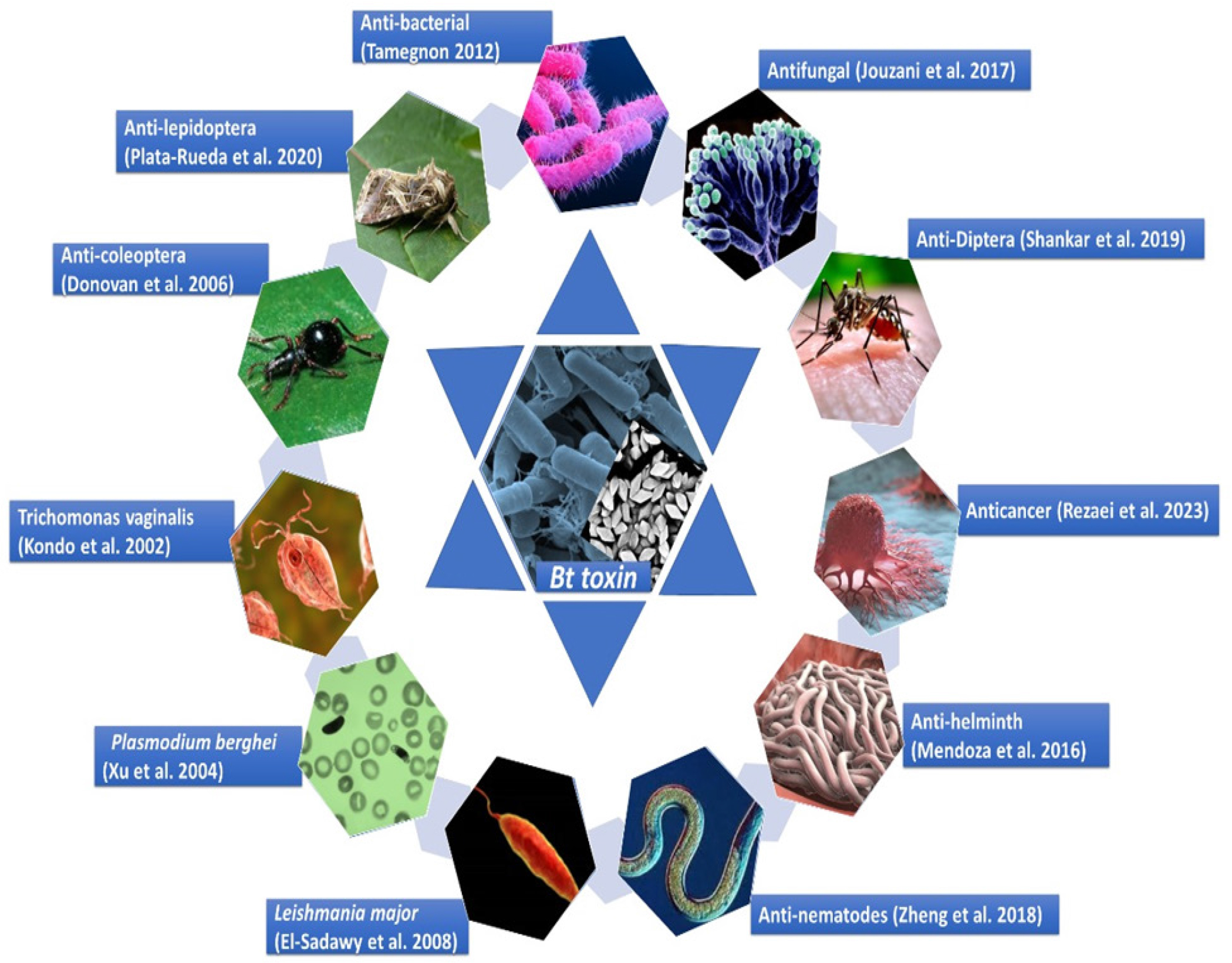
Figure 1.
Diagram illustrating the potential effects of Cry proteins from B. thuringiensis
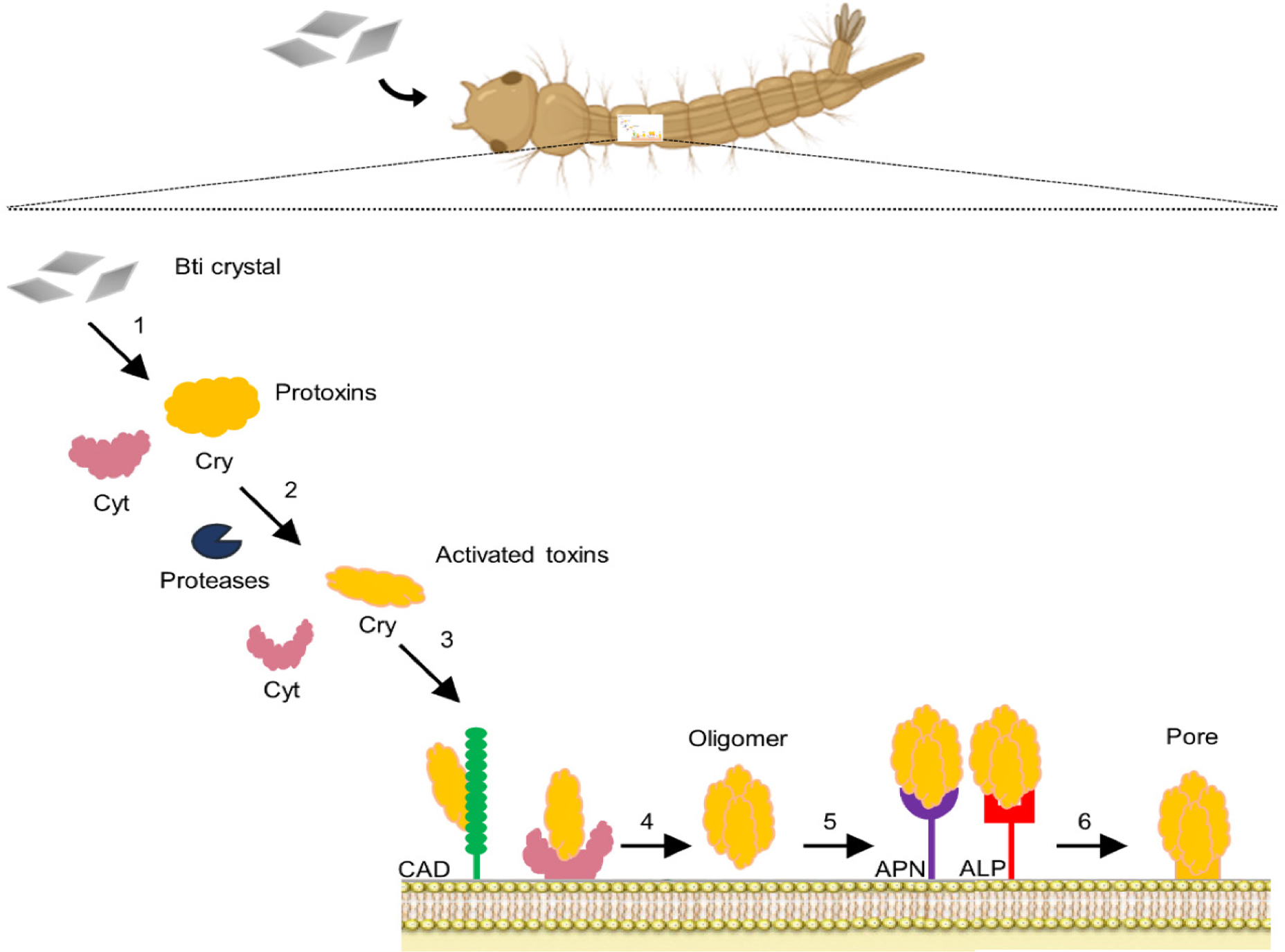
Figure 2.
Diagram illustrating the synergistic effects between B. thuringiensis Cry and Cyt toxins on mosquito larvae.
Table 1.
Overview of identified parasporins (PS/Mpp): B. thuringiensis strains, associated Cry genes, activation proteases, main cellular targets and observed cytotoxic outcomaes.
| PS | B. thuringiensis Strain | Cry Gene | Protease Activation | Main Cellular Target | Observed Cellular Outcome | Reference |
|---|---|---|---|---|---|---|
| PS1Aa1 | A1190 | Cry31Aa1 | Trypsin | HeLa | Apoptosis | (Mizuki Eiichi et al. 2000) |
| PS1Aa2 | M15 | Cry31Aa2 | Trypsin | HepG2 | Not determined | (Jung et al. 2007) |
| PS1Aa3 | B195 | Cry31Aa3 | Trypsin | HeLa | Not determined | (Uemori et al. 2008) |
| PS1Aa4 | Bt79-25 | Cry31Aa4 | Proteinase K | Not determined | Not determined | (Uemori et al. 2008) |
| PS1Aa5 | Bt92-10 | Cry31Aa5 | Proteinase K | Not determined | Not determined | (Uemori et al. 2008) |
| PS1Aa6 | M019, 64-1-94 | Cry31Aa6 | Trypsin | HepG2 | Not determined | (Gonzalez et al. 2011) |
| PS1Ab1 | B195 | Cry31Ab1 | Trypsin | HeLa | Not determined | (Uemori et al. 2008) |
| PS1Ab2 | Bt31-5 | Cry31Ab2 | Proteinase K | Not determined | Not determined | (Uemori et al. 2008) |
| PS1Ac1 | Bt87-29 | Cry31Ac1 | Proteinase K | Not determined | Not determined | (Uemori et al. 2008) |
| PS1Ac2 | B0462 | Cry31Ac2 | Proteinase K | HeLa | Apoptosis | (Kuroda et al. 2013) |
| PS2Aa1 | A1547 | Cry46Aa1 | Proteinase K | HepG2 | Pore-forming | (Ito et al. 2004) |
| PS2Aa2 | A1470 | Cry31Aa2 | Proteinase K | MOLT-4 | Not determined | (Okumura et al. 2013) |
| PS2Ab1 | TK-E6 | Cry31Ab1 | Proteinase K | Jurkat | Not determined | (Hayakawa et al. 2007) |
| PS3Aa1 | A1462 | Cry41Aa1 | Proteinase K | HL60 | Not determined | (Yamashita et al. 2000) |
| PS3Ab1 | A1462 | Cry41Ab1 | Proteinase K | HL60 | Not determined | (Yamashita et al. 2000) |
| PS4Aa1 | A1470 | Cry45Aa1 | Proteinase K | CaCo2 | Pore-forming | (Okumura et al. 2006) |
| PS5Aa1 | A1100 | Cry64Aa1 | Proteinase K | TCS | Not determined | (Okumura et al. 2006; Ekino et al. 2014) |
| PS6Aa1 | M019, 64-1-94 | Cry63Aa1 | Trypsin | HepG2 | Not determined | (Gonzalez et al. 2011) |
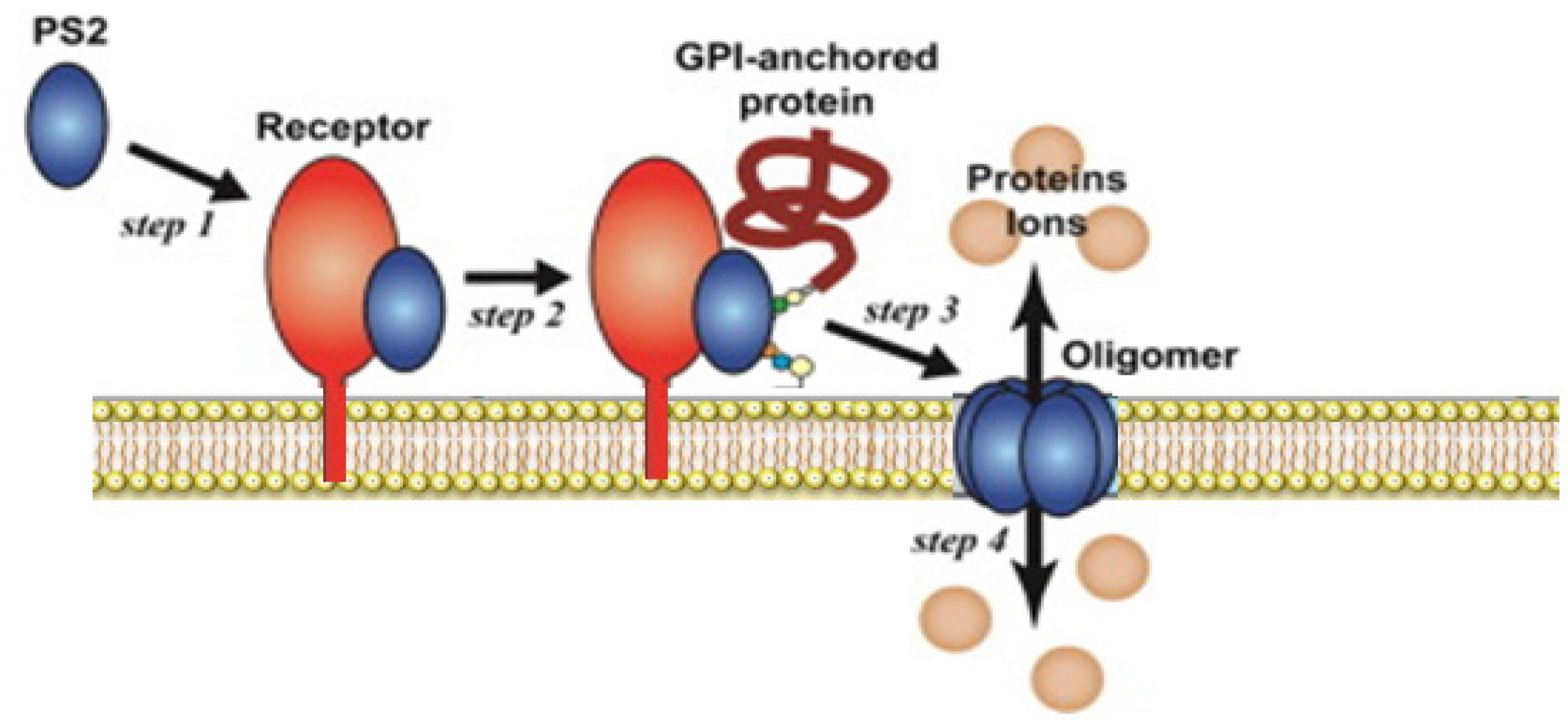
Figure 3.
Generalized mechanism-of-action of parasporin 2 (PS2). PS2 binds to GPI membrane receptors in susceptible cells, which induces PS2 oligomerization, ultimately causing cell death.
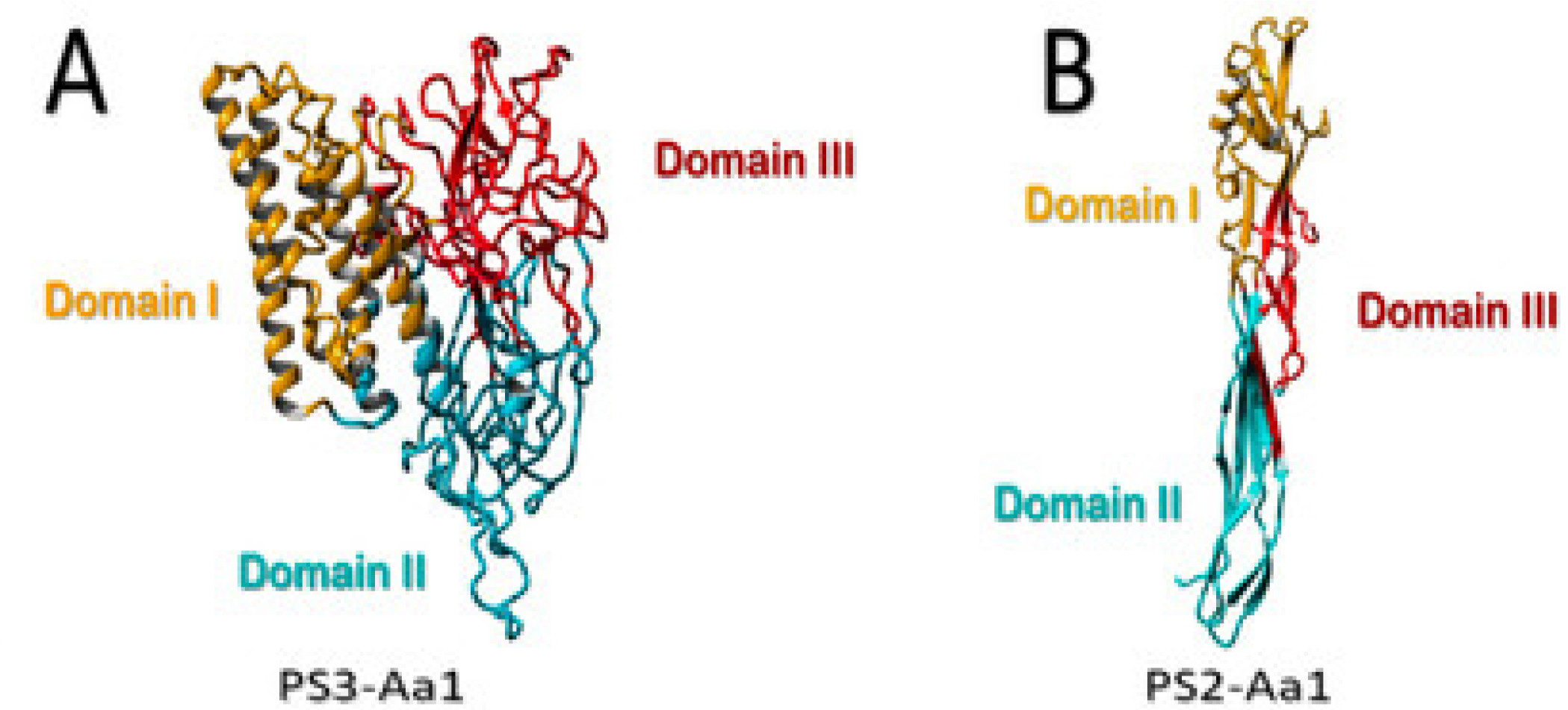
Figure 4.
(A) Three-domain structural model of higher-molecular-weight PS3Aa1. (B) Structural model of low-molecular-weight PS2Aa1. Mechanism of cancer cell-killing action of PSs (Suárez-Barrera et al. 2021).
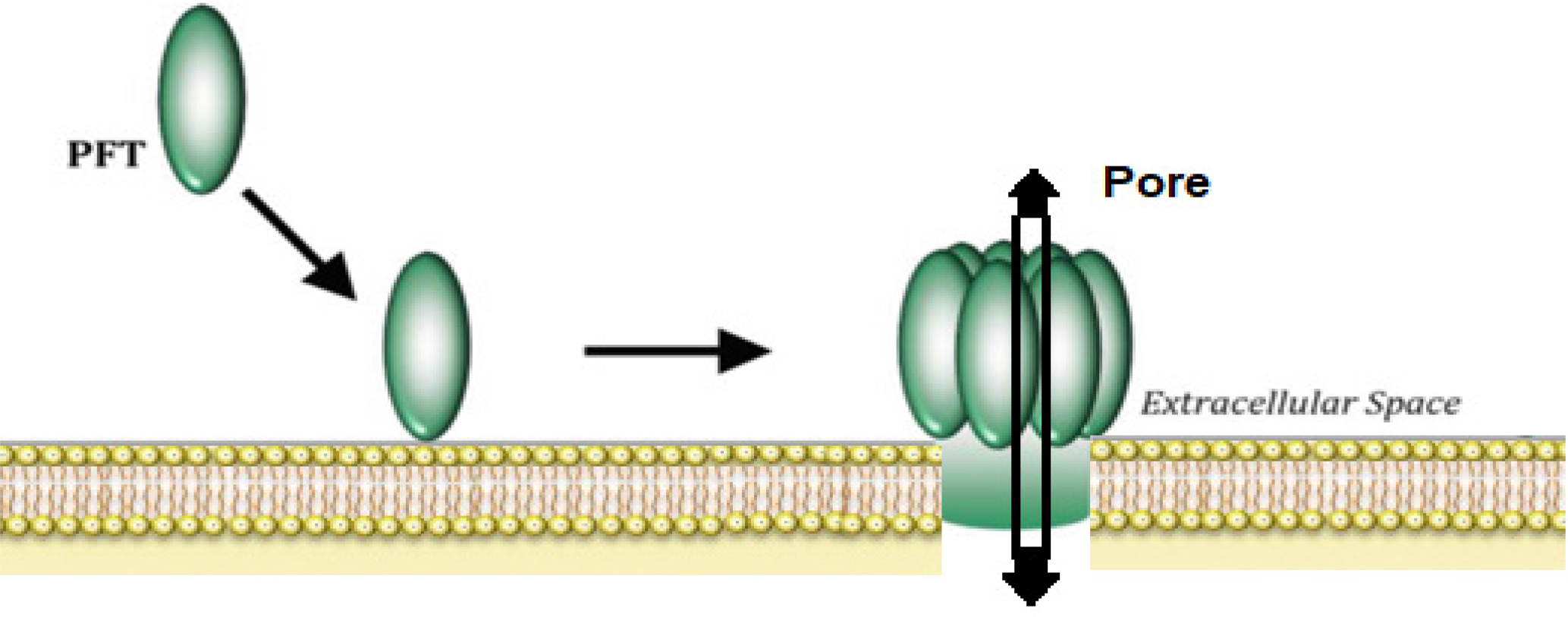
Figure 5.
Diagram illustrating the generalized mechanism of pore-forming toxins (PFTs). Owing to oligomerization and membrane receptor binding, an aqueous hole is formed in the plasma membrane as PFPs attach to their target receptor through contact with an exposed receptor on the cell surface.