
Table 1.
Examples of protein biomarkers of resistance detected using MALDI-TOF MS
| Type of antibiotic resistance | Pathogen species | Biomarker (m/z, protein) | Related gene/mechanism | Phenotypic significance | Estimated effectiveness | Restrictions/remarks | Ref. |
|---|---|---|---|---|---|---|---|
| Klebsiella pneumoniae carbapenemase (KPC) | Klebsiella pneumoniae | Plasmid peaks associated with the presence of blaKPC, no single universal m/z value | Presence of plasmids carrying blaKPC | Correlation with the phenotype of KPC-dependent carbapenem resistance | High specificity and good sensitivity for detecting KPC-associated protein biomarkers | Reliability is limited by plasmid variability, meaning false negatives may occur and negative results require confirmatory molecular testing | (Florio et al. 2020) |
| Extended-spectrum class C beta-lactamase | Acinetobacter baumannii | Peak at 40,279 ± 87 m/z contributing to Acinetobacter derived cephalosporinases (ADC) family | Not stated | Not stated | High sensitivity (96%) and specificity (73%) in comparison to the microdilution imipenem susceptibility testing | Not stated | (Florio et al. 2020) |
| Methicilin-resistant Staphylococcus aureus (MRSA) | Staphylococcus aureus | Peak at 2415 ± 2 m/z corresponding to phenol-soluble protein toxin (PSM-mec) | PSM-mec can predict carriage of mecA – gene coding penicillin binding protein 2A (PBP2A) responsible for MRSA phenotype | High specificity for PSM-mec correlating with MRSA but the protein isn’t present in every isolate | Specificity for PSM-mec close to 100% | The majority of coagulase-negative staphylococci (CoNS) doesn’t produce PSM-mec thus MALDI-TOF MS has limited usefulness there | (Florio et al. 2020) |
| Methicilin-resistant Staphylococcus aureus (MRSA) | Staphylococcus aureus | Peak at 4594 m/z contributing to 50S ribosomal protein L28 | mecA gene | Distinguishing between MRSA and MSSA based on spectrum pattern, without additional preparation | High specificity of 96.8% to detect MRSA isolates | Not stated | (Flores-Treviño et al. 2019) |
| Ribotype 027 | Clostridioides difficile | Peak at 6654 m/z corresponding to 30S ribosomal protein S20 Peak at 6712 m/z corresponding to 30S ribosomal protein S21 | 30S ribosomal protein binding to 16S rRNA | Differentiation of ribotype 027 from non-027 ribotypes; association with hypervirulent strains | High sensitivity, specificity and AUC values for each peak (0.96 and 0.99) | Peak at 6712 m/z is present in multiple ribotypes, complicating differentiation between 027 and 176 | (Flores-Treviño et al. 2019) |
| Carbapenemase | Acinetobacter baumannii | Peaks at 6304 and 6332 m/z corresponding to NADH-quinone oxidoreductase subunit K | blaOXA-24 and blaOXA -58 | Differentiation of MDR A. baumannii and discrimination between blaOXA-58- and blaOXA-24-positive isolates | High AUC values (0,99), specificity and sensitivity | Limited prior evidence and comparison with indirect methods. Biomarkers identified in MDR isolates; previous studies relied on carbapenem hydrolysis assays rather than direct MALDI-TOF MS | (Flores-Treviño et al. 2019) |
| MDR/non-MDR strains | Pseudomonas aeruginosa | Loss of signals at 2726 and 5455 m/z in MDR strains | Presumably UPF0270 protein Pfl01_4103 (2726 m/z) and UPF0391 membrane protein Patl_1732 (5455 m/z) | Differentiation between MDR and non-MDR isolates based on signal loss | Moderate to low effectiveness (AUC 0.81–0.84; combined sensitivity 75%, specificity 74.1%) | Signal loss is non-specific, may be due to non-genetic factors, and cannot be used as a reliable biomarker | (Flores-Treviño et al. 2019) |
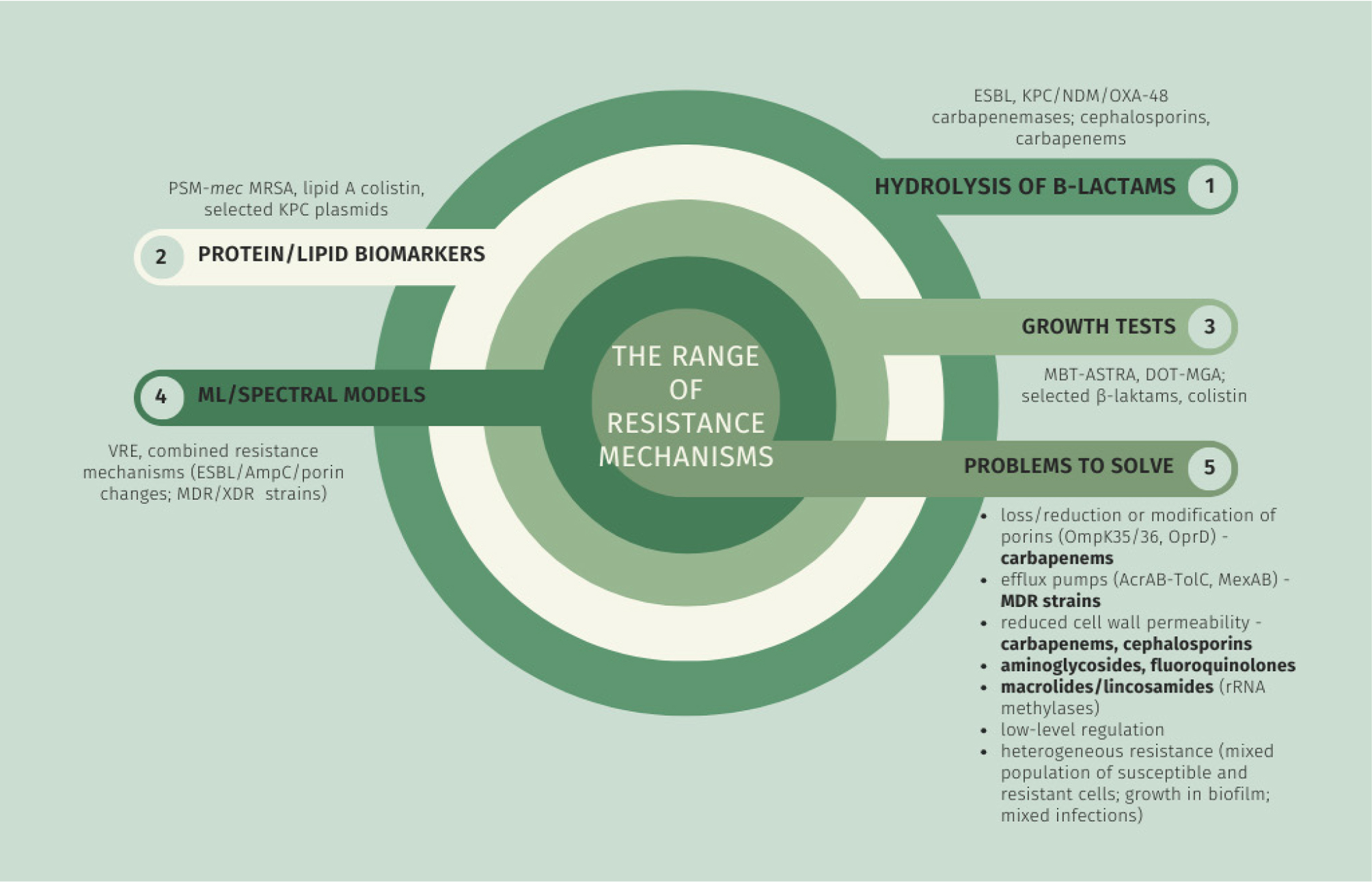
Figure 1.
Examples of limitations of MALDI-TOF MS in detecting different classes of antibiotic resistance mechanisms