
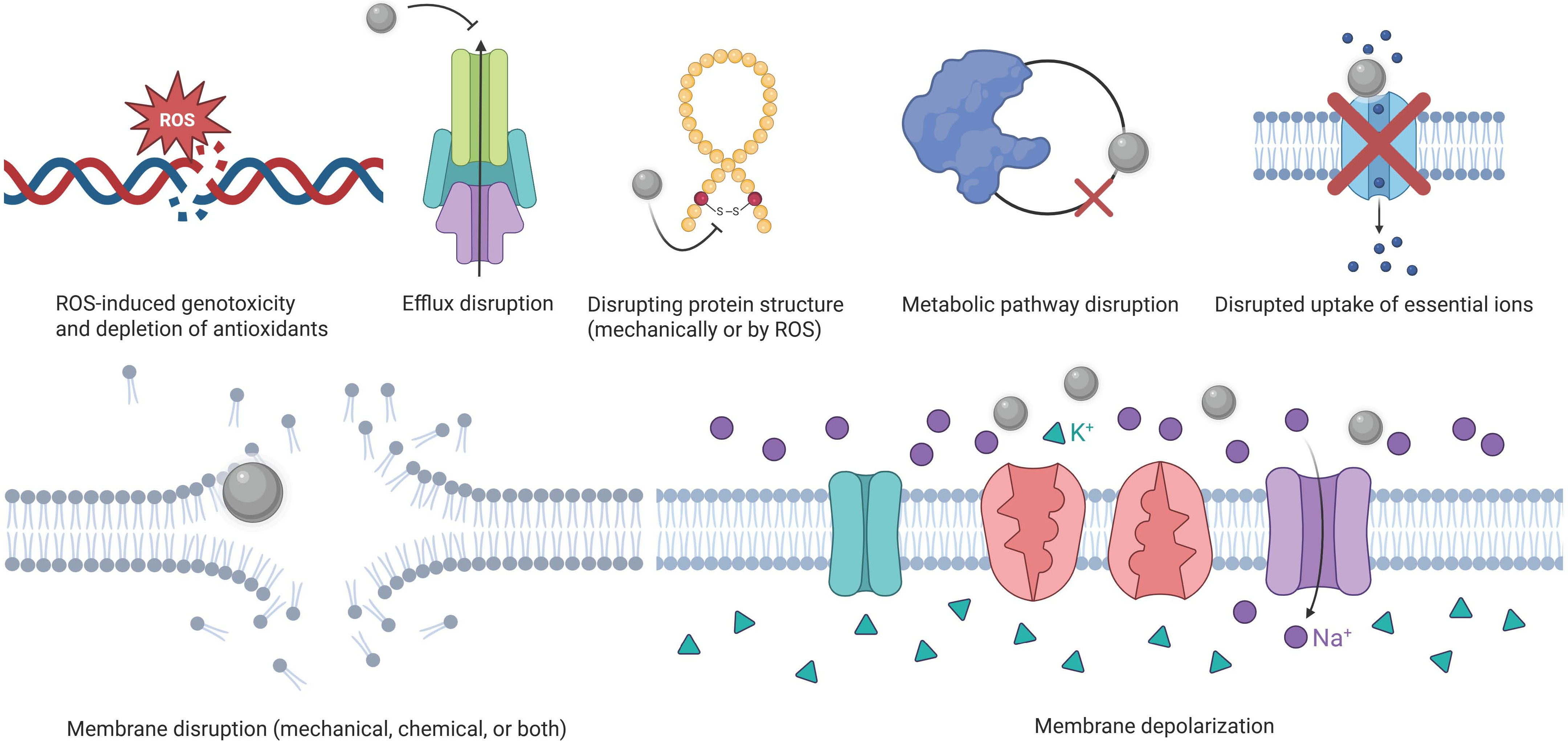
Fig. 1.
Molecular effects caused by nanomaterials on bacterial cells; inspired by (Lemire et al., 2013), Created in Biorender, Augustyniak, A. (2025) https://BioRender.com/h02f263
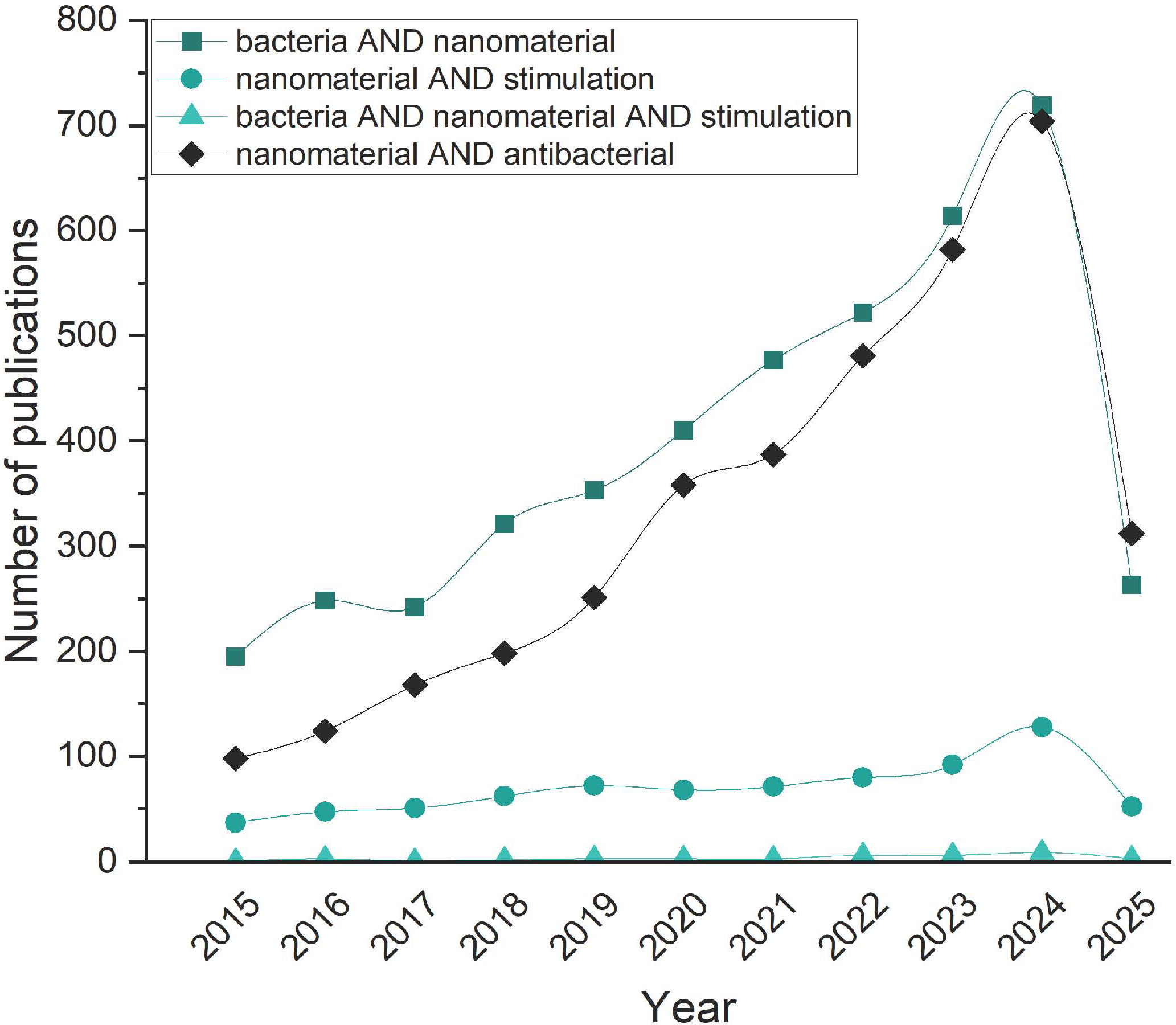
Fig. 2.
Results of Scopus database search showing the number of publications associated with nanomaterials in the years 2015-2024 and until May 2025
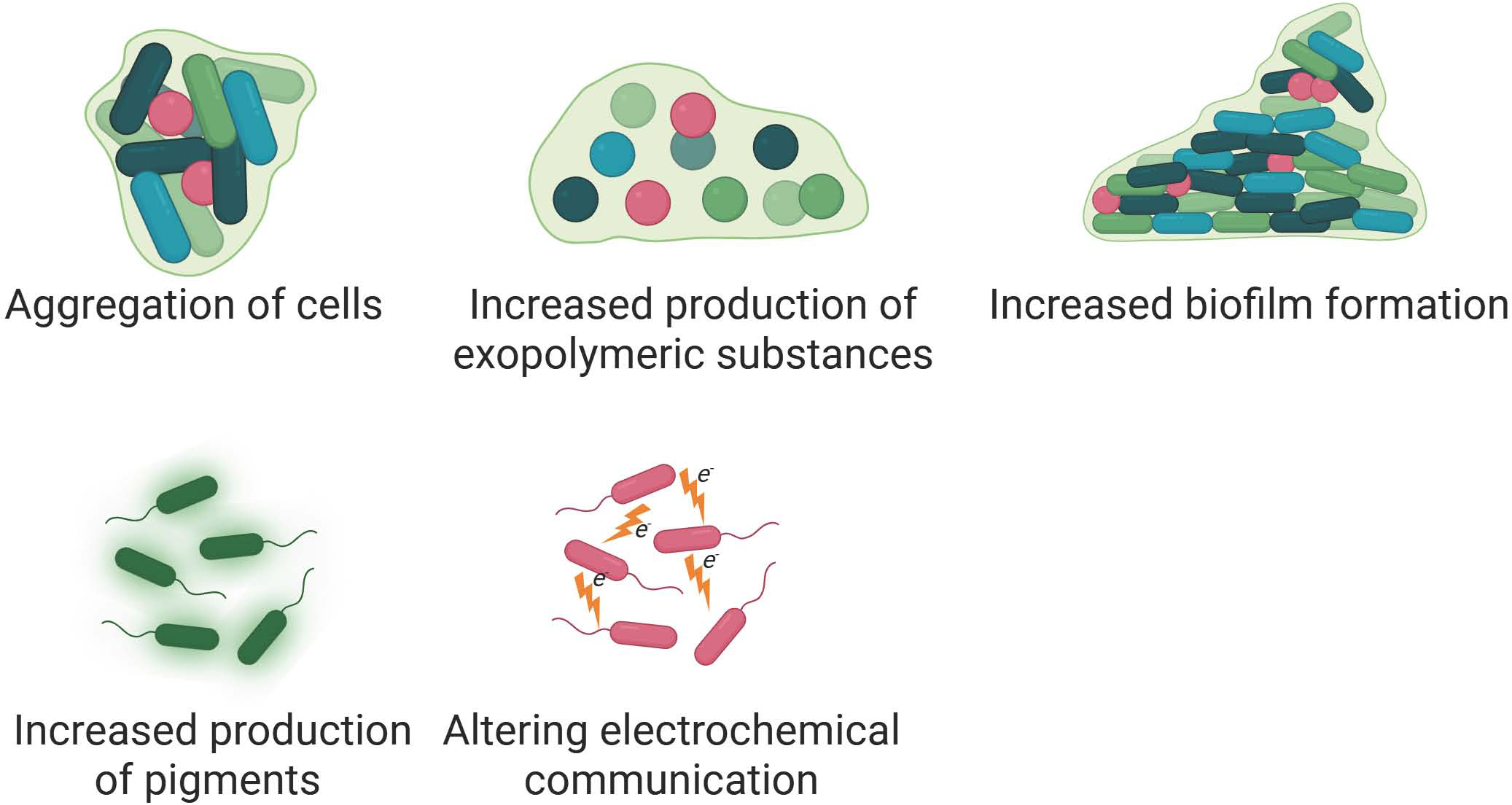
Fig. 3.
Common physiological alterations in bacterial populations treated with sublethal doses of nanomaterials; Created in BioRender Augustyniak, A. (2025) https://BioRender.com/90q8rev
Table 1.
Harmful and stimulatory physiological effects of selected nanomaterials or ions on bacteria
| Effect | Nanomaterial/Ion | Microorganism | Reference |
|---|---|---|---|
| ROS-induced genotoxicity | Bismuth (Bi), Antimony (Sn) ions | Salmonella Typhimurium TA100, TA1535, TA98, TA1537, E. coli WP2uvrA/pKM101 | (Asakura et al., 2009) |
| Efflux disruption | AgNPs | S. aureus ATCC 29231 | (Attallah et al., 2022) |
| Protein structure disruption | Gold-functionalized magnetic nanoparticles (Fe3O4@Au) | P aeruginosa (strain undisclosed) | (Niemirowicz et al., 2014) |
| Metabolic pathway disruption | Cadmium (Cd) ions | Bacillus subtilis TTL1 | (Li et al., 2021) |
| Disrupted uptake of essential ions | Zinc (Zn), Iron (Fe), Manganese (Mg) ions | Bacillus subtilis (multiple strains) | (Chandrangsu et al., 2017) |
| Membrane disruption | ZnO NPs and copper nanoparticles (Cu-NPs) | E. coli ATCC 25922, Bacillus cereus ATCC 11778, Staphylococcus epidermidis ATCC 12228 | (Metryka et al., 2023) |
| Membrane depolarization | ZnO NPs | P. aeruginosa ATCC 27853 | (Honselmann genannt Humme et al., 2024) |
| Aggregation of cells | Silica/titania nanotubes | P. aeruginosa PAO1 | (Augustyniak et al., 2020) |
| Increased production of exopolymeric substances | ZnO NPs | P. aeruginosa ATCC 27853 | (Honselmann genannt Humme et al., 2024) |
| Increased biofilm formation | AgNPs | P. aeruginosa PAO1 | (Yang and Alvarez, 2015) |
| Increased production of pigments | MWCNTs | P. aeruginosa ATCC 27853 | (Honselmann genannt Humme et al., 2025) |
| Altering electrochemical communication | Shewanella-reduced Graphene oxide | Shewanella oneidensis (strain undisclosed) | (Lin et al., 2018) |