
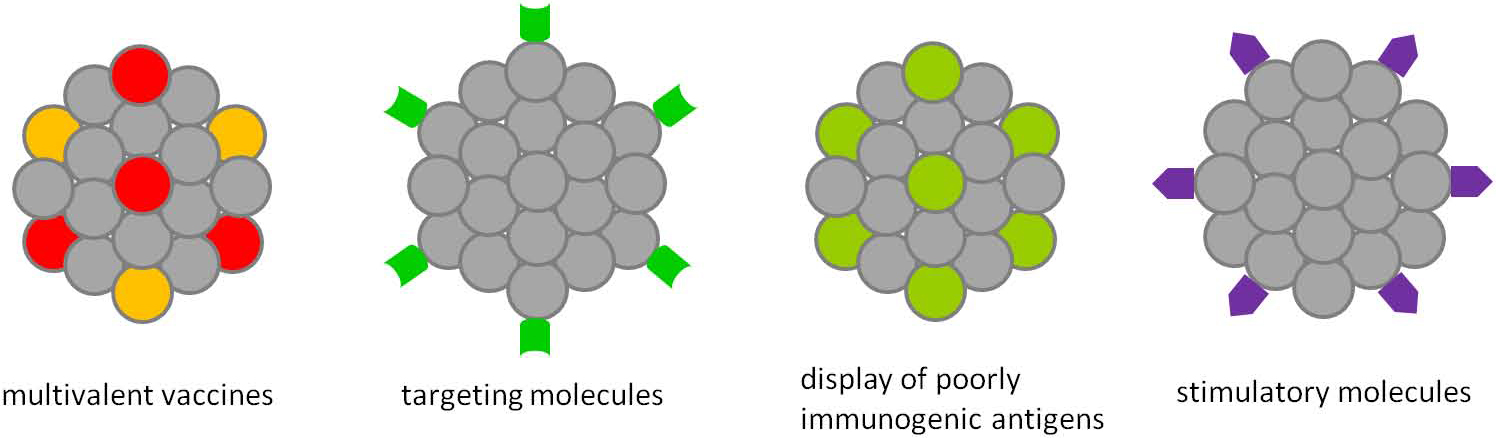
Fig. 1
Chimeric VLPs and their possible applications.
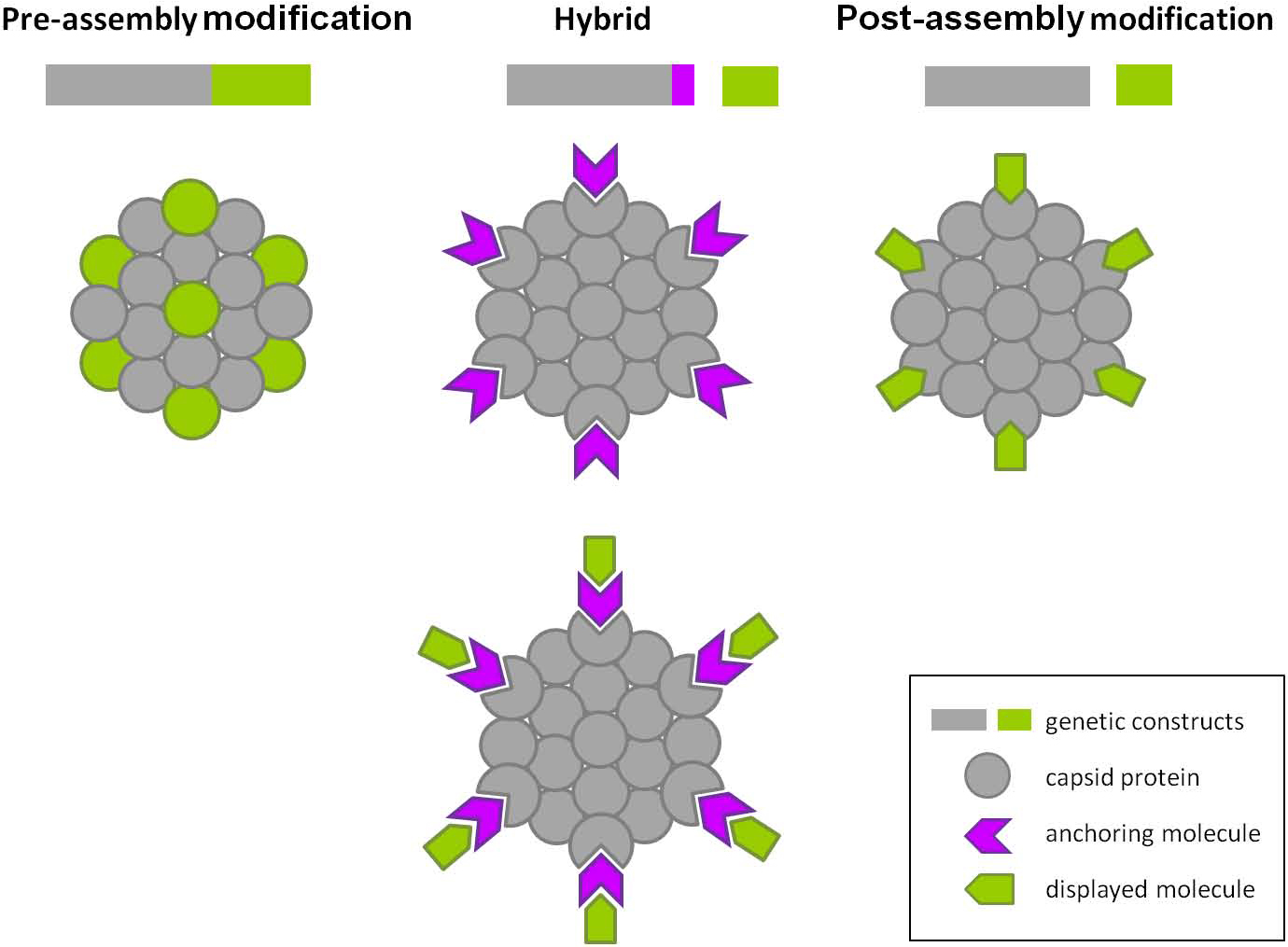
Fig. 2
Strategies for producing chimeric VLPs.
The protein or peptide to be displayed on the VLP can be incorporated either by genetic fusion to the capsid protein before assembly (pre-assembly modification, left) or through chemical conjugation after assembly (right). The hybrid approach (middle) involves genetically fusing an attachment module and then performing post-assembly functionalization of the VLP.
Table. 1.
Summary of methods allowing VLP modularization, discussed in this review.
| Modification Anchoring element (on VLP) | Interaction mechanism | Resulting bond (reversibility) | First used for VLP modularization |
|---|---|---|---|
| Streptavidin – biotin | Hydrogen bonding | Non covalent Irreversible | 2006 (Smith et al., 2006) |
| Van der Waals interactions | |||
| Straptavin – Strep-tag II | Hydrogen bonding | Non covalent (reversible) | 2024 (Tang et al., 2024) |
| Hydrophobic interactions | |||
| WW domain – PPxY motif | Hydrophobic interactions | Non covalent (reversible) | 2002 (Galinier et al., 2002) |
| Aromatic stacking | |||
| Hydrogen bonding | |||
| His-tag – Ni-NTA | Metal coordination | Non covalent (reversible) | 2015 (Koho et al., 2015) |
| Sortase-Mediated Ligation (SML) | Enzymatic (sortase) | Covalent bond | 2016 (Tang et al., 2016) |
| LPTXG or | |||
| GGGGG | |||
| SpyTag – SpyCatcher | Isospetide bond formation | Covalent bond | 2018 (Brune and Howarth, 2018) |
| Intein-mediated protein splicing | Peptide bond formation | Covalent bond | 2021 (Wang et al., 2021) |
| IntN and IntC | |||
| AviTag – biotin | Enzymatic (BirA) | Covalent bond | 2015 (Thrane et al., 2015) |