
1. Introduction
Virus-like particles (VLPs) are structures that mimic viruses but lack the viral genetic material needed for replication. They form through the self-assembly of viral proteins, either during recombinant expression or as a result of viral infection. Composed of viral proteins and sharing structural similarity with native viruses, VLPs are recognized by the immune system as potential threats, which triggers strong immune responses. Their ability to stimulate the immune system is enhanced by their particulate nature and size (generally 20-200 nm), as well as by the repetitive and organized arrays of proteins on their surface (Grgacic and Anderson 2006; Naskalska and Pyrć 2015; Mohsen and Bachmann 2022; McFall-Boegeman and Huang 2022). Despite being highly immunogenic, VLPs are non-infectious and thus safe to handle. These features make VLPs promising candidates for vaccine development. Licensed VLP-based vaccines include those protecting against hepatitis B virus (HBV), human papillomavirus (HPV), and others, while many more candidates are currently under investigation (Bachmann et al. 2025).
Another property of VLPs that is appealing from a biotechnological view is their ability to enter (“infect”) target cells, making them effective delivery tools (Zdanowicz and Chroboczek 2016; Ikwuagwu and Tullman-Ercek 2022). Additionally, if the parent virus enters cells through interaction with a specific receptor, VLPs usually maintain this receptor specificity (Maginnis 2018). This allows tissue-specific targeting, which is especially useful in various therapeutic applications, such as drug delivery and gene therapy (He et al. 2022; He et al. 2024).
For purposes of synthetic biology, VLPs are synthesized through the recombinant expression of viral structural proteins, which then spontaneously self-assemble. While all existing protein expression systems can be used for VLP production, the most suitable host depends on the virus’s origin. For example, VLPs from bacteriophages are generally produced most efficiently in bacterial systems, whereas those from plant viruses are best expressed in plant-based systems. However, most VLPs can be successfully generated in various hosts, including bacteria, yeast, insect, and mammalian cells (Naskalska and Pyrć 2015; Nooraei et al. 2021). The main limitation occurs when the VLP originates from an enveloped virus or includes proteins that require post-translational modifications for proper folding and function. In such cases, a eukaryotic expression system is necessary.
Among several advantages of VLPs, perhaps the most exciting is their ability to incorporate heterologous proteins. Creating such chimeric VLPs can serve multiple applications: displaying antigens from pathogens that are otherwise poorly immunogenic (Yin et al. 2013; Leneghan et al. 2017); simultaneously presenting antigens from different pathogens (serotypes), which enables the development of multivalent vaccines (Jagadish et al. 1996; Luxembourg et al. 2015; Janitzek et al. 2019; Panasiuk et al. 2023; Riedmiller et al. 2024); displaying targeting molecules that confer tissue specificity or enhance cell entry efficiency (Pokorski et al. 2011); Rohovie et al. 2017; Mohsen et al. 2022; Fowler et al. 2023); or displaying other stimulatory molecules to tune the immune response either through endocytosis pathways (Hagge et al. 2023; Su et al.,2024), depending on the desired effect (Fig. 1).
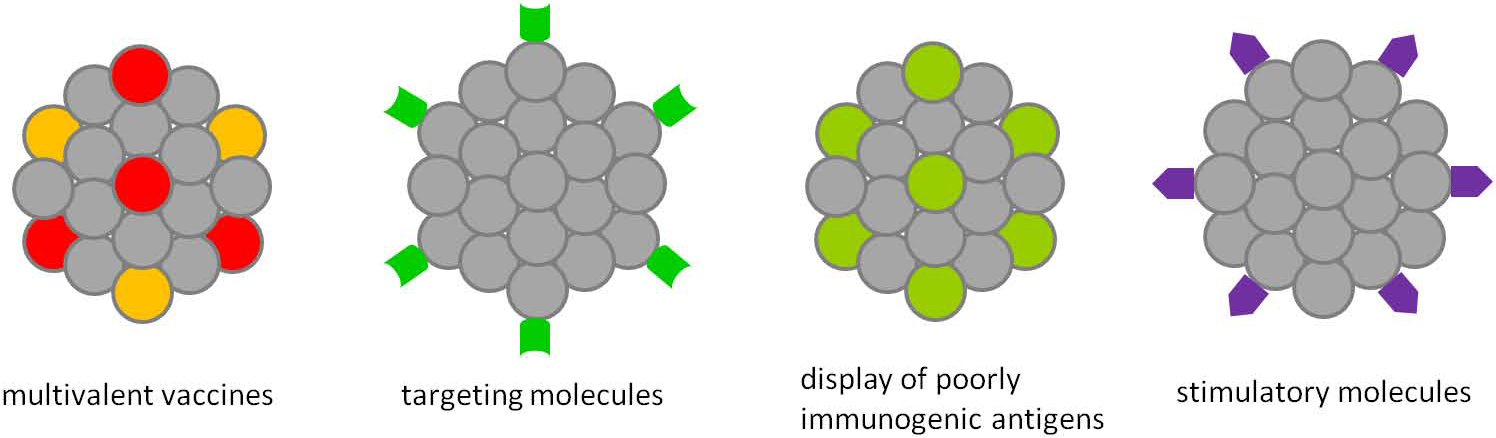
Fig. 1
Chimeric VLPs and their possible applications.
Chimeric VLPs can be produced through several methods, generally classified as pre-assembly and post-assembly, depending on the stage at which the foreign molecule is incorporated during VLP assembly (Fig. 2). Pre-assembly methods involve genetically fusing the protein to be incorporated with the VLP’s building protein. The modified viral proteins then are expressed and self-assemble, assuming there is no steric or electrostatic hindrance. Therefore, this approach requires some prior knowledge of the VLP structure to enable the rational design of the protein modification. Conversely, post-assembly modification involves attaching the desired molecule to pre-formed VLPs. Various techniques, such as chemical conjugation of proteins, peptides, or small molecules, can be used for this purpose. Beyond these two categories, a hybrid strategy exists: creating modular VLPs. In this method, an anchoring moiety—typically introduced via genetic fusion—is consistently incorporated into the VLP structure. This moiety acts as a universal handle for attaching different molecules of interest (Fig. 2). The idea behind VLP modularization is based on several potential benefits, especially for vaccine manufacturing. For example, VLPs used as antigen display platforms can be preassembled and quickly adapted to present an antigen of choice, significantly reducing the time and cost to develop vaccines. Additionally, modular systems support a “scale-up” approach—adding more production lines instead of expanding the size of a single facility. Furthermore, modular units can be produced independently and more locally, which could enhance global vaccine accessibility. All these aspects of modularization enable rapid vaccine deployment and improve overall pandemic preparedness.
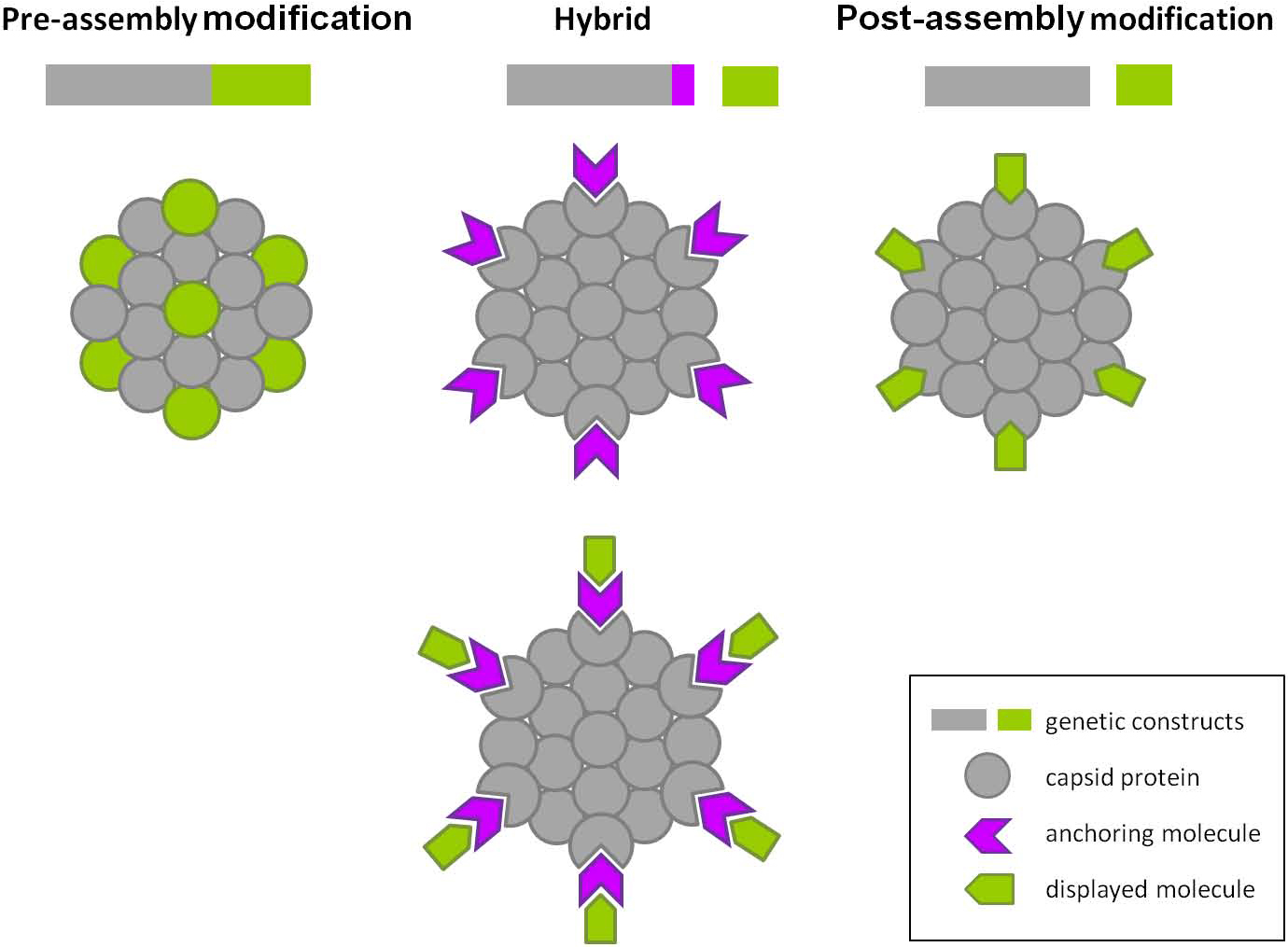
Fig. 2
Strategies for producing chimeric VLPs.
The protein or peptide to be displayed on the VLP can be incorporated either by genetic fusion to the capsid protein before assembly (pre-assembly modification, left) or through chemical conjugation after assembly (right). The hybrid approach (middle) involves genetically fusing an attachment module and then performing post-assembly functionalization of the VLP.
In this review, I aim to organize and compile strategies for creating modular VLPs and to present key examples of their potential applications. Notably, this review focuses only on approaches based on proteinprotein or protein-peptide interactions, deliberately excluding methods based on chemical coupling, which have been thoroughly reviewed elsewhere (Strable and Finn 2009; Smith et al. 2013; Rohovie et al. 2017).
2. Possible strategies of producing modular VLPs
The modularity of VLPs generally comes from two interacting parts: one permanently integrated into the VLP capsid and another attaching to the protein (or other molecule). The interaction between these parts can be affinity-based, electrostatic, or enzyme-mediated, resulting in covalent or non-covalent bonds.
3. Non covalent interactions
3.1. Streptavidin/biotin/Streptag
One of the strongest known non-covalent biological interactions is between biotin (also known as vitamin H or B7) and streptavidin, a tetrameric protein (~60 kDa) derived from Streptomyces avidinii. Although extensively studied, the role of the biotinstreptavidin interaction in its natural context (during bacterial growth) remains not fully understood. Nonetheless, it is highly specific and effectively irreversible under physiological conditions, making it a powerful tool in biotechnology for protein purification, immobilization, and detection (Laitinen et al. 2006). Notably, the tetrameric structure of streptavidin allows the simultaneous binding of four biotin molecules, which can be useful in applications such as signal amplification. Biotinylated VLPs and their subsequent functionalization with streptavidin-fused proteins have been used in various applications. Nearly two decades ago, Smith et al. engineered tobacco mosaic virus (TMV) VLPs to display green fluorescent protein (GFP) as a model protein and an antigen from canine papillomavirus, demonstrating the feasibility of this approach for vaccine development (Smith et al. 2006). Recently, a similar approach was employed by Muthuraman et al., who functionalized Dengue virus (DENV) VLP with another DENV antigen through biotin-streptavidin conjugation (Muthuraman et al., 2024). Conversely, Pereboeva et al. demonstrated that a biotinylated adenovirus vector decorated with epidermal growth factor (EGF)-streptavidin targets the EGF receptor (EGFR), enabling tissue-specific delivery (Pereboeva et al. 2007). Another group proposed a reverse strategy: incorporating streptavidin directly into phage P22-derived VLPs, followed by functionalization with biotin (Sharma et al. 2017). Additionally, a next-generation streptavidin conjugation system has emerged, where biotin is replaced by a peptide tag (Strep-tag II). This system is especially interesting because the interaction is reversible—Strep-tag II binds streptavidin with lower affinity than biotin and can be displaced by biotin (Voss and Skerra 1997). Recent studies have shown the utility of this system in VLP engineering, demonstrating that artificially assembled VLPs from elastin-like polypeptides can be purified efficiently via genetically encoded Strep-tag II, or that Strep-tag II can mediate encapsulation of quantum dots within tick-borne encephalitis virus (TBEV) and Ebola VLPs (Liu et al. 2024).
3.2. WW domain-PPxY motif interaction
The so-called WW domain is a small protein module of approximately 35-40 amino acids, named for its two conserved tryptophan (W) residues. In eukaryotes, it specifically recognizes proline-rich motifs, especially the PPxY sequence (proline-proline-any amino acid-tyrosine). The interaction between the WW domain and PPxY motifs plays a role in various cellular processes, including signal transduction, transcriptional regulation, and protein degradation (Ingham, Gish and Pawson, 2004). Interestingly, some viruses exploit this interaction by incorporating PPxY motifs into their structural proteins, hijacking host WW domain-containing proteins during infection (Yasuda et al. 2003). This viral strategy has inspired researchers to harness the WW domain-PPxY motif interaction to engineer modular VLPs. Adenovirus capsid proteins naturally contain PPxY motifs, making adenovirus-derived VLPs ideal candidates for functionalization through proteins genetically engineered to display WW domains (Galinier et al. 2002; Shepley-McTaggart et al. 2020). Using this approach, a vaccine prototype displaying influenza virus antigens was developed, demonstrating the system’s potential for antigen presentation (Naskalska et al. 2009; Naskalska et al. 2013).
3.3. His tag – Ni2+(NTA)
The His-tag is a short sequence of histidine residues—usually six—that is genetically fused to a protein. The imidazole side chains of these histidines can coordinate with Ni2+ ions, forming a metal coordination complex. This interaction is fairly strong and specific, yet reversible. Adding free imidazole to the system interrupts this coordination by competing with the His-tag for Ni2+ binding. This mechanism is widely used in protein purification and is considered a reliable, cost-effective way to isolate His-tagged proteins. In purification workflows, Ni2+ ions are immobilized on a resin functionalized with nitrilotriacetic acid (NTA), which serves as a chelating agent (Petty 2001). Similarly, VLPs made of His-tagged proteins can be functionalized using NTA as an adaptor to link various molecules. Additionally, the His-tag can help in VLP purification before functionalization. This strategy has been reported by Koho et al., who produced a Histagged norovirus VLP subsequently decorated with a surface-attached cell internalization peptide (VSV-G) via NTA-based interactions (Koho et al. 2015). In contrast, Chung et al. used the reverse method: they chemically attached NTA to VLPs derived from Qβ phage or cowpea mosaic virus (CPMV), then decorated them with His-tagged model antigens (Chung et al. 2023).
4. Covalent bonding
4.1. Sortase-Mediated Ligation (SML)
Sortase A (SrtA) is a transpeptidase originally isolated from Staphylococcus aureus, where it catalyzes cell wall sorting by cleaving the leucine-proline-any amino acid-threonine-glycine (LPXTG) motif and then attaching it to the polyglycine sequence of the peptidoglycan. Similarly, engineered proteins containing LPXTG motifs and GGGGG sequences—preferably at the C- and N-termini, respectively—can be ligated by SrtA (Mao et al. 2004)2004. The native sortase-mediated ligation (SML) reaction requires calcium ions (Ca2+), and its initial applications in biotechnology also required the presence of Ca2+. However, further studies of sortase ligation in other Gram-positive bacteria have allowed the development of Ca2+-independent systems. Furthermore, rational mutagenesis of recombinant sortase has improved the efficiency and versatility of this method (Freund and Schwarzer 2021). SML has been used to construct modular VLPs for antigen display and targeted cell delivery. Examples include anchoring enterovirus antigen 71 to HBV VLP (Tang et al. 2016); influenza hemagglutinin to bacteriophage P22 VLP (Patterson et al. 2017); Japanese encephalitis virus (JEV) antigen to bamboo mosaic virus (BaMV) VLP (Yang et al. 2021); and the integrin-binding peptide sequence (RGD) to bacteriophage HK97 VLP (Woods et al. 2023).
4.2. SpyTag/SpyCatcher
The SpyTag/SpyCatcher system was developed in 2012, based on the observation that some bacterial proteins are stabilized by an intramolecular isopeptide bond formed between lysine and asparagine residues. An example is the fibronectin-binding (FbaB) protein from Streptococcus pyogenes. Interestingly, a domain of the FbaB protein containing the putative residues will spontaneously reconstitute the whole molecule when split into two parts. This phenomenon was discovered by Zakeri et al., who recombinantly expressed the two parts of the FbaB protein: a peptide called SpyTag (13 amino acids) and a protein of approximately13 kDa (116 amino acids), called SpyCatcher, and used them as connecting moieties (Zakeri et al. 2012). The strength of this reaction lies in its speed (within minutes) and its ability to tolerate various conditions such as temperature, pH, and buffer composition. Additionally, both Spy components can function as N-terminal, C-terminal, or internal fusions within the target protein, providing high flexibility. Since the first demonstration that SpyTag – SpyCatcher technology can be used for VLP functionalization, it has been called “Plug-and-Display” (Brune and Howarth 2018) and has been widely adopted for antigen display on VLPs. Vaccine prototypes protecting against non-viral infections, such as malaria (Bruun et al. 2018; Marini et al. 2019; King et al. 2024), Shigella flexneri (Li et al. 2022), and even non-infectious diseases like hypercholesterolemia (Goksøyr et al. 2022), have been reported. Notably, this method also supports the presentation of multimeric antigens with diverse symmetries on a single VLP (Rahikainen et al. 2021). It is also important to note that the Spy system has been utilized to functionalize the interior of VLPs. For example, Yur et al. demonstrated that GFP (as a model protein) and a pro-drug enzyme could be packaged inside HBV VLPs using this strategy (Yur, Sullivan, and Chen 2023).
4.3. Inteins
Inteins are protein segments initially identified in the yeast genome that can excise themselves from a host protein and ligate the remaining parts—called exteins—to create a continuous polypeptide chain. Split inteins occur naturally or are engineered to exist as two separate fragments: the N-terminal intein (IntN) and the C-terminal intein (IntC). Each fragment is usually fused to a different protein or peptide of interest. When IntN and IntC come into proximity, they bind to reassemble into a functional intein (Perler 2005). This reassembled intein then catalyzes its own removal and promotes the ligation of the exteins through a native peptide bond. This process is autocatalytic and does not need any cofactors or auxiliary enzymes. The result is a seamless fusion of the two target proteins, with no residual intein sequence left behind. The use of inteins for VLP modularization has been reported only once so far, to create HBV VLP bearing nucleocapsid proteins from SARS-CoV-2 (Wang et al. 2021).
4.4. Avi tag
The AviTag serves as an alternative to streptavidin for linking biotinylated molecules. It is derived from the natural biotin-accepting domain of E. coli: biotin carboxyl carrier protein (BCCP), where it functions as a specific recognition site for the enzyme biotin ligase (BirA). Further engineering of this domain created a minimal and efficient substrate for BirA, which is the 15-amino-acid tag (GLNDIFEAQKIEWHE) (Beckett et al. 1999). The AviTag can be placed at the N-terminus, C-terminus, or internal loops of proteins, enhancing its versatility. Like other peptide tags, the AviTag has proven useful for protein detection and quantification, studying protein-protein interactions, and protein immobilization. The first modularization of VLPs using AviTag was reported by Thrane et al. for another malaria vaccine candidate (Thrane et al. 2015). During the SARS-CoV-2 pandemic, a prototype multivalent coronavirus vaccine utilizing MS2 VLPs with AviTag was proposed (Chiba et al. 2021; Halfmann et al. 2024).
5. Characterization of modular VLPs
The yield and efficiency of VLP modularization can be evaluated using various biochemical and biophysical techniques (reviewed elsewhere (Heddle et al. 2017; Nooraei et al., 2021)). Common methods include electrophoretic mobility assays, dynamic light scattering (DLS) to measure changes in particle diameter, static light scattering (SLS), and mass photometry (MP) to assess changes in molecular weight, nano differential scanning fluorimetry (nanoDSF) for detecting particle stability changes, electron microscopy (EM) for visualizing particle morphology and integrity, and cryo-electron microscopy (cryo-EM) for detailed structural insights into modified particles. Overall, these techniques offer a thorough characterization of both functionalized and unmodified VLPs. The recent rapid development of advanced microscopic methods such as cryo-EM, cryo-electron tomography (CryoET), atomic force microscopy (AFM), and correlative light electron microscopy (CLEM) has further enhanced this field’s potential (Graham and Zhang 2023; Castón and Luque 2024).
6. Conclusions and future directions
In today’s fast-moving biotechnological era, researchers have access to a versatile toolbox comprising diverse methods for protein modification. Virus-like particles, which are protein-based macromolecular structures, can be functionalized using several of these techniques (the ones discussed in this review are summarized in Table 1). The choice of method depends on multiple factors, including the properties of the VLP scaffold (such as its tolerance to the continuous incorporation of a linking component), the nature of the molecule to be attached (protein, nucleic acid, dye, etc.), and the intended use of the functionalized VLP. Especially if the VLPs are meant for in vivo applications — like vaccines or drug/gene delivery — they must be free from contaminants, organic solvents, and toxic metal ions. Additionally, the expected results of delivering VLPs into body fluids or specific cells should be considered: whether covalent attachment of the modifying molecules offers an advantage or not. In some applications, such as gene or enzyme delivery, the goal is cargo release, making reversible coupling strategies more suitable. An important factor is choosing the most effective type of conjugation for a particular application. Some techniques involve simply mixing the two components (e.g., SpyTag – SpyCatcher, biotin – streptavidin), while others require enzymatic catalysis (e.g., SML, AviTag – biotin), and they can vary in yield.
Table. 1.
Summary of methods allowing VLP modularization, discussed in this review.
| Modification Anchoring element (on VLP) | Interaction mechanism | Resulting bond (reversibility) | First used for VLP modularization |
|---|---|---|---|
| Streptavidin – biotin | Hydrogen bonding | Non covalent Irreversible | 2006 (Smith et al., 2006) |
| Van der Waals interactions | |||
| Straptavin – Strep-tag II | Hydrogen bonding | Non covalent (reversible) | 2024 (Tang et al., 2024) |
| Hydrophobic interactions | |||
| WW domain – PPxY motif | Hydrophobic interactions | Non covalent (reversible) | 2002 (Galinier et al., 2002) |
| Aromatic stacking | |||
| Hydrogen bonding | |||
| His-tag – Ni-NTA | Metal coordination | Non covalent (reversible) | 2015 (Koho et al., 2015) |
| Sortase-Mediated Ligation (SML) | Enzymatic (sortase) | Covalent bond | 2016 (Tang et al., 2016) |
| LPTXG or | |||
| GGGGG | |||
| SpyTag – SpyCatcher | Isospetide bond formation | Covalent bond | 2018 (Brune and Howarth, 2018) |
| Intein-mediated protein splicing | Peptide bond formation | Covalent bond | 2021 (Wang et al., 2021) |
| IntN and IntC | |||
| AviTag – biotin | Enzymatic (BirA) | Covalent bond | 2015 (Thrane et al., 2015) |
Besides modifying the external surface of VLPs, other methods focus on controlling their size and shape using scaffolding materials like inorganic nanoparticles (Sun et al. 2007) or DNA origami structures (Kopatz et al. 2019). The idea of combining VLPs with DNA origami technology is relatively new and leverages DNA’s natural programmability. Due to its complementary base pairing, the DNA scaffold can be precisely folded with specific oligonucleotides (called staples) and functionalized at designated points. This enables coating DNA origami structures with viral proteins, expanding the possibilities for modular VLP modifications (Knappe et al. 2021; Seitz et al. 2023). Furthermore, recent research shows that functional mRNA (instead of DNA) can serve as an origami framework to guide VLP assembly and later undergo translation (Seitz et al. 2025). This integration of VLP assembly with DNA/RNA origami technology and other materials offers great potential for developing advanced vaccines and smart drug delivery systems.
It is also important to note that amid the current surge in computational biology and artificial intelligence-aided technologies, the field of protein engineering, including the development of VLPs, greatly benefits from these advancements (Charlton Hume et al. 2019). Specifically, the de novo design of artificial VLPs (or broader artificial protein cages) is gaining increasing attention, with pioneering work from the group led by David Baker—the recent Nobel Prize laureate in Chemistry. Creating synthetic protein cages with improved properties, such as size (Dowling et al. 2025), symmetry (Lee et al. 2025), and controllable structure (Watson et al. 2023; Pillai et al. 2024), including modular approaches (Biela et al. 2022), opens up unprecedented possibilities for fine-tuning antigen (or ligand) display on VLP surfaces.
In summary, the modularization of VLPs is an evolving field supported by a growing array of chemical and biological tools and empowered by cutting-edge analytical techniques that enable precise nanoscale platform construction for various applications.
Acknowledgements
I’m thankful to Jonathan Heddle for his language corrections in this manuscript. This work was supported by the Polish National Science Centre (NCN) grant no. 2020/37/B/NZ6/03878.
Notes
[1] Conflicts of interest Conflict of interest
The authors do not report any financial or personal connections with other persons or organizations, which might negatively affect the contents of this publication and/or claim authorship rights to this publication.