
Quinuclidinium compounds are a diverse class of natural or synthetic chemical agents with a wide range of potential applications in medicine and industry (1,2,3,4,5,6). These compounds are characterised by a rigid bicyclic core (7) that allows specificity, adaptability, and unique electrostatic properties in various chemical interactions, which makes them ideal candidates for binding to biological targets (8, 9). Recent advances in organic synthesis have enabled the development of synthetic quinuclidinium compounds that enhance the properties of their natural analogues with improved potency, stability, and selectivity for specific biological targets, such as receptors and enzymes, including cholinesterases (4, 10,11,12,13,14). From the therapeutic viewpoint, inhibition of acetyl- and butyrylcholinesterase can increase acetylcholine levels and thus improve cognitive function impaired by neurodegenerative diseases (15).
Several quinuclidinium compounds have shown potent cholinesterase inhibition, but also adverse effects like cytotoxicity. One of the intriguing aspects of quinuclidinium compound activity is biological response to the increase in aliphatic side chain length, as it can enhance the binding efficiency and/or cytotoxicity of quinuclidinium compounds (2,3,4, 14, 16). Better understanding of the relationship between the side chain length and biological activity may reveal structural factors that contribute to the therapeutic efficacy and safety of these compounds. Therefore, we focused on six quinuclidinium analogues of different side chain lengths, previously shown to be cytotoxic, to relate their oxidative effects to their structural properties in a SH-SY5Y cell model.
MATERIALS AND METHODS
Chemicals and cell culture
The six tested N-alkyl quaternary quinuclidine compounds (Q(N)OH-C12,14,16) were designed and synthesised by the Professor Ines Primožič group at the University of Zagreb Faculty of Science, Department of Chemistry (Zagreb, Croatia) as described elsewhere (4, 14). Q(N)OHs were prepared as 100 mmol/L stock solutions in dimethyl sulfphoxide (DMSO) and diluted to a designated concentration in unsupplemented cell medium prior to experimentation. The selected concentrations correspond to the lowest observed adverse effect level (LOAEL), that is, the concentration achieving 20 % growth inhibition (IC20) at 4 h of exposure, determined in our previous study (14), as follows: 60 µmol/L for QOH-C12, 6 µmol/L for QOH-C14 and QOH-C16, 100 µmol/L for QNOH-C12, 25 µmol/L for QNOH-C14, and QNOH-C16.
The cell line used in the experiments was human neuroblastoma SH-SY5Y obtained from the European Collection of Authenticated Cell Cultures (ECACC, Salisbury, UK; Cat. No. 94030304). Cells were cultivated in Dulbecco’s Modified Eagle Medium (DMEM) F12 with 15 % foetal bovine serum (FBS), 1 % penicillin/streptomycin, and 1 % non-essential amino acids (all from Sigma-Aldrich Chemie, Steinheim, Germany) at 37 °C in a 5 % CO2-enriched atmosphere with regular medium changes and passaging as needed.
Measurement of total antioxidative capacity
Total antioxidative capacity (TAC) in cell lysates was measured using the ferric reducing antioxidant power (FRAP) assay as described elsewhere (17) with slight adjustments to 96-well microplates (18, 19). The working FRAP reagent was prepared by mixing acetate buffer (300 mmol/L, pH 3.6) and a solution of 10 mmol/L tripyridyltriazine (TPTZ) in 40 mmol/L HCl and 20 mmol/L FeCl3 in the 10:1:1 (v/v/v) ratio. All the chemicals were purchased from Sigma-Aldrich (St. Louis, MO, USA), except for TPTZ (Fluka, Buchs, Switzerland), and FeCl3 (Kemika, Zagreb, Croatia).
Briefly, SH-SY5Y cells were seeded at a density of 400,000 cells/well in 24-well plates. After the 4-hour treatment, we added ice-cold phosphate-buffered saline (PBS) to the wells, harvested the cells with a rubber scrapper, transferred the suspension into microtubes, and sonicated them at 60 % amplitude with a UP50H ultrasonic processor (Hielscher Ultrasonics, Teltow, Germany) for half a cycle. 10 µL of the obtained cell suspension was added to 240 µL of FRAP reagent in a 96-well plate and incubated at 37 °C for 60 min. The absorbance was measured at 593 nm using a SpectraMax iD3 microplate reader (Molecular Devices, San Jose, CA, USA). TACs were calculated from the standard curve obtained from the absorbance of known Fe2SO4 × 7H2O concentrations (0.02–1.0 mmol/L) and are expressed in µmol/L.
Measurement of reactive oxygen and nitrogen species
Reactive oxygen and nitrogen species (ROS and RNS, respectively) induced by the six Q(N)OHs were determined using one of the following cell-permeable reagents: 2′,7′-dichlorofluorescein diacetate dye (DCFDA) or 4-amino-5-methylamino-2,7-difluorofluorescein diacetate (DAF-FM) (both from Sigma-Aldrich Chemie).
SH-SY5Y cells were seeded at a density of 20,000 cells/well in 96-well black plates. Q(N)OHs were added with either DCFDA or DAF-FM (2 µmol/L final) and pluronic acid (PA) (Sigma-Aldrich Chemie) in the final concentration of 16 µmol/L as described elsewhere in detail (20). The plate was stirred gently and immediately inserted into the plate reader (SpectraMax® iD3, Molecular Devices) and fluorescence registered at 495/529 nm (for DCFDA) or 485/535 nm (for DAF-FM) every 3–10 min for 4 h for ROS or for 1 h for RNS, as described in detail elsewhere (21, 22). For ROS or RNS positive controls we used hydrogen peroxide (H2O2) or sodium nitroprusside dihydrate (SNP) (both from Sigma-Aldrich Chemie) in the final concentrations of 100 or 200 µmol/L, respectively. Results are expressed as normalised fluorescence signal compared to negative control.
Measurement of thiobarbituric acid reactive substances
The end products of lipid peroxidation, e.g. malondialdehyde, were measured using the thiobarbituric acid reactive substance (TBARS) following a previously described protocol (22). Briefly, SH-SY5Y cells were seeded at a density of 400,000 cells/well in 24-well plates. After the 4-h treatment, cells were harvested and sonicated as described above. 200 µL of cell suspension was added to 200 µL of thiobarbituric/trichloroacetic acid (TBA/TCA) reagent and heated to 90 °C for 30 min. Then, it was immediately cooled in an ice bath and centrifuged at 1,006 g and 4 °C for 5 min (Universal 32R centrifuge, Hettich Instruments, Beverly, MA, USA). Absorbances were measured on SpectraMax iD3 (Molecular Devices) at 532 nm.
TBARS concentrations were calculated using a standard curve constructed with 1,1,3,3-tetrametoxypropane (0.3–6.0 µmol/L) and expressed as µmol/L.
Glutathione measurement
For glutathione (GSH) measurement we used monochlorobimane (MCB, Sigma-Aldrich Chemie) as fluorescent probe and followed the protocol described elsewhere (23). Tert-butyl hydrogen peroxide (tBHP, Sigma-Aldrich Chemie) in the final concentration of 100 µmol/L was used as positive control. After the treatment, fluorescence was recorded on an Infinite M200PRO plate reader (Tecan Austria GmbH, Salzburg, Austria) with excitation and emission spectra of 355/460 nm. Results are expressed as normalised fluorescence signal compared to negative control.
Superoxide dismutase activity measurement
Superoxide dismutase (SOD) activity was measured using the SOD Assay Kit (Cayman Chemical, Ann Arbor, MI, USA). After the 4-h quinuclidine derivative treatment, the cells were harvested with ice-cold SOD-buffer (20 mmol/L HEPES pH 7.2, 1 mmol/L EGTA, 210 mm mannitol, 70 mmol/L sucrose), sonicated, and centrifuged at 1,500 g and 4 °C for 5 min. Supernatant was removed and centrifuged one more time at 10,000 g and 4 °C for 15 min. Supernatant was then removed for the assay (Cu/Zn-SOD), while the pellet was resuspended in SOD buffer (Mn-SOD). Samples and standards, 10 µL/well, were mixed in a transparent 96-well plate with 200 µL of diluted radical detector and 20 µL diluted xanthine oxidase from the kit and incubated in a shaker at 22–24 °C for 30 min. Absorbance was recorded on an Infinite M200PRO (Tecan Austria) plate reader at 450 nm. The final concentration of 100 µmol/L of tBHP (Sigma-Aldrich Chemie) was used as positive control.
Results are expressed as SOD activity normalised to protein concentration (U/mg of protein). Protein concentrations were measured using the biochonic acid (BCA) assay (Pierce™ BCA Protein Assay Kit, Thermo Fisher Scientific, Waltham, MA, USA) as described elsewhere (21). Absorbance was detected on a plate reader at 570 nm.
Measurement of DNA damage
DNA damage was assessed by measuring the activation of ATM kinase and phosphorylated histone H2A.X using the Muse Multi-Color DNA Damage Kit for the Guava Muse Cell Analyzer (Luminex, Częstochowa, Poland). The procedure followed a previously described protocol (24) based on specific antibodies. 24-h treatment with 10 µmol/L etoposide (Sigma-Aldrich Chemie) served as a positive control. The results are presented as percentage of total DNA damage relative to negative control.
Statistical analysis
All data were analysed from at least two or three independent experiments (performed in duplicate or triplicate). Statistical analyses was run on the Prism 9 software (GraphPad Software, San Diego, CA, USA) was used. If not otherwise stated, results are presented as means with standard errors.
Differences between the groups were tested with the one-way ANOVA, followed by Dunnett’s test. Statistical significance was set to p<0.05.
RESULTS
None of the quinuclidine derivative treatments resulted in significant changes in TBARS concentrations in SH-SY5Y cells compared to negative control (Figure 1), but all QNOHs significantly increased ROS and RNS levels (Figure 2). Increase in ROS depended on their side chain substituent length (Figure 2A), while in RNS it remained the same, regardless of the QNOH chain length (Figure 2B).
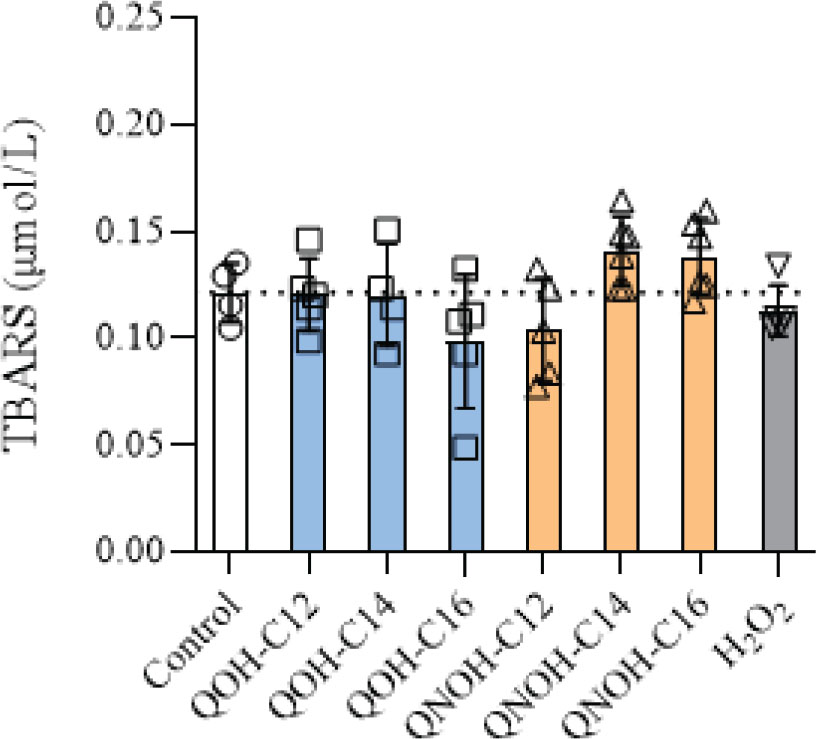
Figure 1
Lipid peroxidation (expressed as TBARS concentrations) in SH-SY5Y cells treated with 60 µmol/L QOH-C12, 6 µmol/L QOH-C14 or QOH-C16, 100 µmol/L QNOH-C12, and 25 µmol/L QNOH-C14 or QNOH-C16 for 4 h. Control – untreated cells; H2O2 – positive control (100 µmol/L)
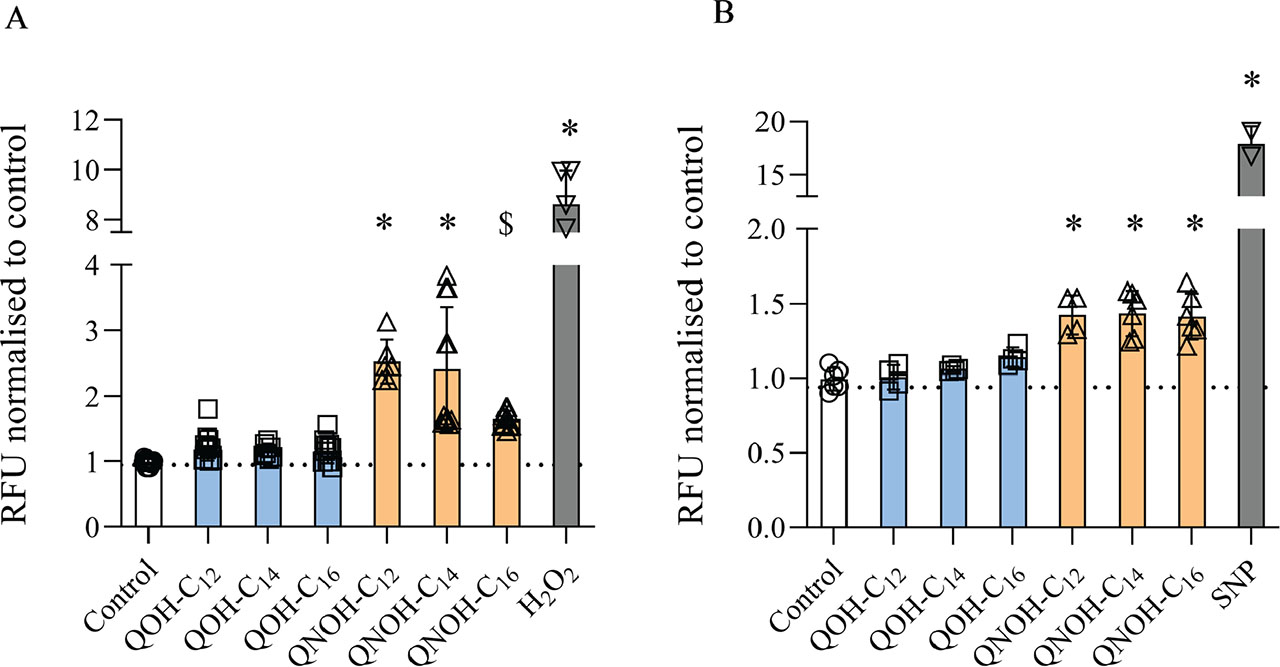
Figure 2
DCFDA- or DAF-FM fluorescence (expressed as RFUs normalised to control) indicating ROS (left panel) and RNS (right panel) levels in SH-SY5Y cells treated with 60 µmol/L QOH-C12, 6 µmol/L QOH-C14 or QOH-C16, 100 µmol/L QNOH-C12, and 25 µmol/L QNOH-C14 or QNOH-C16 for 4 h or 1 h, respectively. $ p<0.001; *p<0.0001 (Dunnett’s test). Control – untreated cells; DAF-FM – 4-amino-5-methylamino-2,7-difluorofluorescein diacetate; DCFDA – 2′,7′-dichlorofluorescein diacetate dye; H2O2 – positive control (100 µmol/L); RFU – relative fluorescence units; SNP – positive control (200 µmol/L)
Total antioxidant capacity in cells treated with quinuclidine derivatives dropped compared to negative control, but not significantly (Figure 3A), whereas GSH levels dropped significantly only in cells treated with QNOH-C12 and QOH-C12 (Figure 3B).
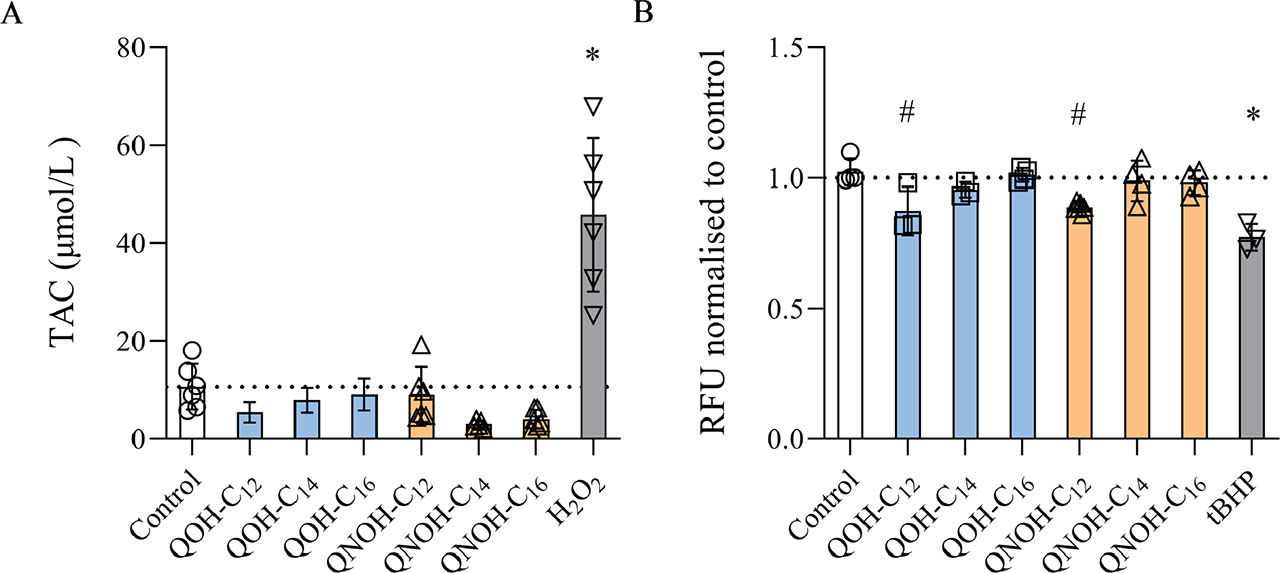
Figure 3
Total antioxidative capacity (TAC, expressed as µmol/L of Fe2+ equivalents, left panel) and MCB-fluorescence indicating GSH level (expressed as RFU normalised to control, right panel) in SH-SY5Y cells treated with 60 µmol/L QOH-C12, 6 µmol/L QOH-C14 or QOH-C16, 100 µmol/L QNOH-C12, and 25 µmol/L QNOH-C14 or QNOH-C16 for 4 h. # p<0.01; *p<0.0001 (Dunnett’s test). Control – untreated cells; H2O2 or tBHP– positive controls (100 µmol/L); RFU – relative fluorescence units; SNP – positive control (200 µmol/L)
Cytosolic SOD (Cu/Zn-SOD) activity significantly increased in SH-SY5Y cells treated with QOH-C16, QNOH-C14, and QNOH-C16 (Figure 4A). Mitochondrial SOD (Mn-SOD) activity significantly decreased with all quinuclidine derivative treatments (Figure 4B).
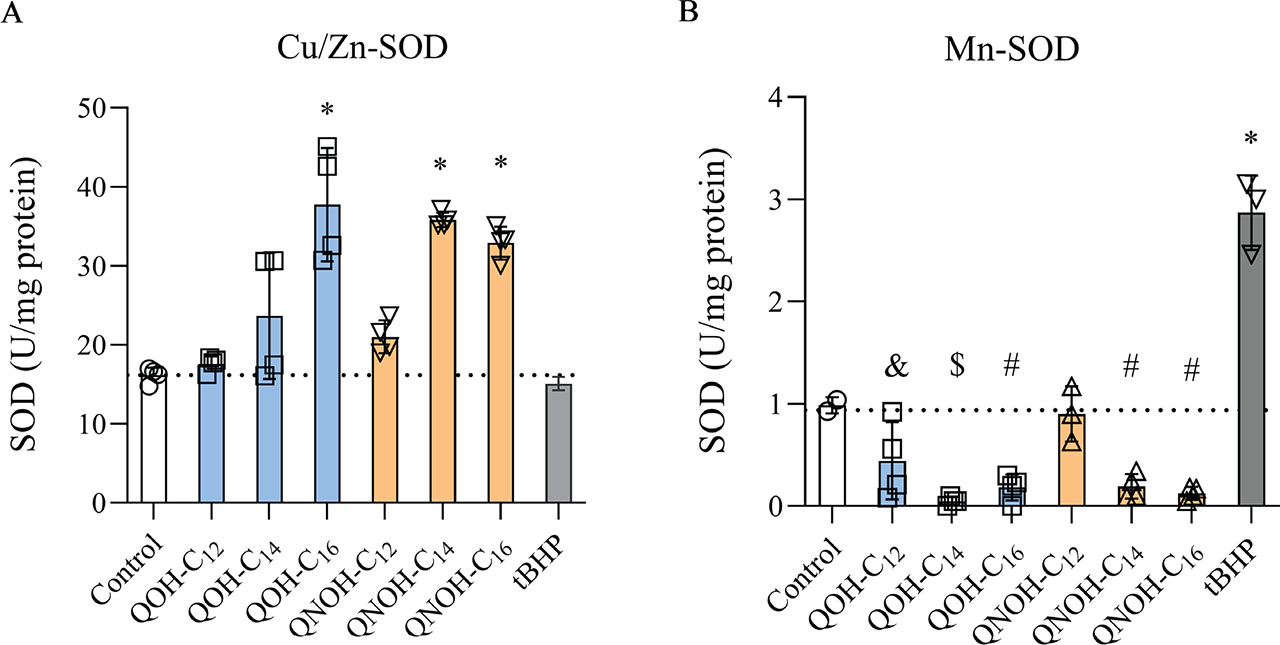
Figure 4
Cytosolic (Cu/Zn-SOD, left panel) and mitochondrial (Mn-SOD, right panel) superoxide dismutase activity (expressed as U/mg protein) in SH-SY5Y cells treated with 60 µmol/L QOH-C12, 6 µmol/L QOH-C14 or QOH-C16, 100 µmol/L QNOH-C12, and 25 µmol/L QNOH-C14 or QNOH-C16 for 4 h. & p<0.05; #p<0.01; $p<0.001; *p<0.0001 (Dunnett’s test). Control – untreated cells; tBHP– positive control (100 µmol/L)
We found no significant DNA damage in cells treated with quinuclidine derivatives (Figure 5), which may be owed to the wide distribution of results obtained with the used method.
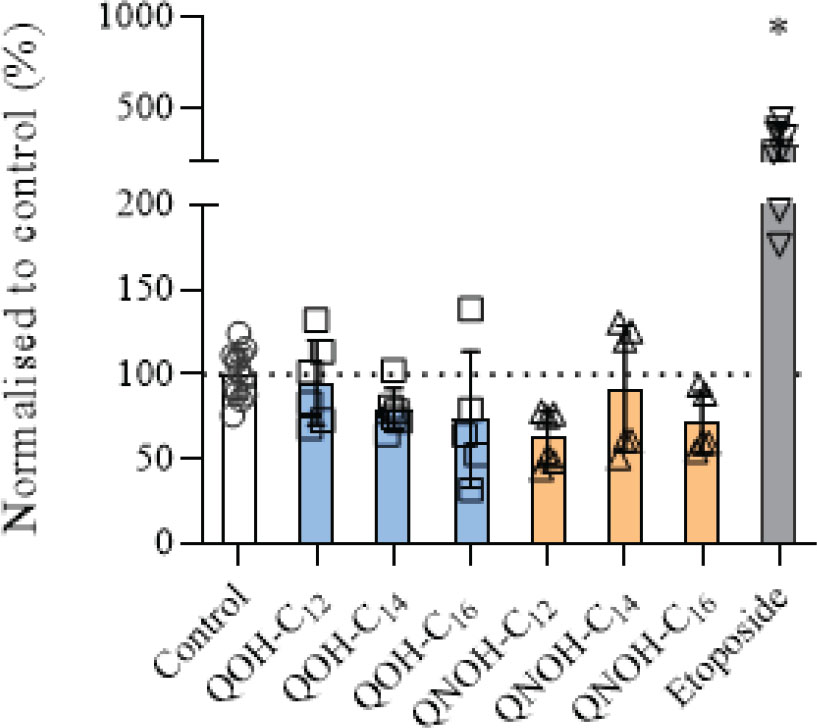
Figure 5
DNA damage (expressed as percentage normalised to the control) in SH-SY5Y cells treated with 60 µmol/L QOH-C12, 6 µmol/L QOH-C14 or QOH-C16, 100 µmol/L QNOH-C12, and 25 µmol/L QNOH-C14 or QNOH-C16 for 4 h. *p<0.0001 (Dunnett’s test). Control – untreated cells; Etoposide – positive control (10 µmol/L)
DISCUSSION
Our findings show varying oxidative effects relative to the structural differences between the six tested LOAEL quinuclidine derivatives in SH-SY5Y cells. QNOH compounds induced more changes than QOH compounds. ROS and RNS levels were elevated in response to QNOH treatment, regardless of the substituent alkyl chain length, and were accompanied by changes in SOD activities and to a lesser extent in GSH levels. High levels of ROS and RNS are often connected due to shared sources (such as mitochondria and NADPH oxidases) and amplification loops (ROS amplifying RNS production via iNOS) (28).
Cu/Zn SOD activity rose with longer alkyl chains, while Mn-SOD activity dropped significantly with all but QNOH-C12, which suggests an imbalance in the cell’s oxidative stress defence system, especially within the mitochondria, where Mn-SOD is critical for homeostasis (29). This sheds more light on the possible trigger for the decrease in mitochondrial membrane potential (ΔΨm) and on the induction of mitochondria-mediated apoptosis observed in our earlier study (14). In addition, increased cytosolic Cu/Zn SOD may reflect a defensive mechanism to neutralise ROS/RNS spilling over from stressed mitochondria into the cytosol (29). On the other hand, this increase may be owed to general oxidative stress but cannot compensate for lower Mn-SOD activity in mitochondria and the resulting mitochondrial damage.
The finding that only C12 derivatives led to GSH depletion suggests that the substituent alkyl chain length influences how these compounds interact with cellular defence mechanisms. Although GSH levels in SH-SY5Y cells dropped following the treatment with QOH-C12 and QNOH-C12, a reduction in total antioxidant capacity (TAC) is evident across all samples, indicating that all tested quinuclidine derivatives increase oxidative stress and cause redox imbalance, as suggested by Micheli et al. (30) in their docetaxel study in SH-SY5Y cells.
The induction of ROS/RNS in our study without lipid peroxidation (no significant changes in TBARS) suggests that ROS/RNS generation is primarily triggered by cellular signalling (e.g. peroxides) rather than the highly reactive species like hydroxyl radicals or superoxide anions that directly attack lipids (31). This is a common feature of many synthetic compounds that disrupt mitochondrial function or electron transport chains (28). Interestingly, treatment with H2O2 also did not induce significant lipid peroxidation in SH-SY5Y cells, suggesting that either the 100 µmol/L concentration was insufficient to overcome cellular antioxidant defences or that additional pro-oxidant conditions (e.g., transition of metal ions) are required to trigger lipid peroxidation.
Moreover, the lack of significant DNA damage despite ROS/RNS generation suggests that the compounds may not directly cause DNA breaks. However, the potential for indirect DNA damage may still exist, as these effects are not always immediately detected, depending on experimental conditions (33, 34). As far as we know, the processes triggered in our study could end in cell death in 24 h, as some compounds induce cumulative cellular damage over time, especially through mechanisms like oxidative stress, mitochondrial dysfunction, and enzyme inhibition (35,36,37).
Generally, the tested quinuclidine compounds induced oxidative stress with a potential to modify key antioxidant enzyme activities by affecting the mitochondrial function. This aligns with earlier reports of mitochondrial dysfunction caused by similar classes of compound (38,39,40).
Judging by what we know about the tested compounds at this point, the safe dose for each needs to be lower than the LOAEL used in this study: 60 µmol/L for QOH-C12, 6 µmol/L for QOH-C14 and QOH-C16, 100 µmol/L for QNOH-C12, and 25 µmol/L for QNOH-C14 and QNOH-C16. Considering that QOH-C12 inhibits cholinesterase (ChE) activity in the range of 9–13 µmol/L (14), it has potential for further development, as its LOAEL is about six times higher than its inhibition constant (Ki). Even more promising is QNOH-C12, whose ChE inhibition window of 5–14 µmol/L (14), and the 100 µmol/L LOAEL provides a nearly 10-fold safety margin. However, the inhibition potencies for QOH-C14, QOH-C16, QNOH-C14, and QNOH-C16 leave no room for further development as ChE inhibitors, as they are in the same range as their LOAEL (14).
All these findings raise questions to be addressed by further investigation, especially in terms of how chain length and functional groups on the quinuclidine core modulate oxidative stress responses and affect mitochondrial integrity.
CONCLUSION
N-alkyl quaternary quinuclidines (Q(N)OHs) in our study induced oxidative stress in SH-SY5Y cells primarily through ROS and RNS but did not cause significant lipid peroxidation or DNA damage. Although the activation of the non-enzymatic antioxidative defence system (evidenced by insignificant GSH depletion) was modest, the cellular response of the enzymatic antioxidative defence system (cytosolic Cu/Zn-SOD) was highly active, which confirms oxidative stress. Moreover, the observed decrease in mitochondrial Mn-SOD activity suggests mitochondrial dysfunction.
These findings highlight the potential of Q(N)OHs to disrupt cellular redox homeostasis, with implications for further studies on their safety and therapeutic potential, including broader cellular effects and dose optimisation.
Acknowledgements
We thank Professor Ines Primožič for providing the Q(N)OH compounds. This study was performed using the facilities and equipment funded within the European Regional Development Fund project KK.01.1.1.02.0007 “Research and Education Centre of Environmental Health and Radiation Protection – Reconstruction and Expansion of the Institute for Medical Research and Occupational Health”.
This study is part of the BioMolTox project funded by the Croatian Science Foundation (grant No. UIP-2017-05-7260) and by the European Union Next Generation Programme contract of 8 December 2023 (Class: 643-02/23-01/00016, Reg. No. 533-03-23-0006).