
1. Introduction
Anterior cruciate ligament (ACL) tear is one of the most prevalent sports-related injuries, frequently resulting in a failure to regain pre-injury athletic capabilities, consequently reducing the individual's overall well-being [1]. The synovial tissue surrounding the ACL prevents the formation of a stabilizing blood clot at the rupture site, thereby inhibiting spontaneous healing [2]. This inability to self-repair can subsequently lead to secondary injuries, such as meniscal tears and the development of osteoarthritis.
Currently, ACL reconstruction surgery is the undisputed surgical option for treating ACL ruptures, especially for young and active patients [3]. However, with current techniques, patients who undergo ACL reconstruction surgery rarely regain their original knee function, and there is a risk of re-rupture of the reconstructed ACL and early onset of osteoarthritis postoperatively [4]. Autologous hamstring tendon grafting is among the most commonly used graft materials in clinical practice, particularly valued for its minimal surgical trauma, ease of harvest, and minimal impact on knee extension structures, which facilitates early postoperative rehabilitation [5]. Although bone–patellar tendon–bone autografts are another popular option, hamstring tendons are often preferred for their lower donor-site morbidity. Studies have shown that autologous hamstring tendons can regenerate, undergo revascularization, and exhibit collagen remodeling, with earlier proprioceptive recovery of the autologous tendon [6]. However, the healing mode of autologous hamstring tendon grafting is tendon-to-bone healing, which is slow and prone to risks of knee instability and failure [7]. The process of tendon-to-bone healing primarily occurs within the bone tunnel, and its outcome depends on the type of graft and fixation method [8].
Tendon-to-bone healing after ACL reconstruction surgery is a major cause of postoperative failure, making the promotion of tendon-to-bone healing an urgent clinical challenge. Researchers have developed various biological methods to promote tendon-to-bone healing, including the addition of growth factors [9], bone marrow-derived mesenchymal stem cells (BMSCs) [10], autologous tissues [11], drugs [12], biomaterials [13], and gene therapy [14]. Although these methods have shown promising results in animal model experiments, clinical studies have reported inconsistent findings, lacking high-level evidence to support their effectiveness, and their clinical applications have certain limitations.
To identify more effective agents for promoting tendon-to-bone healing after ACL reconstruction, we conducted a thorough review of the literature and discovered that platelet-rich plasma (PRP), derived from the centrifugation of one's own entire blood, is a potent concentrate abundant in growth factors and inflammatory modulators, markedly augmenting tissue restoration, mending, and revitalization [15]. Derived from autologous peripheral blood, PRP offers advantages such as no rejection, ease of operation, biological safety, and minimal trauma, making it a promising source of autologous growth factors [16]. Due to its strong tissue regeneration-promoting ability, PRP has been clinically applied in the treatment of Achilles tendinitis [17], refractory wounds [18], and meniscus repair [19], with promising results. Lv et al. [20], in a review of 17 randomized controlled trials (RCTs) (970 patients), found that PRP provided short-term pain relief and functional improvement at 6 months after ACL reconstruction. However, these benefits were not clinically significant at the 1-year follow-up. While some studies suggested PRP may aid graft healing, the overall evidence only supports short-term efficacy.
Given the limitations of PRP in terms of long-term efficacy, researchers have begun exploring other adjuvant therapies to further optimize the healing outcomes after ACL reconstruction surgery. Among them, hyaluronic acid and collagen, as natural substances with multiple biological functions, have garnered considerable attention.
Hyaluronic acid is a polysaccharide naturally present in synovial fluid and cartilage, playing a crucial role in tissue repair processes such as debridement, anti-inflammation, and wound healing promotion [21]. Its metabolites can promote angiogenesis and fibroblast proliferation and regulate collagen synthesis [22]. The hyaluronic acid in the joint cavity possesses high viscoelasticity and lubricity, reducing friction between tissues during joint movement, providing a favorable environment for joint activity after ACL reconstruction, and preventing excessive friction from affecting healing, thereby reducing the risk of postoperative complications such as joint adhesion [23]. Hyaluronic acid also binds to cell surface receptors, activating intracellular signaling pathways that enhance the migration and proliferation of fibroblasts, chondrocytes, and other repair-related cells [24]. After ACL reconstruction, it helps promote the regeneration of ligament cells and the formation of repaired tissue. It is worth noting that an inflammatory response typically occurs in the body after ACL reconstruction surgery, and hyaluronic acid has anti-inflammatory properties. It has the capacity to suppress the chemotaxis and activation of inflammatory cells, reduce the release of pro-inflammatory factors, mitigate local inflammatory reactions, and establish a conducive microenvironment for tissue repair [25]. Excessive inflammatory responses result in tissue injury and prolonged healing; the anti-inflammatory effects of hyaluronic acid help alleviate this issue. Hyaluronic acid has a strong water-retaining capacity, maintaining moisture in the joint cavity and interstitial spaces, creating a gel-like environment rich in nutrients that facilitates the transport of nutrients such as oxygen and glucose to repairing tissue cells. It also aids in the excretion of metabolic waste, providing a good material basis for cellular metabolism and repair [26].
Collagen is the main component of ligaments, tendons, and other connective tissues, exhibiting high toughness and tensile strength [27]. After ACL reconstruction, supplementing with collagen can provide a stable three-dimensional structural framework for new tissue, guiding cell adhesion, proliferation, and differentiation, enabling the repairing tissue to grow and remodel in the correct direction, and aiding in restoring the normal morphology and function of the ligament [28, 29]. The unique structure of collagen allows it to bind to various integrin receptors on the cell surface, providing adhesion sites for cells and promoting cell adhesion [30]. Simultaneously, it is capable of modulating the trajectory of cell differentiation, prompting mesenchymal stem cells to differentiate into specialized cell types, including fibroblasts and osteoblasts, which in turn facilitates the repair and regeneration of ligaments, bones, and other tissues [31]. Collagen can also interact with a range of growth factors, including TGF-β and IGF, to form a growth factor depot [32]. During tissue repair, these growth factors can be slowly released, activating intracellular signaling pathways, boosting cell multiplication, specialization, and the generation of extracellular matrix, thus hastening tissue restoration [33]. As the tissue repairs after ACL reconstruction, collagen continuously deposits and cross-links, gradually enhancing the strength and toughness of the repaired tissue [34]. Sufficient tissue strength is crucial for restoring joint stability, reducing the risk of re-injury, allowing patients to initiate rehabilitation training earlier, and improving rehabilitation outcomes.
When collagen is combined with PRP, it may produce a bioenhancement effect, acting both as a mechanical scaffold and promoting the sustained release of growth factors, thereby potentially improving the biomechanical and histologic characteristics of the ACL [35]. Furthermore, the combined application of hyaluronic acid and collagen may exert a synergistic effect, where hyaluronic acid may provide a favorable microenvironment for collagen synthesis, while collagen may offer structural support for tissue repair [36]. This combination is expected to accelerate tissue repair after ACL reconstruction, reduce inflammation, and potentially improve the quality of healing. However, these speculations still require further experimental research and clinical validation to confirm their effectiveness and mechanisms.
The primary aim of this study is to evaluate and compare the efficacy of PRP alone versus PRP combined with hyaluronic acid and collagen supplementation in enhancing tissue healing, promoting functional recovery, and improving clinical outcomes following arthroscopic ACL reconstruction. Specifically, this research seeks to determine whether the combined therapy leads to superior improvements in knee function scores (Lysholm; International Knee Documentation Committee, IKDC), greater pain reduction (Visual Analog Scale, VAS), decreased postoperative swelling, and enhanced tendon-to-bone healing as assessed by MRI, compared to PRP treatment alone.
2. Materials and methods
2.1. Research object
This single-center study retrospectively analyzed data from 140 consecutive patients who underwent arthroscopic ACL remnant preservation and reconstruction at our institution between January 2022 and January 2024, all of whom had complete follow-up records. Patients were allocated into two groups based on the treatment protocol chosen at the time of surgery: the PRP group (n=70) and the combination group (PRP + hyaluronic acid + collagen, n = 70). The experimental design process is shown in Figure 1.
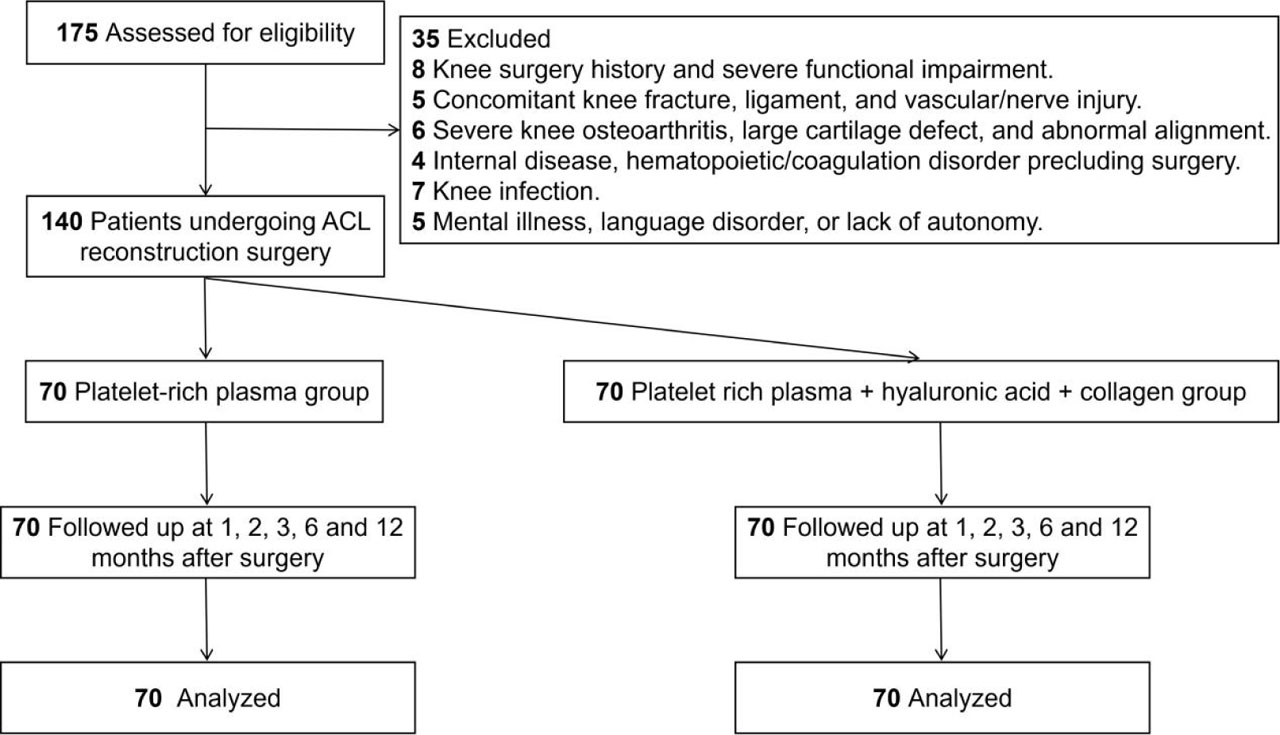
Figure 1.
The flow chart shows the details of the test
Inclusion criteria: ① positive results in the preoperative knee examination including the anterior drawer test, Lachman test, and pivot shift test, with knee MRI indicating ACL injury; ② arthroscopic confirmation of ACL rupture; ③ undergoing autologous hamstring tendon ACL remnant preservation and reconstruction; ④ age between 18 and 60 years old; ⑤ ability to cooperate with standardized rehabilitation exercises postoperatively; ⑥ at least 1 year of follow-up without loss to follow-up.
Exclusion criteria: ① previous history of knee surgery and presence of severe knee dysfunction; ② concomitant knee fractures, meniscus injuries, posterior cruciate ligament injuries, medial or lateral collateral ligament injuries, and vascular or nerve injuries; ③ severe knee osteoarthritis, large knee cartilage defects, and abnormal knee alignment; ④ visceral diseases or abnormalities in hematopoietic or coagulation function who cannot tolerate surgery; ⑤ knee infections; ⑥ mental illnesses, language expression disorders, or lacking autonomy.
2.2. Sample size calculation
An a priori sample size calculation was performed using G*Power software (version 3.1). For an independent t-test comparing two groups, with an effect size of 0.4 (considered appropriate in rehabilitation and physiotherapy research) [37], a significance level (α) of 0.05 (two-tailed), and a statistical power (1-β) of 0.8, the estimated sample size required for each group was 100 participants, resulting in a total sample size of 200. However, due to the constraints of the single-center study design and the specific inclusion criteria, a total of 140 participants (70 per group) were ultimately enrolled within the designated recruitment period. Although this sample size is smaller than the a priori calculation suggested, a post hoc power analysis was conducted based on the observed effect sizes from the primary outcomes (the 12-month Lysholm score difference between groups). This analysis revealed that the achieved statistical power for detecting the observed differences exceeded 0.8 for the key outcome measures, indicating that the study was sufficiently powered to detect the clinically significant effects reported herein.
2.3. Patient management
Before undergoing arthroscopic ACL remnant preservation and reconstruction, both groups of patients must undergo a comprehensive medical history collection and detailed physical examination to exclude any other possible diseases as much as possible. In addition, complete blood routine examination, urine and stool routine tests, nine immunology tests, electrocardiogram, posterior–anterior chest X-ray, anteroposterior and lateral X-rays of the affected knee joint, and knee MRI should be performed to further confirm the diagnosis and exclude contraindications for arthroscopic ACL remnant preservation and reconstruction. The PRP group underwent arthroscopic ACL remnant preservation and reconstruction, with PRP injected into the femoral and tibial tunnels, between the ligaments, and into the knee joint cavity during the surgery. The combination group underwent arthroscopic ACL remnant preservation and reconstruction, with PRP + hyaluronic acid + collagen injected into the femoral and tibial tunnels, between the ligaments, and into the knee joint cavity during the surgery.
All patients were administered intravenous antibiotics during the surgery to prevent infection. In this study, arthroscopic ACL remnant preservation and reconstruction, as well as knee joint PRP injection procedures, were performed by the same team of physicians in our department. All knee joint function scores and measurement data for the patients in this study were evaluated, measured, and recorded by a third party. The specific rehabilitation training program in this study was developed by our department's rehabilitation therapists, and all patients were instructed on the requirements and precautions for rehabilitation training by the same therapist. All X-ray and MRI examinations in this study were performed by the same team of technicians and were interpreted by the same team of physicians. During the hospitalization and rehabilitation training period, patients strictly followed medical advice and returned for regular follow-up examinations. The personnel responsible for postoperative assessments (e.g., collecting VAS, Lysholm, IKDC scores) and the radiologists interpreting the MRI scans were blinded to the group assignments of the patients. However, the surgeons performing the procedures were not blinded due to the nature of the interventions.
2.4. Treatment plan
2.4.1. Preparation of PRP
Using the PRP preparation kit (Arthrex ACP® Double-Syringe System), PRP was prepared according to the instructions. Fifteen milliliters of the patient's autologous peripheral blood were collected into a specialized double-syringe centrifuge system, which was then placed in a sterilized centrifuge cup within a centrifuge (Hettich Rotofix 32A). An equal weight counterbalance was placed in the opposing centrifuge cup to balance the load. The centrifuge was set to a speed of 1500 r/min and a centrifugation time of 5 minutes, as per the manufacturer's instructions for the Arthrex ACP® Double-Syringe System and consistent with protocols widely used in clinical studies to obtain a moderate concentration of platelets and growth factors [38]. After centrifugation, the centrifuge cup was removed vertically, and approximately 3–4 ml of PRP was aspirated using the inner syringe while maintaining a vertical position under sterile conditions.
2.4.2. Surgical methods
All surgical procedures for the included patients were performed by the same team of physicians in our department. Under the combined spinal–epidural anesthesia, the subjects were positioned in a supine posture, and the involved limb was disinfected according to the standard routine, covered with sterile drapes, and a tourniquet was utilized to exert pressure. Anteromedial and anterolateral portals were selected, and the arthroscopic system was set up, with smooth insertion of the scope. During the surgery, the joint cavity was first cleared under arthroscopy. Mild synovial hyperplasia was observed in the knee joint, and the hyperplastic synovium was resected. No cartilage defects were found on the patellar, femoral trochlear articular surface, medial and lateral femoral condyles, or medial and lateral tibial plateaus. There was no damage to the medial and lateral menisci, and the ACL was completely ruptured and lax, while the posterior cruciate ligament was intact. The residual stumps of the ACL at the femoral and tibial attachment sites were cleared under arthroscopy. An approximately 4 cm incision was made on the medial side of the tibial tuberosity, and the subcutaneous tissue and fascia were incised to free the semitendinosus and gracilis tendon insertions. The two tendons were sequentially harvested, trimmed, and their lengths and diameters were measured. Under arthroscopy, an ACL tibial guide was placed at the corresponding position, and a guide pin was inserted under guidance. A hollow drill of the corresponding diameter was used to open the bone tunnel, which was then enlarged with a hollow drill of the same diameter. A femoral guide was placed at the corresponding position, and a guide pin was inserted under guidance. The femoral bone tunnel was enlarged with a hollow drill of the corresponding diameter, and the length of the femoral bone tunnel was measured. The medial segment of the femoral tunnel was enlarged to the corresponding position with a hollow drill of the corresponding diameter. The entrance of the bone tunnel was cleared, and the autologous tendon was threaded through to replace the ACL. The femoral end was suspended and fixed with a microporous titanium plate, and the adjustable loop was tightened. The length of the soft needle insertion was roughly the same as the length of the tunnel. For patients in the PRP group, a soft needle was inserted into the femoral tunnel to the top, and the prepared PRP gel was smoothly injected (while injecting, the soft needle of the syringe was withdrawn until PRP gel oozed out of the tunnel opening). The knee joint was flexed and extended 20 times with the tibial end of the tendon tightened. With the knee in extension, the tibial end of the tendon was tightened, and a soft needle was inserted into the tibial tunnel to the top, followed by the smooth injection of the prepared PRP (while injecting, the soft needle of the syringe was withdrawn until PRP gel oozed out of the tunnel opening). The remaining PRP was injected into the knee joint cavity. The tendon sutures were tied and fixed to the suture button, with the tail threads pressed under the suture button plate. The adjustable loop was tightened again. Under arthroscopy, the ACL was stable, and the anterior drawer test was negative. After confirming the count of surgical instruments and gauze, the surgical incision was closed layer by layer, pressure dressings were applied, the tourniquet was deflated, and the knee was immobilized in full extension at 0° with a knee brace. For patients in the combination group, PRP + hyaluronic acid + collagen were injected jointly, using the same method and positions as the PRP group.
2.4.3. Postoperative treatment
All patients were immediately placed in a knee immobilizer at 0° in full extension after the surgery, with compressive bandaging applied. Within 24 hours postoperatively, 100 mg of flurbiprofen axetil was administered intravenously for pain relief, and tramadol sustained-release tablets were given orally if necessary after 24 hours. The incision was dressed regularly, and sutures were removed approximately 2 weeks after the surgery. All patients returned to the hospital for the second and third intra-articular PRP injections or PRP + hyaluronic acid + collagen injections at 1 and 2 months postoperatively, respectively [39]. Follow-up visits were scheduled at 1, 2, 3, 6, and 12 months postoperatively, during which further rehabilitation exercises were guided based on the recovery status. Patients were also instructed to return to the hospital for a knee MRI at 12 months postoperatively.
2.4.4. Postoperative rehabilitation exercise
Within 2 weeks after the surgery, the knee was immobilized at 0° using a knee brace, and ankle pump exercises, isometric quadriceps contractions, and straight leg raises were performed. Starting from 2 weeks postoperatively, passive knee flexion exercises were conducted with the protection of the knee brace. At the 2-week mark, the angle of the knee brace was adjusted to 30°, with an additional 15° added every 3 days thereafter. With the brace in place, the knee was passively flexed to the adjusted angle and held for 10 seconds before slowly straightening it back to 0°. The passive knee flexion angle was gradually increased, reaching 120° by 6 weeks postoperatively. After 6 weeks, partial weight-bearing with the aid of crutches was initiated under the protection of the knee brace, with walking time and distance gradually increased. Simultaneously, quadriceps strengthening exercises and passive knee flexion exercises were continued. By 12 weeks postoperatively, if the muscle strength on the affected side reached 80% or more of that on the healthy side, crutches were discarded, and full weight-bearing walking was allowed with the protection of the brace. Additionally, static squats were performed to further strengthen the quadriceps, and active knee flexion exercises were initiated. At 4 months postoperatively, the brace was discarded, and activities such as brisk walking, jogging, and swimming were gradually introduced, with the intensity increased step by step, avoiding intense or fatiguing activities. By 6 months postoperatively, noncontact sports activities such as sprinting and jumping were gradually resumed. Normal sports activities were resumed starting from 9 months postoperatively.
3. Observation indicators and collection
3.1. Knee pain and function.
Gather preoperative and postoperative VAS, Lysholm, and IKDC scores at 1, 3, 6, and 12 months to evaluate knee pain and functionality both before and after the surgical intervention.
3.2. Degree of swelling
Measure the circumference of the thigh and calf 5 cm above the superior patellar border and 5 cm below the tibial tuberosity on the day before surgery and on the third day after surgery. Calculate the difference in thigh and calf circumference between the day before surgery and the third day after surgery to represent the degree of swelling, with the unit in centimeters.
3.3. Graft remodeling and tendon-to-one healing
Perform knee MRI at 12 months postoperatively, and classify the healing of the femoral tunnel graft into three grades based on the MRI scoring system. All MRI results were collected using a blinded approach for the evaluators. Grade I: The graft appears as a continuous low-signal band with no fibrous tissue at the tendon-to-bone interface, indicating good graft healing and tight integration with the surrounding bone tissue. Grade II: The graft appears as a continuous low-signal band, but there is a partial high-signal band at the tendon-to-bone interface, suggesting incomplete integration of the graft with the bone tissue and the possible presence of some fibrous tissue. Grade III: The graft appears as a continuous high-signal band at the tendon-to-bone interface, indicating poor graft healing with possible presence of significant fibrous tissue or incomplete integration into the bone tissue.
3.4. Compare postoperative complications between the two patient groups, including knee infection, knee stiffness, deep venous thrombosis of the lower extremities, etc.
4. Statistical methods
Statistical analyses were conducted with SPSS 25.0. Continuous data were reported as mean ± SD, with within-group comparisons at various time points employing repeated measures ANOVA, and between-group comparisons utilizing independent t-tests. Prior to conducting repeated measures ANOVA, the assumptions of sphericity (Mauchly's test) and normality (Shapiro–Wilk test) were assessed. Where the assumption of sphericity was violated, the Greenhouse–Geisser correction was applied. All continuous data met the normality assumption. Categorical variables were summarized by frequencies and compared using chi-square tests. Statistical significance was set at p < 0.05.
5. Results
5.1. Comparison of general data between the two groups
No significant differences were observed in gender, age, BMI, side of the affected knee, or duration of the disease between the two groups (p > 0.05).
5.2. Comparison of Lysholm scores between the two groups
Both PRP and combination groups showed significantly improved Lysholm scores postoperatively at 1, 3, 6, and 12 months (p < 0.05). The combination group had significantly higher Lysholm scores than the PRP group at all time points (p < 0.05).
5.3. Comparison of IKDC scores between the two groups
Both PRP and combination groups exhibited significantly improved IKDC scores postoperatively at 1, 3, 6, and 12 months (p < 0.05). The combination group had significantly higher IKDC scores than the PRP group at all time points (p < 0.05).
5.4. Comparison of VAS scores between the two groups
In both PRP and combination groups, VAS scores increased significantly at 1 month postoperatively (p < 0.05) but decreased significantly at 3, 6, and 12 months (p < 0.05). The combination group had significantly lower VAS scores than the PRP group at all postoperative time points (p < 0.05).
Table 2.
Comparison of Lysholm scores (x̄ ± s, score)
| Group | Group | PRP group (n = 70) | Combination group (n = 70) | t | p | Cohen's d |
|---|---|---|---|---|---|---|
| Preoperative | 45.83 ± 6.22 | 46.76 ± 6.24 | 0.882 | 0.379 | 0.149 | |
| Postoperative | 1 month | 48.14 ± 4.73 | 52.46 ± 5.79 | 4.828 | < 0.001 | 0.817 |
| 3 months | 59.76 ± 6.43 | 69.23 ± 4.76 | 9.902 | < 0.001 | 1.674 | |
| 6 months | 71.54 ± 6.71 | 82.33 ± 4.85 | 10.905 | < 0.001 | 1.843 | |
| 12 months | 84.39 ± 4.13 | 88.81 ± 4.53 | 6.049 | < 0.001 | 1.020 | |
| F | 559.254 | 838.363 | ||||
| p | < 0.001 | < 0.001 | ||||
| Partial Eta Squared | 0.866 | 0.907 | ||||
Table 3.
Comparison of IKDC scores (x̄ ± s, score)
| Group | Group | PRP group (n = 70) | Combination group (n = 70) | t | p | Cohen's d |
|---|---|---|---|---|---|---|
| Preoperative | 40.44 ± 5.61 | 39.84 ± 6.37 | 0.591 | 0.555 | 0.100 | |
| Postoperative | 1 month | 45.47 ± 4.42 | 49.60 ± 4.35 | 5.572 | < 0.001 | 0.942 |
| 3 months | 62.17 ± 6.53 | 66.77 ± 6.21 | 4.27 | < 0.001 | 0.722 | |
| 6 months | 74.48 ± 6.24 | 78.94 ± 6.14 | 4.273 | <0.001 | 0.720 | |
| 12 months | 82.21 ± 4.21 | 88.44 ± 3.31 | 9.731 | < 0.001 | 1.645 | |
| F | 754.911 | 963.453 | ||||
| p | <0.001 | < 0.001 | ||||
| Partial Eta Squared | 0.897 | 0.918 | ||||
Table 4.
Comparison of VAS scores (x̄ ± s, score)
| Group | Group | PRP group (n = 70) | Combination group (n = 70) | t | p | Cohen's d |
|---|---|---|---|---|---|---|
| Preoperative | 5.14 ± 2.40 | 5.20 ± 2.52 | 0.137 | 0.891 | 0.024 | |
| Postoperative | 1 month | 7.64 ± 1.22 | 6.87 ± 1.33 | 3.583 | < 0.001 | 0.603 |
| 3 months | 4.41 ± 1.22 | 3.67 ± 1.64 | 3.04 | < 0.001 | 0.512 | |
| 6 months | 3.74 ± 1.45 | 2.87 ± 1.51 | 3.478 | < 0.001 | 0.588 | |
| 12 months | 2.87 ± 1.33 | 2.01 ± 1.22 | 3.973 | < 0.001 | 0.674 | |
| F | 91.364 | 89.49 | ||||
| p | < 0.001 | < 0.001 | ||||
| Partial Eta Squared | 0.514 | 0.509 | ||||
5.5. Comparison of swelling degree between the two groups
The change in thigh circumference from preoperative to the third postoperative day was significantly smaller in the combination group [(2.95±1.58) cm] compared to the PRP group [(3.68±1.27) cm] (p < 0.05). Similarly, the change in calf circumference was significantly smaller in the combination group [(2.47±1.39) cm] compared to the PRP group [(3.26±1.42) cm] (p < 0.05).
5.6. Comparison of postoperative tendon and bone healing between the two groups
Both groups of patients were followed up for 12 months postoperatively. At the 12-month follow-up MRI examination, it was shown that in the combination group, 51.43% (36/70) of the tendon–bone healing was Type I, 44.29% (31/70) was Type II, and 4.29% (3/70) was Type III. In the PRP group, 30.00% (21/70) of the tendon-bone healing was Type I, 58.57% (41/70) was Type II, and 11.43% (8/70) was Type III. The combination group exhibited significantly better tendon–bone healing after ACL reconstruction compared to the PRP group (p < 0.05).
5.7. Comparison of postoperative complications between the two groups
Neither group experienced complications such as knee joint infection, knee stiffness, deep venous thrombosis of the lower extremities, injury to the infrapatellar branch of the saphenous nerve, or re-rupture of the reconstructed ligament after surgery.
6. Discussion
ACL tears, as a common injury in sports, significantly impact patients' limb function and quality of life. Although ACL reconstruction has become the gold standard for treating ACL injuries with a high surgical success rate, the risks of postoperative ligament laxity and re-rupture still exist, potentially due to factors such as inadequate postoperative rehabilitation exercises, postoperative inflammatory responses, and poor graft healing [40]. In this context, exploring more effective adjuvant therapies to enhance the healing outcomes and patient prognosis after ACL reconstruction has become a key direction in current medical research.
In recent times, the application of PRP in ACL reconstruction has gradually increased, but its effectiveness when used alone may be limited. Ye et al. [39] conducted a double-blind randomized trial to assess the impact of intra-articular PRP injections on knee outcomes in 120 ACL-reconstructed patients aged 16–45. At 12 months, no significant difference was found in the primary outcome (KOOS4 score) between the PRP group (60 patients, 3 injections) and the control group (60 patients, no injections) (p = 0.36). Minor differences were observed only in sports levels and graft maturity at 6 months. The conclusion is that intra-articular PRP injections did not significantly improve knee symptoms and function in patients undergoing ACL reconstruction, and further research is needed to determine its indications. Hyaluronic acid and collagen, as important components of the extracellular matrix, have been extensively studied and applied in the biomedical field. Hyaluronic acid possesses excellent moisturizing properties, viscoelasticity, and biocompatibility, which can promote tissue repair and reduce inflammation. Balagod et al. [41] conducted a randomized controlled trial to evaluate the safety and efficacy of intra-articular hyaluronic acid injections administered at different time points after ACL reconstruction surgery. Ninety patients with ACL tears underwent arthroscopic ACL reconstruction and were divided into three groups: the early hyaluronic acid group received hyaluronic acid injections on the second postoperative day and saline injections at 2 months; the late hyaluronic acid group received saline injections on the second postoperative day and hyaluronic acid injections at 2 months; and the placebo group received saline injections at both time points. The results showed that the early hyaluronic acid group had significantly better range of motion (ROM), pain control, Lysholm score, EQ5D5L, and IKDC score at 1–2 months postoperatively compared to the placebo or late hyaluronic acid groups (p < 0.05). Collagen, with its unique triple helix structure, can provide mechanical support and promote cell proliferation. Sun et al. [42] developed a composite scaffold composed of collagen, polyvinyl alcohol, and PRP for ACL repair. The results showed that the scaffold could protect the ACL from synovial fluid erosion, promote tissue repair, improve mechanical properties, and extend the degradation cycle. In vivo studies demonstrated that the composite scaffold promoted the healing of ruptured ACLs in rabbit hind limbs by promoting fibroblast multiplication, collagen accumulation, microvascular development, and proprioceptor production. Additionally, it efficiently decreased meniscus and cartilage attrition while relieving osteoarthritis and joint degenerative disorders. Based on the aforementioned studies, this study innovatively combines PRP, hyaluronic acid, and collagen supplements to promote the healing process after ACL reconstruction surgery, with the expectation of bringing new ideas and methods to clinical practice.
Pain after ACL reconstruction surgery is a common issue, especially in the early postoperative period, with patients often experiencing moderate to severe pain. Studies have shown that the incidence of chronic pain is higher within 3 months after surgery, affecting patients' rehabilitation process and quality of life [43]. Postoperative pain not only limits patients' motor ability but may also lead to psychological stress and prolonged recovery time. The results of this study showed that the VAS scores of both patient groups were higher at 1 month postoperatively compared to preoperatively, which may be related to surgical trauma, postoperative inflammatory response, and activity restrictions during the early rehabilitation phase. In the early postoperative period, patients typically experience a certain degree of pain and swelling, which are normal physiological responses after surgery. Following ACL reconstruction, the knee joint often accompanies the release of inflammatory mediators, which not only exacerbate the inflammatory response but also directly stimulate pain receptors [44]. Over time, the VAS scores were lower than preoperatively, indicating that the surgical and adjuvant treatment measures were effective in alleviating pain. PRP promotes tissue repair and reduces inflammation by releasing growth factors, and the addition of hyaluronic acid and collagen further enhances this effect. The combination group exhibited lower VAS scores at all postoperative time points relative to the PRP group, suggesting that the incorporation of hyaluronic acid and collagen can more effectively mitigate pain. PRP is abundant in growth factors such as PDGF, TGF-β, and VEGF, which can facilitate tissue repair, attenuate inflammatory reactions, and expedite the healing process following ACL reconstruction [45]. However, the use of PRP alone may not completely counteract the pain caused by surgical trauma and inflammatory responses after surgery. Hyaluronic acid is a high-molecular-weight polysaccharide with strong moisturizing ability and viscoelasticity, abundant in synovial fluid. With its unique viscoelasticity, it can not only act as a lubricant to reduce the coefficient of friction between articular cartilages, reducing pain triggered by mechanical stimulation, but also inhibit the release of inflammatory mediators by regulating cell surface receptors, thereby alleviating the generation of pain signals at the source [46]. Collagen, as a key structural protein in articular cartilage and ligaments, provides stable anchoring points for cells through its three-dimensional network structure [47]. In the process of repairing damaged tissues, collagen facilitates the migration and proliferation of relevant cells, such as fibroblasts, expedites the formation of the new extracellular matrix, fills the injured area, restores tissue integrity, and effectively mitigates pain sensations resulting from tissue damage [48].
In reducing knee joint swelling after ACL reconstruction surgery, the combination therapy (PRP + hyaluronic acid + collagen) has shown significant advantages. The study results revealed that the differences in thigh and calf circumference between postoperative day 3 and preoperative measurements were smaller in the combination group than in the PRP group, suggesting that combination therapy is more effective in alleviating early postoperative swelling. PRP is rich in numerous types of growth factors, which not only promote cell proliferation and differentiation but also regulate inflammatory responses. They activate the function of immune cells like macrophages, accelerating the phagocytosis and clearance of inflammatory factors and necrotic tissue, thereby further promoting inflammation absorption and reducing swelling [49,50,51]. Hyaluronic acid has strong water-retaining capabilities, and the hydrophilic groups such as carboxyl groups in its molecular structure can bind to a large number of water molecules, forming a highly hydrated gel-like substance. In joint tissues, this characteristic can regulate the osmotic pressure of interstitial fluid, redistributing and absorbing excess exudate, thereby reducing local tissue edema [52]. Furthermore, hyaluronic acid can lubricate the joint surface, reducing joint friction and further alleviating inflammation and swelling [53]. Collagen, a principal constituent of the extracellular matrix, offers structural scaffolding for tissue repair. It acts in concert with the growth factors present in hyaluronic acid and PRP to foster tissue regeneration and repair, mitigate inflammatory reactions, and it not only expedites the resolution of swelling but also lays the groundwork for long-term stability and functional restoration of the knee joint following surgery [54].
In addition, the Lysholm scores and IKDC scores at various time points postoperatively were significantly higher in the combination group than in the PRP group, indicating that the combination therapy had a more pronounced effect on promoting the functional recovery of the knee joint. The growth factors in PRP can activate a series of intracellular signaling pathways, promoting the proliferation and differentiation of osteoblasts, fibroblasts, and other cells, thereby providing an adequate cell source for tissue repair [55]. The hydrated microenvironment created by hyaluronic acid facilitates the exchange of nutrients and metabolites, providing favorable conditions for cellular physiological activities [56]. Collagen serves as a scaffold for tissue repair, guiding the orderly arrangement and growth of cells, so that the repaired tissue more closely resembles the normal anatomical structure and mechanical properties [57]. The combination of these three components promotes the repair and reconstruction of damaged ligaments and joint tissues from cellular proliferation and microenvironment maintenance to tissue construction, ultimately significantly improving the functional performance of the knee joint. Tendon-to-bone healing is a critical indicator after ACL reconstruction surgery. MRI examinations at 12 months postoperatively showed that the tendon-to-bone healing in the combination group was superior to that in the PRP group. As a major component of tendon-to-bone tissue, collagen provides a fibrous structure that guides the ingrowth of new blood vessels and cells, promotes cell adhesion and proliferation at the tendon-to-bone interface, accelerates the formation of the fibrocartilage transition zone, and enhances the strength of the tendon-to-bone connection. Meanwhile, the growth factors in PRP synergize with hyaluronic acid to promote the activity of osteoblasts and chondrocytes, accelerating the synthesis of bone and cartilage tissues on one hand, and regulating the balance between synthesis and degradation of the extracellular matrix to ensure that the newly formed tissue has good mechanical properties on the other hand [58]. This synergistic effect enhances tissue repair capacity, greatly promotes tendon-to-bone healing and ligament remodeling, making the combination group significantly better than the PRP group in terms of tendon-to-bone healing outcomes. In this study, no severe complications such as knee joint infection, knee stiffness, deep vein thrombosis of the lower extremities, injury to the infrapatellar branch of the saphenous nerve, or re-rupture of the reconstructed ligament were observed in either group postoperatively. This result may be related to the biocompatibility and safety of PRP, hyaluronic acid, and collagen. PRP is obtained from the patient's autologous blood, evading immune rejection responses; hyaluronic acid and collagen, as natural biomaterials, have good biocompatibility. Furthermore, combination therapy may further reduce the risk of complications by promoting tissue repair and reducing inflammatory responses.
For patients undergoing ACL reconstruction, opting for a treatment regimen that combines PRP with hyaluronic acid and collagen may help alleviate pain more quickly, reduce swelling, expedite the recovery of knee joint function, and enhance quality of life. This approach may also shorten rehabilitation time and reduce the consumption of medical resources, while promoting tendon-to-bone healing, lowering the risk of postoperative ligament laxity and re-rupture, and improving surgical success rates.
7. Limitations of the study
This study is subject to several limitations. First, the participant samples were sourced exclusively from a single medical institution, which may introduce regional and patient characteristic biases, thereby affecting the broad generalizability of the results. Second, the follow-up period was limited to 12 months, thus lacking observation of long-term outcomes after ACL reconstruction, such as joint function, graft stability, and the incidence of osteoarthritis at 5 and 10 years postoperatively. Furthermore, the study did not delve into the specific molecular and cellular mechanisms underlying the synergistic effects of PRP, hyaluronic acid, and collagen, hindering a deeper understanding of how this combination therapy promotes healing at a fundamental level. Future research should involve multicenter, long-term studies and basic science investigations to validate these findings and elucidate the underlying mechanisms.
8. Conclusions
The results of this study indicate that the combination of PRP with hyaluronic acid and collagen is potentially superior to PRP alone in promoting early healing after ACL reconstruction surgery, suggesting a promising treatment option for clinical practice. However, these encouraging findings require validation through larger, multicenter randomized controlled trials with longer follow-up periods to firmly establish the efficacy and optimal protocol for this combination therapy.
Notes
[1] Contributed by Authors' contribution
Le Kang: Developed and planned the study, performed experiments, and interpreted results. Edited and refined the manuscript with a focus on critical intellectual contributions.
Jiefeng Li, Fubin Li: Participated in collecting, assessing, and interpreting the date. Made significant contributions to data interpretation and manuscript preparation.
Fubin Li: Provided substantial intellectual input during the drafting and revision of the manuscript.